Episode Transcript
[00:00:00] Speaker A: Welcome back to the Capes and Tights podcast right here on Capesandtights.com I'm your host, Justin Soderbergh. Once again, this episode is brought to you by our friends over at Galactic Comics and Collectibles at galactic comics and collectibles.com Merry Christmas, everyone.
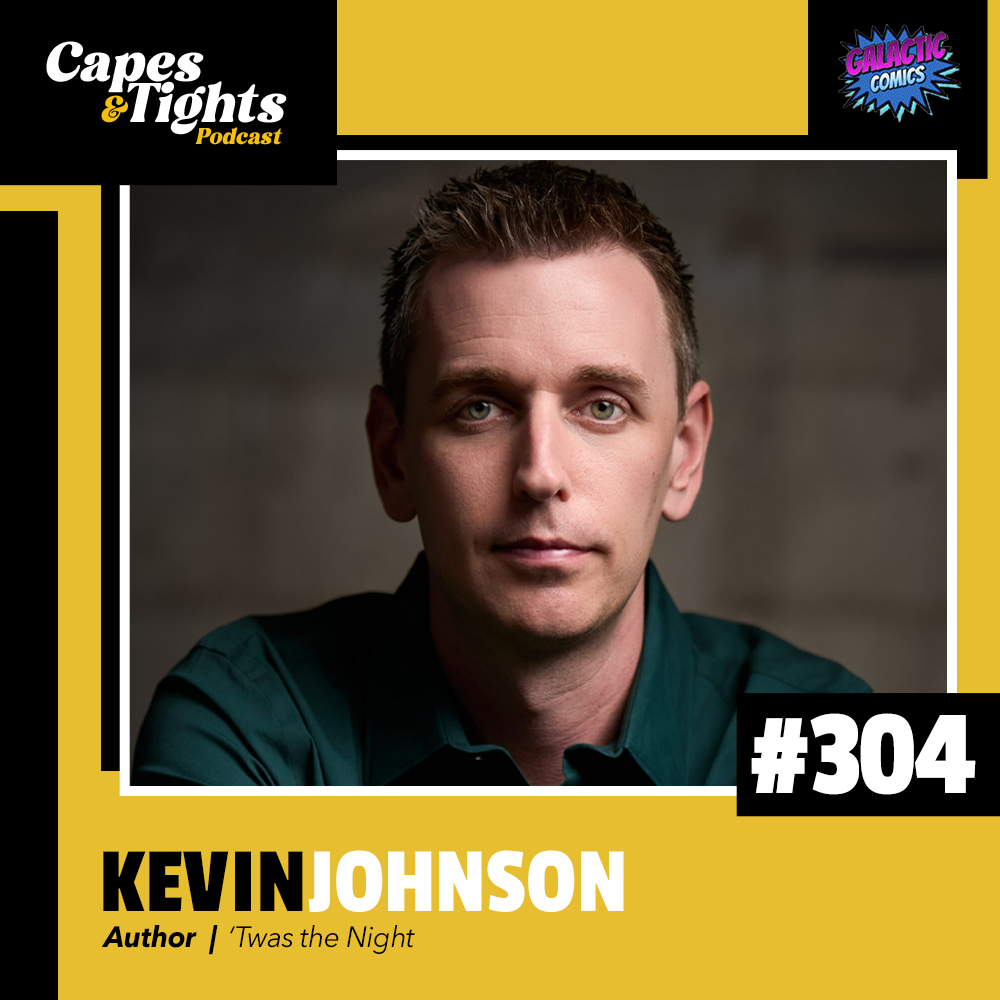
What you might be confused and what we welcome on this episode of the podcast, Kevin Johnson, author of a debut novel, debut horror novel, Twas the Night, a holiday horror novel here on the podcast.
But before you listen, follow us on Facebook, Instagram, Twitter, bluesky, threads, all those places you can rate, review, subscribe on Apple, Spotify or wherever you find your podcasts. You find the video portion of this podcast over on YouTube.com and as always, you can visit capesandtights.com for so much more. But this is a discussion with horror novelist of his debut novel Twas the Night, Kevin Johnson. Enjoy, everyone.
Welcome to the podcast. Kevin, how are you today?
[00:01:02] Speaker B: I'm doing well. I'm feeling good. You know, a couple weeks ago, a little illness, but I'm back on the mend and ready to talk all things spooky Christmas.
[00:01:10] Speaker A: Yeah, that's right. The funny thing is it's like, it's spooky. We're in spooky season, technically, when we're recording this and your book comes out during spooky season. But it's like they can't release Christmas books like this in December. It's hard, right? I'm guessing because like you want to read it during that time and you might not get it when it comes out or might be given as a gift and so on and so forth. So it kind of makes more sense. I mean, other books I know coming out in October that are Christmas adjacent books too, like, they just, they don't tend to usually release them in Christmas time. Is that correct?
[00:01:41] Speaker B: Yeah, we're trying to, I guess, double dip a little bit, right? It's like we want it to come out in October for the folks that are all into Halloween, all into just spooky stuff in general because there's a lot of spooky stuff that happens. But then it gives us like a nice lead up to Christmas season, right? So people that maybe want to wait, people that want to read it around the holidays, like, you know, we wouldn't want to put it out there like a week before Christmas doesn't give people enough time to maybe discover the book. So yeah, we should get, get the Halloween crowd, you know, our people, we love them. And then for the folks that are really into seasonal horror, Christmas horror, like myself. The book will already be out and available. So I kind of did pigeonhole myself with the, with the nature of the book. But yeah, we're hoping that it can capture. But if people are just looking for like a scary, fun read, you know, this is the book for them. But if they love Christmas and they love Christmas horror, then obviously it should really speak to those folks as well. Like, like myself.
[00:02:34] Speaker A: Exactly. You do. You said you pigeonhole yourself. But in the same sense as someone like myself, I am. I think it's funny, I should do a whole breakdown on how anal I am about reading schedules. Like I actually have like a spreadsheet because I have. Well, first of all, I get advanced copies. Twas the Night was one of them, so on and so forth. So like I gotta make sure I don't over commit because I am not gonna be the person who says yes, Kevin, I'll, you know, to your publisher, I'll read the book and then just not read it. Like I'll even say like I got an email last night saying that book sounds amazing. I really want to read it. Book comes out September 29th. And so I'll tell you right now, I would love a copy of it. I probably won't read it until December. And the publisher was like, no issue, no issue. We need that second round of review.
So I just, I'm honest about it. But in order to do that I need to put it out on a schedule and give myself some estimated time. How long does it take usually? Like I'll read a couple of nights in a row and go, okay, I'm reading about 40, 50 pages a night. Okay, this is going to take me two weeks to read. Da da da da da. And then I'll be able to plan saying, okay, I can fit these in.
But part of that is in December I want to read some Christmas stuff too. So like each year there's some things where I'm like, if I don't get to it in December, I might push it off a year. So there's a possibility that someone goes out on October 13th and buys this book, pushes it and doesn't actually read it until December. And if they buy it and put it on their shelf, maybe they'll read it every December. Maybe every year I Google Christmas horror books because I haven't read certain books. So like you might have you pigeonholed yourself, but you also might have gave yourself a built in Google search every year, if that makes any sense. Like every year someone Might, Yeah, every year around this time, you might see that time where people are going, I haven't read this book yet. And then, you know, you get the paperback sales and previous future years and like the deluxe edition eventually comes out and all that stuff. Like I, I do think that that is a kind of cool thing you are to myself, like if someone doesn't read it until January, it might not get right until next year. That might suck. But I do think that every year some might look up horror or Christmas and that your name will now be on that list.
[00:04:37] Speaker B: And that was kind of part of the motivation for writing the book. And look, I know a lot of this is probably my own ignorance, but when I thought of the original idea which was like, what if Santa Claus was bad?
I couldn't really off the cuff think of a lot of Christmas horror novels or films frankly where Santa Claus himself is the primary villain. It's like a killer who dresses like Santa or like a Krampus or like a little gremlins or an evil or whatever they get or robot Santa or Jack Frost or whatever. But it's like, well, I can't think of a lot of media where Santa, the big guy himself, like is the antagonist. So that was so, you know, you write what you want to read or watch. Right. So part of the impetus was like, yeah, what if Santa was bad? What would that look like? And then yes, of course, selfishly, I'd love for people to revisited every holiday season. There's a lot of chew on there, a lot of crazy stuff happens.
And yeah, part of it is like, while it's just maybe a short window where interest might peak for the book, you're correct. Like hopefully year in and year out, maybe new readers discover it. I think Christmas horror is only getting more popular as the horror genre just grows and grows and grows. So hopefully this becomes a staple of people's holiday reading and we can all ruin Christmas together.
[00:05:56] Speaker A: Yeah, you're all right that like there's a lot of like people who dress like Santa Claus are bad kind of thing. Like, you know, even, even they, even the, the people who were bad who dressed like Santa Claus, kind of like the new terrifier film. And like you have all those Christmas movies where it's like horror films of someone who plays Santa Claus at the mall is bad, but like going back to actually Santa Claus, the person himself is actually bad and is very few and far between. If, if out there, I don't even know, I mean, did you stumble upon Smalley? The short stories or things like that over there.
[00:06:30] Speaker B: I. I did the. So, you know, I've been a fan of the horror genre since I was very young. Like. Like, I'm sure, like, you and like a lot of horror fans out there.
And, you know, every year, Christmas time, we, my wife and I. My wife's also a fan of horror, right? So we try to find Christmas horror films. We always have a good time with it. And I want to say it was maybe 20, 22, December that we found a movie called Rare Exports, which is a movie from Finland. I believe it's Finland that came out in 2011. It was kind of quiet, under the radar, but it has kind of since gained a cult following. And I saw it on some, like, Christmas horror list or whatever. We watched the movie. I loved it. It blew me away. And that was the movie that planted the idea in my head because it was the first movie I could think of that dealt with, like, the true, you know, quote unquote, the true origins of Santa, like, going back to the, you know, Sinterklaas and kind of the dark underbelly of the Santa Claus myth. And I'd never really thought about it.
And then it, you know, if you think critically about it for, like a second, you're like, well, gee, a guy breaks into your home, drinks your milk, which is weird, you know, leaves presence is always watching you, knows when you're bad or good, and it's kind of freaking creepy.
And then this movie kind of made me really interested in, like, where did this originate? Like, Coca Cola didn't just, like, make it up.
And that's what kind of started. That's what got the wheels churning about, like, well, yeah, what if Santa Claus was just, like, evil?
And then once as a writer, you know, once the idea is in your brain and it kind of grows and grows, you got to get it out. Um, so that. That's where it came from.
[00:08:17] Speaker A: The first of all, Rare Exports is a phenomenal movie. Christmas movie. It actually, you probably didn't find it on our list, but it's. I have had lists on Capes and Tights website that about, like, Christmas horror movies. And that's always one of them.
And it's funny because I feel like it came out called Rare Exports, but then as it came out, like in previous future versions of it, they actually added the colon Christmas movie or Christmas tale. Because I think people didn't know that Rare Exports was a Christmas movie. It was like, what is this? They kind of like, have to be like, no, it's a Christmas movie. You need to watch this movie. But no, it's true. It's, it's this. But Christmas and horror go together more than people actually think. You know, obviously going deeper, diving and making Santa Claus evil is another part of that. But like in overall scope of things, it's supposed to be a jolly time and everybody's happy and people like family and all that stuff. So when you just twist that and flip it on its head and make it so that it's a bad thing that's happened at Christmas, it's just, it's ripe for it. It's like it needs these stories because you can just take and make things even worse, you know, I mean like if you take things in people on their own, they're on their own high, and then take them and make them be attacked by a serial killer or slasher, a monster, any of that stuff, it's just going from way up high and down low. October, we're talking about spooky season. People expect spooky stuff during the spooky season. So you're taking people who are already scared and making them scared. But then in Christmas time, you're expecting Elf in A Christmas Story and Santa Claus is coming to town and then taking it and saying, what if Santa Claus is coming to town to murder you? Or something along those lines, right?
[00:09:57] Speaker B: And there's something like so awesome and there's something so at least I found. Maybe I'm just a sick twisted person, but like there's something. I had so much fun taking these like tried and true wholesome holidays traditions and I cannot, whether it's a, you know, snowman or nutcrackers or Santa himself, elves, reindeer, like all of them and making them evil and horrible and like taking them to their most wicked extreme. Like it was a blast to do it.
And I think to your point, like, the holiday is ripe for playing, especially as a horror fan, right? Like we want horror all the time. We don't care what the season is.
And then like as you dive into it, you're like, oh, this actually is still kind of like a, a spooky time of year. Because usually it's really cold, it's. There's blizz, it's winter, the sun sets really early, it's dark outside, it's kind of just like all the leaves are off the trees. Like, you know, it's kind of a spooky time. And then, you know, there's all these kind of low hanging fruits of like, well, yeah, I could make a reindeer scary I could make a snowman pretty eerie. I could, you know, I could. Nutcrackers are kind of kooky to look at. Like, I can make that kind of freaky. So. Absolutely.
[00:11:08] Speaker A: Well, one of the oldest and most famous and beloved Christmas stories is A Christmas Carol, which is a ghost story. It's a horror story. To this day I don't understand why we don't have a really well made, like dark, like extremely dark version of that story. I still to this day I'm like, I would just love a like really well done, like almost word for word. Just take Charles Dickens story and create a movie out of it. But like, and have this ending where it's uplifting. Like horror stories can have uplifting endings. They don't all have to be this horrible ending, but like make it deep, make it really bad. Like, you know, obviously you can only go so far. You can't be like this person abducts children and then say at the end he's okay. You have to do some sort of like. And you could attach it to modern technology, like an Elon Musk of the world, you know, like you have someone who's a multi billionaire who has taken advantage of people over these years. And so I wants to make amends for it because three ghosts met him in the middle of the night. I just still to this day I'm like, that seems so, like, I can't wait. We had this, like, the Grinch is also to me a horror story in a sense. Like, I know we had that like adjacent that wasn't an actual Grinch movie with David Howard Thornton playing the mean one. I can't wait till that is public domain because to me I'm like, I want the well written, really horrifying Grinch story. And so like there is these connections that people don't see every year that there's a horror stories in it that you might not know. Like, hey, Christmas Carol, it's a ghost story. So you've been reading it every year for Christmas to your 5 year old.
[00:12:38] Speaker B: It probably doesn't speak well of me, but like, as we talked about Christmas Carol, I'm like, my favorite adaptation of that is probably the Muppets.
The Muppets Christmas Carol.
[00:12:48] Speaker A: Kevin, I knew there was a reason why I liked you.
This is an argument my wife would have all the time. She loves the Mickey Mouse one. Because my wife's. I'm 40 and my wife's 30, so there is this generational thing. But. But I mean, they're all both older. It's not like they're brand new movies, but the Muppets one. Yes, you're right. But you were saying it's like.
[00:13:06] Speaker B: No, it's genuinely a good film. It's very funny. It's very sweet and touching. Michael Caine is going like a hundred. He's acting like he's going for the Oscar in that movie. And then the. I guess it's the Ghost of Christmas Future in the movie that has the big hood and you can't see his face.
I put that in the book. Like, my character of Mr. Zwart is 100% based on that Muppet Christmas Carol, Ghost of Christmas Future. Because even as a kid, and it's a Muppet movie and it's wholesome and fun, like, that character kind of terrified me. He's got, like, the long spindly fingers and he's got the rat, he's got the big hood on. And then you can't see his face. And I always had. It's kind of like a Nazgul in Lord of the Rings. And so as I was writing the book, I was like, well, I must have a character like this in the book because it just. It left such an imprint on me as a young child. And I still think about it to this day.
[00:13:56] Speaker A: So, I mean, it's funny because my son loves to me that movie, too. Like, it was funny because, like, we put it on, we'd, like. It would be in the middle of the movie. You know, we put it on and he'd play and he'd be all freaking out because he knew what the credits were like at the beginning. And so, like, if it wasn't playing those credits at the beginning, he was pissed off it wasn't the right movie. And I'm like, no. So you have to start the movie. I need to watch, like, the old, you know, the Actors Guild rules were that all the credits needed to be played at the beginning and nothing else could be showing. It had to show the credits to play music and stuff like that. But, like, you couldn't do what you do now, which is start the movie, have the credits rolling as we go. So it's like five minutes of credits at the beginning of the movie. He's like, oh, he's so pissed off of it. But until we get to the point where the guy in the mat, the hood, like, he's happy and go, lucky he likes the movie. This is a great movie to do. And he gets to that point, he's like, holding onto my arm. It's actually turns, man, Terrifying. Like really. But also like the only ghost that visits him in this move, Scrooge that's not creepy is the big giant Muppet guy.
The, the, the ghost of Christmas past is like that. She's like a creepy doll looking like ghost that's floating in the air. She's actually. Look at you're like glow. Yeah, but she's like not scary but like unsettling almost. She's like has this unsettling vibe to it. I'm like, am I like. It's like her face looks like poor porcelain almost. It's like really weirdly look. And then that, that guy in the hood. So it's like terrifying. Honestly, in a children's movie. Technically this is like, this is made for kids.
[00:15:24] Speaker B: We've discovered that Muppets Christmas Carol is like a low key horror film because it does have two. Because you're right, that character is kind of uncanny Valley freaky.
And yeah, we can class. I'll classify it as Christmas horror right now.
[00:15:37] Speaker A: But like, there is some horrifying things. And to be honest with you, most times people think about horrifying Christmas. Like the generic public that's not really into horror is like four Christmases with Vince Vaughn where it's like horrifying things happen to you that are horrifying but in the same. It's just like having to visit your family. Like that's terrifying to a lot of people, which it is. It's not always fun, but that's not what twice the night is. Or other Christmas horrors you see where like people get murdered or crazy things happen that, that are like slasher and. Yes. Could you take any slasher film and just put it into Christmas and call it a Christmas movie?
You could make it work. But twist the night's not that. There's this. It's purposefully done and set during Christmas because of. You know, I'm excited, actually. I just got sent the link to the audiobook. I'm gonna read that before our discussion in October again. So I'll have a second time reading it. I'll update on it. But I always like, you know, you can ingest different things differently when you hear it, someone talking to you than it is when you're reading it. And so I was looking forward to reading it again. But like, I'm like, oh, the audiobook was just sent to me. I'm like, I can't wait to dive into that.
[00:16:43] Speaker B: Yeah. The narrator, her name is Mia Hutchinson Shaw, does an incredible job on the audiobook. So I'm excited For you to experience that. It's, it's. She's. She's really awesome.
[00:16:51] Speaker A: I love, I'm a. I listen. I have a 35 minute drive to my office and back. So there's an hour and 10 minutes every day that I get to listen to an audiobook. And I absolutely love it. I'll do the dishes listening to the audiobook too. Where there's a mindless things that you can actually pay attention to things. I'm sure I run red lights. I probably go through stop signs.
[00:17:09] Speaker B: Just listen safely. Yeah.
[00:17:10] Speaker A: When the cop pulls me over, I'd be like, I was listening to an audiobook. I'm sorry. You should really listen to it. Blame. Blame Kevin Johnson. No, but it's set during this time on purpose. Like it's like it's not just. It's not the Die Hard of it all. Which Die Hard to Christmas movie. I'm going to say that right now. But it's not that, like, hey, it's Christmas adjacent. Like this is purposely set during this time.
[00:17:32] Speaker B: Right?
Correct. Yeah. I wanted to write something to your point. I'm not besmirching this technique at all because I enjoy these films and these books, but I didn't want Christmas to just be a setting. Like to your point about Die Hard. Yes, of course it's a Christmas movie, but it's really just an action film that takes place during Christmas. Christmas is kind of in the background. They're like little winks and nods here and there. But for the most part, you probably could have set that at any time. And then there's some Christmas horror where it's like Christmas is in the background or there's murders going on that take place like over Christmas. And maybe you see some stockings or like a chimney or someone dresses like Santa. But no, for this book, I really wanted to. I was like, I'm not only going to set it during Christmas, we're going to deep dive into all things. We're going to drape ourselves in Christmas garb. We're going to go 110% both, like with the mythology of Santa Claus, but then also like little winks and nods to famous Christmas songs, famous Christmas books, Christmas films. Like, I wanted to drape this thing in Christmas and really kind of lean into the premise because I thought it would be kind of fun. And I had a lot of fun, you know, doing it.
So, yeah, I wanted this to like this.
I viewed it as like, I had a giant chest of Christmas toys.
I take the whole thing, I dump it on the ground. And I just smash them together for 300ish pages. That was kind of the goal.
[00:19:00] Speaker A: Oh, now I'm picturing that. No, it definitely had this. You must have been writing it, obviously for a little while there. That not during Christmas.
And so it was a weird writing a story that's draped in Christmas in June.
[00:19:18] Speaker B: It wasn't too difficult only because I started in December. So I started writing it like, so I think, like, I was in the frame of mind to start and I was able to kind of keep that going.
But yeah, it was maybe a little weird in like April as I'm like decking the halls and FA la la la. And like doing all that. All that stuff.
[00:19:36] Speaker A: But you have Christmas tree still set up your office.
[00:19:38] Speaker B: Yeah, yeah. I'm trying to keep myself, like, in the Christmas spirit, so to speak. But no, I think, like, I got the. I'm very much a, you know, on the. The pantser and plotter scale of writers, right? I'm very much on the pantser side. Like, if I get, like, I got this idea in December, like, right as we were watching Rare Exports, like, what if Christmas, you know, what if Santa Claus was evil? And then kind of my first thought was like, okay, well, if Santa Claus. If there was an evil Santa Claus, clearly there would be a cult that worships him.
And my brain went to the Wicker man because the Wicker man is one of my all time favorite horror films, like a lot of people. And so I thought, like, okay, what if the Wicker Man. But Christmas, that was like the idea. And I started writing it like a day later because I. Because to your point, like, I wanted to at least start it while there was Christmas stuff everywhere. Every commercial is Christmas. There's the music everywhere you go. So it like gets you kind of in the spirit, so to speak. And then I was able to kind of keep that role. And I wrote the first draft in like four, five months. This is probably one of the quicker books. It's my first book that's being published, which I'm very grateful for. But it's not the first book I've written.
But this is probably one of the quicker ones I've read and probably the most fun I've had writing a book, which there's probably a lesson in there somewhere.
But yeah, once I started it in December, I was able to kind of keep my Christmas mindset alive. And you'd be surprised, like, how many times as you're writing just kind of standard scenes, you can sneak, like famous Christmas lines In there. Like you probably saw them in the book. But like I think I did it like on accident in like the like as I was writing a draft and I was like, oh, look at that. You know, all is calm, all is bright.
[00:21:23] Speaker A: Hahaha.
[00:21:24] Speaker B: And then I was able to kind of keep that rolling throughout the book. So I had a good time with it.
[00:21:29] Speaker A: I mean nowadays you could have started it in September and still put it in the Christmas spirit because people don't wait anymore. It's like go trick or treating and someone has their Christmas tree up at their house.
[00:21:40] Speaker B: But yeah, Christmas in July and the whole thing. Oh yeah.
[00:21:43] Speaker A: To me, I've always said to myself, yeah, it's New Year's Eve, right, I understand that. But like up until like February 14th for like Valentine's Day, there's not really much decorating to be done. So to me I'm always like, can we start like December 1st and go to like January 31st, not November 1st to December? I mean I say that we do end up doing it earlier. I have a five year old and a two year old and so a lot of it is how you can or when you can, hey, this weekend we can, we could decorate for Christmas. We might not be able to do it for a couple more weeks and then it'll be Christmas. And so that's why we do it.
But yeah, I don't put my Christmas tree up until after Thanksgiving, things like that. So. So there aren't people that do that though. There's some people who just skip Halloween, skip Thanksgiving and like Christmas.
[00:22:26] Speaker B: Sacrilegious.
[00:22:27] Speaker A: First of all, you can't skip Horror Month. Like October is like, like maybe if you want to. I've always said to myself, November is prime for Christmas horror because it's in your riding in between. Like you mentioned like your book comes out October 13th, but if you wait two or three weeks to read it, understandable. November 1st comes around, crack that thing open, read it through November, get yourself in that Christmas move. And then like as you get closer to Christmas, if you want to watch like Rudolph or you know, Santa Claus is Coming to Town or elf or whatever, you can do that. Then read this book in November.
[00:23:01] Speaker B: Yeah, no, absolutely.
[00:23:02] Speaker A: Ideally read this, you crack it open October 13th night. But that's neither here nor there.
[00:23:06] Speaker B: Well look, selfishly, maybe purchase the book, either you can available for pre order now or purchase it that first week and then you can read it whenever you like. But I do think it probably does go best with you know, in the holiday season. You know, the whole book takes place. There's, like, a blizzard. It's very cold and freezing and all that stuff. So. And there's just Christmas. It's a Christmas bonanza. But I've had readers that have read it in March and April, and people seem to have a good time with it, which is very much appreciated. But if you, you know, the maximum experience probably is that is that holiday season. Read while there's Christmas all around you. And hopefully the book makes you kind of look at some of these, like, standard Christmas things with now, like, a jaundiced eye. Like, you won't look at, like, a reindeer the same way, or like Santa Claus, maybe a little bit. I'm not trying to like Santa Claus more.
[00:23:53] Speaker A: Who knows?
[00:23:54] Speaker B: Maybe if you're kind of a weird person, you might appreciate this version of Santa. He's not a very nice guy in my book.
[00:24:00] Speaker A: But I did Christmas in July because I read it in July, so there's that. There's like that extra halfway, you know, you're halfway to Christmas kind of thing. But I guess because I was lucky enough to read it a little early. But you said it's cold, it's blizzardy, it's obviously Christmas time. Well, I see obviously you're in Florida right now, so it's not. Christmas in Florida does not have cold, blizzard, blizzardy weather. But one of the cool things we got connected in the first place is that this book is based in Maine, in a fictional town of Yule, Maine.
Great place to do it because Maine is amazing.
But outside of that, did you have other ideas? Is it always that this story was going to be Maine?
[00:24:41] Speaker B: It was always probably going to be Maine. It's hard to put my. I think Maine was just where my brain went immediately for a Christmas set book. Because we don't get seasons down here in Florida, really. We'll get, like, if it drops to, like, 66, we're all like, whoa, winter. Winter has arrived.
But, you know, up in Maine, you get real seasons. And so I grew up in Florida in the Tampa Bay area where I still reside. But when I was in college, my mother, who had always wanted to go live in Maine and have a house in Maine. So when I was in college, my mom goes to Maine, traverses the whole state, finds a piece of land, builds a house. And as a college kid, I hear she's doing these things, and I'm like, maine?
I don't know much about Maine. I mean, Stephen King's up there. That's kind of cool. But I just Didn't I was kind of.
[00:25:32] Speaker A: I live in Florida. It's north of me. That's about it, right?
[00:25:35] Speaker B: It's cold. I don't know why. Who wants to be there? And then with the first, like, once, you know, they built in, like, a very rural area down east Maine, like, on the water, fishing village, community. But my first visit up there, I was like, oh, I get it. Like, I fell in love with the area. And then now. Now we go two to three times a year, my wife and I go up there. We'll stay with my folks. We'll do family reunions up there. So I've been visiting Maine, you know, once or twice a year, three times a year, since, like, 2006 at this point. So I very much consider it like a second home. And I absolutely love it up there. And so, you know, when I got the idea for Christmas Horror, it's like, all right, well, Florida is not the best Christmas setting. Maine is a much better setting. I'm somewhat familiar with with, you know, rural Maine, you know, at this point in my life.
So I definitely kind of partly pictured, like, the village where my parents live as Yule. But obviously the people in the real village are far nicer and not in a cult.
[00:26:34] Speaker A: Versus Santa Claus does not live there.
[00:26:36] Speaker B: Just no Santa Claus, to my knowledge, does not stop there, though. I've never. I've not actually spent a Christmas in Maine quite yet, so maybe I should. I should. That's right. Yeah. I should do that.
[00:26:48] Speaker A: In making it Yule and not a real town, was that. Was.
Was that just the best idea, the best option?
[00:26:55] Speaker B: I think so, because, like, I wanted the village. Like, there's some.
Obviously there's some pretty fantastical elements, both with the, like, overall mythology of the narrative. But then in Yule, some supernatural stuff happens.
So I figured I would kind of create a town from. From scratch. And, like, where my parents live, they're like, right on the water. I wanted this place to be more, like, in the woods, like, buried deep in the woods, just because it's a little creepier to me.
And, like, you know, it's your standard, like, isolated village. There's no cell service. There's no WI fi network. It's a remote. Like, you are disconnected from the rest of the world.
And so, yeah, I kind of. I took elements of, like, where my folks live and then kind of made up this, like, fictional village. And there's a. I knew I was, like, deep into the lore of this town. And there's a George R.R. martin quote about, like, you know you're in trouble when you draw, like, a map.
Obviously, he writes like, high fantasy, but at one point I drew like a little map of Yule. I was like, oh, I guess I'm doing it. Like, I'm writing this thing. I've got the map here.
So, yeah, it was fun creating the town.
[00:28:05] Speaker A: And I also can see, like I mentioned before we started recording as an author here from Maine, called. His name is Paul Dwaran. And his books, like the 1819 books he's had so far in this series, are all based in Maine. So the real life places in Maine, however, there was a couple of times he created this fictionalized version of something a.
To not worry about copyright or trademark on some things. Like, he talked about a mountain, Sugarloaf mountains here in Maine. But he's like, I don't want to say Sugarloaf, because I don't want to have to worry about potential if it gets adapted to a movie or so I just want to, like, this is easier this way. But also, what happened at this fictionalized ski mountain in Maine. So really crappy things happen from really crappy people. And the people that worked at the crappy place was crap. You know, he's like, I don't want to disparage, like, these people in this town. So I'm gonna create a fictional town based off of a mountain name at the mountain. So, like, there's a slope at the mountain that he used as. And so, like, it's the Widowmaker is the actual mountain, but there's no actual Widowmaker mountain. So the best part, he's like, sometimes you need to just do that just to. To make sure that you're not, like, you'd hate to, like, name it after Bar Harbor. And then all of a sudden, all the people, like, lose all those readers. You have no readers in Bar harbor now. And when there's already not enough people in Maine to read your book, but, like, now we just wipe a whole town.
[00:29:23] Speaker B: Yeah, I get that. And I kind of, in a similar vein, a lot of the characters in the book have elements of people I know in real life, a lot of people that I know in Maine. I mean, the first chapter, Hallie goes to this bar and kind of interacts with a bunch of barflies. And a lot of those folks are based on people that I know up there in Maine that I have great affinity for. And so it's like the way my brain works and probably a lot of other horror authors is my way to pay my respect and homage to Things I love is to put them in horror novels and make horrible things happen.
So it's kind of like a weird.
The way I pay my respect, if I know you and I kill you off in a horror book, that's like the great respect. That's like my ultimate. But your average run of the mill person's like, not so sure about that.
[00:30:09] Speaker A: Yeah, well, yeah, and you wouldn't, especially if you didn't tell them or ask them. Some kid you went to high school with, you're just like, like, oh, it's just happenstance. Isn't that like wording you see at the beginning of books nowadays? Like, nobody actually cares.
Yes, it's purely coincidental that I know someone named X, Y and Z. No, I respected that, but I was like, to me it's like. And as you know people, you know people from Maine, obviously you have family that lives up here and so on and so forth. We are not a small state, but a small state population wise.
And not a lot of amazing, world renowned crazy things happen here. We have Stephen King. Yes, that's a big one. I currently live in the town of Newport, Maine, which Cooper Flagg, who plays for the Dallas Mavericks, went to high school in Newport, Maine. So there's that. So now it's like, that's anything everybody talks about is because, like, again, oh my gosh, something crazy could happen for Maine. There's a lot of, like I say middle of the ground, but there's a lot of like, people who have done things that are not like the top of their game, but they're good. So there's that here. So whenever I ever see anything that has anything with Maine or whatever it may be, I'm always like, hey, they're talking about us kind of thing. Like you. We're not just part of Canada to some people. We're not just north of north of Florida. Like every time I used to go to visit Florida when I was in high school or younger, they'd be like, maine, where's that? So to me, I love that aspect of it because to me it's like you grab a whole group of people who will just read this book because you said it in Maine.
[00:31:43] Speaker B: Yeah. And I hope I do because like, really it is like, I love it up there. I mean, it is so, you know, growing up in Florida, grew up in a suburb of Tampa. I didn't grow up in like a bustling metropolis or anything. But, you know, Maine, especially where my folks live now, is such a wildly different universe than where I grew up and kind of what I know in Florida and I, you know, Florida is a very flawed state. We all know this, but it holds a special place in my heart. Still do enjoy living down here, but going up to Maine, it's just such a different world.
Not only just the way of life up there and the folks that we know up there, but the landscape is completely different, the weather's completely. Everything's completely different.
But I love it. We take any excuse to go up there that we can. So again, even though it's a gnarly horror story and even though horrible things happen to people, you know, setting it in Maine is a way for me to pay my respects to a state that's become very near and dear to my heart.
[00:32:41] Speaker A: And like I said, though, to me it just adds another.
I'm probably not the only person. But there's like horror people from Maine who are going to read this book solely based on the fact that it's from Maine.
Hopefully my review helps them decide they want to. But in the same sense, like, there is this. I have a comic book back here called Exquisite Corpses by a writer named James Tynian iv. And he. It's based in Oak Valley, Maine. Again, fictional town in Maine. So the guy is one of the greatest comic book writers ever. He wrote Something's Killing the Children, which is a hugely popular series. But to me, it was like, I gotta read this comic book because of that. But also, how badass is this? Because it's in Maine. And so it's not just the author or the subject or whatever, but to me, I'm like, I'm reading mystery thrillers and things like that in Maine. And actually I'm discussing your book with you on October 19th in Bangor, which is amazing. But November 17th, Alice Openshaw wrote a book based in Maine that I'm also getting a chance to chat with her about. So it's like, it's kind of cool. Like, again, the reason why this even crossed my. My radar is because, I mean, well, the second one is because she used my. The brewery I work for in the book. And so she asked. She emailed. She emailed us. I was like, do you mind if I use them? Like, as long as you're not, like, saying we're horrible, then. Then you can do it, right? And so that's. That's the other reason we're doing that. But so Maine is a huge thing for me. That was amazing to me. I love Christmas. Christmas is amazing. Christmas is a fun thing. Horror. Horror is my number one genre.
It's absolutely fantastic. There's so many different ways you can go with horror. And you mix all that together and you just got like this, this. You already have like a two and a half out of five stars. Like, you don't have to. You could do a horrible book. It could be a horrendous book, and you're still getting into like a 50%.
But then you. Some elements in there and did some things in there that I was just like. It was refreshing and unique to me. And I think that's what that really stood out to me. I. That you have this.
This reporter.
[00:34:37] Speaker B: Why is.
[00:34:38] Speaker A: In your mind, why is. Why is it important that Haley is a reporter?
[00:34:45] Speaker B: I knew I wanted. I was going for, like a Wicker man setup, right? And so in the Wicker man, he's a police officer going to this island to search for a missing person.
And I don't know, I just felt like, okay, well, I kind of didn't want to make her a police officer. Not that there's anything wrong with police officer characters, but, you know, there's a lot of them, right? And it's funny that you asked that because, like, I was. I was like, okay, well, who. Who would be determined to go to a place that people are telling them, like, don't go there, like, stay away. And it's like, you know, I think of, like, really dogged investigative journalists who are dedicated to getting the truth out in the world.
And, you know, in today's day and age, like, I find myself, I feel like I get sometimes a lot better stories or information from smaller press outlets versus some of these larger corporate media type places. Not that they don't do good work as well, but I find myself drawn to. If I see somebody on a story that's a smaller outlet, I feel like they do a good job of getting the truth out there, and they're pretty relentless. And so I thought, okay, if not a police officer searching for a missing person, for example, some investigative journalist who is determined to get the truth out, who is convinced beyond all reason that something is wrong here and somebody powerful is covering it up, and I will stop at nothing to uncover this.
I was like, yeah, I think a modern day independent journalist would be that kind of person. And also somebody that, you know, everyone wants their big break. Everybody's looking for a story that's going to maybe put their. Their name on the map. And so, you know, Hallie thinks that, okay, you know, bunch of missing children, local authorities don't seem to be doing all that much about it. There's this kind of one area in the whole state that is spared. It's kind of obvious.
So, you know, why does nobody care? And that kind of drives her to, you know, to discover Yule and then all the nastiness that ensues.
[00:36:54] Speaker A: It did. You have to. Obviously, you knew a little bit about Maine. You know, I'm guessing you research.
You guys mentioned research. Christmas traditions and Christmas things. Would you also really research a little bit about journalism and reporting as well? I mean, you have to get all of that. So you get it. All, right?
[00:37:10] Speaker B: I did, yeah. Some of it is just like, I follow some YouTube channels of people that. That do this kind of work, so. So that helped. And I hear stories of how they, you know, are reporting or folks that go overseas to report on war and all the horrible things that are going on.
And then also you mentioned, like, yes, I did fall down many rabbit holes about, like, the true origins of. Of Christmas. I did a lot more, like, YouTube video research than I ever would have imagined for a story like this.
Because, like, once I. Once you get the ball rolling down the hill, you know, and the algorithm knows what you're looking for, it's like, well, hey, have you ever considered this? He could be a pagan deity. Here's a. Here's, you know, here's the true origins of St Nicholas. And so, yeah, I did end up. There wasn't a lot of mythology in my early drafts.
And then as I learned more and researched more and then had some other readers giving me their feedback and my agent giving feedback, it was like, oh, no, that stuff needs to. Needs to go in there. So I did end up putting a lot of. I tried to, like, truncate my research down, but there's the one scene where Hallie kind of gets a lesson, so to speak, in, like, the various origins of what we now know as Santa Claus. So I found all that very fascinating.
[00:38:25] Speaker A: It is. And I do think that it's nice because this is a fictionalized story. So, like, you could get things right, but you also can take and make your own. Like, you could like, the lore.
Santa Claus is your own creation. So, like, it's one of those things where people can't be like, kevin, that's not right. And, like, well, it's also a fake story, so I think I could do what I want.
[00:38:43] Speaker B: Right.
[00:38:44] Speaker A: It's a fake story with fake people in a fake town. I don't know what you want me to do.
[00:38:48] Speaker B: Correct. And, yeah, that freedom was. Was rewarding. That's why Initially, when I started writing it, especially as a pantser, I'm like, yeah, just make it up. And if it makes me laugh or I'm into it, like, good enough. But then like, as I, you know, I got the idea and I'm like, I'm so clever. Evil Santa Claus. And then I quickly learned like, oh, well, you know, the concept of an evil Santa amongst, amongst horror fans and amongst the shadowy corners of the Internet is very well worn territory. So it was a nice education for myself to kind of learn all these different theories about how the myth has evolved over the years. And then, yeah, I made some leaps and bounds of my own to fit into the narrative and kind of make it a little more gnarly and fun.
And then also, like, the Santa Claus story isn't unique in the sense that you can find any group of people, whether it's a specific, whether it's a belief or a religion or whatever the case may be.
Stories change and evolve over times. Stories get modernized, they get sanitized, they get watered down from their origins. And so I wanted to explore that kind of concept as well. How does a story get from the nice, easily shiny package version we get at the end, but like, what are the rough edges that had to be like sanded down to get it to a point where it's more consumable to the masses?
[00:40:05] Speaker A: Basically, she's, she's naturally skeptical, which is awesome because I also, I thought about her as the, like the skull Scully in FBI in X Files where it's like they're researching these crazy supernatural type things. But even if you saw in front of her face, like she saw an alien walk towards her on X Files, she's still like, yeah, but the trick of the light. And I was, I didn't sleep last night. And so I felt like she had that into her, but not crazy. Like, so denial, denial, denial. Like there is a denial part of it. But like, she's just skeptical, which I appreciate it because it could be easily someone who is borderline one of the people who live in that town who worship this, this, this cult and part of this cult. Like you're not fully into it, but you're just on the border of it. Like, I believe it, but I know something's not right here. But from the beginning, she's just like skeptical. Like she's, she's hoping missing kids, but like, she doesn't believe what's going on.
[00:41:04] Speaker B: From the beginning, she, she knows something is going on. She wants to get to the bottom of it. But she's been so hardened by life that she doesn't really trust anybody, which is probably a good ish quality to have for a reporter because you're trying to get to the truth of the matter and people have agendas and you can't just take everybody's word at face value. You got to verify.
But it kind of makes her job a little tougher because, yeah, she really keeps everybody at arm's length.
And I appreciate very much the Scully comparison because X Files is one of my all time favorite shows. Probably I'm 39. You said you're 40. So we kind of grew up around the same time.
And so, yeah, Scully is an all time favorite character of mine. And with Hallie I wanted to create somebody that, yeah, skeptical, hardened by life, keeps people at arm's length, but still is determined, still has her own motivations, doesn't get, you know, kind of drives the plot forward versus gets like led around by people.
And so, yeah, I had a lot of fun with her. She's.
She doesn't take any crap and she's very resourceful and so which serves her well.
[00:42:18] Speaker A: She doesn't take any crap when you know that from the beginning, like it's. It doesn't take long for you to realize that she's not going to put what people shit right.
[00:42:25] Speaker B: But she also, you know, she's not a perfect person. She has things that she has to learn. She has her flaws that she has to overcome. And she, you know, hopefully, you know, has. Has an arc to her that helps her kind of grow and change. Like the Hallie that we have at the end is not the Hallie that we start with. And yeah, that was important to me as well. It's like, yes, you want your main character to have drive and ambition, have a goal that they're trying to accomplish and overcome obstacles along the way. But you don't want her in this case to be, you know, a perfect person because nobody is. Everyone's got their flaws and their blind spots and even the creepy villagers of Yuhl help her realize some of that stuff.
[00:43:01] Speaker A: I mentioned Scully and I just thought about. I just literally just thought about this. Now she's a solo investigative person on this. Did you ever have a version of the story where like it was two people or another? Like, was it always just Hallie was going to be this person and that didn't matter? I only say that because, like, I'm thinking about like the version of the story that has the person who like immediately believes the molder and then The Scully who's, like, skeptical about it. That's the only reason I said that.
[00:43:26] Speaker B: No, it was always kind of her just again, going back to the Wicker man set up, like, I like. I like the.
I think, like, why I like that movie so much and why I wanted to kind of base this book on it a little bit is like, I'm personally terrified of, like, cults. I mean, people innately are scarier than like, any monster or ghost or demon or whatever that you can create. When you get a group of people that believe something to their core, they will oftentimes do horrible things in that. In the name of that belief that terrifies me. And the thought of being like, just plopped into the middle of. Call it 300 people that all believe, you know, that just are so dogmatic in whatever their belief is. And you're cut off from the rest of society and you're kind of at this crossroads of like, do I get along to get along or like, we could have a problem. Like, that terrifies me like that. That. So I think that's why, you know, I want to write what scares me. I want to kind of challenge myself a little bit. So I think that's why I was like, no, I like the concept, like, she's going it alone here.
[00:44:35] Speaker A: Well, it makes sense because there is a version of the story also that's like a simply that Santa Claus just goes to your house and going on Christmas Eve, whatever, kidnaps a kid, and then that's just what the way it is. And these had his creepy elves. And that's, you know, whatever it may be, like, there's a version of that story that's still evil. Santa is still scary. It's still terrifying. It's still something you don't want to happen. Horrifying, a night of. Of what's supposed to be joyous. But then you have this cult, like, following to it too, that you add that other side of things that you mentioned that is scary. I mean, I live. We live in the world. Even further, you think about, like,
[00:45:10] Speaker B: cults
[00:45:10] Speaker A: of the 70s, 80s, 90s, 2000s. Like, you see these things with mass suicides and things like that. Like, you think we're past that, but it feels more evident and more, like, logical now that it's gonna happen. People are still doing that. Like, it seems like it's probably easier to happen now with. With media and social media and all this other stuff to happen. People fall into these. These groups of people that just, you know, you're like, why are you Doing what you're doing. This person's saying, X, Y, and Z. And how are you believing this?
[00:45:38] Speaker B: And we have these super algorithms that can just feed. We start to get interested in a topic, it'll like, like, hell with me. With Evil Santa, I was. I was down a bunch of rabbit holes.
[00:45:50] Speaker A: But you're trying to say is you actually joined us, Evil Santa?
[00:45:53] Speaker B: I did, yeah.
[00:45:54] Speaker A: This whole discussion and this book is just to get you to join the co. It's a weird. If you read it a certain way at a certain speed, you end up, like, getting your mind.
[00:46:02] Speaker B: If you play the audiobook backwards, it's my con. It's my confession of being depressed.
That's right. No, and I think, you know, part of it is, like, it's a way for me to deal with this fear, but it also, like, I don't want to be, like, sneery about it. Like, I want to understand, like, well, what.
How. How does. In this case, right, like, how does somebody end up in a cult, like this cult in Yule that worships Santa Claus like this, that takes part in all these strange, gnarly rituals that they do? Like, and that's why, you know, I can't introduce, like, 200 characters, but, like, there are certain villagers in Yule that you, as a reader get to know pretty well that. That Halle either befriends or has lots of interactions with. And I did want to, you know, try to humanize them a little bit. That's like, okay, even though they live in this village, even though they take part in these ceremonies and they do horrible things, what leads somebody to end up at a place like this?
What makes them continue to partake in these things even though they know deep down that it's wrong?
And you kind of run the spectrum, right? You have your true believers that believe to the bitter end. Everything they're doing is perfect. And then you have the skeptical skeptics who maybe are there because they can't leave. So I did want to also try to make sure to humanize these folks a little bit and then explore this concept of, well, people don't just. They're not just like, oh, I'm in a cult all of a sudden. It's a series of choices and things and circumstances that lead them there. And so that's something I wanted to explore as well.
[00:47:42] Speaker A: Is it weird for me that I just pictured this entire book as I was reading it happening at night?
Like, the whole thing, like, there never was daytime?
[00:47:50] Speaker B: No, it's not weird at all. Most of it, most of it does
[00:47:53] Speaker A: happen at night, but like it just like no matter what, it was dark out, maybe at night, but it was just dark. And I think that's, that's like, it's, it's a. I don't know if it's. You've explained some of it in there and it's obviously a lot of this stuff happens at night. But like it, it for some reason that just like I never like I see this. The Silent Night, Deadly Night. You know that the COVID of that movie where it's like the black sky and the white rooftop.
I think sound is it Silent Night by R.L. stein. Same thing. It's like black sky, white snow. And it's like that. The interaction between those two colors to me was like that too was like not even, but like also like the North Pole is obviously pictured at night a lot too because it's up obviously north, northern lights, some of that. But there's like bright shining lights. Like bright shining lights. For some reason I was picturing like lights that were there but not like fully shining.
[00:48:45] Speaker B: Yeah. And like Yule. So that we talked earlier about like kind of the fantastical elements. Right. Like Yule kind of has its own distinct weather pattern. I mean Maine is cold in December. There's blizzards, there's snow, there's the whole thing. But Yule seems to have a blizzard upon it year round.
And that's, you know, very much intentional because again, I'm a Florida boy. Blizzards freak me out.
[00:49:06] Speaker A: Yes, they're scary as hell. They really are. We know this living in Maine, people like go buy like 5 gallons of water, 3 gallons of milk and a bunch of bread for a potential split blizzard. It's scary, man. You think you're going to be, you're going to be captivated, captivated. Captive in your own house for weeks on end when usually it's like the roads are plowed by the next morning but.
[00:49:25] Speaker B: And there's like a constant like gray like even during the day it's like a gray haze. You never like see the sun, you know, that stuff kind of all freaks me out and I thought it kind of lent well to the setting of the book.
So yeah, I think as we're talking I put a lot of things in there that kind of personally scare me or make me queasy. And it's my way of dealing. And Hallie, the character is much braver than I am. Right. So it's like, okay, well if I was actually brave, how would I handle this stuff?
[00:49:58] Speaker A: Yes, I Would say, women are always more brave than men anyway. But then you add in this character who's even more brave than other women. So that's, you know how it is.
Quick answer. If I were to visit Yule without knowing anything is, like, happening or anything that's wrong, how would you convince me that I never wanted to leave?
[00:50:18] Speaker B: Ooh, I would if I was a member of the village. And so you said earlier how much you love Christmas. I would just instantly pray on your affinity for the Christmas holiday. You know, in Yule, the pitch would be like, you know, the joy and magic of Christmas. Why does it have to be just for one singular month? Why can't it be year round?
And, yeah, I know it might be a little cold here. There may be a little blizzardy, but we build snowmen all year round. We have Christmas lights up year round. The camaraderie, the carols, the food.
Like, we don't just pigeonhole ourselves to a mere, you know, 30, 31 days. We do it 365 in Yule, baby. So why would you want to be anywhere else? That would probably be. And, you know, I think now, probably, as we learn more, that technology is going to kill us all.
The appeal of, like, hey, get off the grid. We don't have the WI fi, We don't have all the nonsense here. We live, like, a more traditional lifestyle. We look out for each other.
We're a real community.
I'm kind of talking myself into it, actually, as I'm going.
[00:51:24] Speaker A: I'm ready.
[00:51:24] Speaker B: That would probably be.
Let's go. But then, of course, there's no.
[00:51:28] Speaker A: Perfect.
[00:51:30] Speaker B: The underbelly. Yeah. Yeah.
[00:51:31] Speaker A: There's this crazy person that you might think is amazing, but it's actually quite creepy.
[00:51:38] Speaker B: Yeah. Pay no attention to the, you know, the fact that snowmen appear to, like, move around the village, or there's a creepy hooded figure that just kind of wanders about. Like, don't worry. Mysterious children wander around. Don't worry about all that. Here's a. You know, here's a. Here's some eggnog.
[00:51:56] Speaker A: What's in the eggnog? Is there any strong. It's very strong.
Okay. I'm cool with that. No, it's. It's had this, like, weird, like, small part of it where it was like. And it's weird. I grew up on Goosebumps books. You grew up on Goosebumps books? Like, there's this, like.
This could have been a story told by R.L. stein, if R.L. stein was telling adult stories. If that makes any Sense and not pratting myself on the back or anything like that. But like, you should be proud of that if that's the case. If that's what came across.
[00:52:29] Speaker B: Because. Thank you.
[00:52:29] Speaker A: Because R.L. stein is. But there's these. Like this. Like, it wasn't like grossing you out. Horrifying. It was not like. It was this unsettlingness, which I feel like, weirdly enough, a lot of R.L. stynes books are. They're not like in your face gory or something like that. And obviously, because a lot of them are just basically good, good horror stories that are based around young people and that's why they're in that genre. And he doesn't go over and like cut people's genitals off and things like that like this. There's a reason why he's. But if you think a lot of those stories are still as good now when you read them because you grew up and you were that person at one point. So it is terrifying to think about. And so I was reading this book and I was like. I also has done his fair share of books based around Christmas. There are Goosebumps books, there are non Goosebumps books. There are Fright street books, Fear street books that are based on Christmas. He had one come out. Was it last year? Two years ago. That was the Scrooge. He did Scrooge book as well. And so there is. He has this. Maybe that's why too. Maybe because I just recently read like three or four Christmas books. But it has this, like. I don't know, this weird. Like if R.L. stine was young when he wrote, like really young when he wrote R.L. stine books. And then he grew older and was like, this is a story.
That's what it felt like. And I think that you're growing up an influential part of having reading Goosebumps probably impacted that.
[00:53:47] Speaker B: And I think that I appreciate that very much. And I think that, you know what I recall of the. A lot of The Goosebump Books, R.L. stein, like, kind of went for it. Like his books, he wasn't afraid to get like fantastical, to go into the build crazy lore around his villains.
Have his stories take place in these fantastical settings. And I think that influenced me without maybe even realizing it as I was writing, which was like, I mean, that's kind of what I like to read. Like. I like books. I like films that really go for it, that like, take a big swing and it doesn't always work. And, you know, it doesn't mean that they're perfect and they have flaws and plot holes and the whole thing. But I like leaving a movie or putting down a book and being like, I've never quite read something like that before or I've never really like watched something quite like. Or that thing went hard. Like, so I think that. And especially when I knew I was going to write a Christmas horror, like, it's such kind of a ridiculous, kind of silly premise at like a 50,000 foot level. So I was like, I can't play it straight. Like, I can't just play like a standard crime procedural with like an evil Santa. It's just a little silly. I'm not sure it will work. So, like, I really wanted to kind of go for it, lean into some of the more fantastical elements, have a little fun with it.
And hopefully that ended up kind of heightening the horror elements as well. Because there are times when the book is maybe a little funny, maybe a little more lighthearted, and then something horrible will happen and it's like, oh my goodness.
So that was kind of what I was going for.
[00:55:21] Speaker A: Do you have a favorite Goosebumps book or do you remember one that sticks out to you?
[00:55:27] Speaker B: Was it the haunted Mask where she's got the COVID She's got the green mask on. I like that one.
There's one. Say cheese and die. I remember I like with like the sky. I remember like the covers. It was like skeletons with like the camera.
[00:55:40] Speaker A: Yeah. So I actually, actually this is ghost speech. You can't hard to see it. But this is a ghost beach. It's actually a sketch from Tim Jacobus, the guy who did the covers for Goosebumps. He's actually been on the podcast. He's a wonderful, wonderful person. He lives in New Jersey, but he did like 98% of the first covers. There's two that he didn't do because of timing and scheduling. And then when they released it, they had him redo the COVID as things that fit more into it.
But yeah, there's. I have the. The haunted mask. A print of the haunted mask in my office in Orono that I loved. It's one of those things, but they're iconic and it's. That to me is like you said, like, it's like the story involved in it with the artwork on the COVID that does.
Does it justice as well. And obviously this is your book is different, but like the COVID itself with the candy cane and this bike that is gonna, it's gonna pull people in, it's gonna show that it's a Christmas book. It's a horror book, and so on. And so for. You're about to see this in a couple of weeks now on the shelves. You're going to go to your local bookstore, and it's going to be on the shelves.
You have written books. You mentioned before. This is the first one that's actually getting a publication out there like this.
You're about to be published, your first novel. What's the spirit of your life right now? And what's it going to be like, three, two, three, four weeks from now?
[00:56:59] Speaker B: The word I keep coming back to is surreal.
Like, at some point, I think I probably will feel like a published author. It has not. We're recording this on September 24th. Hasn't happened yet.
And I.
It. I've been at this for.
So I went to. I went to Florida State. I was a. I was a creative writing major at Florida State. I graduated in 2009. And that's when I was at school. I wrote my first novel. No, it's the worst book that's ever been written in the history of books. There's, like, a serial killer on campus or whatever. It's horrible, but it was a cool.
It showed me, like, I can do this. I can, like, start and finish a novel. And there's a. You know, that's not nothing.
And then I graduated, and I learned that Become Stephen King was not exactly the most, like, stable career choice or path.
And I kind of got sucked into the corporate world, but I rediscovered my passion for writing in, like, 2018. And I was like, I used to love to do this. I still love to read. Like. And I love horror, right? And grew up on Goosebumps and Stephen King, the whole thing. So I was like, I'm gonna do this.
I'm gonna learn. I'm gonna write manuscripts. I'm gonna try to get a lit agent and become traditionally published. And it was a horrible slog. Like, it. It was. There were. I wrote three manuscripts before this one that were universally rejected that I had to shelve.
And it was, you know, I don't know the exact total, but probably 500 rejections all told between the three of them.
And so it was such a long climb that I kind of did have moments where I was like, it's just never going to happen.
It's just. It's not. But I love. But I loved writing. I was. So while I was writing, I was having such a good time, too. And it felt like.
Like I don't write because I like to. I Write, because, like, I need to, like, I've got to get these stories out.
So I was happy that I was doing that again. And so to finally have an agent say yes to my crazy Christmas horror novel and for it to sell to a publisher like William Morrow, who's been, like, a dream to work with after so many years of, like, rejection and kind of doubting myself, it's a total surreal feeling.
And then also, like, just the gratitude that I. I'm. That I feel because, like, it didn't. I. I. I wish it. I wish I could say it happened because I'm just, like, so uniquely talented. But really what happened was, like, I have a great support system. I have, like, awesome parents, a wife who's very supportive. What I would, like, whine about, like, I got rejected again, you know, really supportive friends.
My agent's been. Been amazing to work with. And the team at William Morrow has been. Has been so, like, I've got such.
I'm so fortunate to have a great support system around me, and I'm not kidding myself into thinking that, like, without them, this would have never happened. So, like, very surreal. Still haven't fully, I think, processed it yet, but, like, as we get closer, I'm trying to, like, be in the moment and just be grateful to all the friends and family who have helped me along the way.
[01:00:15] Speaker A: One thing that stands out to me as we close this out here, too, is one of my favorite horror authors of current days and of all time is a guy by the name of Clay MacLeod Chapman.
And that having a cover quote from a person who's widely seen as an amazing horror author must be, you know, must be a dream come true in a sense, that he praised the book like he did and is backing the book like he did.
[01:00:45] Speaker B: Yeah, no, first of all, he, like, blurbs like, he writes. Like, I read a blurb from him, and I'm like, it's better than anything I've ever written in my entire life.
But, yeah, so his. Any, like, it's not just the nice blurb. It's like, you totally get what I was going for, Clay. Like, so, like, yeah, it's having his stamp of approval feels amazing. Eric LaRocco, who's another author that I have a ton of respect for, said a very, you know, had a wonderful blurb. Nikki Gonzalez, who wrote a book called Myra that's really great, that actually takes place in the Florida Everglades. So near and dear to my heart. And, like, for these authors to take time out of their day to read a Debut, like, nobody knows who I am, but they're like, sure, I'll read that wacky Christmas horror novel. And then they read it and then, you know, feel compelled to write. Like, I'll never forget that, like, as long as I like. It just, it's overwhelming.
And again, it speaks to, like, a lot of people have helped out, you know, along the way. And so I am very, very grateful for it. And yeah, my hope, you know, is that people that, that find the book just, just have, like, I had so much fun writing it. I kind of just let loose and just tried to lean in and have a, have a blast.
And I hope people are able to.
Times are tough out there. So if this book is able to give people a good time, a little bit of escapism and shock them and make them laugh and maybe make them cry, the whole gamut of emotions, then I will sleep easy at night.
[01:02:13] Speaker A: But one of the benefits you do have is that this is a William Morrow paperback. So times are tough budget wise too, for people. But this is a budget book in a sense. You're gonna. This is 1899 sticker price. Like, this is no reason why, yes, you could buy one copy for yourself and a copy for a friend, and the same cost. It's going to cost you to buy a hardcover book from someone else at $30.
[01:02:36] Speaker B: It fits so well into a stocking. So might I suggest buying some copies for all those weirdos in your family that would like a book like this, like, throw it in the stock and you're good to go.
[01:02:48] Speaker A: So, and this is one of that. Or I would say it's perfectly one of those things. If you're a kind of person in your life who buys a gift for someone and just cannot stop giving it to them early, that's also okay. So they could read it during Christmas. My wife, my wife's birthday was on Saturday. And I was laughing because I gave her like presents. Like Tuesday, Wednesday, because the kids saw me open it. I was like, oh, crap, I forgot I ordered something online.
I'm like, the kids are gonna say something like, they're gonna be like, hey, mom, dad, you got you this? And so just give it to her, whatever. And I had one present that I had shipped to my office and I had it sitting there and I forgot it on Friday. My office is about 40 minutes away. So I'm like, I'm not going to get it.
[01:03:23] Speaker B: Whatever.
[01:03:23] Speaker A: So. So on her birthday, she got zero gifts.
She got gifts before her birthday, she got gifts after her birthday because I Brought it to her on Tuesday. I gave it to her. And I was laughing because I'm like, I can't do it. She's like, why did you give it to me early? I'm like, I also, I give it to you early because you could use it early. Like, this is something that you could use. And so if I wait three weeks, a month, whatever, to give this to you, that's a month. You're not using this thing. And so I'm like, I always feel like it's crazy to just wait to give someone something. I'm like, okay, so if you want, if you're that kind of person like me, just buy it on release day and then give it to him to read during the holidays as a present.
[01:03:56] Speaker B: You can tell your wife, like, your birthday is such a big deal. Why must we only celebrate it over a day? This should be like a multi week thing of gifts and all that stuff. But.
[01:04:05] Speaker A: And we went to like a Camden, which is like an hour and 10 minutes from our house for the day with her family and stuff like that. So we had a good day. But yeah, no, it was kind of funny. She's like, yeah. And I had a gift that was saving for that day. I was like, I'll just save this one gift for Saturday. And I got home Friday night. I'm like, God damn it. I forgot that my office. So like, I would. I work from home on Mondays. And I went on a Tuesday when I got to work, I slid it out from my filing cabinet in a way that every time I got off my desk to go somewhere, I tripped over it. I'm like, I'm not going to forget it now. Like, this is ridiculous.
Be that person. Give it to people.
And yeah, so it's available bookstores everywhere. Buy it from local bookstore. If you can't buy it online. I want. I like the book a lot. I think a lot of people will like the book a lot.
Kevin is a debut writer here. So this is debut novel. So it also helps to reorder it. So if you haven't, just do that too, because that's worth doing. But if your local bookstore doesn't have it, just tell them you want it. They can get it. Like, this is just not. This is not an issue. Like it may be one of the. There's thousands of books that release every month, every week.
And so there's a possibility that your local bookstore just happened to miss it. But if they did, just tell them, hey, I went twice the night by Kevin Johnson. They will Be able to get it. It's from HarperCollins is the big publisher for it. William Morrow is an imprint from Harper Collins.
[01:05:24] Speaker B: And tell them if they don't get it, they're on the naughty list, which nobody, which you don't want to be on that list. So just go ahead, get your local bookstore.
[01:05:31] Speaker A: You want to do a book club for this, that you're going to start your own cult.
So they have to buy 15, 20 copies of it. I know one of the things I will say is bookshop.org is a great place to order from.
They support local bookstores. So you just type in your local bookstore and it sends a portion of the sale to them and then bookshop.org ships it to you. And the other option we talked about, audiobook, is Libro fm is another version like that where you can buy it and listen to it. And then they get a portion, local bookstore gets a portion. And the benefit for them is, if anybody knows the terminology, it's DRM free. Means you own it. So you buy the book on bookshop.org or sorry, libre fm, and you download it to your computer. You own it, no one can steal it from you. Whereas if you buy it from other audiobook places that just rent it to you, basically, if they decide they don't want to carry the book anymore, they don't have it anymore. So it's a great place to do it. Plus, you're supporting local bookstores at the same time. Buy seven copies, eight copies, nine copies, whatever you want to do, and read this book. But it comes out October 13th at bookstores everywhere. I'm excited for you. That's the other thing. Debut novel. It's a cool thing. It's. You can only have that once. Like the next book is just, you know, I mean, like the next book is hopefully from the amazingly selling first book. But, but, but like you can only be the debut novelist one time right after this.
[01:06:52] Speaker B: And that's why I'm trying to. And that's why I'm trying to soak this whole experience in and not take it for granted and really slow down and enjoy it. And going on podcasts like that, like this has been awesome.
[01:07:02] Speaker A: So I'm excited, so excited to chat with you here in Maine too.
That would be a blast. And so people hopefully come out and see that.
But until next time, until you, until it's the sophomore book. Until you come up for your sophomore book, or we just talk. I just have you on next Christmas anyway, and we'll just spoil the hell out of the book. You can only listen to this book, this podcast, if you've read the book. And then I'm down. I haven't done many of those. And I would love to people. Maybe we should get, like, a panel of people. We'll get, like, three or four different people on a podcast where each one of the novels we talk about for a little bit are all related, but they're, like, been out a year or two. And so people are like, you have to share a disclaimer. You've read the book. Let's do this episode and we'll just talk about people's books.
[01:07:43] Speaker B: Yeah, I'm happy to do it.
[01:07:45] Speaker A: I hate dancing around things. Sometimes I'm like, I just want to talk about the actual book. But I understand.
[01:07:50] Speaker B: I'd be happy to do it. And there are other holidays that I want to ruin, so hopefully this is not the last you all hear from me.
[01:07:55] Speaker A: I mean, every holiday character has a cult around it. So I can see the Easter Bunny.
[01:07:59] Speaker B: Absolutely.
[01:08:01] Speaker A: And they're all part of this major cult that gets together and meets in the middle of somewhere.
[01:08:05] Speaker B: Super cult.
[01:08:07] Speaker A: I appreciate it, Kevin. Best of luck on publication day and all that stuff. All the best to you. And in success, a book was great. Read Twas the Night everywhere you can digitally, whatever you want to do, buy it for a friend. That's all I'm saying.
Thanks, Kevin.
[01:08:22] Speaker B: Thank you very much. Thank you.