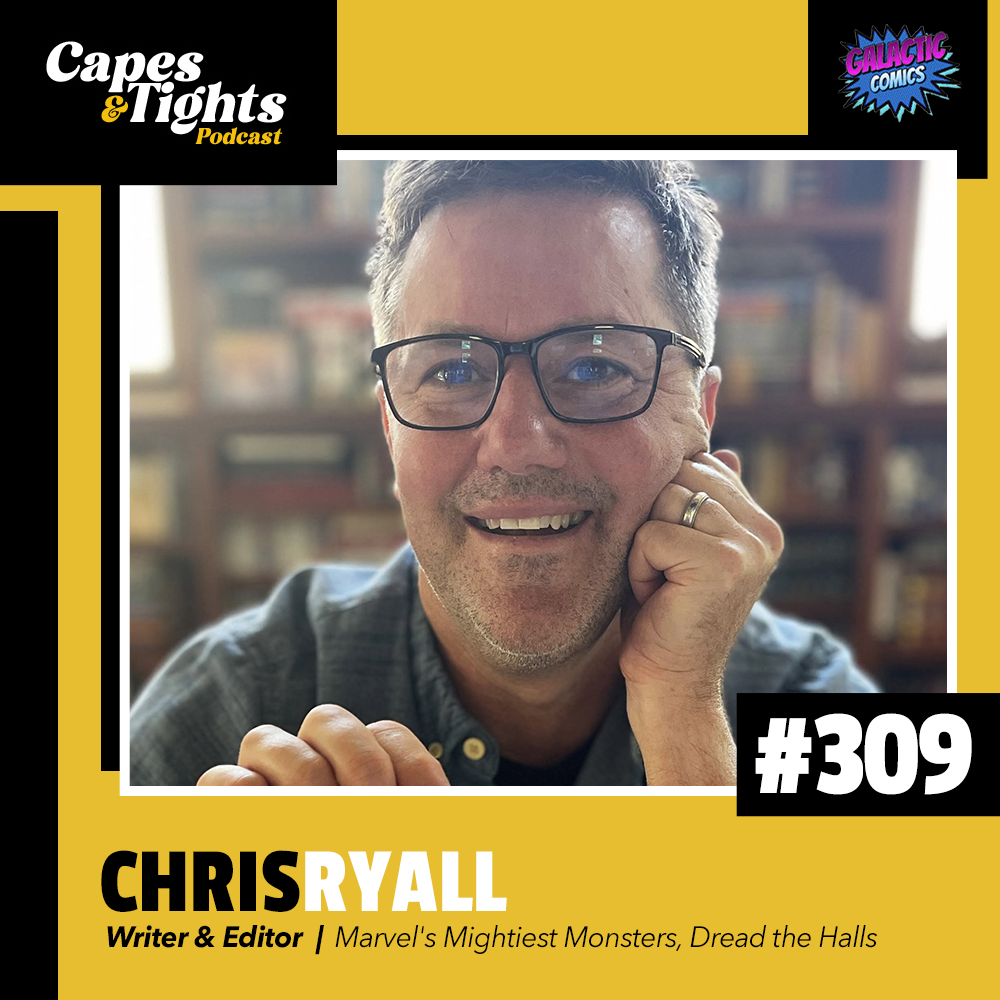
[00:00:00] Speaker A: Welcome back to the Capes and Tights podcast right here on CapesandTates.com, i'm your host, Justin Soderbergh. This episode is brought to you once again by our friend over at Galactic Comics and Collectibles. At galactic comics and collectibles.com we welcome back Eisner nominated writer Chris Ryall to the podcast. You may know him from his work on the Dread the Halls comic series over at Image with his buddy Jordan Hart. He was the chief Creative officer, publisher and president over at IDW from 2004 to 2019.
He owns his own publishing house over at Image Comics called Syzygy Publishing. He also wrote Rom the Space Night for aew, which was pretty badass. But recently he did a book called Marvel's Mightiest Monsters that he edited along with a couple other books over there at Dark Horse. So he came to talk with us about that today. Before you listen though, follow us on Facebook, Instagram, Twitter, bluesky, Threads and all those places you can rate, review, subscribe over on Apple, Spotify or wherever you find your podcasts. And you can watch the video portion of this over on YouTube.com and as always, you can find so much more
[email protected] there's. This is comic book writer and editor Chris Royale chatting Marvel's Mightiest Monsters and so much more. Enjoy, everyone.
Welcome back to the podcast. Chris, how are you today?
[00:01:18] Speaker B: Doing great. Yeah. Good to see you again, Justin.
[00:01:20] Speaker A: Yeah, absolutely. This is fun. One on one. Last time you were. We had to be joined by your partner in crime there, Jordan. But, you know, whatever.
[00:01:28] Speaker B: Yeah, yeah, yeah. We, we had a split. We had a falling out, so now it's just me.
[00:01:32] Speaker A: Yeah, he took up too much time. He talked too much. It was the whole thing. No, Jordan's awesome. You got Dread the Halls is coming back out in December. You excited for that?
[00:01:42] Speaker B: I am, yeah. We just, we just announced that or the solicitation just went live for that, what, a couple days ago. And so, yeah, we could show off the fact that we have a Joe Jusko cover, which is amazing because the original cover he did for this old Marvel comic in the 80s was really our inspiration for doing Dread the Halls in the first place.
So to get the guy that inspired the entire series to not only do a cover but, you know, do a tribute to that old image was pretty exciting.
[00:02:10] Speaker A: It's. You're just done, right? And just wrap it up. You've done it all now you got.
[00:02:14] Speaker B: Yeah, right. Where do we go? Where do we Possibly go from there.
[00:02:17] Speaker A: Well, it is kind of funny. It is somewhat true in the sense, like when you get to that point where you have something like that and then you're like, cool. Now we feel like we have to top it. Somehow I don't think that we're gonna do that.
[00:02:28] Speaker B: I mean, that has been the fun thing about Dread is that every issue we've tried to figure out something that's gonna, I don't know, push things in a different way or sort of just, you know, at one point we. We broke the fourth wall. We did. We did a thing where there was the story at the Comic Con where the question that the one fan was asking during a panel kept sort of rambling on and interrupting the other stories. And so, you know, we try to find ways to play with all the different conventions of comics. And so, yeah, I think that just forces us to keep trying to remain inventive.
[00:03:01] Speaker A: Well, yeah, and he's got that thing to look forward to. I mean, I've done this now. We've hit 300 episodes this week as we're recording Wednesday. This is Monday, but Wednesday will be the 300th episode. And so to me, it was like, now you look for 400, now you look for 500, you look for the next thing. And it's like. But I also, like, had been fighting for. Not fighting, but like trying for. For multiple years to get my 300th episode guest, which was Kevin Smith, who you have worked alongside it in the past. But.
And so finally things came together, pieces fit and so on and so forth. And my wife goes, now what? And I go, oh, yeah, you get a point there. But I always have a list of people that I'm like, I want. These are the goals of people who I'd like to chat with about comics or whatever. And. And so they just move on to the next person and we'll see what goes on from there.
[00:03:47] Speaker B: Yeah, no, that's great that you got Kevin and you know, 300, which means you probably need to do the double sized anniversary edition thing, which will be easy with Kevin because he is a great storyteller.
[00:03:56] Speaker A: It is funny. I don't think I've ever talked less on a podcast. And I like to talk. And so it's like some of my buddy who runs our local convention had.
Had had a couple of the guys from Clerks at their convention and they were talking about it and he asked me that question. He's like, so did he tell you? Did you get a chance to chat? And I was like, no, but it's okay. That's what people are here for. People here try to hear him listen or listen to him, not me. So it's pretty cool. But we're here chat, so Dread the Halls. Yeah, that's December solicitation. Says what? November 9th is FOC. So if anybody has wants to do that, it's such a fun thing. We've talked in the past about Dread the Halls with uxa, you and Jordan, about how there's so much fun because, like, now I'm gonna pull out last year's New Year, I'm gonna pull those other ones out during the holiday season. Even though they're not connected to these, they're like, just fun snippets of stories to read during the holiday season.
[00:04:48] Speaker B: Yeah. Which is what we want. We wanted the perennials because there's always an array of Christmas issues that I pull out every year.
And so, yeah, if we can somehow be that for anybody else, I think that's exciting. Look, can I show you something else, by the way, just to.
Just
[00:05:02] Speaker A: to follow up on the. Look at that thing.
There's the.
[00:05:06] Speaker B: Joe, just go cover for
[00:05:07] Speaker A: the
[00:05:07] Speaker B: new issue. Yeah.
[00:05:08] Speaker A: You gonna put that on the wall somewhere or
[00:05:11] Speaker B: somewhere? Yeah, we'll figure out somewhere where it is allowed to go
[00:05:15] Speaker A: until. Until it ends up in a museum. Because Dread the Halls will make it, you know, into a comic book museum one day. And, you know, there you go.
[00:05:21] Speaker B: Well, and so me and Jordan. Me and Jordan are actually sharing, like, we have joint custody of it. So, you know, I'll have it for this holiday, and then next season, you know, it'll be up at his house and we'll just keep going back and forth until we end up in court and fighting over it and then, you know, tearing it in half as we argue who gets it, you know? You know how those stories end.
[00:05:40] Speaker A: Well, it's like one of us, you get who gets a high quality print of it, and the other person gets the print for half the year and the other person gets the actual thing for half the year. So, like, no one really coming into your house kind of knows which one would you guys know?
But, like, it's like one of those things that, like, it never changed. People don't know that the original one is gone. It's like the. Was it the Declaration of Independence? There's like a fake one that goes in to, like, keep trying. Like, that's what you need to have. I think you need. What I want to know is if there was a map on the back of that One like, like there is in the back of the Declaration of Independence.
[00:06:09] Speaker B: Well, no, but you know what's funny is it didn't even occur to us to do like a nice print of it. So I think you maybe just solve the problem for us. So that's great. Thank you.
[00:06:18] Speaker A: It's. Yeah. When you have a big gathering that you're like, I know I'm having people in my house, I got to have the original. So like Jordan, give me the original, put it on the wall. But in the meantime you have that, that ability to do that because I've got some original art, but I've also got prints of art that's signed by some people and stuff like that. So like it'. That's still cool to have, but. Yeah, so. So it's cool to have it come out again. It's cool that it wasn't just a one time thing or a two time thing. Now it's going on and I'm glad it seems to have a following which, you know, like I said to me, it's like got to turn on Rudolph and watch Rudolph around Christmas. You also have these holiday. And I do that when I read things we talked about. When we talked last is like, I plan December a little bit differently. When I go to read things, I'm like, I got to read the things that are coming out in December because that's part of what I do. But also like go read Klaus or whatever it may be a Krampus story or something like that. And this becomes that thing sooner or later. In a couple of years from now, Chris, I'm not going to be able to have time to read anything else because I'm reading all the Dread the Halls.
[00:07:09] Speaker B: Well and hopefully by end of next year we'll have the first trade paperback collection because we didn't want to, we didn't want to combine the Hall H stories with the Christmas stories because that just feels too scattershot, you know. So we needed to wait till we had enough material for just the Christmas stories. And so now after three, you know, 48 or plus page issues, last year was actually 72 pages. We'll have enough material to make a really nice book too. So.
[00:07:34] Speaker A: So every couple of years it could potentially add a second volume to it, which would be kind of cool to put it on the shelf. And then those need to come in wrapping paper though. You need to figure that out.
[00:07:42] Speaker B: Yeah, that. Well, we've, we've talked about all kinds of things to go along with it and that's certainly one of them. Because, you know, Jordan's covers, the covers he's done have been these great wrapping paper.
And the new. The new wrapping paper cover he did for this December issue is so much fun with the nutcrackers and stuff, which kind of plays off one of the stories that Chris Anderson is drawing.
So, yeah, it's. His covers are great. I love. I love those Jordan design, you know, wrapped paper covers.
[00:08:08] Speaker A: Paper, like you can write to someone. It's like one of those ones that, like. It's like one of those ones that had a comic book store years and years and years later when it's actually worth money.
And someone's like, you drew someone's name on this. What are you doing?
Well, it's always. That's always funny when I see that, like, he's like, oh, this is great. But someone wrote their initials on the comic book. I'm like, okay. Someone had to verify that this was their. Their comic book by writing their initials on it. Not realizing
[00:08:31] Speaker B: that almost all of my childhood comics have a little CR. Up in the back cover, top corner of the back cover. Because, you know, I showed a room with my brother, so we had to make sure, you know, whose was whose. We couldn't have those collections mix
[00:08:45] Speaker A: well. I was at a. In Camden, Maine. My wife's birthday was this weekend. I was at a bookstore. There's a small bookstore. There's no. It's got to be like, two rooms. One's just like 10 by 10, and one room that's like, I don't know, six by six or eight by eight. It's, like, tiny. Like, this is, like it is upstairs. Like, you walk up these stairs. It's apartment door to the right. It's apartment door across the hall. And there's, like, you turn around to a 180, and there's. There's the bookstore. It's like what used to be an apartment for someone, and. And now it's just some guy. He's sitting on the chair, stacks of books next to him. He's just, like, sitting there reading. You can hear him giggling at whatever he's reading. And then he has this little stack of handwritten receipts. And this is his bookstore. And I'd never been in this store before. And I walked in and I was like, holy crap, this is amazing. And nothing's organized, obviously. There's just stacks of books everywhere. It's like, okay, fiction's over here and nonfiction's over here, but it's basically just in the shelves and. And it's one of those ones where you open the book and on the first hard favorite page is a little 1250. Like a hidden pencil. Yeah. So all of them are priced, but they're priced on the inside cover on that little thing. And I was like, oh, my God, this is so much fun. I found two Stephen King books that I was missing. And I was like, all you need to do is take a little eraser and erase the little price on the inside and it's back to normal. But yeah, it was good enough. I was like, this is amazing. I love this kind of stuff. But yeah,
[00:09:57] Speaker B: there's a bookstore in. There's a bookstore in Sleepy Hollow in, like upstate New York that is. I get to use bookstore. And the entire bookstore is just stacks of books on top of each other. So, you know, if you want a book that's 15 books down, like, you've got to very carefully, like, displace all the piles to get to it. And the entire store is that like floor to ceiling. Just the most insane array of books, you know, just stacked haphazardly. The bookshelves all have, like, three rows of books, you know. And I remember going in there, it was last year, and I asked the guy first particular book, and he walked right over to the stack and, like, reached back behind and pulled it out, like, knew exactly where everything was, which just always impresses me. I mean, it's terrifying to be in there because you worry about, like, someday he's going to be buried under all that stuff.
[00:10:41] Speaker A: Local man dies in
[00:10:42] Speaker B: go
[00:10:42] Speaker A: out.
Well, I guess it's better worse ways. But, like, it is kind of funny how that is and like, how they know exactly. And if you, like, organized it, you'd be lost, like, if it was actually in. Even though you could just go to like, last name and like, find it, you still be lost trying to find this book.
But now that he has it all disorganized to everybody else, it's organized to him and he can find it on that. I find a lot of small independent bookstores are fairly stacks of books places too, though. Like, I don't think it's the big corporate bookstores who are like, okay, we know exactly where everything is according to where it's listed. But like, yeah, it was just fun because I feel like those are the kind of stores you're gonna find something. And same thing with old comic book shops that have like, just long boxes sitting like, they don't know XYZ comic potentially had be gone up in value because it's just in a box Somewhere and you find it. And that's the cool, like the hunt that I still love doing. Even though he's kind of lost now with the Internet that you could just be like,
[00:11:33] Speaker B: I will say I was there. There's stuff that I'm like determined to only find in person and not take the easy way out, you know, So I, I was in Colorado this past weekend and so I had a chance to hit Mile High Comics in Denver, which is, you know, ever since I was a kid, you were seeing their two page spread in comics and just, it was just the place that like I've always wanted to go visit.
And it is just the most overwhelming, like airplane hangar size thing that has every possible everything from throughout the entirety of, of, you know, human history.
And it's fun to just. Yeah, you come across it that you've totally forgotten about. In fact, one of the things I found was like, for some reason when I was a kid, like I had all the other pocketbooks and this one I never saw, never found, never anything. I'm like, all right, well, I gotta
[00:12:22] Speaker A: get. Well, I feel like it also saves money because like, if I just wanted to get everything that I ever wanted to get in comics, I could get it. You know, you can just go to ebay, you buy it, but then you also know where you're like, your credit card bill is $10,000. And it also spreads that out in a way too. That makes a little budget, make it budget friendly for me in the sense that like, if I require myself, I need to find this in person or, or I want to save this for when I do go to comic book shops when I'm on vacation or traveling or whatever. Then it also spreads that money and then I find it and hopefully it's. Sometimes it's a deal too. That's the thing. Whereas like you buy it online, the on demand thing, price is a little higher. But if you find it at some shop, some guys like, oh yeah, 10 bucks, you know, I mean, like it's. Well, and you're
[00:12:59] Speaker B: probably never going to forget where you found it. You know, like, I'll never not remember that that came from Mile High or this comic over here came from, you know, a store in Maine or whatever the case may be. And so that's part of the fun of it too.
[00:13:11] Speaker A: It's that in the same. I have like almost all Stephen King's books and same thing, I'll remember those two books that I got at this little shop and I'll have the story that goes along with It I'll go back to this guy too, which is really cool. And I've like, I've bought a lot of Stephen King books online. So these are ones that I haven't bought because the, the price of them were probably way too high for what I wanted to pay for a book. And so to get him for like 1250 a book too. I guarantee you he doesn't go through and like reprice books if, if they go up in price. This guy's just waiting whatever sell it. And it was cool. Saw like books from the 80s, books from the 60s, books from like last year. So it's not even like he bought a bunch of books and he has a lot of old books. It's like people still bought bookstore. He went to like. What ends up happening a lot in Maine is like going to the thrift shop and they just like use bookstores will just buy out the thrift shop of all their books that get donated and then they end up putting them on their shelves for like twice three times the value or the price they paid for them,
[00:14:01] Speaker B: by the way. Good, good, good day to reference King because today's his 79th birthday. And and the funny thing is, so this won't play on camera, but I visited the Stanley Hotel yesterday when I was in Colorado. So
[00:14:13] Speaker A: and that's funny. So this weekend in. I live in Maine, I live in Newport, Maine, but Bangor, Maine is 30 minutes. I drive through Bangor to get to my work, my day job. And so I actually the. My comic book store is a block away from Stephen King's house. Like I drive by every time I go to the comic book store. And this weekend.
See, there you go. You gotta come back. No, this weekend's his birthday weekend. So they celebrate the first two years in a row they've done this like carnival thing in downtown Bangor where they get together and do a bunch of Stephen King related things. And Tom Dettty, who's a writer and editor, he had put together a book about the 40th anniversary of it. The book, it came out in 1986 and so I went and saw him and a few authors there on Friday night. And it's just really cool to see all these people downtown just celebrating, celebrating King. So yeah, happy birthday to Stephen King. 79 years. I mean she's man, like I hope I make it to 79, Chris. I hope I do like.
And I've had a lot less of a stressful or rough life at certain points in life than Stephen King has. So I hope I make it that Far. And, you know,
[00:15:21] Speaker B: I mean, I'm hoping we're still doing this when you're 79. So.
[00:15:23] Speaker A: Yeah, there you go. If we talk episode 3000. No, I don't know if I can do 3000. That's what I give up. I'm like, I'm done. No, but see, we talked about the guests, the future. Like, I would love to have Stephen King on here, and I have ways to potentially get in touch with them, but I'm like, I don't want to do that. Like, I just also feel like it might be. I'll be so nervous or so, like, bad conversationally that it just wouldn't be good. So I probably would want to do like a 15 minute conversation and I'll be done. But maybe I'll add it into something else. Maybe, maybe I get him and Joe Hill on at the same time and then we can have a conversation because, like, have everybody get all the kids. KING Episode 8th, 80th. His 80th birthday is coming up. Maybe we do it for this.
But yeah. So you Dread the Halls is hitting the shelves. You're also working on other stuff, like editing books like Marvel's Mightiest Monsters. So the funny thing is I was originally thinking about getting you back on at some point, chatting and so on and so forth. And I felt like it gets a little bit repetitive if we. Every year you come on, we just talk about the next Dread the Halls because we don't spoil it. So it would be kind of cool if you and Jordan came on the next year to talk about last year's, because he could spoil it. Okay, you've had a year to read it. Let's just talk about things and so on.
But so I thought, I'll change it up a little bit. And I was doing some research and I was like, oh, this is like the monster season. The creepy, spooky kind of season is we're in right now. This, like, end of September to, like the beginning of November is like that season. So it's like, oh, it'd be great to come on. And then you're editing this book called Marvel's Mightiest Monsters over at Dark Horse, and I was like, this is perfect. We could chat about that. So Caitlyn over at Dark Horse was able to send me the PDF over the weekend and I glanced at it and it was just. It's just. So it's a weekend is not enough to glance at this, by the way. Chris just let you know
[00:17:03] Speaker B: it's a big book, It's a Very big book. Yeah.
[00:17:05] Speaker A: And it's like you can just, like, flip through. But then, like, I felt myself like, oh, I'm just gonna flip through. Then I started reading the comics, and I'm like, okay, now I don't want to just flip through. I want to actually read these things. And so I was able to read some of your spots you have in there, like the beginning, you have an opening, and you have a couple different spots. And then there's the Jack Kirby at the end. Has that text at the end. Yeah,
[00:17:28] Speaker B: I love finding stuff like that. Yeah,
[00:17:30] Speaker A: it's so cool. And it's like, for her, for like a second, I'm like, wait a second. He didn't write this right now. This is not possible. And then I was like, wait a second. So, but, like, putting this together, is it something that you've been like, you're a monster fan since, like, childhood, and this was something you wanted to do? Is this something that they approached you with? How did Marvel's mightiest monsters come together?
[00:17:51] Speaker B: Yeah, so I've been doing a number of books with Dark Horse now in tandem with John Lind. John Lind was running the Marvel program over there for them. And so they were doing things like the Marvel bullpen books, which are sort of smaller, Artist edition style books that have fleshed out material that more.
Oh, good. Audio's okay.
Yeah. And so anyway, they've been doing a number of Marvel books, so he brought me in to help with that. And so one of the ones that I first worked on was this monsters book, which is a collection of all the old Jack Kirby Atlas, sort of pre Marvel comics, you know, Marvel superhero comics stories.
And so they're just so charming. You know, like, Kirby had such a great way of designing these monsters that were sort of terrifying, but also kind of cuddly. Like, they.
At a time when the comics code was, you know, in. In full force, and people were worried about the effect of scary comics on their kids. Like, he had this unique way of telling monster stories where you kind of felt bad for the giant creature, alien, or terrifying monster, because they just. I don't know, they had just a.
The coolest, most charming design to them. And so it just. It's a collection of all those stories. It's a lot of essays, and all the captions sort of refer to specific details about the stories, about the covers, about the material in the book. And we dig into the sort of backstory of those stories and Kirby's monster tales and all that. And. And it was designed by A guy named Ian Chalga who's been designing a lot of nice art books. And the design in this one I just find. So like, it's so great. I don't know if you got the whole wraparound cover, but he took one of the great Kirby monster covers of, you know, the monster sort of lurking outside the guy's apartment. And then we made a whole like spread image of that with all the other monsters like array behind him and stuff. And I just. All the detail like from the design to the paper stock, which you haven't been able to experience yet, to the. There's a cool belly band with the sort of silhouettes of humans running away from the monsters behind it. Like just all of this like sort of top notch stuff that just is, I don't know, kind of the ultimate presentation of these stories.
And so, yeah, I have that one. And then a collection of the old Vampire Tales magazine stories also comes out right around Halloween time. So two different sort of monster related collections of old Marvel material.
[00:20:12] Speaker A: It's. It's cool for me because like one of those things that one I loved about like when Marvel Unlimited came out years ago, it was like we're never gonna have not never rarely gonna have the chance to pick up some of these old comics and just read them. Like a lot of them are like you put them in bags and boards, they stay there, they're never gonna be touched again. And a lot of the valuable ones also like that's like you're never gonna. It's like usually CGC'd and it's like encapsulated in something. But, but seeing in this format is like you get a chance to like glance at these stories that maybe you either have never picked up or wanted to always pick up, but want to like physically hold something but then also have like a breakdown from yourself and like, you know, like those kind of things is like a different experience.
I'm guaranteeing it's big, it's heavy because it's probably, it's a lot of materials, 400 plus pages for almost 500 pages, I think when it comes down to it. But it was cool because I had a chance to read some of your analysis on things and so on and so forth that your Daredevil book with the Marvel age of comics, those little books actually have it back here if you can see it. But your Daredevil Born Again book, it's one of those.
I've read them all and because I've got a chance to read the first set of them they all came out right around the same time, the first three.
Now they just send me the finished copy. They send me the copies to be like, hey, you're usually good at this. So you want to read those. Yeah, see?
And so they're like, hey, send this to you. Read this review. And I will say, not just because you're on here and you're the first person I've actually talked to in like, on video chat that's written one of these. Yours is the best one. So I just. But part of it is that I enjoyed so far, out of all of those ones, one that, like, found a section of Marvel history, like a smaller section, like a series Born Again, and chatted about it. Whereas, like some of the other ones that are like longer periods of times with varying things that are happening, it just seemed like it wasn't that small book was not enough to really dive into all the stuff that happened during that period or like, whatever, or there's a couple that are just like retelling the story that happens in the books. And I'm like, oh, this is cool for someone who doesn't read the comics or hasn't read the comics, but in the same sense, I wanted more deep dive analysis on things. And I felt like that's what you did. And so I got that chance with, with that book. And so when I was reading this one, I was like, oh, this is really cool. Like, it's like a. You get to take. You share your love in a new way.
Doing this. Is it a similar approach to doing, like, the monsters of the Vampire stuff and something like the Daredevil board again?
[00:22:34] Speaker B: Yeah, I think with any of this stuff, like, I'm trying to find conversational ways to not only talk about, like, the impact of the story or the art or the creators that worked on it, but also, I don't know, just what makes them cool. Why are they still resonant and talk about it in a more conversational way? You know, because there's like, there's great sort of university press level or scholarly takes on comic books and superheroes and all that kind of stuff, but that's not.
That's never really been. My interest is sort of digging in in such an analytical way. I. I like.
Yeah, just trying to convey sort of the. The passion behind this stuff or why it resonates, why I like it, why I feel like other people like it. And like, with the Daredevil book, there was certainly a. There was a bit of summarizing the stories to a degree, because Part of the goal is like, you're trying to tread a line of making it interesting to people who know the material, but also hopefully making it interesting enough that if for some reason somebody picks up the book without being familiar with the source material, that it makes them then want to go read it. And so you try to, you know, find enough interesting factoids and things like that that pay off for the longtime readers, but also hopefully hook new readers, too.
[00:23:46] Speaker A: Yeah, I mean, it's a balance. I think it's a balancing act. And how to. Like you said, you can't.
You were 100% not going to sell it to people who haven't read Daredevil Born Again if you don't. If you don't say anything about summarizing it. But there's also that fact that I wanted to go read Born Again after again, whereas I felt like there was a couple other ones where I'm like, I don't need to now.
Everything I need to know has basically been told to me. So why go read it again? Unless I want to look at the imagery of what the illustrations are and stuff. But to me, that was that balance you felt there. But also you had that here where there's obviously more writing involved in the Born Again side of things as you're writing the whole book. Whereas this, you have essays in spot and then you're editing in or adding in actual issues of comics that came out with these monsters in it. Did you have like a list of monsters that you know, or issues that you know off the top of your head you're going to include in this? Or did you have to do research on all of that?
[00:24:41] Speaker B: I mean, it started with wanting to include everything we possibly could. And then you go through them and yeah, then you're sort of picking and choosing to some degree, you're thinking, well, this one has to be in there. And if this one has to be in there, maybe something else has to come out. And so either you're trying to find stuff that hasn't been reprinted in 10 other editions, you know, because there's been the masterworks collection, there's been soft cover collections. There's been like the comics that were re released like in the 90s where Jack Kirby wrote that essay about the monster stuff.
So they've. This material is out there in other forms. So you try to find like the greatest hits, but then also like sort of the ultimate presentation material. So hopefully, even if you read these stories or you have it in some form on your bookshelf like this is the version that will supplant all those others and, and, you know, hopefully be the, the lasting thing that you pull down and flip through every now and again.
[00:25:32] Speaker A: It almost felt somewhat of like you have your standard watching the movie theater movie and then you have your like, commentary track on the DVD at the house when you put it in the DVD player. And I was like, this is what you kind of want in that sense where you can just pick up. And again, I mentioned Marvel Unlimited, which still exists. You can still go on there and read comics from that era. So it's not like you need something like this, but if you want that extra physical holding it first of all, and then also collectibility of putting it on the shelf and so on and so forth. The design, which again, you mentioned that ahead of time. I'm a designer by trade. And so to me, I was like, every once in a while I pick up something like this and I'm like, God damn it, why I want to design something? Like, it's like one of those things.
[00:26:11] Speaker B: Ian's amazing. Yeah.
[00:26:13] Speaker A: Like, you're like, oh my gosh. Like, I've talked to people who have like their friend. They're like their artist on a book is drawing another book that has a really amazing, like, plot. And they're like, God damn it, why didn't I think of that plot? Like, that was. That's amazing. What was my idea instead of me? I'm like, I'm looking at it, I'm like, oh, it's so beautiful that I wish I was the one that designed them.
[00:26:35] Speaker B: Yeah, I mean, it was. I think he had a blast with it, you know, and, and you can see that in even some of the, the design work on like the text pieces throughout and everything. Just the little bits of clipped monster art and humans, you know, running in terror, that kind of stuff that he pulled out. The other thing I was thinking about, the stories that we picked were, you know, trying to show the starting place for characters like, like Groot, you know, Groot, certainly it was way different when he was first introduced, you know, in the 50s. He was just this, you know, evil tree alien kind of thing. So it's, it's fun to see like, how he started and where he ended up as like the cute, cuddly, you know, guardian of the galaxy kind of thing. And so it's fun. Like some of them, you know, some of these were just throwaway stories or they were, they were one offs. Never intended to, you know, see those characters again. And then suddenly they come back and they, you know, every now and then the monsters go through a revival and then, you know, somebody else will take them on and bring them back into the books.
And it's fun just seeing the evolution of those characters as they're, you know, portrayed through different periods of history.
[00:27:42] Speaker A: They.
You see there, like I said, the reason why Groot is big now is because of movies. Like, obviously, like, it wasn't like a reintroduction in comics. Like, it was. He was in comics, but it was like, not anything crazy until you see Guardians of the Galaxy and you see Groot. And it's funny how you said that. Like, it is true. Like, the COVID of he's like this big, huge, like, old looking tree. And now like the cute cuddly version of him is like the most popular version of him. Which is the weirdest thing is like how they had to like, Benjamin Button him as he. As his, like history in Marvel has gone along. He's actually gotten younger, which is crazy. But like, truth the matter is, it's all about selling and doing all this stuff. I understand that because my son knows that. He's five. He knows Groot like, the way he knows. If I saw Groot on a comic book, he's like, who the hell is that? Is that his grandfather?
But no, it's true. It's actually funny when I was looking through it too, like, how many of the covers are featuring these monsters, have the monsters doing this too. Like, they're all hands are up in the air like Ra, but they're in current comics. Like, they see the monsters here and there and stuff like that. But like, you argue in the beginning of this book that that they're the beginning. They're really like, before superheroes, there was these monsters.
And some people don't see that. They just see Marvel comics superheroes. It's the same thing nowadays with any other, like, various genres that Marvel can touch on over the years. It's like it's still a superhero comic book, but, like, monsters were like before this in a sense. Like, was that important to say that? That's like, this is like the beginning of. Not beginning, but towards the beginning of Marvel Comics.
[00:29:15] Speaker B: Yeah. Because you also, you also really get a sense of Kirby was figuring out who he was as an artist and figuring out like a more specific style. Because when you see some of his early works, you know, this stuff in the 40s, like, it doesn't feel like the Jack Kirby that we're all familiar with, whereas this stuff does. You know, it is these larger than life characters and these powerful scenes and just this crazy inventive technology and spacecrafts and creatures and all of the stuff that, that sort of not only led into the Marvel universe, but I mean, the start of the Marvel universe. Those are monster comics. You know, the first issue of Fantastic Four was a monster comic with these, these sort of altered humans, but they weren't slapping on costumes just yet. You know, that didn't happened for a couple issues later. And it was just like these powered up humans fighting monsters on monster isle and all everything. And so it was just like it's a definite like connective tissue between his monster stories and then the start of the Marvel universe.
I mean it's probably got to be God. It's got to be goom and googam.
You know, the father son dynamic. Like, I love that he's called out as like son of like
[00:30:29] Speaker A: it's, it's, it's you for. I guess you forget almost about it because of how much Marvel superheroes have taken over the spotlight of Marvel. That there was various ones like you have like the famous ones, Fing Fang, Boom and all those guys. But like you have this beginning part, but the person you mentioned, you mentioned Kirby, you mentioned Ditko, Larry Lieber is one of those names that readers may not immediately associate with like this era of Marvel comics with like Lee Kirby, Dicko, all that stuff. What should you. What did you want to get across that like he's contributed to these stories back in the day.
[00:31:06] Speaker B: I mean a lot of it was, was Stan was just doing too much work, you know, and so he would hand stuff to his brother. And Larry was very good at dialogue and you know, very good at plotting the stories out and everything like that. Like he, he certainly was instrumental in not only the monster story, but then the creation of characters like Thor and Iron Man. Like he, you know, he worked on their first appearances alongside Stan and Jack and so I think he's up there with those two and Ditko as far as the guys who had the sort of biggest impact on the pre Marvel stories. And so I'm hoping we can also do a Ditko book because Ditko is more of the supernatural stories, whereas Kirby was more of the big monster stories. So I think those would be nice companion books to do with each other. So we're hoping this one does well enough that it allows us to do a second volume.
[00:31:51] Speaker A: When you make something like this, is there a certain anybody who's a Marvel fan you're hoping that reads this book? Obviously you hope that. But is there a customer base or readership base that you're aiming towards when you create something like this?
[00:32:06] Speaker B: I mean, to some degree you want the same audiences that I wanted with the Daredevil book. I would love people that are familiar with these stories to see this book and sort of see it in like this beautiful sort of ultimate presentation of these stories. And then if there's, there's new readers who, you know, might only know Groot or some of the other monsters from modern stories, like, it's certainly a fun place to see how they began. Like, I mean, the stories are, are very much just fun for all audiences. And so I think kids and adults, like, this is the kind of book that, you know, parents could pull out at Halloween and like, let their kid flip through and stuff like that. I think everybody gets something out of it. And so, yeah, I think with all of these kinds of books, like all these books that sort of, I, I've had people describe me as my historian period of doing this stuff is, you know, the whole point is just to, I don't know, continue to, to proselytize for comics and I, you know, talk up the, the books from the past that kind of helped build the foundation for where we are now. And so I, I love that. Like, I just like the idea of trying to represent this material in ways that gets people excited all over again.
[00:33:15] Speaker A: I just picture like my mom sitting at the table. Okay, what does Chris have to say about monsters today?
And reading you're opening like over and over again every year as it's Halloween and these guys. Yeah, we're
[00:33:25] Speaker B: maybe not going to get every audience, but yeah, it's, you know,
[00:33:27] Speaker A: I just like thinking like, Chris Ryle is like part of my family now because every year we read Mighty, Marvel's Mightiest Monsters.
Marvel's Mighty is Chris. But no. Yeah, so it's like a three pronged thing. You want the archival project of it, but you also want a celebration of it as well as like learning, getting people to learn new things about maybe some stuff they haven't heard about in the past. Like, it's like this.
There's something for everybody in this. In that sense, like, to me it's, it's an investment. And so, like, I think it's a great gift. We are approaching the holiday season. It's one of those things that if you have a fan that likes to relearn, just someone who's like, I'm so interested in just learning new things about a passion that I'm in. And so, like, if I say Marvel Comics is a passion of mine, if someone's like, hey, what kind of guests want. This would be on a list? Because, like, okay, I want to be able to learn something that maybe I didn't know a little bit about. I mean, I didn't. I'm reading right now. I Am the Night by Daniel Dockery, which is the unofficial, like, history of Batman, the Animated Series. I've never watched the Batman the Animated Series, even. A huge comic book fan, I grew up on the X Men animated show. So, like, to me, it was always X Men. X Men, X Men. And so Marvel ended up being my, like, go to universe. And so even as an adult now, I really want to go see it. But I was like, oh, I want to read this. But it was cool because it's set up in a way that, yeah, it probably spoiled some things for me, but it's an animated show, too, so it's not like it's like, this historic, like, oh, my gosh, Abra Lincoln got shot at the end of his story, like, big thing. But to me, it was really cool. So learning about something new like this would be kind of fun. And that kind of a format with some of the issues in there and some. Some essays and some stuff like that. I think it's a cool format. I think it's a good gift. I think people should buy these.
[00:35:04] Speaker B: Well, and it's funny. So if you want. If you want big Marvel gifts for the holidays. So I have this book, the Vampire Tales book. And then there's two big villains collections that Dark Horse is doing with Magneto and Dr. Doom that all come out between now and the end of the year. And so there. There's more big, hefty, you know, pricey hardcover Marvel collections.
[00:35:25] Speaker A: And you'd be like, you're the monster in my life. You're the vampire in my life. You're the villain in my life. And just do it that way. Right. There you go.
[00:35:30] Speaker B: Or you do like me and Jordan are doing with that cover. You know, just trade
[00:35:33] Speaker A: them off every
[00:35:33] Speaker B: other year.
[00:35:34] Speaker A: Yeah, just share it over and over again. No, it's pretty cool. But, like, is there anything. When you. When you were researching this and doing this, obviously you knew about monsters. You knew about some of the history. Is there anything that you rediscovered or learned or surprised you when doing some of this research?
[00:35:47] Speaker B: I mean, I think. I think it was just how much of the.
How much of the early Marvel Universe stories were just monster stories? Like, and I. And how much of these stories sort of felt like they had the full Marvel universe DNA in them. Like, the Lee Kirby stories in this book just feel like a part of the early Marvel universe. You know, even though they. They predate superheroes, they. They don't feel, you know, some. I don't know, you read some older comics, and they feel older. You know, they feel musty, and very much of a particular era.
I mean, these have some of that because they were done 70 years ago, but.
Or longer, but. But there's just a charm to them that I feel like is perennial, you know, and they're all stories that also don't rely on continuity, so they're. They're just easy reads. And so I think. I think the biggest surprise to me, I mean, I've read some of these before, but the biggest surprise overall was just, like, how cohesive the team was, like, and just how endlessly inventive Kirby was. You know, the art and the stories and just everything he was doing was already so impressive. And this all predates, you know, creating an entire universe. And so that, I think was. Was revelatory, was like, God, this guy's just been doing this for. Over and over again for. For decade after decade. Like, it's so impressive.
[00:37:04] Speaker A: I always sometimes look at him like, leave some talent for the rest of us people. Like, can you please stop being so talented and doing it for so long? The. You mentioned. I mentioned the 300 episodes and hopefully a thousand. Three thousand. I'm like, I don't know if I have the stamina that these early dudes had, was doing this stuff and how much more work it probably was to do this back in the 50s, 60s, and 70s than it was to do it nowadays, too. Like, you have technology that helps you in saving. Like, having to have someone run across town, potentially, to, like, deliver pages and stuff like that. It's just crazy to think about. Well, you
[00:37:34] Speaker B: also didn't get paid. You know, you didn't. You didn't get paid till you got your pages done. And so they just sit down at the table and just draw all day, every day, just because that's how you made a living. And so it was just. It was just a different level of not commitment, because people doing it today are just as committed, but it's just.
Yeah, it was just labor, you know? And so I'm sure a lot of this stuff, like, if. If Kirby were around, you went up to a convention, you asked about, why did you do this with this character, this old monster story, he'd be like, I don't know, man. I was just
[00:38:02] Speaker A: trying to get this working.
[00:38:03] Speaker B: It was just a day's pay. Yeah,
[00:38:06] Speaker A: well, yeah, there is that. So artwork and story go hand in hand in comics, obviously. But like, when we think back to these monsters, like, I think visually more than I do story, it was. Was the stories as impressive to you as the artwork itself?
[00:38:21] Speaker B: Yeah, because they were.
This. This sounds derogatory, but isn't. But they were simple. You know, there was. You didn't. Like, short stories are hard, you know, even for doing those Dread the Hall stories. Like, doing 10 page stories is tough because you don't have a lot of room for character development. Like, you got it. Like, the plot has to drive the thing and you have to like come to a satisfactory introduction, arc and resolution all in just a few pages. And in a lot of cases, these monsters are even fewer pages. And so they had a lot to accomplish in very few pages, which is super impressive.
And they were almost all like a morality play of some sort or another. You know, it was like mankind got their come up and because of hubris or because of whatever else. And like a lot of times the giant scary monster was the wronged character, you know, who we were actually pulling for over the humans. And so there's definitely a sameness in the way. There's a sameness in like Twilight Zone stories where their morality plays and they all sort of hinge on the twist at the end. Like, these didn't necessarily all have the twist, but they did all follow kind of a set formula, which is also so impressive that they could feel different while feeling so similar too.
[00:39:31] Speaker A: It's. Yeah, I mean, excuse me.
They. I said to me, it's always. Not always the artwork, but artwork is what I could. You could flip through these pages and just look at the artwork and know that it's such talented artwork. And so. And the other thing I like about it is how different it is from today. Like, it is a different style of artwork in a good way. This is not like we've improved on artwork. It's just different nowadays. In my opinion, there has been some improvement on some artwork. But I was like, for the most part, like going back and looking at these comics, you're like, this is so cool. And again, simple is a word I use quite often. Not trying to be derogatory for it, but like, like simple in a way that simple in the best way possible.
[00:40:09] Speaker B: Well, and I mean, Kirby was creating these. These monsters for these throwaway 10 page stories. It wasn't like you were Creating a big villain that you thought was going to be part of a, you know, massive crossover event and hopefully get it an appearance in a movie and collect royalties on the co creation of this lofty whatever. He was just doing this three times a month, every month, you know, without fail. And, and so just to put that kind of design skill into a story that was just like I say, largely disposable or just immediate, you know, it wasn't a thing that was lasting, was, was impressive. And also, you know, a lot of the aliens he or the monsters he was drawing were these like gigantic creatures. And so somehow he was easily able to also keep the scale of human size and monster like within the frame and not, I don't know, have it be easy to follow and that like that's the kind of simplicity that is super hard to do.
But for the reader it just like, it just all plays like it all doesn't crowd the panel too much. It leaves room for all the copious amounts of dialogue. Like it just, it just does so much with so little.
And again just that he did it month in and month out, you know, creating these crafts and creatures and all of that was just, you know, I, I, the other thing when I'm writing about these stories is you try to also consider the era in which they're made and you know, just that, I don't know, I just find it superhuman like the efforts and the creativity that went into these stories.
[00:41:37] Speaker A: Well, I think it's also kind of, I was like to me, I'm like trying to think of like maybe why it was more kind of what these are enjoyable compared to some stories nowadays because maybe there was like not less thought but like you had to just get things out and you had to move along these things and they had to be simple. And so sometimes like the more convoluted stories are the ones where I'm like, like I just recently, I'm not going to call out comics, but I just recently read a comic book that I was like, oh, I could read this. And then I realized that I couldn't because I didn't really read the surrounding stuff to it that I thought it was separate from. And I read the first like three pages and I was like, yeah, I can't unless I go back and read this stuff, it's like it's not going to be worth me reading. And that's why Independent comics has pulled my attention a lot more more recently. Because a five issue miniseries that doesn't have any background to it is the Easier for me to jump right into.
And so maybe that's a little bit more why some of these were enjoyable to read when I was reading these, because it's like, I don't really need to know anything, and I don't need to know anything after it's like it's done. They were all very
[00:42:29] Speaker B: alien comes down, human interacts with alien, something goes wrong, alien returns back to us, you know, and that's almost like every story follows a pretty similar pattern, but all still told in very different ways and different visual styles. And. Yeah, I just. I just found it, like, endlessly fun and charming to go through these.
[00:42:48] Speaker A: And so you've done monsters now you've done vampires. You're doing these other ones. Is this something like you have done written stories with. With Jordan for. For Dread the Halls, and you've done some things over the years, but, like, would you rather do these kind of projects than write your own individual? I'm guessing it's two different muscles you're using in your brain. Right. I'm guessing it's like you have to create your own things versus trying to amass this information.
Yeah,
[00:43:10] Speaker B: And I like doing both. Yeah, I do, because I like still telling new stories and trying to find, you know, different ways to explore, I don't know, different parts of, like, the holiday season through horror stories or different, you know, horror tales connected to comic conventions and whatever other new comics I'm doing. Like, I still enjoy that the most, I think, but I do.
I do also love, like, sort of paying back the industry, you know, in ways to, like, reminding people of the stories and the artists and the creators that helped build the foundation and. And all that, and just making sure that the cool parts of the history aren't lost and just finding clever or compelling ways to reintroduce that material to people.
I have a book coming out through Abrams Comic Arts that hasn't been announced yet, but it similar to, like, the Marvel calendar book, where that was a very specific moment in Marvel's history that had just kind of disappeared for the last couple decades.
It's fun to try to find those little corners. And I don't just remind people that they existed and just show off all the just things that have made comics so great over the years.
Oh, yeah, Yeah. I brought in Star Trek. I was the original editor on it. I brought Harlan Ellison back and mended his relationship with CBS to allow us to do the City on the Edge of Forever. So I was. I had a very active hand in that, working with John Byrne and all the Star Trek comics he did. And so, yeah, for the first few years, especially before handing that off to an editor, I.
I had a very direct hand in it,
[00:44:41] Speaker A: I thought. So I thought that's what I was trying to think of. I wrote a note down about it. But yeah, it's like, you know, we're obviously celebrating 60 years of Star Trek too, which is pretty awesome. I mean, that must be. Feel like a cool thing to have worked on in the past, huh?
[00:44:53] Speaker B: Yeah, I did a recent substack column that was touched on that. Like, I certainly couldn't delve too deep into it because there was just so many Star Trek comics, like, and Star Trek comics have always been in my life, you know, since I was a kid. Like, I remember having reprints of the old gold key stuff or like, the first way I ever. First way I ever experienced Star Trek at all was through the photo novels, you know, even before seeing the TV episodes. And so, like, Star Trek in comics and in book form has always been a thing for me. So it felt like kind of a.
Either a badge of honor or a passion of the baton. Like every publisher needs to do Star Trek comics at some point, you know, if they're doing licensed comics. And so we were able to, we started with original series and then next gen, and then added a few of the other titles as well. And I know, you know, I know they're doing lower decks and some of the more modern Trek comics now, but I, you know, it was fun to try to find ways to still do interesting things with the original series characters because like I said, there had been, I don't know, 40 years of Trek comics before I ever got involved with them. And so we would do things like we did a Klingons miniseries where the first issue, we printed a version of it entirely in Klingon, you know, just trying to find fun ways to tell stories that engage that audience and I don't know, hopefully make it feel fresh to them even still.
[00:46:15] Speaker A: Yeah, I was able. Lucky enough to talk with Heather Antos, but it was funny because we released the episode on Star Trek Day and she didn't tell me even, even off the air, she's like, oh, I'm also gonna make an announcement on that day that I'm not in the Star Trek universe anymore. I'm like, God damn it. But no, it was kind of funny. It landed on the same day. But yeah, and she was talking about how, like, it's just this, this what actually kicked off the universes of things. There would be no MCU without Star Trek. Because Star Trek was the beginning of making a multifaceted, multi thing universe between the different shows and comics and books and all that stuff. That was the beginning of it with Star Trek. And so all people should be thanking Star Trek for existing. If you're a big fan of the Marvel Cinematic Universe or what DC is doing nowadays. Because it started with Star Trek.
[00:47:01] Speaker B: Yeah. And the nice thing about working on it for a while, then handing that off or having somebody else take it over is like I felt like I've gone about as far as I can figure out interesting things to do with Trek and then Heather takes over and just totally revitalized it and, you know, made the books really good and compelling in different ways. And so it's, it's just fun to see different people and different teams, like, put their own spin on it over the decades because it, you know, it's meant a lot to a lot of people over the last 60 years, but it's also sort of changed as, as the eras and times have changed and everything like that. And it's nice that the stories could still work for any era and every audience. So it's, yeah, it's, it's still fun to, to pay attention to what they're doing.
There's a 60th anniversary issue that came out just a week or two ago that, you know, a bunch of short stories with guys like Brian Bendis and others that I thought was a ton of fun because it just, it looked at all these different sides of the Star Trek universe and was just a good reminder of why all the different parts have been so compelling.
[00:48:00] Speaker A: It's, it's, it's fun, it's fun to see. But I mean, you've now with monsters, with the Daredevil books, with all those other things you've been able to touch a bunch of different things. You know, young Chris reading comic books. Do you look back at like you ever thought you'd ever like, have a conversation with someone about Star Trek and Marvel and all these different things over the years? Own your own publishing?
[00:48:19] Speaker B: No, man. Like, it's, it's all, it's all been a thrill. Like, you know, speaking of Star Trek, like, I had a couple, like, private dinners with Shatner and have gotten to know other people on the original series cast and, you know, Marvel. Like, I got to know Stan and some of the other, you know, Larry Lieber and just like, I never ever would have thought I'd be more than the person just reading and loving the Stuff, you know, as a kid. And so to get to touch this stuff, like I said, it always has made me feel a sense of responsibility to try to give back and you know, also hopefully make books and tell stories that hopefully inspire people that I was inspired when I was a kid. And so it's. Yeah, it's been.
It's been really exciting just to, I don't know, be a part of things for as long as I have. And hopefully, hopefully, still more to come.
[00:49:05] Speaker A: Yeah. And so we have Marvel's Mightiest Monsters hits the shelves here in October. October 27th from Dark Horse Comics. And then you have the other two. And then you said you mentioned you worked on the Marvel the Villains.
Yes.
[00:49:22] Speaker B: Both come out in December, I think,
[00:49:24] Speaker A: December 1st and December 22nd. So three weeks apart. That's good.
That's not too bad.
[00:49:31] Speaker B: I mean, they're big books. It'd be nice if there was a little more gap.
Then I've got volume two of the X Men elsewhen book with John Byrne comes out next spring. Yeah, there's a lot of different Marvel books in the works right now, which is. Yeah, I was a Marvel kid, so it's a thrill.
[00:49:49] Speaker A: Imagine, I imagine. But then you have FOC, like I mentioned, is November 9th for Dread the Halls 2026. Make sure you grab that because it's phenomenal. And hopefully your stores don't have anymore because it means they've sold out. But if they do, ask if they have any more back issues from previous years, because they're all fun stories to read and so on.
And if not, I'm guessing they're digitally somewhere too. I'm guessing you can get them on, like, whatever. The Amazon version. Yeah, you can get it,
[00:50:14] Speaker B: or you can get copies from me or Jordan whatnot.
So. Yeah, all those ways.
[00:50:20] Speaker A: Yeah, all those ways. They're fun to read. It's like I said, if you're into horror and you're into Christmas, or if you're not into Christmas, but you're into horror still, it's still fun to read this.
Well,
[00:50:29] Speaker B: yeah, so. So, admittedly, like, one of the reasons we wanted to start doing it, because me and Jordan both have spinner extra offices. And, like, we started decorating those, like, different holidays. So Halloween, I'm, like, a week away from switching all those out to, like, all horror covers. And then we started doing all Christmas covers, and we go, well, we want some of our covers in the rack, too. And so now Dread the Halls allows that as well.
[00:50:50] Speaker A: That's so cool. Like I said, Thinking back on as most people I think nowadays you get to work on some cool properties. Would never have thought of that as a child. Maybe there's a few people out there who are so determined that one of these days I'm gonna work on X, Y and Z. And they got that job. But I feel like most of us even sitting here today talking to you, I don't think me as a child was like, one of these days I'm gonna talk to some comic creators on a podcast, which I didn't know it was. I guess they just interview. I never thought to myself I'm ever going to interview or talk to people who work on comics. So it's kind of cool to see this. But you've had a cool story so far. Long tenured, but this is cool to see these books coming out and more coming from you. Editing. So Marvel's Mightiest Monsters and all the other ones we mentioned and Dread the Hall is coming as well. And I would pick up this Daredevil Born Again book if anybody's a big Daredevil fan.
And this is available at bookstores everywhere. Amazon, bookshop.org, all those places it's actually available. It's cool too is that's one of your few things that's available also in audiobook. So if you are an audiobook fan and you can get into that. So
[00:51:51] Speaker B: yeah, I saw that it comes.
[00:51:55] Speaker A: So Libro fm, which is a great independent company that supports independent bookstores. So if you buy a book audiobook through them the audio, you pick a local bookstore and they get a portion of the sale as well as it's DRM free. So you own it's yours. They can't take it away from you. It belongs to you in that download. If you download it instead of using their native app, it has the PDF of all the imagery that's in the book too, which is kind of cool. And so if you want to listen to the book but then also like have the PDFs on your phone or wherever and take a look at you can actually see the pages you reference or things like that too. Which is really cool because I've always thought the same thing. I'm just saying
[00:52:29] Speaker B: they didn't ask me to read it though. They went to a professional for some reason instead. But the cool thing about those Bloomsbury books is so I'm still. I'm still involved with those books in some way working on another type of thing that's connected to those the Marvel books. So I don't think They've announced it yet, so I probably can't spoil it first. But, yeah, I'm still doing some stuff with Bloomsbury that's connected to that Marvel line.
[00:52:52] Speaker A: It's just. It's really cool to me because I also feel like it's another avenue for people. I'm always like, if this gets someone to read a comic, I'm down for it. I don't care one person reads a comic because of these books. I'm here for it because there are people who only read a book, physical books, like actual, you know, novels or. Or books of. Of the sort. And there are other people who are like, that's comics. But if they read this, going, maybe this will get me interested in comics, and then they become a comic book fan, I'm all here for it. So I. I'm well. And we
[00:53:19] Speaker B: did. So when we. When we figured out the trim size of this, we made sure that it fits in almost every stocking. So I'm just saying, like, you're talking about holiday gifts. It's perfect.
[00:53:28] Speaker A: They are. And they're not. I mean, they're also like 15 bucks, too. So it's not even like they're super expensive. So 15 to $20 somewhere in there, which is awesome. But yeah, if you have a new Daredevil fan, I recommend that one. I will say I recommend them all. They're all amazing. There's about. There's a couple. There's actually a couple coming out here in October.
Paul
[00:53:45] Speaker B: Levitt's book. Sounds real interesting. Yeah. Yeah.
[00:53:48] Speaker A: So those are all coming out here soon. There's more announced for next year and so on and so forth to grab those too. But like, yeah, Marvel's Mightiest Monsters, what I was interested in. So that's what I was promoting here. So grab that. Bookshop.org is another great spot to grab that because again, supports local bookstores. And the cool thing about these kind of books, too, is that this you can get at your local comic book shops. If you tell your comic book shop, hey, I want Marvel's Mightiest Monsters, they can put it on the shelf. But if you don't have a local comic book shop and you have a local bookstore, you go talk to them and they can bring it in. Unlike a single issue comic book, both those places can get these kind of books, which is really cool. But Chris, as always, it's so great to talk to you and good luck publication days with all these things and all that stuff, and best of love to your family and all that stuff as well. But in Happy New Year, all that stuff, because I'm sure we won't talk before the end of the year.
But yeah, thank you so much for coming on here and chatting comics and monsters and all that right here on the podcast, though.
[00:54:39] Speaker B: Always a pleasure, Justin. Yeah, thank you, man.
[00:54:41] Speaker A: I will talk soon.
[00:54:43] Speaker B: Thanks.
It.