Episode Transcript
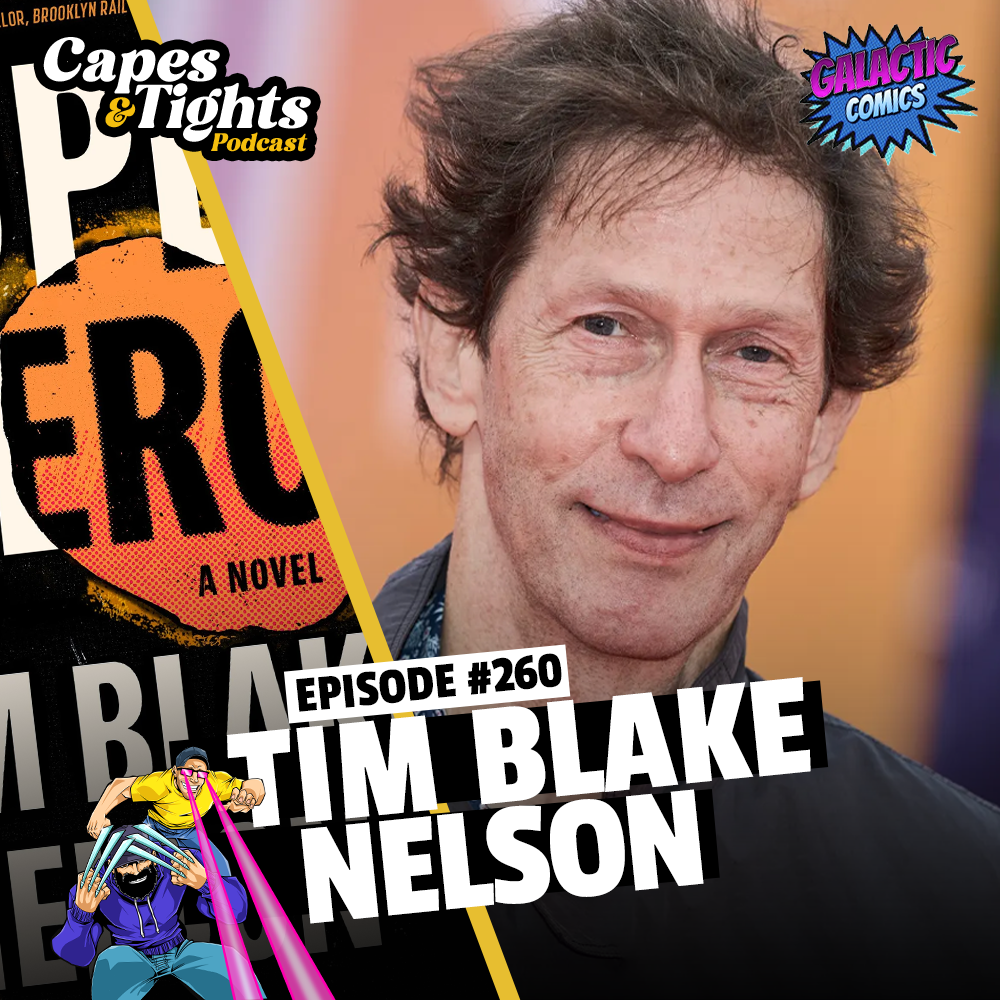
[00:00:00] Speaker A: Welcome back to the Capes and Tights podcast right here on Capesandtights.com I'm your host Justin Soderbergh. This episode is once again brought to you by our friends at Galactic Comics and Collectibles. At galactic comics and collectibles.com we welcome actor, writer, director, playwright, author Tim Blake Nelson to the program. He is known for his roles in films such as oh Brother, Where Art Thou? The Incredible Hulk, Captain Brave New World, the Fantastic Four, Watchmen and so much more. His latest novel, Superhero is what he's actually here to chat about though. A Hollywood Insider novel about the making of massive Marvel like franchise films and told through a kind of a satirical eye and so on and so forth. So this is a wonderful book. It's available now your bookstores but Tim Blake Nelson came on to chat with us. So check this episode out. Before you do though, find us on Facebook, Twitter, Instagram, bluesky, threads, all those places you can rate, review, subscribe over on Apple, Spotify or wherever you find your podcast. You can also find the video portion over on YouTube.com and as well as capes and tights.com has so much more so reviews, articles and all that stuff over there. So check that out. But this is Tim Blake Nelson talking Superhero, his latest novel. Enjoy everyone.
Welcome to the podcast, Tim. How are you today?
[00:01:18] Speaker B: I'm very well.
Week of Christmas.
[00:01:22] Speaker A: Yeah, exactly right. Thanks for taking the time to chat with us about superhero and stuff. You know it is a busy week for everybody but yeah, especially for someone you know as busy as you are. But thank you for coming on.
[00:01:32] Speaker B: It's my pleasure.
[00:01:34] Speaker A: Awesome. So over the years you've added slashes to your name. Actor, writer, director, producer, author.
Where did you get the idea to start writing?
When did it spark for you that became unavoidable to start writing?
[00:01:50] Speaker B: Well, I'd written screenplays and plays certainly I had always mused about writing a novel but I never had the guts to do it. And, and I, and I just also frankly didn't think I was ready. Novels are something I take very, very seriously. I've been reading fiction non stop since I was about nine years old and I don't think there's, it's, it's, it's an uninterrupted string of always reading a novel, sometimes some non fiction interspersed in there, but pretty much always a novel for the past, I'd say 50 years.
[00:02:39] Speaker A: So.
[00:02:42] Speaker B: I didn't want to write something desultory or inadequate that not only wasn't going to have any chance of getting published, but also, were it published, that would just be taking up space. I wanted to feel like I could write something that had a measure of quality to it. So something literary that also exposed the world in a way that maybe no other writer could. Not because I, because of my skill as a writer, but just because of the life I've gotten to lead inside of making movies. So my first two novels are about the film world, and this new one is about a very specific aspect of the film world, which is the making of superhero movies.
[00:03:42] Speaker A: And you write what you know. Right. In a sense that you have be acted in a couple of superhero movies. So it's one of those things that you're not like making this up. You actually have lived some of this. Obviously this book is more satire than that, but like, you know, you write what you know. And so is that what went into this? You had this experience and now this was translated over to writing a book about it?
[00:04:02] Speaker B: Yeah, that's part of it.
You certainly don't just write what you've experienced. Although I will say that it being a satire aside, there are, there are of course gradations of that.
And so can it be construed as a satire? Sure, but. But at the same time, there's nothing in this novel that I didn't either experience firsthand or hear tell of from somebody else who experienced it firsthand. And so it's satirical, but it's also resolutely true to the world that's being described.
And yes, you write what you know because by being specific and credible, you're the. The world that you're creating can quickly be felt as more of a universal.
[00:05:01] Speaker A: Yeah.
So for those people who think when they read the title superhero that it's actually a superhero book, what do you actually say that this is actually as a book. What would you describe this book to people when they think it's a superhero book? When it's really kind of adjacent to a superhero book?
[00:05:18] Speaker B: Well, it's a deep dive into the making of a superhero movie that hopefully is compelling and entertaining from page one till to the end.
But that while exploring the very specifics of that world, and it's a very high stakes world where a lot of money is being spent to create a product that is going to be projected in theaters all over the world, that it's using that to examine broader culture, cultural issues in America. Movie sets are little societies.
And so I think it's an apt metaphor for society at large with a lot of the issues that are plaguing us right now.
Everything from DEI to gender politics to AI.
Geopolitical relationships between America and other countries, the export of American culture.
All of this happens in the high stakes world of making a tent pole movie.
And because that's so true, ultimately exploring that world is to explore larger issues.
[00:06:43] Speaker A: Did you feel like it's important to say that, like, the story comes out now? Like, is it more important now when it was originally crafted, or is it about the same?
[00:06:50] Speaker B: I, I, I, I, this, this stuff happens in this novel that is utterly current.
[00:06:57] Speaker A: Yes.
[00:06:58] Speaker B: So, yeah, it could only have happened right now had I been writing it.
Had I completed it two years ago instead of starting to write it two years ago, it wouldn't be the same novel because it takes on issues that are really in the forefront right now.
There's one particular resolution of, of the main plot that is absolutely of concern right now.
[00:07:31] Speaker A: I mean, does that, does people like to escape sometimes in the books? I'm like one of those people who likes to do a little bit of both. Like, I like something that more like rooted in reality, plus also a little bit escapism.
Does it also backfire a little bit that it's also so relevant at this moment?
[00:07:49] Speaker B: I don't think it backfires.
Look, I, people who go to superhero movies, in spite of what certain people say who look down on superhero movies, and I am decidedly not one of those people.
But people who go to superhero movies are generally pretty smart and pretty caught up in current events, pretty knowledgeable about history, and they have often encyclopedic minds because you have to, to understand the, as an example, the MCU or just Batman. I mean, you have to it. It's not only useful to know a lot about the world of Bruce Wayne or the world of the Avengers.
It enriches your experience the more, you know, you want to be a maximalist with the mcu because then you can delight in how Kevin Feige and the writers and the filmmakers are making these standalone films that never nevertheless have conversations with all the other ones. And that's overt.
And, and there are Easter eggs planted everywhere and there are the teasers at the end of the movies and the, the delight in trying to figure out what they mean and what's coming. And all of that is delivered with the assumption that the audience is smart and keen.
And so my novel is for those people.
It's not a novel for people who don't want to do deep dives. It's not a novel for people who, who aren't smart. It's I mean, I'm trying to write for people who want to read books and see superhero movies.
And I think that's a, that's a smart audience.
[00:10:03] Speaker A: And it's, it's refreshing in a sense that it's not just a this is my experience in Hollywood kind of thing. It's, it's, it's refreshing that there is a fictionalization to the story as well, because I do think that that, that sits in better, at least for me, when I read something that there's not just like this point A, point B, point C of what happens in Hollywood, that there's this fictionalization of it that gives me more entertaining while I'm also learning a little bit about the behind the scenes. You know, you said like the society that is around the Hollywood set and so that, that too. Yeah. So it's. I'm a huge fan of obviously going to see, you know, I saw you on screen in 2008 for the first time, you know, like when you were Incredible Hulk. I saw that. Like that.
But I also want to read these things. So it is for someone like myself like that that you speak to that. It's perfect. Yes, I agree with you 100% on that.
You've acted in Marvel films, you've been on set and so on and so forth. So you obviously, like you mentioned a little bit, you write a little bit what, you know, you don't always have to do that, but you do have a background and we can trust the name Tim Blake Nelson when you see this, that you know what you're talking about in this. But you also created your own comic book universe, in a sense in this movie, this book, I mean, with Major Machina and Sparta Comics. Was that fun to do also, like, I know you're writing this book, like to create your own little, like, you know, universe in a sense in this.
[00:11:23] Speaker B: Yes, I loved coming up with the mythology of the comics in this book and what's called in the novel the Sparta Comic Galaxy.
And of course that's an allusion to the mcu, but it's both the MCU and not the mcu.
But it's, I hope, anyway, close enough to be obliquely recognizable by which I mean, I love the mcu. And this novel is by no means a screed against the mcu.
In fact, in most respects it's laudatory of the MCU and points out what an incredible accomplishment the MCU has been and dc because again, it's not just MCU and what an accomplishment that's been and how, how really actually good and entertaining some of the movies are.
So there's no gotcha agenda and there's no looking down on the MCU or superhero movies or DC in this novel. Yes, there are people very critical of it who speak persuasively in the novel and who think very persuasively in deriding themselves for participating in the MCU and have moments of, you know, have crises of conscience and, and, but that's true. That's what people do when they're on these sets. But then there are other people on these sets who say, are you kidding me? This is extraordinary what we're getting to do. We're making these movies that are having worldwide impact and creating a kind of modern mythology. We're the luckiest people in the world and we've got to be responsible to that privilege. And so, you know, it's that notion of opposing ideas being juggled at once.
And the novel is very interested in that because that's the dialectical reality right now when we go to think about what movies are in movie theaters, which again then we start to think about. Well, since movies are such a dominant force in the culture, when you start to think about that, you're thinking about larger cultural issues.
And that's what the, the novel is about more than being critical of the, of superhero movies, which the novel resolutely is not.
[00:14:19] Speaker A: Yeah.
[00:14:20] Speaker B: And I think that's why, hopefully, anyway, it's a very entertaining read because you, you do get a.
A detailed, nuanced, and I would hope, compelling look at everything that goes into making these movies, including the marketing, the publicity, the production itself, the interactions between the director and the producers and the actors on set, the director of photography, some of the people who drive the actors. I mean, it's a full look at the, at the world in the best way that I know how to depict it.
[00:15:06] Speaker A: And it's like you wouldn't have been able to tell the story until now.
30 something MCU movies later and multiple DC movies. Like in 2008 when you were in the Incredible Hulk, like, you couldn't, you couldn't have told it then because there was basically only a few movies. There wasn't this side. It's like culture.
[00:15:21] Speaker B: Yeah. Was number two. Yeah. After Iron Man.
[00:15:25] Speaker A: Yeah. So it's like it's, you need this, like this, this past 20 years to have happened, you know, 18 years, whatever it is, 17 years to be able to write this story in the first place. So it is like you, you, you Are. Are telling a story, but we also have to give it credit because, like, your story wouldn't exist if it wasn't for that either. Right? I mean, yeah.
[00:15:42] Speaker B: And I'm lucky enough to have been in three Marvel movies somehow with playing two different characters.
But, and, and, and so that was my own experience as well. And, and that's another, you know, I, I feel privileged to have been allowed into that world and anointed as. As, you know, to play my small part in it. No, I'm not one of the. The leads in, in any Marvel movie, but being a villain was an honor and an absolute privilege to have been asked initially to play Samuel Stearns and then to be brought back by Kevin and Nate Moore.
I'm so blessed by that.
[00:16:45] Speaker A: I thought about that when I was talking to my friend this morning about how you were in the 2008 Incredible Hulk and were in Fantastic Four in 2015. Did you think that in 2008 you were done playing that character in 2008? Like, you were just like, okay, this is it. I did my thing and we're moving on, or you think there'll be this many years later?
[00:17:04] Speaker B: I'd say by about 2011, I had given up on it just because I knew they weren't going to do another Hulk standalone movie for various reasons.
And so I thought, well, I'm tied to that.
And were they to do a standalone Hulk movie with Mark Ruffalo? Yeah, I can't imagine them bringing me back for that.
And I would read stuff occasionally online saying, you should bring the Leader into the mcu.
He's a great character in the comics. And it was set up with Tim playing Samuel Stearns. But even that just felt like it never had the kind of groundswell magnitude that was going to persuade Kevin to go to the writers and say, let's bring Tim back. And I don't know why it happened or how, but eventually they did. And certainly when I was asked to.
[00:18:13] Speaker A: Do.
[00:18:17] Speaker B: The character in Fantastic Four that was set up maybe to where I would be become Mole Man.
[00:18:26] Speaker A: Yeah.
[00:18:27] Speaker B: And so I thought, well, then I'll be Mole Man. I guess that's what's going to happen.
But then that movie really didn't work in a way that merited a. A sequel in the. In the eyes of Marvel. And so then I thought, well, I guess I have the reverse Midas touch. Every time I'm set up to play a villain, it's a. It's a one and done.
[00:18:51] Speaker A: Yeah.
[00:18:52] Speaker B: And then lo and behold, they said, come back in into the Captain America.
[00:19:00] Speaker A: Yeah.
[00:19:01] Speaker B: Storyline as, as the Leader. And I, I felt extremely blessed.
[00:19:08] Speaker A: You, you have acted in MCU movies. You've acted in comic book things to you or the Watchmen as well. But like, are you a lifelong comic book fan or is this something you get into later in life? Or did you read. Okay, did you have to read about these roles prior to actually doing them, or were you already aware of some of them?
[00:19:25] Speaker B: I was aware of some of them because I'm not a complete illiterate when.
[00:19:28] Speaker A: It comes to comics.
[00:19:29] Speaker B: So I knew about Hulk and I, I was familiar with the notion of, with the character of the leader, and I, you know, new basics like the Joker and, and, and I also, before I was asked to do Watchmen, I was somewhat familiar with Watchmen, and that's because I've raised three boys and they all love comic books and graphic novels.
And so I went to see Iron man when. With my son, my oldest son, when he was 10.
And that was an absolute.
That was a delight. And I, I, it was in a full theater on 86th and Broadway.
And I, I knew it right then, as did everybody else in the audience, that, that Kevin and his team had come up with something that was gonna just explode and that the appetite for those movies would be insatiable if, if they could keep doing what Favreau and the writers and Robert Downey Jr. Playing Iron man and, And Gwyneth Paltrow.
If they could keep doing that, it was. The world would just be you. You wouldn't be able to get enough of them.
And then it exceeded even those expectations. They just really.
With the teaser on that movie with, with Sam Jackson as Nick Fury saying, I'm gonna put together a team.
That team didn't come together for, I.
[00:21:21] Speaker A: Don'T know, another, like, yeah, yeah, yeah, something like that.
[00:21:25] Speaker B: Yeah.
I mean, that's, that's remarkable.
[00:21:30] Speaker A: It's, it's, it's crazy. I mean, to me, the first, you know, two movie, three movies, those ones are the experience that my dad would have said about Star wars. And so like, to like that experience that I got going to the theater.
Just like, I don't know, it was like this. I'm always gonna remember. I know what seat I was sitting in. I knew where I was. And it's crazy to do that.
But, like, it's just what it'.
Years later, I can't wait. My son's 4 and we went and saw Zootopia 2 together, was his first movie ever. And I was like, that was an experience. I'll never forget, but I just can't wait till my passion, you know, comics or something like that is what I get to actually go see in the theater and see an actual like MCU movie or DCU movie in theater. It's going to be so much fun. That experience you mentioned about you taking your 10 year old son to see, see Iron Man. I can't wait for that. Like, I'm just like, can't wait for. He like didn't in Zootopia, he's like, daddy, can we go home? Because he was just like, I usually get to be able to stand up in the middle of a movie and walk away. Now I have to sit here and watch the whole thing. I don't know. I don't know about this, dad. And so it was just fun to take that experience and bring him to the theaters and, and that's why I'm hoping theaters still exist, like praying that they'll still exist.
But yeah, I mean, you take these experiences that you've been on set, you know, doing these things. Did you approach this as an actor, this book superhero, or did you approach it as a novelist? Like, did you start from scratch being like, okay, if I wasn't acting in these movies, this is how I approach this book? Or do you have to. Is it already bleed in? Does your acting and you're writing a screenplay is bleed into something like writing.
[00:22:55] Speaker B: A novel, it bleeds in and I welcome that because the different storytelling pursuits nourish all the others.
So in writing a novel I feel like it makes me a better actor and a better screenwriter and a better playwright and acting makes me a better novelist and screenwriter and playwright and directing movies makes me a better novelist and actor. And on and on. They, there's a they, they. There's a synergy between all of them that I not only welcome, but I've grown to depend on it.
And so there's a lot of. I like dialogue and I push the dialogue in my novels. I like long conversations and I like the fact that in a novel you can really let a character rip it in terms of giving a speech and making an argument. And you can really be fierce with the arguments between people and you can make them a little more articulate than they are in real life. Because people reading a novel, not only they don't just tolerate it, they want it.
You know, you.
Art is not just a recreation of reality, it's a distillation of reality.
And, and I completely embrace that within each artistic form. And so in a novel it's words.
So I celebrate the use of the word both in descriptions of what's going on, but also in the way that characters interact with one another.
And so dialogue is really an exciting component of that for me. And I like just setting characters against one another and having them go at it sometimes, you know, just rolling for several pages without any description or interruption in between.
I think that's fun. And I love it when novels do that. It's one of the things I adore about Dostoevsky is that so much of his novels take place inside of conversations.
So, yeah, I lean on being an actor and sort of finding a voice of a character and.
And imbuing a character with that on the page.
[00:25:41] Speaker A: I am huge. I love when you open a book and it's more conversational than other books because I always get giddy when you see the quotation marks. I'm always like, well, I really get to be part of this guy's person's conversation. This is amazing. I feel like I'm there.
So I appreciate that. That as well.
It's. I saw your name on the book. So, like, I. I'm on NetGalley. We get NetGalley reviews, so we get advanced copies. And I saw your name on the. And that's what drove me to it. Like, I will be. I'll be honest on that.
I'm a fan of your.
Your acting. I'm a fan of you. I'm obviously majorly, majorly into comics here on the podcast. And so comics are a huge thing. And so knowing your characters and following you and oh, brother, Ra, that was a fantastic movie. So, like, all of that, saw your name and I go, oh, my gosh, I didn't know this person was a novelist. And then I found City of Blows, and so on and so forth. And so not only is it, you know, awesome to talk about to you about your book and your acting in Marvel movies, but really, I'm just now a fan of that. You're multifaceted in this, too, and that you're good at it. And that's the thing. Do you ever find yourself having to not defend yourself, but defend yourself as a novelist, too? I talked to actor and comic book writer Hannah Rosemay about her crossover from acting to the world of writing comics and how she feels like sometimes she has to defend herself as a comic book fan to people like, hey, I'm a comic book fan. I'm not just an actor trying to get into comics. Like, this is my passion too. You're obviously a Fan of books and novels. You wouldn't write a book if you weren't a fan of them, I don't think. Do you ever find yourself having to defend the fact that you're a novelist as well as an actor and a writer and all that stuff, or do you just feel like it's just part of your life?
[00:27:24] Speaker B: I guess I anticipated that more than it has been a reality, so.
And the ways in which it's. It's a reality have.
How is that manifested? I guess, certain, you know, the New York Times hasn't reviewed one of my books. That's a bit frustrating for me. And I have to imagine that the reason for that is they say he's an actor.
We're, we're really interested not in actors slumming it in literature or pretending like they're writers, but we want to honor those who devote their lives to, to fiction. And, and to that. I respond, all right, fair enough. But it's a bit frustrating because this is what I'd like to consider.
It certainly its ambition is to be literary fiction.
And I.
People are buying the book, it's doing well. And, and so I would, I would want for it to get some measure of attention in literary circles. And so maybe that could be a bit better. Although the Los Angeles Times has taken the book very seriously and I'm really grateful for that. I did an article with a wonderful writer there and she, you know, they really took it seriously and that meant a lot to me.
I'm getting to do your podcast, so I guess I would say that I anticipated that kind of attitude, but for the most part, other than around the literary edges of things, it hasn't really plagued me.
[00:29:18] Speaker A: That's good.
[00:29:18] Speaker B: Now, I imagine there are some people who are at the bookstore and they see my name on a novel. If they, if they know who I am, they might say I'm not reading that. He's. I'm. I'm going to read something by Michael Chabin.
[00:29:34] Speaker A: Yeah.
[00:29:35] Speaker B: Franzen or Nicole Krause or Jonathan Saffron Foer or, you know, whomever.
Somebody who is a full time novelist.
And I can't fault people for that. But what I will say is I take novel writing really seriously.
This was a rigorously pursued endeavor for me. It took me a long time to feel like I was ready to write books.
And I've been careful in the execution. And what this is, is, you know, I think more than just an attempt at writing a novel by a schmuck who acts.
[00:30:29] Speaker A: Yeah, I, I think it is and that's not just because you're here. I mean, I wouldn't have worked on scheduling this if I didn't, you know, like the book because it's very awkward conversation with people if you don't like the book to have a conversation with them. But it's, it reads like someone who's passionate about writing a story.
What, what does it matter really, in my opinion, whether this was a comic book or a film or a documentary or anything like that, like, or a novel. It reads like it's supposed to read. And I almost, I don't want to say I respect you more, but I almost respect you just as much because you're doing other things. You're acting, you're doing, you're writing, you're doing, you're writing a novel. Like a lot of these people who are novelists or authors who are.
[00:31:08] Speaker B: Right.
[00:31:08] Speaker A: That's all they're doing is writing a book. And so it's.
[00:31:10] Speaker B: A lot of them are professors too.
[00:31:12] Speaker A: Yeah. That's you. Yes, you're right. You're right. You're right about that.
[00:31:14] Speaker B: There are days you can't really.
No.
[00:31:17] Speaker A: Unless you drop to us. Yeah.
[00:31:20] Speaker B: You can't make a living just writing novels unless one of a handful of writers, a lot of them teach and that's full time pursuit.
[00:31:29] Speaker A: Yes, you are right about that. I, I will say that. Yeah. But it's just like I said, it's. To me, it's like you had a story to tell. I feel like the novel, you know, Avenue is the best place to do this. And you did it with a passion and you did it right, in my opinion. So that's why I feel like it read so well and I liked it so well was because of that. And again, to me, I am the kind of person who, I'm a fan of them doing one thing, so I want to see what they do in the other. So Cannon, Rosemary is one of those. She's. She's a great actor, but also like, she's phenomenal comic book writer. So I'm like passionate about that. Like, that's great. I want you to do more things. I want to be more. It's to me, the mcu, they continue making movies. Continue making movies. I don't care if they're good, bad or ugly. I'll still watch them because I'm just so lucky that we have them. Like, I lived in a world prior to 2008 where there wasn't as many around. So like now we have more of them.
[00:32:13] Speaker B: Cool.
[00:32:14] Speaker A: If you like them or don't like them, I'm still gonna go see them in the theaters because I want that experience. I want that thing that's there now, you know, and I. And I believe in it. So to me, it's like, the more that you have out there, I'm gonna read because I enjoy your stuff. And so superhero is that, you know, it came out recently, so it's only a couple weeks old now, and so people are now getting it. So now you're not just getting advanced reviews, you're actually getting people who were buying. Going to the store and buying this, which is really cool, which is, you know, a good experience.
How has this been, like, has it been a fun experience over the past few weeks? I mean, this is your second full novel. Am I right about that? Yes.
[00:32:48] Speaker B: Yeah.
[00:32:49] Speaker A: And so you've done this before, but, like, what is, like, your sophomore novel? Has it been fun? Like, has it been seeing people post pictures or things like that?
[00:32:56] Speaker B: It feels like I've built on.
You know, more people are buying this one than bought the last one.
And I. I think that's going to be good news because the last one went into paperback, which was a. A surprise and a big victory for it.
And so I'm hoping this will. Will do the same.
And it feels like there's a lot of interest in it, and there hasn't certainly been a negative review of it.
There was one. One guy or woman, I don't know who, on just a reader on Amazon who said something like, there's too much dialogue.
And I thought, well, there is a lot of dialogue.
But every other review, either professional or from readers, has been incredibly laudatory, and I'm grateful for that. Not everybody's gonna like everything, but.
But so far, it's. It's been remarkably positive for this one, and I'm very grateful for that. Although what I really care about is that just people will. Will read the book.
[00:34:11] Speaker A: Yes. Yes.
[00:34:12] Speaker B: Whether critics like it or not, that's really what you want, is you want a wide readership and for people to take an interest because, you know, you spend a lot of time on it, and so you want people to read what you have to say. It's kind of pretty simple.
And I.
[00:34:30] Speaker A: You worked hard on it.
[00:34:33] Speaker B: Yeah.
Wrote a novel that's meant to entertain.
[00:34:36] Speaker A: Yeah. Yeah. And as you worked hard on it, you want people to read it. I mean, obviously, you can't. You can't. Like you mentioned, it's hard to make a living on just one thing. You know, it's Nice to be able to sell them. But go to your library and rent it or, you know, take it out because just read the book. Like, get, get, get the book, adjust the book, enjoy it. You know, there's Christmas vacations right here. Like people can read it. Like, just go, go to your local library and pick it up. You're also getting an audiobook in, in early 2026 I saw too, which is pretty cool for listeners. The superhero will be on audiobook, which is also another avenue for people to read it. But, but if readers finish the book and they feel one thing about Hollywood or the superhero culture, what would, what would you want that to be? When they finish this book, what would you want them to feel after this is over?
[00:35:22] Speaker B: What do I want them to feel?
A love for movies and how they're.
[00:35:36] Speaker A: Made.
[00:35:39] Speaker B: With an attendant degree of concern, care and sensitivity and maybe even worry for where we're headed because the, the film lavishes attention and even a degree of romance on the making of movies while at the same time being very real and critical about that process in terms of the venality, the gossip, the ridiculousness that goes into the making of movies, but does so in a way that says watch out if this is where we are and this is where we're headed.
So it's deep dive into the process of making movies is meant to be very entertaining, but also deep and deeply critical and observant of the, the stuff we're facing in America and in the world right now and how big that's all about to get. And I think that's all present on movie sets.
[00:37:19] Speaker A: Well said. I believe. I agree 100% with you. I think everybody should pick up superhero from unnamed press. You get to available at bookstores everywhere.
And if you don't have a local comic book or local bookshop to get it, bookshop.org is a great spot to get it because it helps local bookstores. So like, if you have a local bookstore in the area, you can say, hey, I want to support this one. You buy it on there and they get a portion of the sales, which is really cool. And when it does his audiobook, you can also get it, I believe on Libro fm, which is also the same kind of format. It helps local bookstores, which is great. But like I said, rent it, get it at your library if you, if you don't have the funds to go purchase it because I think that library is a great place to get things as well.
Tim, thank you so much. Taking time out of your busy schedule to come on here and chat, superhero. And so much more. We really appreciated it. And again, we love the book. I love the book. I read it so fast. It was. It was a lot of fun.
And I'll read anything else you put out there, so keep doing it. Does it sound good?
[00:38:13] Speaker B: That sounds great. And I'm really, I. I'm really grateful that you had me on your show. It was a real pleasure talking to you.
[00:38:20] Speaker A: Thank you so much, Tim. And Happy New Year, happy holidays, all that stuff. And I'm hoping 2026 is great for you. And we'll get you back on in the future if you're up for it. We'll get in touch later on. But appreciate you taking the time. We really do.
[00:38:32] Speaker B: You bet. Take care, Justin. Thank you, Wall.