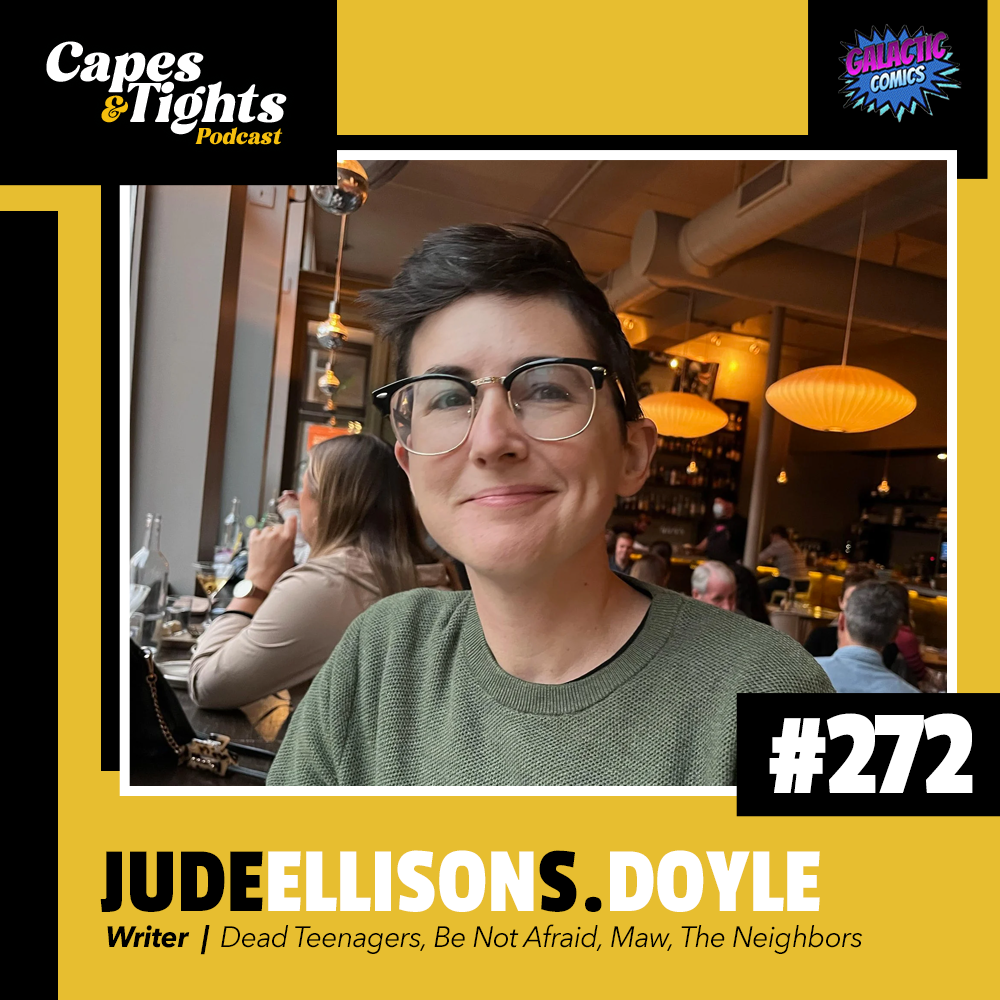
[00:00:00] Speaker A: Welcome back to the Capes and Tights podcast right here on Capesandtights.com I'm your host, Justin Soderbergh. This episode is once again brought to you by our friends over at Galactic Comics and
[email protected] now at 499 Hammond street in Bangor, Maine. But as always on the website, so check that out. We welcome back Jude Ellison S. Doyle, who is an author, journalist and comic book writer known for their work on Boom Studio series such as Ma the Neighbors, Be Not Afraid, and his latest comic book series, Super Excuse Me, Dead Teenagers, which hits local comic book shops on March 18, 2026 from Oney Priss. She was here to discuss Dead Teenagers, a little bit about Be Not Afraid and so much more right here on this episode of the podcast. But before you listen, follow us on Facebook, Instagram, Twitter, bluesky, Threads and all those places you can rate, review, subscribe over on Apple, Spotify or wherever you find your podcasts. And the video portion's available over on YouTube.com as well as capesandtice.com but also visit capesandtice.com for so much more. This is comic book writer, journalist and book writer and author Jude Ellison S. Doyle chatting Dead Teenagers right here on the Capes and Tights podcast. Enjoy.
Welcome back. Belated welcome back to the podcast. Jude, how are you today?
[00:01:15] Speaker B: I am doing really well. Thanks so much for having me. It's great to be here.
[00:01:19] Speaker A: Yes. I said, I guess before we started recording, I said three years. I think that's crazy. There's certain people who are like, you know, chomping at the bit or have so much going on or so many comics that they're like emailing me, like, can I get on again? I need to promote my comic. But I'm like, dude, you were on three weeks ago. Like, like, let's, let's space it out a little bit. And I've learned three years is too long.
Yeah, exactly. Three years is too long. However, I have learned from other podcasts where they make a not a, you know, hard, fast rule, but like a quasi rule of once a year. And I was like, I could see that, like, you know, months every nine months, maybe 10, 12 months, you know, 13 months. But, but three years is too long. So. Welcome back.
I'm glad, I'm glad you were here.
We talked last time about the Neighbors, which was, was a, was a hit for me. And then in between time, you have had Be Not Afraid, which just finished up the sixth issue released on February 25th. And I was lucky enough to read the entire trade a couple weeks ago, and I loved it. It was fantastic. It was dark. It was you.
It fits your style of writing and storytelling, which was excellent. But you have another comic book coming up here pretty soon called Dead Teenagers, which I've always said in my local comic book shop, if titles aren't the way you order something, like covers, maybe you know how you look at solicitations. But I'm like, if you don't order Dead Teenagers based just on the title, I forget who's writing it, who's illustrating it. Forgetting. That's like, it's the same thing with Fred Kennedy. Had a comic book came out recently called the Florida Hippopotamus Cocaine Massacre.
[00:02:57] Speaker B: Yeah.
[00:02:58] Speaker A: And I was like, I don't understand how you don't order that.
[00:03:01] Speaker B: That's. That is. It says what it's going to be.
And you know that you need to be part of that. You need to be part of its becoming.
[00:03:09] Speaker A: Yes, exactly. I mean, there's other comic books, like right now, a hit comic book are a very, you know, reselling comic book. White sky over at Image is like this comic book that came out, and, like, the second day it came out, it's like a $50 comic book on ebay or whatever. It's crazy. But White sky isn't very like, I've got to order that comic book. Dead Teenagers, I feel like, fits that category. Do you agree?
[00:03:27] Speaker B: I would say, yeah. It's very upfront and very callous in its titling, and hopefully it like.
I mean, I named it that because Slashers, Roger Ebert called them dead teenager movies because that's what happens is just like, teenagers get fed into the wood chipper. And I kind of wanted to actually pull back the focus to the titular Dead Teenagers. I always get so obsessed with, like, random little side characters and slashers.
Like, not even like, let's talk about maybe the defining cinematic achievement of its day, I Still Know what yout Did Last Summer, where there's just like. I mean, Brandy is there and Jennifer Love Hewitt is there, and they're very admirable. But there's also Jack Black in, like, his friend, Worst Motion Picture Performance, doing a fake Jamaican accent as a weed dealer. And it's. I mean, I think, you know, he probably wishes it were erased from reality. But I want to know more about that, man. I want his prequel.
[00:04:30] Speaker A: I want that story. Well, it was actually an origin story. Just talking to my. My. My brother in law about how there's so many first appearances or just like cameos in X Files. Like, I'm rewatching the X Files over again. They're like, I want to do an article on the, on the website about like the. The number of people who have been like, famous people who have been on the X Files before they were famous. I mean, I was just watching one with Shia LaBeouf in it. Who's this? A kid who has cancer and he's like in a bed. And that's him. And then there's like Ryan Reynolds is in the beginning of one for like three minutes. This is like high school teenager. And it's just like the number of people who have been like, just in these things. And Jack Black's actually been in an episode of X Fil.
[00:05:12] Speaker B: Black and Giovanni Ribisi, the Lightning Kid episode. Yeah, Cinema.
[00:05:18] Speaker A: You know, like, and now he's a multi millionaire playing like, you know, super Mario characters on TV and so on. But. But yeah, yeah, decided this character. But they say, yeah, dead teenagers, that connects. That works. That makes sense.
Just to get us started, what. What is dead teenagers to people like, this specific story? I obviously, without spoiling anything.
[00:05:38] Speaker B: Yeah, I know it's hard because this is the first thing I've written where you could really, like, spoil it.
But it's a story about five teenagers who have been going to prom night in 1997 for about 30 years.
And they die every single time they go to prom night.
And it's always something new. It's always some new horrific monster. Which is great because I get to just like throw in any monster I want at any time, which is amazing. But it's also a story about how they are trying to figure out how they get caught in this loop. And at a certain point, something they do breaks the loop a little bit. It starts to work differently as they get closer to the secret.
[00:06:28] Speaker A: Perfectly explaining for. At least for the first issue. For me, I think it's, it's. It's funny because I've read all of your stuff, your comic book stuff, and it's like this is slightly different in a sense. Like, it has a. As a Jude tone to it. But like, it's still. This is more like, I don't know, the other ones are dark. This is dark, but in a different way. And also, like, time loop stories aren't like, you're not like, you know, making this, you know, from scratch. Like, obviously time loop stories are a dime a dozen, except for you're making it your own. And I think that's One of the things I put together on my notes when I haven't actually physically written my review yet, but it's a positive review. It's coming out and soon. So there you go.
[00:07:04] Speaker B: Oh, thank you.
[00:07:05] Speaker A: A little preview on that. But, like, it's not. Like I said. If you think about, like, oh, Jude's, like, this time loop thing. Oh, my gosh, Jude's created this thing that's, like. It's not that. It's. It's. It's. Time loops are a thing. It's been in stuff. You know, we've watched Groundhog Day a number of times. You've seen this thing. However, you're able to make it your own in this story, which is really cool. And I think that you also did this thing where, like, I feel like, time loop people, the stories are being told and they're figuring out, oh, my gosh, we're in a time loop. They've already figured this out. Like, this has been going on. And you started off with a thing where you're like, you're not. You're not telling the origin story of Spider man over again in a movie. You're like, okay, it's. It's the new iteration of Spider man where they're just like, he has powers. He's had these things. Here's a little taste of how it happened. But, like, we're in this because we don't need to hear it again. And that's what I appreciated when I got in that first issue. I was, like, waiting for them to be, like, you know, doing their normal life, and then all of a sudden, nowhere. They fight. Oh, my gosh, what's going on? We're living the same day over again. No, they're already in this thing. Like, this is happening. This has been happening. And that was refreshing to me because I was like, I just want to get into the meat of this. I just want to get into, like, what's going on here? Was that on purpose? Is that, like, a design you wanted to do?
[00:08:14] Speaker B: I wanted you to feel like you had been in it for a long time.
Because, like, I think the first scene is, like, Alicia, who's, like, the lead final girl, is like. All the other teenagers are having very dramatic reactions, and she's just like, I got to take my shoes off. I'm going to be running. I'm just like. I wanted. I think the first time you see all your friends die in horrible ways at prom night is probably really traumatic. But by the 11,000th one, you're just like, all right. You know, like, I wanted you to be in a place of like, the same level of acceptance that they were in, because that way I could, like, move around and make it very interesting and for once, not make it entirely about trauma. Like, it's a very bright, fun book because horror has room for that, frankly. You know, like, there are bright, fun, campy horror movies by the dozen, you know, and I felt like that might be something we need right now. I feel like after doing Be Not Afraid, which was literally just like the most depressing story I could think of, every time I thought, you know, of something worse I could do to these characters, I was like, yes, let's do that. Amp it up, let's make it worse.
[00:09:21] Speaker A: It's refreshing because I did read that comic and I was like, holy crap, this is like dark and deep and depressing. And then you read this and I wrote. I know. There is this playfulness that is also horrifying at the same time. It's like, what have I wrote my notes, I wrote when I was reading it and it was like, it is this. This is like this. Hey, this is kind of funny. But at the same time it's horrifying because you get to see your person like 11,000 plus times of seeing you or your friends die. Yeah, that's like, that's still horrifying every time. I'm sure you lose. And they do, in a sense, lose their okay, here it comes again kind of thing. Oh, it's a monster this time. Or we've never had. But that's the thing is, like, they get to the point where, like, wait, this has never happened again? And that, that's the stuff. I will say that if you did say, oh my gosh, they found out they're in a time loop and they had these would have been longer. Like, it would have been not as good at first issue because it would have just been like an explanation of them in a time loop, whereas you get the story, the ball rolling. I'm not going to point out the comic that it is, but I just read a comic book recently where I'm like, they laid the foundation.
But then by the end of the first issue, you're like, nothing happened. It was like, like there was like, no point. It should have been a double issue. It should have been, you know, a 48 page issue, because the, the first 24 pages is literally just telling you what's gonna happen potentially. And it kind of like gave you little nuggets of like, what's going to happen. But then it's like at the end of the issue, you're like, dude, if this was like, if I didn't like, like the creator team or the. This would have been like, I don't know if I want to read this, because is anything actually happened in this comic book? And that's not what we got out of this. This is like, okay, we're in a time loop. It's horrifying. It's also playful. And we get. By the end of the first issue, you're like, I really want to read the next issue. And that was done well. And I appreciate that.
[00:10:59] Speaker B: Yeah, I mean, I think that it's. It's very fun for me as a writer to do this because once you get that we're in a loop and the same thing is happening over and over again, you get to be like kind of a bad writer. You don't have to explain how you get to a certain point. You just get to like, come in for a page or come in for a panel and be like, look, time traveling Nazis have taken over the gym. I don't know why, but they did.
And now that's. That's what's happening. You know, at some point in issue one, there's just. And this happens a few times through the series, having written it all, there's just like a page where it's just like, panel, panel, panel, panel. Yes, exactly.
[00:11:38] Speaker A: You have to just figure it out on your own.
[00:11:39] Speaker B: Yeah. And I think that's, you know, it's fun. It's sort of like, it's. It's aimed for that short attention span thing almost, which is kind of funny.
[00:11:52] Speaker A: I just read an article.
I'll lie. I read the title of an article because I just can't read everything, but it was saying that there was something about how, like, these short attention span things are almost as bad for you as alcohol.
Did you see this thing where like the stories, like, like image, like stories on Instagram or whatever is like that quick, like, dope, mean thing about just going through it is almost as like, bad as just drinking like a bottle of liquor. It was like this weird thing and I was like, wow, it's actually. And it's probably true, but that's how we all live right now. Like, I had a stomach about two or three weeks ago. I actually had. I haven't had a stomach bug in 20 years, dude. Like, it's crazy. And then I had two in 20, 26. So far it's been. I mean, I have a five year old and a two year old. So that's probably the, the reason. But I had. So I was doing this and I was like, oh, watch. So I was watching X Files. I'm like, I'll watch some X Files in bed while I'm like, you know, recovering. And I had to, I was just on my phone because it was like I couldn't keep attention to the X Files. But I also like, it was like almost making me more sick.
But like quick 5 second, 10 second, 30 second videos on Instagram was, was doing it for me. And I passed the time with that. I think my algorithm changed completely on Instagram because of that day. Because like it was like cat videos or whatever it may be. And now I'm like seeing all these things. But you need that. And I think that, that you do accomplish that in this where it's like you get these short like spurts. And if you had done like a 12 issue maxi series and like each, each issue was a longer, drawn out version of this time loop, it might just get repetitive in stale in a sense. Like, whereas these small little snippets of it made it be like, you got to be able to throw.
You didn't throw people.
Drew doesn't have a thousand things in here, like 11, 000 things in there. There's some skipping. It goes from like 500 to like 11 000. Like it's not like we have 11, 000 panels on this thing. He did a pretty good job at making it. So it was skipped for a little bit. But like this is, you have that and that's what's cool about it. Like you get a lot out of this first issue without having to put a lot into the first issue, if that makes any sense.
[00:13:49] Speaker B: Yeah, and I think that, you know, it is. Hopefully sooner or later we get to the point where it's a fairly character centered work and a character driven work, you know, which I've, I've always tried to do that. But in order to have time sitting with the characters and watching them grow as people, you have to like do something to make people realize that this is a comic and you're not just like drawing heads, talking to each other for a full issue. So it's really, it was a useful way to do character centered storytelling because every time it started to drag, we could just be like, also this, you know.
[00:14:28] Speaker A: Oh, you see, I mean, I mentioned Groundhog's Day. Like that's a very famous time loop story for people to get onto. It's not a horror story. I mean, it's horrifying in a sense. Living the same day over and over again is pretty horrifying in general.
Yes, it does. But this. This thing where he needed to change a couple of things. It seems like they keep trying to change a couple of things or try something new or see something new, and it's like, it almost get exhausting. It is exhausting. I would guarantee you it's exhausting to. To not know what to do to get out of this time loop and to try small things as much as you can do. It's not like you can be like, let's fly to Japan. Because, like, yeah, it doesn't let, like, it lasts that long. It's prom night, and so on and so forth. But, yeah, so you have that, and you put us into that spot where it's like they are trying things and it finally breaks. And I'm not. That's a spoiler, but that's how the story goes.
It finally breaks a little away. But you can figure out how they do that. Or maybe not in the book, but.
Yeah, it's like. It's like I said, I feel like I was in it. I felt like I've been living this, like you said, for a long time, and that they actually tried the things to get out of this loop, and it just never worked. It just. And something happened. The cool thing is, is that something different happened every time, which is unlike other time. That's why I said you made it your own, like, time loop. Things basically have been like, I just watched the X Files episode about that, where he has that time loop and the. The water blood breaks and, you know, the phone call and all that stuff. Like there is there on prom night, but different things happen, which is.
[00:15:57] Speaker B: Yeah.
[00:15:58] Speaker A: Draws you in, if I should say that. Yeah.
[00:16:01] Speaker B: Yeah. And I think that it's. Yeah. You want to mess around with the structure and make sure that people don't always know what's coming next. But I think the sort of paralysis you get in the first issue where they are like, they're naming them variables and they're trying to write down, like, well, does anything change if I do this? Does anything change if JT actually wears prom clothes? Does anything change if, you know, blah, blah, blah, blah.
And I think that's kind of adolescence, is that you're stuck in the same scenario, and it kind of feels like you have no control over your life and none of the decisions you make actually make a difference.
And getting to the point where your actions have consequences is kind of what adulthood is. And they're, they're slowly slow. Not as well, about as slowly as me. Getting from adolescents to the point where they're actually like functionally in charge of their own lives in the world around them.
[00:16:58] Speaker A: And I know you did teenagers because you mentioned that, that idea that like teenager slashers and so on and so forth, that teenagers. But it does give it a spot where it's like they aren't all knowing or they. Well, yes, they think, because all of us as teenagers thought we knew everything, but like, at least that they didn't know everything. It's not like you can be like, I've lived 60 years, so I kind of have some history of what to do in this situation. Like, they're all still learning how to be people. And at the same time, everything happening. I did want to mention, like, they've tried different things. And I said, I don't want to spoil much, but they do get drunk at one point to say, like, maybe that changes things. And like so and so forth. All I could think of in that section was like, they don't have to worry about a hangover.
You can get as drunk as you want because you're just dying tonight and you're going to wake up tomorrow morning, like just another day.
[00:17:39] Speaker B: I think that actually starts to play a role in the plot at some point.
[00:17:45] Speaker A: Like, that's why I don't drink as much anymore. It's literally the only reason, like I, I, as a 40 year old person, I'm like, you wake it up the next day after having like a couple of drinks. You're like, this is awful. I don't want to do this anymore. So I could just be like, if it's just started over tomorrow, like this morning started over, I'd be, I'd drink a little bit more. Which is, yeah, probably a good thing that it doesn't do that way. But no, I was just thinking to myself, I thought like, literally as a 40 year old, I'm like, that they're not gonna be hungover tomorrow. That's what I thought. I was like, that's not the full point, but like, that's what I thought.
[00:18:13] Speaker B: There's a character in there, Brandy, who's just like, I think like, just as an ongoing gag where she's on every substance imaginable.
[00:18:23] Speaker A: If you thought about it like 11,000 times, being in a time loop, you would try things not just to get out of the time loop, but try things to be like, hey, if it's gonna reset tomorrow, I might as well do coyote. Like if they're trying tomorrow, I might as well steal something.
Yeah, I might as well steal something. I might as well murder someone. I might as well do something that steal stupid and crazy and, you know, whatever. And if you're just gonna have. The problem is I would do that crazy thing and the time loop would break and I'd be like, oh, crap now. Now I've murdered this person and I've
[00:18:52] Speaker B: stolen something on the way out and
[00:18:54] Speaker A: I now have to live in prison for the rest of life. All my friends are out doing whatever.
[00:18:57] Speaker B: No, but I thought mistress.
[00:18:58] Speaker A: But that made it. That's the fun part about it. Like, it's like you mentioned the horror and I have mentioned this before. It was like comedy alone is hard to write and hard to get people to buy. And that's because, I mean, you're in a business of writing creative things, but also you to do what you want to do. People have to buy this comic book, right? Like you have to sell the comic book. It's not just as simple as making it and putting it out there. If you were a multi billionaire, you just wanted to create comics or whatever, then you could do whatever. But like, you have to make a limit. Is it comedy? And I've talked about this with Kyle Starks before about. Because Kyle is very good at like horror and comedy. And like comedy is so subjective in the sense that like, there's not like a thing where like it's like funny to people or not funny to people. Like, there's no like big but horror. There's so many different levels to it, in my opinion. Like there's horror like this and there's horror like your last series, Be Not Afraid. And there, you know, there's just levels of horror that I think that you can get into. And like, comedy turns some people off sometimes, but when you mix it with horror, I think that's where you get like, that's a good, that's a good spot for it in a sense. So there is this playfulness and this, this, this funniness to what's going on. But deep down this is a horror comic book that's like scary as hell to go through. And so I think that blend and I think you mixed it just well enough and I think it benefited by your artist. I think that the playfulness, the colors of what's happening that, you know, the variant covers that are going on along with these issues, add to that level of this is 90s scream style time loop horror. And I think it's I think it works out so well, and that's. I was attracted to it because I'm a friend of your writings. Like, that's the first thing. And then the title, but then the plot itself is what pulls you in. And the playfulness that goes on here. You mentioned it already, but, like, that's important, right? The playfulness mixed with the horror is important to the series.
[00:20:37] Speaker B: Yeah. I mean, I think that's what it is. And hopefully there's a good tonal mix of this, of horror that is over the top and taking the piss and silly and campy and horror that's actually horrifying. Like, I want. It's hard. It's really hard to write something like this because the tones have to be so disparate, and yet they always have to work together.
You know, the funny parts have to be absolutely clearly funny. The scary parts have to be absolutely clearly scary. You can't mix them together. You'll get mud.
And I think it was Caitlin, really, who saved the project because whatever you threw at her, she could do it anything. And, I mean, I threw a lot at her, and she could just always do it.
The character acting's really good.
There's a Godzilla that. I get to have a Godzilla in my comic, and he's really good. There's character acting beside the Godzilla that's really good. You know, it's just. She really is able to capture anything you need her to do.
And then after that, it's just like, load it up with bright colors, make it pretty, send it out there, and it's going to feel right for people.
[00:21:50] Speaker A: Yes, yes.
The Godzilla part, that must be cool for you to talk about writing that stuff. But it must be cool for someone like Caitlin to be like, I'm partnering on this comic book. We're going to create it, and you get to draw. I guess you think about, like, if you created, like, Be Not Afraid, had to have these characters and these storyline, you have to keep it in this. This could be, like, I could draw Godzilla.
That must be such a badass thing to do. Like, it's just one of those things that, like, you don't always expect to do that when you. When you get a series, like, I'm writing this horror series, if you could find space to be in. But a series.
[00:22:20] Speaker B: This is my stupid, dorky thing. My stupid dorky, like, Hitchcockian Easter egg is that everything I've ever written has an incredibly expensive, explicit reference to Jurassic park at one point.
Finally, I get the actual dinosaur in there.
[00:22:36] Speaker A: That's That's. That's amazing. Yeah, so it works out. It works out well in that sense. But yeah, I mean, so ma be not afraid and. And the neighbors are all at Boom. This is at only Press. Obviously there's a bunch of good publishers out there in. In places to put things and things like that. This is not like a. This is bad. This is good, whatever. But, like, was it on purpose that this is slightly different than everything else so it ended up at a different publisher, or is it just the way it worked? You pitched it and only press wanted it and that's how that worked?
[00:23:04] Speaker B: I don't know. Like, Boom does have a sensibility, and I love their sensibility. I love working within it.
And I've been incredibly lucky to have three comics with them, and I hope I have more comics with them.
Sierra Hahn and Alison Gronowitz, my editors on basically every comic I've done, moved over to ONI and I knew I wanted to keep working with them. And one thing Sierra said is, if you want to pitch us something that's just different than anything you've ever done, go ahead and do it.
So I was like, well, this is like, this is very different from me. So, like, why not just throw it out there? And yeah, it actually got greenlit. I was surprised. I thought I was 100%. Every time I send in pitches, I send in a few at a time. And there's always one where I'm like, this is just for me. No one will greenlight this, but if they do, I will have a good time. And this was my if they greenlighted I'll have a good time pitch. And it got greenlit, you know.
[00:23:59] Speaker A: Well, that makes sense. I mean, there's always a story and there's always. There's. There's some behind the scenes stories sometimes where it's like, oh, they treated me horribly, or something like that. Obviously we wouldn't talk about that.
[00:24:08] Speaker B: No, I've been treated really well everywhere I've been.
[00:24:10] Speaker A: But that makes sense. And it does make sense that it's a different.
It's a little bit different, Jude. So, like, it's like, okay, it makes sense that if someone's so used to what they're expecting from Boom in you and then see this, it's like, it is nice to almost be like, well, it's that oni, so it's a different storyline, that kind of thing. And I do think that ONI has a wider variety of what's going on. Whereas you, you, what you're writing over at Boom is like. It does fit their mold in that sense. So it makes sense. But, yes, it makes even more sense that your editors are now ony fresh. That. That. That helps a little bit too. Yeah, that does go that way. But, yeah, it is different. That's why I kind of, like, made a point with it. And it was almost refreshingly different. Especially you're starting this three weeks after Be Not Afraid finishes, whereas Be Not Afraid was a little bit further after the neighbors, and the neighbors was after. You know, like, there was a little bit of a gap between Be Not Afraid and the neighbors. So there's, like, you know, if they're the same in. In darkness, in depression and all that stuff, to go to this three weeks later might have been a lot for me, Jude, I'll tell you that much. If I was reading another five or six issues that were in the same style as Be Not Afraid, I might actually be like, I don't know, man. I'm gonna wait a little bit.
I'm gonna breathe. I'm gonna read a trade on this one. But it actually was refreshing. It was. Like I said, I still get that horror. I still get that style from you. But it was, like, a little bit lighter and playful, which is nice.
[00:25:26] Speaker B: Yeah. I mean, I think this is the first thing I've written that just, like, kind of pulls from what I really like about comics, you know, and, like, mainstream comics, like superhero comics. Like, I was like, I want to be able to do banter. I want a wacky team where everybody's a little bit different, but they all have a role to play. You know, I want big action set pieces. This was kind of my, you know, like, Be Not Afraid. Definitely. Like, Junji Ito was a weirdly big influence on it. It was like Uzumaki. Like, I want a town where everything is going horribly, horribly wrong.
That mood was. You know, that has its. Its antecedents in comics, definitely. But this is, like, a very comicy comic because I wanted to prove to myself that I could do it. And also just because I wanted. Those are fun, and I want to have one that I've done that's. That's in that vein, you know, and it makes sense.
[00:26:19] Speaker A: There is a point to it. So all comics, in my opinion, that. Especially independent comics, I say, well, mostly independent comics have deeper meanings to most of their comics. Like, there's a story to be told, and you're using comics as a platform to sell this story. It's. Honestly, every Pixar movie is that way nowadays. It's Like, Pixar is this animated movie, but there's a deeper, darker, or not darker, but sometimes darker, deeper meaning to the story that's being told.
And sometimes when you're. When you're so on the nose with things like with. With. With Be Not Afraid being dark and the artwork being the style it is and all that stuff, it's like, that's what you get out of it. You get the story and you get the meaning behind it. This is more like, there's a meaning behind it, but let's have some fun while we do it. And that's what I feel like. Which is cool about this. And not. I love your comics. Like, that's nothing against any of your comics. I think the Neighbors was fantastic. Fantastic. Be Not Afraid was wonderful as well. So, like, there is a great. You have a great lineup of comics that you put out, but this was like, I get to have a deeper meaning to it, but I get to have some fun with it too. It's not like I get excited to read every issue. Not like, oh, I gotta read this issue, because I wanna know what happens. But, damn, this is gonna be a moment.
This is like, I get excited, like, I can't wait for issue two because of the fact that there's just so much going on as well as at the end of this. I know we're gonna have a deeper meaning to what's going on, but, like, we're having fun along the way. That's. You're right.
[00:27:37] Speaker B: Like, there's. There's yuckiness and sadness and, you know, unfortunate lessons about the world around you going on underneath the fun. And we'll get there. But it felt like I. I love Be Not Afraid. I think it's some of my favorite writing I've ever done in some of those issues.
But it's also, like, it's meant to be a mood. It's meant to be heavy. It's meant to take its time and to have sort of that Cormac McCarthy thing where it's. You know, but that's not. Nobody needs only one mood in there, you know?
And it was actually really. I was working on the two scripts at the same time, and it was really useful because I was just like, all right, if something feels too dark or too sad, I can just move over to this one.
[00:28:29] Speaker A: Yeah.
[00:28:30] Speaker B: And, you know, it's true.
[00:28:32] Speaker A: And that's why, to me, for novels, when I'm reading novels, it's like, I have to. I can't do back to back of the same author usually. Or the same. Like, if I'm reading stories that are in the same series of novels, I'm rereading. I just reread the Silo first book, Wool.
And then I wanted to read Shift and I want to read Dust. And those three books are all in the same world, all the same vibe. But I have to read something in between that because, like, I can't stay in that spot the whole time. It's just this thing. Even lighter books, even books that are just mystery novels. I like, I read a mystery novel about it from. From author in Maine and he has like 16 of them. Every single one of them I read like a book and like two or three other books and then a book. And then because I was like, I just can't live in the same place. And so the same thing goes for me. Like, I think that Be Not Afraid in Trade is going to be wonderful for people because I feel like they're going to be. I'm a huge fan of monthly comics. Like, I love single floppy comics. Like, that's one of my favorite things in the world. But then there's also some stories that just do so well in trade for people that it worked well in single copies, but it also is gonna work so well in trade. And I think Be Not Afraid is that because you can live in that space for six issues, like right away, and then you can go on to whatever's next. To me, it was like I lived in the space for the month and then I got like out of the space and then I had to get back into the space and then I had to get, you know, like that kind of thing. So to me it's like, Be Not Afraid. When I read it again, as the whole trade, I was like, it was just so nice to get the whole story out and be in that space for a little bit of time and dive right in, you know, check your mind and be like, I'm going to be in this depressing area.
But it was so wonderful and so, so wonderful written and the illustrations are so beautiful in such a dark way that just like, I don't know, like I said, I feel like you're one of the few people that could do this and get away with it, I'll tell you that much. Is that fair? Is that fair to say?
But yeah, I said to me, it's like, if you read this and then read the Dead Teenagers, okay, I'm out of that space. I've got some horror, I got some little lightness, playfulness, but there's A story behind it. I don't want a story nowadays that doesn't have something deeper to it. Like, I don't. To me, there is some place for it. But, like, you know, there is a place for the. My. One of my favorite new series, Archie vs. Minor Threats, because Minor Threats is amazing. Patton also in Jordan Blue series. And then you have Archie. And, like, Archie's like, the nexus of the entire multiverse in comics, basically. Like, the. There could be a Be Not Afraid Archie crossover, and it would work because of the fact that just like Riverdale seems like it's the middle. It's the nexus of all comics. And then for some reason, the Archie and the Riverdale crew just crossed the border over the next town, and bam, they're in the Be Not Afraid universe. And it's like. And it works. And it's so weird. I've written articles about this. It's like. It's just so weird how it works. For every single crossover it's ever done, there's a place for that. But for the 99.9% of comics I want, or books or stories or movies, I want to be entertained. I want my horror comics. I want to be horrified. But I also, at the end, want to be like there was something more than just someone getting their head decapitated. Like, I want something to be there. And so I'm getting that out of the. At least the first issue so far of Dead Teenagers. I got that out of Be Not Afraid and the Neighbors. And, you know, there's all these stories to be told, but you're telling them in different fashions, and this is just a new fashion for. For us as readers of your stuff.
[00:31:47] Speaker B: Yeah, exactly. It's like, if you like an artist, not every single one of their songs is going to be the same tempo. And, you know, sometimes they're going to have an album that's popular, and sometimes they're going to have an album that's just like them and a guitar doing the Bruce Springsteen Nebraska thing.
And it's, for me, really exciting to always open up to a new vibe and a new aesthetic every time I take something on. And with Dead Teenagers, you're right. There is, like, an aboutness to it. And I don't want to spoil it, but a lot of it is about growing up and about looking at your youth and realizing that it was never as perfect as maybe your nostalgia cycle made it seem. Like maybe there was always something wrong there and you didn't have words for it at the time.
So I think that you know, just having them be totally inured to this violence when we start out, hopefully when they start to get to the violence, that actually matters and that actually feels like loss that, you know, adds to it, that you start to wonder whether any of this was ever actually okay.
[00:32:56] Speaker A: You know, I just think when you talk about memories, and I just had Daniel Krauss on talking about his book Partially Devoured, which is his. It's a memoir. Closet, like, 25 memoir, but it's 75% about the night of the Living Dead and his love for the movie. And he breaks down the movie and so on. But I talked and I was like, memories to me, as my childhood are so vague.
There's some people I talked to were like, December 25, 1977. Like, how the hell do you remember that? Like, to me, I'm like, there's stories that I tell people over and over and over again. And my mom's like, that never happened. You know that, right? And, like, why do I think in my mind, this happened? And. And I changed things and so on and so forth. I can't imagine being a teenager that had a time loop 11,000 plus times. And then you get older and you're, like, trying to memorize, like, tell memories of these things that you did. And there's 11,000 different prom nights that different things happened. I'm just like, I feel like my life is stressed trying to memorize, remember my childhood. I can't imagine these people. Like, those are the things I think about, Jude. I'm like, I don't know why I'm thinking about these things in this comic, but that's fun, in my opinion. Like, you made a comic book that made me think in so many different ways while also being entertained. It's just. It's just a fun thing. And things that you're probably gonna like. This is like a. Might be the first time you ever heard someone say that. Like, they're talking about the memories you might have 11,000 times over.
Yeah, good.
[00:34:16] Speaker B: So weird to me because I had, like, the worst teenage experience. It was, like, so hellish. I was super gay. I got bullied out of school. And, like, I'm still obsessed with, like, clueless and 10 things I hate about you. And, like, the whole teen movie genre. I would always just watch it and be like, this is what being a teenager must have been like for everybody but me.
It actually took me a while to realize that, no, everybody else was having a horrible time too, you know?
[00:34:43] Speaker A: Yes. No, it was not fun for any of Us, it's. They look back on it. It's like, I have a five year old and I'm like, I want them to get old, but I also would love to be like, can you just skip like 8th grade to like college, please? Like, that whole teenager pirate is just coming of age and things that you don't know and learning things. And also it's just like, it's so in the moment, you're worried about it. But also when you look back on it, I'm like, that wasn't fun. Like when someone's like, I want to be 18 again. I'm like, no, I don't. I do not want to be down that age again. I just don't want to do it again. Or like living vicariously through their kids who are in high school. I'm like, I don't want, like, I'd rather live vicariously through my parents were like 65. Like, I want to, like, if I like, I want to go forward, I don't want to go backwards. It's like, this is crazy.
[00:35:22] Speaker B: Yeah, I've reached that point where I like, I think the nicest thing to do would be to somehow travel back in time and become a boomer or a Gen Xer.
Just get a functioning adulthood before everything fell apart.
[00:35:35] Speaker A: That's a great story to go back and like, figure it out and then get to live through teenager years. Like, know what it's like to be an adult and then leave through teenager years. Be like, okay, A, it's gonna get better hopefully.
And that stuff. Yeah.
Living in the teenager spot. And I think that's a, that's a great spot space to be in again. You mentioned this fits in that like you have your scream. You're, you know, I know what you did last summer. You know those kind of movies where it's like these teenagers that horrible things happen to and they get to most of them hopefully get to survive it and see what happens. That's where this fits. And I think Scream is one of my favorite horror movies of all time. And so like having that be a part of what like the theme of this book was is amazing to me because I just think that like the, the, the campiness of the, the, the, the upfront being like, we're gonna make fun of ourselves in a sense, which is also kind of funny because it is scary movie, which makes fun of.
[00:36:29] Speaker B: Yeah, you're doing a joke on the joke.
[00:36:31] Speaker A: Yeah, it's a pretty great. But like, so that's what your next one needs to be a Joke on this.
Amazing.
[00:36:36] Speaker B: The sequel, Final Destination. I'll throw in a shout out for that. It's not technically 90s. It came out in, like, 2000.
But you were talking about X Files. That was basically an X Files script that they took away from Chris Carter and turned into their horror franchise.
And it's. That, to me, is like. That's what comedy is.
[00:36:53] Speaker A: Yes, yes.
[00:36:54] Speaker B: Bunch of teenagers blowing up in a
[00:36:56] Speaker A: plane, you know, and doing stereotypical things, like all this stuff you see in this book. And moving forward, you'll see, like, these teenagers doing stereotypical things about drinking on prom night or wearing prom dress, like, all the stereotypical things you see. But then you throw in, like, here's a monster, or here's some sort of weird death or here's a car accident or whatever it may be that kills these people. It kills these kids, and they have to start over again.
It's just. It's just so much fun. And. And how many issues is this one gonna be?
[00:37:22] Speaker B: This one's gonna be five. It's gonna be five issues.
[00:37:23] Speaker A: Okay.
[00:37:24] Speaker B: Yes.
[00:37:25] Speaker A: It's all your other ones. Six issues.
[00:37:26] Speaker B: Or is it no Neighbors in Malware. Five. Be Not Afraid was just a bigger story. Okay.
[00:37:31] Speaker A: That's right. Yeah. I was trying to think. I'm like. For some reason, I'm like, there's some people who do, like, consistently do six issue series. And I'm just like, I don't know where you get how you get the approval for that, because I feel like most people are like, I want to do five. And they're like, we'll give you four.
So I don't know where you got the approval to get six issues out of this. No, but. Yeah, so it's their typical length in that sense. And so issue one sets up. It tells a story. So there is concise story in there. And you get a beginning, middle, and end, and you get the push towards the next issue, which I like. But not big enough of a cliffhanger where you're like, I want it tomorrow. Like, you get to some time to eat it and digest it and so on, so forth. Issues two through five, similar speed. Are you slowing things down? Is it like, you know, what's going.
[00:38:17] Speaker B: What.
[00:38:17] Speaker A: What can we expect moving forward?
[00:38:18] Speaker B: Well, you have to have some scenarios that play longer than others to.
To have time for the characters to, like, actually talk to each other and for decisions to be made and for consequences to Consequences to accumulate. There you go. It's early in the morning.
[00:38:37] Speaker A: No, it's not.
[00:38:39] Speaker B: But yeah. So there's a mix of longer and shorter coming up. You will get to settle down in these new realities and sort of get inside them. And there's a longer plot line that plays.
But we're not gonna forsake, you know, like the opportunity to just do like Red dawn for two pages, you know, like so.
[00:39:06] Speaker A: Well, that's fine. Actually. I. Speaking about previous Daniel Krauss interview, I talked to him, but he wrote a book called the Death and Life of Zebulon Finch. And it's like 15 novellas in one. Basically a guy that dies and then doesn't actually die, he's undead and then lives for like ever and goes through like the moon landing and Woodstock and whatever it may be. And he's part of them all, but doesn't actually like influence them enough to change what could be real history.
And that's what's fun about stories like this. He was able to tell like a dozen stories with one character and it's like, this is what you're gonna have an opportunity to like you said you could do, like, you could do this for a couple of pages and be like, we told a cool story and I didn't have to do a whole five issue miniseries on it, but I got a chance to actually dive into this universe or this plot or story, which is really exciting. And I think that's what's fun about dead teenagers.
Part of what's fun about.
[00:39:58] Speaker B: No, it's. The great thing about it is that having set up a universe where time is kind of fluid and the storytelling is really non linear, you're allowed to like, really experiment with pacing as much as you like, you can make it. There's. There's long, slow parts in this too. I hate to tell you I could not write the first issue of this five times in a row, but.
But there's also like hopefully moments where the plot accelerates.
You know, it's. It's something where you don't quite know what's coming next. It's like a song where the time signature is always changing. Yeah, sure, yeah.
[00:40:35] Speaker A: Which, which is fun. I think that's. And, and so I was looking. So my son was laying in bed with me last night, getting ready for bed, and I had my iPad up, I have a mount for my iPad, so I can read comics at night and stuff like that. And we're reading there, I'm looking through and I'm like, I can't look at this comic book with you. I can't look at this one with you because like, like we gave him nightmares with the comics that I have on there. And I'm like, and you won't know, like, some of them. He won't know, like, 8 billion genies won't give him nightmares. But I have that on there. I'm like. And I was like. I had. I'm reading for my book club, my local comic book shop, the Fantastic Four series by Ryan north, the first volume. And I was like, oh, he knows a Fantastic Four is. So I can go through that pretty easily. But then I was looking through. I'm like, I realized I don't have a lot of Big two comics to read. Like, I just don't do that right now that the independent comics have just taken over my life in a sense that they're just more interesting to me. I think that there's just more.
More stories to be told. There's no history to know. There's no. I mean, there's no future to be known if you have to. It's just the story that lives in this one place.
And I was like, and that's what's fun. You can do things like this. I just feel like if you were to take this and be like, I'm going to tell this is the Fantastic Four, it just wouldn't work. And that's why I think it's so much fun to be in this spot. And so you get to play with it. And I'm interested to see where it goes. You know, in Big Two comics, sometimes you'd be like, I know it's going to. They're going to survive at the end. You know, like, you can just kill it at the end. They could just all die. And you'd be okay with it. You could just close the book and you'd be like, oh, that's how the story went.
How many times this Batman, Superman, and these people died and then they always come back. It's not like this is. There's no actual. They're like a horror movie in a sense. They're never always dead.
But that's what's fun about independent comics. And I think. And you also the variety. Like, you have the ability to tell a story like ma or neighbors or be daughter and then tell a story like this. This is really fun to do. But Dead Teenagers comes out March 18, the first issue. And then it's monthly after that for five issues, which is great. Over ONI Press. I'm so excited. People should get it. It's phenomenal. I mentioned before we started recording July 7th, I believe it is Is. Is the trade of Be Not Afraid.
So that's coming out too, which is really cool. You can obviously buy the trade of neighbors in MA as well. It's out there. But that must be excited, too. For those who were trade waiting. You must be excited for people to actually get hands on it this summer to read Be Not Afraid altogether.
[00:42:47] Speaker B: Yeah, it'll be. It'll be nice. We had.
Our release schedule was a little bit wacky because we had a hiatus in
[00:42:52] Speaker A: the middle, and I was like, oh,
[00:42:53] Speaker B: are people gonna still be there when we come back? But this, I think it is probably one of those things where you just want to spend like a weekend.
You know, this is like the Bruce Springsteen, Nebraska thing where, like, you want to play that album from front to back. You don't want to pace that out. You don't want to stay in that vibe for too long, and then you can come back to reality. So I think that, yeah, it's one of those stories that'll probably play really well or maybe even better in a trade. I'm excited for that.
[00:43:19] Speaker A: It's so funny. A final order cutoff on that now is April 6th. When I first read. It's funny because I read some of these, so I get. Publishers will send them weeks before. A couple weeks. A week before, like, on. The press might send out dead teenagers to me soon. I mean, obviously got it from you for this purpose, but, like, they'll send it to me, like, tomorrow to be like, hey, it's coming out in a couple weeks. But trades. A lot of times I read through NetGalley because I have an account on NetGalley and this one came up. Be Not Afraid came up, and I was like, oh, I'm going to read it. And then I realized as I'm reading it, I'm like, wait, issue five is not even out yet, or something like that. I was like, it's crazy. I finished, like, I had to read this way before anybody else. And then I'm like, when does this book come out? I'm like, oh, July 7th. Jeez.
But it didn't have the final order cutoff date yet. But that's actually up now. So it's April 6th for. For your local comic book shop. So tell them that you want Be Not Afraid. It's fantastic. It's dark. The artwork is phenomenal and different than you. You nicely. You'd expect, but, like, different than everything else in some sort of fashion.
[00:44:15] Speaker B: Like, it's just Lissandro has this dark Americana vibe that's like, nothing I've ever seen. And he didn't want to write horror. He turned this down. He's like, horror. But I was like, look at how many barns there will be, Barnes. When.
[00:44:29] Speaker A: Look at all the barns.
That's phenomenal. I love that. That's amazing. But, yeah, and then. So that's amazing. So there's two different. Like I said, two different styles, a little bit. Two different vibes you get out of Be Not Afraid and Dead Teenagers. And so you get a little bit of both from you on that.
[00:44:47] Speaker B: So clear and almost classical, but yes, mainly flexible. You can do anything, anything, anything.
And then the second you're in Be Not Afraid, you're in a very dark pencilly universe, you know?
[00:45:01] Speaker A: Well, it's funny because I expected, like, that's. I've read other things by you, so I've expected that to open the page up and be like, okay, here we go. We're in for a ride. And then I opened Dead Teenagers and I'm like, wait, hold on. Jude actually did. Jude wrote this because it was just. It was just so different. But then I got to the end, I'm like, okay, I can see some of those. They're intertwined, you know, vibes here and stuff that are definitely you. And again, Caitlin's artwork is phenomenal. And the colors are so vibrant too. That screams 90s as well, which is amazing. I love that too. So, yeah, March 18, you can grab that. The Neighbors is available in trade. Ma is available in trade. You've been writing books. You're an author as well. I love that. I haven't got a chance to read any of your stuff, but I will at some point one of these days when there's a spot in the schedule for stuff. Quickly as we finish up here, what's it like? Comics versus books versus whatever. Like, is it. Do you sit down and have a time. Okay, I'm going to write a book, and then I'm going to write a comic book. Or do you do intersperse these things through there? Like, how does your schedule work? Like that?
[00:45:59] Speaker B: I really, like, in 2024, I just said yes to writing three things at once, and one of them was a nonfiction book. And I'm probably not going to do that again because it was really messed up. But when I write journalism or when I write a nonfiction book, I have fun with it, but it's very servicey. It's very much about, like, let's raise awareness of these important issues and let's be responsible to my community. And it feels a Little bit more like something I do because I'm not very good as an organizer. I'm not very good as an activist because I don't like to be outside of my home. That's really a problem.
So. So it feels like something I do out of responsibility. The comics are pure joy to me. The comics are something I just like.
If they decided tomorrow not to pay me, I shouldn't say this, but I would still just be there. I'd have my face pressed up against the office window being like, I have an idea.
You know, like, it's I. You know, I genuinely. Writing the comics is maybe my favorite thing that I do because I'm allowed to tackle wider ranges of comp of topics. I'm allowed to write a story about God and a story about nostalgia and a story about family. And they're all considered things I can do as long as I can pull them off.
And I get to work collaboratively and I get to watch these amazing artists come in and improve everything I've done. So it's.
[00:47:27] Speaker A: Yeah, I mean, it's right, but like, you're right because it tells. You can tell meaningful stories with a facade, a comic book, horror vibe to it or whatever. But like, some of the stories you're telling non fiction, if you put those in comics, it might be like you're taking it lightly in that sense. Like, it's like one of those things that, like, people still. There's still the stigma to funny books with comic books and like, there are some very, very, very important stories being told in the world of comics. And there has been forgiveness, gears. I mean, Mouse is a Bone. Like, all these stories are so impactful and why the Last Man. All these different things are amazingly stories that I absolutely love. And they have a heart to them and a meaning to them. But then people are like, it's a funny book. I'm like, God damn it, stop doing that.
There is so much this, however, there is a line sometimes where you're like, you have to be like, okay, I need to tell this as a book. I can't. I can't put this in a graphic novel format. This is not going to work.
Then there is a hybrid of them. I read the, you know, a couple of. One of my early, early, early episodes in the podcast. I want to say it was like episode, like 10. This is episode 272 of Jude. So it's a long time ago. They wrote a book called Free Speech Handbook. And it was like a mixture had like, like comic book panels in text like, that was dispersed into text, so it was like a hybrid between the two. And that works too. But, like, sometimes the stories you need to tell need to be told in book format, and sometimes they be told in comic book format. That's just the way it is, right?
[00:48:51] Speaker B: Yeah, that's how it is. Everything has its way that it wants to be told.
[00:48:56] Speaker A: Absolutely. And so you can find all that stuff online. You have a website, obviously, so you can go on that and find out all that information. But March 18, a local comic book shop go in there, buy all the covers of dead teenagers, sell them out so that they have to go into a second printing, because that's just fun stuff to do.
And then make the comic book worth $50 so that you can sell them all and make some money.
That's all I can think of is
[00:49:20] Speaker B: like, I've got a kid. I, you know, I gotta pay for college.
[00:49:24] Speaker A: I laugh at those people who are like, their comic book randomly gets $50 for a single issue. I'm like. And all the comps they have, I'm like, how do you not just go on the ebay and throw them up there and make some money off this thing? It's. It's kind of funny.
But, you know, buy them all. And then again, the trade for. For being out of free comes out this summer. But it just like in anything comic books, you have to tell them way early that you want it so that they can get it. So April 6th is the cutoff on that. So tell your local comic book shop I want it so they can put it on the shelves. We are lucky enough here that I have the COVID pull quote on the book.
Dude, I was so honored. It's right on the COVID on the bottom corner. I'm so pumped about this. I'm so pumped about this.
[00:50:05] Speaker B: I think I picked that out.
[00:50:06] Speaker A: Hopefully.
Hopefully you're a fan, but it was nice. It's one of those things that, like, I've always. I had these, like, small increments of, like, achievements that I wanted to get. Was originally the first one, like the first poll quote to be on a book. I'm like, I don't care where it is. It could be inside or whatever.
And then you're the second cover. Because I was actually on World Tree number three, the third issue of third volume of World Tree. I was on the COVID Now I need to be like, on the front. The top is where the next goal is going to be.
We got to that.
[00:50:36] Speaker B: There's this, you know, you just got to file multiple reviews. And then the next one, the Dead Teenagers one, is just going to be, like, different. Like, what I need to do is,
[00:50:45] Speaker A: like an entire review that's just full of, like, one liners. They have to pick something, right? I mean, you just. That's just like one liner after one liner after one line after one liner. Get very concise and very, you know, put through there. But it's funny because it was a very small minute there. I was, like, trying, like, I'd write the, like, the last paragraph and I'm like, I got to put a line in there that they're going to love. And now I'm just like, I just have to write, you can't. You can't do that anymore. And so on and so forth. But that. It's been. It's been. It was really cool to see. I like to see that every once in a while. And a lot of times I don't see it, someone points it out to me. But I was able to get an advanced copy of it, so I saw that it was there, which is really cool in that sense. So buy it, everybody. Be Not Afraid in trade. Buy dead teenagers on March 18th. Buy everything from Jude. It's phenomenal.
You are outstanding.
Yes. I'm so happy you were able to join us again here on the podcast and we'll have you again on your next thing. I'm excited. We won't skip a thing this time. How about that? Does that sound good? Because we didn't get on here before when Be Not Afraid was launched. We got to talk about it now a little bit, but not when it was launched. We skipped one. So let's do the next thing.
[00:51:46] Speaker B: Next one.
[00:51:47] Speaker A: Yes.
Awesome. I really appreciated you. You joined us right here on the podcast, taking time out of your busy schedule to talk to us. We'll get you on again sometime in the future, but until then, hopefully, launch of Dead Teenagers is phenomenal and everybody buys Be Not Afraid and trade. How about that? Sound good?
[00:52:03] Speaker B: Y. Sounds great.
[00:52:04] Speaker A: Thank you, Jude.
[00:52:05] Speaker B: Lovely to be here.