Episode Transcript
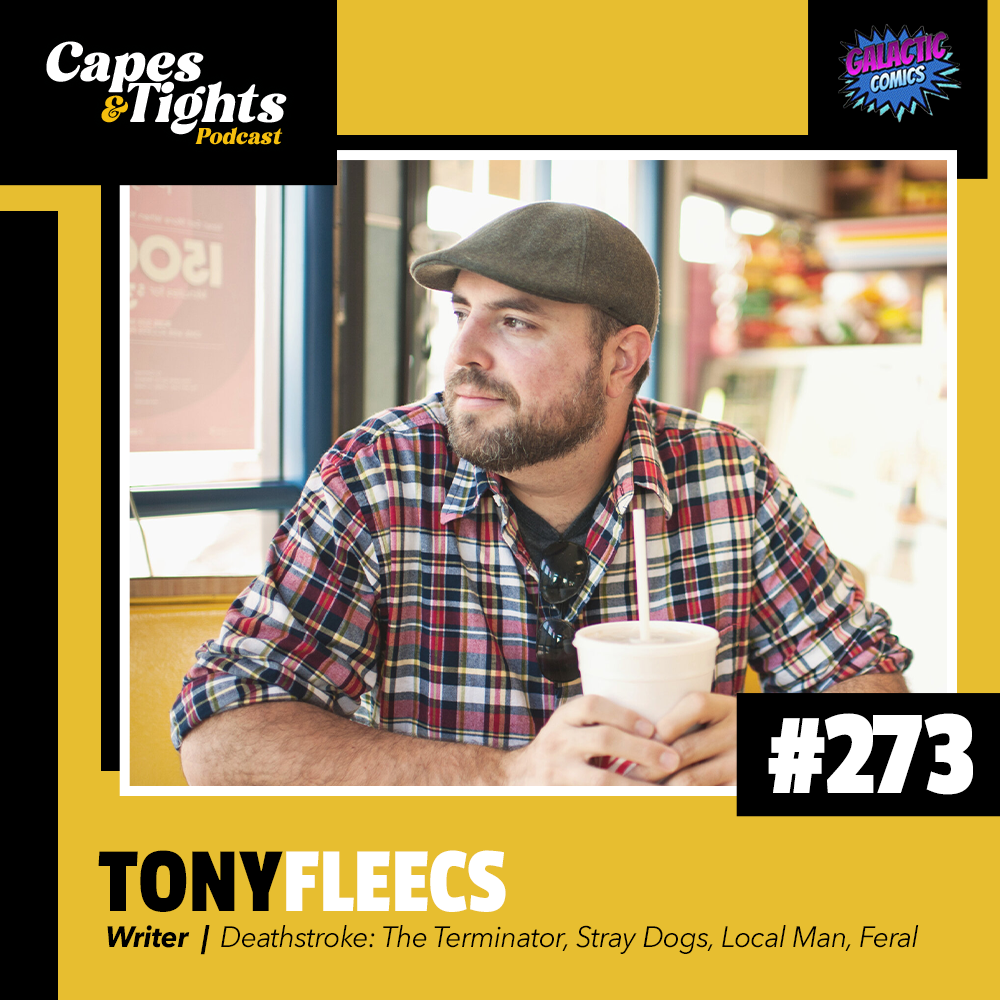
[00:00:00] Speaker A: Welcome back to the Capes and Tights podcast right here on Capesandtights.com I'm your host, Justin Soderbergh. This episode is once again brought to you by our friends over at Galactic Comics and Collectibles. At galactic comics and collectibles.com we welcome Tony Fleece back to the podcast. The first time in over three years or just nearly for three years. Tony came on in episode 95 in return to talk about his latest comics right here. But Tony is a prolific and critically acclaimed comic book creator and TV writer. He, he's creator owned books such as Stray Dogs, Feral, Uncanny Valley, Local man. And he has a new series at DC Next Level called Deathstroke the Terminator which hit shells March 18th. So we touched and dabbled on a little bit of everything right here on this episode ending with Deathstroke which comes out March 18th. So before you listen though, check us out on Facebook, Instagram, Twitter, bluesky, threads, all those places you can rate, review, subscribe over on Apple, Spotify or wherever you find your podcasts. You can watch the video portion of this podcast over on YouTube.com and and as always, you can find more on capesintights.com but this is comic book creator Tony Fleece talking about all of his creator owned comics in the new DC Next Level series, Deathstroke the Terminator right here on Capes and Tights. Enjoy everyone.
Welcome back to the podcast. Tony, how are you today?
[00:01:23] Speaker B: I'm happy to be back. I just got back last night late from Emerald City Comic Con. So I'm either going to be slow and sluggish or I'm going to be so amped from talking to people all weekend. Normally I don't talk to people for weeks at a time, you know, so it might be that I'm really on my game right now.
[00:01:42] Speaker A: We'll see like a lot of energy because you have no energy about that. Like that. You know how it works. Like you get overtired, you're like, oh, I'm so exhausted. And you're wide awake for hours on end now. But let's start. How was Emerald City? Was it, was it fun? Was it, you know, it was great. It's great.
[00:01:57] Speaker B: People show.
But like the, the fans that read comics in, in Seattle tend to like, they really read. So I get to talk to people about the books and stuff. And then there's a bunch of good friends out there. I hung out with Aubrey Sitterson a bunch. I hung out with Jason Aaron and Amy Chu and Erica who does the design on Feral is a cartoonist and she was out there. So, yeah, it was just great to get to hang out with a bunch of people and catch up. And I was on, I was on the DC panel as my first DC Comics panel.
And that was fun too.
[00:02:31] Speaker A: That's, that's awesome. I, I, from a distance, obviously get to follow people on, on Instagram and see a lot of people said it was very successful on multiple levels, whether it be financially, whether it be copies, like given to people or things like that, or just conversations with people that it seemed like one of the best that they had been to at Emerald City in a long time, which was really cool. Kind of cool to hear.
[00:02:49] Speaker B: Yeah, the money was good too. I, I went last year and I, I was surprised at how many books they bought. So I like doubled up in a lot of cases this year and I still sold almost everything. Like, I, I, I had to ship in a cart. Like, I ordered all my books from Image and then I also ordered from Amazon, like a, a rolling cart because I, I had to get it from the hotel to the convention. And I just have a picture of this enormous box of books on this cart. And sure enough, they all.
I don't want to wait.
[00:03:20] Speaker A: That's the hope is you don't want to have to bring that stuff back. You want to be able to collapse most of the cart to bring it back.
[00:03:25] Speaker B: You're really betting on yourself. Because I definitely at most shows now have more books than I can take back with me on, on the plane. So I would either have to wholesale them or FedEx them somewhere. I had friends sometimes that would just throw books away at the end of the weekend. And I was like that, that does not jive with my ethos.
[00:03:44] Speaker A: You'd rather just drive by some sort of, you know, donation box and donate them or give them out to people than that. But ye, that's really cool. I mean, you, you know, we talked last time we talked on here was three years ago, and that was, I had to look back because it was episode 95 and this is like 273, I think it is. So it's been a, it's been a while, but. And you've had a lot of come out. I mean, you had a lot done a lot since then. And obviously you have many, many issues of Feral, Uncanny Valley just wrapped up and the trade was just released for the second volume.
You have the thing that came out from Marvel and you're working on Local man finished up, and then you have Deathstroke Coming over at dc, so a lot you're in different publishers and you're in your different, you know, different things. Superheroes, non superheroes, like it's just you're a little mixture of everything, including I mean obviously My Little Pony stuff too is like you have all kinds of stuff now on your resume on this. Has it been nice to really like jump around and do all these different styles of books over the past couple of years?
[00:04:45] Speaker B: Yeah, it definitely is nice. It's, it keeps you from getting bored, you know, being able. I don't, I don't have like two books that are exactly the same. You know, like I'm not doing like Local man and then like the Marvel version of, you know, like some, some Marvel shitty character down on their luck.
So that, that definitely feels good. It feels like I get to stretch different muscles on every book that I'm working on. And then, you know, like just working on Feral for as long as we've been working on it now it feels nice to be like, to feel like we're, we have a zone that we're in and where we sort of understand how to make this book. And it's still challenging every month, but it's, we're having a lot of fun on all the books.
[00:05:26] Speaker A: Is it more challenging now to find the variant covers to be of horror movies now? Like, I feel like at some point you're going to run out.
[00:05:33] Speaker B: Yeah, they keep saying that, but I've always said that there are. I mean what I love about horror movies is that I will die not seeing, not having seen half of them. You know, like they're, they're always cranking out horror movies because they're the ones that always make money. The trouble is nowadays they don't always do great posters. You know, like the, the, you know, the 80s and the 70s, they would have great posters even up into the 90s. Like we do some, you know, some like Dimension Films style posters where it's just like the photoshopped heads. And at the time everybody was like, it's so, you know, that's not scary, it's so corny. But now it sort of has like a, a charm to it. But yeah, sometimes nowadays like the posters tend to look very similar. Like we did a, a long legs poster. It was just like a very high contrast red and red and black poster. And then I went and saw a primate and I was like, that ruled we should do a primate poster. And it's just the exact same as the long legs poster.
[00:06:34] Speaker A: Yeah, I mean this is Funny. So this is a good one for me. Is that the Beneath the Trees right of Spring cover? I had to look this one up because I didn't know what this one was. I was. Yeah, yeah, Serial mom. And it was actually kind of funny because the actual quote on the top of it came from our review of Rite of Spring. And so I bought this when I was in Florida, which was really cool because they also had the black and white variant for only like nine bucks too. I was actually pretty. This is like the 1 in 25 variant.
But yes, like, certain ones nowadays, I do feel myself. I like horror movies. And I know a lot of horror movies. There's a few of them that I'm like. I have to like, kind of Google and be like, oh, and there's other people who don't know who this is either. I'm not the only one.
[00:07:15] Speaker B: But majority of people do know that one's tricky because it's a. It's a John Waters movie. It's a comedy. It's not a horror movie. But Beneath the Trees. We were doing all serial killers.
[00:07:24] Speaker A: Yeah.
[00:07:25] Speaker B: So we had more of a theme on that one.
[00:07:28] Speaker A: It was just kind of.
[00:07:29] Speaker B: Sometimes they're comedies.
[00:07:31] Speaker A: It works out. It works out well. I think that I always love cover A because cover A is like what you get in the book most of the time is what the COVID is. And. But the variants in those movie variants are a lot of fun too, because they're just. Just the connection to other things that you love. There's not many things like, you know, novels, they don't do that kind of things. Like, very rarely do movies do that to other things. It's like comics. It seems like the one thing that we do that homage thing to or very, very common nowadays. And I love that part of it. It's so much fun.
Yeah.
[00:08:03] Speaker B: Well, we had great success with it on Stray Dogs. And I feel like it works best for comics just because the periodical nature of them makes it easier to sort of skirt, like, legal cease and desist orders or whatever. You know, like I always say, by the time they would send us a cease and desist, we have already desisted. We're.
We're ceasing, you know, that's out.
[00:08:28] Speaker A: I was talking to my brother about it when we were in Florida at this comic shop, coliseum of comics. And we were looking at different books and so on and so forth. And I always like to go in. My buddy who owns Galactic Comics and Collectibles in Bangor, Maine, just moved his shop to a New shop. And so he had an 800 square foot, 900 square foot shop, very small shop. He just moved it to double that. And he's so excited. And, you know, so. So when I was down there, I wasn't just shopping. I was also, like, ears open, listening to what people were talking about, how they did their poll lists, how, you know, I was just like trying to, like, eavesdropping almost trying to see, is there anything you could do at your new shop?
And my brother was talking about how he was like, don't you just miss walking into stores and be able to buy the comics that are on the shelf? And so on. So I'm like, yeah, but, like, this is the sixth issue, so you kind of want to be able to get the sixth issue. Or if it's a specific cover, you don't want to miss out on that and so on and so forth. And that's also, you know, why I like these homage covers. It's like you could see them ahead of time. You're like, well, I want that one. You call your local shop and you put it in my box, collect it. The collectibility there is there. And I see he's like, well, why don't you just wait for it to come back? I'm like, it won't come back. This is it. Like, the comics that are on, they know very rarely. I mean, you can sometimes reorder. Like your LCS can reorder, but it's not going back. That issue or that version of it is not going back into print. So you're not getting a second printing of this cover. You're getting a second printing with a different cover. And so I'm always like, no, you got to be able to call and have reserved that book because you're going to miss it. It's gonna be gone. No, no, no chance. Second chances.
[00:09:56] Speaker B: A lot of times, yeah, we're actually surprised. Like, the. Our A covers sell better than our B covers.
They always do. But I guess it shouldn't be surprising. But it's exactly what you're talking about. When we do more popular movies, they do sell better. And it's sort of. It's great because it's like, we know that trick. But also my impulse is always to go like, what's some movie that no people don't know about? Or what's some movie that, like, I love and I want other people to know about or whatever. And so I have to sort of fight that impulse to go too obscure because I know that if I just Do a Halloween or Friday the 13th or something. We'll. We'll do better that month.
[00:10:35] Speaker A: Well, I mean, there's other ones too, but not just like you do too is. We have the. I have the feral back here from Scotty Young, which this. The Jaws variant. And I was like, that is amazing. And my wife actually bought it for me for my birthday, which I loved. And so, yeah, it's like that recognizable. But again, there's other ones that are not. But at some point, you can't always have, like, each issue can't have a Halloween variant. It might get a little. A little old at that point, but. And it's like you did it with Stray dogs and you did it with Feral.
And then other companies, obviously, and other publishers and other creators are doing it, like, one shot here and there on their things. And obviously Patrick's done it a lot with, you know, with the different books over there at idw. But. But you didn't do that with. You did a couple. Have you done it with other books, like Uncanny Valley? Did they have any horror movies or movie variants?
[00:11:19] Speaker B: No, we didn't do any with Uncanny Valley, and we didn't start off doing it with Local man, and we did a couple retail variants that were ox of Vocal Man. And then at the second arc at issue six, we were like, we need to.
We need to try and make more money on this book. And so we started. We started doing it then. But that was a similar thing of where if you do the popular movies, you'll sell more. That was us doing like, well, we want to do, you know, like, Blood Strike and. And, you know, trencher and stuff like that, where it's like the Image Comics that we love and it's. It will be like a shibboleth to other 90s Image Comics readers to see that and be like, oh, this is a book for us. But it didn't necessarily make people go like, I got to run out the Youngblood Strike file cover.
[00:12:07] Speaker A: Yeah, there was that for like 8 billion jeans. Think it was the Mario one store did Mario three, and it was one of those ones that, like, sold out instant and was like $100 on eBay the next day or something like that. It was like, there's certain. Yes, yes, that was. That was. It was crazy. I am always the one that's way behind on that. I'm never going to make any money on comic book. I don't want to, but I never. I'm never going to, like, I'm always like, oh, that's Amazing. Three weeks after it's. It's already sold out and everybody has all the copies. I'm like, that's great.
[00:12:34] Speaker B: Yeah, you got to really be up and running, buying and selling that stuff. You know, you got to sell it before the, for the hype dies down.
[00:12:40] Speaker A: Yeah, exactly. And then. Or like, I liked White sky, the first issue. I got to read that digitally. And then I was like, oh, I kind of want to have it. So I went to the store the next day to buy it, because I didn't buy it.
[00:12:51] Speaker B: And.
[00:12:52] Speaker A: And he's like, yeah, we don't have any more of those. I'm like, how come? Like, oh, because it's like a hot comic right now. I'm like, God damn it. I just, I like the book. I don't care about the value. I just want to. I want to own the comic. This is not for, for resale.
You know, kind of hoping he would go, oh, I got one out back. Don't worry, I'll bring it back. But it didn't work out that way.
But. So I talked to you a little bit before we started about catching up on reading and stuff like that. I wanted to jump in really quick on. Uncanny Valley was such a fun and unique series that had like, is this, Is it? Are you done with it? Like, I know the volume two wrapped up, but you don't have. Do you have any plans eventually at some point to revisit it? Or are you, Are you done done?
[00:13:31] Speaker B: We sort of wrote it where it could. Where there's. It's open. Sorry. My, my dog doesn't like to stay inside his crate all the time. He's gonna clack around a little bit.
We wrote it so that it would sort of be open ended.
Other possibility, we could do more stuff, but that, but it's probably that's it. Unless there's like, you know, a huge call for it.
[00:13:52] Speaker A: Like.
[00:13:53] Speaker B: Yeah, if there's like a movie or something and people are clamoring, we, Dave and I love making it. We would love to make more. But it also was the sort of thing where that was the ending that I always envisioned for it. And like, you know, that big climax at the end and the stuff with his dad and all that stuff like that all felt like what I wanted it to be. And so I'm happy if it's just that if, and, and if they want us to come back and do more, there's definitely more stuff. You know, coming of age doesn't really stop when you're 12. You know, there's there's definitely more stuff to explore with that, and so I'll be interested in doing. Doing a little more. But I think it's probably just these two volumes. They're going to put them out in a big.
[00:14:34] Speaker A: Yeah. Complete collected edition. Yeah, a lot of completed edition. I love that because they want that stand. The second that's on the shelf is when they want more. And so the complete edition won't be completed anymore. It was like the complete edition of, like, Indiana Jones. All the Indiana Jones movies. And Crystal Skull came out, and it was like, oh, cool, I've got the complete edition. And.
But it was like that. I don't need that last movie anyway.
No, but it's, you know, so, like, one of the things you talked about Beneath the Trees and one of the things that Patrick Horvath's done so well with that is. It's the. The artwork and the juxtaposition to horror on it made it like, oh, that you want to look at this in the story. And I felt like with you and Dave in this. This. This uncanny valley was like, the artwork was like, a lot of what I showed up for. I love your writing, but, like, when I turned the pages, I was like, how is this two styles of artwork gonna work on every page? And how amazing it was. And then the story itself blended so well together with it that I just, like, I plowed through that when I read both volumes. And I was like, my brother, who's just basically Big two, like, he just reads Big two comics, he's like, I just can't get into it. And I was like, no, you need these. So I gave them over to him, and he absolutely loved it. It's just like. It was just so much fun. I was like, you have this with stray dogs. You know, the horror with the animation part of it, or the blue style illustration. It's like that cool juxtaposition, but this has it put in a different way.
Like, you have this ability to be that guy who does this, but they're different, if that makes any sense. It's not, you know, Patrick went ahead and did another series that was horror in this style, but had nothing to do with, you know, the. The towns and beneath the trees. It'd be like, ah, you're just kind of like, retooling the same thing over again. Nothing gets Patrick. I don't know why I just called out Patrick on that. Patrick's awesome. The story itself's amazing. No, but I also think about it. If you think about the What I wrote is true.
[00:16:19] Speaker B: He.
[00:16:19] Speaker A: I said, patrick Horvath has truly outdone himself. Because I didn't think in my mind subconsciously that he would be able to do a second volume. Because I'm like, the first volume was so well done that I'm like, I just feel like it's a. It's a grasp at money in my head. And then I read the second volume, and I was like, dude, I was so wrong. I. So wrong.
[00:16:37] Speaker B: But I felt the same way. I. I did not think it was just a money grab, to be fair. Like, I know Patrick. I know why he was doing it. But I did think the first one was great. And I was just like, what are they gonna do? And then when I read the very first issue of the second one, I was like, oh, this makes the last one better. Like, it's. It's not just that they. That they managed to figure out how to do a good follow up. Like, he's building a thing and putting this part into it makes the whole thing better, you know, like, it's a piece that you didn't have, and now it makes it better. And then when you get to the end of that second volume, that issue five and six is, like, psychotic.
It was, like, crazier than he's ever gone before.
[00:17:11] Speaker A: Well, the part of me also goes. I always hate this. You know, when I have this conversation about certain creators where I'm like, fantastic writer, fantastic artists, and, like, how the mind. How your mind works in a way that I'm like, how the hell did you even come up with this idea and then be able to execute it, both story and illustration? I'm like, it's not fair. Can you pass some of the talent along to other people, please? Like, this is not. And he's an amazing person. So, like, there's. On top of that, it's like, not even just like a. I wish he was a dick so that I could just be like, oh, he's a horrible person. So, like, comic book's great, but he's horrible. No, everything's all great. So it was just.
It's amazing.
[00:17:46] Speaker B: Patrick has a confidence, and I think that's part of what it takes. I'm not a confident person by nature, but creatively I have a confidence in when I've.
I know what it feels. I know. Like, it's like you read Local man, right Cross. Jack's power is like, when he aims at a thing, it clicks in almost like a. Like a video game when it, like, you know, like, it vibrates. In your hand. It clicks in when it's gonna be, when it's gonna hit the target. And I have that thing with a lot of times, hopefully most of the time with when I'm creating creator own stuff, when I go like, if it looks like this with the realistic backgrounds and the cartoon characters, but it has the heart of like a coming of age story, a story about a strained family and a. And a broken family coming back together, that feels like a thing and like that. And even though they don't make comics like that, I feel like I. That actually works, you know, like, and feel it like click in like that. And I felt that way about Stray Dogs and I felt that way about Feral. And it just sort of like, you know, and, and obviously Patrick, when he drew that sketch of that serial killer bear was just like, oh, you know, like that's what that is. I feel, I feel what that is.
[00:18:54] Speaker A: You know, in.
I'm guessing for a while there, your stray dogs run and then like Patrick and beneath the trees, you're going to be compared to each other in the sense of taking a childish thing and making it into something a little bit scarier and a little bit horrible.
But like, it is different. And you did that with Stray Dogs and Feral, which has the same, similar style of animation but like. Or illustration, but a completely different story. That's, that's. Honestly, I'm a huge Walking Dead fan, so that helps too. But then like I said, the cool thing about, to me about Uncanny Valley was the fact that I would have read your book with the exact same story.
Family issues, things like that obviously had to be a little bit different without the cool illustrations. I thought the story itself was amazing. But just like watching what Dave was able to do with the story and the different pieces of falling off of a bridge and going into the ground stuff, again, my mind doesn't click that way. I don't like. It just doesn't work that way. And so those are the kind of things where I'm like, oh, the very beginning, because that's at the very beginning of the first issue, is that this is going to be different. Right from that moment, I was like, this is going to be something that's going to be not only a great story, but it's going to click differently artistically. And I think that's what was cool about Uncanny Valley. And I think that 10 issues was perfect, honestly, because I do think that you got the point across. It does have a great ending, but at the same sense, I want more stray Dogs. And that was perfect at five issues. So I always just want something that I really like. I want more of anyway. So ultimately, I don't even care if it ruins it, because I just want more.
[00:20:24] Speaker B: I. I could have done a couple more issues of Uncanny Valley. You know, like, we. I feel like we could have stretched out that ending a little bit and done, you know, another issue or two.
We had that big, crazy battle, and it would have been fun to do, like, almost like a Helm's Deep or something, you know, where like, that goes on for a whole issue and you just get to really like that there. You get, like, the sugar pop of it when it first happens. But then it would be fun to get to, like, go into that battle and have, like, people yelling back and forth and, you know, that sort of thing would be fun. I could definitely see doing more that way. But, yeah, the. The.
The story, as it stands definitely feels like we closed the loop on it. I just have a lot to say about cartoons, I guess. You know, like, I draw cartoony. I grew up in. You know, everyone in our generation grew up watching a lot of cartoons, but I always tell people I had younger siblings, too, so even. Even if I was ready to stop watching cartoons, I was still watching cartoons through them.
And so I just. I feel like I have a lot to say. And also, it feels sort of like an unexplored part of the. Of. Of comics. You know, like, animation is its own thing, and I feel like sometimes they explore animation and animation, but that we're so close together that you can do stuff like Uncanny Valley, where you can draw a Roger Rabbit and have it look, you know, like. Like the thing. And that was something else that I had. You know, we hadn't seen anyone do before. You know, we'd seen even in the Roger Rabbit comics or, like, the Cool World comics or Slapstick or any of these ones where it's like a cartoon and a person. Nobody had really done a realistic character and a cartoon character that way, in the way. In a way that it looked like, you know, where it was convincing, which
[00:22:02] Speaker A: is kind of funny because you look at it, you're like, they're both illustrations. They're just styles of.
[00:22:05] Speaker B: Drawn by the same person on the same computer.
[00:22:08] Speaker A: It's just like. It's like. I mean, in that sense, that specific sense of how this was done, were you supporting, surprised, entering the creation in the. In the plotting and the planning of Uncanny Valley that it hadn't been done more, or was that just like, there's a Reason why it hasn't been done
[00:22:22] Speaker B: more because, like, no, I'm never really surprised about it because I. I always think of my ideas as being sort of like, you know, a little bit off center.
And so I'm more excited that it hasn't. You know, I'm just like, oh, cool. You know, like, this doesn't exist that I can think of. Let me figure out a way to, you know, to make this do this big thing.
I was more surprised just how good Dave was at it, like, because he. I'd seen him draw very few things cartoony. And then I've talked to about. To him about it since, and he describes it more as like, he still draws realistic. Like, if you convince commission him at a convention or whatever, he'll draw you a realistic Ninja Turtle or a realistic Godzilla or whatever.
But when he would do the cartoony stuff, he sort of thought of as like playing a cover or do, you know, like, like doing an homage or a mimic. You know, like, he would look at like that. I would say, like, this is like, you know, Hanna Barbera 1980s stuff, or this is like, you know, classic Looney Tune stuff. Or this is like Klepski Chupo or what, you know, like, he would just look that up and go like, yeah, I can sort of see what the moves they're doing. I can. I can play that song. And then he would just do it.
[00:23:40] Speaker A: And I've talked to people who are voice actors too. I've run panels at conventions where I've had to interview voice actors. And there's some people who have done Bugs Bunny or any of these other ones, and they feel like if they do an original voice for a new cartoon, it's an original creation. Whereas if you do the voice of Bugs Bunny, you're just emulating what.
Yes, exactly. And you're just trying to do the best job you can doing that person. And so the same thing I could see is like, if you're trying to emulate Hanna Barbera, you're just trying to do the best Hanna Barbera style illustrations that you can. I would love that thinking about it now, like Dave Watcher, like a. Like a realistic Ninja Turtle or something like that with, like, me as the animated person in front. Like, I'm the animated person, not like the. The switch of what it would really be like and if a Ninja Turtle showed up here at this moment. But yeah, it's. It's fun. And again, this continues. Like if you think about feral stray dogs and uncanny valley having this, you know, using Cartoons in a more deeper meaning in animation. And these, like, say, bubblier cartoons.
Ferals, like that, too. I mean, you have this beautiful little kittens who turns into a horror story fairly quickly in the first issue and has gone on for more. I mean, do you have. We're. Like I said, you're in the fourth. Fifth volume. Fourth volume.
[00:24:59] Speaker B: Right now. We're drawing the fifth volume, fourth one just came out in stores.
[00:25:04] Speaker A: So you have plans, Obviously, that's, what, 20, 25 issues? Something like that? I mean, are you planning. Do you have in your mind 50 issues worth of story, or do you have, like, do you do five issues at a time and then just go from there, knowing that I know it's an ongoing. But, like, do you have a plan for the end? Or that's saying, I wanted to end, but do you have in your mind how this will end?
[00:25:23] Speaker B: Yeah, I have a plan for what the ended.
And we have also a plan for sort of, like, big moments that happen throughout and sort of, like, different areas we want to explore and different things we want the characters to go through and. And characters we want to introduce and stuff. So, yeah, we have. We have plans for all that. It's not like a Jonathan Hickman chart that has the.
Has all the issues broke down or. Like, I talked to James Tynan, like, a year ago, and he was. And I was like, you're gonna do 100. Something's killing the children. And he told me what every issue was, and I was like, God damn this guy. You know? Like, he really has it figured out.
[00:26:00] Speaker A: Yeah.
[00:26:00] Speaker B: I mean.
[00:26:01] Speaker A: Yeah, so yours is a little different. It's. It's. I have the quote unquote, 100th issue, but then you have the big points that happened in between, but not the small points that happened in between those big points.
[00:26:10] Speaker B: Yes. Yeah, I have a. And. And he does, too. It's not like he has them all written out, but I have the.
I know what happens at the end. I know what all these moments are, and I. And I know, like, about where I want to hit them. And we're hoping to do 60 issues. That's. That feels like, like, a cool number.
But then part of me also wants to, like, get to 60 issues and have people go like, no, you can't leave, and then go like, I will do 100.
[00:26:36] Speaker A: I feel like you need to end it like Kirkman did and just, like, ended on surprise 57.
[00:26:41] Speaker B: I feel like we get compared to the Walking Dead so much that.
That if we did the Kirkman ending, where we solicited fake covers and didn't surprise people. It would be one step too far.
You get the.
That last push where you get people excited again, where you're like, last five issues, last four issues, you know, everything comes out of this. I know when I'm watching a TV show, I'm excited for that second to last episode because I'm like, this is where it's going to get crazy.
[00:27:07] Speaker A: Crazy. Yeah. To wrap everything. I mean, I just saw the schedule for the Boys, you know, series finale, and at the very bottom, it's a serious finale. I'm like, that means that this season is going to be extremely watched. People are going to. Because it's the end. You don't you want to see how this is wrapped up and how this ends and things like that. But yeah, it would be a little bit too close to home on that. You know, ending it randomly. I still remember the day that I walked into. It was a different shop because my buddy shop hadn't opened yet. And I had walked in and said, I'm gonna get my pull list. And I was pulling the Walking Dead and I got my stuff and I was oblivious to. It. Wasn't on the Internet at the time. Wasn't doing any of this stuff at the time. And I was just. The guy walked in behind me was like looking at the shelves and there wasn't any because all of the poll customers grabbed them all. They were already in the box. A small shop. And he's like, you don't have any more. You just opened. He's like.
And he was coming in there for the value of the last. Come to find out, the comic books like, face value, if not less than that. Now it's not worth a bunch of money. But it was just kind of funny. He was looking for that, oh, I'm gonna make a bunch of money off this last issue. Because people didn't know it. And then I'm like laughing. I'm like, I remember seeing the solicitations for the next three or four covers and I'm like, that's so funny. That was such a great, like, surprise.
[00:28:09] Speaker B: Kirkman, real smart. He's a. He's very canny businessman. We just did.
They did an Invincible Month where all the Image comics could opt in and do Invincible covers. Where, like, we did a Feral with Battle Beast cover and oh, line wide. I saw they sold like a half a million or like a quarter million in just Invincible covers.
So that guy's really got the touch. And we sold a ton of that Battle Beast one like a real blessing. He's a sharp dude. Robert Kirk.
[00:28:41] Speaker A: Well, so he tricked me into not tricked me into it. I love them because they're fun and they have the back issue, the back matter and the colorization of the deluxe editions. But from issue one I started rebuying. I mean I have 95 of the original run already but like I wanted to have this other ones. And then I thought to myself, we're approaching in the next year, maybe 18 months, we'll be at the last issue again. And I'm thinking myself, like he's been riding that ability to just have people buy it again for what's next for the Walking Dead after this deluxe comes up. Is it Deluxe super edition or they're all hardcover.
[00:29:14] Speaker B: Every single issue Deluxe collected seems pretty like a pretty smart movie.
[00:29:19] Speaker A: Just think to myself, I'm like it. I'll be there. I'll be there on new comic day buying it again. It's just the way it is. But no.
[00:29:26] Speaker B: Do you read the backup features still? Like, do you read the, the process stuff in the end?
[00:29:30] Speaker A: Oh yeah.
[00:29:31] Speaker B: Is it still like that far into it? I figured like he would run out of stuff to tell you about it.
[00:29:37] Speaker A: It's not as much as the beginning. There is still some, but it's. There's definitely. The first 15, 20 issues was amazing. It was so, so cool to see. Plus I mean I like the black and white version of it but like the colorization, like just seeing what it would look like colored was just fun. Plus they got new covers and all that stuff was cool too. And like just the ability to take a series that you know is going to go 190 something issues from the beginning was kind of fun too to see that. Like, okay, I know how many issues I'm going to buy. And honestly like the first 10, 15, 20 copies I got all the covers too. Because I was just like, I want all the covers. And then I realized that that was in long boxes in its own that I was like, I can't do this anymore. That's just too much. And now I'm more selective. I'm a cover a guy like I mentioned before. But then I'll cover, I'll grab the random ones I see that I really like. But. But yeah, I mean. And so Farrell has that comparison and I like that. I guess that because I miss the Walking Dead. I miss new stories from the Walking Dead. So I can see that. But I get fussy little cats with this instead and stuff like that. Are you. I Mean, you said you have a dog. Are you a dog person? Cat person? Is this. What. What. What are you right now? Are you like all animals?
[00:30:39] Speaker B: I have. I do love all animals.
I'm a great person, Justin. I love all animals. Everyone knows this about me.
No, I am a. I'm a dog person. I have a dog and he is a little too curious and troublesome to. For me to have a cat at the same time.
So. So, yeah, I'm a dog person.
[00:30:57] Speaker A: So at 60 issues of feral, is it now you're going to do like chipmunks or germinals or. Yeah, like you're going to do some other animal.
[00:31:05] Speaker B: Now that's a little reductive, Justin. And I take offense at that question.
[00:31:10] Speaker A: I'm just trying to think. I was trying to think of the odd. Like, like one of the most fun things about Secret Life of Pets the movie was the idea that how on the nose, you know, no pun intended, there it is about you would think your animals act when you leave the room. And I. So to me, it's like when you take real life situations like stray dogs or feral, and you do tell the stories from the point of view of those animals, I think it's fantastic. It doesn't matter what the story is about, in my opinion. I just love that. That view, that version.
[00:31:39] Speaker B: I think we're going to end up getting into chipmunks and squirrels a little bit in feral at some point. That's something we've talked about a lot is sort of like doing like.
Like going a little bit left to center from the cats for. For a minute and just going like, what's going on with these other guys? You know, like. Because a thing that we're about to get into in this arc is how cats don't. They can't talk to other animals. It's not like a full Disney where like all the barnyard creatures can communicate.
And so the, the cats are having a different experience of this than dogs would be having and squirrels would be having a different experience. And like, there's some animals like, you know, like, possums can't get rabies. You know, like some. Some kind of birds can't get rabies. And so it's like, well, what's their. What do they think's going on? You know, like, everybody else is acting fully psychotic.
And so we're interested in. In getting into some of that. That's part of what will happen in the. In the next four years or however long.
But yeah, after that we've. We've talked about what, like, we would love to have it be a trilogy. Like a, you know, Stray Dogs, Feral, and then the Last Thing. And we've talked about it being something with horses. I sort of have like, the idea of, like, a.
A horse.
Like a western supernatural thing, you know, like a ghost horse type thing, and that would tie it back to Ponies where From whence we Came. And, you know, that feels like a fitting, you know, little bow to put on this. That would be like a. Just a one small one.
[00:33:09] Speaker A: Yeah, yeah. It just. It's funny because it does.
It does. I mean, the success of Stray Dogs, I'm guessing, at the end of that and Dog Days even was that. I wish. You Wish it was 10, 15, 20 issues, I'm guessing, because you could have done more. But, like, now being able to start Feral from the beginning, being like, we're just gonna go until we can't go anymore, obviously, is much better for a lot of us who want to pick up every. Every month, pick up that story and find out what happens next, which is great. So we have that still. I mean, Local man, you got. You guys were. You and Tim were, like, stretched a little thin there when you guys were doing Local. Like, you had Local man going. Tim is one of the busiest people in the world right now. He started. He's got his hands and everything. And then obviously, you have multiple different books going on at the same time now right now.
But, like, the Feral, it seems like it's that.
That little horse that could. That little engine that could. I should say. You said horse. I'm now thinking horses, because it's, like. It just keeps going. I'm excited for the next issue, which I'm really pumped about. And Trish's artwork and Tone's artwork is fantastic, and the story is great. I'm excited for that to keep going.
[00:34:09] Speaker B: Yeah, that one's getting. That one's. It doesn't run on its own, but it. It definitely. We've been doing this long enough now. Like, you know, We've done almost 30 issues together, this team, you know, between the two books, and.
And we're sort of. You know, we sort of have a method down. It definitely still is stressful every deadline, but.
But it. It's vocal, man. Was like, I'm gonna have to draw this and write this and letter it and. And it's going to be three weeks out of my month every month at least.
And. And Feral, I can definitely, you know, write other books around the edges of it.
[00:34:47] Speaker A: Yeah, you got that team that can help. Like, that works together cohesively. And like I said, you and Tim also had to draw these issues here and there. Like that's, that's make a lot more sense. And I've seen this, I've talked to you. You and Scotty Young and Kyle Starks and all these people who are illustrators who also write comics now they're writing a lot more comics because it is one of those things that you can have. You can write your comic and do multiple things at the same time. You have multiple stories you want to tell and it's hard to do that all yourself unless you had nothing else to do. And like you're writing and drawing 24 hours a day and so forth.
[00:35:17] Speaker B: You could just have one smash hit and then just only do that. That's the, that's the platonic ideal, right. Is I could be very relaxed. I could have weekends off. I could just do, you know, the smash hit Feral and then not worry about anything else.
[00:35:32] Speaker A: Do a variant cover here and there just for fun. And then if I feel like it.
[00:35:36] Speaker B: Yeah, I like that people are just like, maybe if I have time, I'm like, I'm trying to hit my mortgage, baby.
[00:35:41] Speaker A: Yeah. Does anybody have any variant covers they need done right now? Like you said, in my way. Yeah.
[00:35:46] Speaker B: Watch my career. You'll see the ones where it was like this guy needed to pay his mortgage.
[00:35:52] Speaker A: Oh, well, that's. There's some illustrators out there that. Scotty Young is one of my favorite illustrators and he does that thing where he does like the Daily Sketch. And I've always laughed because I'm like, he's done this Daily Sketch that it takes him like 25 minutes to do. And I'm like, cool, he'll sell that for a thousand dollars. Awesome. As I'm sitting up here taking three weeks is on a beer can label. And I just do it for my job. So it's part of my salary. So it's like, I'm cool. It's just the way some things are.
[00:36:15] Speaker B: Scotty's got a good business put together. He's got a. He's got a whole corporate machine set up. He's got employees, he's got offices, he's got a whole thing there.
[00:36:24] Speaker A: Yeah. But yeah, so you did Feral Street. All these things are all creator owned. This is not your first Deathstroke's not your Big two comic. You also did the thing recently. Talking about is the thing over at Marvel, which was fantastic.
Dan Graham and Thing is one of my favorite. He's my favorite Fantastic Four character. Like I think that the one that got the short end of the stick, you know, the one that can't obviously change back and look human again and all that stuff on a regular basis and so on and so forth. Plus you made it street level.
Like you made it so that like it wasn't like you're, I mean at the beginning of it. Obviously it's, they're in the negative zone and things like that. But like from that point on it's just basically like he could be part of the Defenders at that point, you know what I mean? Like he could just be hanging out with Daredevil and Luke Cage and things like that. It just seems really cool in that sense because you typically don't see that with a Fantastic Four story. You see them saving the world or New York City or so on and so forth.
So we'll start quickly on that and then we'll go over to Death Drift. But what draw you into doing a big two book? You know, I mean, you don't need to do that financially. You might want to do it, but I'm saying like you like creator owned stuff. What led to doing some big two stuff?
[00:37:29] Speaker B: Well, they reached out, you know, like there's, there's a certain level of validation, you know, that, you know, I read comics every week. I, you know, I love superhero comics. I make my own stuff and I, and definitely my goal is to continue to do that and make that my, you know, be Jeff Smith or be Scotty or be, you know, one of these guys that can just make, create our own comics and have that be their business.
Terry Moore.
But in the meantime, like I said, validation is super cool. You know, those guys did that too. Jeff Smith did Shazam and you know, did some of these, these books when they, when they came calling and so they reached out and it was, it took a little while for them to, to find me because I always describe it as. This is probably just my personal, like the way it looks from, from my side. But doing Stray Dogs, which was a hit big enough where if it was a superhero thing, they. I would have been, you know, at the retreats or whatever. I would have already been writing Ultimates.
But because it had was just about dogs and serial killers, nobody was like, oh, this guy should do the, the X Men.
[00:38:44] Speaker A: Yes, exactly.
[00:38:45] Speaker B: But when we did Local man, they then a lot of editors saw that book and, and then I had got, that got nominated for the Eisner and Stray Dogs did too, and Uncanny Valley did so finally they were just like, all right, we'll see what this guy's up to. You know, seems like he's doing something.
And they reached out and Porn Sack had actually pornsack pset Joke, who does the good Asian and Horizon project. And Infidel, he's a buddy of mine and he had, he was. Was an editor at DC previously, so he knows all those guys and he put a bug in some editor's ears. He's like, you guys know about Tony, right?
And so they reached out and the. The thing I had done with Sealy, I had done a Wolverine thing the year before, and that was fun. That felt like just like, you know, wish fulfillment, you know, just getting the. Getting to write the word snict in a script and get paid money for it.
But they reached out about the thing and they, they said that they wanted it to be sort of out of continuity, not it. It happened, but it's not in current continuity.
And they wanted it to be street level. I think they said street level. They just wanted me to pitch them a bunch of ideas. So I sent them, you know, three or four ideas for thing stories and, and we sort of settled on that one.
And.
And then it was the.
One of the few times where I'd done this where it was like it had the shape of the plot first and the character stuff really filled itself in as I started outlining and writing it. Usually I have the character stu figured out way earlier, but this one, it became all the heart that's in it sort of came out of the outlining part and, and figuring that part out.
[00:40:26] Speaker A: It's. The story was great. I love again, I.
I like Pharaoh being ongoing. I want more ongoing because I do want a couple of those in my, in my, you know, poll box, but also in my cool five issues. Let's do this kind of thing. It's like they're both. You need both. I think. I think when the world basically turned over to all miniseries, it was very difficult at that point. But when now there's certain ones you. And like I said, something's killing the children. We talked about. Other people are doing these more ongoing things. Great. But you still need these. I think. I think you need these five issue miniseries that you don't really need to know anything. But the fact that the thing exists, like that's all you. And then some of the villains you need to know, but that's it.
[00:41:02] Speaker B: Yeah, you get to do a more concentrated punch of a story in that way where like, I'm pretty sure there's that they're not going to do another thing miniseries with me. So it was just like, let me put everything I want to say about this guy. Let me have him fight everybody. I want to see him fight. You know, let's just put it all in here. And.
And they got Justin Mason to draw it and Alex Sinclair to color it and you know, came out and looks like it. That was one of the ones where some. The pages would come in. I'll be looking at me. The Things fighting Juggernaut. This is a real comic book, you know. This is crazy.
[00:41:33] Speaker A: This is not make believe. In my head, this is real. This is actually happening. No, it's true. Oh, I felt one of the things I thought about when I was reading the Thing, I was like, God, I'd hate to be Justin Mason right now. Having to draw the rock thing like sequential art. I could see doing a variant cover or some sort of COVID art, but having to draw the Thing on every page and all the different rock textures to them. I'm always like, that seems like it takes a lot of work and time.
[00:41:57] Speaker B: He was very adept at it. Didn't slow him down.
I don't think that was an issue for him. He liked the rocks.
[00:42:06] Speaker A: You also got the ability that you're outside of continuity, and it's not outside of continuity, but outside the main storyline right now or that moment. And so you also got the ability to use bait. Not basically whoever you wanted, but really whoever you wanted. Because it didn't matter at that time. It wasn't inconsequential. It was inconsequential to the bigger story. Where sometimes if you're writing a, you know, certain specific offshoot of the Thing, you have to be like, well, these characters are actually over here right now, so you really can't touch those characters.
[00:42:28] Speaker B: This was more like there was some of that. As soon as we started putting specific characters in certain places, that's when Tom Brevoor clicks in and he can start to like, like circle and sort of like pinpoint exactly where you are in the timeline. So after I wrote like the first issue or two, he was like, well, Titania wouldn't be here yet because this feels like it's pre Secret Wars. And then later is like, well, Lecter wouldn't be here because she's dead during this period. And he's like, sandman couldn't be here because there's that issue of Marvel Marvel Team up where him and Thing are buddies. He wouldn't be fighting the Thing, you know, so it was. It was fun to sort of like, you know, I was going through all my official handbooks and looking at my John Byrne Fantastic Four and stuff, and.
But, you know, nobody can compete with, like, a Marvel continuity computer like that when it comes to.
I'm just going like, wouldn't it be cool to see her, you know, Electra try and kick things ass? He's like, well, she's dead. We all remember, famously, one of the most dead characters ever.
[00:43:35] Speaker A: It seems like it'd be a difficult thing to task to take on because of that. But it does seem like there's enough people now a pirate, but Marvel that can say this, that, and the other thing. And I remember hearing stories about other people jumping into Big Two and saying, I really wanted to do this, and there was a obscure character they wanted to use, and you can't touch that. And they're like, but they're not in anything else. Then they made them think, what's going on? Where are they going to be here? Am I going to be able to see this character somewhere else? Or is it just that they don't want to touch this character in general? I remember Kevin Smith was talking about that in one of his Marvel or DC things. He was like, I can't use this character. And he's like, I want to know why? Why can't I use this character? This is ridiculous. But so you had a good experience with it. The book was nice. It just came out in trade in January in the Collected Edition, which is really cool, hit shelves.
But now DC comes calling. Is that how it worked right afterward, Right afterwards, they're like, you did such a great job with the thing we want you to do. Deathstroke.
Yeah.
[00:44:32] Speaker B: I don't think they read the thing.
I think it was from this. It was the same thing as what got me. The thing was that we always say that not a lot of people read Local man, but everyone who did was a comic book editor. And so that has worked out for both Tim and I that we've sort of gotten jobs off of that book.
And yeah, so they did come through and. And asked me to. But before they knew. What's it called? Next level.
[00:45:02] Speaker A: Yeah, D.C. next level. Yeah.
[00:45:04] Speaker B: Before they knew what, like, Next Level was called, they just knew that they were putting together some sort of, like B list characters, maybe C list characters with.
With interesting creators and. And trying to do like a absolute type move, but without the full brand new universe, like in continuity, but behind the scenes, do the same as they do with absolute. Where it's just like, get cool creators. Let them do something interesting.
And so, yeah, they reached out and they, they gave me a few, like, a list of a few characters, and I came up with pictures for those, and Deathstroke was the one. They're like, yeah, that's. We could definitely sell that book.
And so, you know, I just started. Started putting my head down and figuring it out. And then we. We looked at some artists and they were like, what about Carmine?
And I was like, he's a genius. You know, that would be great.
I loved his. I loved his Marvel work and I loved his more recent, like, his absolute Superman stuff and his Flash stuff.
And, and, and. But then I think what he, what, what he's doing on this is like, even. He's definitely trying to.
It feels like he's trying to prove something or he's just drawn such over the top crazy action stuff in this book. And, and then, like, the, the scenes that have heart, he's. He's able to play them with such a gentleness, which seems weird when you're talking about Slade, but it does have like a, you know, like the. When the movie slows down, you need a moment to catch your breath. He can do that too. He's just a. He's like all around, you know, he knows all the. He can play all the parts.
[00:46:43] Speaker A: It's so. So I've read a little Deathstroke. I've obviously seen Deathstroke on different iterations of things and stuff like that, but, like, do you have a history? Like, is Deathstroke one of those characters that you knew already a lot about? Or is this something that, like, you knew the, the hits but you didn't you get to do some more research to actually, you know.
[00:46:59] Speaker B: Yeah, I had, I had to. To dig in and, and read the rest of it.
But yeah, I knew Teen Titans and I knew.
I had read some of the 90s book, like in the 90s. And then I had read the Biggie. I read most of New 52, actually, because they kept. Like, I was buddies with Kyle and I was like, I want to see what this is. And then I love the artwork on it. So I kept reading that. And then I like the. I like the twist that he put on it. And then they replaced him with Rob Liefeld, which I felt bad about, but I love Rob Liefeld. So I was like, well, see what this is about.
I'll hang out here for a little while longer, see what's going on here.
And then the Priest Run. I had read a Little bit of that. But I had, I hadn't read all of it, so I had to dig back in and read all this stuff. But I knew the basics of him and I knew like the idea of taking the, the scariest guy in the DC universe and making him like actually scary and making him. You know, we talked a little bit about, you know, that scene with Al Pacino and Once Upon a Time in Hollywood where he explains, like, if you let your hero get their ass kicked by some young guy that he does, he's not the hero anymore. He's just the, you know, the, he's the, the villain of the week.
And so we talked about that. We're like, well, he's not going to fight teenagers in this thing. You know, like, we're gonna have him go up against other assassins and, and go up and do assassinations and do like, do the scary stuff and have that be what this book is about and, and actually like make it so that when we finally do have him come up against, you know, a Teen Titans or, or you know, characters like that, other, other DC characters, when they're horrified, it is, they, they should be horrified. Like they were, you know, like when he shot Impulse in the knee or when he kicked the whole Justice League's ass in, in Infinite or Identity Crisis. You know, like when they see him after a couple arcs of our book, they should be like, get out of here. You know, like if, if I'm not Superman, I need to run the fuck away from here.
[00:49:11] Speaker A: Which is great because. But I also feel like what's cool about people who have done a bunch of creator owned stuff to jump into these big two universes and do a book like this, you're going to bring some of that vibe over while still keeping the vibe as a big 2 DC book, which is pretty cool. And I think that is gonna merge together pretty well. But I'm also like, I'm a huge. I've been a Marvel zombie since I was a teenager in my childhood. And so Marvel's always taken that one step and I've always just dissed dc. Not because it has any issues, just because I'm a Marvel person kind of thing growing up. And I'll tell you right now, I told a buddy of mine, like the last three months, four months of last year and all of 2026 is the year of DC.
I cannot. Marvel's gonna do some good stuff this year, but like the next level stuff too. Big Scotty fan here. So seeing the Lobo series coming, Batwoman coming This series, the next level, but also all the absolute stuff. Like, to me, it was like, how do you get new fans to read DC Comics? This is like the blueprint on how to do it. And they're doing it right now. And I think that's what's cool, because I remember walking into comic book shops and being like, okay, that book has a Batman in it. That book has a Joker in it. That one has a Wonder Woman in it. And then there's no other DC books. It was like, for a while there, it was like, if it wasn't those three characters or Superman, it was just not existent. It seemed like everything was an iteration of that. To see Deathstroke get their own book again and Lobo get a book again and Batwoman, it's just really cool, in my opinion. Like, I feel like some of these characters that deserve a little bit of attention, and they may not be like, oh, my God, we're gonna break records in sales, but, like, people are going to buy these books just because they're different from the regular mainstream books. I think that's what's cool about it.
[00:50:50] Speaker B: It's tough because Deathstroke and LOBO Both were 90s comics, so I don't know if we broke records in sales, but we sold real good. You know, like, D.C. is having, is definitely having a moment, and what you're saying is correct. Like, they're doing a smart thing by not just doubling down on the stuff that they already know sells, but going like, is there a way we can grow some, some of this other stuff and so, and really start to, like, build out, you know, continue to build out this line where they, they've always had, like, you know, the Bat family and the Justice League family and the, the Green Lantern Corps and stuff like that. But let's, let's see if we can take some of these other characters and get a hit off of, you know, a Deathstroke or Batwoman or so. Yeah, I, I, I definitely, I think they're doing a good job of, of playing with the stuff that the toys that they have in their toy box
[00:51:39] Speaker A: right now and then pairing them with creators like yourself, who I, I am, like, 99% of my polis and reading and reviewing even is independent stuff. And so the independent creators are the ones that I know more about than I do the big two people who are, like, solely in the bullpen there. And so seeing you and Scotty and even with the Vertigo stuff with, like, Kyle and doing this, like, those things are going to get me to Follow the creator. And so, like, I'm going to go from reading a feral issue to come to read Deathstroke. Even if I don't know anything about Deathstroke or don't really care about this, I'm gonna give it a shot because the creative team behind it, and I think that's what's really cool too, is not only you getting a character that you might not hear a lot about, but like, you're also hopefully pulling some independent people over to your, to your. Buying your DC books every week because of that. I think you mentioned that too. Like, that's the point. The point is lesser known characters or characters that don't get as much attention and putting in some creators that, that are, that have been like, proven to do stuff on the independent side.
[00:52:37] Speaker B: Yeah, I think they're hoping that I bring some, some of my people with me. I'm obviously the bigger hope is that I bring some of their people back. You know, I can, I can grab some of these Deathstroke people and, and come. Even though that seems like a very large chasm to bridge. But just go, like, what if you. I know you like Assassins, but have you considered kittens also?
Have you consider what it might be like if a kitten was really frightened?
[00:53:03] Speaker A: Well, maybe there's a stepping stone. Maybe it's okay. Assassins. And then they go read Local man and because they like Local man, then they go over to kittens and, you know, rabies and stuff. Like, maybe there's a level then you get multiple purchases of those things now. But no, it's true. I think that. And also now you get to add it to your bio. You get to add, like, we've written for Marvel and dc.
You have that ability now, that clout that comes with it as well. No, I just thought it was really cool and I thought Deathstroke a cool, badass character.
Like I said, same thing with some of these other characters that are coming out with on this next level stuff.
[00:53:35] Speaker B: Definitely. It definitely has given me like my 1990s.
Like this, the. That I like that went into Local man. Like all that Image comics, like, over the top stuff. It's letting me get out a lot of that stuff in a way that feels appropriate. Where it's like, this is a story where this fits in perfectly and let me just go, you know, over the top crazy. Let me have him blow stuff up. And I want, you know, I'm always putting in the scripts to Carmen. Like, this should be a huge shot. You know, this should be, you know, like, really show off this thing. Let him go. Let the art go crazy.
[00:54:09] Speaker A: Do you feel like you've come a long way? I mean, you have My Little Pony, and now you're drawing. You're writing Deathstroke. I mean.
Yeah, it's a lot different.
[00:54:17] Speaker B: It's a lot different, or it is different? Yeah. I mean, the fundamentals are similar. I guess this. You still type. Panel one, page one, panel one.
But I. I definitely. I think I'm the only My Little Pony artist to write Deathstroke so far.
[00:54:34] Speaker A: Hey, you know, it's a long history of comics.
[00:54:36] Speaker B: Yes.
[00:54:37] Speaker A: Hope it's more, but that's pretty cool. So March 18th is the first issue of Deathstroke the Terminator, which is part of that next level thing, like I mentioned. And it's cool because they're coming out like we. I think both of them are actually coming out. Lobo and Deathstroke are coming out on the 18th.
[00:54:51] Speaker B: Yeah.
[00:54:52] Speaker A: In Batwoman. Yes. Sorry. In Batwoman 2. I keep on forgetting that one. But then you've had trades like I mentioned. You had the thing dropped January 20th. Uncanny Valley, second volume came out February 3rd. Feral's fourth volume just came out March 4th. And then Destro Kits on March 18th. So you got some stuff for people to read and enjoy and stuff like. Plus, you've had things like you did some Twilight Zone and other stuff, too. You've kept busy on other stuff, too. Here and there. You did the Marvel Sweat. They didn't do this swimsuit one.
Yeah, yeah. With Tim. Yeah. Which is. Which is pretty awesome. Tim is fantastic. Godzilla was great. It's been great. All that stuff's been great, too. Like, the. Tim's been dipping his toes in, too. But Revival is one of my favorite comic book series of all time, so there's that, too.
[00:55:38] Speaker B: We're cooking up a new thing together.
[00:55:39] Speaker A: There you go.
[00:55:40] Speaker B: See, we're very collaborative, the same way that Local man was.
So, yeah, we're. We're always in touch. We're working together.
Twilight Zone's not out yet. That one is still just in solicits. But that's. That's going to be really beautiful, too. That's. Andy Price is drawing that, who is another My Little Pony.
They came to me about that. They were like, hey, would you be interested in doing Twilight Zone? And I was like, this is idw. It'd be cool to do, like, to get the pony people and get them to do something completely different. And so I reached out to Andy and they reached out to Andy, and so we're Doing a. Like, a very. One that you. When you look at it, you won't be like, well, these guys both made my.
[00:56:19] Speaker A: It's. Yeah, that's April 6th is FOC on that one. It's May 13th. That's his shelves too. So that's coming up right here. Too soon. But, dude, you just talented. And I'm so thankful that you continue to make books and you're with amazing creative partners on those books too. I mean, I think that's another. There's never been a time where I'm like, ah, Tony's with this person. It's always been like, yeah, hell yeah, let's do this. Let's keep this going. And so it makes it a lot easier to digest when you like both creators a lot. And then the artwork works so well with the. With the writing. So I'm thankful for that. You keep on doing that.
[00:56:51] Speaker B: Yeah, me too. I'm fortunate. I've. I've haven't been stuck with in too many situations where it's just like, I'm just going to have to put my head down and push through this comic. Like, I. On the team that works on Feral are some of my best friends and. And Tim's one of my best friends in comics. And, like, you know, it's just nice to be able to go and make your living making stuff with your friends and then. Then, you know, like, Carmine and. And the team on Deathstroke are great and like, I love, you know, communicating with them and working with them. And I did this X Men book with Andreas Chenolet last year, and that guy was, you know, like, I was a fan of his work before, and then he turned into what I think is his best stuff, you know, like on. On the book that we did. Yeah, it's. It's. I love. I love doing this, and I feel very fortunate that I get to do it at the level that I'm getting to do it right now, and also with. With the people that they're sort of.
That I'm getting to work with.
[00:57:45] Speaker A: That's. It's just fun. It's just. It's great to see your name on the COVID of things and see a variety. Like I said, it's not the same thing over and over and over again and again. Those people who only read Marvel got a chance to do it with a couple of things like the X that you just mentioned and the thing. And then the PDC fans are now going to be able to do that with Deathstroke, but also continue to get Feral. Because that's the, that's what you have right now, going independently, right?
[00:58:10] Speaker B: Yeah, yeah. Feral is the only one.
[00:58:12] Speaker A: Yeah. Because I just ended and yeah, I'm
[00:58:16] Speaker B: doing like politics, Justin. I go to. I go meet people where they're at and then I bring them over to my cause.
[00:58:22] Speaker A: That's the way it works. I mean, I listen and like you said, it's like you're going to do it and you did it. But if you can make money doing Feral and all those other things, you might just continue doing that. But if they keep calm and want you to come back to dc, you'd likely go to that too. You don't have. It's, it's, it is. But we're all come. That's the school. They're all on the same shelf. They might be next to each other in different shelves, but they're all in the same store in the same area when they come out. So hopefully they're not. So.
[00:58:44] Speaker B: I mean, they're all like pulp adventure comics, you know, they're not so different. It's not like I'm Jeffrey Brown or something where I'm doing my comics about being a dad or falling in love or whatever. They're like, have you thought about Deathstroke? And it's just like, well, I could see a way to bridge these two things together.
[00:59:01] Speaker A: You're not doing like your historical or like real life traveling comics. And then all of a sudden I know where someone's like, do Deathstroke. This is amazing. You just wrote, wrote about war torn countries and now you're talking about fake people killing each other. Yeah, let's do this.
[00:59:15] Speaker B: Yeah. Is there a way to make the work that you just did less important by doing this new work?
[00:59:20] Speaker A: No. Can you do this? Can you make it?
[00:59:23] Speaker B: All the stuff that I do is all could go on the same shelf, no problem.
Just as you know, some of them have DC superheroes and some of them have cats and some of them have cartoon characters and they're all great, I'll
[00:59:35] Speaker A: tell you that much.
There's not been a miss for me and that's great about it. So I appreciate you coming on, taking the time on your busy schedule to talk to us here and to tell people about your books. We kind of touched on a little bit of everything here, which was really cool to see and do that. It's been three years. Hopefully the next time you come home, it won't be three years. We'll have like one thing to talk about, so. Or a couple of things. To talk about because it'll be busy.
[00:59:56] Speaker B: Yeah, me and Sealy's new thing launches later this year, so maybe we'll talk.
[01:00:00] Speaker A: Chat again. Yeah, we'll talk. We'll chat again soon. But thank you so much. I appreciate it, Tony. And we'll talk again soon. And until then, people go to the shops, a bunch of trades are out that have Tony's name on it. And then March 18th, check out Deathstroke the Terminator, which hits shelves at your local comic book shop. But until next time, I appreciate it,
[01:00:19] Speaker B: Sam.