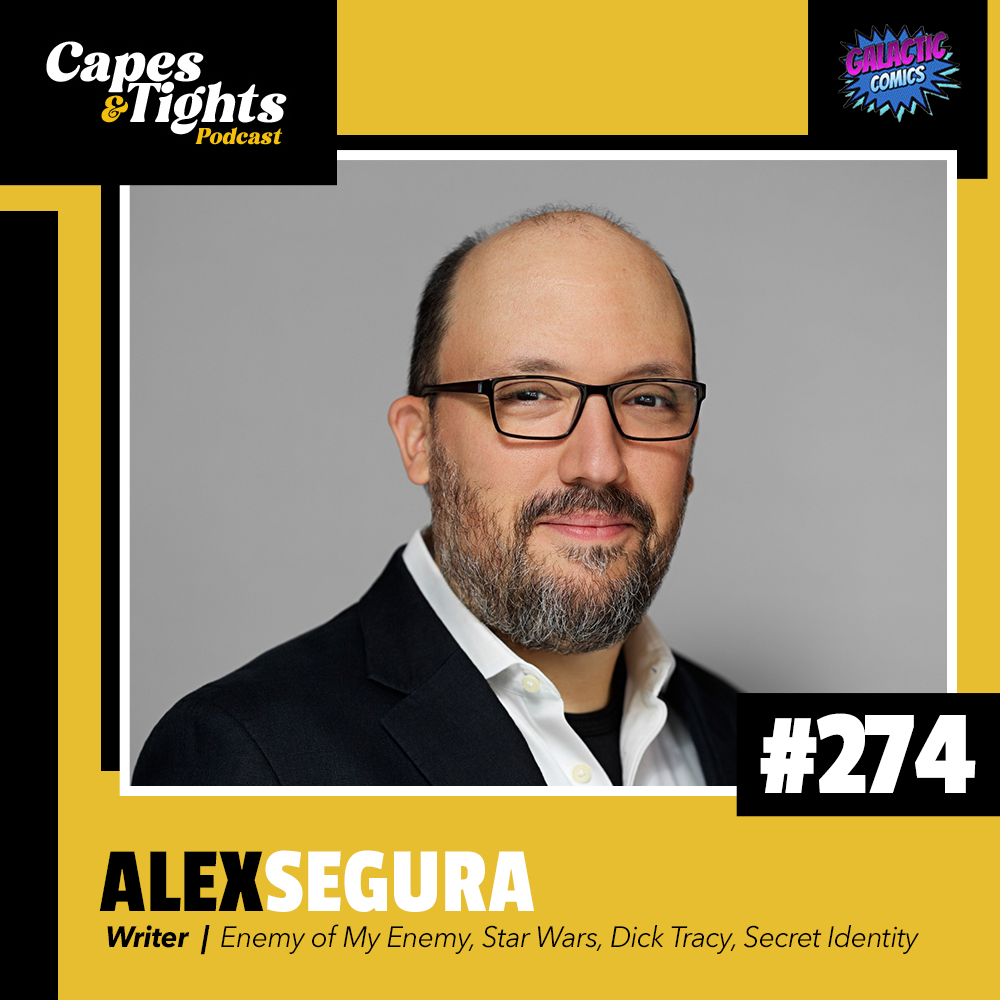
[00:00:00] Speaker A: Welcome back to the Capes and Tights podcast right here on Capesandtights.com, i'm your host, Justin Soderbergh. Once again, this episode is brought to you by our friends over at Galactic Comics and
[email protected] now at 499 Hammond street in Bangor, Maine. New location to check them out if you're in the area. But this episode we're here to chat with Alex Segura talking about Enemy of My Enemy, a daredevil Marvel crime novel. Segura is a best selling and award winning author of novels such as Secret Identity, the sequel Alter Ego, Dark Space, he wrote with Rob hart Spider Man 2099, dark tomorrow, we got Pete Fernandez series and so much more. In the world of comics, he has written Star Wars, Dick Tracy, the Black Ghost as well as many Marvel and DC comics. But today he is here to talk Enemy of My Enemy, a Marvel daredevil crime book which is available right now at your bookstores everywhere. But yeah, before you do, follow us on Facebook, Instagram, Twitter, bluesky, threads, all those places you can rate, review, subscribe over on Apple, Spotify or wherever you find your podcasts. And as always, you can visit YouTube.com for the video portion of this podcast. And don't forget to check out capesandtice.com for so much more. But this is author and comic book writer Alex Segura talking about his daredevil book Enemy of My Enemy. Enjoy everyone.
Welcome back to the podcast. Alex, how are you?
[00:01:24] Speaker B: Good. Thanks for having me.
[00:01:25] Speaker A: Absolutely. I'm glad that we're here again.
I said it before but happy birthday. It's nice to to celebrate birthday with some people around you and and now you get to celebrate on a podcast too, which is pretty cool.
[00:01:34] Speaker B: Something get any better than this talk
[00:01:38] Speaker A: nerd out about some comics and some books and things like that here. But yeah, I mean it's been a while since you've been on so it's pretty kind of cool to talk about things. I want to jump into to Enemy of My Enemy, your new book coming out.
But I also want to touch really quickly on things because it's been, you've been busy. This is not like you've been sitting around idle for the past couple years. You've been doing like Dick Tracy, you did greenhort, Ms. Fury, you obviously have done various Spider Man DC things. But you did start. We're doing Star wars right now. Yeah. Like you have done Star wars stuff in the past. This is not your first foray into Star wars, but you're the Star wars person at this point right now because you're the main mainline person. You took over for Charles. The new, the new. The reset of number one here, here. The next volume, the new volume is right here. So yeah, that's been like. What's it been like to write some Star wars here now?
[00:02:27] Speaker B: Yeah, I mean, it's been crazy in a good way. The run just concluded with issue 10 of the Main series. But before that I did the 12 issue Battle of Jakku miniseries, which was basically two to three issues a month over three or four months.
So it was kind of like expedited, but it was three, four issue miniseries. And then the main Star wars book with Phil Noto and also Pete woods and Luke Ross and Ramon Rosannas finishing up the run.
To answer your question, it was great. It was amazing. You know, it was such a thrill to not only tell stories based. I kind of got both ends of the spectrum. Like with Battle of Jakku, I had to weave through so much established canon and so much lore to find the narrative for Luke, Leia and Han during this very important period. But that has, as recorded before, that series didn't really feature the core characters. And so the big ask was, well, what were Luke, Leia and Han and all the beloved characters doing during this, like, really seismic moment? But that. So that was a lot of dancing between the raindrops. Whereas the main series with Phil, we had a lot of open space, no pun intended. Like, you know, after Return of the Jedi, there's a bit, a big quote unquote gap before you get into like Mandalorian and then obviously before you get into the next trilogy of films.
So it was really a question of like, well, after all these big epic battles of the first trilogy, like, what's next?
What's, you know, what's. What's the say? Like, you know, as Hamilton said, you know, war, war is easy, governing is hard. And so that was the big idea I took into the run. Like, what happens when they have to start putting their ideas and their hopes into practice? Like, you know, what happens when Leia actually has to govern or when Luke actually has to decide his path as a Jedi, when Han has to realize I'm a dad and I'm working for somebody now, as opposed to just being a scoundrel on my own, flying around doing whatever I please. Like, I have responsibilities. Like, how do I grapple with that?
And it was fun to weave in Baylor Valance, who I love as a character and is a great foil for Han. And the idea for me was like, what if I pair each of the core three like Luke, Leia, Han with another character that reflects them back? You know, like, so for. For Luke it was Rinzanot, who is a pilot with. With a mysterious past and a destiny that we kind of get to see roll out during the run. And for Han it was Valance. And for Leia, in some ways it was Mon Mothma who is not what she was before, but kind of where she's heading as like this, this government official. And so that was a lot of fun. And I really enjoyed playing with a little bit of the lost legend stuff like the guy and that lore, but also tinkering with new villains like Reyna Oscur who we created for in Battle of Jakku. And yeah, just kind of cutting loose with that and just telling a. I really tried to just evoke the films feel like if there was two more movies, what would it be? If it was Battle of Jakku and. And this next arc as a film, like how would it play out? And you know, you'd always wish you can play longer, but you know, the market is what it is. And we had a nice run and I'm happy and proud of it.
[00:05:39] Speaker A: It's. It's fun to see. I mean, I think there's two different types of Star wars comic book readers. There's the ones that like read all of it, doesn't matter what it is, the tales, the adventures that whatever it may be. And then the ones that read the main story like this, like that. They just, they just like stick to like, okay, I'm gonna read one that just says Star wars on it.
And obviously people have known your work from the Battle of Jakku and things like that, but now I actually get to see Alex Segura writing Star Wars.
[00:06:02] Speaker B: Yeah, that's cool.
[00:06:02] Speaker A: Which is kind of cool. It's like one of those things, like a graduation thing. There's people who have written all kinds of Yoda and. But they haven't written the main storyline. And it's pretty cool to see your name on that. I mean, writing Star wars in general must be a pitch me moment. In general, like it must be something.
[00:06:16] Speaker B: Yeah, I mean when they told me I was working on the Jakku stuff and I remember talking to my editors, Mark and Mikey and just saying, hey, just let me know how I tee up the next person. Because we knew we were doing Jakku into the ongoing and you Know, just let me know if they want me to drop any plot. You know, being a good citizen, like a good writing citizen, just like, let me know if you want me to like bake anything for them while they get going.
And they said, well, it'll be easy because we're hoping it's going to be you. And that was really like one of the best. Like, we were on a zoom call and I was like, oh, I need a minute to just like kind of sit with that. And it was pretty neat. Yeah. So, yeah, it's an honor. It's a thrill. It's always cool to play in that space. Like, I love, love Star wars, you know, I'm a big sci fi guy, so. And just being additive and the, the thrill is always like, will they take your ideas and play with them later on in comics or in other ways? And so I'm excited to see what those additions do to the lore. And yeah, so it's been cool.
[00:07:11] Speaker A: It's funny because you can't be like, this is Alex, he's a Star wars writer, or a Dick Tracy. Now you have all these names that are on your thing. It's like, it's exactly. You have all these like intellectual property or characters that people know today you're still Dick Tracy. You're. What is it, 16, 17 issues of Dick Tracy in.
[00:07:28] Speaker B: Yes, I'm writing eight, we're writing 18. So 16 is about to come out right now.
[00:07:34] Speaker A: Yeah, I think it comes out soon. It's about.
[00:07:36] Speaker B: Yeah, the St. Patrick's Day special just came out and then 16. So that's a new arc. And the fun thing about Dick Tracy is I think people expect, whenever new Dick Tracy stuff comes out, people expect it to be like a Chester Gould imitation or riff. And I think that's fine. And we love the Gould stuff, but for Michael Moracy and I, it was really, how do we take the elements of this character in this world that we love, but really kind of remix it and rework it so it still feels like the source material, but feels modern in terms of storytelling. So it's very much like the, you know, Casino Royale version of Dick Tracy, like reimagined a little bit. It's still a historical noir, it's still a hard boiled mystery. Dick Tracy still does the things he does. And if you read those original strips, they're pretty brutal.
You know, Chester Gould wasn't exactly like pulling his punches. So I think the violence and, and all that stuff is still there. It's just told in a more modern sensibility we're not trying to imitate Chester Gould's style. Like, Geraldo doesn't draw like Chester Gould at all. He draws much more, like, in a kind of Frank Miller Sin City style, which I think is beautiful and really well done. And so we. We tried to modernize it, and I think the response has been huge. I think everyone's really into it.
The fact that we can have close to, you know, about 20 issues, if you count the specials in this day where everything's a miniseries and everything gets rebooted after five, is really a testament to people wanting that ongoing story. And we have subplots that have been simmering since issue one. We've been able to reintroduce a lot of the key lore, like the kid and a lot of the villains. And Tess Trueheart is one of my favorite characters to write in fiction. She's just like a little Lois Lane, a little Vicki Vale, but very much her own character.
So, yeah, we were having a blast. And I think this new arc is, in many ways, the culmination of everything. It's like everything we've been building towards. Like, you know, whenever we go to a new A plot, like, the Blank was the big A plot for the second arc. We still have a lot of the simmering mob stuff spilling out from the first arc.
And then the next arc3 was very much espionage, Jean Le Carre spy stuff. But we still had clues as to what was going on with the underworld, especially, like, the return of a very notable mob figure to the city.
And so that character's return incites a gang war that really blows up in this fourth arc. But also, in many ways, it's kind of like Dick Tracy born again. I don't want to spoil too much about it, but it's very much like what happens if everything Dick Tracy holds dear or assumes is going to be there forever, isn't there, and can he crawl his way out of it? And.
Yeah, so Geraldo's killing it.
Michael's a great collaborator. We're so lucky to have an amazing colorist in Mark Englert.
And Pat Brusso has joined us as a letterer. So that's really cool.
[00:10:27] Speaker A: It's just really cool to see. For some reason, when I went to look up, like I said, what issue we are, for some reason, I want to feel like it was on issue, like, 30, been going on a lot longer, but I was like, wait a second. It's like this April, but two years since issue one came out of this run. You've had your specials and stuff like that. Maybe that's why it seems like it's a little bit longer. Like specials usually don't come out in the first five issues. It's usually a little later and things like that. So it's kind of cool. But to see that and see the St. Patrick's Day film, especially in the Valentine's Day, that's kind of cool to see. And so, yeah, I was just, I was pumped to see that it's actually still going and people are still buying it. And so, you know, I'm about, I want to say, five or six issues behind. I think I read the first 10 issues and then there's just so, so much stuff going on. But I have them. I'm ready to read. They're in the stack. They're ready to read whatever. My buddy say it's a shame pile. I had to come home to my shame pile. The pile of comics.
[00:11:13] Speaker B: Not a shame pile. Yeah. And the cool thing is that Mad Cave has been a great partner, publishing wise, because they've been doing the trades, they've obviously been doing these specials, but they're putting out these really nice deluxe editions, which I've never had in my career. Like to see my run, like, collected as a nice hardcover. So that's neat to see on the shelf. I just got a box of them this weekend, so that was a nice birthday present.
[00:11:33] Speaker A: What is this heavy box?
[00:11:35] Speaker B: Oh, it's me.
Something I toiled over. Yeah, it's cool.
[00:11:39] Speaker A: It's just funny to see that. But I've read Secret Identity and Alter Ego. So you have your books you've read and you have other books that go around those books as well. I was trying to talk to my brother for some reason I moved in May and I'm still like, I bought a house. I'm still like finding boxes and things like that. And I was like, I couldn't find my Legendary Links trade because I was trying to explain to him about the connection, how cool it was that a Legendary Links comic book came out, that it's like meta and all this other stuff and I couldn't find it. I'm trying to explain it to him like, well, I don't need to show you it, but I can tell you it right now. And he was like, oh, this is pretty cool. And I sent them home with both, both books and be like, read these books and then Legendary Links, you'll be able to read that and go, this is pretty cool in that sense.
[00:12:21] Speaker B: Yeah. People have asked me, like, what the Best reading order is. And I mean, it's really like, what you make of it. Like, I tend to think, like, read Secret Identity, then read the links, then read Alter Ego. But, you know, it might just be fun to read the two novels and the interstitials as you read and then go back and read the graphic novel. But it's kind of. I've also met people that read Alter Ego first and were like, this is such a great book, but I feel like there's more. And I'm like, yeah, it's part two, but, you know, it's okay. I wrote it as a standalone, so you'll be fine.
[00:12:50] Speaker A: And it was cool. And actually it was kind of cool because it was part of Alter Ego is part of Now I can't Think Aardvark, the book series, which was really cool to see because I was really cool to see that aardvark logo on it, which is cool because I think probably people probably stumbled upon it that way too, potentially, of their aardvark subscriptions and didn't realize there was a book also that came out before it, which is pretty cool.
[00:13:09] Speaker B: Yeah, I think the market book novel publishing outside of, like, work for hire and IP is you really are kind of dependent on the book clubs to help elevate your sales and your numbers. Because I think it's really hard to cut through the noise unless you have, like a New York Times bestseller or you have something that really is on the Today show or something. You know, it's like a very book club driven industry, which is just how it is. You know, it's an aardvark is, I think, one of the better known ones in terms of, like, what they curate. So it sounds like it was an honor to be part of that. Yeah, it's.
[00:13:41] Speaker A: It's such a cool thing. When I saw it, I was like, oh, my gosh, this is really cool because I like the connection of obviously having you on the podcast, but also really like it. And the book itself is like, it speaks to the deep comic book reader as well, because of the fact of how, like, it's like inside baseball almost of comics and the industry itself. And so it's kind of funny. Like, you always want these books, like, because I'm such a big comic book fan, I want these books about comics that are not really. It's not like I'm excited for it. I mean, I hope people are excited for An Enemy of My Enemy, the Daredevil, but, like, I want that. This was, like, cool because it's like, not that it's a different version of that. It's the story behind the story, but not really true still story. It's like it was just a.
Yeah, you get them in probably in other things like Inside Baseball. You might get those books about baseball like that. But like comics wise, it was very rare and rare to have that and that to read. That was really cool.
[00:14:28] Speaker B: It's very rare to see it like from a mainstream publisher like you. Obviously Tomorrow's does great stuff. There's a lot of like indie in the industry publishers that handle a lot of that stuff. But like Sean Howe's book or, you know, like there's a few like ones that are really great.
The funniest thing is when Secret Identity came out and I think I mentioned this to you. I got a lot of emails from people saying, you know, I read the book and I really liked it. But then I went to my comic shop and I couldn't find the Lynx comic anywhere. And my, you know, my shop owner had no idea what I was talking about. And I feel like I'm crazy. And I'm like, you're not crazy, but, you know. And this was before the Lynx comic came out.
But now I can say the comic does exist. P.S. this is a work of fiction, but I'm glad it was so evocative that you wanted to, you know, we've manifested this thing into comic book history kind
[00:15:14] Speaker A: of now they could say it's here, it's still not real, but this is where this is the comic.
[00:15:19] Speaker B: Yeah, I mean the trade is very. Yeah, the trade is very clear. Like this is wink, wink, Carmen Valdez and all these people doing it. But it's also written by Alex and drawn by Sandy. And so, you know, we're not lying to anyone, but we are definitely letting you believe what you want to believe.
[00:15:34] Speaker A: And I love the fact that it does exist because the fact that I don't think that is like a movie. I read books recently about a movie that was, you know, haunted and the movie was about the book was about the movie that was haunted, but the movie doesn't actually exist. So it would be cool to see more of that where like the books made instead of an adaptation of the book, adaptation of the movie that's in the book and put that on screen and say that's we're going to write the. Make the movie about. Or the comic book book about.
[00:16:00] Speaker B: My buddy Alejandro Arbona did something similar. Lake Yellowwood Slaughter, which was. It's a comic book adaptation. And Gavin Guidry, if I'm. I hope I'm not mispronouncing his last name. He's doing the Flash with Ryan North. But Lake Yellowwood Slaughter is a comic book adaptation of a slasher film that obviously never existed. But it's really fun. Yeah. It's neat that that also plays in, like, that meta space.
[00:16:24] Speaker A: Yes. That space that's like, you want it to be real, but it's actually not real. It's fiction, but still reads the way that it's, like, based on a true story. It's really co.
But, yeah. So I've read all, like, stuff you obviously. Like I said Spider man stuff you've done. You've done some Marvel stuff, you've done some DC stuff, but now you get to join the ranks of Marvel in prose form as well. You've got Marvel Comics. Now you have Marvel prose with Enemy of My Enemy, a Daredevil crime, and I actually had to do some Googling on this. This is the first time you've actually been able to write the character Daredevil. Right. You haven't written Daredevil in, like, a character in a panel somewhere.
[00:16:55] Speaker B: I have not. Yeah. I haven't had the chance to write Daredevil, so, I mean, I am a huge Daredevil fan. I've written.
Well, we'll talk about it. But the irony of while I was writing the novel, I got to write the illustrated history around the same time. So it's been a very daredevil centric 12 months, to say the least.
[00:17:11] Speaker A: You've been dived right into Daredevil, which is good.
[00:17:13] Speaker B: I mean, there's definitely nothing to complain about.
[00:17:16] Speaker A: But this book is the second book, and it's one of the things I appreciate the most of this Marvel crime series thing is that it is. You mentioned people reading Secret or Alter Ego and then reading Secret Identity. It's like you can read March 24th. You could read Enemy of My Enemy and then go back and read Lisa Jules, Jessica Jones book. Like, it's not like you have to read them in order. They're based in the same crime universe. I mean, all of it's based in Marvel Universe, but, like, it's based in the same place, but not like, they're not like, oh, Daredevil's not like being like, hey, Jessica, how's it going? Like, they're not talking through it. You don't need to know the other one to know the other one.
[00:17:48] Speaker B: Yeah. I mean, it's a. It's a series. It's. It is a series in that Lisa Jules book leads into mine, but they're very different tonally.
There's no homework required. Like, without spoiling anything, my book in some ways sets up Essay Cosby's Luke Cage book. But if you don't read my book, which you should, but if you don't, you'll be fine understanding Sean's in the same way that you don't have to have read Lisa's to read mine. But we did all get together and kind of talk it out and carve out little spaces.
Jessica Jones shows up in my book. I know she's a factor in Blue Cage book, obviously, but it's also not the kind of thing where you're going to be missing something by not reading the others. So they're all standalones, they're all tonally very different, but they're in the same universe. And the prose stuff does happen outside of standard comic continuity, and it's not in the continuity of the shows. It's its own little thing. But I tried really hard to evoke the comics in the prose, and hopefully you saw that as you read it.
[00:18:46] Speaker A: Yes, yes, yes. That was my point. The point about. It's not like you need prior knowledge to read this book. If you're a Daredevil fan, you can read just this book and be okay. If you're a Jessica Jones fan, same thing. And the same to Luke Cage with Essay Cosby's as you can get that out of it, which is good, which is smart in a sense that you don't want to make it so people have to read all of it to get the information they want, you know, and so on and so forth. But, like, it's a. I mean, I. I'm a big fan of yours, so that was huge. I'm a big fan of Daredevil, so that was huge. But I liked Lisa Jewels so much that it was like a must read to read this one, whether or not you were attached to it or whatever. That was so good that this made it must read information. And then this is now must read for Essay Cosby. So it's like one of those things that I'm like, it's like they build off of each other, but not in the way that you think they build off each other. They're just so good, and they're so.
I don't say unique, but their own standalone thing. It's like, it's not. If you like all the other stuff, you're gonna like this, but, like, it's just this. Like, I'm glad it exists in the form that it exists. Like, this story would have been good on TV or it would have been good in comics. But I like the fact that it exists in this format, which is amazing.
[00:19:51] Speaker B: Yeah, I mean, it was. Daredevil was one of my favorite Marvel characters. I was a big Spider Man, X Men, Daredevil guy. And what I loved about Daredevil is that his life felt much messier than much more complicated. Peter Parker's life is complicated, and the X Men are definitely living a challenging situation. But it seems like Daredevil was much more grounded and lived very much in the gray areas of things.
His decisions were always very complicated. And what I loved is that while he had these amazing powers, his stories did feel very noir and very hard boiled and very, very much like a crime story.
You know, it's those. Miller has made no secret of his affection for, like, Dashiell Hammett and film noir while crafting his iconic Daredevil run.
So to get a chance when I realized this was happening, the first thing I did was make a list of all the elements of an essential Daredevil story. Like the things that I.
I needed as a fan to feel like something was important or as a key Daredevil moment. And so it was stuff like Ben Yorick, Elektra, the Hand, Kingpin, Punisher, New York City, Hell's Kitchen, Catholic guilt, you know, messy relationships, Foggy Nelson, Matt as a lawyer. You know, Matt's done a lot of different things. He's been a prosecutor, he's been disbarred. But. And I really wanted it to be in conversation with two of my favorite Daredevil stories, which will not surprise you. Born Again, the Miller Mazzucchelli deconstruction of Daredevil and Fall the Kingpin, which in many ways is the other side of that coin and I think really underrated. It's Dan Chichester and Lee Weeks, who's a fantastic artist. And so if you read those two and then read Enemy of My Enemy, you'll feel like, okay, they're all kind of dancing around each other. But I wanted it to also serve as a real introduction to people that aren't familiar with Daredevil, who might know it from seeing a poster and walking around or maybe seen a few episodes of the show or read a few comics years ago, but don't have a doctorate that you can come into this novel knowing nothing and you get brought up to speed, hopefully immediately. On the flip side, for people like us who are, like, hardcore, who do have A doctorate in Daredevil. Like, there's a ton of Easter eggs and things like that. There's a lot of obscure characters that hopefully people be like, oh my God, he pulled that out. Or, you know, like obscure villains, obscure supporting cast members, a few fun, like cameos. Like Dakota north shows up. And I love Dakota North. I think she's a fantastic character and she's part of Daredevil's world and they have a history together and it's messy and I really hope the twist lands. The few people, the people that have read it and gotten to the end were surprised. And so I'm hoping that that pays off for readers.
[00:22:38] Speaker A: You've obviously written novels. We mentioned that we've written comic books.
Do you think that you had the ability with this because it was a prose novel and it was longer that you have the ability to add those cameos and those lesser known characters? That's a little harder to do in a five or ten issue miniseries. In comics. This is like a place where you had that ability because it was a bit more expanded and had some more room for it.
[00:22:57] Speaker B: I wouldn't say so much about the cameos. Like the cameos I think you could probably do in comics. Not to undercut your question, I think it's more just. You spend more time in Matt's head.
[00:23:05] Speaker A: Yeah.
[00:23:05] Speaker B: You know, in a way that you really can't in comics because it's also visual. You. You don't want to cover the artist's work with a thousand captions, but in prose, it's an internal monologue. You're in Matt's head for a few chapters. We're in Elector's head when Matt's out of commission.
And so it's a rare opportunity to see what they're thinking beyond the surface level and what their motivations are and how complicated their lives can be.
But in terms of the breathing room of the story, with a novel, you just have more space.
I think the way comics are set up now is you get your five issues, hopefully you get five more. But it's very much building on.
The arcs are tighter and so you don't have that room to take little deviations or subplots. But there's a ton of stuff in there for folks like us who know the lore.
But I also was trying to be super mindful of people that don't know who Ben Urich is and how do we explain who Ben Yurich is in a page and a half without making it feel like a Wikipedia page. You want it to Feel like I'm a real firm believer in character through action. So I show you who they are by what they're doing, as opposed to, I'm Matt Murdock, and this is what I do. Rat tat ta tat. Like, it's more about. You're seeing him.
We open in a court scene, and I think the first line is, you could hear a pin drop. And probably the only person that could hear that pin drop is Matt Murdock, because he's Daredevil, and this is his story. And, you know, you roll into a little bit of the origin, and then you just show him in action. You show him listening to the jurors. You show him listening to the defense attorney. And you already realize this guy is a lawyer and obviously very much believes in justice, but he is blurring the lines by kind of violating a lot of tenets of being an officer of the court. You know, if you can listen to what the defense attorney say or the prosecution saying while you're a defense attorn, that's got to be some kind of breach. But he's doing it because he's doing it for the better, you know, better reasons. You know, he's decided that his reasons make more sense. And that's the big question of the book. Like, at what point is the line drawn? Like, the Punisher has the same logic. Like, he kills people because he thinks he's right, and the Kingpin breaks laws because he. Because he thinks it's for the best of himself. And so.
And I think one of the questions I ask myself is, like, what is the most challenging situation I could put Matt in?
And that was, well, what if he has to defend the killer of his worst enemy?
And that killer is Frank, is allegedly Frank Castle.
You know, and at one point, Matt's like, well, I would be very. And he feels bad about this. You know, I would be very happy if Frank is sent away and the Kingpin were gone, because then two major problems that I have to grapple with all the time are off the grid.
But I think the book is about his journey, realizing that despite those feelings and the shame that comes with those feelings, he has to do what's right. And. And then he decides I have to defend the Punisher because he's not going to get a fair trial. And even Frank Castle, a serial murderer and, you know, vigilante, deserves justice.
And then it goes from there. And obviously, there's a gang war breaking out, because when the Kingpin's gone, all the rats come out and Start fighting over the scraps. And that's where you see a lot of the cameos. You see a lot of fun underworld, Marvel underworld figures. Like, I'm. I'm still surprised we got Silvermane in there. So.
[00:26:20] Speaker A: Well, it's. You get to pull those things out. And, you know, there's like, David Harper from off panel podcast. Always, like, excited about these stilt man in comic books. It's like, if someone could put Stiltman in. I'm so excited. It's like, there's definitely people who are fans of these Garrison fans are like, oh, my God, how'd this happen? And like I said, it's one of those things. If it takes up, you know, you impactful real estate in the panel of a comic book and do a story on that, and it's only going to sell a comic or two extra. It's not gonna be big for someone to be like, yeah, let's do this. Like, let's make sure you focus on the big people. Punisher. You want a Daredevil and Kingpin to be on most of these pages. Electra and so on. So it is really. It was really cool to see that. Plus, I think that, again, a book that's about Daredevil is. Most of the people that are gonna pick it up are fans of Daredevil. Like, this is not gonna be someone who's like, I've never heard of Daredevil and I'm gonna pick a baby.
[00:27:07] Speaker B: Well, you never know. I mean, you have.
Yeah, yeah, go ahead. No, I think the hope is, obviously, it's coming out the same day the show premieres, so the awareness will be high. And the hope is that folks that are aware of the character in the world surface level will want to learn more. And so this book is. I wrote it as a primer to the key elements of Daredevil. Like, if you like this book, you'll probably like stuff like the Bendis run or the Brubaker run, and you want to get pulled into the comics and the source material or the show. And so it all kind of plays
[00:27:40] Speaker A: off each other in my hope for success of people that I appreciate and respect, like yourself. I hope that the TV show is what helps propel people into something like this. And then maybe they're picking up those runs like you mentioned. Because I think that, like, you do have the benefit of all of you. You know, you, Lisa and Sa. Cause you all have the benefit of these have been on screen somewhere so people can pick up, even if that's the only Knowledge they have of the character. But they don't read comic books, so they like to watch TV shows and like to read novels. This is exactly the place for them. Because the fact that I've seen Daredevil. Cool. I know exactly a little bit about who the character is. And I can go into this. And you said it. You did. You mentioned earlier, you set it up in a way that people don't have to have, like the Encyclopedia Daredevil in front of them to understand what's going on in this book and then also read it.
[00:28:25] Speaker B: I wrote it.
[00:28:26] Speaker A: It's. Yeah, there you go. There is something for you.
[00:28:28] Speaker B: No.
[00:28:29] Speaker A: And it's street level. That's the big thing for me. I think that.
I think everybody has those questions, like, what the hell happens when the Avengers destroy New York City? Like, what's the repercussions of that? What's the rep. But then we also realized that, like, one of the benefits I loved about the first, the Netflix TV show with Daredevil was the fact that he didn't have spoiler alert to anybody. He didn't really have his costume. That was like his costume until the very last episode. Like, he didn't get called Daredevil really until, like, the very last episode. Like, it was like, it was just him. If you have superpowers or you have the ability to fight crime better than someone else, you would just do that. It's not like you'd immediately be like, cool, I have these superpowers now. Let's go in the office. Let's brainstorm some names for myself. Let's figure out a costume, and then I'll go fight crime. It was like, yeah, it was very grounded. He's grounded. And that's what this is. And I think that street level, gritty. What are these? What do these people do to protect their own neighborhood? I just read Tony Fleece's the thing, run his5.5 issue miniseries about Yancey Street. And it was like, you always see Fantastic Four, like, fighting other godly things or the Negative Zone, or like protecting New York City or whatever. But very rarely do you see them, like, protecting, like, the Thing being like, I'm going to help protect my neighbor.
And seeing that, to be like, yeah, that's what would happen. Because there can't always be attacks from these bigger, bigger, bigger beings. There's smaller attacks. And I think that that's what this is. And there's also, like I said, the courthouse part of it has to be brought into it, the legal part of it. And so Figuring out a way to tell a story that's grounded in street level, but also big enough that it feels impactful enough.
Like I said, Kingpin, like you mentioned, Kingpin being murdered is having this. This thing and having to be Frank Castle. There's just so much into it. I was reading it along and I'm like, thinking about the different things that are going on. I'm like, my mind was just going, like, I guess thinking about how someone would have to defend someone they don't like, who kills someone they don't like. And it's like, it's just.
It's like a mind crazy thing because, like, to me, I'm like, yeah, let him rot. I just let them rot.
[00:30:23] Speaker B: Cool.
[00:30:24] Speaker A: Who cares?
And how.
[00:30:26] Speaker B: That's the relatable. Go ahead. Sorry.
[00:30:28] Speaker A: No, in my mind went to the stupid thing. Like, how is it even possible in comic books or Marvel, I should say, to defend a court of your peers that don't or that are like, honest. Because, like, the Punisher has killed so many people and been done so many bad things in the name of potential justice because he thinks that's what's going the right thing to do. But, like, how do you pick a group of people appears that, like, weren't going to be like, yeah, you killed a bunch of people. Like, you should go to jail whether you killed this person or not. How are you going to get that?
[00:30:56] Speaker B: Yeah, I don't know.
It's inherently flawed, too, when the person defending you is Daredevil, like, you know, and that's. You don't know that. So it's complicates the situation. But yeah, I think the core story is Matt grappling with that question. Like, I could just shrug and let these people go into the void and move on with my life and for the better. But, you know, it's about his sense of justice and also how he gets to that sense of justice and sometimes the bad choices that take him there.
So it is a mystery, and it is a mystery that hopefully pays off at the end and that readers are satisfied with the twist and how it culminates. And then, you know, it leads you. If you want to keep reading, it'll lead you to Sean's book. And that's a blast, too. I've gotten to read that as well. So it's really an honor to be among these two, like, writing titans.
[00:31:43] Speaker A: It was cool because I saw Lisa. I'm not a fan of Lisa Jewels. Lisa Jewels, a fantastic, fantastic author and writer. And when I saw that Lisa was Doing a Jessica Jones story, I was like, this is fantastic. And then in that, I think that first either press release or on Amazon or something, it said you were doing one of them. And I don't even know at that moment if essay Cosby had the announcement on that right around that same time. It might have been in there just saying, like, this book's coming from you or whatever. Maybe there wasn't attached, whatever it was. But I was excited because I was, like, I said I was so much of a fan of that Netflix stuff that grounded the Defenders and all that stuff. Like, it was like, I want more of that. And the way to expand that and get into more people's hands and is bringing different formats to people. And I think the format of a prose novel just makes it a little bit easier. Again, I know people who will read this who do not read comic books, but are excited.
[00:32:34] Speaker B: Yeah, it's a different audience. I mean, it's. I mean, there's definitely some overlap. The Venn diagram has some overlap. But, you know, there's people that will come because they know us from the novel space. And that's the hope is to activate new readers and bring them into this world and show them how cool this character is and how cool the supporting cast is. Because I got to play with, you know, Elektra was there. Foggy Nelson's there in. In this continuity, which is a little. He's a little more closer to comics. Karen Page is gone. And so there's a lot of grief for Matt grappling with that and the fallout and the guilt of, like, starting a new relationship after Karen's death and how he's. How does that work? And I was lucky that Brian Bendis got to read the book and said some very nice things about it. And so that's what you feel like. You've been blessed. Like, the people that actually wrote the comic and that I read as a fan, approved of the book. And I think it's very much in conversation with Annie Nocenti's run.
Obviously, Frank Miller, anyone that writes Daredevil is talking to Frank Miller in some way. But Annie Nocenti, Dan Chichester, Bendis Brubaker, a little bit of Charles Soule and Mark. I love the Wade run. Daredevil is one of those characters that's been universally blessed in terms of the writers that have gotten to writers and artists, the creative people that have gotten to work on the book. So there's no shortage of great comics to read. So hopefully the novel will bring people into the world.
And there's plenty of stuff for them to enjoy.
[00:33:56] Speaker A: I'm hoping also, just as a fan of comic books, that people do this, read, watch the show, so on and so forth. But also, I mean, Stephanie Phillips new runs coming as well next month. So it's like, hopefully it feeds into people wanting to read more Daredevil and pick up a comic book. Because I'm always the same way. The opposite way being that, like, if an author writes a comic, hopefully they read the comic and reads the books. Because a lot of the people that I like that crossover in this stuff do great job at both of them. And so I'm wanting people to read all of the stuff, get it all, read it all.
[00:34:23] Speaker B: Yeah. And I think the, you know, the.
Stephanie's great, but also, Lee Garbutt's an amazing artist and has done so much great stuff. And I think he's really been building to this Daredevil run. Like, his Daredevil feels very like John Buscema and very kinetic and how he draws him. So I'm excited for people, to people who aren't aware of Lee's art to get turned on to how good he is.
[00:34:46] Speaker A: You've written Marvel Comics quickly. Was this a different experience, interacting with Marvel when writing this? Was there a little bit more parameters, less parameters to go around? Were there characters you couldn't use or could use or had to do something a certain way? Or was it a little bit more
[00:35:00] Speaker B: freedom since it's in its own continuity? It's less about, oh, well, we have. Have black tarantulas over here now. You know, like, we can't use them because they're over here. Or it was less like horse trading for characters. It was more like this is its own little continuity. But you obviously didn't want it to feel completely different from what folks are familiar with. So I think there was. We tried to be consistent, but not completely. You know, it doesn't feel like it's tied into, like, Steph and Lee's run. That's the current Daredevil stuff. This feels a little more outside of that continuity and a little bit more like daredevil 101. Like, people, this is like Prime Daredevil. Like, Daredevil is a defense attorney in sharing a business with Foggy Electra's his ex girlfriend who came back to life. You know that it's still complicated, but it's not the same kind of complications as right now.
[00:35:51] Speaker A: That's. That's cool. I love that. I love that all to me, it was A huge thing. I think that. That having the ability to be able to write a book about Daredevil, but.
But then you having to write the illustrated. What did you say? What was it called? The title of the other thing you're doing with Daredevil?
[00:36:04] Speaker B: The illustrated history. Yeah. Yeah.
[00:36:05] Speaker A: So, like, it's not like now you're living in Daredevil. Now you are Alex, a daredevil writer, daredevil expert.
[00:36:11] Speaker B: Yeah, yeah. I mean, it was funny because it came together. I had gotten the novel. I was working on the novel, and then Insight reached out. Now, obviously, it was.
The thought was, well, he's doing this, so why not do this as well? And so I was already reading every Daredevil issue again, reading some new stuff that I hadn't read, like Pre Miller. I needed. I had a.
My knowledge wasn't complete of the Pre Miller stuff, but I'd read everything from Frank Miller on a few times. And so I went back and read everything again. And that helped inform the novel and the history. But the cool thing about the illustrated history is that I got to interview all the key players, like Bendis, Brubaker, Zdarsky, Charles Soule, Mark Wade, everybody. Andy Nasenti, Dan Chichester, even, you know, Greg Wright, people that contributed to the character. Mark. Wait, I said Wade already. But you know everybody.
And so the. The cool thing about that is that you're working on Daredevil, a new Daredevil story, while hearing from all these iconic writers what they brought to the table. And that was really inspirational and helpful. Like, it really put it into context. And I think everyone coming into writing Daredevils, like, who, me? You want me to write Daredevil? So there's a sense of, like, the history and the weight of the character. And that made me feel a little less alone because I definitely had those feelings when. When I got the gig.
[00:37:31] Speaker A: Do you want to write more Daredevil?
[00:37:33] Speaker B: I'd love to. Yeah. Yeah. I'm. I'm enjoying what Stefan and Lee are doing, so I don't want to step on any toes, but.
[00:37:38] Speaker A: No, exactly. But you also know for a fact, like, for. For a fact in these modern days, like, they're not going to get 150 issues of this, so there's going to be an opening at some point. I hope they do, too, but I'm just saying, like, it's just the way it is.
[00:37:49] Speaker B: So.
[00:37:49] Speaker A: So there might be an opening at some point for a Daredevil comic, and if they do, I mean, maybe they give you a call.
[00:37:54] Speaker B: Sure. Yeah. I'D be happy. I love Daredevil. I mean, I love a lot of Marvel's characters and they know that.
[00:37:59] Speaker A: So are you, are you writing anything else novel wise? You don't have to say anything about it. But are you like, is it comics? Is it, are you doing both still? Is it still like a little bit of dipping toes in each second?
[00:38:09] Speaker B: I'm working on my next crime novel. I'm finishing up the first draft, which is, I guess the high concept is Godfather meets all the President's men. Like a journalist uncovers connections between a political candidate and organized crime as. As the streets of Miami are kind of engulfed by a gang war. And so she's got to figure out how to solve this case while saving the city, basically. And so it's, it's a kind of a love letter to those 70s movies that I like with a modern twist and that's been fun. And I'm working on a horror novel for Simon and Schuster after that.
[00:38:44] Speaker A: Nice. That's awesome. I'm so excited for that because like I said, I've read most of your stuff. I mean, I read your Bruno book. I read everything, man. There's like this, there's a bunch of stuff out there. You and Rob Hart did some great stuff.
I'm excited for people to read the Enemy of Miami coming out March 24th at a bookstore near you and bookstores everywhere. And so I think this episode is actually dropping on the 25th. So it's in your bookstore right now. Go get it, pick it up, grab while you're there, ask him to find the Lisa Jewel Jessica Jones book at the same time. And then I don't know if you can pre order Truth of Power yet, but if you can have the pre order, pre order essay Cosbys too. Get the whole, get the whole kitten caboodle there and have the Marvel crime series on your bookshelf and read all those. But also you have all kinds of trades out there. You got Dick Tracy, you got the Green Hornet, mysterious stuff. You've got Star wars, obviously we just mentioned as well.
Yeah, I appreciate all you do and everything that you're doing here. I, I appreciate you taking the time out to talk to us.
[00:39:43] Speaker B: Yeah, yeah, thanks for having me. It's always great to be here and you ask great questions. And so, yeah, pick up Enemy of My Enemy when you can. And thanks so much.
[00:39:51] Speaker A: Absolutely, I appreciate it. Alex. Yeah, Enemy of Enemy at your bookstores everywhere right now. Go grab it. But thanks again. Until the next time, we'll talk to you later, Alex.
[00:39:59] Speaker B: Thanks so much, Sam.