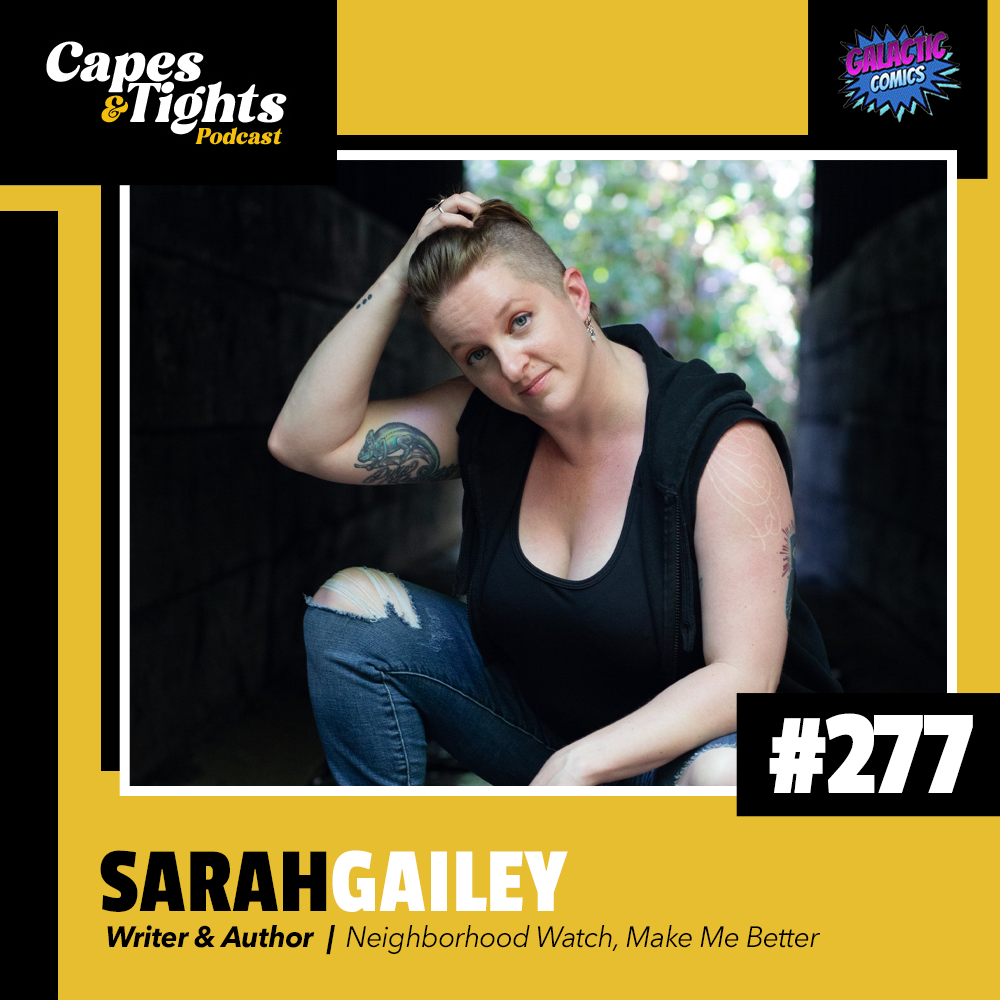
[00:00:00] Speaker A: Welcome back to the Capes and Tights podcast right here on Capesandtights.com, i'm your host, Justin Soderbergh. Once again, this episode is brought to you by our friends over at Galactic Comics and Collectibles at galactic comics and collectibles.com this episode we welcome author and writer, comic book writer Sarah Gailey to the podcast. Sarah is a Hugo Award and British fantasy award winning author and best selling author of speculative fiction, short stories and essays as well as horror stuff as well. They are known for comics such as Eat the Rich, Know youw Station and now Neighborhood Watch which is on shelves now at your local comic book.
In the world of novels, they're known for books like just like Spread Me and the upcoming Make Me Better pre order it today. But yeah, Sarah came on to talk about all those things and so much more. But before you listen or watch, follow us on Facebook, Instagram, Twitter, bluesky, threads, all those places, you can rate, review, subscribe over on Apple, Spotify or wherever you find your podcast. You can also visit us for the video portion of the
[email protected] and as always, rate reviews, subscribes. All not review, subscribe all those things over@capes and tights.com so check it out. This is Sarah Gailey talking neighborhood watching a little bit about Make Me Better. Enjoy everyone.
Welcome to the podcast there. How are you today?
[00:01:21] Speaker B: I am doing so good. I'm so excited to be here.
As we're recording this, I am one week away from getting married, so I'm a little bonkers in the brain because I'm balancing like 100 million things in my mind at all times. So you're gonna get a very unhinged version of me for this recording.
[00:01:43] Speaker A: That's amazing though. Like, that's awesome. Well, early congratulations.
Marriage is wonderful. You know, it's one of those fun things you just can say, hey, I just spend with my partner for the rest of my life. This is amazing. So yes, that's awesome. I was glad because we had to schedule this because I mentioned before I had food poisoning and I'm glad it wasn't like this and rescheduling it because we would have just been like in this limbo for a while because you would have been getting married and then not wanting to talk to anybody. No. But then you got your book tour coming up, so like it's the whole thing. Like you're just, you're squeezing it in there. Right? Like you're just.
I got married during the pandemic so it wasn't any much better.
[00:02:15] Speaker B: So when we were figuring out when to get married, we got engaged in November, and we were figuring out when to get married. And it's a pretty, like, large family. And so we were like, you know, we're gonna need time to make this happen. But also we're very impatient to be married. We want to be married to each other. We're like.
And I was looking at my calendar and I was traveling for work for literally all of March, all of it, the whole thing. I was home for, I think, one day to do my laundry.
And then in May, my book comes out and I go on tour. And I was like, okay, can't do March, can't do May. And then the only month that all of our heart people could come was April. And I just turned to my partner and said, okay, so here's what's going to happen in June. I'm going to go into a sarcophagus and then I'm not coming back out for a little while.
[00:03:08] Speaker A: That sounds like an amazing idea.
No, but that's a fun thing. It is hard. I can see, like, for most of us scheduling something like that, it's like, I can schedule it in the summertime, then I'll schedule everything around that where it seems like comics, novels, all the other stuff that you're doing, it seems like you almost have to schedule that around everything else.
[00:03:30] Speaker B: Exactly. And I will say, though, one thing that nobody told me ahead of time is scheduling a wedding in the off season. You save thousands of dollars and every vendor is available.
No run around of like, oh, you're only available on this day. And also because we both work in creative industries and so do most of our friends and family, we're getting married on a Tuesday.
So it's like discounts on discounts. And boy, is that nice.
[00:04:01] Speaker A: It's also probably me in creative industry too. Like, a lot of weekends in summertime for them is too like con season and other stuff like that. A lot books come out in the summer. So I can imagine that, like, on the weekend would be hard anyway. So, like, Tuesday is probably great. Saving money and making people's schedules better. Well, it's like the same thing with this. I always get to people. Like, I work, I'm a creative director for a brewery by day. And but the benefit I get is that this is my lunch break. And so, like, I'll eat while I work before, like, up until this point, I ate my lunch, I'll record with you and then I'll Go back to working, and then I'll edit it at night.
[00:04:35] Speaker B: And.
[00:04:35] Speaker A: And the benefit I get from working from home and doing that is this. And people are always like, you can record during the day because anytime, any. All these podcasts are like, I'm available after 9:00pm and they're all like, Dude, I'm like, Done by 9:00pm I'm in bed. And so, like, the benefit I've gotten from multiple people been like, you can do it during the day. This is amazing. Yes, I'll be on your podcast. This is awesome. So, yeah, working around someone's schedule like that, it's kind of funny. But, yeah, it's fun. I got married at a Boy Scout camp because the, like, in the facility, in the building, because it was like 800 bucks for the day or something like that. It was some sort of crazy, cheap thing, and it was beautiful. It's obviously this wood structure. Saw a lake. It was. It was awesome. It's just I had like, max of 50 people, and like, half the people were wearing masks. It was like August of 2020. So it was a very unique experience in that sense. But, hey, we were happy. Exam. We wanted to get married. They're like, well, we could delay it a year, but we're also like, how long is this pandemic thing gonna go on? So, like, delaying it a year. Still could have the same situation. And a year later. Yeah. And again, nowadays, you feel more safe doing stuff like that. But, yeah, it was one of those things. We wanted to get married, wanted to do it. We want to move on with our lives. This is how we're going to do it. And if people are mad, they can't come because they're the 51st person.
[00:05:43] Speaker B: Sorry.
Be more friend than each other early.
[00:05:47] Speaker A: Be more friendly. Be more of a friend to us. We should have done it like, whoever. Give us the best gifts. You send us what you're going to get us for a gift, and then you can make the list if you get. If you're getting us a $5 gift. Sorry.
[00:05:59] Speaker B: You keep that ranking published live, too.
You. You keep that. You're like, hey, where are you in the bracket? You can change your fate. Just.
Just throw down a stand mixer.
[00:06:11] Speaker A: And the better you are at this, you get closer, too. You can be closer. You can sit at our table with us. Depending on what you get. We, you know, the married couple and you. But you want to be best man.
You want to be best man. Here you go. No, uh, that's. Yeah, it's.
[00:06:28] Speaker B: It's.
[00:06:29] Speaker A: It's fine. That is a lot of work. My, my sister in law was just talking about how she's getting, she's getting married in September, but then they're moving to Montana from Maine. So like add that into it too. Like literally like weeks after.
But she was saying that she's happy that things are starting to like fall into place and now is just waiting for the day and figuring that stuff out which is, which is really cool. But yeah, that's a lot that I was gonna ask you. One of my questions I actually had there was like how do you balance between releasing a book and releasing a comic into marketing and promoting it. But then you add in there as a wedding as.
So I guess we'll get into that. Like how is that? Like if you're on here talking, we cover novels and comics on here, so we'll talk a little bit about both.
But you do podcasts or interviews that are comic centric and you do ones that are prose novel centric. Like do you have to pick them? Do whatever comes? How do you keep that organized in your brain?
[00:07:19] Speaker B: I will say it is not an easy valence. Especially in the world of comics, a lot of the promotion lands on the creators, which is part of what you're signing up for. When you, especially with creator owned comics, when you're making something that's not part of an existing ip, there's an expectation that the creators are going to do a lot of promotion online and I'm totally fine doing that.
I'm saying that if my beloved, incredible, wonderful assistant, who I couldn't live without, hears me saying that I'm going to get such a spicy text about how really, if I'm fine doing it, why can't I remember to post on Instagram without being reminded?
But you know, ideologically I'm fine with it.
In promoting a novel with a major publisher, mainstream publishing, not self pub, there's still a lot of expectation that the author will represent the work. The publisher is doing a lot of marketing, they do a big lift and I'm very fortunate to be extremely well supported by my publisher. But there is expectation that I am also out there being the face of the book. I'm the one who goes to an event and I say this is mine. Even though, as in comics, there's a lot of creative collaboration in prose writing.
So that said, there's a big lift expected from me on both arms, both the comics arm and the prose arm. And I'm fortunate enough to have a one month gap in between these projects. Coming out, which means that I can do the like, big lift for Neighborhood Watch and do a lot of promo there before rolling into my ramp up for Make Me Better.
Make Me Better is coming out May 12th and right around the corner. And I have like basically a personal marketing plan of like, you know, one week out, here's what I'm going to be posting. Two weeks out, here's what I'm going to be posting and all that.
In addition to that, I'm very well supported by marketing and publicity who do things like reaching out to you to say, do you want to have Sarah on the podcast?
And then I have a really unique, like, good fortune in this, which is that my readers cross over.
And this is really interesting. There's all this traditional wisdom in both comics publishing and prose publishing that says readers don't cross over. Comics readers is comics readers, book readers is book readers. And within prose publishing, there's a lot of traditional wisdom that says science fiction readers read science fiction, horror readers read horror. Right, because that's who. That's your marketing segment. That's where that comes from. And it's all coming from people who have a lot of experience and are smarter about the industry than I'm ever going to be in my whole life.
However, I get to be this annoying little outlier.
I must be so irritating to them because my prose readers cross cross genres for me. They will see that I have a horror novel coming out and be like, I've never read horror before, but I liked your other stuff, so here I go.
And that also happens for me across forms.
No one believed me for a really long time. I kept going to people in the industry and going, I gotta leverage this. Like, my comics readers keep coming to me with copies of my prose novels and saying, I never read prose, but I bought this. And the same happens the other way. My prose readers will come to me and go, I don't normally read comics, but I heard you had one coming out. And so. And then I went into the store and I saw that they had a bunch of different covers and I didn't know which one's best, so I bought all the covers. Which one should I have you sign or whatever? And when they say that, it's like, it's like getting smacked on the back of the head with a good luck hammer. It's just like somehow I've managed to tap into readerships that are so adventurous and courageous with their taste.
And so having a comic come out, I think for a lot of people would be its own Kind of column of marketing and conversation. But because my readers cross over and wander around, I get to use the comics promotion to also say, also, I have a novel coming out. And when the novel comes out, I'll be able to say, also, I have this comic that's on shelves right now, and the trade is going to come out such and such months, which I don't think I have on my gigantic scary calendar yet. But it's a lot of promotion. But also, it's like I get to use both of these things to promote the other one. I almost just said raise awareness as if my comics are like nose cancer.
[00:12:14] Speaker A: Yes. We need to raise awareness to your comics.
[00:12:18] Speaker B: Yeah, I'm gonna have a walkathon.
[00:12:21] Speaker A: Well, I mean, you make so much money on it. Maybe you should, you know, honestly.
[00:12:25] Speaker B: Yeah.
[00:12:27] Speaker A: Help support us. No, no, that makes sense. It's funny how you say that, because I do talk. I'm a huge. I. I read a lot of books. You know, I read hundreds of books a year. I read, you know, probably thousands of issues of comics a year, depending on, you know, what, what year it is and so on and so forth. And with this, I read a lot of number ones, uh, you know, to get ready for promotion for people. I usually tend to try a week or two before. But, like, again this week, your your your know, your state or sorry, Neighborhood watch came out April 8th, and this is going to come out April 15th. So, like, it is already on shelves. Usually we're like the release date or the week prior to get people to talk about it, or this time right now to talk about. Make me better. At some point, it's, it's coming out. It's like getting ahead of it. So read a lot of that stuff. But, like, what I talked. I talked to a lot of people like you, you know, who are cross pro. Like, there's a few people that we talked to, I mean, recently, just over the years, Christopher Gold and Clay McLeod Chapman and Adam Caesar and Daniel Krause. They've all been on and they talk. Oh, Clay. It's amazing. Clay's actually been up. I've actually had Clay up to Bangor. I brought him up to where I live in Bangor, Maine, last. Last May to do an event up here with Christopher golden, actually.
But they're the kind of people that, like, they have the people who follow them, that know them, right? They write books, and then they're the people that follow them and read their comics and they're like. There's very little of this, like, crossover when you Say to someone, you, Adam Caesar wrote Dead Mall for Dark Horse. And they're like, doesn't he write the Clown in the Cornfield books? I mean, yeah, they can do both. Like, it's the thing they can do. But you're right, there is this, like, one. There's fans of one, fans of another, and they don't usually cross over. And I can say this. I mean, know your Station really invited me into. I actually missed the boat on Eat the Rich. But, like, Know youw Station, being a fan of Liana's brought me into Know youw Station. We read it for our book club, actually, my book club. Book club for the comic. Book comic store. A couple of years ago, we read or whatever. It came out one of the. Yeah, it's. It's fantastic. I love talking about it. But they.
But because of that. And then I was like, oh, just like home. And then whenever a book comes out now, it's like, I got to read this because I feel like, yeah, you have this. And what I can imagine in your head that you have these ideas, and this would make sense for prose novel, and this would make sense for comics, and this would make sense for whatever, you know, Like, I'm guessing that's how it is. But it could go, like, I would have read Spread Me or Make Me Better as a comic if you could do it. But it makes sense to get away
[00:14:42] Speaker B: with the Spread Me as a comic.
[00:14:44] Speaker A: It makes sense.
[00:14:45] Speaker B: I would be putting that one in the foil bags.
[00:14:49] Speaker A: Well, I mean, tell you what. I've always said there's a missed opportunity because, like, James Tiny in the forest there, his world tree. The character's a nudist. And I thought to myself, why wasn't there a full nude cover with a black bag? Like, you had an opportunity. This is not. This is not. You, like, taking Vampirella and taking her clothes off and making it nude. Like, this character is nude in the comic book. You just don't show her that. Are you sure? Here and there. But, like, you could do a nude comic cover that fits. It's not like you're just trying to throw down there to sell comics. Like, it fits the whole thing into a black bag and people could get home and all this other stuff, but it didn't happen. And I was just like, this could have been something here, people.
No, but, yeah. So, like, you have this crossover, and I said. Like I said, it draws me in and I get pumped when I find out. Like, I personally get pumped, and I'm like, this person writes books Too. Like, this is amazing. And then I just, like, die full in. And like, no one else, no other author matters at that moment because I'm just like, I want to read all their books.
But, yeah, it's true. And so I. You know, I mentioned I read audiobooks of yours as well. So, like, spread me. I listened to an audiobook format and I just read Make Me Better back in January, actually. So it's a little while ago.
But yeah. So, like, I love that. I do think that there is this rarity to that in that sense. Not to say you're the only person, but, like, you're probably one of a few that your marketing people are like, this is different.
[00:16:09] Speaker B: Yeah, well. And it's.
It's. It's like, because this traditional wisdom is that these readers don't. Don't go into each other's houses. I guess there's like. It feels sometimes like I'm inventing how to.
How to walk through this, like, duplex I've built.
It's also. I mean, it's.
I think that there is some frustration in certain sectors of comics about prose writers writing comics. There are certain people who really believe that those two things should never meet. And I will say, the one time I have encountered someone who knew that I wrote prose and had no idea I wrote comics was a prominent American Nazi, whose name I'm not even gonna say because he, like, term searches and web crawls for himself or whatever, but he put me on blast online at one point, saying, like, this person isn't a comics writer. Why are they talking about comics? Basically, at that point, I had two original series out. I had a ton of IP work under my belt. I had been going to Comic Con and doing this work for years and years, and I was so wounded initially when I saw this notification on social media that was saying that I wasn't a comics writer. And then I saw who was saying it, and I was like, oh, I'm doing something right. Fuck that guy. Like, if he doesn't know I'm. What I'm doing in the world, great.
[00:17:45] Speaker A: I also love the fact that, like, it'd be like, it's Edgar Allan Poe writing comic book. Like this. Like, this fact that you're, like, this person of, like, such stature in prose novels that you are just like, now I'm going to take my weight and just come over here to comic books and write comic books like that. To me, it's like, it's. There are people nowadays who are using comics knowing that they're.
I Mean, they're here and people like them and they are. They're famous people. And again, not going to mention it because I don't want to throw anybody under the bus a. And I don't want to get promotion for it. But there are people who are using comics as a avenue of how can I promote my thing. You wouldn't probably be able to write a comic book if it wasn't for who you were, that kind of thing. And they're having that nowadays. But they're also other people who are extremely. Patton Oswald is a fantastic comic book writer, fantastic actor, fantastic comedian.
But that's. He's not using Patton Oswald, the name to sell the. He wants to do this. Like, this is not like, all of his comics are well written.
He has the knowledge that goes into it. So, like, there's this weird sense of like, you're coming over here because you have some sort of weight to throw around and that comics is just like, oh, no one else matters. I can do this. I can do this too. But like I mentioned before, it's like there's a story. They're all stories. We're telling stories here. Audio dramas, you know, plays, movies, tv, all this stuff is a story. And sometimes a specific avenue to tell that story makes the most sense. And that's why it does work that way. And I've always said there's certain novels that I would love. Like, I'm a huge. Like I mentioned Adam Caesar. I'm wearing actually a Bapen shirt right now from Clown the Cornfield. I love those series. I would love him to write a horror comic book based on this. Like, not like adaptation, but like some of the stuff that happens in between or after like, segments here and there.
I'm reading currently Robert Kirkman and Jay Boninzinga's the Walking Dead novel series.
And those are adding on with a little bit of crossover to the comic book series. So, like, there's. There's place for both, like, sometimes like that. But, like, there is just, you know, make me better make sense in a novel. So why not write a novel, you
[00:19:49] Speaker B: know, Neighborhood Watch comic. It would be 9,000 issues long.
[00:19:52] Speaker A: Well, that's the other part about it is there's certain story, like there's short story format and long format. Like there's, there's, you know, like there's certain stories. There's a main author who I just read all of his books called the Mike Bowditch Mystery novels by Paul Dwarin, and he has a new one coming out that's 58 pages long. Obviously that author knew that that wasn't a full length novel, that he's going to write a story about the same character. But it's a short story because it makes sense to be a short story. And so there is these space for that. And I think that there's this, I don't know, it's territorial. But also this person you were talking about is just an ass anyway. So.
[00:20:25] Speaker B: Well, I mean, I think there's also, like, you can kind of tell when someone is trying to use comics as some kind of stepping stone as opposed to when they're passionate about the form. And I think, you know, you mentioned Pam Masalti is a great example of this.
I think also the Clive Barker comics that I've read are like, phenomenal. And it feels different, it crunches different between your teeth.
And for me, part of that excitement about the form is the creative collaboration involved. My work is totally different.
I'm not writing a comic to be like, look at my writing. I'm writing a comic script to say, hey, artists who I get to work with, here's what I think we should do.
And you know, Neighborhood Watch is such an incredible example of this. I'm getting to work with Heining and Rebecca Nulti on art and colors, and then Jody Troutman, incredible letters. And every step of my work on this comic has been me saying, like, how do we feature your art best? How do we highlight what you can do? How do we get weird with the format? Like, they let us put colors in the gutters, which is thrilling to me.
[00:21:54] Speaker A: Gosh, it was so amazing.
[00:21:57] Speaker B: I always.
[00:21:57] Speaker A: I get lost so much. They're like, I get lost so much. It is not. Without that, I still would have been fine. Like, your, your, your script and the artwork and all that stuff was fine to me in a sense that I would be able to pay attention. And there's not like this extreme deviation that you'd like or not. Sorry, they're not close enough. They'd be like, who the hell are these characters? Like, the characters look different, so that's great. But it makes it so much simpler and easier to tell what neighborhood you're in when the gutters are different colors. Like, that's just awesome.
[00:22:28] Speaker B: We also did different panel border shapes, which, again, it's like, this is one of the things that's wonderful about being a little bit more established in comics than I was when, for example, I wrote my first comic. That is how, like, linear time works.
Getting to say, hey, I want to take all these. I want to do all this weird stuff with format. I want to be formally adventurous. And I've said that to many editors over the years and frequently been met with like, hey, just so you know, like, that adds expense in some way, or that's going to be a pain in the ass for the artist. And I'm always really thankful for that advice because the writer who writes the script is the first step in a process of shit rolling downhill. And the last thing I want to do is crunch everybody else who that script then rolls to after me.
But with this one, we had enough lead time. We had an artist who was down, and we were able to be like, hey, let's have a little adventure. I got my scripts written, like, bonkers early, so we were able to give as much time as we could.
And, you know, I'm sure that there's. There's a lot on the remainder, the remaining parts of the process that had, you know, stressful parts in them because that's how creating something works. But we had somehow enough time and capacity and space to, like, really roll around in the form. And, oh, my God, I'm so excited about it. And Heining ran with everything I did. I would be like, I have this idea, and Heining would all of a sudden be all the way at the other end of the field.
Just incredible, incredible artist. And then, of course, we went to Rebecca Nolte for the colors, and the colors came back, and I felt like I just got hit in the face with a baseball bat. I was like, these are unbelievable. The visual language is just, like, stunning.
I'm sorry. I'm such a. I'm such a wife guy for my collaborators. I'm so, like, I'm glad because it's also, like, red carpet.
[00:24:41] Speaker A: Well, I think it's also this. This. This difference between. I mean, you've done. You've done Big two comics, too. And so a lot of that stuff is arranged marriage, in a sense. Like, a lot of that stuff's like, hey, we have an. We have an artist, and we have a, you know, writer. You guys are working together. Cool. Is that cool? Or like, here you are as a writer, you have these two artists to pick from or. Or those things. So you, like, you're really pigeonholed in that sense a little bit when it comes to some other publishing. But, like, this is like having the ability to work with someone you actually trust and care about. And all that stuff does make it. And when you're that proud of it afterwards, it's. I Mean, people will somebody, oh, you're trying to sell the comic. No, I mean, you're passionate about this. You can tell. You are very happy, very. To work with Heining. But, like, it's. It's. It's. It's beautiful. But, like, in the same sense, like, I laugh because I go at the end, I finished the first issue, and I'm like, so know your station is a murder mystery in space. And then you.
Then you got Neighborhood Watch, a murder mystery in certain communities. And, like, you just, like, killing people in, like, these different spaces. I feel like, is that just the way it is now?
[00:25:42] Speaker B: Absolutely. I mean, I don't get to do quite as much murder in Neighborhood Watch as I did in Know youw Station. Because Know youw Station was very much working on the NBC's Hannibal model of, like, we're gonna do. And I actually. I use that as a comp because I. When I was talking to Liana Kangas, my collaborator for New York Station, we had this meeting where, you know, I hadn't worked with Liana before, and my editor, Elizabeth Bry, had been like, you are gonna love Liana Kangas. I really think you should consider them to work on it on this project. And we had a meeting where I explained sort of the vision for the comic. And I was like, we want to have really visually stunning, brutal deaths in every issue. What's your comfort level with that? And Liana was like, what do you mean? What's my comfort level?
And, of course, from Liana's perspective, they're like, I'm an artist. I make art. Like, what are you talking about? From my perspective as, again, the person who, like, creates the situation the artist is going to get into. I want to know the boundaries. I want to be respectful.
And I ended up talking about this legendary thing that happened on NBC's Hannibal. There's an episode where a couple gets murdered and their backs are flayed, and then the skin is lifted up into these big wings. And they shot this scene. It was, like, so gory that the set underneath them started mildewing from the saturation of fake blood.
And they. Bryan Fuller reportedly was, like, extremely pleased with how the shooting went. But then the network came back to him and said, you're shooting this couple from behind, and you can see their butt cracks. And we can't show butt cracks on network.
And in frustration, he said, well, what if I just fill the butt cracks with blood? Will you be happy? And they said, that's perfect.
And so in talking to Liana in This meeting, I explained that, and I was like, we're trying to keep the rating of this comic. Like, we don't want it to be in the black bag.
We want to be able to sell to more people, so we want to keep it palatable to older teens and whatnot.
How do you feel about potentially filling the butt cracks with blood? And Liana was like, I'm on board.
[00:28:01] Speaker A: Yeah, let's do this.
[00:28:03] Speaker B: So that was. That was. The little tonal difference is like, Know youw Station. I got to really exercise my.
My how to creatively murder people. There's one issue where I had the comp for the image was a spiral sliced honey baked ham, which I feel Liana really delivered on. And then for Neighborhood Watch, we're kind of focused more on one specific event.
[00:28:27] Speaker A: And so it's not as gruesome of a death as of right now. You can see it's not as gruesome of a death as they fillet back into wings. Tell you that much for those who haven't seen it yet. But yeah, it's funny though. It's like there's this, like, I said that when we read Near Station, it was like, it was cool to tell people, like, there's these murders happening in space and like, the confinement of, like, there's someone killing someone in this space you can't get out of. Like, I feel like there's also this entrapment or this feel like claustrophobia feel of this. These communities as well, in the sense of, like, obviously people can just leave. I mean, it's. It's possible to just move. But in the same sense, you. It's a lot easy. It's not just like getting up and being like, see ya, peace. So you have this. I feel stuck in these things and so on and so forth, but like, these juxtaposition of these two different communities, like the complete polar opposite ends of the spectrum of how people live. And like, one person's like, you can't paint your friends purple. And this one over here is like, how do we make sure the vegetables grow better? It's like, wow, people have different mindsets in this situation and so on. But so did you. I mean, do you have, like, communities that you've thought about or have seen or been to or whatever that you had in mind when you went to create this? Like, these are ones I want to mimic.
[00:29:40] Speaker B: Absolutely. I mean, I've been part of communities that are similar to both communities in the book. I have lived in suburban environments where, you know, the length of your lawn is like, a topic of discussion. And if you put the wrong color of knocker on your front door, you're going to get a citation in the mail.
I've lived in hell, is what I'm saying.
And I've also lived in collaborative communal areas where it is like, okay, so and so is going to have way too much zucchini, and my clementines are going wild. How do we find a way to, like, exchange fresh produce and exchange preserves? And how do we. How do we pool our resources in a way that lets us support each other?
I much prefer the second kind, but they both have foibles and pitfalls and, you know, human beings are annoying and messy and complicated, no matter what environment you're in. I will also say, can I. Can I nerd out for a second on the actual design of the communities and Neighborhood watch? So this gated community with an HOA and this commune are on opposite sides of a big hill.
And the commune, Open Arms Intentional Collective, is built on the grounds of a former weapons manufacturing distribution center.
Basically, like picture an Amazon fulfillment warehouse, but for weapons. Because we do have those kinds of distro centers throughout the US And Canada, certainly.
And when that distribution center was abandoned by the weapons manufacturer, this commune moved in and took it over and started turning it into something else. And this is a thing I'm very into. I love Swartz to Plowshares is like, deep in my heart. I think that rehabilitation extends to land and manufacturing materials and machinery.
Meanwhile, this gated community is just a suburban residential community on the other side of the hill. And it's actually, this setup is based on something that I see frequently when I'm driving between the San Francisco Bay area, where I live, Los Angeles in Southern California.
As you go down the highway, you pass, like, a lot of horrible industrial meat facilities where there's cows packed in like sardines. But you also pass distribution centers for major companies. There's an Amazon one, I think. There's a Walmart one. There's a Costco one.
And these are kind of, you know, in areas that aren't necessarily close to major metropolitan centers and aren't necessarily close to established suburb. It's like the land there was probably cheap, and so the company bought a big hunk of it and built this massive, massive warehouse that you'll see, like, 100 semis outside of getting ready to transport stuff. And then about five miles later, you'll see a planned suburban community that's like, you know, that theme song from Weeds Tiny boxes. It's like, you know, 500 houses, all identical, all in a row. And there's billboards saying, like, come buy your new home today. And there's like a community pool that they'll advertise like a gym.
And that planned suburb is. Is only there to house the people who work at that distribution center. It's not like people are going to buy a house there and then commute an hour and a half up to San Francisco. That's not the plan anyway. That's not the idea.
And I've seen these rise, and then I've seen them fall. I've seen what happens when the distribution center closes. And suddenly there's an awful lot of houses for sale in that suburb. And what. What do we do?
So that's what I based these two communities on is like.
Like, okay, so a weapons manufacturer build a distribution center during, for example, a time of extreme profit, because that weapons manufacturer has gotten permission from the United States government to sell massive amounts of weapons to overseas interests.
I'm just pulling that one out of thinner.
So they've got a boom time. They've got this big distro center. They need a lot of people to work there, including people who are working in support roles like janitorial staff and warehouse workers and people who are working in C suite roles, managers.
We build this community nearby for them to live in. And that community is stratified in its own ways.
It's on the other side of the hill so that the people who are living in the community who don't work at the plant don't have to see it.
It's the first time I've gotten to tell anyone the humongous, ridiculous amount of backstory behind these communities. And it feels so good. Thank you for indulging me.
[00:34:57] Speaker A: That's great. And it's also kind of funny, is like, I could just. Now I want the prequel comic book of, like, the actual.
The closing of that facility and then the rise. No, but yeah, it's. You're right about that, though. Like, there's so many places. There are actually there's quite a few places like that. Maybe it's not that massive of a scale, but there's this. I mean, you see it all over the place where, like in history, like, oh, look at this abandoned mine city. Like, it's happened for centuries. It's not just a new thing where, like, there's a. Some sort of need for a lot of housing in a specific area, and then. Then that thing dies out and goes away.
They're just left to either completely abandoned or few people live there and tumbleweeds are going by and so on and so forth. But yeah, there's these neighborhood communities and there are different. I mean, there's some, obviously the similarities. They all live together. They also, they want to live together, but how they. What their first world problems are.
And you know, when you see that saying of like how long your grass is compared to how, you know, you can support.
Excuse me, support each other in a community is a lot different when you come to that. And then when there's a death, a mysterious death takes place. And that death technically happens at the beginning of this issue. So that's not even like a spoiler. It happens at the beginning, but also it happens at the end. Like, it's like, you see it, you know it's coming, but then how it's discovered and how all that stuff happens on. Later on the first issue. But, but you get to meet these.
[00:36:23] Speaker B: There was an early write up of this that referred to that as a death and that kind of got like picked up and circulated. But I'm not going to refer to it as a death.
[00:36:33] Speaker A: It's a, it's a body in the
[00:36:36] Speaker B: sense of we have a, we have a gunshot wound.
[00:36:38] Speaker A: Yes, I'm not going to. I'm not going to. Yes, it's a, it's a. But, yeah. And then they. Obviously it's going to force these communities to come together, I mean, or work together or at least see them interact. Because at this point in this first issue, now that I remember it, they don't interact with, together to each other. They don't, they know each other exists, but they're not like, people aren't saying hi to each other yet at this point into this first issue. Second issue comes out in May and May 20, so you'll be able to get a little bit more further along on this. But like, you have, you've lived in these kind of communities. You obviously like to, to kill people or, or shoot people in that sense. Narratively. Narratively like to kill people.
But is that like a. We needed to tell the story. Is this a story that's been like, percolating for a while? Is this something that, like, you know, you're not, like, you're not the comic book writer that's writing, you know, three or four times a year having a comic book come out. This is like once every couple of years you've had obviously black, white, widow and stuff like that. But like, independently, I should say, your own Creative story from the beginning. Eat the Rich, you know, Know youw Station and this are a little bit spread apart. Is there just a. Is this the right time for this comic book? Or was this just. I mean, obviously you're working with Boom on this too. So it's like, obviously they want to fit it into their schedule as well. But, like, have you been percolating on this idea for a while?
[00:37:54] Speaker B: Yeah, I've been. I've been percolating on a lot of things that are in this same world.
I've sort of been like, wandering around in it for a little while. I have.
I have a lot of interconnected concepts around, especially the weapons manufacturing industry and how it reaches into every aspect of American life. Like, it's one of those things that. I think that industry benefits a lot from us not thinking about it all that much, but once you start thinking about it, it's fucking everywhere. It gets into everything, and the money that moves around with it affects, like, every part of our lives.
And so I'd been sort of searching for a little bit for a way in to writing about that, and I got to write for a story for Black, White and Blood, which, oh, my God, was so much fun.
And that was sort of the first time I really got to pop the lid on this. I have the.
The Yautja warrior in the narrative coming to a weapons and tactics conference, which is something that these dipshits hold several times a year, where it's like, look at all of our means of murdering people from far away.
And, you know, people dress up in their little outfits to be like, look at me. I'm a big, tough warrior with my, you know, punisher skull, whatever.
And I'm very excited about drone missiles. And, you know, it's like. It's like this.
So researching these conferences really sent me to a dark place.
I have the. The yacht warriors showing up, because he's heard that this is where warriors are. And part of their code of honor is that they will only kill worthy victims were the opponents or people who represent a real threat. And so I got to really explore through the lens of someone who is very violent and approaches that violence as important and grounded. And with this code of honor and conduct, I got to put them in a situation with, I would say, a distinction, lack of honor, and a distinct lack of. Of actual importance being assigned to acts of violence.
And it was like, oh, this is what I want to be writing. It was awful to write. It was horrible. I had to learn so much about, like, gun culture and webtac culture and it was like, what? But it's also like this exists so prominently in our culture and getting to explore it was a thrill. And I just.
That's where, that's where my mind is lately. And getting to go, okay, so what, how does this bleed out into communities? Because a suburb that's founded in order to serve the needs of the people who work in this industry, it's going to have cop mindset to the bone.
That's what, that's what these suburban HOAs are.
I will say there's like, there's multiple types of HOA and like in a communal building, like a condo building. Right. Your HOA exists to like make sure your roof gets fixed or whatever.
But when you move into a suburban environment where people are atomized and living in single family residences, the HOA becomes way more of a means of policing people day to day. Like just taking the cop inside your head to the dog park and letting him run free off leash.
Then also working with police systems, which is something else I get to explore throughout this series is the HOA exists to report people to the cops.
That's what the neighborhood watches for. That's where the title comes from. A neighborhood watch is composed of people who want the opportunity to report something to the police.
And that is like such an inevitable bleed out from this industry that sees violence as a means of profit.
[00:42:32] Speaker A: It's funny reading this and seeing this, the HOA part of this you mentioned at the end there, it reminded me of the Arcadia episode of X Files. I don't know if you ever saw that episode like season six where they had, they went and lived as a couple on the HOA and there was another creature of some sort. Like it's like further than that. I just like every time I like hear the HOA now I'm always go back to that episode, but it's kind of cool. So you're seeing a Yachu warrior is going to come in to show up on a future issue. Is that you're trying to say?
Are you trying to say that? Yeah, I started trying to say a yacht worry is going to show up in a future issue of Neighborhood Watchers that no spoiler.
No, but I understand that like you get this mindset and you like you want to create your creative person so you want to use the. When you're stuck in this space and you want to place to. To an outlet in a sense and it sparks and it works. And you have a great art team with, with Aing and Rebecca Naughty and like you mentioned, it's like it works in this fashion. Like it. It definitely. And I'm a big, like I said, I'm a big fan of yours. In the first place, your writing is phenomenal. And I not just saying that because you're on here. Another reason the benefit I have of running your own podcast is that I get to talk to who I want to talk to instead of who I have to talk to. It's not like I could have responded back to the. To an email saying, do you want to have Sarah on your podcast? I could have been like, my schedule's kind of full. Sorry, you know what I mean, if I didn't want to talk to you. So like there is this, this, this benefit to that. So I really like your writing. And so there was a no questions gonna grab this to my. Add this to my polis. Plus I'm a huge fan of Boom. So there's also that and all that stuff too. So like that the connection to all of that. But then when I read the first issue, it's like, this is, this is amazing. I can't wait for more of this. Like, I'm a huge fan of single issue comics, but then read an issue like this, you're like, screw single issue comics. Give me the graphic novel. Forget that. You know what I'm like. Because it's like, there's certain ones, you're like, okay, that makes sense. I'm ready for the next issue or whatever. But like, there's certain ones that just end. And you're like, I want more now. And in someone in this industry, I get to read it like weeks in advance. And so not only am I waiting between issue one and two publication, but I'm also now waiting the extra weeks that you. That I got the first issue.
And I tend to not. I tend to, if I'm gonna review it, I'll read it advanced. If I'm not, I usually tend to just wait till you get new comic book day on that sense. And I have a such a busy schedule, it's hard for me to review issues 2, 3, 4. I'll probably do issue 1, then the trade, you know, review of the trade. Because again, to me, it's like the premiere episode of a TV show is worth reviewing and then the end the whole series. Because like, issue, episode six of a TV show, it's like, well, they're leading up to an end. Like, there's a whole plan here. You can't really.
Issue one is to get people to read the rest of the series. But I'm like, I don't know what to say about issue three as much because, like, I'm waiting for issue four, maybe five. Like, I don't know what to tell you, but.
But yeah. So I'm excited for more of this Neighborhood Watch because it can go in so many different directions. I'm so pumped about that. Like, there's no definitive way. And then after talking to you, I'm like, I don't even know where we're going go now at this point. I'm excited to see where we're going to go on this point. But you, I mean, your, your issue 81 hit April 8th at local comic book shops, and I'm hoping it did. Well, I don't know if you get numbers ahead of time or any of that stuff or. You don't know.
[00:45:39] Speaker B: I don't get numbers, but I've been, I get, I'm again, I don't know if this is an outlying thing. I don't know if everyone gets to have this experience, but I feel so lucky every time it happened that I get to hear from comic book shop owners frequently. They'll contact me via Instagram or social media or whatever, and they'll tell me like, hey, issue one sold out, or I'm running out of this variant or whatever. And every time I'm like, both. There's both, like, the thrill of finding out that I'm making money for the publisher, which means they'll let me keep writing and then, and then also hearing that my readers are going to their local comic book stops.
I love that. I, again, like, my readership is so awesome and they love supporting independent booksellers, libraries and local comic shops. And it's like, hell yeah, that's the way to do it. I also, I do get to hear from librarians who are like, people check out your comics from the library, which is phenomenal. I love it.
[00:46:40] Speaker A: I love seeing like, like seeing sometimes like their trade and having the library's barcode on the side of it. I'm always like, yes, this is, it's all about. Because, like, it's, it's don't pirate comics. But other than that, read them. So like, if you borrow them from a friend, if you, if you go to the library and check it out, if you buy the graphic novel or buy the single issues, if you wait, whatever, digitally, whatever it may be, just read it. Because these creators are making these comics to be read. They'd like to get paid so that there's, there's there's that, but it's still like you. It was sunk. It would stink. You know, there was that stupid pharma guy who bought the Wu Tang Clan album. There was like that one album. He's the only person who's ever loved you. Listen to it or whatever it may be. It's like that to me is like, that's great, you made a bunch of money. But in the same sense, like, don't you create art to have people enjoy it? If you just created something and sold it to one person, they're required to keep it in a locked cabinet for the rest of their lives. It seems like. It seems like it's not very much art in that. Like you want people to read it. However, again, make money off of it. So there's this you have to pay your bills thing too. So we want you to continue creating comic books. But libraries are huge in that because the more libraries they buy copies and copies and copies of these trades and so that's a sale. And so hopefully people do that more again. But if you're financially strapped and you want to read issue one from someone else so you can go to the store and buy issues 2, 3, 4, 5, whatever, do that too. Just read them. That's my biggest thing. It's the same thing when it comes to prose novels, audiobook, physical book, digital book. Renting it from or taking it from the library, borrowing it from a friend. Just read this because someone had to buy it at some point. Just don't steal it. Please don't steal it. Yeah, that's all I'm saying.
[00:48:12] Speaker B: Yes, especially I would say don't steal from independent bookstores and local comic book shops. They, they are running on narrow margins and they're doing the real, real work out there.
[00:48:23] Speaker A: Yes, exactly. I wanted. We're going to finish up here, but I wanted to quickly just pitch make me better because again, that's coming out on May 12th at bookstores everywhere and it's also coming in audiobook. So there's that too. If you listen to it. Libre FM's huge on that because they support local bookstores. And bookshop.org is a great spot to grab that if you're looking to pre order it because they support local bookstores. Very simple to do. You can go on there and pick your bookstore. They get a little bit of money for it, which is awesome. Go to their shop and buy it if you can. But like if not, then that's the place to go to get that as well. And pre ordering is huge. So if you're listening to this episode, go pre order it, tell the book publisher that you want it, but tell people a little bit about what Make Me Better is about, so people can have an idea what they're buying an idea.
[00:49:06] Speaker B: So Make Me Better is a prose novel and it's about a high control community, a cult that lives on a secluded island in the middle of a saltwater lake. And this community promises that if you come and join them and adhere to their rules and live the way that they live, you will never have to experience grief or shame or loneliness ever again. It follows the stories of two different women who interact with this group in different ways at different times.
And it's really a very thorough meditation on how these groups appeal to, you know, just about everyone.
A lot of us like to think that we're immune to that kind of appeal, but grief and shame and loneliness are some of the most universal and unpleasant experiences of the human condition.
And, man, if someone came to you and said, hey, I promise you're never going to have to feel those again, I mean, how could you?
[00:50:13] Speaker A: Who would say no to that?
[00:50:15] Speaker B: Tempted.
And this is a book about that temptation.
[00:50:21] Speaker A: It's just like any of your. I hate to say this, but when I.
I know what to expect, but I don't know what to expect when I enter something that you write. Like, it's one of those things that, like, I expect a certain thing. And I'm like, but Sarah's gonna take this a notch in a direction that I'm gonna love. And same thing would have spread me.
I should have been known by the title that it was gonna like. Like, you should know. Should know by the solicitation, the book description, where it's gonna go. But like I said, it takes you there. And you're like, I don't know. Sometimes if you explain certain parts of the book that much into detail in an advertisement, whether or not it would have been a. I gotta read this book right away.
But then once you're in it, you're just like, I can't get enough. I want more. Like, I want more of this. I want more of that. And so making Better was a similar situation. If you're a fan of Sarah's work, you're gonna like this book. I will. I'll tell you that right now, comics wise or any of your previous novels, it's just fun. But it's also horrifying and psychologically horrifying and intense. But that's what I wanted from you. So it worked. So it worked. Perfectly for me.
[00:51:31] Speaker B: That means so much to me, especially right now in this lead up to it coming out as we're recording this. And actually I think as your listeners listen to it, I have no idea how it's going to land.
I can talk to individual people who say extremely touching and wonderful things about it. Thank you. But it's like every day it's kind of getting closer to that moment of like, how's this one going to do? And this one's risky. It asks a lot from the reader.
This is a book where I'm asking my reader to sit with some hard ideas and hard emotions. But like I said, my readership is incredible. I think readers don't get enough credit for, for how smart and brave and capable they are.
And so I just, I'm excited for us to go on this journey together.
[00:52:22] Speaker A: And if you are in the California area, this is gonna be out for a couple of weeks. So I don't usually promote dates because like it's evergreen thing people listen to whenever they want as much. But you have bookshops, you're going May 12, May 13, you're in California, you're in San Francisco, in Huntington beach, was it May 14th, you're in Salt Lake City.
And then May 15th is. My birthday is May 15th, so. But I don't live in Missouri, so I can't be there for that.
[00:52:46] Speaker B: Sorry, you're gonna have to move. Sorry.
[00:52:49] Speaker A: And then what I was trying to was like, so we're working on this thing. So I have a comic event that I do on May 16 here in Bangor. And we usually do. It's bigger. It's a one day comic show that we usually do in Bangor, Maine or Brewer, Maine, which is this neighboring city. And we decided to take it down a notch this year because the guy who runs it with me owns his comic book shop and he just doubled his space.
He just moved like last month. And so he doubled the space and he's like, ah, I kind of want to pack everything up, move across the city to do this one event. So we're like, let's bring it to you. And so we're doing an event that has no other comic book dealers coming, just some creators coming, which is really fun. But that's on May 16th. And so I was trying to get Clay McLeod Chapman. I'm like, hey, you want to come back up? And I said, he's like, I don't know. I'm like, it's my birthday weekend. And he's like, oh, why didn't you Say that ahead of time. Thanks a lot for the price pressure. I'm like, no, no, seriously, no pressure. I know New York City to, to, to, to Bangor is like a seven hour drive. And so I was like, it's not. I don't want to put any pressure on you, but we're still working on it.
And I pitched your name at some point to the local bookstore in the area to get you come up here. So we'll, we'll work at some point on seeing if you'll cry, fly across the country or come across the country to say hi to us in, in, in Maine here. But yes, you can see Stephen King's house. It's down the street. So there you go. Right?
But you can see, go see some spots and you're at some. You're doing comic cons to. Are you doing any upcoming comic cons or.
[00:54:11] Speaker B: I am. I don't know what's announced yet and they usually ask me not to announce before the con does. But I'm looking at my big scary calendar and I can say that if you are planning on going to any of the major comic Cons this the rest of this year, there is a 60% chance I'll be there.
[00:54:35] Speaker A: No, I understand that. So you are doing conventions. So keep an eye out on your Instagram or any social media posts for that because conventions are fun and you should support them and see the creators. It's just great because you can go to these individual events. Your book events are fantastic. And these book events, you mentioned the crossover. I know people like myself bring books to comic cons to get writers of comics to sign their books, but do they do that to these book events to bring up People bring their comics?
[00:54:59] Speaker B: Absolutely.
[00:55:00] Speaker A: That's awesome.
[00:55:01] Speaker B: And sometimes there will be a long line and someone in line will be like, I came in to the line with this book and then as I was walking through the line, I was talking to people and they were telling me about these books and I'll get people also. This is actually okay. When you go to a book event, buy a book from the store. That's the purpose of the book event, is to buy books from the store. Do it, do it, do it. But when people bring their copy of the book from home that's been like dropped in the bath and dog eared and like the spines ripped in half.
I am so thrilled because it's like this book has been getting read.
It's similar to.
Who was it? Maurice Sendak, I think, who drew a picture for like a little kid Wrote him a letter and he drew a picture to send back to them. And the kid's mom wrote back and said he loved it so much that he ate it.
[00:55:55] Speaker A: That is.
[00:55:56] Speaker B: It's like, I. That's a compliment.
[00:55:58] Speaker A: That's like the epitome. Like, I don't know, how could you get better than that, like, and not be weird? You know what I mean? Like, there's probably more things you could do that are really weird that you could go like, yeah, maybe not. I don't want to hear about that. I'm probably not going to tell that story to anybody. But, like, eating it, I could see that. Like, that's like an intimate and exciting thing.
I hope that's not. They don't do that all the time, though. I guess it seems like it would be very unhealthy when you get really excited about something and eat it.
Like, look at this raw.
I just.
[00:56:26] Speaker B: Different strokes. I don't know.
[00:56:27] Speaker A: Whatever. I mean. But that's awesome. That's really cool. No, I understand that. Like, I do that. It's like, you know, Joe Hill was up here. I was like, I brought a, you know, basket full of heads comic book to have him sign as well as the books that I bought at the shop or whatever. But I'm always like, why not? This is a place for them to sign books. Comic book is just as equal. So I know I said, I've done it the opposite, where someone's at a comic show and I've walked up to your booth or whatever and been like, can you sell my copy of Make Me Better?
But I've also done it. I was like, I want that. Bring your comics. If you're going to a place, buy the book at the place. But then also bring your comics to get signed too. Because that's always fun, but awesome. You have a big, big, big time coming up. You're getting married. But, like, go buy Neighborhood Watch. Hopefully it's still on the shelf of your local comic book shop. If it's not, see if they can reorder. I don't know what the distribution level looks like right now, but at least bring it up. Don't go in there and be like, I don't see it anywhere. Go talk to the owner or the person running the counter and ask them, is it possible for you to get this? Because there is any copies left at distribution level, get them to get it to the shop for you. If you can't and you missed out and it's sold out digitally is an option, then go Buy number two. I always hate this too. But your FOC date for number two was two days prior to the comic book coming out, number one coming out. So people didn't even have an opportunity to.
That's another whole topic about the comic book industry. That's a whole other topic about comic book industry. That is this neither here nor there right now. But. But look, local bookstores have the book. So go check out make me better at your bookstores. Spread me. If you're going to a bookstore, you can also get your trades there, which is really cool. So if you want to make one stop, go get your trades, order your trades from the local bookstore as well, which is really cool. So you can get Know your station and Eat the Rich. I'm guessing Eat the Rich is still on print, but I'm not sure. I don't know that. I didn't. I didn't do the research on that.
Yeah, I'm sure guessing it would be. It's popular. And then obviously you can get Know your station again. If you're waiting for a trade. We understand.
Look at that. There's no date out for that yet, by the way. Just so you know, that I know of. It's not online, at least. Only two issues are solicited right now. So is there only going to be two issues? No, they already canceled that. We're doing this episode and we already canceled it. No, but thank you, Sarah. I said a lot there. But like, thank you so much for coming on here and chatting your books, comics, all these kind of things. And congratulations early on getting married.
We're so excited for you and we'll get you back on it sometime in the future. Does that sound good?
[00:58:36] Speaker B: Absolutely. Get into my inbox anytime. And you've got my. You've got my contact information. I'd love to come back. And when I do come out to Maine, I will be looking up your brewery.
[00:58:46] Speaker A: Come, come. Yes, exactly. Liana did my 200th episode. Can. I don't know if you can see it. It's kind of right here.
It's kind of hard to see.
[00:58:53] Speaker B: Oh, yeah, I can see artwork.
[00:58:55] Speaker A: You see the artwork?
[00:58:58] Speaker B: Yeah.
[00:58:58] Speaker A: You see the artwork? This is some of the artwork that was done for it.
[00:59:01] Speaker B: Phenomenal.
[00:59:02] Speaker A: But. But Liana did that because Liana has been a longtime guest of the podcast. And I reached out, I was like, I have a milestone episode. It's 200 episode, and I love to do it. My brewery to a can for it. And they were very, very happy to do it. And then I sent out very late. I literally just said it was where this is episode 277. So we're like, 77 episodes. This episode came out, and I just sent her some blankly or some labels not on the can be like, can you sign me these for these for me?
Because I'm like, I really missed out on this. But yeah. So we're approaching 300. Maybe we'll get Liana back for 300. I don't know. We'll see.
[00:59:35] Speaker B: Awesome.
[00:59:36] Speaker A: But no, Leon is awesome. But thank you so much, Sarah. I really appreciate it. And we'll talk soon. Okay?
[00:59:40] Speaker B: Yeah. Thank you so much for having me on.
Sa.