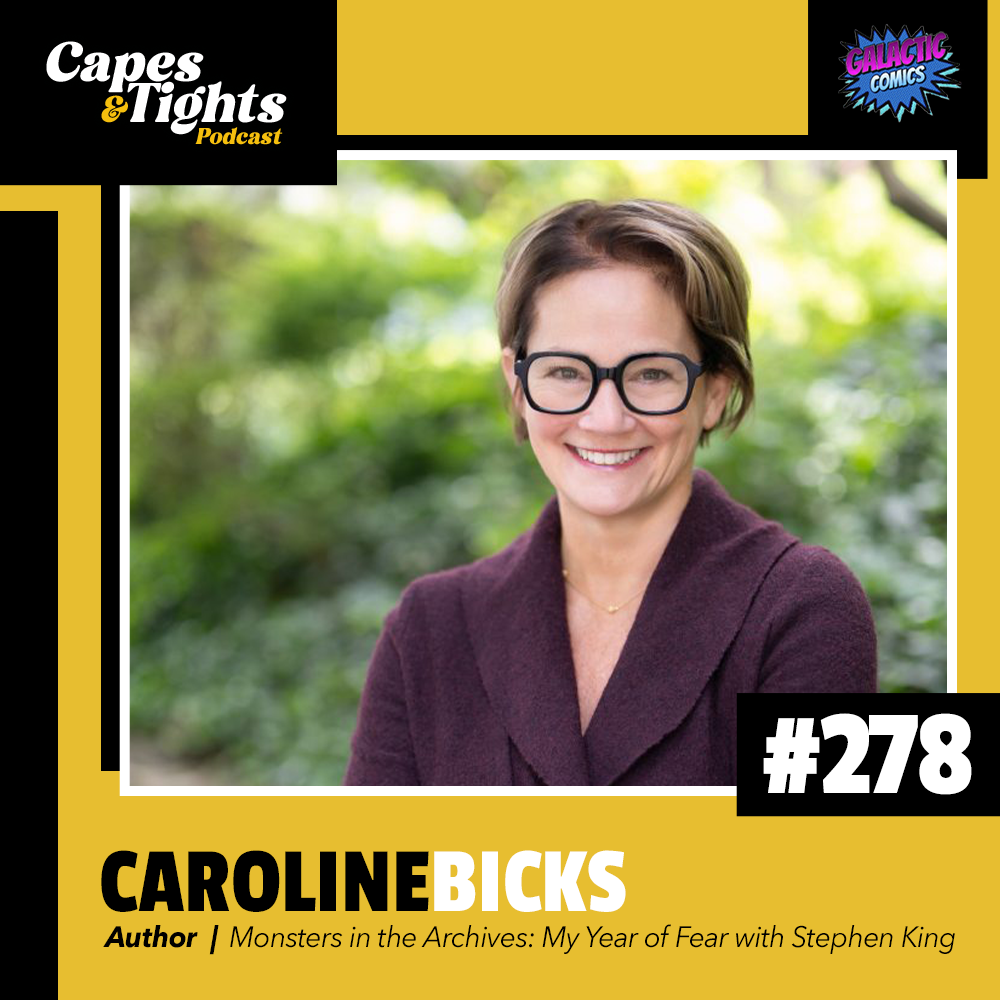
[00:00:00] Speaker A: Welcome back to the Capes and Tights podcast right here on Capesandtights.com, i'm your host, Justin Soderbergh. This episode is once again brought to you by our friends over at Galactic Comics and collectibles@g Galactic comicsandcollectibles.com or at 499 Hammond street in Bangor, Maine, if you're in the area. This episode we welcome Caroline Bix to the podcast, who is the Stephen E. King Chair in Literature at the University of Maine, where she teaches courses in Shakespeare, early modern culture and horror fiction. She is the author of many different books and co host of Everyday Shakespeare Podcast, where you can check out everywhere you find podcasts. But Caroline is here today to talk about her latest book, Monsters in the Archives, My Year of Fear with Stephen King, where she discusses how she went into the archives at Stephen King's house in Maine and discussed books like Pet Sematary, the Shining, Carrie, Night Shift and Salem's Lot and more. So check this episode out with Caroline Bixby right here on the podcast. But before you do, follow us on Facebook, Instagram, Twitter, bluesky, Threads, all those places you can rate, review, subscribe over on Apple, Spotify or wherever you find your podcast, as well
[email protected] for the video portion of the podcast. But as always, check out capesandtights.com this is Caroline Bix, author of Monsters in the Archives, right here on the Capes and Tights podcast. Enjoy.
Welcome to the podcast, Caroline. How are you today?
[00:01:28] Speaker B: Thank you. I, you know, I'm hanging in there.
As we were discussing, there's another snowstorm coming, so. Hey, it's April in Maine.
[00:01:38] Speaker A: Well, the benefit of the snowstorm is this late in the season, too. They tend to melt themselves a little bit. Like, I didn't. I did a good job shoveling for the last snowstorm and snowblowing. But like, there was a layer on the driveway after I finished snowblowing, and I just left it because I knew it would melt and it melted. So, you know, early in the season, you have to make sure you clean up very meticulously or it becomes a problem all winter.
[00:02:00] Speaker B: All I know is like, I take my dog out for a walk and I'm taking my life into my own hands every time. I'm like, core work, core work. You know, just don't, don't break your hip.
[00:02:12] Speaker A: No, that would be bad. That would be very bad.
[00:02:14] Speaker B: That'd be a sad way to kick off the year of the fire horse.
[00:02:17] Speaker A: Yes.
It's like insurance Renewal season at my work. And it was so funny. We're talking about like short term disability. Like, do you get a. Do you. And I'm thinking to myself, like, I work remotely very well. And so I'd have to like break both my arms, both my leg. It'd be a really bad situation.
[00:02:35] Speaker B: It's like, is it worth it?
[00:02:37] Speaker A: My wife was like, don't say that that's gonna happen now. Like, we can't have this.
Our lives for you. Plus we have two kids. They have a four year old and a two year old. That would not be very good. No. Oh no, no, no. That would be a horror story in itself right there, I'll tell you that much.
[00:02:53] Speaker B: Yeah.
[00:02:53] Speaker A: BUZZER yeah, we're not, we're here to talk Maine. But like, you know, the weather is one thing that we deal with and maybe that is, that's probably the main reason why our friend there, Stephen King, does live in Florida a lot more than in Maine. But that's, you know, neither here nor there.
But we're here to talk your book. We got your book coming out, Monsters in the archives. Your Year of Fear with Stephen King.
You are a literary chair, the inaugural Stephen E. King Literary Chair at University of Maine, down the street from my office where I work at Orno Brewing.
But I guess to start things off, I really just want to know, when did you know that you wanted to teach, you know, molding minds in, in the world of literary, you know, teaching in life.
[00:03:39] Speaker B: Wow.
[00:03:40] Speaker A: When you were to start that way
[00:03:41] Speaker B: to kick it off with a light question, Justin, you know, I, it's funny, I'd never thought of it as molding young minds. Like that wasn't the thing that drove me into this profession. Like, haha, I'm going to mold young Mayans.
I really, you know, I started in my early 20s teaching high school at a small school in New York City.
And I really just, you know, I was always passionate about literature and about talking about literature.
I had fantastic middle and high school teachers who, you know, showed me what is so awesome about language and specifically Shakespeare. So when I graduated, graduated college, I just started teaching high school. But again, I wasn't like, they will think what I think, you know, I, first of all, I just want to put it out there. I'm a third child of four.
Most academics are only children or first children. So I go into this thinking, hey, I'm just here as a resource, let's just talk.
I've always enjoyed mediating.
So for me, when I teach, I'm Teaching it as a conversation that I'm having with the people I'm talking about books with, no matter what their age.
And, you know, part of that is just selfishly because I get bored hearing my own voice and hearing my own ideas. Yeah. Like, I want to hear what other people are thinking. And, you know, the incredible thing about being able to teach in. I've always been able to teach in kind of smaller classroom settings. So, you know, at Umaine, most of my classes are around 15 to 20 students.
And even at the graduate level as well, I've taught at the Breadliff School of English, which is a wonderful setting where it's a lot of high school teachers getting their master's degree. So I've taught a wide range of people at different points in their careers, in their age trajectories. The one thing I will say that is consistent. It's a long way around to your question, is that people, everyone has something valuable to say about a piece of literature.
And that if, you know, lecturing to me, I'm like, why would I. Yes, I can tell you what I think, but I want to hear what you think because that's where you can build. That's why works like Shakespeare and Stephen King endure. Because we're all bringing to it our own experiences and our own connections.
We're all going to see something different, which really is the spirit of why I wrote this book, Monsters in the Archives.
I didn't know what I was going to find when I walked into Stephen King's archives. That would have been so boring if I was like, well, I will be looking for references to the wizard of Oz and nothing else. You know, I mean, like, I didn't know what I was going to find. And I always try to, you know, when I'm teaching, I always try to hit this home with my students. Like, don't read the text, read it closely. You know, have the book in front of you. Don't go in with any preconceived ideas about what you're going to find, because then you're going to miss out on all of the magic. Right.
You're going to see something you didn't anticipate you were seeing. And you're going to see something different than the person sitting next to you.
And then we're going to come together, we're going to talk about it, and that's going to help you see even more things.
So, yeah, it's not for me about shaping minds. It's about what we're going to do. Together with this. What's the alchemy that's going to happen when you put a great piece of literature into the center of the table and you start talking about it?
[00:07:13] Speaker A: Almost how are they going to shape your mind really, to be honest with you, like, how are you going to change how I feel on something?
[00:07:17] Speaker B: I always tell my students that I'm like, I know I've been teaching Shakespeare for 30 years. I've written many books about Shakespeare, but there is always something new that you're going to show me that I will have not seen. I always make that clear at the start of the semester. And it's true.
It's.
[00:07:31] Speaker A: It's funny how you mentioned the how Stephen King and how people have stories about things. There is. It's weird. So I've been a couple events recently in the past couple of years. We talked when you met with me at or in a brewing. But how about he showed up at his son's book event that happened with Keith Rosin a couple years ago.
Joe Hill was the in conversation. So Stephen showed up and people talked about, oh, Stephen's here today. It's crazy. And then he showed up for the End of the World that We Know it book release at Bookspace in Bangor. Knowing that. And then people started telling their stories about their first Stephen King experiences or all. It's so weird to think that, like, I think about it as being from I moved to Bangor, Maine when I was 10, I'm 4, I'll be 40 in May. And so when I was 10, I moved to Bangor, Maine. There was a gap in the year there. I moved back to Massachusetts. But that's not neither here nor there. But for me, growing up in this area, it was always just like Stephen King. Stephen King. Stephen King was always just so cool. But what I didn't realize it until I got older and thought it's hard talking to people on the podcast or across the world through social media is that these are conversations people are having everywhere. This isn't just because he's in our backyard and we walk by his house to go to the park or something like that. Like, these are conversations people are having about what was your first Stephen King book? Or what's your favorite or what's your favorite adaptation to a movie or something like that. It's just it baffled me that I only always thought as like this small little world that because he's in our backyard, you're gonna focus on him. It's worldwide.
[00:08:58] Speaker B: Right? But I think you're hitting on something really important that makes Stephen King so unique is that he is such a, on the one hand, local writer, right? I mean, like, especially the books that I'm looking at from the 1970s, you know, they're so main based, right? And he really put Maine on the map. So you have a very specific kind of different relationship with him. But he's also so universal. Like he's so global that I can meet someone anywhere I am, you know, any context. I can be on a bus in another country. You know, there's going to be somebody when they find out what I do, who, who has a specific memory about a specific line from a specific book that still sits with them 40, 50 years after they've read it.
So there's this. And again, that was part of why I wanted to.
What became clear to me as I was working in the archives and thinking about what kind of book I wanted to create out of this was to tap into that.
What are sort of the universal elements when we're talking about. And I should say, of course, we're talking about English language. You know, the way that he's.
He's able to manipulate the English language to produce certain sound effects.
But also what are the ways that he is so place based, he is so local. Which is something I didn't appreciate because I grew up in New York City. You know, I mean, I read. I first encountered his stories in Castine, Maine, because my parents took us to Castine every summer. We would spend our summers there. So it was actually the Witherly Memorial Library in Castine where I first found Stephen King when I was 12.
So I, I did have some connection, but I didn't, I didn't really get what it meant, like what Bangor, why that was so important to these stories. Or Durham for that matter, with Salem's Lot.
Until I was researching this book and really starting to learn more from him and from reading his interviews and mining the books for the ways they intersect those early books and how important how Maine is a character in his books in a lot of those early books.
[00:11:00] Speaker A: It's funny because I do have a similar. I have an experience of living in Maine and growing up with Steven and so. But I almost had. I had this like weird childhood or, you know, high school years of like wanting to be not weird, but wanting to be different, wanting to be the person. I almost put myself, a teenager who
[00:11:14] Speaker B: has ever wanted to do that.
[00:11:16] Speaker A: I wanted to put myself as the outcast. I mean, I was into skateboarding, I was into heavy music and all. But in the same sense of that. I wanted that oppositeness of everybody else. So I always was like, steven's a local guy. I'm not gonna pay much attention to that guy. It was one of those weird, weird, like, you know, anarchist thing against Stephen King. For some weird reason, he's the local author. So I'm gonna go check out someone else because he's right there. Why would I need to care about that guy? And so it wasn't until later in life, you know, as I got a little older and honestly into my 30s, where I even started actually exploring his actual books. Like, I actually get into it. I'd seen the movies, Pet Sematary, I've seen the things. Because that was easy access stuff. And it didn't take much time, couple hours of my night to watch a movie here and there. But it wasn't until later. And it was funny because I picked. My first Stephen King book I ever wrote was actually Sickle the Werewolf. And that was mainly because it was so short.
Stephen King, in my mind, had always had this like, oh, my gosh, he writes such long novels. I'm like, well, I'm going to start off by saying I conquered it and read a book, but I'm going to read one of the shortest books. And that was why after that, I jumped into Salem's Law and so on. Salem's Law has become one of my favorite books of all time. But it was funny how I just didn't want that. And it was. It was like this odd, like, push off of Stephen King because he was local and. But that's a story. I mean, that's not. It's very uncommon story, I would think, because I live in. I literally grew up two blocks from his house, a block and a half from his house. I'd walk to the park, he'd walk by his house, and I go to the comic book store now on the way from Orno, and I drive down Union street, and then I drive down West Broadway to get to Hammond Street. And you drive by his house. And I laugh as an adult. Like, all these people, like these tourists.
I'm like, look at them all out there sitting there thinking they're gonna see him in the window.
But no, it's funny. And it's crazy that I've invited authors up to come up to Hero. We've had Clay McLeod Chapman and Christopher golden and Daniel Krausen. All of them stop by the house to take a picture in front of the house. And it was this crazy thought that, like, there's Such a. A lore behind this guy who's just a guy. You see him on the street, people wave at him. Still to this day, a guy who's worth millions of dollars, sold many, many, many, many copies of books, won awards like, you know, been on, had movies made, and people just wait. He just waves at you. And it's just crazy. So there's that. There's the actual books like you talked about, where there's this Internet connectivity to them about Maine and the character that Maine is in there. But, like, what was the driving force to actually starting this? Obviously. Well, I guess let's go back up a little bit. How did you become this, the inaugural Stephen E. King Chair. How about that? Why don't we start there, actually, before
[00:13:49] Speaker B: we get into something? So we have to go back to 2016, when the job was advertised.
So I was at Boston College for 15 years before coming here.
I was tenured, I was part of English faculty, Shakespeare professor, you know, having a perfectly lovely time at Boston College. It's a great, great school.
But I was at a point in my career where I felt like there was. There must be another chapter, you know, because you get tenure and, you know, it's fine, it's great. It's an incredible privilege.
There isn't always an incentive to try new things. Once that happens, although I should back up, there is an incentive to try new things and that you can try things that aren't academic and it's not going to affect your job. So that was a way for me to start exploring things. Like my very good friend and collaborator, Michelle Ephraim, who is a Shakespeare professor at Worcester Polytechnic Institute. She and I had been sort of blogging about Shakespeare. We both have senses of humor.
We both don't take ourselves too seriously. I mean, we're both serious academics, but we also like to have fun with Shakespeare. So we started a blog, Everyday Shakespeare. And then we started. We wrote a cocktail book, Shakespeare Not Stirred. That was our first commercial book, which actually did really well. I was like, oh, okay, great. We can have fun with Shakespeare.
And then now we have our podcast, the Everyday Shakespeare Podcast.
All that is to say that when this job came up, the Stephen E. King Chair in Literature at the University of Maine. And I saw that a big part of the job was. I mean, they looked. They wanted a Shakespearean. It was the English department was posting for a Shakespearean. But the fund itself, funded by the Harold Alphond Foundation, I should say. And we all know and love the Harold Alphond foundation here.
Great Supporters of the humanities, among other things in Maine, that the. The mission of the chair was to support the public humanities. So here was this fund available with the. You know, really, I had an opportunity to put my mark on that and say, okay, what does that mean to support the humanities? Like, the public humanities? What does that look like? I had been doing that through my podcasting and other kinds of public facing.
You know, I was doing creative nonfiction writing for the New York Times and McSweeney's and other kinds of venues. And I thought, okay, this is a great way to pull together my academic part of my brain and my side and my other things that I'm really interested in, which are bringing Shakespeare to popular media, you know, but also, hey, extra bonus. I love Stephen King. Like, this is incredible. Like, he actually. He and Shakespeare were, like, captured my imaginations at the same time. In my development as a 12, 13, 14 year old, I thought, this is incredible. What a great opportunity. I have no idea what this is going to look like. It was a huge risk. I was 50, you know, I was sad. I had kids in Boston who weren't particularly like, yeah, let's move to rural Maine, you know, Like, I definitely took some hits there for a couple years for my son, who was in the eighth grade, but very fortunate to have a husband who was like, yeah, why not? Let's do it. So they're like, all right, well, it looks like something's happening here, and it's gonna. Let's just go. So. So, you know, it just. It was one of those moments, you know, you have these moments in your life, they don't happen often, where it becomes so obvious you're supposed to be doing something that you just get on. You just get on the ride and you just go. And that's how it felt from the moment I read this job description, to getting here, to eventually meeting Stephen King, to the fact that the archive had just been collected and attached to their home in Bangor, to Stephen out of his home, and that they hadn't yet made it available to people in an extended way. And that I happened to have a sabbatical coming up. So it all felt like lightning in a bottle. Like, if I don't seize this moment, it's on me. Like, this is. This is one of those moments where the universe is like, here, here, look, look, look. You know, if you ignore it, that's on you, you know? So, like. So that's where I thought, okay, I have a sabbatical coming up, which doesn't happen very often.
I could write another Shakespeare book. I've done it before.
There's plenty of things I'd like to write about. But I thought, what an opportunity I really have to get in those archives. I really want to be the first one in there. I don't know what I'll find, but I know that I love those books. I know that I'm a fan of Stephen King. I had been teaching Stephen King's books in my classes.
I knew that.
I didn't think he had gotten the treatment he deserved from the Academy.
You know, that he is a phenomenal. I mean, I'm saying this. Most people listening to this would be like, of course, he's an incredible writer. But I felt like he hadn't gotten that kind of, like, really close attention to, you know, this. I begin the book with an anecdote from the foreword from On Writing Right, his memoir of the craft, where he's talking to Amy Tan and they're sort of talking about how weird it is when they do book events.
You know, Amy Tan says, how come nobody ever asks about the language?
I thought, okay, I think I have my mission now.
I'm going to talk about the language. Like, I'm going to go in there, I'm going to see what I find. I'm going to read those drafts. I'm going to see how he's crafting the language. I'm going to see in the notes he's writing to himself. I don't know what else I'm going to find in there, but I really want to talk about the language and give it its proper due and, you know, be the mediator. Right. Going back to our initial conversation, like, I see myself as the mediator between Stephen King's text and a wider public, but I have been privileged enough to have this position and that Stephen, Tabitha trusted me enough to. To let me be in that position, but that the University of Maine trusted me to hire me, you know, that it felt like this was so natural in a way, that this is what I was supposed to be doing next.
Organic. Really?
[00:19:59] Speaker A: Yeah. I mean, I know exactly on a different level and different side of things about that feeling of, like, this is just the way it's supposed to happen. This is what we're supposed to do. Because my job at Orno Brewing Company started that way, in a sense, that I had gone through a divorce and I was a single dude living in Maine. And I'm like, I don't know what to do next. I was working in the field that I've been working in, which was go as a creative person, a marketing person working for car dealership and brewer and. And this job for Orno Brewing as a manager of their tasting rooms came available. I'm like, I love beer, I love working with people. I don't care. I'll cancel everything. I'll go to a flip phone with pay as you go, I'll cancel Netflix. I'll do whatever it needs to be to get this job because I don't care what the pay is. Come to find out the pay was worth it. I could keep everything and do everything, but nine years later, I'm still there. And it was one of those things that if I didn't take that opportunity at that moment in time, I probably wouldn't have taken it if I was still married because it would have been a different risks, all that stuff if I had kids or whatever. So it took that time to be like, we need to do this and make this happen. And nine years later, I'm still, still kicking there, which is amazing. And I've gotten the opportunity now to do stuff like this and meet people like yourself and, and all that stuff. So it's just cool to see that, like, you just take that chance and you get there. And for you, it ended up leading up to, to meeting Stephen King and getting to read early works and things like that, which is, which is craz.
[00:21:17] Speaker B: Which is crazy. Nuts though. And that's why, like, when I talk to my own kids and I talk to, you know, people that my students, I'm teaching, I'm like, you don't have to know what you're doing when you're 22.
In fact, I'd be worried if you knew what you were going to do with the rest of your life when you were 22. You know, you've got, you know, use me as the poster child for post 50, you know, transformation, like it can happen, you know, just, just get on
[00:21:43] Speaker A: the ride and go and see what happens. And that's the thing is, and I think there's a little bit of a.
That's way too risky. And there's a, that's risky, but like, we can make it work kind of thing. And I think that's where this falls in that sense. Like, if it didn't work out, you are in the teaching field, you probably could have found something else to go and do and so on and so forth. But this is working and it's amazing. And I think that there's this connection, obviously this connection to Bangor, Stephen King, but like, now there's the connection. Also student at Humane, teaching at Humane, and obviously being around this area and stuff like that. And so the legend of Stephen King has grown and survived. But it's mainly because, I mean, I have a stack of some of the original, like, the works. I've got the only one. I actually don't. I actually don't even own Night Shift at all, but I have.
[00:22:29] Speaker B: It's okay, hold on.
[00:22:31] Speaker A: So you have. Right there.
So there you go. See, I don't have, but I have.
[00:22:37] Speaker B: This is the original one that I read.
It came out in 1978, but this is the one I found on ebay.
[00:22:44] Speaker A: That's amazing.
Yeah, I was able to get a bunch of them over the years. Like I mentioned, it was late in life that I actually started to collect and do that. So I have. It's funny, I have a bookshelf built in bookshelves over here. You can't see. And then there's a shelf in my dining room that has a glass case in front of it that I used years ago. That's where the Stephen King's books live. Because this, like, there's so many of them, first of all, that it takes up so much room that I'm like, I need to have another spot for it. And then also people come over. They're like, oh, that's kind of cool. You know, maybe they don't come in here that often, or whatever. But you got to read. We got to read all these. You got to read some of the alternate endings, some of the notes on the side of where things are going to go, original storylines that changed and things like that. That's cool. Obviously, like, jealous here. Everybody should be jealous of that. But did that. Did that change any of that? Like, did it, like, it was obviously great for the book, so people can learn about this stuff and you talk about language and things like that. But that, as a Stephen King fan, now you've seen behind the curtain.
Does it change? Positive, negative? Is there any. Like, is it just more wonderful? I just try to think of, like, did it ruin any. Like, did it. See. It ruined the lot. Because some of things were different in original.
[00:23:54] Speaker B: No, it ruined nothing. Ever. Nothing. It made it even more fabulous, you know, because I could appreciate how he got to what has become the iconic story, right? To get to talk to him and, you know, because he was very generous with his time, you know, have conversations with him about, like, why did you change that? You know, and sometimes he'd be like, I don't remember. You know, it was 50 years ago. So it's also just incredible to like, he's a human.
He's this creative force, you know, who just keeps creating and creating and creating. And so it was very generous of him to be willing to spend so much time going back in time 50 years often. Right. Most of these books I'm talking about, he wrote 50 years ago. They're all having these 50 year anniversaries now.
So first of all, incredible that I can remember why he did some of the changes, because I can't even remember yesterday what I did.
This man has an incredible. It's a shocking memory.
[00:24:52] Speaker A: It's hard for you to remember changes to the book you just wrote.
[00:24:55] Speaker B: I can't even remember exactly when you're. When I'm like, did I write about that part? Yes, I did. Okay.
Yeah, so, so, yeah, so to hear, I mean, some of the conversations were, for me, all of them were profound. But I think what I would say, I can't really pick a favorite moment, but I would, I will talk a little bit about the Shining and what that experience was like, because I had no idea because a lot of this is not documented anywhere. You know, going into the archive, I'm like, I don't know what's going to be there. I mean, people might had. I mean, again, because there's such a fan base and an energy around Stephen King globally. You know, people, you go on Reddit threads, I mean, there's all kinds of stuff out there about Stephen King. How much of it is accurate? I don't know. You know, so trying to. That was sort of a challenge for me as an as working on this was like, okay, I need to get at the truth. Because some people are claiming that they have the first draft or a copy of the first draft of the Shining.
Do they really? Because when they talk about it, they don't seem to be talking about the details that I'm seeing in the first draft of the Shining called the Shine that's in the archives, they might have part of it because so many, there were so many copies of his manuscripts made and distributed in different ways, like to different, for example, to movie moguls or just see if they wanted to buy the movie. So that might be a particular version, but it's not the one that he necessarily typed out on the Olivetti or what, you know, it's like maybe a slightly different version. So part of the challenge was just trying to track, okay, what is the actual original version?
And, you know, getting to the bottom of the Shine, which is his first draft of the Shining and is very different from anything that I've seen anyone else putting out about the Shining.
That one was really shocking and profound because in that first draft, he has divided it into acts and scenes, like, literally Roman numeral 1, little Roman numeral 5.
It looks like a Shakespeare play, the way he's divided it up. And when I was in the archive, I found a draft of a introduction he did for whispers magazine from 1982, I believe, where he's talking about that first draft. Right. So sometimes you're finding it through interviews that aren't really readily accessible, you know?
And he says, yeah, I was imagining this as a Shakespearean tragedy.
And I was like, drop the mic. This is it. What is happening again?
[00:27:36] Speaker A: Everything is supposed to work. This all works.
[00:27:40] Speaker B: That was one of those moments where I was, like, just trying to be reverent to the powers and be like, okay, clearly I have been sent here to be, you know, the channel. I don't know why, but I'm here in a past life. Maybe I did something that means I am now here. I don't know. And I was like, okay, are you kidding me? Not just a pla. A Shakespearean tragedy, which is my field of expertise. Like, okay, if anyone's meant to be figuring out what this means, it's got to be me.
Not because I'm special, but just because whatever reason I got picked out of the universe as the. I'm sure there's some Stephen King story we could connect this to. Maybe it's like, insomnia or something. Like, I've been picked out as, like, the little, you know, alien that's coming to channel this. I don't know. I don't.
But I will say that was the moment where I was like, I can't believe it. And then. And then when I was reading through the draft, I didn't want to ask him which Shakespearean tragedy, because I didn't want to be.
I just wanted to go in with an open mind.
And I did find some details in there, references that didn't make it to print to a particular Shakespeare play. So I was like, oh, well, this must be it. You know? And then when I started talking, when I finally did ask him and he told me which one it was. Which, of course, like, when he said, I was like, right, of course it wasn't the one I thought it was. Although there were certainly still references to the one that I thought it was.
But the heart of it was clearly the one that he said it was. I was like, oh, my God, this blew the lid off it for me.
So that was really fascinating. And then talking to him about why he had that original ending and why, for him, he was trying to recreate the ending of the Shakespearean tragedy that he had in mind and then decided it was too bleak.
So one of the surprising things I learned about him working on this project was he's really an optimist. I mean, he really actually thinks that people are kind of good, you know, and so sometimes when he writes those endings, rewrites those endings, it's like, well, let me start with the bleakest and let me move from there.
[00:29:51] Speaker A: It's. But I could see how that could. That. Obviously, finding the Shakespearean connection is obviously huge, too. But, like, I guess reading that and then reading what we have on my desk here, or what you have on your shelf, you're. We're all happy with it because the way the book turned out is not bad in the sense that even if there was a version that was also extremely good and you had that connection, this is what we got. So, like, why does. It's cool to hear about it, but, like, I'm glad those are in the archives, not on the shelf, because this is what we got.
[00:30:21] Speaker B: So I am, too, and he is, too. I mean, that's the thing. Like, it's also inspirational, you know, for anyone who's a writer. You know, it's a reminder that you have to draft. Like, you can't. It's not going to come out perfectly the first time. You have to give yourself time to let that first draft metabolize and have the bravery to go back and redo it. That was another great. I found a really old interview from, like, Billerica Library. You know, he'd done an interview there in Massachusetts, and he was talking about the process of revising the Shining and how he was so terrified to go back to the scene of the woman in room 217.
And how he was like, oh, it's like eight days to the woman in the tub. Seven days to the woman in the tub. Oh, it's the woman in the tub day. And just hearing him write about that, because for me, that was the scene that as well, made me sick to my stomach. Like, scared me so badly that when I was in the archives and having to read it again and again and again through its different iterations, you know, it really had an impact on my body mind, you know, because, of course, our minds are connected to our bodies. I mean, the whole etymology of the Word horror is horary, which means, like you're literally bristling, you know, so horror is an embodied experience. It's not just about, you know, your imagination. Your imagination is connected to your mind, which we all know, right? We all know that psychosomatic like you. These things are connected.
[00:31:51] Speaker A: What I'm jealous of in general and you speaking about first reading things or like, is the fact that some of these things I already have visualizations in my head because I've seen the movies.
So, like, if you think about what reading the Shining, although the Shining movie is different than the book, there's still these scenes in people and subjects and things that you already have ingrained in my mind. I see Jack Nicholas as, you know, like there's this mind. The same thing with Pet Sematary and things like that. It's already here. So then you go read the book. It's like I'm picturing the actor who's playing the character and it kind of sinks. So that's one of the benefits you get about modern Stephen King books, books that are hitting shelves now is that is I get to create all that visualizations from Steven's writing in my head. The downside is, is all the books I have on my desk right now have movies. And so now I'm like, I don't get to get that creation of imagination.
[00:32:41] Speaker B: I feel like again, like I've never talked so much about my age in an interview, but this really feels like I need to be talking about my age. Like I was reading, I got to read the book. Like I'm lucky because I got to read the books before the movies came out. Like I was reading them in the 70s or before at least my mom thought it would be a good idea to let me go see Carrie, you
[00:32:59] Speaker A: know, like, I mean, again, this is not an age thing, but it's also harder to do. You had to go to the theater or go to go to the theater. This is not like I could just
[00:33:08] Speaker B: passed get into an R rated movie, which actually, frankly was probably not that hard. Like actually I actually saw Jaws when I was nine. I'm like, why is someone letting me go see Jaws anyway?
[00:33:16] Speaker A: Hey, look over there. Cool. I'm gonna go.
[00:33:18] Speaker B: They were probably giving me a cigarette to smoke in the theater too, you know, when I was nine.
But anyway, you know, very different experience. So I didn't have all those. I mean, I did have. And I write about this in the book, you know, there are a lot of those insert editions of the books that were coming out in the 70s, I just hadn't seen the film. So I saw the Kubrick insert in the version of the Shining that I had that I came across. And also, there's another benefit, maybe not to being a third child, is that you've got older siblings who have the books. So I'm just taking them.
So I didn't have those same things stuck in my head. I hadn't seen Tobe Hooper's Salem's Lot yet, so I could encounter that.
I would say, this is the scene that when I talk to people, this is the one that they. If they've read Salem's Lot, they will say, danny Glick at the window. Like, that is the one that King. That's the scene. I mean, there's so many incredible scenes King crafted, but that one, when you read it, it's like, oh, he just knows how to harness all of the sensory elements that writing can bring, right? The word sounds, the choice to pare it down to just the bare essentials. What is it like to be Mark Petrie lying in his bedroom, age 12, and you hear a scratching in the window? Oh, I'm, like, getting chills. And then you look over, and of course, he's on the second floor. So you're like, how is there someone outside the second floor window? You know, so he's so brilliant. And that scene is so terrifying. And then Tobe Hooper did it. I can't remember what year that came out, but did you see the Tobe Hooper miniseries? You know, and it's like, first of all, it's not true to the movie because Ralphie Glick does not turn into, you know, Ralphie is not scratching at the window. It's Danny, only Danny. Ralphie is a sacrifice to get all of the, you know, vampirism kicked off in Salem's Lot.
But it's still pretty freaking terrifying to see Tobe Hooper's vision of these kids scratching at the window.
So, yeah, I think part of it. Again, I don't talk a lot about the films and the.
And the adaptations in the book because, again, to me, it's really a love letter to language. And what language? How language can create images in your head almost more effectively.
I don't want to say more effectively, but I would say what makes it stick, perhaps in a different kind of way, in a different part of your brain. And I'm not a cognitive scientist, so I take that with a grain of salt, is that when you are bringing. When you're reading something, first of all, you can control the Pacing at which you're reading it. So I think you have a different relationship to the story as it's going.
And you're also bringing your own memories and your own experiences to the reading of it. So, you know, if you're thinking about, okay, what would the sound of something scratching on a window sound like? You know, maybe you have a memory of, you know, a bird or something. Like something that's going to interact with that experience or. For me, like, the story that really scared the absolute crap out of me when I was 12, and that's one that really, in some ways, is kind of the Earth story that got me started on this whole project was the Boogeyman from Night Shift, which is why you have to read Night Shifts.
[00:36:30] Speaker A: I've read stories out of it, but I just don't have the physical copy.
[00:36:35] Speaker B: The full 20. Yeah. I mean, so the Boogeyman, I'm like, and I still can't sleep by an open closet. Like, why did that get to me so intensely?
And it's not just because it's a terrifying concept. He didn't invent the idea of the Boogeyman. It's the way he tells the story. It's the way Lester Billings is telling the story. Like, it connects so beautifully to, like. Part of the fun of this book as well was like, getting to research King as an undergraduate at U. Main, where I am, you know, because that's where he crafted a lot of his early stories. Certainly most of. Not most, but, yeah, maybe most of the ones that ended up in Night Shift, you know, because he's doing drafts of them. He might not actually be selling them until he's graduated, but, you know, a lot of them are being generated during that time when he's an undergraduate, which, you know, it's the time of such cognitive dissonance and intensity and discovering who you are.
So getting to see what he was experiencing when he was generating stories like Children of the Corn, which is, of course, about kids who have to sacrifice themselves at age 19. Hello, Vietnam War protests. Things that were starting to come together because King was really coming into his. Discovering his politics as an undergraduate at Yume and going to those protests and seeing the ways that those stories were really generating and moving and changing as he was moving and changing. Getting to see the ways he might have had one version of Children of the Corn that he wrote when he was closer to being an undergraduate and then one that he wrote when he was already a father and getting, like, 26.
You can see he's changing a Little bit of the Angling. But what I loved about the Boogeyman when I was reading the first draft of that manuscript and seeing how he was starting to change that, is that you can see the influence of his Gothic fiction class that he took at Yumain that had such an impact on him. Obviously, not only because it's like, yeah, we're studying Shirley Jackson and Bram Stoker and all the books that had such a huge influence. I mean, he's so well read. I mean, that's obvious again, to anyone who knows and loves King's works, is that he's. He referenced. He'll just drop a reference like, you know, what's he doing with Wallace Stevens as an epigraph in Salem's Lot? Like, that's not an easy poem. Emperor of Rice. Like, he's. He's so, so well read and so connected to all of these literary iconic works.
But when you look at how he changes the Boogeyman, he changes it so that the frame story becomes. It's like we've stepped into the start of the turn of the screw. Right? I need to tell you a story. I want to tell you a story. Right? It starts to develop into. I want to tell you something.
[00:39:24] Speaker A: Yes.
It's.
It's amazing the. The. I like how you basically is saying that if you want to be the next Stephen King, you have to study literature at Humane is what be an
[00:39:38] Speaker B: English major at Human.
[00:39:41] Speaker A: That's the way you do it. That's it.
[00:39:42] Speaker B: That's the only way you don't have to study Shakespeare. I won't be hurt if you don't take my class. But come be an Englishman.
[00:39:49] Speaker A: That's the only way to become the next Stephen King is to go to Umaine. Just saying. And while you're there, you're supposed to take study breaks. That Owner Brewing Company. But that's all we're going to say that there. No.
So I guess the question. I guess you mentioned some of it already, but I wanted to quickly touch on this before we get closer to the end here is you must have read a lot of stuff in the archives. You must have read far beyond what you put into Monsters in the archives, because obviously you need to take broad things and make it into something that's more entertaining. Is there a reason why you started with the five early drafts, or was it because that had the most meat on the bones?
[00:40:29] Speaker B: Well, first of all, I'm only human and I only had one year. So if I had gone beyond these five, I would have never come out of the archives.
[00:40:36] Speaker A: So there's a Volume two?
[00:40:37] Speaker B: No, it could be. Anyway, I picked those five because I. Because those were the five that I first encountered when I was a teenager.
And I really wanted to connect this book. I wanted. Obviously, I want to bring my expertise as a literature scholar, but I wanted to make it a story that would speak to people. You know, anyone who's ever been impacted by a book or had an emotional connection to a sentence, you know, whether it's Stephen King or not. Like, I think this book, you know, I'm already getting feedback that's really. Makes me really happy from people who are like, I don't want to ever read Stephen King. I'm too scared of him. But I really like your book. Your book.
[00:41:16] Speaker A: Yeah.
[00:41:16] Speaker B: I'm like, okay, great. Because it's like. Because it's about the craft of writing. It's not just about, like, you don't have to have known all of Stephen King's works. And I give enough plot summaries. You don't have to read the books. If you're too scared, that's fine, you know, so I. But I wanted to pick the five that really made a huge impact on my imagination and my fears, you know, when I was 12, 13, 14, 15, 16, you know, when I was reading those books.
So that's why I picked those. I could have picked the Stand, which also made a huge impact on me.
But again, I had to kind of draw the line somewhere. And I felt like the Stand was. That one is so massive. I'm going to have to do just a separate book about the Stand, because that one is just. And yeah, that's. So, yeah, I was thinking.
[00:41:56] Speaker A: I was like. Also, I was like, looking at the chronological release of books and thinking, Rage is obviously a tough one to discuss at this moment in time in this world we live in today. But also, if you're looking at it, you're like, where do you stop at some. I'm like. It's like. You're like, oh, that would have been great to talk about. Oh, then that's like, okay, cool.
The book he came out with last year, we're going to talk about. No, you can't do all of them. And so it does make sense. You had to stop at a certain point you mentioned. And the next book on the list, if you talk about the first, earlier book, again, if you leave Outrage, but you have the Stand, and it's like, okay, that's a lot. It could be a book. Monsters in the Archives, the Stand, and just talk about the Stand the whole time.
[00:42:34] Speaker B: And I was also really interested in the supernatural element, like the monsters specifically. And the Stand obviously has a villain, but it didn't quite feel the same to me as a vampire or a boogeyman, you know, or a corpse in room 217's bathtub. Like, it felt a little bit different in that way too. So.
[00:42:55] Speaker A: But yeah, they're obviously iconic books too. It's not like you pick these obscure books that no one knows about you. And I read a book about. On writing.
[00:43:06] Speaker B: I mean, I have to say, like, I had not read the Long Walk until recently.
It's brilliant. And he was like, in high school when he wrote it. I mean, I don't know how.
He's just a genius.
[00:43:17] Speaker A: Well, and that's the thing. I, I know he has this. He has this. Like I said, Stephen King is the quote, unquote, king of horror. He is this person that's larger than life in most people's minds and things like that. But, like, one thing I have to think about is that would he be even bigger if he didn't write horror? And that's where I, you know, that the, the. It's weird to say bigger than what Stephen King is now, but I feel like that's one of the reasons you spoke to earlier about how sometimes they don't talk about the language and the way that he's crafted these books and things like that. And I do think that there's. Part of that is because horror is always these. I don't read horror. Horror scares me too much. It's just this weird thing that has been changed more recently.
[00:43:56] Speaker B: It is starting to change and that's inspiring. You know, there is more gender bending happening and I think people are not. Sorry, genre bending.
Maybe gender bending too.
There is as well, but genre bending, you know, so there isn't as much siloing as there was when he first started writing these books. Or even in the aughts when, you know, the Academy, some people like Harold Bloom are saying, oh, he doesn't know how to put a sentence together.
I think now that that's being dismantled in important ways.
And again, like you say in part because writers themselves are starting to break down those silos and making it like, what do you mean, just horror? Like, what does that even mean?
And also, he's writing across all kinds of genres. I mean, he's. It's not just horror. Also, what's wrong with horror? Like, hello. Like Dracula, The Haunting of Hill House, like some of the greatest classical Novels are horror. Yes, technically, you know, and I think
[00:44:58] Speaker A: there is this connection to horror. Like horror literature, horror movies, horror, you know, tv. And then this. I'm frightened. Like a Scare jump scare part of it that a lot of people turn off about. But like, this is more.
You can't. It's really hard to jump scare in a book because of that reason that you have to do it in a certain way. Same with comic books. I mean, who's into comic books here? Is that it's really hard. You have to like time out the panel. So that's the next panel on the next page. Because you need to be. So. But yeah, with books it's more. More dread filled and more suspense psychology.
[00:45:29] Speaker B: Yeah. This is why the woman in room 217 is so interesting. Because she's like, never. You don't see her feeling like the first half of the book, she's just referenced. And then you've got like Danny going in or almost going in, and then he does go in and then Jack goes in and it's like, you see. Yeah. So the comic book actually is an interesting analogy because it is a little bit like you've got to anticipate it, get to it.
[00:45:55] Speaker A: You get timing out. You got to work with the artist. Not the artist. You get to time out that. The dreadful situations on the bottom right panel. So when you turn the page, you're like, oh, gosh, there's a monster in the closet. And you can't do that as much. And again, literature. That's why it's different. I feel like that's why there are their own things that like, be like, oh, I've seen all the Stephen King movies. Well, that's not the same.
[00:46:14] Speaker B: You're not the same. I always tell people when they're like, which Stephen King book should I start with? I was like, just go read the Shining. Because Kubrick's film has so overshadowed that book. It just deserves. You gotta. You have to go back because the Kubrick film is so different.
[00:46:28] Speaker A: I am watching this.
[00:46:29] Speaker B: I mean, look. And that's. I will say. Hold on, I've got it here somewhere. Right? All right. I've got.
Yeah, I mean, this is the. Oh, it's lost its cover. Hold on, I gotta get it. No, I've lost it. Anyway, this is.
[00:46:42] Speaker A: Oh, that's right there.
[00:46:42] Speaker B: I can't even say it's falling apart. Like, this is.
[00:46:45] Speaker A: I saw the thing though. Did something come out of.
[00:46:46] Speaker B: Yeah, this is from the 1970s. This is the copy that I read and I've Got all my.
[00:46:50] Speaker A: Look at that, Jesum. That's awesome.
[00:46:52] Speaker B: I mean, it's. Yeah. I mean, this.
[00:46:53] Speaker A: It.
[00:46:54] Speaker B: It is the movie poster. That is the COVID Right. So it's really hard to disentangle the film from.
From the book, but it needs to be disentangled. And one of the things I talk about is when King had to buy back the rights to his own story from Stanley Kubrick so that he could create the NBC miniseries that was filmed at the actual hotel where he had the dream. The Stanley Hotel is much truer to the psychology and the spirit and the intergenerational trauma that dapa.
[00:47:28] Speaker A: Yes, absolutely. It's one of those things. So I want to finish up here because we want to just not go on forever. But the experience of actually being in the place on West Broadway like that alone, you wrote, saw stuff there, you read through stuff there. But my wife's actually been in there because she's a structural engineer, and for some of the products they need to do, she needed to go in.
But. But I've never, obviously been in there. I'm not a big friend of best friend of Stephen King or anything like that. But to go to this place that people find iconic. How was that experience like?
[00:48:01] Speaker B: I mean, that I felt like a movie star. You're getting, like, pulling in. I'm like, okay, bye, everybody. I'm just going in.
[00:48:07] Speaker A: I'm allowed to be here.
[00:48:09] Speaker B: I'm allowed to go through the gates. No one's stopping me, you know, so, of course, I felt it was probably the most glamorous, you know, intellectual experience I ever had, was getting to pull in and, you know, go in to the archive and get started and then, like, it.
You know, it's such a beautiful home, too.
And one of the coolest things that just happened this fall, you know, because the first time. And I write about this in the book, the first time I got to know Stephen King was when I invited him to come talk to our students.
Sort of a super secret, you know, no media, no anybody, you know, just come talk to our students. And he was so generous, and he's like. He's a born teacher. Like, he started, like, he cares about the students, he cares about humane. And this fall, I decided to teach the Shining for the first time in a course on American Ghost Stories. And he agreed to let the students actually come into his house, go into his private library, and he talked to them for an hour. And it was just this astonishing, moving moment. It felt like things had come kind of full circle, like, whatever this Journey is not that it's over, but it felt like real closure. That here was a humane alum, right? English major, our most famous English major, coming back, you know, having his student, having students come to his home, to his library, where he can talk about this book that is so iconic. And they were just, you know, obviously, when the students were like, I can't believe I'm talking to Stephen King about this. But also, he was having fun, you know, that was what was so, so awesome for me.
Going back to the Mediator thing, it's like, I really felt like I had a chance to be, like, helping bridge something there.
Let's go back to when you were a student yourself and see how students, generations of students, see themselves in you a lot, because a lot of them are local kids, and they know that they have some of the same memories you have have.
But they also want to be great writers. And it's so wonderful to be like, yeah, once again, going back. Your point? Be an English major at the university.
All dreams can come true.
No problem.
Everyone's gonna have different.
You know,
[00:50:29] Speaker A: you have a better chance than not studying English, just so you know, than if you do. But no, there's this. There's this. I can imagine him talking to people on a.
On a level of we're talking about the work itself and not what it's been like to sell this many copies or what the movie adaptation will be or whatever. Like, do you actually talk about the actual piece? I think there's a lot of people out there, authors, artists, anybody, to talk about specifically, like, something that they really are passionate about and then care about that and that alone, not what came after the fact.
[00:51:02] Speaker B: No. And they had read the book. I mean, like, they had the book with them, the hard copy. They were referencing passages and lines that we had talked about in class, class, you know, and I felt like, yes, this book needs to be talked about. And here you get a chance to talk to the author about it. Incredible.
[00:51:15] Speaker A: Which is something they probably never thought about. Like, you think about, like, we're going to teach this class. We're going to teach this thing. It's the same thing, like, with, With. With. You know, anytime there's an event, like I mentioned these events that we talked about earlier about him showing up at. It's not like you're expecting that to happen. It just happens. It's cool. That's the same thing these students didn't expect. Hey, I'm going to take a class about this. That we're going to meet the Author.
Especially an author of that stature. And it actually happened. Just pretty cool in that sense too, because, like, I've read books were like, cool, I'll at one point maybe meet this author. But that's like people who have like three books out and they're just getting started. This is not someone who has the. The bibliography and the history that Stephen King has. So I imagine that was just a pinch me moment for most people in the first place anyway. But then you actually dive in.
[00:51:57] Speaker B: For me, I mean, it was. Yeah, it was extreme.
[00:51:59] Speaker A: Well, yeah, as a teacher too. It's one of those things you get to. You get to give this. This ability that no one else really gets that chance to do. And now people are like, they're like, why do I have a wait list for this class all of a sudden? This is weird.
I thought it was only 50. It's 50 people in this class. I thought it was only 15. No, no, that's the way it is. But yeah, but I mean, this is cool. And it's like, I think we could talk for hours about this. And I think that's cool. That, that. And I'd love to have you come back at some point too and chat more about it.
[00:52:26] Speaker B: I'm so glad we got to talk yesterday at Orano Brewing.
[00:52:28] Speaker A: Exactly.
[00:52:30] Speaker B: But yeah, the book launch.
[00:52:31] Speaker A: Books launch into books on the shelves now. I think that's cool because I think again, the biggest thing to me was when I read this book was I came into it as a fan of Stephen King, someone who lives in the Bangor area. And so I came up with a different mind. But I did read it and hear that, like, the, the words coming off the page saying, it doesn't have to be someone who's a big Stephen King fan or a horror fan. I feel like there's a lot more into this. There's people who. I've never really read any Stephen King. Start here, do this, read this. And maybe that will teach you which of these, you know, early, early editions you want to read.
Or if you're a longtime Stephen King fans, but you've only read Pet Sematary or whatever. This is something that's like, beyond that. And I've talked to a couple of people now over the past 1252 weeks.
One about the author who wrote about Hannibal Lecter and the early writings of Thomas Harris and things like that. That was. I.
I don't envy that author because the fact that there's like no interviews with Thomas Harris out there to kind of reference.
Reference. And so like, Thomas Ayers didn't talk to anybody. And so, like, that. Him trying to piece together different interviews is hard for him to do that. But like the Scream franchise, I've talked to someone about.
Daniel Krause came on recently, talked about, partially devoured the book about Night of the Living Dead and George A. Romero stuff. So there's, like, there's a need and a want for people learning deeper things about authors or books or works. And I think that this just adds to that. Like, I feel like I can have a section on the shelf now of these books about books or about.
And I think that this is one of those that you don't have to be.
I have a Stephen King tattoo. You don't need to be that kind of person. You can be.
[00:54:03] Speaker B: You don't have to be. Yeah, no, not at all. And again, that's my hope for the book is that it will just, you know, that people will. I mean, I have had a lot of people, which has been really fun, say to me, this makes me want to go back to the books again. So for a lot of people, it's like, I haven't read that book in 50 years. I'm ready to go back. Like, I'm psyched to go back. So that's great. But again, I think, like, it's just as satisfying to hear somebody say, I don't know if I ever want to read a Stephen King book, but I learned a lot about Stephen King as a craftsman.
[00:54:37] Speaker A: Now I can actually have a conversation with someone about Stephen King and actually reading. I can just read Caroline Bick's book
[00:54:42] Speaker B: because, let's face it, it's cultural capital. I mean, this is a man who has cultural capital.
It's like, you didn't ever have to read Hamlet, but it's nice to know a little bit about Hamlet. Like, Maggie o' Farrell is actually changing the shape of, I think, people's relationships to Shakespear with Hamnet, which was a beautiful film adaptation of her gorgeous novel, you know, And I think it's getting, you know, I think people feel a little bit like, yeah, I've got a little bit of cultural capital because I now know what Hamlet is about. Like, I've got an idea of what Hamlet's about because it's referenced everywhere. You know, some things are just referenced everywhere. Like the woman in Route 217, Redrum. Like, it's just.
It's just good to know what that's about, because, like it or not, that it's part of the cultural landscape, right? And it Will continue to carry. Like, you don't you. Maybe you don't want to read Carrie or see the film, but you should know what Carrie's about because it has a real hold over people's imaginations. When we talk about school bullying, when we talk about school violence, you know, it has a very long shelf life, literally. Like, it will be on the shelf long after I think we've all passed on. Like, Carrie's gonna be a survivor. It's the most. One of the most banned books in America.
[00:56:01] Speaker A: I say hopefully, because I feel like the trajectory potentially in this world we live in that
[00:56:07] Speaker B: now, kids, social media makes it cool if it's been banned.
[00:56:10] Speaker A: Oh, yeah. Now you want to read it.
[00:56:12] Speaker B: It'll be somewhere. I'm not worried about it.
[00:56:13] Speaker A: And I'll always have that connection. Connection to Pet Sematary, being that I live on the street.
I live down the street from where the pet cemetery was and where he wrote the book in Orington. And so that's what. So I hear those. I heard those trucks driving by. And. And they still do. It's not as in. No, they do probably.
[00:56:31] Speaker B: They still drive behind those trucks. When I'm driving to work, I'm like, come on, speed it up. Yeah.
[00:56:36] Speaker A: So that will always be a connection to me.
[00:56:38] Speaker B: Don't speed it up. Drive safely.
[00:56:39] Speaker A: Yeah, exactly. Drive safely.
[00:56:40] Speaker B: But.
[00:56:41] Speaker A: But. Okay. I don't want anything bad to happen, but I'm pretty sure, hopefully people have learned not to bury children in pet cemeteries. But that's just. That's neither here nor there. I'm not gonna.
[00:56:49] Speaker B: You hope that's a takeaway.
You don't have to have a psa.
[00:56:53] Speaker A: Which is actually sad because on the way to drop my kids off at school this morning, there was a cat that was on the side of the road. And I was like, oh, my gosh. First of all, I was like, that's really eerie that that's today. That. That. Like, this is really weird, but do
[00:57:05] Speaker B: you drive down Route 15 to take your kids?
[00:57:07] Speaker A: No, I don't. No, I don't. Not anymore. I actually moved to Newport. So now I live in Newport. But, like, okay, I read Route 2, but. But there's a cat. It was a cat there. And I was just like, that's so sad, because I've actually never seen. I don't ever think I've just seen a cat on the side of the road. This hasn't been like, yeah, but there was a flower on it.
And I thought to myself, I'm like, oh, it's probably because it is either someone hurt, hit someone or something. There's a story that goes along with this, but it also probably, like, if it's your cat, I don't want. I don't know if some people just don't want to pick it up. I don't know. But I saw the flower and I thought that was just like, so beautiful at the same time, weird and so horrifying. It was all this emotions. And the bad part is I drive. Took my kids to school on Mondays. I drive back to go home because I work remotely on home. And so now I'm like a normal day. I would have been driving up to Orono and I would have been driving on. I wouldn't have seen it. But, like, today I saw it twice. And I was like, that's just so weird that it's day that we're talking about this book.
[00:58:01] Speaker B: But I'm gonna say, I mean, you know, in the opening, my first chapter is all about how Pet Sematary was like the gateway. Supernatural experiences were happening to me.
[00:58:10] Speaker A: Yes.
[00:58:11] Speaker B: When I started Pet Semat. There's a lot. Yeah, there's a lot.
[00:58:15] Speaker A: Again, read the book. So Monster's in the archives. My Year of Fear with Stephen King. Available at bookstores everywhere. We recommend here at the podcast to buy it on your local bookstore or bookshop.org It's a great place because it helps support local bookstores and things like that. And Caroline actually read the audiobook, so you might want to listen to that if you want to listen to this sultry voice over here listening to.
[00:58:36] Speaker B: Exactly.
[00:58:37] Speaker A: Which I always respect. I respect that. I love that people. Because again, the Daniel Krauss book. Daniel also read his own.
[00:58:43] Speaker B: I mean, why would I want someone else to read my book? I mean, yeah.
[00:58:46] Speaker A: But I read a couple of books. Kevin Smith's biography, the comedian and actor and writer. And he wrote read his own book. And it was almost like I was just like in a room listening to him read me the book, which is really cool in that sense. So having the author actually read the book is a pretty cool thing. And Libro FM has that available again, helps local bookstores, supports them and so on and so forth. But my biggest thing is, if you want to read the book, just buy the book somewhere or rent it at your library.
Just get it wherever you can find it. If you find it on the shelf and you want to get it. If you can't afford it, go to your local library and take it out
[00:59:16] Speaker B: because that maybe it'll be on the side of the road with a flower on it.
Pick it up.
[00:59:21] Speaker A: Should I go bring my copy of Be like Weird? What the heck's going on?
[00:59:26] Speaker B: It might be the take and leave at the local dump.
The Surrey Blue Hill dump has amazing books.
[00:59:33] Speaker A: Anyway, what I think you should do
[00:59:35] Speaker B: is it's not there yet because it hasn't even come out yet.
[00:59:37] Speaker A: But if you have any leftover copies of the. The advance, the arcs, you should go. On West Broadway, there's actually two library boxes. Like, you know, the boxes where people take and give library. Throw a couple in there and see if people are on press Broadway. I actually get to read the book or something like that, or the original book.
[00:59:53] Speaker B: But, like, that's a fantastic idea.
[00:59:55] Speaker A: I mean, it's like, literally on, like, other two other sides of his house. Not, like, directly, but, like, like within. There's a couple things, and maybe you throw a couple in there, the signature on there, and people go, oh, look at that.
[01:00:07] Speaker B: I love that idea. Well, thank you for taking me on.
[01:00:09] Speaker A: Absolutely. I really appreciate it. And again, we'll talk at some point soon, but congratulations on publishing this book. And I'm sure a lot of people are going to love it, because I did. So that's all that matters to me is that because I know.
[01:00:20] Speaker B: Thank you. Thank you so much, Justin.
[01:00:22] Speaker A: No problem at all. Thank you, Caroline.
[01:00:24] Speaker B: All right, take care.