Episode Transcript
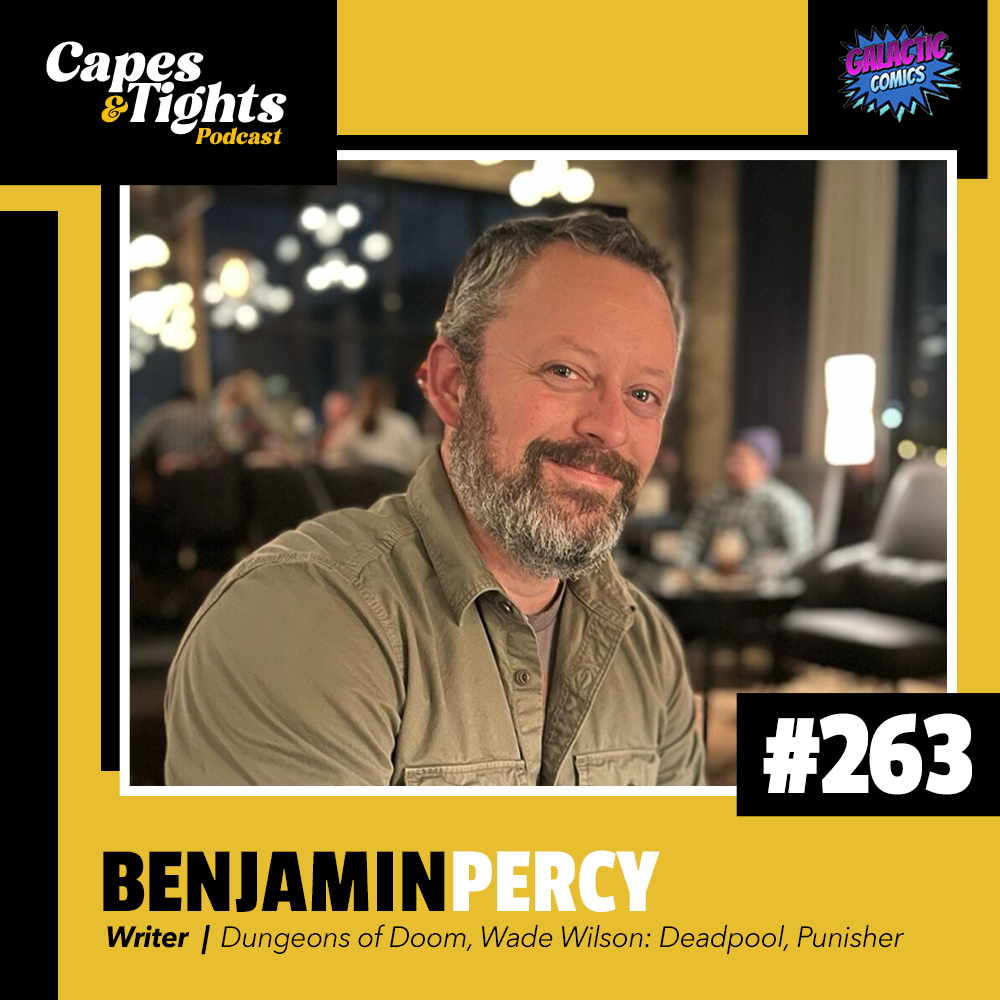
[00:00:00] Speaker A: Welcome back to the Capes and Tights podcast right here on Capesandtights.com, i'm your host, Justin Soderbergh. This episode is once again brought to you by our friends over at Galactic Comics and Collectibles. At galactic comics and collectibles.com we welcome writer Benjamin Percy to the podcast. He has seven novels to his name, including the most recent Sky Vault, which is the Comet cycle series, and then he also broke into comics in 2014. He is the writer of such comics as X Force, Wolverine, Teen Titans, Nightwing, and the upcoming Dungeons of Doom, Punisher, and In Star Shadow of Maul, as well as Deadpool Wade Wilson. So check him out. But he also wrote two audio dramas for Marvel, Wolverine, and one that features old man Star Lord, so check those out as well. But Benjamin came in and talked about his career, a little bit about how he got into writing and things like that. So check this episode out. But before you do, follow us on Facebook, Instagram, Twitter, bluesky, Threads, all those places you can rate, review, subscribe over on Apple, Spotify, or wherever you find your podcast, as well as view the video portion of this podcast on YouTube.com and as always, you can visit capesandtights.com for so much more. But this is writer Benjamin Percy chatting all things comics, books and more right here on the Gapes and Tights podcast. Enjoy.
Welcome to the podcast. How are you today?
[00:01:25] Speaker B: I'm doing all right. Thanks for having me.
[00:01:27] Speaker A: Absolutely. I'm excited. So it's funny because I, I've had like a. When you do podcasts that you have like a short list of people that you always want to chat with, things that you like, things that you, you know, whatever, and you've been on that list. And it was kind of funny. I just, like, I always wanted to time it out with something. And then something else came up, and then Philip Fricasse was like, have you ever had Benjamin Percy on the podcast?
I was like, no, it's actually someone who I wanted to get on the podcast. Like, you need to do this.
[00:01:51] Speaker B: And I love, I love Philip.
[00:01:54] Speaker A: Yeah, he's a great dude. So I was like, finally, we're going to get to do this. And you're, you're pretty busy. So it's, you know, you're writing a lot of comics and books and things. And so it's, I juggle a lot of chainsaws. It's kind of hard. Like, other people I've talked to, it's like, okay, this is the time to talk to them because they have X, Y and Z coming out. But I feel like you could do that every week with you, I'm just.
[00:02:16] Speaker B: One big annoying media rollout.
[00:02:19] Speaker A: It's. It's never ending. But I. I mean, I think the people that.
[00:02:24] Speaker B: The other day that I. And this is actually a true joke.
[00:02:27] Speaker A: Yeah.
[00:02:27] Speaker B: I don't know when I have comics coming out unless people tag me online and I'm like, oh, yeah. Just because I'm juggling all this. All this stuff that the business side of things isn't necessarily on my mind.
[00:02:38] Speaker A: Yes.
[00:02:39] Speaker B: Fos and. And all that kind of stuff. So it's always.
[00:02:42] Speaker A: I think it's crazy.
[00:02:43] Speaker B: I get online and it's like somebody's like, hey, I just read, you know, predator Kills The Marvel Universe 5. Really liked it. I was like, oh, it's my. The message that I tucked into a bottle and sent off to see it. It found a farther shore.
[00:02:58] Speaker A: Yeah. Finally someone's actually ready. It is kind of funny because it's. I don't think anybody really knows. Even huge die hard comic fans knows when things come out nowadays. It's just, you know, you're a comic book writer, and I think most of the people that I talk to know you from that medium. But really, I mean, you started writing in novels, right? In books? I guess that's.
[00:03:17] Speaker B: Yeah. Well, I was a prose writer, so I started off publishing short stories. I was writing novels and failing to publish them at the same time. You know, so I was publishing short stories, trying to write novels. I was also doing journalism. You know, I wrote for Esquire long enough that I became a contributing editor there and GQ and Time and Wall Street Journal and such.
And then I started to publish novels, and then I started to break into screenwriting and comics. And everything in my career is incremental, you know, like you're ascending a ladder rung by rung, and sometimes you slip down a few rungs and then you climb back further up. But it, you know, it excites me to work across all these different mediums, and it keeps things fresh for me every day at the desk.
And if I ever feel stymied, if I ever feel trapped by a plot or uncertain about a character's motivation, or I just, you know, pivot my attention to some other project I'm working on, feel like, you know, a renewal there, and. And I'm still thinking about that other thing, and then I can return to it with, like, a refreshed sense of excitement and perspective later.
[00:04:30] Speaker A: I've talked to Many people who have, I mean, you know, crossed over one that across. It has multiple mediums to write in. One that comes to mind is Daniel Krause, because he finished or finished, got us started. Finished, but also started year zero in a sense because he did the prequel for it. But, you know, stories. You're a storyteller, you're a writer, and you have specific stories that make sense in comic form and make sense in prose, novel form. It makes sense maybe on a screenplay or in. Some of them can be both. But is that to you, like, if you had stories in your head, is it like, okay, this is, this looks. This is gonna be a comic book. This should be a comic book story or this should be a movie or something?
[00:05:05] Speaker B: Sometimes, Sometimes I could actually go either way. But when a story is intensely visual, you know, and, and, and let's say it's a, a sci fi scenario that takes place and, I don't know, some other dimension, you know, you're going to have to do a lot of heavy lifting as a prose writer to convey that experience to your audience.
And an artist, if you, if you pair up with the right, you know, talent, like an artist can just like, bring that flourishingly to life and knock everybody's socks off. And it takes two seconds for somebody to turn that page and understand, you know, this vortex or, or this spaceship, you know, warp reactor or whatever else. You know, it takes two seconds for them to process that visual. Where it might take me, I don't know, five pages to convey the same information. Sometimes, sometimes I'm thinking like that, you know, I'm thinking purely in visual, almost cinematic mode. There's also, I don't know, when it comes to comics, like, you can, you can split the difference in a way. You know, I'm writing narrative captions that are kind of like muscular poetry.
[00:06:23] Speaker A: Yeah.
[00:06:25] Speaker B: But then I also have like, the more cinematic, you know, approach of. Here, here are visuals playing out, here's dialog. Like I can do if I wrote that purely as a film, I wouldn't have access to the omniscience, the authorial control that a caption can give me, or the interiority. If I'm doing, like, psychological insight, like if I'm inside that character's skull, if I'm. If they're narrating their own story or whatever. Like, so I feel like I'm writing a novel and I'm writing a movie. Sort of like I'm somewhere in the ghostlands between them. When I'm, when I'm writing comics, one.
[00:07:04] Speaker A: Of your pieces of work that I thought was like, kind of weird. Like I could see as a movie, television, I could see it as prose novels, which it is. And I would love to see it in comic book form. Is the comet cycle like that? You know, like. So it's one of those things that like, I would love to see like different artists interpretation of each of the novels, if that makes any sense. Like, because they're different types of material in it with, you know, fauna and flora and with, you know, the metal and stuff like that having like someone who draws like fluidly in something or some sort, or someone who draws more organically or something like that, seeing that. But I also would love to see like a season that's the Ninth Metal and then this season that's the unfamiliar, you know, like that kind of thing too. So I see it all away. So it's kind of cool that some work specifically, you know, like the Year Zero example probably works mostly in comic form because of the visualization of some of the things.
But like, whereas the Ninth Metal in the comment cycle seems like it could work in all mediums.
[00:08:03] Speaker B: Yeah, I mean, I. I really scratched my head on that one for a while, deciding how I wanted to approach it. I ultimately decided on prose.
I imagined it though, when I first pitched it as something that could be like ever expanding so that, you know, not only could there be not just three, but six or eight or 20 novels, but maybe I could publish some short stories connected to that universe as well. And maybe I could do some comics connected to that universe and maybe I could do, you know, a screenplay here or a screenplay there, and one of them could be a TV series and one of them could be a movie. And that's my approach to that cycle was. Was not just, you know, like as a gardener who wanted like an ever expanding crop to come out of it, but also I was thinking about it as my own version of the Marvel or DC universe, you know, so there is a comic. Comic Y parallel there.
And each book sort of has like a different, you know, if you think about comic titles, right. Even though like Swamp Thing exists in the same universe as Wonder Woman, they're very different, you know, tones.
And in the same way, like the Unfamiliar Garden has more of like that horror tone and a little bit of Swamp Thing in. In it, actually.
Whereas, like the Ninth Metal, that book is more of like a. There's sci fi elements to it, but it's almost like a crime story. Yeah.
[00:09:35] Speaker A: It'S. It's cool. And also I feel like, you know, I was introduced to you originally from comics. Like, I, you know, see your name on things. And I honestly think, honestly, the first thing that I like Dove was, was the Long, Long Night Wolverine podcast. Like, that was the first thing I was like, oh, my gosh, this is like, to me, I'm always, like, looking for that additional. I love my comics, I love my books, but, like, it's that other thing that connects something to those things in the scripted podcast. Like, this is amazing. I can listen to this on the way to work. I'm getting my comics, I'm getting my, you know, books. I'm getting all this in one thing. And I'm audiobook listener as well. But, like, that was so cool to see. To see that form of storytelling that, that, you know, I think that's what I honestly think I originally was introduced to you as. And so to me, you're a comic book person. But then I realized I was like, your books are awesome too. But you always tend to always. Most of the time, I see you tend to at least include comics in your stories. Like, everything has, like, someone read comics or someone has brought comic books, or someone has comic books and, you know, there's a comic book reference to a lot of your stuff. Is that on purpose because you are a big comic book fan or is it just happened to be what's in your mind?
[00:10:44] Speaker B: Like, you know, you write what you know.
So. So there's that I've got characters reading comics or referencing comics for sure is. And. And there's that inside baseball to it all. I have, like, comics writers buddies of mine appear. You know, it's not them, but I'll use their names. Yeah. And, and yeah, when it came to Wolverine, the Long Night, that was a, you know, just one of those fluke things where this possibility opened up for me. I was leaving D.C.
at the time because of some frustrations over Nightwing getting shot in the head. And it just so happened that at the same moment there was this, you know, audio universe being born over at Marvel. And all they knew was it was going to be about Wolverine.
So they asked a bunch of people to pitch. And I put together this massive document. You know, I think it was 30 pages, single spaced. And the subtext of it was like, you better give me this project, because Wolverine's my favorite comics character. But the struggle of it was in the beginning, like, how the hell do you write, you know, a visual.
A character who I associate with a visual medium. How do you write that as audio? Because the rules are so different. The storytelling arsenal that you employ is so different.
You know, how do you write a fight scene in audio and not completely confuse your audience? How do you just ground them in a new environment? How do you negotiate more than five different voices in a room? And, and, and, and like there's all these things that are bewildering in, you know, a medium where you only have one of your senses to stimulate. So anyways, that was really fun. I'm doing some more audio right now. It'll be announced later in the year.
Such a fun form though. And I think it lends itself to horror too, which Wolverine, the Long Night is like borderline crime mystery horror the way I wrote it and just the way that so much of the greatest moment in any horror movie is when somebody hears a noise behind a door and reaches for the knob because there's that wonder, like what's on the other side? And the audience fills that in and becomes a participant, becomes a co author of that moment. So they're more complicit in the fear.
In the same way, when you're writing for audio, you're only giving them so much. Right. Sort of like your, your whole podcast is essentially the noise behind the door. And so the audience is leaning forward. It's a lean forward medium as opposed to tv, which is a lean back, or film, which is a lean back medium where everything's being fed to you. You're more of a participant in audio.
[00:13:25] Speaker A: Yeah.
[00:13:25] Speaker B: So you lean forward and you fill in the gaps yourself and you're part of the conjuring of the storytelling, which again, it's cool.
[00:13:35] Speaker A: I mean, you see graphic audios out there. So there is like this, this, this adaptation per se of comic books have come out for, for years now. There's different random ones out there. I know there's a couple of dark horse ones and things like that. Like, so they have this like a comic book that's then been adapted into some sort of graphic audio. But it, it's different, it plays different when, when something's written for audio, you know, I mean, like, so like it's one of those things that someone just took a comic book and was like, okay, now we need to make this into some sort of audio format. When it's written for audio, you get a little bit more out of it. Plus it does also feed into the weekliness of it because it was a weekly. You know, things were coming out. So like it almost felt like comic books. I was almost like, oh, on Wednesday I'm going to get my new comic book. And it was like that feature, but also plays well as a. You can binge it. Like, it also plays well that way too. The fun thing to me was from the beginning, on a long night, I almost got like an X Files vibe to it. I'm a huge X Files fan and having the, you know, your investigators and doing things and this mysteriousness to it and crime solving on it. So that also pulled me in as well. But I mean, that's kind of what the Ninth Metal got me with too. Is that investigation part of it too? It's like not just X, Y and Z. It has this other things that play into it. And Wolverine along small town investigations.
[00:14:47] Speaker B: That's kind of my jam.
[00:14:48] Speaker A: And I have friends that are from Alaska. So it's also kind of cool like that thing too is like to see this, you know, cold climate. A wolverine in a cold climate is pretty cool too on that sense.
[00:14:58] Speaker B: I've been to Alaska three times now.
I want to keep going back. It's my favorite state. If I didn't live in Minnesota and I love, I love living here. If I didn't live in Minnesota though, I think Alaska would. Would steal my heart away.
[00:15:11] Speaker A: I live in Maine, so it's like one of those things that to me it's like very not similar, but in the same sense it gives me that vibe. And my friends who lived in Alaska actually moved to Maine that's know them. And they're like, this is kind of cool, but this is like a lower version of what we get in Alaska.
[00:15:27] Speaker B: Like Alaska light.
[00:15:29] Speaker A: Yes. And he's like, I can still feel like I'm at home, but not really in that sense. I'm like, okay, yeah, we got hunting, we got fishing, all that stuff. We got wildlife, but. But it's a little bit more different. And I was like, oh yeah.
[00:15:39] Speaker B: I mean, one of the things that distinguishes Alaska is just the excess of it. So.
[00:15:43] Speaker A: Yeah.
[00:15:44] Speaker B: You know, growing up in Oregon, I had the Cascade Mountain range always in view. And so I could constantly orient myself against it. It's like a spine running down the center of the state. And you're never lost because you look up and you see the three Sisters or you see Mount Bachelor. You know, you know, you where you stand as a result, you go to Alaska, there is an uncountable number of mountains. You know, it's not. There's not one range. It's all range. And so, you know, it's just what. What I thought of as a scenic view was detonated.
[00:16:18] Speaker A: Yeah, well, I felt that I went to Iceland once and it was like similar to me to the same thing. It was just like there was just so much to look at. And I was like, I thought I had a lot to look at in Maine. And then I drive like down the highway I made. I'm like, there's stretches of highway that's literally just trees, but like not like fun looking trees or just like boring trees. And I'm like, yeah, this is not, this is not nearly as, you know, visually attractive as some other places in this world. But ye. Yeah, it's kind of funny. But you main connection here, you're also doing something with our, you know, claim to fame here.
[00:16:50] Speaker B: Stephen King of Maine.
[00:16:52] Speaker A: Yeah, I actually lived like a block and a half from Stephen's house all through high school. We walk by his house all the time. It's actually down the street from my, my local comic book shop. Stephen doesn't actually live there.
[00:17:04] Speaker B: The cobwebbed entrance.
[00:17:05] Speaker A: Yeah. Oh yeah, it's, it's right there. Like I used to walk by if I went that way. I used to go two different ways walking to school. And that was one way you could go.
And it's also the widest street in Bangor.
It seems like back when they built the street, they were like, one of these days people are going to be lining the side of this road with cars, so we're going to need to make this wide because it's like abnormally wide. Like it's like a five lane highway wide.
And. But yeah, I still live down the street from that. And then when I moved to Orington, I was getting older. I lived down the street from where Pet Semataries was written. Like the actual place. Like I have this connection not only living in Maine, but I feel like I lived in the backyard of Stephen King.
So I guess my point is I'm.
[00:17:44] Speaker B: Expecting like a grave rotten cat to come walking by.
[00:17:48] Speaker A: Yeah, no, I mean, how did you get connected to Stephen King and do this project with him?
[00:17:53] Speaker B: I mean, I grew up worshiping at the altar of King and it's surreal to me to have any sort of connection to him now.
He was kind enough to read and shout about one of my novels, Red Moon. It was one of his first tweets.
And, and I was friends with Peter Straub. Peter Straub was kind of a mentor to me.
Peter Straub recently died, left a big vacancy and in literature in my heart.
But I contacted Peter and I was like, can you just. Sorry to intrude, but can you just please email Mr. King and tell him thank you for, you know, that endorsement online of Red Moon. And within, like, five minutes, Stephen King had just written to me directly.
And so I've never wanted to be annoying and, like, suck too much oxygen out of him, but I'll, you know, drop my line now and then. He's blurbed several of my books, including The Deadlands and 9th Metal.
He was interviewed by me on stage at a literary festival in Minnesota, so I got to spend some time with him there and introduce him to my wife and daughter. And anyways, with the End Times, which is a short novel told in the form of a newspaper that's delivered monthly, I was thinking about him for a few different reasons. One, it's basically the world of the Stand.
Two, I read the Green Miles, a serialized novel. Some people might not realize this, but back in the day, the Green Mile was originally released in installments, and I would rush to the crappy bookstore, my crappy mall, to pick it up every time it dropped.
And so I love the idea of serialized, that sort of Dickensian serialized storytelling.
And Carrie is an epistolary novel. If you haven't revisited in years, you might have forgotten about this, the movie might have superseded it in your mind. But Carrie, when you read it, is mostly like interviews and articles.
And King has also taken some big swings experimentally with the Plant and Riding the Bullet, two of the early ebooks, one of which he bought directly through his website. I figured he might be game, so I approached him and he was like, I want to hear more. And he's like, yeah, I'll contribute. That sounds cool.
You're reinventing the epistolary novel.
And so he.
We found a way for him to contribute, and it ended up being really cool because he needs a byline. I needed a byline, too, because this paper is not written by Benjamin Percy. It appears to be produced by somebody else.
The End Times. A small town that has survived this woman, Mary Poole, decides that her way of contributing in this new and broken world will be to put out this paper to share news, to share information, to bring people together, to even save lives as the danger in the story progresses. Anyways, he needed a byline, and so he pitched Claudia Inez Bachmann as his pseudonym. And if you know Richard Bachman, right, Stephen King used Richard Bachman as a name when publishing, you know, Rage, the Long Walk, Running Man.
He did. Richard dedicated every one of those books to Claudia, and Claudia appears in the Dark Tower series.
So Claudia is the writer, you know, and she has her own backstory and says what happened to Richard and, and, and, and she has her own secrets. And, and, and she's working as a reporter on this, on this paper. So cool to be able to like, shoulder up against the King canon and be in like a peripheral way, part of the Stephen King universe.
[00:21:45] Speaker A: That is awesome.
[00:21:46] Speaker B: I mean, this total gentleman, he's incredibly generous. You know, it's not like we're BFFs, but he, he's always looking out for me. It feels like.
[00:21:56] Speaker A: I think it's really kind of cool, like over in the past couple of years of the, of the change in some things. And, and I don't know if it's getting older in age. You're just doing whatever. Just. He's just opening up to different, more different cool things. And like the whole Stand, you know, anth book that came out in 2025 and there's another one coming out in the near future based around the Shining. And so, like, it's these different things that he's doing, which is really kind of cool. And I actually got the chance and I'm actually a professor at umaine. Caroline Bix wrote a book called Monster and Monsters in the Archives and she's actually releasing and I'm actually going to be doing the in conversation with her up here, which is kind of cool. And it's just like, just like these things are just different and fun and unique. It's not just amazing novels now too. It's just there's a lot more, I think, going on to it. I mean, I grew up with him donating a bunch of money to make a baseball field and a Polygram and all that stuff. So I saw the philanthropy part of Stephen King, but like. And he also donated money to our library in Bangor.
[00:22:52] Speaker B: But like, the way he treats people as well, like, he's very supportive of emerging writers and yeah, he's a greater.
[00:23:01] Speaker A: Than life still to the people in Bangor, but actually like the Stand anthology release. And when Joe Hill was up here with Keith Rosin doing. Doing an in conversation around Keith Rosin's book release, Stephen came to both of them. And it's at the small, intimate little building and sat in the back and watched and, you know, whatever, and then left and no one really bothered him and stuff like that. So it was like one of those things where I feel like he feels comfortable still to go do things, even though in most places if you just ran into Stephen King, people would likely try to mob him and try autographs or pictures or things like that people are respected. Yes. He's very respectful to other people. And so in Bang, where I feel like we treat him as. No, he's like, he's the uncle. He's the uncle over there. He's just. He's just Uncle Steve.
[00:23:44] Speaker B: That's great.
[00:23:45] Speaker A: It's awesome. I think it's really cool, but. That's really cool. The end times, that's. It's. It's front with. With Bad Handbooks.
[00:23:51] Speaker B: Yeah. If you want to subscribe, you go to Bad Handbooks. Check out their website. You can subscribe digitally, which is less expensive. You can subscribe, you know, physically. It'll show up at your doorstep once a month. And it's cool to have like, this artifact, this paper.
Later on, you know, we'll put out some sort of deluxe version of it, some book that collects it all and still appears in newspaper format.
But yeah, I think you should make.
[00:24:16] Speaker A: People go to, like, libraries and read it on microfiche.
[00:24:19] Speaker B: That's the next project.
[00:24:21] Speaker A: It only is available in the library. You have to go to your library. It's making people get out there and take out books from the library. No, I think that's pretty cool. But, like, that's the school. I consider you a writer as a whole. You have these different formats to do things, obviously screenplays as well, and, and all that stuff. But I, like I said when we started off here, I think most people, at least the people that I'm around, know you a lot because you work with Wolverine and X Men and Marvel and dc.
[00:24:45] Speaker B: I mean, comics is like, I never expected that to be the case, man. I grew up on comics. I'm successful. I never expected to have a career in comics and to be. To be known principally for, you know, my work on.
On Wolverine and Green Arrow. Different characters, like. And I know that people are coming to my work for the characters and not for me necessarily.
So I, you know, I. I value my role as like a custodian of, of some of these characters, these canonical characters. And I try to put, you know, try to put my own mark on them while I'm here. But. But the thing about writing Wolverine or writing Ghost Rider or writing Punisher or any of these characters, you know, that, like, somebody else is going to take over after you. These characters are going to be around another 50 years.
So you do the best you can with what you got, and hopefully people will, as a result of reading, you know, my work on Wolverine, maybe discover the ninth Metal.
You know, it gives me a nice opportunity to showcase some of my other work working with these, you know, Marquee.
[00:25:52] Speaker A: Yeah, I think so. Yeah. And you got, I mean, you obviously had a good, you know, busy 2025 with Marvel and you got 2026 coming up here. You got Dungeons of Doom coming.
You get, you know, Deadpool, Wade Wilson, Punisher. You're doing More Punisher. But I was actually. You're doing Darth Maul. I know you did a story in the red. What's the black red and white or whatever it's called? The Darth Maul thing. I did. You did a short story in that, but you're also doing a miniseries. Is it connected to the show that's coming? Is that what.
[00:26:23] Speaker B: The comic would not exist without the show. It's serves as a prequel to the show. So it's been really cool to be part of the conversation with Lucasfilm to be able to watch episodes, to be able to be privy to their character designs, the blueprints of the City Called Janix and and so on and, and just, you know, be able to participate in like this larger storyline and, and, and to approach Star wars from a different angle.
This is crime.
This is a crime story, like a, A Blade Runner esque story. It's, it's noir, it's gritty, it's grounded.
There's some equivalency to Andorra in that way.
And, and my job is to build up this character named Lawson who's a captain in the police department there, and his sidekick Two Boots who's a droid.
And, and Darth Maul is there, you know, his plan which builds towards the debut of that Disney plus series. His plan is, is running through the background dangerously.
[00:27:41] Speaker A: Okay, so this is a prequel to it. This is like getting people set up for that Disney plus series, correct? Yeah. Okay, that's pretty cool. It's pretty cool to see these characters. I'm a big fan of Marvel's take on the Star wars universe and such. And I'm a big. People who listen to this podcast will know I'm always just for the next thing from Star wars. Like to me, like, people like all the movies aren't good or, you know, I don't care. They can be absolutely garbage and I would still watch them. I'm still lucky enough to live in a world right now that has more of this. And so like, it's cool to see though. But it's like Darth Maul has been like a fan favorite character for a while and it's cool to see more coming from that story. I Mean, I'm actually going to be chatting with Mark Guggenheim for Star wars podcast day about his Jar Jar Binks series that's going out, and I'm like, oh, my gosh, we're having a Jar Jar comic. This is. I don't care if it's horrible.
Like, I don't. Like, I want to read this. This is Jar Jar Man. Like, it's a. Is great. It's obviously not gonna be horrible because Mark Gurgenheim is a great writer, but, like, it's just fun to see these different characters get some more attention. Like Darth Maul.
[00:28:38] Speaker B: Yeah. And I have another Star wars announcement coming in the next two months. I think there's something exciting that's going to come at the end of spring, the top of summer, but it's just a total delight to be able to, you know, ride in the Star wars universe in that. It's one of my earliest, like, storytelling experiences is being in the theater watching Empire, you know, collecting the toys. Like, little Ben Percy would not believe that old man Ben Percy is doing this.
[00:29:09] Speaker A: He's doing this right now. Yeah, it's pretty cool. You get. You play with Wolverine and you play with Punisher, and you get to play with Darth Maul. And this is like. Like, me with action figures where you're actually doing.
On a comic book format.
It's pretty crazy.
[00:29:21] Speaker B: I've been training my whole life for this.
[00:29:23] Speaker A: Is it similar writing, like, a Marvel character to writing a Star wars character? Or is there a little bit. Is there a little bit more oversight because of Lucasfilm being involved, too?
[00:29:29] Speaker B: No, I'd say that Star wars is much more strict. You know, they're. Everything fits within their canon. So with Marvel, you're able to, like, all right, I'm going to take a swing, and I'm going to do this. Predator versus Wolverine, you know, Predator versus Spider man and so on. Like, I'm going to build my own, like, Predator verse over here that's separate from Marvel continuity. You can't do that with Star Wars. Every single thing, whether it's a show, a film, a comic book, it all fits tightly within that puzzle, that jigsaw puzzle they're building.
[00:30:04] Speaker A: And so, yeah, so it's some things that you're like, I want to. And that's. I've heard that, too, actually, in the past. Like, I want to use this character. Like, now we're saving that character for something else or wouldn't be here at this time or. Or whatever. And so that gets, you know, that's pretty Cool. That's pretty cool, though.
[00:30:16] Speaker B: They've got their larger plans in place, so it's. It's cool to be able to play in that sandbox. But you're definitely, you know, you're not. You're not playing fast and loose there. You know, they're. They're supervising.
[00:30:30] Speaker A: I also feel like Marvel and DC fans are. Are vocal about what we like and what we don't like. But I think that Star wars fans are a little like, you screw something up or do something they don't want, they'll tell you. Ben.
[00:30:40] Speaker B: Yeah, I've seen this. I haven't.
I haven't been subject to this yet, but I've seen people get attacked by Star wars fans. And so I was honestly a little bit worried when I had my first Darth Maul. That one shot come out, and then the Boba Fett one shot came out. And so far, so good. I mean, we'll see. But I know that they'll come after me with their plastic lightsabers eventually.
[00:31:06] Speaker A: Yeah, well, I was laughing because I'm like, it's not like you're not a fan of this. Like, it's not like you're taking it over and being like, I don't know anything about Star wars, so I'm gonna write Star Wars. Like, you're also a fan. So I'm always like, well, you're a fan too, so this is your take on something. I also like, I guess I just more respectful some other than other people, but, like, it just passionate. Yeah, I just like new stuff. Like, to me, I'm like, if it has something to do with something that I know about, like a new Wolverine or a new, you know, a Star wars thing or whatever, if you came with another, you know, comet cycle book, I would be like, oh, this is cool, because it's something I already know about and it's more of that. And so, like, that's what's cool about, like, those things. And I saw me. I'm always like, star wars stars.
[00:31:46] Speaker B: Cool.
[00:31:47] Speaker A: I'll sign me up, put it on my poll list. I'm going to get it.
[00:31:50] Speaker B: Hopefully you dig it. And hopefully the. The hardcore fans dig it as well.
[00:31:54] Speaker A: Yeah, I mean, it's cool. And so you got Dungeon Doom coming out. You got, you know, Punisher, you got Wade Wilson Deadpool, you got Star wars stuff, you know, and obviously you're working on other stuff behind the scenes too. The stuff we can't know about yet. But, like, did you know you were. So Dino Krause is Partially Devoured, which is his book that comes out soon. He actually name dropped you in it because he was talking the Year Zero and that he never thought he would ever do another zombie thing after writing the Living Dead with Romero. And that he says he got this opportunity and that he said that it was because of the way that it was structured and set up and so on and so forth. That's the reason why he even said yes to it. And that's actually, again, I read that one because Daniel, I did a beer with Daniel. I worked for a brewery and we did a beer together for his Whalefall release. And so I was reading some things to catch up on his comics, and I read that, and then I actually went back and read, you know, volume one and Volume two. So it's just such a cool, unique take on the zombie genre. And I think that's kind of cool.
[00:32:49] Speaker B: A World War Z sort of story. Except I was adamant from the very beginning they would not interlock. Like, these characters are snapshots of what's going around on. Around the world, but they're not going to, like, have a team up.
I didn't want that sort of ridiculousness forcing my hand when it came to character decisions. I just wonder, like, what's going on on the ground in Tokyo, what's going on in Mexico City, what's going on in the suburbs of Minnesota, you know, and so on, and. And, you know, having, like, wildly different characters.
Like somebody who's a street urchin, essentially, somebody who's Yakuza, somebody who's a prepper, like a conspiracy theorist, like somebody who's a scientist in, you know, at the North Pole. Like, how. How are all these different people approaching the scenario? And some of their stories end happily, and some of them don't end disastrously.
[00:33:46] Speaker A: It's true.
[00:33:46] Speaker B: It's like, you know, unlimited storytelling. Right. I could just keep going back into this world and dipping into it as long as I want.
[00:33:53] Speaker A: I mean, like, Romero, one of the. One of the godfathers of the modern zombie. It's like, it's okay. A lot of the stuff happens in the Northeast, in Pennsylvania area and things like that. And then you have, like, the Walking Dead, where it's like, okay, a lot of it happens in the south and. And they have obviously expanded with their TV shows and different things going in different places. But, like, that was what's refreshing to me. It was like, I don't. Yeah, of course, you always hear about specific groups of people or something like that, but you never hear about, like, other Places around the world. I guess it might be just because we're live in North America and there probably zombie stories that are told in Japan or. Or things like that that you deal with characters that are based in Japan. But I was like, Daniel Kress brought it up because it was one of those things was about being able to do things. He's like, I don't want to do things that's based in the United States anymore. I want to do these things that are all over the place. And so that's able to. What he was able to do, which was really cool. But then it was like, oh, two of my favorite writers writing one series together. And the artwork is so amazing from three different artists too in that story. And AWA does a lot of great stuff. So it was, it was one of those things. But it was really cool. I'm like reading along and I always love that like connection when he's like, oh, here. I'm like, I know you're zero.
[00:34:52] Speaker B: Yeah, there might be. There might be another little bit of year zero coming. I have another zero.
[00:34:56] Speaker A: There you go. It's one of those things you probably could tell. Like you could just continue telling stories as long as people are buying it. It's because it's. They're you're telling so snap. Such snapshots from different places that like there are infinite number of stories from a zombie apocalypse that could tell.
[00:35:10] Speaker B: And it also just scratched an itch. I've never written a zombie story before then.
I love the Shambling Dead.
[00:35:17] Speaker A: Exactly, exactly. But yeah, I mean, so yeah, you got a lot of stuff going on, so on and so forth. But it's so cool to see that you haven't left your roots in longer form storytelling too and having that writing novels and things like that. I would recommend anybody. The Comet cycle series is phenomenal if you're. If you're into that kind of stuff. It's just cool. It's each stories connected but not fully. Like you probably could read like the Unfamiliar Garden without reading the other stuff. Yeah, you can read it references other stuff.
[00:35:47] Speaker B: I wanted to make it like comics in that way where you can like, you know, they're all part of the same continuity. But yeah, you can jump in and out read book three before you read book one.
[00:35:55] Speaker A: Whatever you have to do the Star wars way, read book three and then it's true because you do enough of a referencing of the ninth metal of omnimetal in, you know, in the other books. But not enough. You're just, okay, we're going to give you a little bit of what it is. Oh, it's in northern Minnesota, north fall Minnesota. We're going to tell you about that, but we're not going to go too far into it. But so you reference it so there's enough people can know about it. But in the same sense, if you read the Ninth Metal, you go, oh, I know what he's talking about. There is this connection.
[00:36:22] Speaker B: Yeah, yeah. Again, similar approach to comics where it's like, if you read Green Lantern, there's probably going to be a reference to Superman in there. If you read Superman, it's probably going to be a reference to Batman. Like they share, they share, you know, that, that larger superstructure, but you can just read them in a siloed fashion as well.
[00:36:43] Speaker A: And it's really cool. So you can get all those available. And then again, Dungeons of Doom come out. Comes out this January is a big, you know, big year for Marvel and that it's pretty exciting.
[00:36:52] Speaker B: Like Spirit of EC Comics, Tales from the Crypt Vault of Horror. That definitely informed the way Philip Kennedy Johnson and I were approaching this.
And if you've been following along with Doom, you know, and his role in the 616, you know, he's fallen as Sorcerer supreme.
And I don't, I don't know if that story is totally completed yet. So I won't say exactly what happens. But here's the. You already know from the solicits. Like, you know, he left behind this dungeon full of horrors and everybody's going after, you know, the treasures that lie within, you know, the darkness below.
And it's, we, we've drummed up some pretty horrifying stuff in here, so. Which is awesome.
[00:37:40] Speaker A: I love Marvel horror, to be honest with you, like that. Not like it doesn't have to be like horror horror, but like just horrifying things that happen in Marvel because it's, you know, we can blow up New York City enough times and then our.
[00:37:49] Speaker B: Goal too is like introduce new cool stuff. Yeah, like introduce new characters, introduce new objects that could become sort of totemic and really important in the future of the 616. So here's all these little stories, but they're all like, hopefully adding to Marvel lore in a way that will carry on to other series.
[00:38:12] Speaker A: That's awesome. That's just so much, so much fun. And then, yeah, the Long Night's an awesome overeem podcast. You can get that anywhere.
Try that out. And there's also the, the follow up series as well as there's actually a comic Book for Long Night, right?
[00:38:24] Speaker B: Yeah, they had me. That was my first comic for Marvel was adapting Funny Enough, but I had to take 10 episodes and turn them into five issues. So a lot of the plot gets truncated.
[00:38:35] Speaker A: It's. It's. I guess it's worth it. It's one of those things, like, if you're an audiobook listener. This is fun because it's also the sound effects and other things that go into it as well as a drama, not just a straight ahead reading of a book. It's pretty cool in that sense too, on that. But yeah. And then like I said, you got a lot of stuff out there, so just Google Benjamin Percy on. On. On the Google Webs and find all the stuff that's out there. But I'm looking forward to 2026. It's gonna be awesome. And I appreciate you taking out the time to talk to us here on the podcast about your career and in comics and all kinds of things.
[00:39:02] Speaker B: Hey, happy to chat with you.
[00:39:04] Speaker A: We'll do this again sometime now. Thank you to Philip Fricassi for. For, you know, making this happen technically.
Because, you know, and Philip's got a bunch of new cool stuff out too, so check all that stuff out too.
[00:39:14] Speaker B: But he's got a one coming out that I'm really excited about.
[00:39:17] Speaker A: Yeah. Actually, what's kind of funny is I got a movie right here. It's called Santa pause 2 that Philip, for Cossey, wrote a song on.
[00:39:25] Speaker B: I find it hilarious that he's. He wrote that.
[00:39:28] Speaker A: It's signed by. It's.
[00:39:29] Speaker B: Given how dark of a sensibility he has. He wrote this cute puppy movie.
[00:39:33] Speaker A: I had him sign that once. And then Brian McCauley, who is a slasher horror author, wrote an episode of Fuller House.
And so I had him sign the Fuller House. I brought it to a convention or a book book festival.
[00:39:45] Speaker B: Y' all gotta pay the bills, man.
[00:39:47] Speaker A: And he's like. So he wrote the word murder at the top of it just because he wanted to make it more like his.
He answered the question. He's like, someone asked him, goes, do you have to justify to people that you write slash like your family that you write slashers? He's like, no, I had to justify it more that I wrote an episode of Fuller House not they know I read slashers. They were wondering why I'm. Did someone die in the Fuller House that. Did someone get murdered?
I wish. That would be amazing. That'd be the number one episode for me. But I appreciate you taking the time out chatting with us and so much more. Enjoy 2026 and point. We'll check. Check in again, but thank you again. I appreciate it.
[00:40:16] Speaker B: Appreciate you. And let's chat again.