Episode Transcript
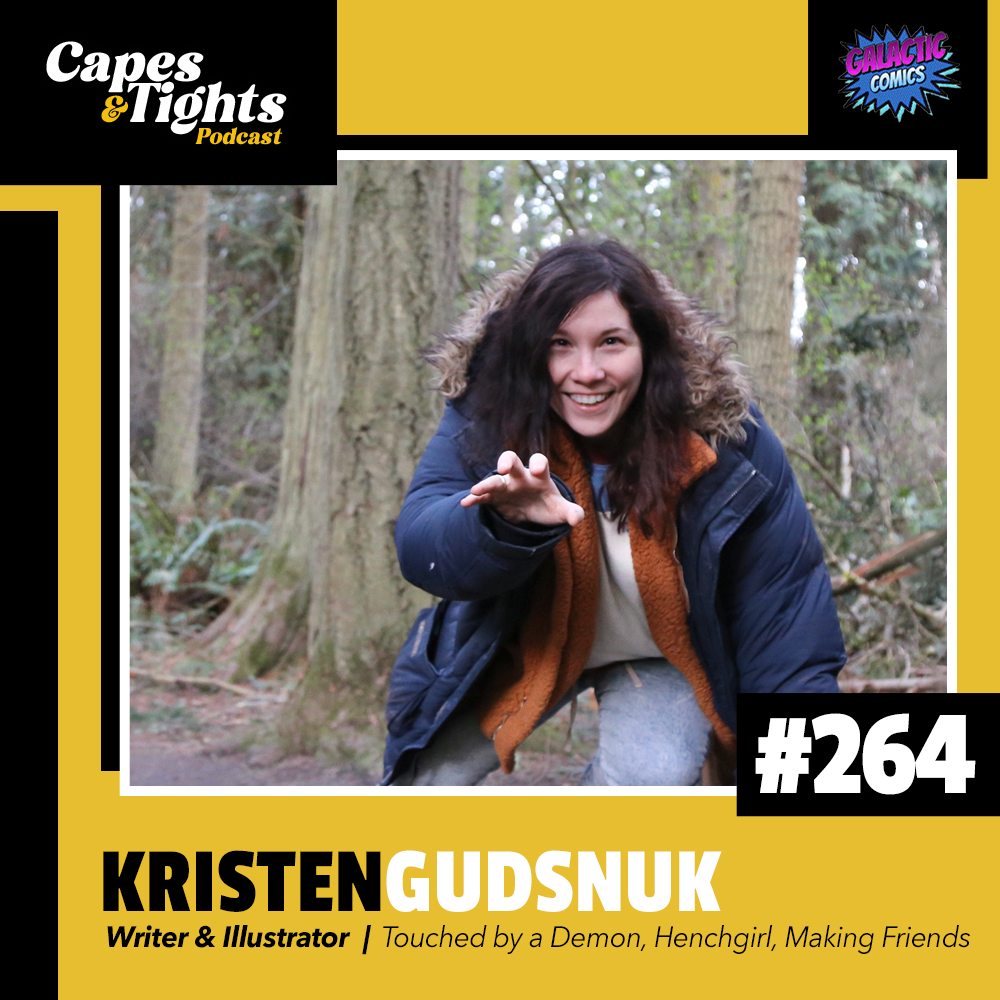
[00:00:02] Speaker A: Welcome back to the Capes and Tights podcast right here on Capesandtights.com I'm your host Justin Soderbergh. Once again, this episode is brought to you by our friends over at Galactic Comics and collectibles. At GalacticComics and Collectibles.com we welcome comic illustrator and writer Kristen Goodsnuck to the podcast to discuss comics. She got her start with the webcomic Hench Girl which was later published by Scout Comics and then the trade was published by Dark Horse Comics. She's also known for her graphic novel series Making Friends as well as co illustrating Emily Basic Witch which was written by Emily Hempshire and illustrating Modern fantasy comic as well. And Kristen has also worked on the Minecraft with or without yout trilogy and so much more. But Kristin's here to talk about her upcoming comic book called Touched by a Demon over at Dark Horse Comics.
But before you listen, follow us on Blue Sky, Twitter, Facebook, Instagram, all those places threads, subscribe, rate, review over on Patreon, Apple, Spotify or wherever you find your podcast. You can also find that video portion over on YouTube and as always visit capes and tights.com for so much more. But this is comic book illustrator and and writer Kristen Goodnook talking Touched by a Demon right here on the Capes and Tights podcast. Enjoy.
Welcome to the podcast. Kristen. How are you today?
[00:01:23] Speaker B: I'm great, thank you. How are you?
[00:01:25] Speaker A: Good. How was your hobbies? The holidays been good for you? Was it low key or was it stressful?
[00:01:32] Speaker B: A little bit of both.
I'm in my parents basement right now and have been hanging out with my family for about a week straight.
[00:01:46] Speaker A: So I can see both sides of it. I can see how it would go that way.
Yeah, it's a, it's a, I weirdly on Christmas day had my, my in laws and my sister in law and brother in laws, all them and my, my mother in law father in law came over and then my parents live in Connecticut which is actually where you're actually from, right right now? Yeah, see they're in Wethersfield, so near Hartford. So it's a little bit of distance but not too far. You can, you could quickly get over. There is they came up and drove up on Christmas Day and I was hoping there'd be like an hour gap between when would leave and one would come in. But like literally my, my in laws were like stepping down my front porch when my parents were walking up the front porch and I was like I don't even get A breather. I love my family to death, but I was, like, hoping I could, like.
But nope. Yeah, right into it. So it was. It was fun, though. My. I have two kids, 4 and 2, and they were absolutely ecstatic to see everybody on Christmas. So it was fun on that sense. But now I'm ready to get back into the real world of doing things because I just. I'm. It's so much buildup. And then just like, the day after, you're like, okay, now what?
[00:02:50] Speaker B: Like, now I have so many toys, and I don't know where to put them all.
[00:02:53] Speaker A: I was like, we got way too.
[00:02:55] Speaker B: Many toys for my. I have, like, a one and a half year old. And I was like, I just kept buying him stuff. And then I was like, after a point, he was tired of it. And I was just, like, opening presents that I had wrapped. And I was like, why did I do this to myself?
[00:03:07] Speaker A: Well, my. My daughter's too. She's like, open a present. And she's like, I'm all set. I don't need to open. I'm like, wait a second.
[00:03:12] Speaker B: Don't.
[00:03:12] Speaker A: Don't do that. My. My son is the one that just wants to open things, get it all open, and then look at what the thing is. People are, like, kind of depressed that they're like. When he goes to open things and he's not, like, super excited, I'm like, don't worry. Just give it a second. He wants to make sure everything's open so he can see it.
We had to train him ahead of time. As you probably know is when you see something that you might already have, do not say it. Please do not say it. He made it almost all the way. Only one gift was repeated, and it wasn't even his. It was his sister's. And he said something, and my mom's like, do you want us to take it back? I'm like, no, no, no, it's okay. It's okay. We'll just. We'll make it happen. Make it work. She's like, I could take it back to my house when they come visit. I'm like, don't worry. His brother, her brother probably steal it anyway, so.
But, yeah, it's fun. It's our first Christmas in this new house. We bought a new house. 100-year-old house, but we just bought a house in May, so it was kind of nice to have our first Christmas here and be here, but I don't know. The weight of the number of toys might. Might crush the foundation.
[00:04:05] Speaker B: I don't know.
[00:04:09] Speaker A: I'm like, I don't know. Where are we gonna put all this stuff? And my wife's like, we'll just throw some stuff away or give it away. I'm like, sounds good. Not the new stuff, but the old stuff. Yeah, yeah, we'll pick the gifts we didn't like the most and we'll just throw those away.
But no, it was pretty cool. And I'm glad we're now almost to the new year. This episode will actually drop in the new year. So happy 2026 to you.
But yeah, exactly. So I'm looking forward to getting into a new year because it was a fun year. But also 2025 can kind of like go, goodbye and let's start a new fresh year. And you get a new comic book coming out in 2026, which is awesome. But let's go back a little bit.
[00:04:44] Speaker B: Let's.
[00:04:45] Speaker A: So. So when did you really know you wanted to write, draw, illustrate comics and graphic novels? Was this something like a lifelong thing? Were you young? Were you later in life? What's a little bit of backstory about how you got into this?
[00:04:57] Speaker B: I always liked writing. I always like drawing.
And honestly, I always found it hard to think of what to draw unless I was writing something. Then I was like, now I know what to draw. So that always kind of made a lot of sense to me. When I was a kid in school, I would draw little comics to like, entertain my friends, but I didn't think of it seriously.
And then I got really obsessed with Naruto when I was like a later teenager. And then I was like, I want to be a mangaka.
But then I gave up on that for a while and then I found it again. So there was a lot of, like, leaving and coming back.
But throughout my life, most of the time, I was pretty intense doing comics.
[00:05:38] Speaker A: Did you. So, like, it was. It was there specifically. You didn't wrote to. But like, is there specific comics that you, like, go back to or love or still read? Or is it just like a wide variety of comics of graphic novels?
[00:05:50] Speaker B: Yeah, well, when I was younger, back in the day, it was like you would find like one manga or one comic, and then you would have to just read it over and over again because, like, we did not have this culture where you can just read literally everything on an iPad. Like, so I just had like, like a few volumes of like, Ranho and Half and Inuyasha. And I'd read them so much that, like, I could recite them, which made me very Cool at school.
And so I just really like those and Sailor Moon, Dragon Ball Z, like anything that, like any anime thing that you could get your hands on, I was really into as a kid. And then I loved Scott Pilgrim.
And I remember when I was like, let me explore what is not Japanese. I started reading Fables. And I got really, really into Fables.
[00:06:44] Speaker A: We wanted to read that. So I'm part of a comic book, graphic novel book club at my local comic book shop here in Maine. And we wanted to read fables. It was one of those things that like, okay, let's read fables. Let's read like the first volume or a volume, whatever we want to do, whatever the comic book store owners will look at. And he couldn't order it. It was like print. It was the weirdest thing. And so it must be. But it's also like, I feel like there's this weird thing higher up in comics. They just like in Big two and older comics, let's just say that they don't really pay attention as much to when they should print things. But like, Marvel was bad for a while there. Like you did like the she Hulk TV show on, on Disney plus and the local comic shops couldn't order any she Hulk trades. It was like there's like little girls walking in being like, I want to read she Hulk. And the guy would be like, I got a one used copy of volume two over there or something. Because like it just wasn't available. But yeah, it was weird. We wanted to read it. So I actually haven't actually read Fables and I was really excited for reading that. So maybe one of these days we can get into that. But yeah, it was, it was harder. But you're right, we read the same thing over and over again. And kids or younger generations are actually kind of spoiled. But also it's somewhat less expensive for, for, for parents or people buying comics. Because I know I used to manage and this customer and this family used to come in and before I had kids, they were like my surrogate daughter. I used to like, she used to be into like geeky and nerdy things. So I'd be like, oh, cool, let me give this to her. And I give her a graphic novel or something like that. And the parents like, she read it at the table. She's done. She's. She's, she's done. She's ready for the next thing. And I'm like, yeah, it gets kind of expensive because kids read them so fast and they want the next thing. And I'm like, well, now you have this digital subscription kind of stuff that you can get that makes it so they have ability to read it on a tablet or something like that. So it makes it a little bit easier. But yeah, I could give something. Oh, they're done. I'm like, awesome. This is great.
[00:08:34] Speaker B: I felt that with my. I do middle. I've done middle grade comics too. And I've been like, sold a book to some kid at like a convention. And then an hour later they're like, I read it. I would like the next one. I'm like, you know, that was like a year and change of my life.
[00:08:50] Speaker A: You truncated it down to an hour sitting on a floor while waiting in line for someone else's comic. And now, now that's great. Awesome. But no, I mean, it's true.
Maybe some of that's lost also. Like my kid watch TV shows or movies over and over and over again. But like, I don't know, maybe it will be lost at some point that people won't read them over and over. They want the next thing because it is kind of more readily available to buy volume two or whatever it may be. And so maybe they won't read it over and over again. I don't know. But like, I'm a nerd and a geek and I love comics. So, like, if my son's like, can I get volume two? I'm like, yep, let's go buy volume two. Like, we can't afford it, but we're buying volume two for you right now. Because I want to share that passion with them. But parents who maybe not have that passion being passed down, the kids are just into something because maybe they will have to read the same thing over and over again.
[00:09:34] Speaker B: I don't know.
[00:09:35] Speaker A: It'll be interesting to see as it move as things go. But yeah, the digital subscriptions to things or I mean technically now with libraries covering stuff, it's so cool how you can just go check it out at the library and stuff. And actually mine's within walking distance right now, so I'm hoping that they get into that kind of stuff too. But yeah, it's. It's a. We used to read the same thing over and over again. You're reminding me about that. Like, it's just. It was the same thing.
[00:10:01] Speaker B: Back in my day.
[00:10:03] Speaker A: Back in my day. Yeah, exactly.
Well, my kid was like reading.
He's reading Disney, some sort of Disney book about like, this is who Elsa is and so on and so forth. And at the bottom of the page, the page Numbers are massive. They were like 27, 28 were huge. And he kept on saying the character on that page was that age. And so he was like 28, so on and so forth. And he kept on asking me, is that old?
And I'm like, I'll be 40 in eight in May. And I was like, no. In joking around, he finally got to like 60 or 62 or 65 or something like that. And I was like, fine, if you want to start saying that's old, that's fine, but don't tell your gram because your gram is that old. And she might get a little offended.
And then my wife comes in because she's younger than me. She's like 39's old. And I'm like Ah, stop telling him that. 39 is not a whole young.
I'm still in my vibrancy by my thrown out back and bags under my eyes. Don't, don't know. But yeah, so it's funny how, how the age us older folks kind of thing goes into that.
[00:11:02] Speaker B: Yeah.
[00:11:02] Speaker A: My parents are in their 60s, so I'm like, yeah, you can say they're old, that's fine. They're not around enough to get offended.
[00:11:10] Speaker B: So.
[00:11:10] Speaker A: Yeah. You mean your illustration style is similar to that kind of like Japanese, Japanese anime and that style of things. It's hard to put up actual like style to it, but it's unique. Did you. Have you always drawn that way? Like you mentioned before, like you did that. Have you always drawn this specific style? Like you're kind of like.
[00:11:29] Speaker B: I feel like my style kind of shifts with the tone of whatever it is I'm drawing and like.
But I always liked how expressive anime was so I always take a little bit from it also I just like how it looks so I think it's just like kind of baked in.
But I've done stuff where it was like, oh, I, maybe I should send this to you afterwards. I did this horror one shot a year or two ago. I like self published it and I drew it like more like a normal western comic where like they have noses, nostrils and like little eye.
And it was fun like as an experiment.
But I think that like in terms of like what I think is most effective for like what I'm usually trying to do, I feel like the kind of like anime influenced but not totally anime style is what works because you can like really like go over the top with like emotional cues. And also it has this like pleasing like mix of like real anatomy with like more of a cartoony face.
You can kind of like put whatever into and also has to do with like how easy, how easy is it to just crank out a drawing?
[00:12:45] Speaker A: Yes, yes.
[00:12:46] Speaker B: How many pouches are going to be on this character? Because I don't have time for that.
[00:12:51] Speaker A: Well, it's true, but it's safe to say easier. It is, but it's also one of those things that like it's not easy. Like, it's also like being more minimalistic on things is also like trying to get the point across still and make it not look like a two year old drew, but also make it look professional at the same. It's just like balancing that out. But I think it's like a mixture especially Touched by a Demon and it's like a mixture of it. Like the eyes and things like that are one way and the characters are certain. You know, like it's just. There's not like it's straight up like, oh, this is the anime, you know, this is. Or this is a manga that you, you have this like mixture in there, which is kind of cool. But the simplicity, I think it. But do you think that like, because you're writing this like say for Touched by a Demon, we'll get into it a little bit here. You're writing it and illustrating it, that it makes it easier because not easier but like you can now put expressions on people's faces instead of having to like describe their, their emotions or things like that. Like having that ability to those writing the comic while also illustrating it lets you tell the whole story the way you want to tell it.
[00:13:47] Speaker B: Yeah, yeah, definitely. I mean you've probably seen how like Alan Moore like writes his scripts where you're like, it's like super in depth.
And I always like, I admire that but when I write things I'm like, I hardly describe anything because I know it in my head. And like the most I do is like in parentheses sadly or like, you know, just like a little emotional beat kind of thing. But it's nice because I know what I'm going for and I'm like in my character's heads when I'm writing it and then I get in their heads even more when I'm drawing it.
And so I feel like doing both like really helps you feel like super connected to the thing that you're doing and like understand your own comic. Although when I have worked with a different, with a writer, it's been really fun because I feel like I leveled up at writing because I could see how other people write.
That's smart planning Things out beforehand.
[00:14:46] Speaker A: That's interesting.
Well, I've always found it's crazy. I know some authors who write the book as they go along, and I'm like, if I ever sat down to write a novel, I'd have to have not a strict outline, but something.
There's people who are like, oh, yeah, they started on page one, and they started on page 396, and they had the story. I'm like, how the hell do you do that? But it's different for everybody, their abilities. So, yeah, working with someone. Someone else gives it that ability to see how other people do it. But I'm looking at a touch by a demon and, like, as a. As a spot where, like, character turns and one shrugs and it says turn and shrug. Which kind of reminds me on it. Was it into the. Across into the spider verse, the movie where he throws the bagel Adam, and it hits him in the head and it says bagel on the screen. Instead of like, ouch or bang or whatever, it says bagel is like the sound that it made when it hit Peter Parker in the head or whatever. I thought that was kind of funny. Like, I got that little moment in there of that.
[00:15:44] Speaker B: That.
[00:15:44] Speaker A: And like, who does that? Ryan Brown did that in 8 billion genies, I believe it was. No, it was Barfly that came out from Dark Horse in the Minor Threats universe. And he did some things on the screen that were like. Are on the panel. I mean, that were like. He wrote them in place that he didn't need to write that. But it was kind of funny to write it because it got. Went across even more. But I saw that you have, like, click and things like that. You have different words you write on the screen. Even though we kind of understand what's going on, it's kind of cute.
[00:16:12] Speaker B: Yeah, I read some comic once where, I mean, it was really well drawn, except the clue. The artist didn't feel like drawing, like, a good building. So they just, like, drew, like, basically, like a toddler's drawing of, like, a school and then wrote school and drew an arrow pointing to it. And I was like, that's so much funnier than, like, a beautiful drawing. It brings me so much more joy than, like, a beautiful drawing. So, like, you could be lazy and.
[00:16:35] Speaker A: Own would be different if you had this, like, utter serious comic book that you're writing here that, like, you have this comedy aspect of it. But. Yeah. What was. The Velocipaster was a movie that came out a couple years ago that they didn't have in the budget to actually blow up the car behind them, that this guy's parents died in it, and they blew up this car. And literally all I cut to was, like, a screen saying explosion and car blowing up, parents dying or something like that. And then it cut to the next thing, and it was like. You thought you almost saw, like, an unfinished cut of the movie. They're like, no, we just didn't have the budget to actually blow the car up. So we just did that. And it was like. That was actually kind of funny, and I actually liked it. It was kind of a cool spot there. But, yeah, so, yeah, I can see the comedy in that. Well, so. So we're touch.
[00:17:15] Speaker B: Talk.
[00:17:15] Speaker A: Talking a little bit about Touched by a demon here, which comes out January 21st at Dark wars comics.
What do you explain what this comic book is? Because I read Touched by a demon, and I remember my childhood watching Touched by an angel, and it's like, not.
Not the same thing. But I love that that it made me think of that. But what do you explain to people what Touched by a demon is?
[00:17:39] Speaker B: That is, like, where I got the title from. I was like, touch my nasal. But demons.
So it's about a demon who is like. He's like a fallen angel named bifrons or franz, as his, like, human version of his name is.
And he regrets, you know, rebelling and going to hell because he's not appreciated there. People don't listen to his ideas.
He doesn't get respect.
So he decides he is going to try to redeem himself by going to earth with his demon assistant, pazuzu, and a cursed soul who was like a tiktoker in her real life.
And he's gonna try to redeem himself by helping people.
So, yeah, it's kind of like sort of like a dark, twisted version of Touch by an angel.
[00:18:37] Speaker A: Well, this is my kid, my childhood. I just remember it because I always remember, like, if you went into a room and, like, a light would shut down, shine down on your head, you'd always be like, oh, you're touched by an angel. Like, you're always, like. It would always say that joke, like. And I don't remember a single episode. I'll tell you that right now. I just remember watching it. I don't remember the name, but I.
[00:18:56] Speaker B: Couldn'T at my grandma's house all the time for some reason. That and golden girls. Yeah, it was like.
Well, I did watch some for research.
[00:19:05] Speaker A: Yes.
[00:19:06] Speaker B: And they're actually. I saw a few that I thought were good, and I was like, oh, I always thought this was really bad. But, I mean, if you like 90s character actors, you're gonna see a couple in there that will be exciting. Also, there was one with, like, a young Pedro Pascal playing a poet who didn't think his poems are worth anything. So he wrote them on, like, the bathroom wall at a gas station. And then this rich boy stole his poem ideas and was passing them off as his own.
And it was, like, really dramatic.
[00:19:34] Speaker A: That's awesome. I love that. That's like. But it ran for a while, didn't it? Like, was like nine seasons or something like that. It was crazy.
[00:19:42] Speaker B: And honestly, people could not get enough.
[00:19:44] Speaker A: No.
They wanted it more of a Touch by an Angel. But no, that's what's funny. When I saw that, because I was looking ahead at Dark Horses releases, and Dark Horse was one of my favorite publishers to work with. So I was always like, what's up? What's coming up? And so on and stuff. And I saw it and it caught me off because I actually haven't, up until now, I hadn't read anything or seen any of your work. And that's just because of the vast majority of so much stuff out. There's so much stuff out there. And so when I was like. And I was like, oh, this is amazing. I love this because also, your art illustrations are a little bit different than what I'm reading. And there's a comedy aspect of it, but it's also like, by France wants to do something good, in a sense that he wants to be there, but he's like. It's just like, no, it's not. It's not possible for you to do that. Like, you just. Bad things are going to happen because that's who you are, and that's what's going to happen. Like, I'm not going to get into. Obviously, I don't want to spoil anything, but, like, it just seems like he can't get out of his own way. And it was just kind of funny on that, too. Like, I was, like, reading it along. I think I know where this is going. Then the last couple of pages, I'm like, oh, it didn't go. That was going to go. This is amazing. I love this.
There was a story, actually. I think it's right here. I actually have it right here. This is not planned. R.L. stine's Snowman, where there's a similarity in there that I like. I actually talked to you when we stopped recording because I don't want to spoil it for anybody. But I was like, it's kind of funny that I was like, oh, this is kind of like. It reminded me of that in a sense. Which is kind of cool to be compared to R.L. stein, right?
[00:21:02] Speaker B: You know? Yeah.
[00:21:06] Speaker A: But so. So you've worked with a few publishers, but like Dark Horse, you. You. The Hench, Hench Girl got published by your. By webcomic and then it was pushed by Scout. And I'm guessing when that whole Scout thing, people got their stuff back is when you published it by Dark Horse. Is that correct? Am I correct on that?
[00:21:27] Speaker B: No, actually.
[00:21:28] Speaker A: Okay.
[00:21:29] Speaker B: It's interesting.
[00:21:31] Speaker A: You don't have to get too much into the details if you don't want to, but I'm just saying, like, it's now on a graphic novel at Dark Horse, but.
[00:21:37] Speaker B: Yeah, no, no, I. The single issues came out from Scout and then I still retain the rights to the trade. So when I met Dark Horse, I was like, hey, publish my book, please.
[00:21:53] Speaker A: But that's where it's at now. So people can read Hench Girl, which is one of your early.
[00:21:57] Speaker B: That was my first comic. Well, my first official one, I guess.
[00:22:02] Speaker A: That people got to know who you were and stuff like that. But now you're back at Dark Horse with this series too. Was that like they wanted more from you or you just really liked working with Dark Horse?
[00:22:11] Speaker B: We've worked together a few times, so I did Hench Girl first.
And I always love working with Dark Horse. Honestly. They're really, really creator friendly and like, I don't know, they seem really supportive. I don't know if it's because they're like West Coasters. They're just more chill than like us East Coasters. Particular New Yorkers.
Yeah, late. Like, I didn't even.
I didn't even sign the contract yet. It's already late.
[00:22:42] Speaker A: Exactly.
[00:22:43] Speaker B: Yeah.
[00:22:44] Speaker A: They're just like very free flowing. Going with the. Going with. Yeah, yeah, yeah.
[00:22:47] Speaker B: Because they're in the woods. Yeah, they're in like Oregon.
So I always liked the vibe there. So I did Hench Girl with them. I did a Minecraft trilogy with them and I also did a miniseries with them called Modern Fantasy. So other than Scholastic, they're like. Those are the two companies that I've like, basically worked with.
[00:23:08] Speaker A: Yeah, I like Dark Arts. Like I mentioned, I like working with them. Caitlin, who does a lot. Some of the PR stuff that I work with is amazing too. So it's just working with them is always great to connect with them and I like how it's there and they have A variety of comics. And that's what's pretty cool too. Like this fits the vibe but also is separate from other things and so on and so forth. So it's like you can get a little bit of everything with, with Dark Horse and Touched by a Demon fits in there. When you set out to do something like this comic, like Touched by a Demon, one that you're illustrated and writing yourself, do you have like a certain order of like, do you illustrate some characters to see what they look like and then write a script? Do you have a script already in mind? Do you do, like I mentioned earlier, do you do it as you go along? How does your thought process go on creating something you're illustrating and writing?
[00:23:55] Speaker B: Yeah, you know what I usually do is like I come up with an idea and I like let it percolate for a bit and then oftentimes I'll either walk around and like think of things that would happen, just like daydream the story and flesh it out and just like occasionally run to my phone and jot down notes. I don't forget things. Or like I'll sometimes when I'm driving I get all these ideas and I just like voice notes it to myself so I don't forget.
And then I'll just like, sometimes I'll just put on like a song that reminds me of my idea and then just like hang out and doodle and sort of think about what would happen. And that's kind of where I usually come up with like character designs and stuff is by like just doing little like random doodles. Because I feel like when I was actually when I was a kid, I used to just doodle half rate stories and half just be doodling and it would just be like random moments from some story I never even like wrote.
And I kind of like operate like that. And then, and then usually I try to nail out like the major story beats before I do anything.
Just because I feel like back in the day I used to not do that. And then I would come to a point where I'm like, I don't know what happens and I suddenly don't want to do this anymore. And I feel like if you know what's going to happen, you know what you're working towards, you can put in little breadcrumbs, etc. So I'm definitely of the camp of like right out playing out what you're doing.
Do you find a little bit change?
[00:25:30] Speaker A: Yes, you've had a little bit of freedom that where you're like, okay, this is where I wanted this, like, issue where the story arc to go, but I decided I'm changing it a little bit because I'm the one in charge of most of it. I mean, you have an editor that you work with, like a Dark Horse and things like that. But, like, do you have. Do you like. Oh, cool. I was gonna make them go to the mall, but I'm actually gonna make them go to this place instead because it makes more sense.
[00:25:49] Speaker B: Yeah, yeah, I definitely do. If I want to change something. But there has to be a reason to do.
Has to be a thematic reason. But if I think of that in time for it not to be super inconvenient to change, then absolutely.
Yeah. But I feel like a lot of times I'm pretty set in what I want to do by the time I get around to actually drawing it.
But what I always change is always like, panel one, this happens, panel two. And then I'm like, actually, what if I had five more panels? Exact every page of so many pills kicking myself. But.
[00:26:28] Speaker A: Do you. Is this a five, Four or five issue miniseries?
[00:26:31] Speaker B: This one's gonna be four issues.
[00:26:33] Speaker A: Okay. And do you have like. Are you like, obviously, Dark Horse? Yeah, we'll publish this. Do you have it all done? Like, is it like, you know, because you're working, you're illustrating and drawing. Do you just continue doing it? I know you're not.
[00:26:45] Speaker B: Wait.
[00:26:45] Speaker A: You're not waiting for, like, illustrations to come back if you're writing or so on and so forth. Like, do you just have this story done up to the whole thing's written?
[00:26:54] Speaker B: I have, like an outline done. I didn't want to.
You know, sometimes you have this idea that you're really married to, and you spend all this time working on it, and then you just get rejections all around.
And then you're like, it's like the worst feeling ever. Because you're like, but it's. It's here. It's like you have a little baby that you can't feed or whatever.
So it's like, I was like, at this point, I'm not gonna write out a whole script until I have the book deal. I'm just gonna do the working it out heavy outline. Especially because, like, a lot of. I mean, not so much with Dark Horse, but with other publishers, they want you to change what you're doing. And if you have a full script that you're perfectly happy with, that can be really annoying.
Whereas it's fun to do it when the script isn't written yet. And Also, honestly, this might just be like, add, but, like, if. If it's too long of an interval in between when I've written a thing and when it's time to draw it, I'm like, I moved on. I don't care anymore. I'm bored.
It doesn't matter how. It could be freaking Citizen Kane. And I'm still like, I want to do a new thing. This is not novel enough for me. I need some dopamine, please.
[00:28:12] Speaker A: Well, I've had to have. I'm a graphic designer, a creative director for a brewery, so I could do beer labels for, like, beer cans. It's part of my job. And we've had that before. The ownership has come to me and was like, we're going to create this beer with this title and this theme. And I create, like, the outline I draw, I sketch it out, I get it all set, and then something changes in the brewing schedule. And they're like, yeah, we're going to wait. We're going to do that later on. And then I go back to it later on, and I'm like, almost like, okay, can we do. Can we just do something different? Not that anymore, because I've already done the thought process. I'm already done with that. My creative juices are gone. Now I just see. Seems like work.
I don't want to do that. Like, it's. That's not fun for me. Like, let's come on. Or I do the opposite. I do it all. That's fine. Perfect touch. And they're like. It's like, I can't wait for people to see this thing. Like, yeah, we're not gonna do that anymore. I'm like, seriously?
So, yeah, I can see that for sure. I can see that idea that, like, I'm a person. I want to do something new, too. So, like, I could see, like, if you get it all written out, you're like, okay, I want to go to the next. I want to write the next story or the thing I'm thinking about right this moment, and instead of that.
[00:29:06] Speaker B: So, yeah, because you get it out of your system.
[00:29:08] Speaker A: Yeah.
[00:29:08] Speaker B: You don't want to get it.
[00:29:10] Speaker A: People don't understand creatives. Sometimes they just, you know, publishers.
No, but like, you mentioned, it's work. Fun working with Dark Horse, but. Yeah. So you're still working on the illustrations of.
You know, you're not done illustrating this story yet.
[00:29:23] Speaker B: I have a baby, and I don't have childcare other than me and my husband just being like, I'm going in the other Room.
Don't. Don't come to me unless he's literally on fire.
So it's really hard to get stuff done. And honestly, the hardest part is me. It's not like he's my baby. It's like, I need mommy. He does need me a lot, but most of I'm like, I don't want to miss it. He's being so cute right now.
And he, like, really wants to play with my Apple pencil all the time.
And I actually was like, oh, I have an old iPad and I bought, like, a fake Apple pencil here. Now you have one, too. And I was like, I'm being a bad mom by giving my, like, literal baby a tablet. And he was like, didn't care all. He just wanted the one I was playing.
[00:30:09] Speaker A: Of course. Yeah, of course. Yeah. Well, my daughter, who's almost two right now, or she'll be two in March, she. She won't nap. She'll nap at school, at daycare, right? She'll go to daycare and she'll nap there for, like, forever. Which is annoying because she's like, I don't know how they get her to nap for, like, two hours. Like, how did you do this? And then she'll like, she's at my wife's aunt's today because their school's out right now, so there she's someone else watching her is. And she'll probably nap there, but for some reason at home, she just won't nap. Like, it's just. She'll get in her crib at, like, nap time, and she's just like, I. To play.
And so what I've had to do over the past couple weekends was drive her around in my car. If I get in my car and drive her around, she'll fall right asleep. And I told my wife, I'm like, I can't wait for that to not happen anymore because a, it's costing gas mileage of my car time away from the house. But then also, I'm like, sad for that to go away because I'm like, this is time. Like, even though she's sleeping, that's like the five or ten minutes before she falls asleep and the five or ten minutes after she wakes up before we get back home, where I'm like, that's the time that we get that. I'm not going to get that back again. So part of me was like, I want this to end, but I really don't want it to happen.
[00:31:08] Speaker B: I know. I feel that so hard.
[00:31:10] Speaker A: But, yeah, I can understand that.
[00:31:12] Speaker B: Put him in the stroller, walk to the library. In the interim, he falls asleep. Then I work in the library, and then maybe take him to the children's section when he wakes up. Win, win.
Because also, I struggle sometimes. Even if, like, baby's asleep, I have nothing to do, just work. I still. I'm like, why am I on Reddit? This is like my, like, two hours of, like, perfect focus time.
[00:31:36] Speaker A: Well, I've done that before, right? For example, getting ready for this episode where I was like, oh, I gotta read Touched by Angel, and I got it. Or Touched by an Angel Demon. I got it. I think Monday of last week, Caitlin sent it over because I was getting prepared. It's like, cool, I'll read this over the Christmas break or whatever. And then like, last night I was like, oh, crap, I gotta. I gotta read this so I at least have some, like, knowledge during Christmas.
[00:31:56] Speaker B: Break, everyone thinks they're gonna get work done.
[00:31:58] Speaker A: And then I'm like, scrolling through my phone. I got in bed and I'm like, oh, I. I'm gonna read this. I woke it up the next morning before. I've been like, I didn't read what I was supposed to read last night because I was on Reddit or, or Blue sky or whatever it may be. But yeah, that's. That's a funny thing how that works. But, yeah, the. The moments you missed. But like, Rob Hart, who's an author, just posted, like, a co. Space and working space in New York, New York City, that he was thanking them, saying, I wrote six books there, or something like that, because he had to do the same thing. He had to get out of the house.
His spouse was like, okay, you watch the kids. I've got to go work at the office, my office for an hour or two and write this book. Because if I'm in the house, I'm going to want to play with the kids or be there or help or do things. I have an office in my house, but it's like, in the back side of the house. So if the kids are upstairs with my wife or in the other room, at least there's a separation where I'm not like, what are they doing?
That kind of thing. Which is nice, but I can see where it is where you're trying to get things done, but then you want to play with the kids or be with the kids or. They're not, say hastily, we're bothering you, but they're, they're. They're interrupting what you're doing, and all you want to do is Sit there. My. I worked from home on remotely on Friday, but my parents were in town, so I was like, you watch the kids, okay? You're gonna be in the other room. And they kept on coming in. My daughter sat here on my desk for, like, an hour and just watched me work.
It was great. But, yeah, it's. It's a. It's a tough thing to do. So I can see wanting to do, having to get everything done, but. So you're still working on it, which is fine. I'm not, you know, dissing that. I was just wondering if that's. Yeah, I was wondering if it's different. How if you're. If you're doing both. If you. If it makes sense to get it all done just out of the way.
[00:33:33] Speaker B: Or is it working, is definitely done.
I always get all the writing done first because it's.
I always say, like, it's like, super easy to, like, rewrite. Like, oh, this is the line change. It's so hard to, like, change the art.
Well, like, if it's, like, substantial, like, if you're changing what's happening that. I just, like, don't want to sign up for, like, you know, 20 hours of extra work because I had a whim.
[00:34:01] Speaker A: Well, you have some time, right? I mean, like, because you have issue coming out in January, this. January of March, and you have April, and then you have. I'm guessing May. So you have some time that is.
[00:34:08] Speaker B: The next month after that.
[00:34:10] Speaker A: Yeah, you have some time to. To figure that out. But, yeah, it's one of those. Yeah. So. So are you. I mean, obviously you're working on this. You're obviously taking care of your child and things like that. But is there other things that you have percolating or working? You can't talk, obviously, but there's certain things that you're also working on the next project. Or is this, like. This is what's going on right now?
[00:34:29] Speaker B: I have a few cool pictures.
I've just been feeling very horror in the horror zone.
So most of my stuff that I have in pitches are horror. So I think that's like.
I mean. Well, it's funny because now with a baby, it's like, I don't want to watch horror. I don't want to traumatize him and turn him into, like, a little Dexter.
[00:34:50] Speaker A: Yes, exactly.
[00:34:52] Speaker B: But, like, horror is one of my favorite genres. So, yeah, I feel like we're kind of in horror comics, right? Because, like, you. The thing that makes things. I was thinking about this thing that makes things actually scary.
Is like pacing is like, you're not in control of when a jump scare is going to come to you. Oh, there's also, like, existential dread and stuff, or like a scary image.
But like, the. When you're reading, you're in control of the pacing of when things happen. So something can't, like, literally surprise you. And also, like, so much of it is like sound and pacing.
[00:35:26] Speaker A: So I mean, the music. Yeah, the music is one of those things for, like, jump scare things like, oh, it's getting really eerie. It's hard. It's one of those things that, like. And I talk to illustrators who illustrate horror comics and like, having that jump scare be like, on the next page and pasting that out in a way that, like, you can't put the jump scare at the bottom right corner of a traditional comic book because, like, we're not help. We can't help ourselves.
[00:35:46] Speaker B: But look. Yeah, you look at it. Yeah.
[00:35:48] Speaker A: And so, like, obviously a web comic could be a little bit different because you're scrolling or whatever. But, like, it has to be on, like, the next page. Top panel has to be the surprise. Because if that's anything, then, you know, so you have to, like, plan that out. You can't just be like, these are the panels and they're gonna go in this order and hopefully it lands in the right spot. You kind of have to, like, plan that out ahead of time.
But yeah, I could see where, you.
[00:36:05] Speaker B: Know, scary stories, that, that one, those, those 90s books. Scary stories tell in the dark. Like, that's like how you do horror, horror illustrations.
[00:36:16] Speaker A: It's, it's, it's, it's, it's. That's why it's different. Again, there's some people who can't cross that over. Same thing with someone who writes horror novels versus horror movies. Like horror. Something really scary in horror or really brutal in horror comics you can set down or books you can set down. Like, it's really hard to, like, find the remote during the scary moment and turn it off because you're, like, trying to find it. Like it's under the couch somewhere.
Whereas comics, I could just be like, okay, I'm done. I don't want to do this anymore. Going to bed. Like, it different in that sense. But yeah, My wife and I are watching the show paradise on Hulu. It's about an end of the world, the city that's under the earth, under a mountain, and the president gets assassinated. And they're trying to figure this out, whatever. But one of the episodes is About a child dying.
And so we're like, it doesn't affect me as much just in general like this. I know it's fiction, I know it's not real. But my wife's like, do you want to watch another episode? I'm like, yeah, kind of. I don't want to go to bed thinking about this kid die. I want to watch the next day. I don't care. Whatever else happens, another person can die as long as it's not a child. I want to watch that before he go to bed because I don't, I want to end on a high note. Yeah, in a sense. I don't want to watch this, you know, very depressing thing before I go to bed. So we have to like, we watch like the half of the next episode. I'm like, okay, let's go to bed now. I'm good.
Yeah, I'm in a good spot right now. Well, I mentioned that to. I went to a bookstore and I was reading, I read a lot of horror and the. I bought a mystery thriller and the lady was like, why'd you buy this for? I'm like, oh, it's a palate cleanser. She's like a mystery thriller palate cleanser for you. I'm like, I don't think you understand the kind of horror that I'm reading here. Like this is a palate cleanser for me. But yeah, that's this pretty cool. So yeah, horror is a good place to be, I think, you know, and like this is, you know, you dealing with the underworld, the devil you're dealing with, with, you know, Lucifer in moments in this, in this series and you're dealing with kind of like a redemption, trying to be a redemption. But things are going awry in this comic. So it's, it's, it's fun. I think it was a fun comic to read Touched by a Demon because I enjoy comics that make me grossed out. But I also enjoy the comics that are like clever story that also makes you have a little light hearted moments that are also kind of dark because this comic is also dark.
[00:38:16] Speaker B: Honestly. There's parts where just issue two gets really dark in certain ways that I'm very excited, scared. And issue three also I'm a little scared of what people are going to think. But I think that's also exciting because I'm that way.
It's like that not knowing what people are going to think.
[00:38:37] Speaker A: And you also wouldn't expect it with the art style. You're not expecting something to be super dark. It's playful in a sense. You're like, you know, when something gets really dark, you're like, oh my gosh, it's even more dark than you expected it to be. Because it's the juxtaposition between like a little bit more of a playful artwork and dark.
[00:38:52] Speaker B: That's what I love. I like tonal whiplash. Like what you like. Because that's like one way of fooling people.
You know, you give them a set of expectations with like color palette and like art style and stuff. And then you're like, haha, I'm Eddie.
[00:39:08] Speaker A: Yeah, well, it's true because it's funny because I showed the comic cover to my wife sitting at the table and she's like, is that for as a young adult? Is it middle grade? Where does it go? No, it's an adult comic book. Don't. Don't let that fool you.
[00:39:19] Speaker B: I just draw like that.
[00:39:21] Speaker A: No, it's great. It works great to me. I mean, think about it. What was one of the two of the most successful horror comics of recent days has been Beneath the Trees where Nobody Sees by Patrick Horvath, who was like, like Rich is scary meets Dexter. And then you have Stray Dogs by. By Trish Forstner and Tony Fleece, which is like again, childhood movies that are horror involved in it. So like that. To me, I love that stuff. I love that, like be able to pick up a book and be like, I don't know what to expect in this. I don't know where this is gonna go. And I'm really hoping it goes somewhere where I'm like, oh my God. Yeah. And it kind of did. It does a little bit to the end there. But it's also your art style works because it's also not. Like there's certain books I've talked to people about that if it was so realistic art, it'd be gross. Do you mean like, it could be like. I don't. It's turn off to me. Like, this is. I don't want to see this. This is really gross that this is happening. But like, if art files more playful and more simple, then you have that ability to be like, okay, this is really dark and really gross, but like, it's not as jarring to you to read. So I think that's what it is. And that's what the last couple of panels of the first issue does to me. It would be a little bit different if it was more realistic in that sense. So that's great. But that's a fun place to Be. I think that's a great place to be.
[00:40:35] Speaker B: Awesome.
[00:40:36] Speaker A: Yes. It's exciting. I'm excited for people to read it. It's Touched by a Demon over at Dark Horse Comics, coming out in January 2026. We're here, we're doing this. Is there anything else you want to accomplish this year other than writing a bunch of comics and illustrating a bunch of comics? What, Are you looking to do something special in 2026, or is this just get things done and make sure your child is healthy and.
[00:40:58] Speaker B: Yeah, there's too many things I want to do. I feel like it's just like, stop playing with my phone as much and, like, get stuff done and eat healthy.
I had this idea where I was going to start jogging, but every time I say I'm going to start jogging, like, some body part starts hurting. So I think my body is literally saying, no.
I'm like, I'm gonna jog. And then a second later, my foot just, like, hurts.
[00:41:22] Speaker A: I can just picture in my head, like, the Pixar, like, inside out. Or like Osmosis Jones where it's like, things inside your body going, yeah, we're not gonna do this. Like, come on, sound the alarm. She wants to do what?
This jogging. Yogging. What the heck's yogging? I can just picture that happening. My body's doing the same thing where it's like, oh, today it snowed here in Maine and pretty, like, snow and sleet and stuff.
[00:41:43] Speaker B: Stuff.
[00:41:43] Speaker A: And it's like, I need a snow blow. But my body was like, you don't need to do that. Let me throw your back out. So you can't go outside and do that sciatica.
[00:41:50] Speaker B: We need him here.
[00:41:52] Speaker A: We need him inside in the warmth. Don't go outside.
But, yeah, so, I mean, yeah, making some comics, getting touched by a demon done and get the last issue out there, It'd be great. And then obviously it's coming out fairly early in the year, so I'm expecting a trade to come out in 2026 is what I'm what I would think. Right.
[00:42:08] Speaker B: September.
[00:42:09] Speaker A: Okay. Which is great. Good time for people to buy it for Christmas presents or things like that, too.
[00:42:13] Speaker B: Or for me to sell it at Comic Con. New York Comic Con.
[00:42:15] Speaker A: There you go. That's exactly what you want. I always hate that. I always, like, I've seen that happen so many times where it comes out, like, two, three weeks after a big convention, and I'm like, what do you do? And it's not even like a week prior. Like, I did a Convention. I run a single day comic convention in Bangor, Maine, or Brewer, Maine, and Clay McLeod Chapman, his graphic novel came out a week later, or his trade after the convention. But Dark Horse worked to get it sent to the local bookstore to sell it. So it was great. It worked out perfectly in that sense. But sometimes it doesn't work that way. Sometimes it hasn't even hit printers yet. It's almost at the printer. It's in the final stages to get printed and you have a convention, you're like, God dang it.
I promise I have it coming.
But yeah, exactly. Perfect timing for that. But people should buy it. I think that it's a fun, great comic to kick off your 226, if you like a little bit of dark humor in there.
And some people from the underworld from, From. From.
[00:43:11] Speaker B: From religious jokes, demons, Comedy.
Yeah.
Nihilism.
[00:43:20] Speaker A: Yes, exactly, exactly.
And horror with a smile, in a sense. Like horrific things to the smile. Because that was like. I think it's a. Yeah, it's like the middle panel on the last page where she's smiling and something has horribly happened and you're just like. Like, this is awesome.
[00:43:40] Speaker B: Yeah. I can't wait to find out what happens next.
[00:43:43] Speaker A: So if you like all that, then grab Touched by a Demon at Dark Horse comics, hitting shelves January 21st of 2026.
[00:43:50] Speaker B: Yeah. Yeah.
[00:43:51] Speaker A: I really appreciate you coming on and chatting with us here on the podcast. I appreciate this one of the first episodes of 2026, which is great. I'm really excited for people to listen and talk about this book because I think it's fun. I think people are gonna like it a lot. Hopefully everybody goes out and buys it.
[00:44:04] Speaker B: It.
[00:44:04] Speaker A: I'd say tell them the FOC day, but FOC's already passed. So, like, we're.
[00:44:07] Speaker B: Yeah, it's true.
[00:44:08] Speaker A: Just buy it at the local comic and you have your comic book shop doesn't have it. First of all, go in there, smack them across the face, but then tell them to get it, because I'm sure that at least you might be able to get it still. And then get issue two ordered too, because I think FOC is like five days later after issue one hits the shelf. So, like, get it, read it, and tell them that you want the next issue so they can get it on time. Foc, it's such a horrible thing. Horrible system. I know the number of times I've seen FOC hit, like the Monday before the Wednesday comic comes out, and they're like, I don't know what to do. I don't know how people are gonna like it or not. I can't place orders. And so at least this way you have, like, a week's difference between the two.
It's so difficult, but thank you so much, and Happy New Year.
[00:44:48] Speaker B: Happy New Year to you, too.
[00:44:50] Speaker A: I appreciate you taking the time out of your busy schedule to come on here, but we'll get you back on again in the future if you're down for it. Sound good?
Yeah. Thank you so much, Kristen. Bye. Bye.