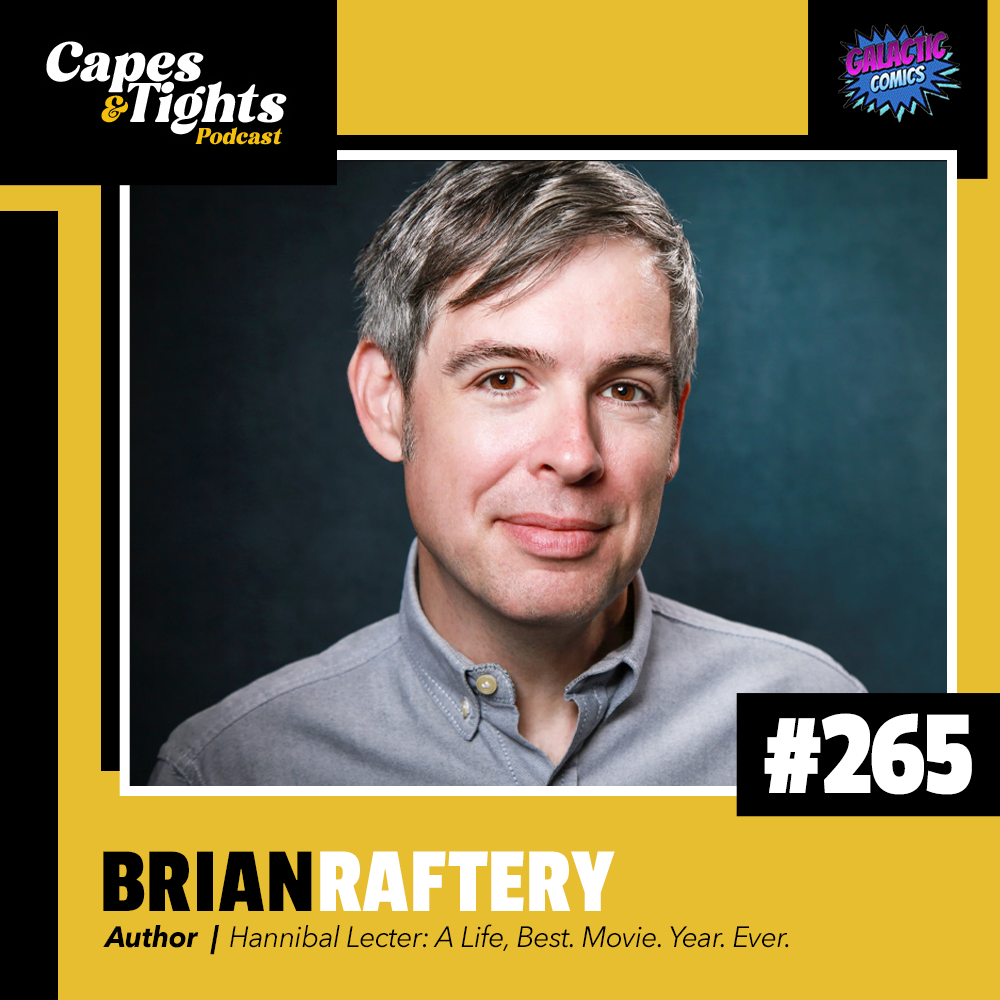
[00:00:00] Speaker A: Welcome back to the Capes and Tights podcast right here on Capesandtights.com I'm your host, Justin Soderbergh. This episode is once again brought to you by our friends over at Galactic Comics and collectibles@gitalitycomics and collectibles.com new shop coming soon. Can't wait. But this episode is our friend Brian Raffrey talking about his book, Hannibal Lecter A Life. Brian is a journalist, podcaster, and author of the book Best Movie year ever, how 1999 blew up the Big Screen. And again, like I mentioned, the upcoming Hannibal Lecter a Life book that comes out February 10th at bookstores everywhere about this little guy, Hannibal Lecter, and so much more, including discussions with the people who were in the movies. And there's just so much in it. You got to read it. It's about behind the scenes, about the Hannibal Lecter and the series that Thomas Harris created years ago.
It's amazing. But before you listen to this episode, follow us on Facebook, Twitter, Instagram, Blue sky threads, all those places. You can rate, review, subscribe over on Apple Podcasts or Spotify or wherever you find your podcasts. And then you can find us on YouTube as well. And as always, you can visit capesintice.com for so much more. This is Brian Raftery chalking Hannibal Lecter a Life, coming soon. This bookstore is near you. Enjoy.
Welcome to the broadcast. Brian, how are you?
[00:01:17] Speaker B: Thank you for having me, Justin. It's great to talk.
[00:01:20] Speaker A: I'm glad to finally get to do this. I mean, I read the book a little while ago, Hannibal Lecter A Life. And first of all, when I first came up on, like, NetGalley is where I see a lot of these things. And I was like, I gotta read this is the name. I was like, just in general, I'm big Hannibal Lecter and Silence of the Lambs and Thomas Harris's Books fan. And so there's that. But then just the way that it was in the COVID I tell you right now, that cover is awesome.
[00:01:46] Speaker B: I wish I could take credit for it. People keep complimenting me on it, which is nice, but it's like, oh, please send that to the artist. I did not have any. Trust me, the writer does not design his or her own book. Trust me, I wish. It's so much better than anything I could have come up with.
[00:01:59] Speaker A: Yeah, I might have never read it. Brian, if it was you design, I was kidding. But yeah, it was. It was awesome. So that's really cool. But like, you know, first of all, let's just get it. So you were a journalist, podcaster, author. You have multiple little names after your name. If that. If you say that, what made you want to get into telling stories in writing? Just go back a little bit and talk about that first.
[00:02:19] Speaker B: Oh, it's interesting. You know, it's funny.
It's such an easy reason, but an obvious reason. But I didn't really. Didn't really dawn on me until I was in my late 20s, which is. Both my parents were journalists, so I kind of grew up, but I was never like, oh, this is the life for me. And they were never like, son, you're going to be. It would always seemed like an incredibly stressful but fulfilling but also not always economically reliable kind of job.
But I just. I mean, I grew up in a house where, you know, my dad was a newspaper editor, my mom was a freelance reporter.
And so there was always stuff to read. I mean, and they were not like bookish academics. They liked to watch movies and talk and all this stuff and talking about baseball, but there was just always books in my house. And my mom, both my parents really liked history, but my mom really loved movie history. So I grew up. I just sort of assumed. Everyone grew up with like 30 books about movie history. Like, I knew what, like, you know, I knew who Judy Garland was by the time I was four, because there's just like a biography of her there. I mean, you know, it's. So I think that got me interested in cultural history, and my dad was really into American history, which is also something I'm interested in.
But honestly, I didn't really know what else I could do. I worked at the college paper, and I worked on the high school. My own little paper. Newspaper I put out. And it just seemed like what you did every day, but it was never like, I woke up one day, I was like, I have to be a writer. I have to tell stories.
But the thing that's been really cool is I spent the last.
I don't want to give away my age, but I'm very old, but for the last 25, almost 30 years now, writing about movies and music and TV and books and all this stuff. And what I love about it is that if I have a question about how was this movie made? Why did this happen? What did this person do when this particular weird cultural moment happened? When you're a journalist, you can just call up people and ask or go somewhere, and it seems like the biggest cheat.
So I've been very lucky. And for this book, I had always Loved Silence of the Lambs. And I was actually talking to my agent a couple months ago. I was like, when did we first start talking about this idea? And I realized that I found an email I'd sent him, like, hey, I really think Sounds of Lands is a book. Here's why. And it was like, January, February of 2020. And I was like, oh, that's why. That idea went nowhere. It's like, I don't think we even respond to that email. I think that chain died right away. So this idea specifically about this movie has been in my head for a while. But I had an editor, I have an editor, Simon Schuster, who was like, at a certain point, just said, why make this just about Silence of Lambs? Why not make this about Hannibal Lecter in general? So the book, which opens the book up a lot, because the book I get to talk about, you know, the publishing industry in the 70s and 80s when Tom Harris was just this blockbuster star. I get to talk about Hollywood in the 80s and 90s when, you know, Manhunter is made and Silence of the Land and Hannibal, the movie goes into production. And I get to talk about the TV industry in the 2010s, when NBC's Hannibal becomes the most grotesque show ever to be on network television in my entire life. Maybe there's something worse that I'm forgetting. But anyway, so it was very fun to kind of, like, trace this character and kind of look at what he. What. How he was created, why people love him, why he's endured so much. But, yeah, to answer your original question, like, I was just curious about all that, and someone let me write about it. So I have. I still feel like I kind of stumbled into this. I. When I was 14 or 15, I was convinced I was going to be a movie director. And then at a certain point, I realized I didn't have the talent nor the people skills to marshal thousands of people every day to create a vision. And I had no vision. So writing about people who have a vision is like the next best thing, I guess.
[00:05:43] Speaker A: Yeah, I mean, I was going to be this amazing artist, comic book artist. And I realized that my. My. I'm an artist in general. My. My main job as a creative director. I make beer labels. I'm a graphic artist. I can't draw as well as I used to be. So to me, I just realized I better just talk about these things instead of actually doing them. Like, how about just talk to creative people instead of actually doing it? No, it was funny because I had this first moment, this.
I'M a huge. I love movies. Movies are a huge part of my life. I think movies have been this just, just as long as I can remember doing this. And like when I had my, my son turning 5 in May, when he was born, I was like, I can't wait to have that experience where he's telling someone in his future. We went to this movie together, my dad. And so it was kind of funny. I actually got into kind of a little bit of an argument with my, my father in law because he wanted to take my son to a movie. I'm like, no, I got my job.
[00:06:28] Speaker B: Stop.
[00:06:29] Speaker A: My first, his first. We went saw Zootopia too. I mean it wasn't like a. It wasn't like a amazing. It was one of the most like successful financially movies in a while. But like it wasn't like this like oh, I brought to see Star wars. But it was like to me it was still a movie he wanted to see, he enjoyed. And I had this experience but over the weekend I actually had this experience where he really wanted to watch Back to the Future. And Back to the Future to me is one of my favorite movies that they're like just such enjoyable movies to watch. Yeah. And it honestly as a father and son with Doc's kind of like a surrogate father to Marty and all that stuff too. It's also good. But he wants, oh, there's a second one. And he wants to watch the second. Oh, there's a third one. To the point. Last night we put on the animated cartoon. There's a series. And I was like, it's not nearly as good, but it was just this amazing experience to see this, like my son watching these things. And I'm like, I can't wait. I thought about in my head as I'm preparing for this, like for me to actually finally sit down and watch Silence of the Lambs. It's gonna be a while before I do that. Yeah, I think. But there's these movies that just stick in my head that Star wars. But I would actually put these movies sounds the Lambs, Hannibal Red drag into that category to me because I think Hannibal Lecter is such a, you know, interesting and weird dude that that makes these movies so attractive to do it. But so obviously there was a time when you said in your mind Hannibal Lecter deserves a story, deserves this thing. And then you're actually. You mentioned your editor and talking about expanding it from Silence to the Lambs. But the moment you sat down to start writing this, we're like, okay, this is gonna be something. Did you have research to do or is this all this in your head? I mean, like, what was the research process like?
[00:08:01] Speaker B: The research is the most fun for me. And for this, it was a lot of fun. I mean, you know, one thing I knew is that Tom Harris or Thomas Harris, everyone calls him Tom. I never spoke to him, I never call, I don't call him anything. You know, I knew from the get go that he was not going to talk to me. He has given, from what I can tell. And I really spent like two or three years trying to find this out. I think he's only given three.
Published, extensive on the record press interviews in 50 years, which is really slim. I mean, like, you know, it's especially by 21st century standards, especially when you look at the authors who came, came around the same time as he did. I mean, Stephen King would give Playboy interviews. He was everywhere. I just finished reading, listening to this really interesting Elmore Leonard biography. Elmore Leonard had reporters at his house every time he had a new book over, like, and he, you know, a lot of these 70s, 80s authors doing press, going on TV, doing, like I said, a Playboy interview was a big part of the process. And Tom Harris has never talked really extensively in any way about Hannibal Lecter. So I knew I was get him. I also knew that because he's in his 80s, a lot of his contemporaries and peers have passed on. And in fact, you know, John the Demi who directed Silence of Lambs has passed on. I mean, a lot of people involved in the creation of these films and books, sadly are gone.
So. But the research for me came down a couple things. One is trying to do as many interviews as I could. Like, I talked to Michael Mann and Brian Cox about Manhunter. I talked to Ted Talley who won an Oscar for adapting Sounds to Lambs, talked to Diane Baker from that movie as well as other people. I talked to Peter Weber who directed the Hannibal Rising movie. So I talked to as many people as I could. But for me, the two main lanes of research is one, I always tell young people, newspapers.com, which is like 120 bucks a year, is basically like a second Google. It's like a secret hidden Internet because there's hundreds of thousands of newspaper articles that are not online. Like, they're not PDF, they're not scanned, like, they're just. It is an amazing kind of resource. So I would just go and find like the most remarkable, you know, tossed off comment from Anthony Hopkins in 1991 and I'm like. And like, it's in, like, you know, like the Pittsburgh Post Gazette on page 26. It's not anywhere else. So going through archival stuff is great.
Going through, you know, commentary tracks. But for me, the real joy was I got to go to a couple different archives while researching, and one of them was Jonathan Denney's archives at the University of Michigan, where they had it like, 12 to 13 boxes of just all Silence of the Lamb stuff. I mean, this, like, really, like, Ark of the Covenant kind of stuff.
And it hadn't been looked at by anyone, really, by a journalist, as far as I know, maybe for decades. But it included everything from script drafts to, you know, letters from the FBI to the producers. Like, at one point there's a letter saying, like, could this movie maybe not be rated R? And it's like, I don't know what script you're reading, but there's no way this, you know, the Sounds of Land is going to be rated R.
You know, there's correspondence between Thomas Harris and Jonathan Demi. So there's, you know, amazing transcripts of Anthony Hopkins doing a Morning Zoo Crew radio show in 1991, where women are calling in and asking him to talk to him, talk to them as Hannibal Lecter. So for me, all that research was like, again, it's the real joy, like, finding this stuff.
Especially, like I said, when you kind of. When you're kind of uphill in terms of interviews where people either don't want to talk or they're. Or to be honest, or passed away even, you know, sadly, like Roger Corman, who's in the Silence of the Lambs, I was talking to his office about saying at the interview, like, a month or two before he passed away. So people actually passed away while I was working on this.
So anyway, it was the research. Like I said, it's what I love to do. Writing is fine, but the research and finding stuff as a nerd. As a real nerd of these movies, these books, and being like, I never knew this. Which means most people who care about this have probably also never heard of this particular fact or quote. So, yeah, that's the real fun for me.
[00:11:44] Speaker A: Well, to me, I'm always like. Because I said, I'm a big fan of movies, and what I'm passionate about, I'm passionate about. So if there's something I like. So say, for example, this Hannibal Lecter series of movies and books and things is.
If there's something else to go with it, I want it. I want to know more about it. So, like, over the Past few years. I mean like even just the Michael J. Fox book that he wrote co wrote about the back to the future called Future Boy. I talked to Ashley Collins about your favorite scary movie about the Scream franchise. Like there's these books that are out there and these things that are out there that are just like I want to just devour these things because I learn more about the stuff. Like obviously watching the film is the most enjoyable experience because that's. Or the book, reading the book is the most enjoyable experience because that's what it is. But like then learning the behind the scenes things just, it always just grabs me and like it's the next thing it's like to me it would be like if I had a shelf of all these Blu Rays and books, it'd be like Thomas Harris collection, the movies and then your book. Yeah, because it was like that's what goes together. It goes together in this sense and you learn more about it. And that's the same thing I'd say about best movie year ever is the same thing if you're a fan of any of those movies in that year in amazing, you know, Hollywood in that year is that you just learn more about that stuff. And so to me I'm like this is a no brainer. I wanted to hear all about this stuff and you probably didn't tell me enough in that. There's probably more stuff you could probably do a second month and actually Daniel Krauss has one partially devoured coming up.
[00:13:04] Speaker B: Reading that right now.
[00:13:05] Speaker A: Yeah, it's phenomenal. And it's the story Night of the Living Dead. So like anything can get more. And I also a big Daniel Krause fan so learning more about Daniel is also amazing. So but like this, this, this, the attachments to these things and I hope more people do, I hope you do more of them and stuff like that. But I think it's the right subject matter and the right material. I just feel like there's certain people who have heart. Like it's hard to do the research because like you mentioned, where do you find you can't talk to the creator? The creator is not going to come to you. And, and it's not even the fact that like the creators pass. You're not writing something about some long dead person. This is like this person just. It's not on the public eye ever. So you can't even get in these public interviews. So that's an uphill battle in that sense. But the movies are also so successful and the books are also so Successful that there's things around it. And that's what you did in this book. You used around this stuff. You talked to the people that were around the people, the people that were in the movies and things like that, which was phenomenally laid out. I love that in the way that progressed by telling how the tour, the story the book was told was well done too.
Do you have any big surprises that you.
That came to you while you were writing this book? At the end you were like, wow, that really surprised me about either the books, the movies, or the experience of writing it.
[00:14:13] Speaker B: I mean, there are a couple of things. I mean, in terms of just actual granular stuff, you know, stuff like I said, like finding Jodie Foster's, like, itinerary for her Quantico training. Like, stuff like that. I'm just like amazed at the actual length of production or, you know, at one point I found, tucked away in the back of one of these boxes at the University of Michigan was like a note, a note to Jonathan Demme that was like folded up in an envelope, I don't think. And it was yellowed. I don't know if anyone seen it and just said, like, dear Jonathan, congratulations for once the best picture the year actually. Wonderful. Signed Steven Spielberg. And I was like, this has been sitting in a box, like, so that kind of stuff is so fun, you know, even things like toward the very end, I was doing a second. I was doing a third or fourth round of research, like, what did I miss? And I'd already turned the book in or turned early drafted. And I found out of nowhere, kind of like I hadn't popped up in other searches. I found a news item about Donald Trump going to the premiere of Hannibal at the in in 2001, which hadn't popped up in previous searches. And I was like, this is out there. It's easy to. It's kind of findable, but I didn't know this. So. So those kind of like making of things or what the kind of immediate cultural impact is Interesting. What also surprised me was when I started out writing, I was thinking, well, this book could also be a bit about, you know, I had this question which is like, well, all right, well, how did Hannibal Lecter kind of affect the real world? And then one thing that really fascinated me was really tracking the true crime and serial boom of the last 30, 40 years. I mean, true crime has been around forever.
But I distinctly remember in the 90s, because I will give my age away, I am 50 years old. So I was in college and high school in the 90s. So that stuff is very culturally, I was very in the culture. And I remember when serial killers just became this strange pop cultural thing. I remember when Charles Manson was on the COVID of Spin magazine, which made no sense. Like, Spin did not put non musicians on the COVID I remember all these TV movies about Ted Bundy and John Wayne Gacy. And it's a certain point, in the 90s, post Lecter, serial killers were just kind of all over the culture. And I do think that Lecter and the Silence the Lambs did have something to do with that. I mean, obviously, serial killers were not new. He didn't invent them. But there was a level of fascination and I would say lionization of serial killers in some ways that I think only was, I think, sounds. Without Silence the Lambs, I can't imagine it happening to such a degree. So that stuff was really surprising to me. And also being surprised by the number of serial killers that I'd never heard of, that I was like, I don't want to know all this. Like, I was doing research and I was like, geez, this thing happened in, like, you know, Oklahoma in 1976, that never gets written about. And I was like, I don't need to read all about, like, at a certain point. Like, I admire true crime and I'm interested in it, but I'm not someone who can obsess over killers all day without getting kind of, you know, sleepless nights over it.
[00:16:51] Speaker A: So, yes, well, there's certain books where I've been like, why did I read this while I'm laying in bed? And that's like, because I won't be able to sleep at night. And that's true. And it's. Hannibal Lecter is a fictional character, obviously. There's an amalgam of a bunch of different things that makes up who Hannibal Lecter is. But, like, it's. In the end, Hannibal Lecter is not going to come get me at my house. And so there's that separation there. But like, yeah, reading true crime stuff, sometimes I'm like, there's definitely some times where I'm like, oh, my gosh, this is really creepy. This actually happened. And I'm reading about it. It's just kind of creepy.
[00:17:19] Speaker B: Yeah, yeah. I mean, there have been some amazing, you know, biographies the last couple, last decade or two about.
About Manson, about even Jim Jones is not a Sealcoat. But that stuff's when it's really, really reported and put in the bigger context. That's really interesting to me. But I'M certainly someone who's like, at a certain point, you know, when you look at Hannibal Lecter, who's so refined and so intelligent and funny and kind of cool in a way, a lot of ways. You know, when you read about real life serial killers, you're like, these guys are just degenerate, like, scumbag monsters. Like, there's no.
I think at some point in the 90s, we kind of convinced ourselves that, like, serial killers were kind of these brilliant, misunderstood, dark, terrible geniuses. And it's like most of them are just like this absolute morons who are terrible. Like, I mean, I don't, I don't know if there's a real Hannibal Lecter in terms of like a real intellect, but it's still correct. I saw, I saw an ad for a TV show the day where it's like the most devious, brilliant serial killer. And I'm like, yeah, I don't know if that really exists, but I mean, it's true.
[00:18:13] Speaker A: I mean, there's the, the, the.
They feel like they're almost lucky. Serial killers have almost just been lucky over the years. How they got away with. I mean, we've seen some of these things in the True Crime. Things are like, police entered Dahmer and there'd be like a barrel in the corner full of a dead body, and no one did anything about it. Like, stuff like that. Like, they're just lucky. They're not devious and smart. They just end up getting away with shit.
[00:18:31] Speaker B: Yeah, that's what I mean.
[00:18:33] Speaker A: Yeah, it's like, it's, it's, it's insane. But do you think so. So Harris created these, these books years ago, and then the movies came out. Do you think that take Thomas Harris to 2026, have him not be as old as he is. Like, it just transport him to now. Do you think these books would have been written the same way in the same.
Had the same success in modern day as it would have, you know, when they were originally created?
[00:18:57] Speaker B: That's an interesting question, because I've, I've thought about this a bit. What would happen if you introduced lecter in the 2000s? And I think, you know, you know, when you read Red Dragon, the first novel that came out in 81. So Hannibal Lecter is almost 50 years. He's almost as old as I am at this point.
You know, he's only in that book for like 11, 12 pages, tops. He's barely in it. He's talked about more than he actually talks. And he looms over Some things, but there's a long. You've read it. There's long passages without him. And even in Silence of the Lambs, like, is Clarice Starling's book with. With a lot of Lecter in it. And there's very little about his past. There's very. He just exists. And I think were that book were Red Dragon or the Silence of the Lambs like to be introduced to modern audiences, I think an editor would say, hey, we need to know more about this guy. Because we are so obsessed now with, like, how did so and so become so and so? How did Darth Vader, like, how did you know Anakin Skywalker become Darth Vader? There's so many prequels or prequels in the works or backstories, you know, and even the backstories we know are being repeated. I mean, I love Batman. I don't know. I don't need to see Batman's origin story, like, ever again in my entire life.
[00:20:02] Speaker A: No one does.
[00:20:03] Speaker B: I get it. I read the Killing Joke when I was 13, and then I read the original comics when I was 14. Like, I know all this stuff, but I think it would be very hard to have a character like Hannibal Lecter. Just a guy who's kind of in the sidelines for so long. I think modern audiences would be like, what makes him tick?
And, you know, as. You know, as you've read the later books, Tom Harris does go into what made Hannibal Lecture tick. And I think audiences weren't as super interested in that as maybe he thought.
[00:20:27] Speaker A: Well, you wrote this in your book, too. It's like, it's. It's. You know, Thomas Harris wasn't really keen about writing Hannibal Rising. So, like. So, like, he didn't really want to tell the story of how he became who he became. It just was. They just wanted you to believe. And sometimes that's great. Just plop you in the middle. They'd be like, okay, this person's a horrible person. A very smart, intellectual person, but this is just who he is. Like, don't worry about what happened in the past. We're moving forward now. Like, it's just. It's an interesting interest. All of us want the origin story. You're right. It's a. It's a, you know, thing. And some of it's because it makes money, Right? We told the story. You like this thing. Let's create the. We can't go past that because the guy's dead or whatever it may be. So we have to go before that and Tell you the story, how they got to where they were. And it's. I mean, I'm. I'm a glutton for anything that I'm a big fan of. Like, I mentioned seeing it again. So I'll see every Star wars movie ever. I don't care if they're good, bad, or ugly, because it's a Star wars movie. And I'm lucky enough that they're still making them. Same thing with the Marvel Cinematic Universe and all that stuff. Like, I'll watch all of these things because I love them and they're still making them. So, yeah, my ticket. Like. And so I'm. I will read the book about this, the prequel. You know, I just read the Hunger Games prequel. Like, it's actually was pretty good, actually. But, like, that was pretty good.
[00:21:37] Speaker B: I mean, the prequel movie they did. I haven't read the new. Like, that was like, well, this is actually pretty good. It's pretty good. This is a rarity. Like, this is not. You know, most of these are not as satisfying.
[00:21:45] Speaker A: No. As I satisfy. And we've seen it with, like, Solo for an example. Like, no one wanted to see Han Solo. That wasn't Harrison Ford. And so, like, it was. It was a weird thing. I liked the movie, but a lot of people didn't. And so it's this. What can we do to make some more money and tell some more story without telling the future story? You can tell a past story, and that's. That's where that is. And so, yeah, I mean, the best books are, you know, Red Dragon, Silence of Lambs, and Hannibal. Like, those are the best books. Animal Rising is like, okay, it's there. Same thing with the movies and Hannibal Rising. Hannibal, the TV show was actually pretty good, though. So, like. Oh, yeah. Yes, yes. But, like, it is one of those things that it's. Silence the Lambs is the most famous out of all of them. And I think it gets the push above everything else for. For quality because of that.
But they're the first two books, at least Red Dragon and Silence Lambs are phenomenal. And then they made the movie, so. So obviously they made Manhunter, which is obviously largely forgotten for a lot of people who don't know the entire, like, deep dive into what's going on there. They think that sound slams is first of all the first of the story, which is not tr.
But do you have a preference?
You obviously have read all these books, you've watched all the movies, you've seen all these things to do these things. Do you think I think Anthony Hopkins does such a great job playing the character that I think to a lot of people, writing the books or watching the movies or doing both, put the movies above the books because of that. What do you think? Do you have a preference on either one? Or is it.
[00:23:10] Speaker B: I mean, it's tough. I mean, my answers would be obvious. I do think the Songs of Lambs is. Is obviously the best movie of all these. At the same time, it's been really fun watching as someone who really, really got into Michael mann in the 90s. I know Michael Mann is like a very, like film dude, kind of beloved figure now or film fan figure I've loved in the last 25 years or so. Watching Manhunter kind of creep back on people's conscious. I mean, I think it is for. I mean, I went to a screening in LA a couple of years ago with Michael Mann there. And what really struck me was the number of people who were very young, who were nowhere near alive when this movie came out, who fought really hard to get tickets to see Manhunter. I mean, it was like, really. And a lot of them hadn't seen it. They were just kind of fascinated by this character, by Michael Mann. So that's. Watching that movie now kind of has come to its place as like a real, kind of 80s, real modern classic. I love that.
As far as the books go, you know, Hannibal Rising does not work for me, which is fine. And I'm not a critic. The book is not a. The book. My book is not like a critical takedown of any reading of these.
I don't think it's anyone's favorite. I wonder who in Tom Harris cares for that book. In some parts of it, I perversely. Even though Hannibal the novel, I'm going backwards. Even though Hannibal the novel has a lot of stuff that I would cut in terms of storyline and cut in terms of specific choices. There's a lot of stuff in Hannibal I really, really like. I love the stuff in Italy. I love Mason Verger. It's the most over the top. I mean, it's absurd how evil he is, but it's kind of fun.
But I really do think Harris's first two Lecter novels, The Red Dragon, 81 and Sons of Land in 88. For people who haven't read them, they are so crisp. They're very hot. They're really, really well written. And so is his debut novel, Black Sunday, which is a phenomenally fun read. I mean, it is a far flung global terrorism thriller. It reads so fast. It's like, you know, I know people use the term airplane novel or airport novel as a negative. I don't. I love those kind of books, and I think those first three Harris books are perfect examples of what you can do with really smart. A really smart, very art, very, like, really prose friendly writer who just craft incredible sentences with an incredibly pulpy story. Like, it's a perfect combination of those kind of things.
[00:25:26] Speaker A: Yeah, I mean, they're all. It's a place, time and a place. I've always said to myself, like, audiobook audience, physical novel, movies. There's times and places. You can't sit and watch movies all the time. I wish I could. I just. You can't. You can't. There's not other things you need to do. And you can't, you know, physically read a book all the time because, like, same situation. Audiobooks help because, like I said, I drive in the car. So. Yeah.
And so there's a time and a place for everything. I just think that's one of those things that the first two books, specifically Red Dragon, Silence of Lambs, the conversion and an adaptation to screen is done so well that it's like one of those things where I'm like, if you read the book Red Dragon and watched the movie Silence of Lambs and then read, like, you would probably do that and not really miss out on much. There is some obviously things, and there's obviously purists who are gonna be like, the book's always better than the movie.
It's not. I think Jaws is better than the book, to be honest with you. I think people added some things into the book that didn't really need to be on, and they actually saw that and didn't put them on screen. And I think Jurassic park, the movie, is better than the book. And that's a hot take for some people. But, like, there's some things that are better. And I think that. I don't know. Anthony Hopkins, to me, it's just always been in. Have you ever seen Fracture?
[00:26:34] Speaker B: Oh, yes. Yeah, that.
[00:26:35] Speaker A: That to me also, honestly, some of the same character he's obviously playing like this, it's a little. It's a little bit of a character acting like you have some of the same mannerisms and the way he speaks and things like that. But he's such a good actor playing a creepy serial killer that I'm like.
[00:26:49] Speaker B: He'S very good at that.
He really is, though. You know, I think. I think the two performances that I really think. I mean, there's three performances I really Love of Hopkins, and this is one is obviously Hannibal Lecter in Silence of Lambs. I think when he comes back for Hannibal and Red Dragon, Hannibal especially, it's a little over the top.
[00:27:06] Speaker A: Yeah.
[00:27:07] Speaker B: But I also, I think, you know, Remains of the Day and his performance remains of the Day and in Nixon and in Silence of Lambs, he's doing three different variations of a very buttoned up, very cold person who's trying in some ways to actually kind of like, connect to other humans.
He's very good at those kind of. He's very good. Those kind of roles.
You know, he's also fun when he's having, like, fun like when, you know, he's in Dracula or something like that where he can be a little over the top.
But, yeah, all of that. I mean, what's so interesting about these adaptations? You know, two things come to mind when you listen to you talk about the adaptations. One is that, you know, Ted Talley's Silence the Lambs adaptation is still basically the textbook book to screenplay model for how to Write. You know, he won an Oscar for it. When you read the novel and realize how much he cut out, I mean, because I feel like adaptation. I'm not a screenwriter, but I feel like you get the sense that it's mostly a process of subtraction. Yeah, but if you subtract the wrong thing or add the wrong thing, you're going to completely discombobulate. That's a pretty pristine adaptation. I mean, he cuts a lot of big stuff out of the movie, but you don't feel it.
And I also think the Bryan Fuller who created the NBC Hannibal show, that's also a really remarkable adaptation. There's very few that are. That are comparable to it. He takes all these very granular details and characters from these books, all four of these books. Basically, he couldn't get Sounds of Lamb's Rights. But characters who span these horror books, he puts them in rooms together where they never existed in the books.
And it feels a, very honest to what Tom Harris did. But B, it feels very much in Bryan Fuller's voice. And that's a really tough thing for any creator. So I really. The Hannibal TV show sometimes icks me out. Sometimes it goes a little too over the top for me. But as an adaptation, I'm kind of in awe of what he did with all those novels because it really feels like its own unique thing and that.
[00:28:55] Speaker A: And that. You're right about that. You have to subtract a lot and sometimes you have to add something to make up for the stuff you subtracted to, like, push it all together. And sometimes people are not very good at it. It's definitely seen some adaptations that were like, wait, what?
[00:29:07] Speaker B: Yeah, I know.
[00:29:09] Speaker A: Hold on a second. And that was one of the few of them, and I will say it's funny, is that as much as people don't like to talk about J.K. rowling, the Harry Potter and the Sorcerer's Stone, and Harry Potter and the Sorcerer Store in the movie, I think the first couple of them are like. Like, you basically. Like, there's, like, lines from the book in the movie. Yeah, it's like, yeah, I was like, I've read the book and then I watched the movie. I'm like, wait a second. There's like. Like, the adaptation literally is cutting a few things out because there's, like. I could, like, read along with it in the book. And some of it, I felt like that. And there's certain scenes and certain things in Silence of the Lambs that are in the book that are, like. It's. It's. If you're a fan of the book, you're gonna like the movie kind of thing.
[00:29:46] Speaker B: Yeah.
[00:29:46] Speaker A: And I think that was a. A safe play, but also the right play. And I think that. I think doing that. And I think sometimes adaptations are done too much to say, look, what I can do. Look, what I. Look, I could do is I was supposed to stick my name on this thing. And they change a few too many things. And yes, that adaptation for film is done so well that, like, sometimes I forget who adapted it, because it's not. I don't need to know kind of thing, because it was done so well. Yeah, I mean, like I said, they all have their own place, and that's what's cool about the story. And so you have read all the books, you've watched all the movies, you've seen the TV show. Obviously you've done the research behind the scenes.
How has your view of Hannibal Lecter changed from. From 2020 when you decided to make this book till now? Like, is it. Has it changed? Has it morphed? Has it improved? Is it negative? What was your feeling now on Hannibal Lecter now this far into the. The process?
[00:30:35] Speaker B: I mean, if I had to hang with a fictitious serial killer, he'd probably be among the upper. I mean, he's, you know, he's a lot more chill than others, and he's pretty funny.
[00:30:45] Speaker A: You're gonna be the guy. Someone's like, you wanna have coffee with one famous person, who would it be? Living or dead or fictional, you'd be like, Hannibal Lecter.
[00:30:52] Speaker B: Yeah. Or Tom Harris at this point. Yeah.
No, I gotta be honest, just going back to what we were talking about earlier.
As someone who also shares your love of, like, I want to listen to the audit commentary track. I want to read this book. As a journalist, the fact that I couldn't talk to Tom Harris drove me crazy at times. As an admirer of his work and as someone who sees very few modern artists being able to maintain a sense of mystery, I respect it. I understand.
I love that for the last 20 years or so of his life, Prince gave very few interviews. I liked having some mystery about him.
And in fact, there was. There's been a couple of big books about him in the last five or 10 years, and I just haven't read them because I'm like, I kind of want to preserve the mystery I have.
But in terms of, like, lecture, my view of Lecter changing. I think what's fascinating is, like, it's not even just my view, but it's like he's become more and more prominent, like, even since I started the book, which is like, when I signed the contract for the book, Trump had mentioned Lecter, like, maybe twice, maybe. And it was kind of a far off thing. And then, weirdly, as soon as I started working on it, he was talking about it again. And then so all of a sudden, like, you know, my family is calling me in the living room being like, hey, Hannibal Lecter's on the opening of Saturday Night Live. Like, Hannibal Lecter came back in the culture. I mean, I just took my daughter to go see Anaconda a couple weeks ago. And there's, like. There's a Silence of the Lambs reference in that. There's a Hannibal Lecter joke in the Naked Gun movie that came out last summer.
He's still huge, and it's just so wild because he's nowhere to be found. Like, that TV show went off the air almost a decade ago. There hasn't been a book now in 20 years. I think there hasn't been a movie in almost as long as a time. So for him to hang around this long in the culture, I think it says a lot about what we think about antiheroes. Like, he is like an antihero now, and he's like, you know, he's. To be honest, like, he's not a good dude. Let's not forget, like, he chews people's faces off. He kills a patient because he's bored by that patient.
Yet There is something kind of people celebrate about him. And I. I don't always know what it is. I think maybe it's how brazen he is, how unapologetically he pursues things he loves. I think it is, as we talked earlier, he is kind of a model for what a killer should be in terms of like, you know, at least in terms of being funny and intelligent and like, probably a good hang for a little bit.
But there's, there's whatever the fixation on this character is, and I think people have their own reasons. But it's wild to me, again, like, he is, he's not out there. It's not a Star wars thing where they're making new Hannibal Lecter stuff every year on multiple platforms. And it's, He's. He's. He started as 11 pages in a book 45 years ago, and he honestly is like, only been blown up bigger, like a little bit since then. So it's wild to me that he's still has this hold on people's, the public's imagination.
[00:33:29] Speaker A: It is great. And it's like he was. He was part of that first novel and then obviously said the second novel was a Clarice story. Really is that. It's also funny how he was kind of like the secondary part of the stories and he's now become primary of. Yeah, the, the lore. Like people forget about Clarice almost.
Well, I will say I don't, because.
[00:33:46] Speaker B: I think Clarice is very big.
[00:33:47] Speaker A: I mean, I think there was that Clary show too, actually. I forgot about that too. Yeah, yeah, that there was that show Clarice. But.
[00:33:53] Speaker B: Yeah, but I think, I think. I mean, this is my own theory that I think a lot of the, the boom in true crime, you know, true crime is a. Is a. Is a category that's created and consumed primarily by women. And I do think Clarice Starling, you know, I interviewed an FBI agent who loved Clarice Starling when she saw Silence of the Lambs, who wound up going in the FBI for 20 plus years. I do think that Clarice Starling is kind of like the unspoken kind of star. I mean, granted, she won an Oscar, she's a huge character. But I don't think there is. I think our fascination. Hannibal Lecter would not be there if it weren't for the Clarice Starling character. Because she's our entry. She's the one we literally look at. I mean, she's looking in his eyes. She talks to him. She's the only person he really connects with. In any meaningful way across, you know, aside from, like, his. His sister when he's younger or other, you know, whatever. But he. She's. She's the portal into which we view Lecter. And I think there is part of. It's like, well, Clarice Starling can see something humane in Lecter even, you know, to whatever degree. Maybe we can, too, you know. So I do think she's kind of secretly as big you. You could almost do Clarice Starling a life if there have been more books, if she'd been the novels more, you know.
[00:34:56] Speaker A: Yeah, absolutely. Yeah, there's enough there. And like I said, you mentioned, it's still in the public eye with this stuff. And having our president speak about him is also kind of funny to hear that too, because you don't see that. I mean, think about it. If it was me, and I don't care who the President just mentioned some character for my book, I'd be like, holy shit, what's going on?
[00:35:14] Speaker B: Right?
[00:35:15] Speaker A: And in what context you could, you know, whatever. But, like, it's just funny how that's. It's like it's almost gone past pop culture to. To the mainstream in that sense of. Of the character Hannibal Lecter is going to. I mean, there are probably people out there who think Hannibal Lecter was a real person, like, legitimately.
[00:35:32] Speaker B: Not too many people. I mean, that's a. I mean, and I don't. You know, to be. To be clear, I don't think Trump believes that head of. He called it a late, great call. I don't think have like, their action. But it was funny that he just kept speaking as if he were a real character.
[00:35:43] Speaker A: Gosh.
[00:35:44] Speaker B: I think that goes into kind of like, you know, Trump's. You know, this is not about Trump as a politician, but he is a boomer, and boomers love pop. I mean, there's certain pop culture references that boomers just like the. You know, they'll say a certain line from an old movie, and it's like, it's. Everyone in the room laughs. I've been around that. I have a lot of boomers in my life.
But, yeah, I mean, it's. Well, it's funny, too, because, you know, in terms of how big this film is. Like, you mentioned Zootopia 2. It's like they had a scene in Zootopia 2 that they cut that was an exchange between two characters. Just the dialogue between Lecter and Clarice from Silence the Lands. And they cut it for. It sounds like kids didn't quite get the reference or it'd be too weird. But it's like that's how big is. They could have dropped that into that movie and everyone like your age and up the mountain. Kids in the audience would immediately have known what. That what this was referring to. They would have totally caught it. He's a very easily referenceable character. And I think that's one of the. I know people want to look for a lot of super deep reasons why Trump was talking about Lecter. And I do think there are some interesting similarities. But I think a lot of it's just sort of like. It's like saying Darth Vader. It's like everybody knows Darth Vader is right. So easy applause, easy laugh, you know?
[00:36:45] Speaker A: Yeah, yeah, I can see that. Yeah, it's true. Zootopia too is funny. My son got some of it. I'm like, it's. Zootopia 2 is. If you think about how long it took between one and two. It's kind of like Toy Story nowadays where it's like Toy Story is a kids movie. But it's like really made for the adults that are bringing their kids to the movie. Because some of the references are definitely for me. And I was like, there's some things I laughed and there's a bunch of the parents laughed in the theater. My son's like, why it wasn't funny. Yeah, I don't think you understand, but I got it. It was awesome. But yeah, it's pretty crazy. It's. It's. It's just living stood the test of time, I think. I mean it's across pop culture. I don't know if you can see it here, Brian.
[00:37:20] Speaker B: I was gonna ask what that. I could see that straight.
[00:37:22] Speaker A: It's Stray Dogs by writer and artist Tony Fleece and Trist Dorsner over at Image Comics. And it's comp things Silence the Lambs meets All Dogs Go to Heaven. Like the style of artwork is that. But it's about a.
A dude who kills people and takes their animals. And then the animals now live with him. And so they have this short term memory so they forget who their people were. But they all. They figure out finally that they. The guy's a serial killer. And it's all from the point of view of the animals. It's actually. I believe it's been at least optioned. I don't know if at one point it will make it into an animated series, but it's like the Bluth style artwork in there and then. But but it's about a serial killer and it's about the dogs of these victims.
[00:38:07] Speaker B: I saw it like on free comic book store day once and I thought it was a kid's comic. I just saw the COVID and I was like, I'm not gonna. That's cool. I'll check that out.
[00:38:13] Speaker A: So good. But this is a they. This is. Again, this is one of those things that's crossed over to the point where Silence of the Lambs gets a. Gets a dog friendly variant cover for comics. And it's just really cool to see that. So, like, you see that like the imagery has transcended just the books or the movies. It's become this bigger, bigger thing. And that's why I think that this book means a lot. And I think there's so many people who are fans of the books or fans of the movie that just want to learn more. And I don't have the time, energy and effort that you did to put into the research into making this book. And so it's easy for us just to read this and learn a little bit more about, you know, the movies, the books. Thomas Harris. As much as you could discuss the creator publishing, like you mentioned the different ways that books are published and how it adapts into film and stuff like that. Like, it's a cool, grand scope of what Hannibal Lecter is, but also the things that surround Hannibal Lecter. And that includes the book.
It's such a good book. And I think that honestly, there's only been one that I won't obviously mention a book about something like this that I haven't really liked in the past 18 months or so. Most of them pretty good. So I'm hoping more people do this. I think that these, these historical.
These places in history that need to be talked about and that I don't like I said I don't want to do the research. I don't want to pay the $120 for a newspaper.com, whatever it is.
I want you to do that and then I'll buy your book and we'll be good. So, yeah, it's a good plan. I think it's great and I think that's great. So I think that Hannibal Lecter is one of those characters that forever actually have him. Actually, I don't know if he's over here. I didn't realize that.
[00:39:43] Speaker B: Oh, wow. Let me see. Bring him up. Let me see. Which is. He jumped? Is he in his. Oh, look at that.
Very nice.
[00:39:48] Speaker A: Like an action figure. Brian is an Action figure.
[00:39:51] Speaker B: There's a funko pop of Hanabolictra. He used to be the most terrifying creep, you know, like.
Yeah, it's a bizarre trajectory.
[00:39:58] Speaker A: And I think there's one of my favorite comic books of all time, Nail Biter by Joshua Williamson and Mike Henderson. They have a cover that has a baby wearing the mask on the front, the drawing of a baby. And the book's about a serial killer who bites his nails.
[00:40:12] Speaker B: And.
[00:40:13] Speaker A: But like, so, like, this is also, like I said, it's like this crazy in all these different places you see these things. And you mentioned it potentially have been in Zootopia 2 and so on and so forth. It's pretty insane. It's an insane thought to think that this serial killer that spent 1112 pages in a first book has become what it is today.
So as we finish up here, Brian, what do you hope that people get out of this book? I mentioned all the stuff that I said, but what do you hope that people get out of this book? Do you hope that they go read the books and watch the movies? Or do you think that this is for the people who have already done that?
[00:40:41] Speaker B: I think it's for both. I mean, I would love. I mean, I do think Tom Harris is writing, as you mentioned earlier. I do think, especially his first three novels, the writing is so fun. I know a lot of people who have read, who watched the movies a million times and the TV show who haven't read the books. I do think they're really kind of rewarding, you know, in terms of, like, what it. What else it might do. I mean, I. I kind of think maybe it'll let people think about their own relationship to villains and to true crime. I mean, I think we are at this interesting point now with true crime where it's like, it's become, you know, for podcasting, for documentaries, it's obviously become, you know, one of the most lucrative. I don't know how lucrative action is, but, like, definitely one of the most dominant genres.
And it's also a genre that, you know, when. When done really poorly is like, awful, but when it's done really well. And one thing about Tom Harris is, you know, he. He was one of the first people to be like, I'm writing a novel about a serial killer. I'm going to go talk to the FBI. I'm going to visit them. Like, he based all this stuff on research and really kind of learning what actually happened. And I think that's kind of one of the things I, like, I love about and remind about his work is that it never feels kind of exploitative or he's kind of making stuff up. Like he's really trying to root all this stuff in real science.
And I think that's the most effective. You know, whether you're writing fictionalized crime or true crime, the people who do the research, they're there and it can put things in a bigger context. That's the stuff I love. I mean, I think that's like, you know, I mentioned that Charles Manson biography that came out about 15 years ago. I think it was Jeff Gwynne who wrote that. He's written a bunch of these books. He wrote one on Waco, he wrote one on Jim Jones. And he's one of my favorite authors because he is such an insanely dogged researcher. And for anyone listening, his Manson biography will basically flip. Whatever your perceptions of, of Manson, like whatever your. It's really, really. I mean it starts them as a young kid, but it's based on interviews and research and transcripts. And I love that kind of true crime. Like that's, that's when you can. When true crime actually tells you a little about the country we live in and the world we live in. Aside from just like so and so killed so and so. I find that really rewarding. So anyway, I hope people, you know, people read this and want to read more about true crime or take a break from serial killers for a while. Like I do hope they kind of seek out the people who are doing like these really kind of interesting intent research intensive projects.
[00:42:53] Speaker A: It's, it's, it takes a skill. And I think that I saw you see it in Best movie or Ever. You see in this. You see the, the, the, the no page unturned that you possibly could find. And at some point obviously you had to say to yourself, okay, I gotta stop because I gotta read this book. I can't do this forever.
It's one of those things that like, like if you found enough information, it's like the deluxe edition comes out in a couple years, you add a few things. But like it's, it's one of those things you have to cut, you had to cut it off. You'd be like, okay, I'm done.
[00:43:20] Speaker B: And.
[00:43:20] Speaker A: But you did it just enough. And I think I said it captured me along the way. I wasn't bored. And so that's what's really good about it. I think it's, I'm a diehard fan of it so that there's that. But also like, I want to learn more about Passions and pop culture and things like that. And that's where this fit right in that. That. That area. Area.
[00:43:35] Speaker B: Well, it's very. It's very.
[00:43:36] Speaker A: You want to read something that's based on true story and not if you're reading fiction and you want to, you know, little, you know, palette cleanser. If you want to say between fiction stories, you can read this nonfiction story about, you know, Hannibal Lecter, a fictional character, but like, the creation in the evolution of him.
[00:43:53] Speaker B: Well, I appreciate what you're saying. I mean, I wish I could say and be very noble and say that all this research I do is because I am a truth teller who is obsessed with finding the truth. And that's kind of true. Like, I wish I could say I was like Jake Gyllenhaal in Zodiac. But honestly, one reason why I love all the research and doing all this stuff, it lets you put off the writing, which is the real painful part. It's the greatest form of procrastination ever, is just waking up being like, should I start writing that chapter? It's like, no, I still need to find that one. Tom Noon interview about playing Francis dollar Hyde. I need to. I need to learn more about this particular thing. So it is. That is. That's part of the love of the research for. For all these books and projects.
[00:44:27] Speaker A: The publisher's like, okay, okay, Brian, we get it. You. You've done enough research. Let's just freaking put a book out.
[00:44:33] Speaker B: No, I found. I found a lecture Brian cox gave in 1991 in Scotland. I've got to. I've got to listen to the whole three hours, see if he says anything of interest.
[00:44:40] Speaker A: Yeah, I might not use any of it, but I got to listen to it, so I can't write anything.
[00:44:43] Speaker B: Oh, you don't use. You don't use 90% of it. It's amazing how many. How many rabbit holes you go in that just bring you to the rabbit hole, and you're like, where'd that rabbit hole go? Oh, well, I got pulled nothing out of it.
[00:44:52] Speaker A: And I imagine they say the same thing over and over again. It's points, too, where they sell the same stories and they tell the same.
[00:44:56] Speaker B: Sure, sure. Yeah, yeah.
[00:44:58] Speaker A: There's duplicates of that, too, but. Yeah, but out February 10th at bookstores everywhere. You can
[email protected] is where I like to go, as well as Libro FM for the audiobook form of this book. I believe it's available in audiobook. I'm pretty sure it is. I think it is.
[00:45:11] Speaker B: It Is. I think I did it. It was the first time.
[00:45:12] Speaker A: Oh, you did. Yes, you did.
[00:45:13] Speaker B: It was a trip.
[00:45:15] Speaker A: That's awesome.
[00:45:16] Speaker B: Reading Hannibal Lecter's dialogue and my voice was a very strange afternoon.
[00:45:21] Speaker A: Well, it was Lavis of Ashley Collins had your favorite scary movie, Roger Jackson read it. Who? Oh, yeah, does the voice of Ghostface. And I said, when it's up there, when it's his. Did you read the whole thing in Ghostface voice? And then when he's doing the interview, is it's just him or do they do the opposite? Like, how does that work? Yeah, like actually, I don't know. I'm like, I really hope he reads his interview questions like what he's his lines in Ghost Voice and that everything else is read in Roger Jackson's voice. But Ghostface voice is like the Roger Jackson quote. That's what I hope. But. But yeah, so get it anywhere. February 10th. You can also grab best movie year ever. About the year that was in 1999 and the amazing amount of movies that came out and so much more. But Brian, I really appreciate you taking the time out to discuss your book and so much more right here on the podcast. We'll have to get you back on in the future, but until then, thank you so much.
[00:46:07] Speaker B: Thanks, Justin. I'm going for a walk now in my neighborhood of Burbank, California. And just so you know, I am right near the Burger King that's in Back to the Future. So every time I walk by it, I go, there's the Back to the Future Burger King. In fact, my kids do not care about it anymore when I point out. But I have always.
I'm always very. I'm surrounded by Back to the Future, even just in my backyard. So I'll be thinking of you when I walk by.
[00:46:26] Speaker A: I love you say that because I used to live in Lowell, Massachusetts, and I drive over the bridge that's in the Fighter. And oh yeah, yeah, he's running across the Fighter. And I would say it to my ex wife, I'd be like, this is the bridge that's in the Fighter. She's like, shut up.
I'm like, okay, sorry, I'll stop. I am not going outside for a walk because there's 60 inches, of course out there, but I'll stay warm inside. So how about that? So thank you so much, Brian. I really appreciate it. It. Have a good one.
[00:46:48] Speaker B: Thanks, Justin.