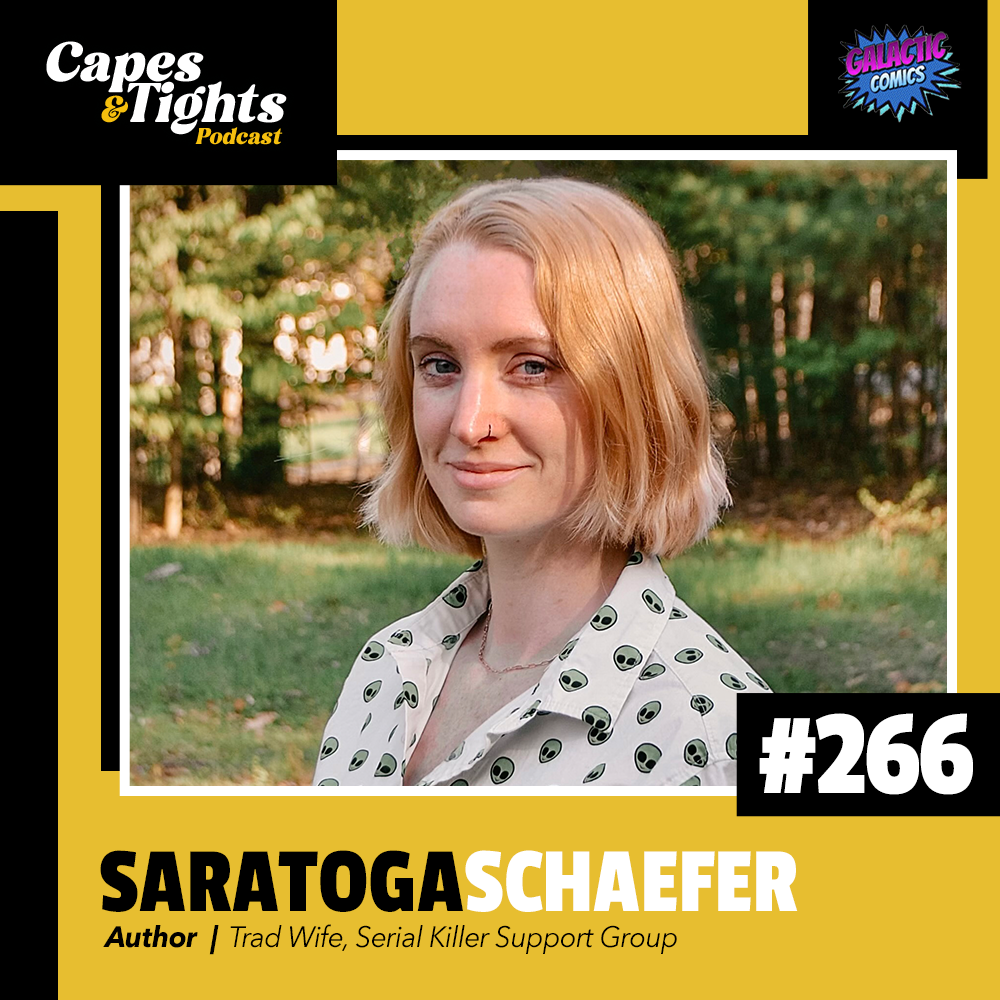
[00:00:00] Speaker A: Welcome back to the Keeps and Tights podcast right here on keepsandtights.com, i'm your host, Justin Soderbergh. Once again, this episode is brought to you by our friends over at Galactic Comics and
[email protected] Moving into a new store soon, which is really exciting. But this episode we bring back Saratoga Schaeffer to the podcast who is a New York based author of books like Serial Killer Support Group, one of our favorites of last year, as well as upcoming books trad wife, out February 10th, the last time we drowned out June 2nd in a thousand monstrous forms, out in September 2026. But Saratoga is here to chat Trad Wife mostly. So check this episode out. But before you do, follow us on Facebook, Instagram, Twitter, bluesky, threads, all those places you can rate, review, subscribe over on Apple, Spotify or wherever you find your podcasts as well as you can check our YouTube channel out over on YouTube.com and as always, visit Capes and Tights for so much more. This is Saratoga Schaefer talking Trad Wife out this February. Enjoy everyone.
Welcome back to the podcast. How are you?
[00:01:08] Speaker B: I'm good, how are you? Thanks for having me back.
[00:01:11] Speaker A: Absolutely. I was looking forward to this next time. It's time chatting. But yeah, we're here. I mean Serial Killer Support Group is in people's hands. I mean we, we chatted, you know, right around that time and, and it's in paperback and hardcover and and so on. What's it been like? Let's start with that. Let's just. How has it been for the past like, you know, year basically?
[00:01:30] Speaker B: Yeah, it's been amazing. I went into the experience because Serial Killer Support Group is my debut. So I went into it with like extremely low expectations.
I think that's maybe a little bit unusual. Like debuts are like, yeah, I want all the things. And I was like, uh huh, we're gonna see how this goes. And it's just, it's surpassed any and all of my expectations, which again were low. But still it's been really awesome. It's selling really well. I'm super grateful to everyone who's read it or reviewed it or you know, borrowed it from their library. And it's just been really exciting to see people connect with it and to see it in shelves and in stores and in readers hands. So it's been great and it's just been a really fantastic way to start, start this career officially.
[00:02:23] Speaker A: Yes, exactly.
[00:02:24] Speaker B: It's been wonderful.
[00:02:25] Speaker A: I mean, obviously it was exciting to get your. Your novel purchased, obviously, to get that deal, to get it on the shelves and things like that. But, like, was it almost more exciting seeing it in more languages?
Like, I don't. Like, is it weird? Like, is it weird?
[00:02:39] Speaker B: So weird. I mean, I didn't even really. There were a lot of things about the publishing process that just legitimately didn't cross my mind. Like, I didn't think about.
I didn't really think about getting blurbs from other authors. I didn't think about hitting bestseller lists. I didn't think about, like, movie TV options. I didn't think about translations. It just wasn't on my radar. So when some of those things started to happen, I was like, what is going on?
Like, especially with getting all these different translations of Serial Killer support group and having like, that weird. Like, I wish I could read this. I don't read this language. I want to see what this experience is, like when it's written in Brazilian or German or whatever.
And that part has just been very cool. And seeing, like, all those different covers and all the different versions of the covers was just very exciting. So that was definitely a highlight.
[00:03:34] Speaker A: I'm coming at this from a comic book side of things too, where I'm a collector of different covers of comic books. So, like, to me, that's where that foreign editions come into play for me. Like, I'm a huge fan of Adam Caesar's Clown in the Cornfield. Like, you, huge fan. And I have the German edition, I have the French edition. And mainly because I'm like, you know, crazy. But the other side of it is, is because the covers are just cool, like, seeing how people.
How it's not even just like, oh, this is a cool, like, in. In. In comic book variant covers. It's like, this is just a cool cover. We're gonna make another cover. It's about an artist in different countries. It's like, how is this book gonna sell to the people that live in that country and speak that language? And so that's what's kind of cool, like, how they interpret. And sometimes I'm like, damn it, the European edition is so much better than ours or whatever. So I want those. And I'm like, but. But I don't have enough space to show them all. So it's just the spines. And I'm just like, okay, now I'm crazy for collecting all these things. But it's just fun. It's just fun to see how, like, as a fan of Serial Killer support group, like, looking at the COVID and then seeing what it's like in another language or another country, what they've said, this is what's gonna sell to our people. And I think that's pretty cool to see.
[00:04:38] Speaker B: Yeah, it's been amazing. I mean, Brazil especially, like, all out and made like, the most gruesome cover of all time and also fulfilled one of my author dreams of having, like, sprayed edges on something. It's like the edges are all blood splattered, which is very cool. But, I mean, all of the covers were great and I love that. I love that some of the other overseas press liked our US Cover enough to actually use that one too. So that's also like a cool little validation of, like, oh, cool. They think that that cover will sell over there too. So you. Yeah, it's just been very cool to see all of that unfold.
[00:05:17] Speaker A: Now you have to turn from, like, finally got my novel published to what's next. Like, there's no now. There's no stopping now. You can't take a break now. You have to continue going. And so this is pretty cool.
And I see an author who I'm a big fan of or in their books and seeing it and then seeing the next thing. I'm always excited to read the next thing, but I'm also, like, excited for them. And so, like, seeing Tradwife be, you know, be, you know, solicited and said, hey, this was going to come out, and so on and so forth. I originally called Traditional Wife, which I want to just chat about really quickly. What. But why the change? Obviously it's much better. I'll tell you that right now. It makes more sense and everything. But just was it more like. It makes more sense. The novel makes more sense with the lifestyle that's out there.
[00:05:57] Speaker B: Yeah. So originally when I was drafting it, it was called. Well, I was going back and forth between calling it Traditional Wife and Trad Wife, so I was kind of calling it both. And then when it got purchased, it was being called Tradwife. And then in it being called Tradwife, I was already calling it, like, I was already calling it Tradwife, even though I was the name on the manuscript was Traditional Wife because it was just too much of a mouthful.
And then a lot of the times when book titles change after they've been announced, it's because the publisher has kind of got an evolved a little bit and they're like, hey, so. So sales and marketing also agreed that Trad Wife was better than Traditional Life.
And like I said, everybody was Calling it trad wife. Anyway, it was like, sure, we'll just lop off the last end of that first word.
And it makes more sense as well from like a design standpoint. Traditional is a really long word and white is smaller.
[00:07:03] Speaker A: So like, it's like a weird lineup Y.
[00:07:06] Speaker B: Right. So if you think about stuff like covers, it's so much nicer to have that symmetrical forward trad wife set up than to have something where it's a really long word and then a really small word. So it's just like little things like that that we maybe don't think about when we're writing the book. And then it also just sort of comes together and it was like, yeah, this is the correct.
[00:07:32] Speaker A: This needs to be this way. Yes, exactly.
I'm a designer by trade. And that's one of those things that, like, when know the brewery, I work for it, they come up and we're like, this is the name of the beer. And I'm like, geez, really? Like, that has to be that long. I have to fit all of it. And like, it's not. And if you think about it on. On a label or you're designing like a rectangle, but really what you want it to be is like the front of the can. You want the front. This to be the most important part. And so like the, you know, same thing with the book. It's like the spine, the back can be great, but the front is what's most important. And so like, we have a beer called the Way Life Should Be, which is the slogan for Maine. But it's like we call it internally everywhere Waylife. Like, hey, it's waylife. Waylife. Why don't we just call it waylife? I know it's the slogan of Maine and it makes sense, but I'm like, waylife would have worked so much better on the front of that can. For hours and hours and hours, I boggled my mind how I was going to fit this on the front of the can.
[00:08:18] Speaker B: Right.
[00:08:18] Speaker A: So it's kind of like, it makes sense. You know, having that short name works. And it also works that, like I said, I'm going to use quotations on this. This lifestyle. It is a lifestyle, but it's not kind of annoying way still. But.
But yes, it's a traditional wife turn into trad wife. Now it's being, you know, is this a story you've had also, like when you were soliciting and trying to get out or shopping serial killer, support group, or is this something you wrote afterwards?
[00:08:44] Speaker B: Yeah, I wrote this after.
The story of this getting written is actually kind of nuts. I wrote it really fast and I wrote it.
I wrote it after I was done with what's called pass pages of Serial Killer Support Group. And that's when you do like a final read through of the whole formatted, like how it's going to look as a book manuscript just to make sure there is no additional errors and whatnot. And at that point I had read Serial Killer support group like 60 times in six months. And I was so incredibly sick of it. I was like, I never ever want to look at this book again. I need something else. And at the same time, I was texting with my sister and I was saying something about trad wives and she did not know what they were.
And I was like, have you been living under a rock? And then I was explaining them to her. And in the process of this explanation, I started to actually pitch the idea for Trad Wife to her because it just came to me. And then a week later I started writing it. I was just ready for something new and it was extremely fun and fast to write. So that's kind of how it came about.
The other books I have coming out next were already written. So Trad Wife is technically like the newest thing that I have coming out.
[00:10:08] Speaker A: And just so anybody knows, what's your little elevator pitch for what Tradwife is?
[00:10:13] Speaker B: Yeah, so Tradwife is about a tradwife influencer who is desperate to have a baby. So she enlists the help of a creature she finds in a well on her property and she has a very demonic, very hungry baby.
[00:10:28] Speaker A: Perfect. That's an excellent explanation. What's going on? I mean, so. So you get this. There is this. I get frustrated. I'm a quiet person on the Internet. I'm a person who like says verbally out loud, what the hell, but doesn't actually comment, what the hell? Like, I just don't want to get into it with people. I feel like my life is happier not arguing with people on the Internet. And so I do say that a lot. And I say that a lot now because of the way the social media is and whether it's the current political landscape that's out there or just like influencers or things like that. And we had this conversation in my office about the idea of a trad wife. And most it was funny. Like, I have an office that has like three men in it and three women in it. And it's a very equal, like very split down the middle and everyone's all the women are like, why would you want that lifestyle? Someone was like, why would you. Like, what? What is so appealing to this lifestyle? And I'm like. And then I started going further into it, and I'm like, how many people out there, do you think, Saratoga, that are like these tradwise lifestyle that after they turn the camera off, live the thing that they're doing on the Internet, right? Like, how many of the people are just doing it because they know it fits in to what the influencer landscape is right now? And that's just not even treadwife. You're talking any of the influencers that are out there, the people that are anti seed oils or anti this or that. You know, what percentage of them are like, cool, I'm going to go use my olive oil or canola oil in the kitchen now that I'm off the camera. Like, how many percentage you think that are really actually into this thing or just do it for social media? Influence something?
[00:11:52] Speaker B: Yeah, I mean, I think that's the whole question, isn't it? It's how many people are essentially buying what they're selling and how many people are simply selling something?
I think that whole question of why, why is somebody in this lifestyle, why is someone drawn to this was also a question I had and is kind of why I wrote this book. I really wanted to get into the head of somebody who would be attracted to this lifestyle, who would be living this lifestyle, and why, why. Why was she drawn to this to begin with? What is she getting out of it? Is she happy in it? And that's kind of the impetus of the whole book. And Camille, who's the main character, who's our trad wife trying to get pregnant, she has a huge arc because of that and that exploration of, like, her place in her community, the community itself, and how she relates to the community.
And I think for me, personally, for the tradwife influencer aspect of it, from what I can see, I think two things are kind of going on, and obviously there's a big spectrum, and people will fall anywhere in between this spectrum. So this isn't like a blanket statement, but something I have noticed is that those larger accounts, the larger Tradwife accounts have, like, millions of followers, and they're. They're already monetized and they have lots of eyes on them.
Those are the ones that are selling you something, and they're not subtle about it. It's like, whoa, here's my amazing new special bamboo dish rack. It's $458, but you can get a discount using my name or whatever. Link in bio. So like, those accounts are selling you something.
Whether or not those accounts really live that lifestyle or not I think is questionable. It's up in the air. I'm sure some do. I'm sure some don't. I'm sure some do a little bit of both.
I think there's also very much the question of generational wealth and who is already wealthy enough to be able to live like that in a way that makes sense.
And then you have the smaller accounts who are not quite at that level, but maybe want to.
Camille falls into one of those categories. And those accounts, I think are more often actually trying to live that lifestyle or that's their maybe ultimate goal. And they have these bigger accounts on kind of like a pedestal and they're a little bit brainwashed because social media is not real. And I think they take some of these things that the larger accounts say and do as gospel and that's maybe not, you know, realistic or relevant to their specific life.
And same thing there. I think some of them are totally bought in. Some of them are maybe like, ooh, this is a way that I can get like Instagram famous. But I think it's very interesting and it's, it's like this whole other social landscape and there's just a lot of layers to it. And I could have probably written like 14 books about this, but I narrowed it down to one.
[00:15:06] Speaker A: And I think, I mean, it's, it's. I. You bring up in this, in this novel that not only is it trying to get the followers and make the followers happy, but I never even dawned on me the idea that these people need also affirmation from their fellow people that are on the Internet doing what they're doing. Like, you don't fit in until you know, if you're, if you're in the health or like trying to get people to stop eating seed oils, there's specific people that if you can get them to share your video or comment, you are made. And that never thought about it to me until the time when I read this book, I was like, oh yeah, she's also. Camille's also looking for the affirmation from other trad wife insular influencers to like her because the second she's in, she's going to go even further in the landscape of it. And I just like, that's, that's crazy. So there's this. You could have written a horror novel that was literally just about that, like, forget the supernatural. Part of this, like literally the horrors of being an influencer in general, just tradwife, whatever other influencer out there, is a horrifying novel in its own place. But you threw in there, you threw the supernatural part in there, and that's which is. Which made the book even better. And so where did it come into balancing the difference between the real life horrors versus the supernatural horror? Was that a difficult balance or was that something that really just struck its way as you were writing?
[00:16:20] Speaker B: Yeah, it kind of flowed a little bit naturally because the real life horrors were not hard to write. Like, they're unfortunately very real. And it wasn't like a whole.
I didn't have to do a whole lot there. It was just observing and then writing.
So that part was a little bit easier. The supernatural stuff is kind of meant to be a foil for Camille's life and relationship. And without getting too much into it, it'll. It becomes obvious throughout the book that the thing that we think is the horror is maybe not as horrible as her actual real life. And like you said, the social media and her relationship with her husband and all of that. So it's sort of meant to be. Like, is it horror, though? It's a little bit of that, like, man versus bear and like, dude versus monster kind of kind of thing.
So, yeah, it's sort of meant to come together in tandem to work alongside Camille's overall character journey and how she is at the beginning of the novel and how she becomes at the end.
And yeah, that was all pretty intentionally done. And I mean, there's a lot of horror. There's a lot of specifically body horror. Like, I tell people to not read this book while they're eating, and I think that's valid.
But yeah, I think people are already noting that the real horror of this is more of the, like, social horror.
[00:17:54] Speaker A: I would also put it in there, you know, some sort. If you're currently pregnant and you're having a trouble, like, if you're having a rough pregnancy, do not read this book right now. Like, I went. My wife was pregnant twice. I've been through the. This side of things that I'm like, I would not have been able to read this while she was pregnant or b, had her read it whenever she was pregnant. It's not like it's. It's not horrendous. But I'm just saying, like, if you already are struggling with your, like, emotionally with your pregnancy, like, don't read this book yet. Wait till you're more than welcome to read it. But don't do it while you're pregnant, please.
[00:18:21] Speaker B: Yeah, I think you have to be like a very specific kind of pregnant person to want to read. Like, I say that either pregnant people are either going to be like, really into this book and be like, yeah, or they're going to be like, I cannot read this for like 7 months. Which is totally fine. I get it.
[00:18:36] Speaker A: There's books for everybody. It's all that, you know, everybody's not going to read everything. But yeah, this is.
I was just like, oh, yeah, this is interesting. But yeah, it's. It's the writing. Obviously your writing style is very similar because you're. It's you writing. But this book is obviously different than Serial Killer Support Group. You mentioned that it's more body horror and stuff like that. Like, serial killer support group is more like after the fact kind of thing. It's not like you're like following an actual serial killer murdering people, you know, and you're seeing gruesome deaths all the time over and over again. This is more like there's actually some gruesomeness and some body horror in this novel.
Do you enjoy writing both? Like, obviously you enjoy writing your novels because it's your novels and you have stories, but is this like, did you have a lot of fun getting in there and being like, this is really disgusting and I want to do this?
[00:19:18] Speaker B: Oh, yeah. I mean, the Serial Killer Support group is technically a thriller. I like to say it's. It's a horror. If you squint at it, yes. And Trad Wife is firmly horror. But I write both. I write thrillers, I write horror. I enjoy writing both.
I started writing thrillers like 10 years ago, so that's always going to be, like, kind of special to me. But horror is so fun and exciting because it gives you, I think, a lot more freedom, which is exciting to play around with as an author, you know, I.
None of my books are really for anybody who's looking for something super believable that's gonna happen in real life. So, like, if that's your jail, maybe I'm not the author for you. But I think you do have to have some kind of, like, groundedness in thrillers for the most part. And I like that in horror you can just be totally unhinged and just be like, it's horror. I don't have to, like, really explain that to you. It is what it is. It's. It's a creature who lives in a. Well, we're gonna just move on and.
[00:20:22] Speaker A: Get to the story part somehow impregnates a woman, a human woman. That's the way how it works. It's, it's funny. It's really. You mentioned the squint at it. To make a horror, you almost have to like thrillers, especially serial killer support group. Like if you squint at it, it's real. Like that kind of thing too where it's like you have to have that like the moment where you're like, okay, this is not real. But for most of it can be believable in my opinion. Like a thriller has that like pseudo believability to it, whereas horror, you're right. It's like you could do anything. There's moments and then there's people who question it. Well, how is this possible? Like, well, it's a demon baby. Like how that's not real either. Like, I don't know how to tell you right now, like what's going on right now.
It's the.
But that's what's cool about it. You have a little bit more freedom. Like you said, it's a little bit different. And, and I'm guessing it makes your mind and muscles work differently writing each one. So you obviously have a busy year coming out with publicity books and things like that. I don't know why you're doing this to yourself. But your other two books, I'm not going to jump to those yet, but where do those fall in the pantheon of genres and things like that?
[00:21:23] Speaker B: Yeah, so yeah, I have three books coming out this year.
I have no patience, so I guess that's why I'm doing this to myself.
But yeah, so the next one that comes out is a speculative thriller. So that's the last Time We Drowned and that comes out in June. And that one is a thriller. But there are some sort of like psychological elements to it where like there's maybe a ghost on this boat. So like stuff like that where it's not horror but there's still that same kind of horror element that I think I have to all of my work, but it is firmly like a thriller. And then the book that I have coming out in September, which is called A Thousand Monstrous Forms, that is solidly like a gothic, contemporary gothic horror. It's like a gender swapped bluebeard retelling. So that one is. That one's very horror.
[00:22:17] Speaker A: That's awesome. I like that. So you know, one of my favorite authors is Daniel Krause and Daniel has this ability to like write in like 17 different genres. Like it's just like, he has horror novels, he has this, he has that. You know, all these different things.
You know, war novels and things like that. And I love that, and I think that's cool about it is like getting your style of writing, but also in different things. So going back and forth between thriller and horror will be. Will happy with me. Is it going to be weird in September? Okay, come September, that you went From March of 2025 being an unpublished novelist, now you're here, and now all of a sudden, a year later, a year and a half later, you're going to be. You're going to have four novels on the shelf.
[00:22:52] Speaker B: Oh, yeah, yeah. I've thought about this already. I've already had, like, my own little. Little breakdown over this where it's like, I went for, like, so many years, working so hard and trying so hard to get published, and now at the end of next year, I'll have four published books. It's just wild. I'm so grateful. But it's just like, how quickly things can change. And I mean, it's great because, I mean, I write fast. I like to get out fast. So, I mean, I don't want to have three books coming out a year every year because I'm already extremely tired and it's January.
But it's been really exciting to see people get excited about my stuff too. So it's been great.
[00:23:35] Speaker A: Well, it's just funny is if you think about someone comes to your bibliography 18 months from now, they're gonna be like, oh, they have four and all. They might think that you've been doing this for a long time, physically promoting books and things like that, when really it's only been 18 months between book one and book four, which is pretty remarkable in that sense. But it's also showing that Serial Killer Support group was such a success that these people now want your books in their thing. So you had serial killers at Crooked Lane?
[00:24:06] Speaker B: Yes.
[00:24:07] Speaker A: Is Trad Wife Crooked Lane, too?
[00:24:09] Speaker B: Yes. So serial killer support group, Trad Wife and A Thousand Monstrous Forms are Crooked Lane books. And the Last Time We Drowned, which is the thriller, is Cosmo Reads, which is the new imprint between Cosmopolitan magazine and Source Books.
[00:24:22] Speaker A: Okay, yeah. So like I said, but so obviously Crooked Lane knows because they see the numbers. But Cosmo was like, oh, yeah, obviously, you know, Sarah Turk has got some. Some hype behind them, and let's. Let's do something with them and do this book. I love it because it's like, my wife might read the Last Time We Drowned. She's not gonna read Dreadwife. Like, she just doesn't. It's just not gonna.
[00:24:43] Speaker B: That's fair.
[00:24:43] Speaker A: It's not gonna happen. But. But I think she actually would read Last Time We Drowned, which is pretty cool. And I think I love that aspect when I can actually hand a book over. I've read, you know, I gave her simultaneous from Eric Eisner last year and I was like, hey, earlier this year. It's technically last year because it was a couple weeks ago, but last year and said, hey, read this. And she loved it and I loved it. It was great. So there's certain books where I'm like, yeah, I can read this. And there's other books where I'm like, no, she's not going to read this.
And I'm glad that, you know, she'll have that ability to do that, but.
So Trad Wife is coming out at the end of middle of February, February 10th.
You're gearing up for it now. You're only a couple weeks away. What's the next couple of weeks gonna be like for you? You're doing a tour, I heard, or some spots that you're doing that. But, like, is there a lot of, like, other podcasts and interviews and things like that getting up to this or is this, is this the home stretch or what's going on now?
[00:25:33] Speaker B: Yeah, it's. Yeah, I think I have, have or had like 10 different interviews in the past, I don't know, three weeks or so. I have an. And I also have an event every month this year with I think the exception of December. And like I said, it's only January. So, yes, things are about to pop off. I do have a tour happening for Tradwife. It's mostly east coast dish, like tri state area kind of thing.
New York City, upstate New York, Salem, Massachusetts.
So I'll be traveling for a couple weekends in February to promote the book and to meet readers and just have fun and. Yeah, so that's, that's all happening. I also do work full time as well, so I'm juggling a lot right now, which has been very interesting. But yeah, it's been, it's been exciting to see the early support for Tradwife. So I'm really hopeful and excited that people are gonna like it and buy it and, you know, hopefully my career has a little bit of an upward trajectory. That would be. That'd be great.
[00:26:42] Speaker A: That would be great.
[00:26:43] Speaker B: That's.
[00:26:43] Speaker A: That's a lovely mention that you work full time. It's like, that is, you have four books coming out, but that are three books coming out, four books total in 18 months. That's not. People just assume like, okay, serial killer support group came out, now you're offset, now you're a full time author, you can't do anything else. It's not the case for most people. I would say most people don't make an extreme living on that. And if it's not, then it's like them or their partner work together and the partner makes a bunch more money so that we can, you know, one person can do that and that's, that's okay. It's just, that's the way it works. So hopefully what I want is the ability to, for you to be able to write full time all the time, which would be great. But yeah, my bookstore, local bookstore, Briar Patch here in Bangor, Maine is actually doing. For our horror book club, they're actually doing Trad Wife, I believe in March. I believe it's March.
He usually does it like the month after the book releases or right around that, which is pretty smart. Which is really exciting because I love that idea of like a book that I got really excited for. I either get to read again or if I don't have time, I can't read it again. But I can at least have a conversation with people about it. It's hard sometimes with the number of books that I read in the genre that I'm in. I don't have a bunch of people who are reading horror novels with me. Right. Like locally. Most of my communications with people on the Internet and so it's like every once in a while I'm like, yeah, I read this book called Tribe Wife.
[00:27:56] Speaker B: Cool.
[00:27:56] Speaker A: No one around me is ever going to read it. So that sucks because like they're all like in the like, like Nicholas Sparks and, or like superhero stuff. And I'm like, cool. And then the one person reads it, I'm like, I want to talk to you.
[00:28:06] Speaker B: Where are you?
[00:28:07] Speaker A: I'm like running after them. Talk to me about it. But no, it's, it's exciting to see a group. There's like 15 people in the group. We'll all read it. So there's 15 book sales for you.
[00:28:16] Speaker B: Thank you. There you go.
[00:28:17] Speaker A: On your way to bestseller.
[00:28:19] Speaker B: Yeah, I love that.
[00:28:21] Speaker A: That's cool. You know, And I, He Gibran's the owner, he usually messages me and was like, you have any ideas? And I didn't even bring it up. Like it was. I've been so incommunicado with them over the past Couple of months because of busyness of life and things like that. And. And I saw that he sent me a message being like, this is the books we're gonna read. And TradWife was. Was one of them. I'm like, geez, that's awesome. That's when I was recommended. This is amazing. So it's exciting. I'm excited for that coming up here. I think in March, I didn't find the. I think I threw the flyer away yesterday. I got to find it. But, yeah, it's really cool. So Ben Gormane is showing some love for TradWife here in the Northeast, for sure.
[00:28:56] Speaker B: I love that. Thank you. You don't have to put this part in the podcast, but if you're. If they're interested, they can reach out to Dolce at Crooked Lane.
And they can, because they were doing this with another, like, bookstore book group where they're sending them signed book plates and, like, stickers. So if they're interested in that, like, feel free to connect them.
[00:29:18] Speaker A: Yeah, absolutely.
[00:29:19] Speaker B: With Dolce, and then I'm happy to send some signed stuff for. For them.
[00:29:23] Speaker A: That'd be awesome. Yeah, it's really. It's really cool. And I. And I've done that before, actually. It's kind of funny. I've actually done that. We've been. My graphic novel book club that I'm part of. Something similar happens, like, when I talk to someone like this, there's a connection. They end up doing that same similar thing, which is really cool. I think people like that. I think it's like one of those things where, like, book clubs, you have so many books, but the one that has something like that in it, there's the one you tend to keep and not either sell to someone else or give to someone else. That's the one you put on a shelf. So, like, it's kind of like a. Oh, this is pretty cool. Get to keep this on my shelf. But, yeah, I'm a big person. Like, I collect. I have too many books. And so to me, I'm like, the second it comes out, I'm gonna buy anyway. And so it's gonna be exciting for TradWife. February 10th, but so Trad Wife. It's a Supernatural. So do you. Are you a fan of Rosemary's Baby? Is that like.
You know, I'm like. I mean, I'm a huge fan. I think the movie is phenomenal. I like the book a lot too. But, like, I think that it's one of my favorite horror stories, so I was happy to see that connection to this book. Is this something where you're coming from, too?
[00:30:20] Speaker B: Yeah. I haven't sat down and watched the whole movie because it's, like, three hours long, and I just don't have the patience for that. But, yes, the book is great. The movie is great.
I.
It's a little bit of an homage to it, but it's also extremely different.
[00:30:34] Speaker A: Yeah.
[00:30:34] Speaker B: From Rosemary's Baby. It's also partially inspired by some of Guillermo de Toro's work, especially the Shape of Water.
So that's kind of part of the inspiration of it, too. You know, the. The concept of a demon baby is not an original idea that's been around for a long time. I'm not claiming to be the originator of Pregnant Woman Demon Baby, but I think it's such a fun trope, and it's an interesting trope. So it was why I was attracted to that aspect of it to begin with.
But, yeah, it's definitely like. I think we're calling it. My publisher's calling it, like, Rosemary's Baby for the digital age, which I think is an apt description. Like, if you enjoyed Rosemary's Baby, you'll probably like this too.
[00:31:21] Speaker A: Well, you don't want it to be exactly the same thing, because that's just. That's not fun. But. So, like, I like the idea they connected. And I do think there's certain publishers who can connect books together like this, and then they don't. Where I'm like, what are they talking about? And sometimes it does work really well, and that does. And I think that the different.
But Shape of Water. And I guess I think, oh, I always bring up Howard the Duck. I don't know if you've ever seen the Howard the Duck movie from the 80s that was based on the comic book character, but it's got Leah Thompson in it from Back to the Future and things like that. And so she's, like, gets in bed with a. Like, a humanoid duck, and, like, she's implying that she's falling for him. And I'm like, okay, I don't. What is going on here? Like, this is just. I don't want human duck hybrid. Like, I don't know how this would work. And the same thing with Shape of Water. Like, it's like, you're, like, falling for a monster. How is this gonna work? It's not that. Like, that's not the creepiness that's in this. The different creepiness that's in this movie. But, yeah, like, to me, I'm like, I don't know, it's just there's a different reason behind it too. I think that there's like the falling for the other creature and the result of what would happen if you did. That's more what trad wife's about. Like you want the baby, not the intimate relationship with another creature.
But yeah, but it's cool about it. I think it's like I said, there's this supernatural element to it that for the most part you can believe it. And then the supernatural element kind of takes you out of that, which is really cool. And you feel so much for Camille, like in multiple avenues, like multiple things. You're like, I just want to be there to support Camille right now.
I wanna, I wanna, but I also wanna shake her at the same time and be like, can you get your head out of thing? And that's what social media does to people. And I think it's so crazy and just. And that's one of the things that I sit back and I wanna start my own Instagram profile saying all of you people are crazy. Not just specific avenue of people, but you all, I hate to use the word crazy, but like you're all just sucked into this thing that just is, is, is, is so bad, but so good. And sometimes too. Cause like without social media, the situation that's happened in Minneapolis wouldn't be as we believing the lies that are out there, we wouldn't see for our own eyes. So it's like you need it, but we also hate it.
It's so bad.
[00:33:35] Speaker B: It's so, it's so interesting because it's such a, it's such a tool to like mobilize and support and like connect with your community. But then it's also a great way to like get entrenched in really stupid arguments that really don't matter and that are distracting from the actual.
So it's just such a double edged sword and I'm just very fascinated with social media in general. And part of that is because I have worked in social media management before, so I have kind of that professional mindset of it. Part of it is because for many years I was you know, essentially a sober lifestyle micro influencer. So I was kind of enmeshed in that aspect of it too.
And so I've seen like kind of different sides of it and it's just been very interesting to see how people react. No matter what community or lifestyle you're kind of like engaging with, it's the same sort of stuff over and over again. And it's just it's just so weird, and I just can't. Again, I could write many books about this. And in fact, the thriller I have coming out is also about social media because it's just there's so much to explore there. And I think it's very hard to say definitively if it's bad or good because we see it being able to help people and then we also see it causing part of the downfall of civilization. So it's very tricky and it's just something we need to be aware of.
[00:35:18] Speaker A: Yeah. And I think having the awareness of it is a big thing because in my previous life I worked as a marketing director for a church, and one of the discussions we had over and over again was whether or not our ad should be in the newspaper anymore because we're paying for it and we're like, well, if we take it out, does that immediately assume those people who think that read the newspaper that we're not there anymore? Like, is it one of those things? Like. So, like, I always feel like that with social media nowadays is that, like, if you're not on social media, how are you gonna promote your book or tell people about events and how, you know, you kind of need it to do the job you're doing, but also don't want it to. To take over your life and things like that. And I think the big thing is, to me, the biggest thing is if someone can say something on the Internet now, and if a couple people believe and share it, it's now truth. And that's the big thing to me, and that's where we're going on. Huge to me right now is like, there's just so many lies and misinformation being spread on social media because people with influence are saying things without actually having the facts to back them up, and they can just say whatever they want and no one stops them. And that's, I think, where I think the biggest thing is, it's freedom of speech. But in the same sense, it's just dangerous as hell.
You know, it's just really dangerous. And I think it's dangerous for people's psyche and dangerous for people's physical health at some point. And I think it's crazy.
[00:36:31] Speaker B: Yeah. And I mean, that's not even getting into the AI stuff, and people who are posting AI pictures and AI videos and like, you can't trust anything anymore. And it's just. It's awful. So, yeah, it's. It's. We're watching stuff kind of evolve in real time, and it's getting more and more dystopian. And it's just, it's crazy.
[00:36:49] Speaker A: I tell you, I hate the fake, like the fake bad things about AI But I'm also annoyed with AI Videos of like car crashes. Like, to me, I go like scrolling through Instagram and there's like a car sliding into another car and it's like, that doesn't look real. I'm like, it's AI. God damn it. I don't want to see this anymore. I want real stuff. I don't want the stupid fake stuff that looks so bad that why are you even publishing this? But yeah, it's that. And so that, that is trad wife. That's. It's, it's an unhealthiness that Camille has to this trying to be a specific person for other people and less caring about what Camille actually wants, deserves or is healthy.
And her absentee of sorts husband, who doesn't really see, it's like he has his blinders on. And so that's what forces her to do what she does. And it becomes horrific. And I think that it's a great, great, great sophomore novel. I will say, you know, you're killing it out there. And I'm excited for people to get it February 10th at bookstores everywhere. And it's. This will come out February 4th. So you have a week before the book comes out, which will be great to go to your local bookstore, get it. If they don't get it, tell them to get it. And bookshop.org is a place that I send people a lot because that helps support local bookstores. And is there, I'm guessing there's an audiobook coming, right? Yes, there is an audiobook. I just saw it actually come up on NetGalley. I almost sent a picture to you being like, I'm so tempted to just to read it to listen to it too.
But yeah, it's an audiobook. So grab that. That's at Libro fm, which is amazing because that also helps local bookstores as well doing that stuff too. So. And then anywhere you're at, in the tri state area, like I mentioned, go, go meet Saratoga. They're amazing.
[00:38:28] Speaker B: I would love to meet people.
And if you, if you do order the book before it comes out on the 10th, you can submit your receipt so you can order it anywhere, any your favorite indie or favorite retailer and then submit your receipt to marketingrickedlanebooks.com and they will send you a free signed book plate and a sticker sheet.
[00:38:50] Speaker A: There you go. That's awesome. I love that stuff. I actually have a bookmark, I think, from Daniel Krause for Whalefall for that that has, like, Daniel Krause signed a bunch of, like, bookmarks to do that with too, which is really cool. But yeah. And honestly, a lot of places, if you pre order it, you might not have to pay for it until you pick it up. So, like, it's not hurting you to just go to a place and be like, can I pre order this book? And they'll put your. Right. Write your name down or whatever. But if you want this receipt thing, pay for it. So you have a receipt that shows that you paid for it. But yeah, February 10th, and then so quickly. We're gonna wrap it up here pretty quickly. But, like, the Last Time We Drowned is in June, and that you mentioned is a speculative thriller.
Do you want to give a quick synopsis? Is that something you could pre order now as well? So I would like to get people on that.
[00:39:34] Speaker B: Yes, you can pre order it now. The COVID is up. You can find it on my website, saratogashaefer.com the last time We Drowned is a thriller about a bookstagrammer who joins an elite group of influencers on a yacht, but gets trapped on board by a hurricane. And she begins to think that one of these influencers is a murderer. So it's very fun. It's very locked room. It's very kind of like luxury turned dark.
So it's a great summer read, even though it's kind of creepy. So I definitely recommend checking it out.
[00:40:06] Speaker A: The COVID fits that so much. Like, when I saw the COVID come out, I'm like, that fits that style of book so much. It looks just like. It looks like it fits in that category, which is amazing. I love it.
[00:40:15] Speaker B: Yeah, totally.
[00:40:16] Speaker A: So awesome. And that's available again bookstores everywhere. So you can check that out. That's June 2nd. That book drops, and then you have A Thousand Monsters forms coming out in September.
Horror novel you mentioned you have nothing, no covers out for that yet, but what's that about?
[00:40:33] Speaker B: Yeah, so I've seen cover sketches, and it's really, really cool, so I can't wait to share.
But it's about a ceramic artist who moves into her new wife's manor house in upstate New York, and she starts to suspect that the house is haunted. And this one, again, this is a Bluebeard retelling. So if you know the story of Bluebeard, you might know where this is going. If you don't, and you don't want to be spoiled, you can just go in blind. But it's. It's very creepy. It's very dark. It's very kind of moody, and it's very sapphic. So I hope people like it. It's going to be fun.
[00:41:09] Speaker A: That's awesome. I can't. Like I said, you're going to go from like, okay, cool, try to wipe out. Damn it.
And then you're like, last time I try to.
[00:41:17] Speaker B: Ugh.
[00:41:17] Speaker A: And then. So hopefully you're not doing anything December. Hopefully in December you just take a month off and just don't do it.
[00:41:23] Speaker B: Yeah, right.
[00:41:25] Speaker A: But I'm excited. That's so pumped. And it's one of those things that, like, I'm excited because it gives me the authors that I'm fans of and like their writing. It gives me something to look forward to. Whereas there's other authors. I'm like, when is their next book gonna come out? And so this is like, at least for people who are huge fans of yours, like, they have some reading to do. They have some reading to do this year and they're spaced out enough. This is not like you have a book coming out June 2 and 1, you know, June 15 or July 2. This is like there's six months or so, five or six months in between these. Like, you have some time.
[00:41:56] Speaker B: Yeah, I'm feeding you every six months or so. So it's good. I think it's a good amount of time between each.
[00:42:01] Speaker A: Gives yourself.
Because you're gonna need some time to relax after reading Tradwife, people. You're gonna need some time to just breathe. And you don't need to go from TradWife to reading like a Nicholas Sparks novel. Like I mentioned. You need that, like, you need that separation from the body horror that happens in this book. No, it's amazing. February 10th at bookstores everywhere. Saratoga, I'm so thankful that you came back on here and chatted with us. And thanks for moving around and stuff like that, too. My son's doing great. He was sick, but he's. He's doing great now.
And then other stuff happened. Yeah. So it's a craziness. Winter in Maine. It's just, you know, sicknesses, frozen pipes, snow. It's just. It's just we asked for it. Right?
[00:42:36] Speaker B: It's the whole thing.
Well, thank you for having me back.
[00:42:40] Speaker A: Absolutely. And we're looking forward to it. And check out, you know, I said February 10th and then June 2nd, so get the last time we drowned pre ordered as well, please, people. It's. It's. I haven't ready yet. I'm excited. I'm waiting. I'm waiting eagerly here. Just let me know when you want me to read it, because I can read it.
[00:42:54] Speaker B: Absolutely.
[00:42:55] Speaker A: Yeah, Absolutely. So thank you so much, Sara Toa. Have a great day. And. And thank you so much for coming on. We'll get you back on at sometime in the future. So maybe at the end of the year we'll get you back on a chat two different times.
[00:43:03] Speaker B: Yeah, that would be great. Thank you.
[00:43:06] Speaker A: Thank you.