Episode Transcript
[00:00:00] Speaker A: Welcome back to the Capes and Tights podcast right here on Capesandtights.com, i'm your host, Justin Soderbergh. Once again, this episode is brought to you by our friends over at Galactic Comics and collectibles@g Galacticcomicsandcollectibles.com we're here for our first ever inclusion into the Star Wars Podcast Day.
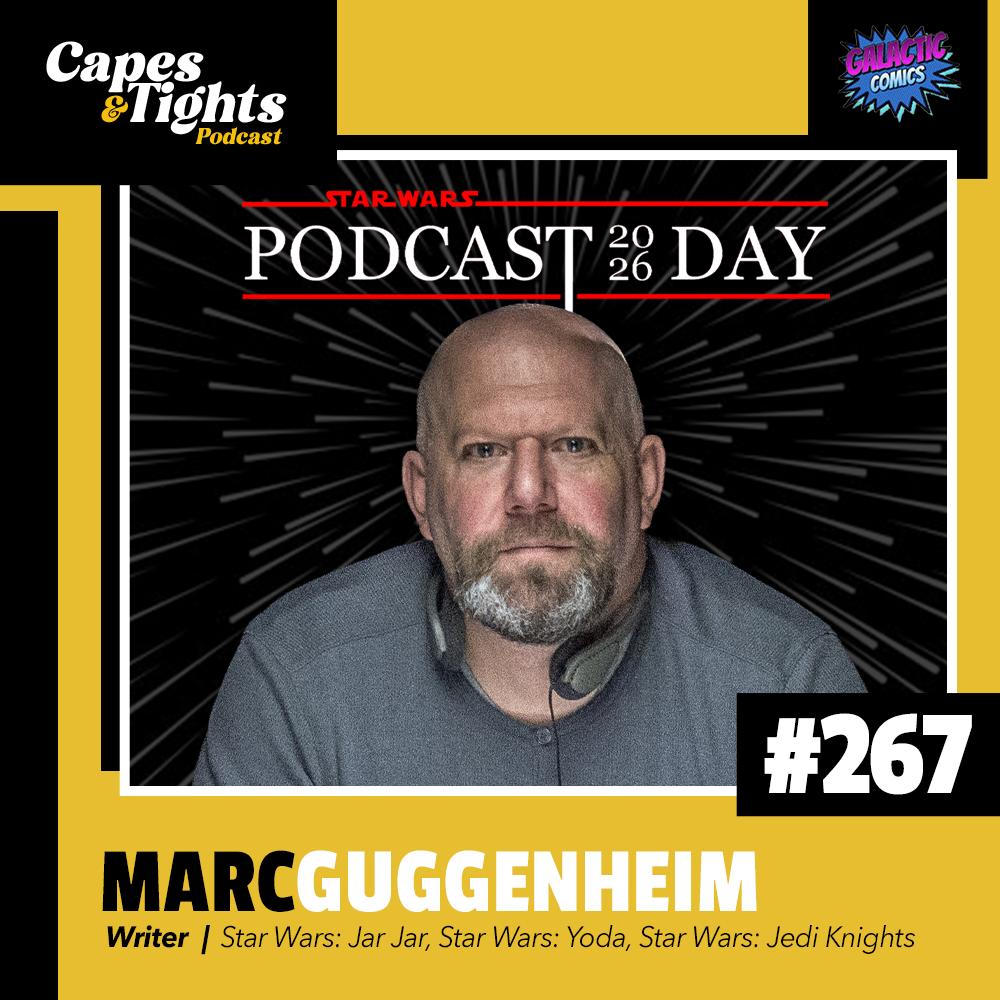
This is our little slice of life in the Star wars universe here. So we welcomed comic book writer, Star wars comic book writer Mark Guggenheim to the podcast to chat all things Star wars, but to focus on the book that he co wrote with Jar Jar Binks himself, Ahmed Best, the upcoming Jar Jar comic book, which comes out February 11th at your local comic book shop. But Marcus has a history. He's been writing comics for about 20 years now. He's also written TV and movie and all those different things in the DC and other universes as well. But he's also known for his work at Star Wars Yoda Jedi Knights, which has recently just come out. And again, the upcoming Jar Jar comic that comes out with Ahmed Best. That's what we talked about this episode. So happy Star Wars Podcast Day. I hope everybody enjoys this episode. But before you do, follow us on Facebook, Instagram, Twitter, bluesky, threads, all those places you can rate, review, subscribe over on Apple, Spotify, or wherever you find your podcast. You can watch the video portion of this over on YouTube.com as well as visit Capes and Tights for so much more. Happy Star Wars Podcast Day to all you listeners and viewers out there, and I hope you enjoy this conversation with Mark Guggenheim, comic book writer. Enjoy.
Welcome to the podcast. Mark, how are you today?
[00:01:33] Speaker B: I'm very good. I'm very good. Thanks for having me on.
[00:01:36] Speaker A: Absolutely. And you bet you could. I mean, we actually were on like 100 and something episodes like a long time ago.
[00:01:41] Speaker B: It was a long time ago.
[00:01:42] Speaker A: Yeah, it was a long time ago. And it was like one of those things where I'm like, I always wanted to have you on, had you on. And then I was like, oh, we'll get Mark on at some other point in the future. And it just, it just got crazy. And then we had so many things that come out. I've wanted to talk to you about any life things, comics. There's so many things. But we're here now, you're busy. You took time out of your schedule to talk to us. So we'll make this painless and easy. Let's just talk Star wars today. I mean, this is a Star wars podcast day, our first time doing it. So I'm excited to have you on as a prolific comic book writer of Star wars legends.
But let's just go back a little bit. Let's talk. Do you remember. I mean, obviously you were what, like 7 or 8 years old? I'm not gonna put your age out there, but I'm gonna say somewhere between the ages of 5 and 10, when the first Star wars film hit the.
Do you remember that? Is that a far back you go, or is this something that came up? Okay, you have.
[00:02:36] Speaker B: I remember.
[00:02:37] Speaker A: Do you have an early memory? It's.
[00:02:39] Speaker B: Yeah. I mean, it's so vivid. Like, I. My. I'm the oldest of three, and my dad took me and my brother Eric to.
We thought we were going to go see a movie called the Bad News Bears, which is about this ragtag group of kids playing baseball.
And my.
[00:03:00] Speaker A: And we sit.
[00:03:01] Speaker B: The theater, actually, I still remember exactly like, which theater and where in the theater we were sitting. We were sitting on the right side of the aisle, like, close to the aisle, and the, you know, the. The John Williams score comes on and there's these huge yellow letters, and then suddenly a Star Destroyer is flying over my head and I'm like, this is not the Bad News Bears. And I just. I honestly, like, I think at this point it's cliche to say it, but it happens to be the truth. Like, I was profoundly changed.
You know, like, I saw that. I went. I saw that movie a million times. My brother Eric and I once. We once went to go see it. We knew that we were going to be late. Like, we came in during the cantina sequence. We didn't care. We just wanted to see it again.
Didn't matter to us.
So, yeah, it's. It's always had, like, a really profound impact on my life.
[00:03:55] Speaker A: That's awesome to hear. See, the funny thing is I was born 86, so I was a little bit late to that. But also my parents were, like, into movies and things, but they weren't like. I've heard stories where I was like, I want to be that parent. My child is. My son's 5 and my daughter's 2. And I want to have those experience. And I kind of did. Recently we watched Back to the Future. My son was, like, ecstatic about it, and I was like, hopefully this is, like a transformative moment in his life that he always looks back. We watched, like, the three Back to the Future movies in one weekend.
But I just love hearing people's stories about how, like, we went and saw it in the theaters and so on and so forth. I was, I just recently watched rewatching X Files and there's an episode where a guy with. The guy with a pigtail impregnates a bunch of women. And one of them, he pretends like he's Luke Skywalker. And I just laugh.
[00:04:44] Speaker B: The, the, the.
[00:04:45] Speaker A: The woman is in the bed. She's. She's had the baby and they're talking to her and she's like, how many times have you seen Star wars? And she's like 368 times. And I'm like, I want that to be my son.
I've watched this so many times. It's just cool to hear. And I'm guessing, Mark, thinking about those moments and the transformative part of your childhood, this was. And now being. Be able to like create these stories must be some sort of. I mean, you live a pretty good storytelling life. Like, you have some pretty good characters, you told stories. But like, it must be a pinch me moment still to be able to make these.
[00:05:19] Speaker B: Yeah, I always actually like, you know, from, from very early on in my writing career, like it's been, it's been a pinch me moment. It's a great way of putting it. And I, I promised myself very early on that I would never let it not be, you know, I would never, I never wanted to allow myself to get to the place where I was so jaded that it just became work, you know, I, I like to say, like, I work for 10 year old me, you know, and 10 year old me is like, you've got to be fucking kidding me. Like, you know, you write all this stuff and y. Just unbelievably fortunate and it is, it's a constant pinch. It's honestly like I will tell you, especially when it comes to comics, like no one does comic books for the money.
Spoiler alert. There's no, there's no money in comic books.
So you really do it for the love of the game and yet you do it for the pinch me moment of it all.
[00:06:12] Speaker A: It's funny how you say that. I just talked to someone this morning on an episode and they mentioned that they made the fifth issue of their creative own series and they're like, the fish. I probably lost money on the fifth issue, but I needed to tell it. I wanted to tell it and I got to do this. And he goes, if I have to start doing Door dash, I'm still going to write comics and draw comics. But I, I just, I need to tell these stories somehow. And I think that's how most comic creators out there are. They want to tell these stories and they know they're not gonna, you know, you have to do other things, Mark. You're, you're doing tv, you're doing film, you're doing other things to, to make it so that you can do comics as well.
[00:06:43] Speaker B: Well, you know, it's kind of funny. It's like there is a way to look at it which, you know, let's say, you know, random people like my agents look at, like they look at as the comic book work. Like those hours could be spent writing things that are a lot more lucrative for me and quite frankly for them.
And I, instead I, I choose, you know, to spend my time on comic books when I spend my time on comic books. So. But again, it's like, I, I think it's, you know, it's such a, I hate the word privilege because it's just gotten so like ridiculously overused.
But like, it is a real privilege to like do something that you love. And, and I, you know, I, very early on in my, in my career as a writer in television, I realized that I wouldn't or I shouldn't make any professional decisions based on money or lack thereof.
So I really do try to, you know, make my choices based not on, you know, money or practical things like that, but rather what really excites me. Like I said, I work for 10.
[00:07:55] Speaker A: Year old me, so that's the case too. Like, so you work for 10 year old me, but like, how do you approach these? You've written real to write for Yoda, you've written for, you know, Han Solo, you've. I'm going to go on and on but like now you got Jar Jar, do you. As he's a fan of these things, obviously it makes it easier to write these things because you have some knowledge and things, you know, so on and so forth. If someone's like, I'll give you a bucket full of money to write this story about a character you know nothing about, you're like, yeah, you mentioned don't do it for the money. But in the same sense, like, well, I could pay a bunch of bills, let me figure it out. Obviously you have some knowledge going into this. Does that approach change? Like, does it change what you do for creating these stories or like being a lifetime fan of it also? Like, I don't want to screw this up for people. Like, there's definitely there, there's a lot.
[00:08:40] Speaker B: Of, I mean, you know, I'm an Erotic writer. So there's a lot of like, little neuroses that go through me. Like, I don't want to screw this up for.
There's also the, like, I don't, I don't want this to be fan fiction. Like, you know, I've got to maintain a certain professional distance from it because. Not, not that there's anything wrong with fan fiction, but. No, but by definition, no one gets paid to write fan fiction. I mean, I am getting paid. You know, the Marvel Disney Lucasfilm, you know, corporation is, is paying me money and I want to make sure that I'm being professional about it.
So it's like I've got to, you know, I've got to sort of like, figure out whenever I sit down to do something like a Star wars comic, I have to figure out how to sort of like, weaponize my fandom and utilize my fandom, but not be so consumed by it that I stop, you know, telling the story that I'm trying to tell, you know, as a writer, as a professional writer. So it's, it's, it's, you know, you're sort of, you know, trying to thread a certain needle. But my, my approach and my process is pretty much always the same, you know. And you know, that being said, like, it, it varies only insofar as, like, sometimes I'm hired, you know, we'll stay with Star wars, you know, but this is true for pretty much everything else. Like, there's sometimes where I'm like hired tell a very specific kind of story, you know, like with, with, you know, the Yoda issues I wrote that was like, there was a very, I was part of a larger, you know, 10 part story that, that Kevin Scott had come up with.
And I wanted to make sure that like, I was, you know, doing my part again, trying to be professional. There's other times, like, where it's like, you know, do a Han Solo comic or do a Jedi Knights comic where, you know, I, you know, there isn't as much, you know, sort of a prerequisite or as much of a bullseye that I'm trying to hit. And I would say in both cases, though, no matter how much I start off with, in terms of guidance or a mandate from, you know, from Lucasfilm, at the end of the day, it's, it's the same thing as it is with everything else I write, it's me sitting down, writing longhand notes to myself, kind of daydreaming on paper, you know, that, that's sort of, you know, where I start you know, regardless of what it is I'm doing.
[00:11:12] Speaker A: And I know writing any intellectual property is in something like Marvel or dc, you've always had this, like, there's backstory. However, if you write a comic book about Abomination, there's so many different versions of Abomination, there's so many different storylines, there's so many different resets in number ones and whatever it may be. And I don't know why I use Abomination as one of these characters. But there is, however, Star Wars. There's canon. Yes. There's like. There's just like everything affects everything. And there never really has been this. I mean, there's like Star wars visions and things like that where there are like some like, alternate universe kind of like, stuff. But like, most of the stuff, I would say 99 of the stuff, TV shows, movies and comics and books are canon. And so that's where I think I would. I would assume it differs from writing Green Arrow or whatever it may be because of that fact that there's like you, like you mentioned the Cavin Scott story. You're affecting a lot of other things. If you write Yoda doing something, then that person, if for some reason you create a new power for Yoda, for some odd reason, that person has to be like later on when they use that character. It has to be done that way. So I'm guessing it's a. There's no reset. So whatever you do, it's in canon.
[00:12:23] Speaker B: Now.
I'll tell you a funny Yoda related story.
Because I basically screwed up Cabin Store. I. I completely screwed up the ending. What happened was originally the Yoda series that Kevin had, you know, written and outlined. Yeah. Was gonna end with Luke arriving on Dagobah.
And it was in, you know, like the 10th issue. The 10th mile issue was going to be like the minutes leading up to that moment. And I had like a weird, like, thing where I'm like, do I say anything about this?
And I decided not to.
I decided, you know what? It's not my place to raise this thing that I'm about to tell you.
But someone in story group, Lucasfilm has the story group and they know. They know more about. They've forgotten more about Star wars than I'll ever know. And I think I've got some game in this department, you know.
Anyway, someone in story group sort of raised their hand, said, you know, we actually did an eight page story in Age of Rebellion about the moments leading up to Luke arriving on Dagobah.
Just so happened. I was the person who wrote that story.
And I'm just sort of sitting there going like, yeah, I figured if it.
[00:13:42] Speaker A: Was an issue, people would, you know, raise their hand.
[00:13:45] Speaker B: And that's what happened. But, yeah, it's like, you know, you.
It's funny. Yes. You. Everything you write, because it is canon, like, affects everything that came before and since and even affects the things that haven't been written yet.
And I will say, though, like, you. I.
You kind of. It's not that complicated really. I think, you know, in your bones, sort of where the no fly areas are, you know, and you. And, you know, in your bones, the stuff that if you were to. If it were to be canon, it would. It would screw things up too much, you know.
So, you know, 9.9 times out of 10, if I've written something that Lucasfilm doesn't approve of, it's because, again, they've forgotten more about Star wars than I'll ever know. And it's like, you know, in this, you know, in canon novelization, on, you know, page 130, in the third paragraph on, you know, there was this, you know, established, you know, stuff. Very, very, you know, sort of very specific inside baseball stuff. So, you know, I think. I think you kind of know, it's. It's a little bit like I.
Working with intellectual property like Star wars, but any of these sort of work for hired gigs. I. I sort of liken it to. It's like being a guest in someone's home.
You know, you kind of. No one needs to tell you, like, don't, you know, tread, you know, dirt into the living. Into the living room, you know, like, no one needs to tell you to, like, you know, close your mouth when you're chewing.
You know, just. There's just good, good manners.
And yes, though every now and again there's this weird thing, you know, but. But generally speaking, it's, you know, it's not rocket science. It's like just having, you know, a certain amount of empathy and a certain amount of understanding that you're, you know, basically, you know, I'll now switch metaphors, like renting someone's car.
You know, you, you know, you've got to just, you know, be. Be smart about.
[00:15:55] Speaker A: Yeah. I mean, I think that I've seen in the past where people have created a dog or some sort of random ancillary character or thing. It's more in, like, the Star wars adventures or like these. These like, like longer stories that have, like, big, large, you know, ensemble casts to it and less of it. Happening in Yoda or in the Star wars main, you know, the storyline or something like that. And so, like, I could see where, like, because I've talked to, like, Alyssa Wong and how they created some of the small things that are funny to them that later on this might be something. And it's just pretty crazy. And. And that, to me, is like, the second benchmark. It's like, where there's, like, this. This, like, you now created something. Like, you've created canon, you've created more. You've created this thing where now. Now no one can say anything about the Star wars universe and not at some point, like, some sort of historian can't mention.
Cannot go without mentioning Mark Guggenheim. Like, it's like, now you're in this.
[00:16:54] Speaker B: Well, that's very nice way to think about it.
[00:16:56] Speaker A: It's not like you're gonna be like, oh, George Lucas and Mark Guggenheim. But my point would be, is, like, anybody who's been able to go in there and touch a comic book or a book or a TV show or something and worked on it now has to be part of that history of it. And it's, you know, Marvel's like that in dc, but those are so much.
[00:17:13] Speaker B: Bigger and so much more a canon that's a little.
[00:17:17] Speaker A: It's funky.
[00:17:18] Speaker B: It's kind of what counts, you know?
[00:17:21] Speaker A: You know, and someone, like, I even talked to, like, Chris Connor about, like, ultimate Wolverine, and he's like, the new ultimate. I got to create this. But, like, people might be mad at me and for the rest of history because I screwed with Wolverine, even though he's in an ultimate alternate universe.
Yeah, it's like this, like, thing. And like I said, he goes, I.
[00:17:38] Speaker B: Got to play with Wolverine.
[00:17:39] Speaker A: But, like, you know, yes, I'll be attached to Wolverine, but it's not, like, the same. I think it's weird about this. And I would compare this, and it's kind of a weird podcast to talk about it. But Star Trek similar. I mean, people can create things in Star Trek. There's these. But these fandoms are also very finicky. Like, they're very. And I'm speaking this on a podcast about Star wars, and they're very anal about their characters. And it's so funny to me because that's why I loved starting this episode off with you talking about your fandom and you're remembering that you're a fan of this, and it's like, you can do. No. Right.
[00:18:09] Speaker B: Well, I will say that's the weird.
You know, it's funny, like, I, you know, my relationship with fandom, you know, I guess like any. Any other writers, is complex.
And also, like, you know, I've been writing professionally for 25 years. I probably, you know, I broke into complex about 20 years ago. So for 20 years, I've been, you know, interacting with fans, and I've had some great experiences. I've had some less than great experiences.
But, you know, where I've come about, you know, having matured myself, is that it is sort of, you know, is really comes down to. On Arrow, we used to say the opposite of love isn't hate, it's apathy.
And I've. I've come around to the. The feeling that some people, not all fans, I don't even think even a large segment of fans, but there's a percentage of fans for as. As small as that percentage is, is disproportionately loud.
And those fans, this is how they interact with art.
You know, the way they interact, unfortunately, through anger. You know, like, that's how they engage.
And it probably has to do without, you know, how things worked in their family. You know, it's like, oh, the more angry you are, the more passionate you are. Blah, blah, blah, blah. Like, whatever it is.
And I, once I sort of realized that, oh, you know, it's just. These are just, you know, this is just the way they experience and express their fandom. It made it a lot easier. At the same time, it's. It's very. We. It's weird. It used to depress me, but now I just think it's so strange. It's like, you're gonna tell me I'm not a fan of this stuff.
[00:19:51] Speaker A: Like, exactly.
[00:19:52] Speaker B: I don't take second position in my fandom of the things I love. Like, you know, I, like, I am like one of the biggest Star wars fans around. Like, you're not gonna tell me that I'm not. I. You can say you're a bigger fan than me, but you can't say I'm not a fan. You know, and that goes for the.
Or Green Arrow or. Or Black Canary or any of the characters that I've written. And, you know.
You know, I actually haven't. The fun thing is, I don't know, maybe I'm doing something right or maybe I'm doing something wrong. I haven't experienced, at least to my knowledge, any issue from fandom with my Star wars work.
And that's the other thing. There's different fandoms. Like, I know Star wars, like, you know, like, there's A toxic element in. Unfortunately in Star Wars. But I've been very lucky that for whatever reason I haven't, I either am ignorant of it, you know, or it's, you know, it's something I've managed to avoid. I mean, when I say ignorant of it, I've been off of Twitter for about a year now, so who the hell knows what's happening on Twitter, you know, as far as my Star wars and my Star wars writing is concerned.
[00:21:03] Speaker A: Well, I mean, it's also this. It's the age we're in where people can just say whatever the hell they want to say on the Internet. No, no repercussion to it. But. But I mean, having thick skin. I mean, you. You deal with intellectual property and work for hire on a bunch of stuff, whether it's TV or comics and. Or movies. And you obviously have to have some sort of a thick skin to be out there in the public and so on. So I'll tell you right now, we are huge here at the podcast here. We're a huge fan of the Green Lantern movie. So there's that. So that's.
[00:21:30] Speaker B: I appreciate that. I do.
[00:21:32] Speaker A: We discussed it once because we do these, like, obscure movie reviews of, like, movie reviews that you wouldn't typically see people do. And we were. We're like, this is like. I think it had a time issue where we're out. Other movies were around. It were so much, like, so good that some people were like, taking that and comparing and all that stuff. It's a very timing of a thing. But you have to thick skin. And so I think you had to have thick skin and. And to take on a comic book like Jar Jar. I mean, I think that's a character that's a very polarizing character for a lot of people. I'm a fan. I think we got a little Jar Jar somewhere up here. We got a little character of Jar Jar. I'm a huge fan of Jar Jar, honestly, not like a Die Hard, oh my gosh, everything's Jar Jar kind of friend, but like, I never had a particular issue with Jar Jar Binks. Like, never really had like a why do people hate this character so much? Kind of thing. And so, like entering this. This spell. This is not the first time you've written Charger technically either, right?
[00:22:20] Speaker B: No.
[00:22:22] Speaker A: 2019 was it? Was it?
[00:22:25] Speaker B: Yeah. Yes, it was 2019. It actually my very first Star wars story. Okay, so there's a real. In doing this Jar Jar special with Ahmed Best, there's a real sense of coming home. There's a real sense of full circle.
It's, you know, one of the reasons why I wanted to do it, quite frankly, was, oh, this is. There's this wonderful sense of, of, you know, symmetry involved, but also like, you know, I, I really want to work with them, Ahmed, you know, I, I want. Because I, you know, you know, say what you want about the character of Jar Jar, you know, the, the way Ahmed was, was targeted, you know, and blamed and, and just vilified was all always struck me as just so horrible and, and so terrible. And he's such a smart, classy guy. You know, he didn't deserve, not. I don't know if anyone really deserves it, but he certainly deserve it. And, and the, the chance to like, you know, sort of really, you know, where my. I see my role in, in this book is like helping Ahmed do his version of Jar Jar, you know, and we also, just as a bonus, also have his version of Keller and Beck as well.
So which is the other role that Ahmed had originated in the Star wars universe? Anyway, I, you know, like, I sort of really saw myself and see myself as a facilitator.
And the reason to do it is so that Ahmed, someone who, you know, has, has really suffered all the slings and arrows one can suffer for the portrayal of a character to get to give him his chance or help him, you know, take his chance of, of, you know, interpreting this character again in a different medium. Like, I feel like. I just felt like that was really important. I was super glad that, you know, this was something that, that, you know, Ahmed had had the opportunity to do as well as, like, he came to the project with a lot of really great ideas. I mean, we're basically telling the story that, that he really wanted to tell. And it was super, super smart, you know, and it was. Is the kind of story that I think only someone who spent several decades thinking about a character can, can really come up with.
So I'm really excited, like, and I think, I think people. Sorry, I know I'm going on.
[00:24:58] Speaker A: No, you're good.
[00:24:59] Speaker B: People are going to be very surprised at just how much heavy lifting this. This 25 page issue does, not just for the character of Jar Jar, but honestly, like, for the backstory of the Rebellion, for the, you know, interconnectivity with the Star wars saga in general.
You know, it's. It's really kind of cool, you know.
[00:25:24] Speaker A: Anyway.
[00:25:25] Speaker B: All right.
[00:25:25] Speaker A: No, that's great. I've always assumed, like, I'm from New England, live in Maine. I've been a Boston Red Sox fan my entire life. And I've always, you know, Buckner with the ball going under his legs. And that's obviously a mistake that he made. This is not like, you know, it's not like Ahmed Mess made him. If people would say the only mistake that he would be of accepting the role of John Derbinks. But, like, who would not do that? Like, I'm like, any. Anybody out there who. Who makes fun of Jar Jar Binks got the opportunity to play Jar Jar Binks in that movie originally would have said yes. So don't. Like, that's always my thing. And so, like, and then when that day that. That after the Red Sox won the World Series for the first. And he got. Buckner was there, and the fans cheered him and all that stuff and so on and so forth. I was like, seeing that and the more acceptance of Ahmed Best in Star wars culture nowadays and, like, coming around a little bit on people and really seeing years and years and years after those movies came out that it was not really Ahmed's fault. Like, I don't understand. Like, this is how you should play the character. Okay, I'm gonna listen to what I'm doing. Like, I don't. Like, I never understood that aspect of it. But to see him now, and I'm a big fan of people who cross over into other mediums. So, like, seeing Ahmed be able to write the character that he actually played on screen or in cgi. And again, obviously he played other character too.
You get to see this in Keller and back. But, like, I don't know. I just saw that. And I saw. First of all, I'm a fan of your writing in general, and I'm a fan of your Star wars writing. And so that was the first draw. But then I'm like, I'm at best as part of this. Like, you can't. You can't miss this now. Like, this is one of those things where I'm like, can't miss Star wars here because of that. But I also feel like. I mean, he's been. Jar Jar's been in other comics. He's not in a ton of comics, but he's in other comics and not just adaptations of the Phantom Menace or he's been in actual stories and that, you know, Your special from 2019, I was in that. He's been in Star Wars Adventures and other things too. But to get his own comic book, like, to get to the point where now Jar Jar has a title on a comic book. It's awesome. I think it's so cool to see it. It's not. You would have seen this potentially in the early 2000s when the movie was out to kind of be like, we're gonna try to, you know, milk everything. This is for. But, like, to see this, this many years later to see, hey, Star wars and Lucasfilm and Disney and Marvel are gonna put out this comic. I mean, that must have been so cool. So how did. I mean, obviously, you've written Kelleran. Beck's been in Jedi Knights, Is that correct?
[00:27:42] Speaker B: He has, yes. He was in issue eight.
[00:27:45] Speaker A: So. And then. And then you have. Obviously you've written Jar Jar before, but, like, in Ahmed Best. But, like, how did you connect to this? Like, is that because of the connectivity in Star wars that you were part of this, or how did Mark be part of this?
[00:27:55] Speaker B: That's a great question. I don't know. I mean, I don't know why they picked me to work with Ahmed. I think.
I hope it has.
[00:28:03] Speaker A: You always question yourself that.
[00:28:04] Speaker B: Right.
[00:28:05] Speaker A: You're like, oh, why do they pick me?
[00:28:06] Speaker B: No, I never know. It's always. Honestly, every time I get one of those. Those incoming emails from Marvel, it's like, did someone who made a mistake, you know, how many people said no?
[00:28:15] Speaker A: How many people said no? Yes, exactly.
[00:28:18] Speaker B: You know, but I think. You know, I think. I think it was. I mean, I think it was. I don't want to speak for Marvel, but I think it was a combination of several things. I had just written Kelleran. I started off my Star wars, you know, writing with Jar Jar, and because of my Hollywood stuff, I'm used to working with actors, you know, so.
And I just, like, jumped at it. Like, you know, again, I love the. I. I love the character of Jar Jar. It felt like coming home to me.
I can't imagine someone asking me to write Star wars of any stripe and me saying no and. And finally, like, the opportunity to, you know, work with Ahmad and be part of this.
You know, be part of this. Like, you know, like I said, his version of Jar Jar, like, was incredibly exciting to me.
[00:29:08] Speaker A: It's just cool to see that. And I think that it makes sense. I mean, obviously, you work with actors and people in that realm and stuff like that, too. But, yeah, it was cool to see that. Like I said, the Jar Jar part of this is just so cool to see. And I'm so excited, like, that people are going to read this issue about a character that, again, it's some reason I never understood it. Do you have any idea, like, I know you Talked a little bit like, why Jar Jar has been like, why. Oh, the character itself.
[00:29:33] Speaker B: People. Why people don't like Georgia.
[00:29:35] Speaker A: Yeah. Like, do you have any idea? I mean, like I said. And I don't know, maybe it's because I have the mentality of that I got from. From Kevin Smith, who one point said on a podcast episode that he doesn't give a crap if the movies are good or bad or any of these, any of these. Marvel, DC anything. They're still making them. Like, why we should be happy that they're making good, bad or ugly. We are thankful that we can go to the movie theater now and see a movie or TV show or whatever it may be. Star wars or Marvel, whatever. So that's maybe the mentality. I get that, like, you really can do no wrong. Even if a character is not the best. I'm not going to villainize it. It's. It's. I don't know. What do you think it is?
[00:30:08] Speaker B: I have this theory. So, you know, I saw Star wars when I was between 5 and 10 years old, as you said.
And George Lucas had always maintained that these movies are for kids.
The problem with the prequel trilogy was that he, George made it for kids.
But all the people buying tickets and all the fans and all the people who are so excited were not kids. They. They were. They had. They grew up from the original trilogy and they became adults. And then they go to the movie, go see Phantom Menace, and there's this, you know, comic relief, you know, slapsticky character with a funny voice and a funny way of talking that I think is very appealing to kids but is less appealing to the fans who grew up.
And, you know, and I. So I think. I think that was a piece of it. I think again, the fans and, you know, who saw Phantom Menace, the fans of the original trilogy who. Who saw Phantom Menace were really disappointed by Phantom Menace. And they.
I think they just sort of like located their disappointment in Jar Jar. Like, you know, it wasn't just enough to not like the movie. They had, like, dislike a specific character in the movie.
And, you know, Jar Jar just became the unfortunate target. Is my.
[00:31:37] Speaker A: It also doesn't help that people were bitching about the CGI and the character is cgi. So that probably didn't help it at all either. I mean, like, you know, although a practical effect version of Jar Jar might have not looked as good in that sense, like, it was possible.
[00:31:52] Speaker B: But yeah, was. That was. That was cutting edge. You know, I mean, that.
[00:31:57] Speaker A: That was.
[00:31:57] Speaker B: I want to say Jar Jar was the first fully digital charact speaking character. You know, I could be wrong about that, but I'm pretty sure if not, if he's not the first, he's certainly like the second up there.
[00:32:10] Speaker A: Yeah, yeah, it's. It's one of those things, I think that, like, again, I, I, if you. This podcast is actually a fan of those movies. I'm a fan of all the Star wars movies. There's obviously levels of how much I like them, but, like, I never had a problem as much as some people do with those.
The second, the original trilogy, or, sorry, the, the prequel trilogy, I should say, is that maybe the same thing with me? Oh, there's nothing really that bad about this movie, but I'm supposed to not like it, so where can I find that? And I found that in.
And then for some reason, I'm going to take it out on the actor that played it too. I just.
That sounds like a good idea. It sounds like, you know, strong, great morals in that sense. But, yeah, it was always kind of funny to me. I just never understood it. I, I feel like he was a likable character. He, he was helpful.
He obviously made some mistakes and things like that, but I feel like that's how this storyline progressed in this point. Like, like, it's one of those things that if you take certain things out, how good would have that movie have been if he wasn't there? Kind of thing. You know, they had to go to certain places because of Jar Jar. So there's just these things that I never understood that aspect of. And so seeing a comic book based on Jar Jar was really cool. And seeing Ahmed again, to reiterate that, seeing Ahmed attached to it as two as well, it's pretty cool. And I'm guessing, I mean, you guys obviously work together. Ahmed's never written a comic book before, so this is obviously helpful. Where you could come into the play, too, is that where it was, like, bouncing ideas back off of each other? And were you the main scripter? Like, were you writing the actual script for it, Ahmed there?
[00:33:36] Speaker B: Actually, that was the best part, that I wasn't.
The way we started off was, you know, it was just me and, and Ahmed, you know, on a zoom together, talking about, you know, his, you know, different ideas.
And I would just sort of like, you know, kind of like if we were in a writer's room together, I'd sort of weigh in and be like, okay, here's, here's how I think we can get these different pieces to fit together, and then we Got on the zoom with Lucasfilm, you know, further refine the idea. And then, you know, we just wrote up like a short. Like there was like a two page synopsis, like sort of pitch that got further refined. And then for the actual scripting, I told him that Ahmed, I want to work however he wanted to work.
And he's like, well, I really. He's like, I really do want to, like, write this with you. And I'm like, that's great. Like, it was, it wasn't like me being a scripter at all. What, what. Basically what I did was I took our synopsis and I wrote up sort of like a script outline hybrid, you know, where there were some scenes that I just wrote. And then there's other scenes where I said this. This I think would like. I, you know, like, obviously, like a lot. It. The whole book is Jar Jar and Kelleran, so it in. And, you know, Ahmed wrote, you know, at least a half of it.
But there were certain scenes I just felt like, you know, the scenes that were closest to those original ideas that Ahmed came to the table with, those were the ones I was like, okay, I think, you know, we'll have X number of pages for this scene. You write that and X number of pages for that scene. You write that. And because we both knew the story, he knew what had to happen each scene.
And I also said, like, look, if you, if you need less pages or more pages, that's fine. I'll do the comic book thing and move stuff around. And similarly, I was like, just write the scenes, like, write the scenes as if it was a movie. Like, don't. Don't worry about the panels and the camera angles and. And all that stuff. Like, write the actual. Just write the scene, you know, as if you were performing it.
[00:35:42] Speaker A: And.
[00:35:43] Speaker B: And then I just sort of translated into comic book ease, you know, and, and you know, and in. In doing so, like, I would do a pass on his stuff and he did a pass on my stuff stuff. So there's, you know, like, I mean, he really, like, he did some great things to my scenes. Like, he added like, just like really clever turns of phrase or like there's a cute little character moment between Kellerin and a new character.
That, that was also, you know, that character was Ahmed's idea. So, like, it was. It was a true collaboration in the sense that we're, you know, right. We're both writing an equal amount and we're rewriting each other's material. So it's, you know, hopefully, I mean, you know, I, you know, my, my goal, apart from just producing a good comic book, was I didn't want anyone to be able to read this and go, oh, that's the stuff that Guggenheim wrote. That's the stuff that Ahmed wrote. Like, it should, you know, when you write something with somebody, it should feel like the, the duo did it.
And hopefully it, hopefully it feels that way. Hope it should be.
The, the collaboration should be invisible.
[00:36:53] Speaker A: That would, which is, which would be great. And it's very rare. Does a comic book writer have the ability to actually talk to the character that you're writing about. It's so like, I was just thinking, I was just thinking to myself, like, it's like, oh, yeah, if you were to Green Arrow and like, you know, you know, Stephen Amell.
Yes, exactly.
[00:37:11] Speaker B: Writing a comic book with Oliver Queen.
[00:37:12] Speaker A: Would be a really, the writing was a jar. Jar. It's just, it's pretty crazy to see that, that, that connection and, and the, the teamwork or the collaboration is really cool and letting. And I said letting. But, like, I could see someone who's like, I write comics to be like, I'm gonna do this. You give me the ideas. But they see the collaboration between it and see how the final product will come out. But like, there's also. Laura Braga is the artist on most of this book. And then there's a cover. Yeah. Cover artist. Tierra Clark. Yeah.
[00:37:45] Speaker B: Is also. Yeah. Co artist with, you know, I mean, I think they did an absolutely outstanding job.
You know, first of all, it's, it's very, I think it's very difficult for, you know, two artists to collaborate on a comic. It's, it's a lot easier if you're two writers on a comic book and just the, the way their art sort of talks to each other, you know, as I was, you know, I, I did several passes of the lettering, you know, for this issue, and like, the difference between the artists, even though their styles are very different, like, it sort of, for me, it fell away, you know, and I was sort of sucked into the story in the way they were visualizing it. And Torin is amazing. He had done all the covers of my Beware the Planet of the Apes series, as well as all the lightsaber variants for the Jedi Knight series. Yeah, yeah. I, I, I love his stuff. It's, it's always fun to work with him.
[00:38:46] Speaker A: But there's also, as a cover, as a cover B, Dave Watcher variant, which is pretty badass as well, because it's got the, the COVID A, is Awesome too. But like that has just Charger on it. Yeah. But Keller and Beck is on the Dave Watcher cover too. Both of them. Which is pretty badass. And then there's a Black History Month connecting.
Yeah. Which is drawn by drawing. Yeah. Which is pretty badass. But like that, that Dave Watcher cover, like I'm always, I'm a cover, a kind of guy. Like that's what the intended cover was for. Like, yeah, I want that. I always, I'm like, if I ever buy a comic that I buy a variant, it's by cover A and the variant. Because I want the COVID the B or whatever.
And so that's huge to me. But like that cover of a different Dave Watcher is a phenomenal artist as well. But like just.
[00:39:30] Speaker B: It's a great coverage.
You know, it feels like cover A1. You know, it doesn't quite feel like a B cover.
[00:39:37] Speaker A: Yeah, yeah.
[00:39:38] Speaker B: You know, nothing against B covers. I, I love them. But yeah, no, it's. And I. And actually like I've just also noticed that in a lot of the promotional materials about the book, David's cover gets as much play and exposure as Torrent's, which you know, I think is wonderful.
[00:39:56] Speaker A: It's usually kind of weird because like we always set it up on our website. We do the reviews of things we also do like these are our featured four comics of the week or so on and so forth and for next Wednesday or we come out this weekend before next Wednesday. Jar Jar is one of the featured comics of the week. And a lot of times if it's the. Will use like the B cover as part of the imagery so that the both articles don't have the same imagery in it. And so a lot of times the review will get cover A, but then the, the, you know, promotion for it will get cover B or C or whatever it may be. And so that's kind of cool. That's where I found out about that Dave Watcher cover, which is pretty badass. And we talked about Jar Jar for a little bit here. We're going to get ready to finish up here pretty soon. But we didn't actually talk about what it was fully about. I don't think so. Like what would you explain this, this comic book about Jar Jar or featuring Jar Jar to be about?
Yeah, it's funny.
[00:40:43] Speaker B: I, I have to figure out how to reduce it down to a non spoilery elevator pitch.
[00:40:51] Speaker A: The solicitation is like three words. It's like the weirdest thing. I don't know. It's Very, you know, small, but. Yeah, yeah. And I did.
[00:40:59] Speaker B: I think I did the first draft of the solicitation. I was, I was. I was. So I've been very coy about this. So I guess I would say is in the wake of Jar Jar being the one responsible for Palpatine having emergency powers as a result of. Spoiler alert, episode two.
As a result of that, Jar Jar is brought to a planet by Keller and Beck and kind of uncover something that is go, really, really. There's two. There's two elements.
This is where, again, where I have to get quiet. There's. There's two elements that are become important pieces of the foundation of the rebellion.
[00:41:47] Speaker A: Yeah.
[00:41:47] Speaker B: I'm being so coy about it.
[00:41:49] Speaker A: That's, That's. It's. I, I, I'm glad because it's also one of those things. If I've talked to people, like, about comics and they're like, yeah, whatever, people aren't gonna care. I'm like, no, it's. There's a thing about, like, first of all, you have to, like, there's. You have. You have certain rules and regulations you have to follow for Lucasfilms, but also, like, I don't want to spoil this for people. Like, read the comic. How about that? It's featuring Jar Jar and Keller and Brecht, and it's, It's. It's including Mark and Ahmed and Laura and Kieran. But it's a fun read.
[00:42:15] Speaker B: I mean, it's just. It's designed to be a fun read. I think the thing, you know, what excited me the most about Ahmed's ideas was, oh, we have a chance to not just do a fun Jar Jar comic, which is really all anyone's expecting, I think, of us, we have a chance to do a Jar Jar comic. That feels like, for lack of a better word, it matters.
I hope people read this and go, oh, wow, that feels like a bigger building block in the Star wars universe than I expected.
And that truth is, that's really, for me, a metaphor for the whole character.
This is a character no one takes seriously, no one expects a lot out of, but when you do something really cool with him, it's a very pleasant surprise.
So my hope is that the issue is a lot like the character himself.
[00:43:10] Speaker A: And it hits shelves February 11th at your local comic book shop, so make sure you grab that. You also be able to. You can get a digital or whatever you need to get on there too, which is pretty cool. And so we're excited for that. As I said, I'm Excited for more Star Wars? I mean, is Jedi Knights 10 issues? Is that done or is that more.
[00:43:25] Speaker B: 10 issues and no, unfortunately we're done at 10 like most Marvel series these days. You know, I, I have to say, like, that was such a wonderful experience for me.
You know, to work with Madame Musabekov to have, you know, 10 issues with the entire same creative team is so unbelievably rare in comics these days.
You know, I love, I really love telling these done one stories. I'm like, oh, I want to figure out a way to do more comic books like that. I really, really enjoyed that challenge. And you know, yeah, I'm super proud of those 10 issues. I hope one day Marvel publishes it in a single trade.
I'd like to see them do that for a lot of their 10 issue series. So Marvel, if you're listening, literally the.
[00:44:14] Speaker A: Same creator I was talking was Kyle Starks I was talking to earlier today and he was mentioning the idea that we had this little tangent about how I don't feel like everybody's on the same page with trade paperbacks and hardcover. Like, they just don't. There's certain things that we're just like, we don't understand. Like his Peacemaker Traping Back comes out February, but the TV show second season came out in October. It seems like it may would have made more sense to do it in October. And so this whole thing, we're like, it's. I don't think that they're all communicating in well ways, but yeah, it's, it's a, it's a.
[00:44:42] Speaker B: Speaking of someone who, who, you know, had a live action comic book show and was always trying to sort of get better coordination between, you know, the studio and publishing. Yeah, Hard stew, no matter which organization you're dealing with.
[00:45:02] Speaker A: Yes, exactly. I brought it up. There was this TV show on TV and a young girl, she must have been eight or nine years old, came into the local comic book shop, Galactic Comics and said, hey, I want a book featuring this character. And the character shows on tv and they didn't have any in stock and they went into the system to order it and there were none in print. And it was the weirdest thing. And it was like, now this 89 year old could have been hooked on comics and comics for the rest of their lives because they saw the TV show and now they're not actually get this thing. So it's one of those things that like I remember back in the day when you made a Transformer cartoon to sell the toys. So I Never understood why. If you're making TV shows, why are there not, you know, in a world that if you. If. If Any Life and any Left Them came out as a feature film and it had a different poster, in all likelihood, you get another print of this with that poster on it. Of course, it's like. It's just how it works. So. So I said maybe not like that working that way in trades. Like, if they made a Jedi Knights movie about your thing, maybe there's like a. A poster that comes in like a shrink wrap to the thing so I can try to promote it. But if you overtake the poster off, it's the actual trade cover or something, but something along those lines to help promote it. But it's. Again, that's a whole nother episode about, like, how we don't know sometimes what's going on. But, yeah, so that's pretty cool. So Jedi Knights is wrapping up. I mean, I'm guessing you haven't been kicked out of the Star wars universe yet.
[00:46:15] Speaker B: No, not yet. Not yet. So, you know, I keep waiting for them to do it, but, no, not.
In fact, last week I saw, you know, Mike Siglen and head of lucasfilm Publishing, and Mark Panicci, the Star wars editor. Like, we're always talking, you know, we're definitely like, you know, you know, we're talking about stuff.
[00:46:37] Speaker A: Yes, yes, yes. And you've got. Obviously, you got Marvel stuff and DC stuff and all that. You've been working on some stuff, which is great. I'm.
My favorite comic book that you've ever written is Last Flight Out. And so I'm, like, eagerly waiting what's next for that. I know it's. There was news in October about adaptation and things like that, so I'm looking forward to that. Whatever comes by comes with that. It's like. I don't know. It was something about it. I picked up one day and I read it, and it was just. I was hooked forever and ever. And so, yeah, it's so, so amazing. I'm a big fan of everything you do, so don't. Don't go anywhere. Please don't go anywhere.
[00:47:12] Speaker B: I'm still. I'm still doing my thing.
[00:47:14] Speaker A: Okay. There you go. But, yeah, that's pretty cool. So. So Star wars is. It's a massive part of your life, which is really quite cool. And you get to continue doing that as an adult. You get to play in these things. And I. I mean, I'm lucky enough. I feel like when people talk to you, like, how much money do you make on the podcast. I'm like, you. You don't understand how this works. But. But the lucky thing I get is to talk to people like yourself. Like, that's, that's. I used to write sports, too.
And in sports, it was like, what are you making off this? I'm like, I'm spending more money every weekend going to these sports games than I am making. And it's because I got to talk to these professional athletes and find out about their games. And. And I do the same thing nowadays with comics and movies and TV and all that stuff, is to talk to you people about the things that you create. And it's just so much fun. And so Star wars is a massive thing and a massive part of my life. And it's so cool to talk to some creators like yourself on a special day, like podcast, Star wars podcast day here and about Jar Jar. I mean, who talk to me 10 years ago and tell me that it would have been a Star wars comic book called Jar Jar. I would have thought you were crazy.
[00:48:14] Speaker B: You know, it's how you mentioned something that like, you know, gave me a bit of hope, which in such short supply these days. You mentioned, like, Bill Buckner and how he, you know, and, you know, I will say, like, humanity, humanity sucks, particularly lately. But the one. I think the one good quality we have is we. We have this tendency to, in a good way, like, find grace over time, you know, and, and come to appreciate the people that we didn't originally appreciate more with time. And I think that's. That's kind of wonderful, you know, and I'm glad, I'm glad, you know, thanks for reminding me about that because, you know, it's, you know, finding those, those shafts of sunlight are, Are, you know, it's harder to. These days.
[00:49:09] Speaker A: Well, yeah, and you're right. And it's the best thing about something like Star wars compared, I mean, a big horror comic book fan, I'm a big horror fan in general, is that some of those horrors that are being told nowadays are so adjacent to the actual horrors that we're living in our lives. Oh, my God, it's hard. It's hard to escape it. And we're a better place to escape the actual horrors that are going in our lives than go to a galaxy far, far away and read something about a fun character like Jar Jar and know that this is not real, that I can actually escape. I can live in a little another dimension, another world, another universe, whatever it may be. But yeah, I've read so many Books that are like, yeah, that's too real. Yeah, yeah, that is way too real. I mean, it's. It's. It's. You gotta suspend belief. But, like, you know, there's some things where I'm, like, reading about someone who's this book called Trad Wife, about the people who are Trad wives on the Internet, and I'm just like, that's too, like, real. Like, I see them on the Internet where Jar Jar is like, okay, it's just this character.
It's. It's.
And that's what's fun about not saying I won't continue reading things that are based in real life.
[00:50:11] Speaker B: But, like, yeah, no, but I'm right there with you. I'm right there with you. Like, escapism, you know, I mean, that's what Star wars always was. Even though, by the way, Star wars has a lot of social relevance.
[00:50:22] Speaker A: It does was, you know, in the.
[00:50:24] Speaker B: 70S, like, after the Vietnam War. There's a lot of commentary about the Vietnam War. There's a lot of commentary, obviously, about fascism and authoritarianism. But, you know, Star wars is, at its heart, an escapist fantasy. It is a. You know, it's literally described as a space fantasy, you know, and that. That's, you know, that's what it should always at least start out to be. And, yes, can occasionally, like, touch on aspects of real life because that's also, again, part of Star wars DNA.
[00:50:53] Speaker A: But even that, it's like, it's still in a galaxy far, far away. So it's like, it's not, you know, Maine or California or Minnesota or wherever. It's just. It's not real. And so that's what's cool about it. And so thank you so much for spending Star wars podcast day with me, Mark. It's so much fun to talk to you, and I don't want to wait this long again to talk about something in the future. How about that? Does that sound good to you? Yeah, absolutely. Thank you so much for taking time out of your busy schedule to chat with us here, and we'll get you on as soon as we can in the future. But, yeah, thank you so much, and best of luck with the launch of Jar Jar and everything else that comes in the future and all the stuff you're working on right now.
[00:51:28] Speaker B: Thank you very much. This is a lot of fun. Really appreciate it.