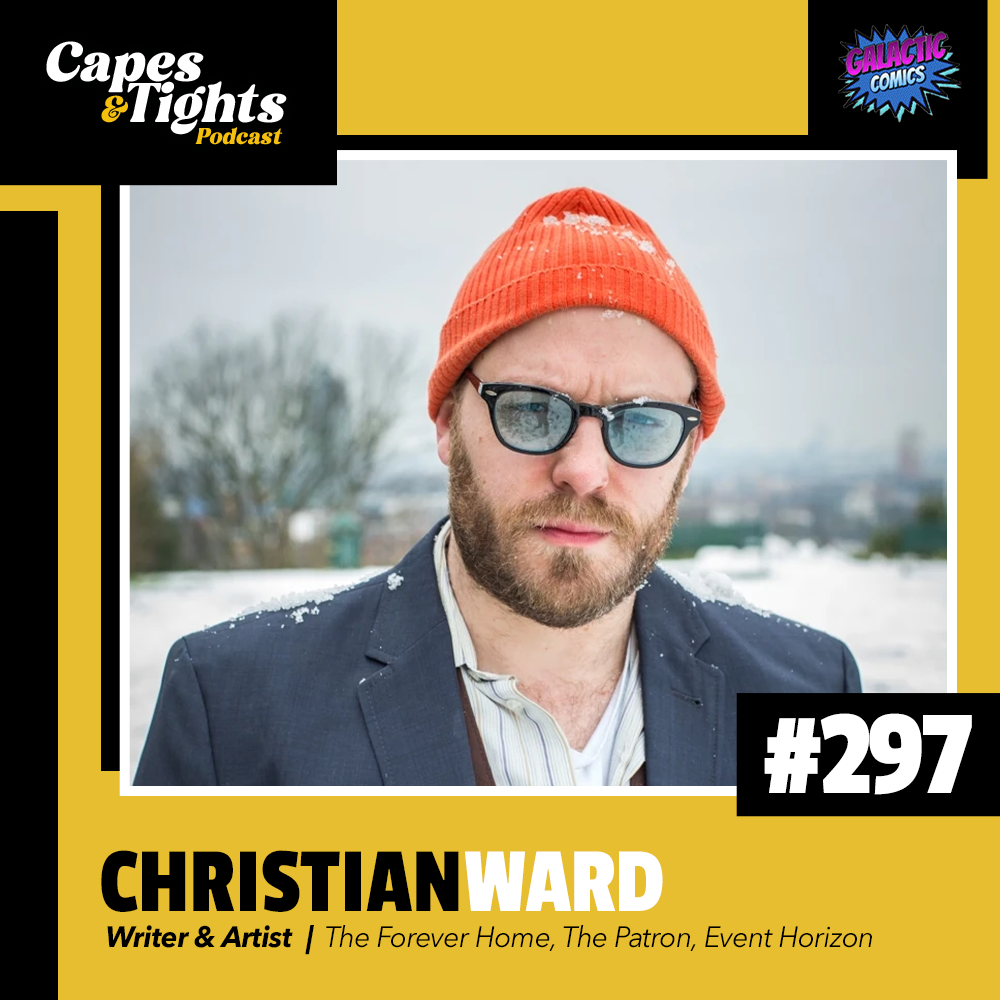
[00:00:00] Speaker A: Welcome back to the Capes and Tights podcast right here on Capesandtights.com, i'm your host, Justin Soderbergh. This episode is once again brought to you by our friends over at Galactic Comics and Collectibles. At galactic comics and collectibles.com we welcome comic book creator Christian Ward to the podcast. Ward is the artist behind such comics such as Odyssey, the Black Bolt, Invisible Kingdom, Spectrograph, City of Madness, which he also was the writer for, as well as the writer of books such as Blood Stained teeth, Tommy Gun, Wizards 2face, and Red Horizons series over at IDW, Dark Batman, Detective Comics, and so much more. But Ward is actually here today to chat his latest comics, the Forever home, which drops September 9th from Onei Press, and the Patreon, which is currently on your shelves with issue one from Ignition Press, with issue two coming September 9th as well. So check that out. But before we discuss this awesome comics on this podcast, check us out on Facebook, Instagram, Twitter, bluesky, Threads, and all those places you can rate, review, subscribe over on Apple, Spotify, or wherever you find your podcasts. You can find the video portion of this podcast
[email protected] and as always, visit capesandtights.com as we approach 300 episodes, there'll be a couple of fun pieces going up on Capesandtights.com Episode 300 is coming right up around the corner with this being 297. Enjoy this episode with Christian Ward, comic book creator right here. Enjoy.
Welcome to the podcast. Christian. How are you today?
[00:01:27] Speaker B: I'm very well, Justin. Thank you for having me. I'm very well indeed. Just been doing a little bit of work and having a nice break to chat with you.
[00:01:34] Speaker A: Absolutely. And you are in the uk?
[00:01:37] Speaker B: I am, yeah. Yeah. In a little place, yes.
[00:01:40] Speaker A: I thought so. I was trying to figure that out. I'm always. The time zones are always weird because I'm on East coast United States and so a lot of comic creators are in California or the uk.
It's one of those things. It's always one of those, like, oh, we said 11. But like, which time zone?
[00:01:56] Speaker B: Yeah, yeah, yeah, yeah. No, it's all good. Oh, good.
[00:01:59] Speaker A: So it wakes up and then I got on my calendar and it said 10am and I'm like, that's not right anyway. It's not right anyway.
It's like, you know, but. But welcome. I'm glad you were able to make it.
It's a. It's fun to talk to creators of comic books that you like, and that's what I tend to do.
And so I'm very, very happy with at least the recent two. How about that? Does that count?
[00:02:21] Speaker B: Yeah, that counts. That counts.
[00:02:24] Speaker A: But no, it's always funny. It's fun to also go back when you get ready to talk to a creator, and you're like, okay, what's their background? What comics have they worked on that maybe you weren't aware of or whatever? And then I go into my local comic shop, and my buddy Paul, who's a regular on the podcast, we review movies and stuff, and he was like, who do you have coming on soon? I was talking about you coming on. He's like, oh, yeah. And he's like, oh, I forgot he did that. It's so much fun to go into all those things, especially with someone with a career like yours, being able to do a little bit of everything and from writer to with artists and all that stuff. So it's fine. But we're here. I just read, like, right before we talked on an email, I had just read the Forever Home, and so I was ecstatic about it. So when we decided to talk, I was like, this is amazing. It's so amazing. I also want to yell at people like yourself, Christian, because can you save some talent for the rest of us?
Like, you're an extremely talented artist. You're extremely talented writer. Like, come on.
[00:03:24] Speaker B: I can't think. You know, if we were gonna. If we. If we were gonna go karaoke up against each other, I. I can guarantee you would win. So, you know, I don't have all the skills.
[00:03:36] Speaker A: I've always said that because, like, one of those things that I've always said about, like, the people who do both, I'm always like, come on, save some for the rest of us here. And then there's those crazy people who are like, I also lettered my book, and I'm like, shut up.
[00:03:46] Speaker B: Oh, I couldn't do that.
[00:03:47] Speaker A: Stop.
[00:03:47] Speaker B: Yeah, I couldn't do that. Yeah, Larry. I think Larry is a real.
It's.
Larry's one of those talents that you don't realize how important it is until you're bad at it, you know, And a bad lettering job will just kill a whole comic.
So. Yeah. No, no, no. And, like, has. Is like, why would I work? Why would I let her. When I've, you know, I'm working with House, who's, like, basically the best industry in the industry. He's just won an Eisner, you know, far too late, in my opinion. He should have won one Years ago. But, yeah, no, I can't let her. So, you know, don't feel too bad. I don't have all the skills.
[00:04:24] Speaker A: It's like one of those things. Lettering always stands out when it's horrible with the occasion of like, oh, my gosh, did you see how this was laid out or something on a page? Otherwise you almost want it to be like the unsung hero where, like, you don't notice it. And that's a good letter, in my opinion. So, yes, I. The people I have talked to have said letter have also said that they'll never do it again. So it's not saying that they're like, oh, I've lettered my own book and then I'm going to call someone else to do it future, because that's just too much work.
Let someone else do that for you. Yeah, but. Yeah, so you've spent a lot of your career as an artist. Like you, most people probably know Christian Ward as an artist.
Do you still see yourself as an artist that writes? Or are you both. Are you a cartoonist, A creator to you? Are you just someone who.
[00:05:09] Speaker B: Yeah, yeah, I think I always. I always tend to lean on, like when I introduce myself on a panel or something. Like, if I'm a kind. I'll often say I'm a comic book creator. And I think. And I always struggle with cartoonist because, you know, I think about people like Daniel Warren Johnson, who to me are like the pinnacle of, you know, being a cartoonist. And I don't see myself in the same kind of sphere almost as talents like Daniel. And it's weird. Like, I think for me, I have more similarity to someone like Jonathan Hickman, who obviously started off with like, the Nightly News and like, maybe some people who are big fans of him now, I wouldn't realize this, but he started off doing his own art, you know, in a lot of his early Image books.
And it was very kind of graphic designing and really cool and really kind of, you know, very, you know, individual. And I think kind of my stuff was similar that I kind of started drawing comics because I wanted to write comics. So I kind of went into. Because my very first comic, before my first Image book was I did a short for a book called Atomic Robo, which is a really brilliant indie comic from about sort of like 18 years ago, I believe it's. It's either. It's either still going or it's only just recently finished. It's a really good book. Indiana Jones, but with a robot is basically the quick pitch.
And I Did a. A five page short in the back of their first kind of like run, their first series that I both wrote and drew. So really I started off 18 years ago doing exactly what I'm doing now. But what happened is people noticed my art, which was quite different and quite, you know, it stood apart from a lot of other artists. And I've had people, you know, I had people like Nick Spencer, Matt Fraction, you know, G. Willibleson, you know, wanting to work with me because I was, you know, a different sort of artist. And, you know, you don't turn those people down.
[00:07:16] Speaker A: And.
[00:07:16] Speaker B: And so I ended up having a career that completely distracted me from my initial goal, which was to write and draw. And actually, I really love just writing for other artists. I mean, my.
My ideal life would be having two or three books out a year written by other artists, and then maybe one book out a year, like six issues.
Like, I draw because I kind of prefer writing to the art now.
So I think kind of, yeah, I kind of like, I lean away from artists who writes because I think there's this weird thing that, oh, an artist who writes is somehow the writer bit is lesser than the artist bit, you know, and it's absolutely fine. If people think they prefer my art to my writing, that's absolutely fine because it's a personal taste in both camps.
But I'm definitely. I don't view myself as.
As an artist who writes because in a way, it's almost like I'm an accidental artist like that I just kind of went in because it was easier for me to draw my own stuff and get an artist to do it for me.
I didn't have, you know, I could do it, you know, and I love, I love them covers. Covers are like one of my favorite things because when I went to university, I studied illustration, which is very much like a singular image.
Um, and I love telling stories more than I do in.
More than I do enjoy drawing, if that makes sense. You know, I love having drawn. I love having drawn a page rather than the actual. Like, I'm not. And when I think. Again, tying this back to your original question, I think about cartoonists like, like Daniel Warren Johnson.
Like, I always imagined that they enjoy, you know, cartooning and drawing. And I don't know whether I have that gene of like, well, I'm really enjoying this panel. Like, I just want to get it done, you know, because it's part of the story.
[00:09:13] Speaker A: I've always considered someone a cartoonist, and this is obviously not a definition or not the actual legal Rule of it. But like someone who regularly draws and illustrates their own thing, like, you know, your Patrick Horvath, your Daniel Warren Johnson, who are people who do both for one project, whereas you do mostly, you know, illustrate for one person who's writing it. And you're drawing, you know, writing for yourself and someone else's drawing. So you're doing both but for. With two other people. And I think that's where it's like one of those things where like comic creator is the. Is the only one. I talked to my buddy, actually. This is the Blood Stained Teeth cover. Cover right here. Somebody there by Joseph Schmalke, who's here from Maine. He calls himself a storyteller because he can write, he can illustrate. So that to me is like, yeah, it's all this is, this is storytelling. And I have talked to people who have, you know, transitioned from one from, from writing or illustrating a lot of stuff into writing. Most of this stuff is. And one of the things they said was you can't tell all the stories that you want to tell if you're illustrating at all, because there's no way that if you were doing both, you'd have three or four comics out a year. It just wouldn't happen. There's no time.
[00:10:17] Speaker B: It wouldn't happen.
Yeah, well, I don't do that much of that anyway.
And the other thing is, like, my style in my art is very kind of ethereal, very kind of cosmic horror, very kind of sci fi.
And it wouldn't. Sue.
Wouldn't suit all the ideas I have. Like, if we talk about like, like the Patron, for instance, which I'm writing at the moment for, for John Pearson, like, that's so set in now and so reality based. It just wouldn't suit my, my art. So it just, you know, you have to look at the story and who suits that and who will bring out the best of that story. And you know, and it's, it's kind of not approaching projects with an ego and actually being, you know, thinking someone can do better than me at this and being. Absolutely. That's cool. That's a cool thing. That's not negative.
[00:11:12] Speaker A: I just thought about that this morning. I actually wrote a review for David Dastmalchian, Leah Kilpatrick's the Accessories, which is phenomenal. And Patrick, I'm gonna, I'm gonna butcher it. But pizza Lungo, Piazza lungo. Art is the artist. And I said that like in the art part of the description, I was like, no one else. Not no one else, but like this is the perfect artist for this story. And that's because it was like this, like there's this dark humor to it, but there's also this horror part of it. And Patrick's style, it just fits that, like not taking itself too seriously, but also having the horror elements. And he did those unafraid with Kyle Starks and the same thing. If Kyle Starks would have illustrated, if Kyle Starks would have illustrated that book, it would have been a different book, I'll tell you that right now. Kyle's one of those ones who has a very unique style of art who's also now writing mostly than doing art illustration. Yeah, so you're right. It's about the best way to put this out there, like for people to read it and people to be entertained by it. And your art might not fit some things, and I think that that's a good way to put it. But does being an artist fundamentally at all change how you go to write a story? Like, does it help, do you get on any artist nerves because you are an artist, or is it just, again, you're trying to tell a story here?
[00:12:25] Speaker B: I, I, I'd like to think that it, it's kind of a bit of a. Writers who also draw, I think, are a little bit more sensitive about the actual mechanics of what it takes to draw a page.
And I'm very, I'm pretty offhand when it comes to scripts. Like, I don't, unless the artist specifically wants it or it's, you know, or the editor specifically wants a little thing here or there. Like, I won't, I won't do any kind of, like, I don't sketch, like, layouts or any of that. Like, I leave it to the artist. And primarily I do that because that's what I want. You know, when I'm doing a script, I don't want the writer to like, go lay out like this because it's a bit condescending. Like, they know my artists know what they're doing.
I mean, the only time I kind of do do stuff like that is if I can't.
Well, there might be a bit in the script where I, you know, it's easy for me to go, it's going to look a little bit like this, but do this in your style or, you know, but it's going to look a little bit like this.
That's the only kind of exception to that rule.
But I'm very, like, I'm very pro work life balance. I'm very pro people not working all the time. I'm also very pro. I'll often write into scripts little cheap bits here and there. If, like, I'm aware of, like, this page is gonna have a lot of work on it, I might say, okay, later on in the script, you could reuse a background here, a background there. You could, you might even reuse a character here, a character there. Like, I'll actually think about kind of like parts of the story where it won't make sense to kind of repeat, you know, a panel or whatever. I mean, in fact, if we go back to event horizon, Dr. Sent, which was the, the first Event Horizon series I did with Christian Jones, we had the issue for people who haven't read it. It's like a time loop issue where we kind of get the same thing repeating and repeating and repeating it. It's part of the story, you know, and I was very aware at that point that, that Trishan, who's incredible, was putting so much time and effort into his pages. You know, all the details, the backgrounds, you know, he doesn't shortchange anything. And, you know, if anyone's reading his Godzill moment knows that, you know, it's incredible.
But like, I, I specifically kind of like was aware of the, the time sync that the pages were being. And so I gave him a few pages where I was like, you know, this is a, this is going to be a little bit easier. This is going to save you some time, you know, and it's going to work within the context of the story.
So I think kind of like, you know, the short answer is I would like to think that writers like working with me because, you know, I'm aware of how hard their job is, but I don't, I don't apply my artistic touch because again, going back to the previous answer, I don't want, if I've chosen an artist to work on a book with me, it's because I want someone different. So I don't then go, well, I would have done this in this way. It's no, I want you to do it in your way, not in my way, because otherwise I would have just drawn it myself.
[00:15:39] Speaker A: Exactly. That's why you have this other partner in crime on this is because you have to work together and it takes the pressure off of you. So why would you want to do half their job? Just do it.
But I mean, you've luckily in your career you've been able to work independent creator own stuff. You've been able to work independent IP stuff as well as Batman 2 face things like that the last two, the one that we're mainly going to focus on this episode of the podcast is creator owned in their, in their independent comic books. What does this, what it's what scratching itch. Does this do that? Maybe IP stuff doesn't. You were also doing Event Horizons, so it's not. You are working on an IP based thing too. But like, what does these two comics do that maybe some of the other ones don't?
[00:16:28] Speaker B: What I would say is I don't tend to approach different projects different, differently.
So like at the moment there's a lot, I'm working on a lot of stuff that has been announced. I mean, I'm working on it. I'm writing a DC book at the moment, which I've sort of talked about publicly, but obviously I can't talk about what it is, which I'm also going to be drawing and I'm writing Event Horizon and we have Forever Home and we have the patron. But I don't necessarily get, okay, well, this is a licensed book, so I'm going to write it in this way. Or this is a, you know, a BC book, so I'm going to write it this way.
It's really, I'm quite, I'm quite privileged in the fact that because my, my earnings come from me being an artist and I'm still drawing comics, they just haven't come out yet. I can be really picky and choosy with what I'm writing and because of that I only choose projects that I feel like I can bring myself to, you know, that I can kind of, you know, tell a story that's important to me and I don't really appreciate, apply different kind of rules or qualities to the things I'm doing. But I think, you know, obviously what a creator owned book buys you or what you get with it that you don't get with a licensed book or, you know, a DC book is complete creative freedom. You know, I've been really lucky with Event Horizon that Philip Leisner, who's the scriptwriter and Paramount, who obviously own the license, I've loved what I've done, you know, and it's basically greenlit everything, you know, and this new series that's coming out in December, you know, we're literally going to have and you know, and we start off in 17th century England. It's like a real swing.
And Paramount and Philip were like, amazing, go for it, you know, but you're not always that lucky. And I know from friends who work with licensed books haven't been that lucky. You know, working for dc, you always have to think, okay, well, what's this character doing over here? What's that character doing over here? You have to work within the framework work of all, you know, a myriad of all the stories that have come before and that are happening at the same time.
But we've, we've acquired our own book. You can do anything, literally, you know, and when I was writing the Patron, it was really about just really wanting to surprise myself and just like, write something that's gonna be, you know, the readers aren't going to be able to predict.
And likewise for the forever home, you know, you're able to go, okay, anything can happen.
Literally, as long as it makes sense for the world and the story and the characters, anything can happen. So, you know, you know, I've had like, some really wild ideas of where to take the story, and it's brilliant. You can just kind of like go on a real. You think you know where the story's going, and then you just take this huge rate of risk, a big swing, and you can do that.
So, you know, that's.
I always feel like when you do crowd books, it's like 100% you. You know, you can't hide behind a license. You can't hide behind a character. It's just you, you know, you and your, you either on your own or with a creative partner. And it's just you telling whatever story you want to tell in whatever way you want to tell it. I mean, it's, it's really unfiltered and, you know, and undiluted is how I would des. But, but, you know, it's something I really, I really love doing.
And for me, the license stuff and the DC stuff is very much about kind of getting a bigger audience that I can then tell my own stories to. I mean, that's the, that's the strategy behind it. But I love event wise and I love all the D.C. stuff, you know, you can see from behind me, you know, I'm a fan, but, but the end goal is to tell your own stories.
[00:20:24] Speaker A: And I wish I remember we're approaching. This is, I want to say, episode 297. So we're approaching 300 here real soon.
[00:20:32] Speaker B: Right.
[00:20:33] Speaker A: And so I've talked to a number of people, but I really wish one person was like, yeah, one of the goals to do is to get a bunch of IP stuff like DC Marvel or whatever, get your name out there and then be able to do whatever the hell you want on your own, because now your name's out there. So like that's the real goal you should have is a lot of people. People may potentially do the opposite way. Like finally I got my big two book. But if you were lucky enough and you get your big two book writer, illustrate a bunch of big two books, get your name out there so that when you go to promote your book, it could be like Christian Ward from Batman or Two Face. Like you can, like, you can actually put that in the parentheses next to it saying this is what people. You should know them from or whatever. Hey, you know, they've been able to do that. But. But in the creator owned side of these things, you have a really good real estate opportunity here with the Forever Home, a very interesting house to live in for this family that's over at ONI Press. This is the first book in your deal with them.
[00:21:20] Speaker B: Right.
[00:21:21] Speaker A: You have multiple books coming from them in the future.
What is, what is the. For people who are going into the Palm bookstore cold and don't really know what this is on September.
Okay, go ahead.
[00:21:30] Speaker B: Yeah, here's the elevator pitch. Okay. The Forever Home is about a. A billionaire who could have saved the world.
He's a. He's a genius, kind of like inventor, and he could have saved the world, but he chose instead to just save himself. And he's with family with the titular Forever Home, a house that is built to withstand climate change. But when they get in it and they close the door, they realize what it also does is withstand time itself. And so for every year, outside is 20 minutes inside the house. And so our family watch the world end and then they watch it be reborn. And then the story is about what happens after the end of the world with a whole new world outside of them, but still with that 20 minutes for every year. And it's, it's the perfect mix of two kind of some sci fi genres clashed together. It's kind of like a black mirror type thing, which is kind of like the future of tomorrow and far flung. You know, almost like Mad Max, post apocalyptic, almost Avatar. Like you know, really just anything goes. Far future stuff clashed together with a really. And I can't sort of say what the big twist is, but you know, you've read the first issue, there's a big twist at the end of the issue that, that really is the kind of the story engine that's really based on characters and, and tensions between characters. Yeah, I'm very proud of it. And you alluded to the. The only deal, so only was so thrilled with this book that they have offered me an additional three books afterwards. This isn't part of the book deal. It's basically, it's what started the book deal. They were so happy that they said, okay, let's do more. I was like, I want to do more because I've really loved working with them. And so, you know, there is going to be three more books by myself over the next few years with, with oni.
And that, that is testament to their confidence in. In the Forever Home and their confidence in me as a. As a kind of comic book creator. Comic book creator.
So, yeah, so that, that. That's the Forever Home. And I think, you know, I mean, Hunter, who's the publisher at Owner, he. He said to me that, you know, he thinks it's my best book out my entire career, so. Including things that I just wrote, including things I wrote, including things I just drew, you know, and obviously he knows what's coming, I know what's coming.
And it would be hard for me to disagree. It's a book I'm very, very proud of. And I would be remiss if I didn't also mention Sammy Cavella, who's the artist, and Jason Wordy, who's the colorist, who have really, you know, brought their story to life in an amazing way.
[00:24:26] Speaker A: It's.
[00:24:26] Speaker B: It's.
[00:24:26] Speaker A: I. You. It's funny how you could like, somewhat sometimes read between the lines that a publisher, when, when myself on the media side of things gets an email, well in advance maybe of FOC or right before FOC or whatever, compared to when you get like somebody sends you an email out like two or three days before the book hits the shelves and like the one that, like, you're always like, I don't know if I've ever wrote a book two or three weeks before. Before or five weeks before maybe sometimes before Focal, that wasn't outstanding because I feel like publishers are like, we believe in this book so much that we, we know we put it out there early. People are going to review it. Well, and so to me, I'm like,
[00:25:01] Speaker B: they sent the first two issues to a bunch of retailers. The first two. Not even just the first one. And that was two months ago. Something.
So, I mean, and that's great, you know, and I think that's one thing that I really like about working with oni. They.
They've. They've really got behind the book and behind me and, you know, they help. It's really helped to boost my confidence about the book and everyone that's read it Yourself included, has just raved about it. So September 9th, if you guys haven't pre ordered the book, my suggestion is people get out there and buy it because I think it could sell out quite quickly.
[00:25:40] Speaker A: It's not going to last long on the shelf. People, you need to call your bookstore now and let them know, hey, I didn't order it, but if you have copies, please put it aside for me. Because I do think it's one of those books that has that, that ability. I think it's because it mixtures, it's a mixture of things too. I think that that's what sold it to me in a sense. Like has this post apocalyptic feel to it. It has. I mean the time dilation part of it too is like you didn't invent that, right? Obviously you could admit that, like this is something that happens in a lot of sci fi things over the years. Like I mean I literally the Star Trek number one that comes out in September as well has a part where they do that, but it's also been part of Star Trek for years. Like it's like a, where they're going, you know, but they're going away, they're going to a special person that's going to a special place that's like one year here or five years there or one year there is five years here. So like going on this mission would mean that you'd be gone for a very long time with loved ones you leave behind.
[00:26:30] Speaker B: Right?
[00:26:30] Speaker A: See that and it's happened in other shows. However, was that something that started this was the post like end of the world was the, the family, was the house. Like how did the initial part of
[00:26:40] Speaker B: this was, I think the, the initial idea, I mean, because like, I mean a lot of what you're alluding to, it often happens besides big sci fi, like interstellar. Right. You know, it's a big. Obviously everyone knows interstellar and I think that hap, you know, and the idea of, of that happens when you're in like two different planets or two different solar systems. And I really love the idea of what we're not, we're on. It's like literally between a door, you know, so that's quite interesting.
And, and where the idea came from.
I, I'm struggling with, with remembering because this has been an idea that I've had for, I think I pitched it to only two years ago.
So I can't quite remember what came first. But it was all about looking at, you know, I was looking at kind of like climate change obviously and looking at the idea of a lot of governments kind of bringing up their drawbridge because they're kind of getting worried about, you know, immigration. You know, we've seen a lot of governments looking at nationalism because, you know, as the world changes because of climate change, we're going to have a lot more people shifting around and, you know, moving from country to countries. They're trying to find a place that is sustainable.
And that idea both frightened me, and obviously I found it quite interesting from a story point of view. And then we all. We're also seeing kind of like people like billionaires who are either building bunkers or they're trying to get off the planet, you know, mentioning no names.
And so it was those two things put together. So what happens if you built a bunker essentially to withstand climate change? But then it was this. This idea of, like, what if it.
What if it kind of stop time or slow time down? And I really wanted to look at the idea of. Of separating people because I think, you know, without.
Without getting too political or without getting too kind of, like, heady and too kind of, like, heavy, I should say, not heady.
You know, I think a lot of our society now is quite fractured and. And it's very, you know, you're either here or you're here, both in terms of where you are politically, but also in terms of, like, whether people have got money or they haven't got money, that getting further and further apart. And so I really want to kind of explore that, but do it with a story that's really, you know, exciting, thrilling, you know, and entertaining, you know, So, I mean, for me, I think when I write a story, I'm kind of hanging it around, like, real life themes that are interesting and are important to me, but those themes are just for me to be able to write a story. Then, you know, when people read it, they can either accept, you know, can read it either as, like, entertainment, but if they want to kind of dig deeper, they'll see some of the themes that I'm kind of exploring, which is, you know, you know, climate change being number one, but it's also about kind of billionaires. It's also about, you know, how governments run and about immigration and, you know, what's important to us as people and, you know, about us kind of connecting with people. And a lot of the drama in the book is really about a family made out of two generations, and those two generations don't agree with each other, which is something that I think we've all experienced.
[00:30:05] Speaker A: I mean, you also there's also this, this threat of family and parent parenting and the decisions you make as a parent. So I'm guessing as a father, there's a fatherhood part of this that goes into it as well. Like this family, this guy thinks it's the thanos of it all. Like, you think you know what you're doing is right, but like, you're just like twisted in your brain that it's not probably the best idea and yet it's still protecting your loved ones. It's the putting the mask on the people you know yourself first before putting the mask on other people on the airplane. I'm guessing that had a influence into writing the story as well.
[00:30:37] Speaker B: 100. I mean, it's, it's somewhere kind of Henry, who's our like, antagonist, he's.
I've had a lot of people sort of ask me about him and show is he evil? And I'm like, you know, is he evil?
Yes, in a way he is. But also, you know, and I often tell people that a big part of him is based on me and they're like, oh my God, what? I'm not billionaire, you know, and I, you know, and I disagree with a lot of things that he's doing, but I also, I wanted him to feel real, you know, and I wanted him to feel like, yeah, he, he does love his kids, you know, but he's got a massive, massive ego.
No, I'm not saying that comes from maybe does, but that, that necessary doesn't come from me, but his temper probably comes for me, you know, I've got a bit of a temper, you know, you know, you know how young kids can just press your buttons and then suddenly you're like, you know, that, that comes for me. And again, it comes from. I wanted it to feel relatable, particularly to other parents.
And as you can sort of say, he thinks he's the hero of the story, doesn't think he's the villain. He thinks he's saving everybody.
And a lot of his decisions, particularly as the book goes on, are based on fear.
They're not based on I want to rule the world. They're based on him, like holding what he thinks is important to him and protecting it from these outside forces, quite literally outside forces, and then just basically, you know, making mistakes, but making mistakes because he's scared.
And that's not to excuse the real life counterparts that, you know, I, I just referenced. But, you know, I wanted to make sure that, I mean, I don't like billionaires and I've got a big history of kind of demonizing billionaires in my books. You know, I've done it a lot. In a way, I didn't want him to be fully demonized because I felt like that would nullify the thing because.
And also, you know, he's going to have a character arc.
But, yeah, so it's. I forget where we started, but it is about, like, looking at the outside world and looking at myself and wanting each character to feel like a real person so that, you know, when we were going on this really wild story, when we're going to go to some really wild places, we're able to kind of empathize with each character's decisions, whether we agree with them or not.
[00:33:14] Speaker A: I want to say that there's moments where I'm like, does the father just saving himself, but his family has to come along? Do you mean, like, is this part of it? And it's. Part of it wants to be like, is he also actually being like, okay, this is a family unit. We need to save everybody in this family? And like, there's part of that's like a mixture of the two in that first issue where I'm like, I don't know, maybe he just wanted to save himself, but he couldn't do it without being villainized by putting his family outside and saying by himself, like, it's just a weird balance.
[00:33:43] Speaker B: I'll throw someone else out to you. I think when someone has a huge ego, they need someone to feed that ego, you know, and, you know, like, that's. And for him, part of the family unit, particularly his wife, is about, look how great I am. I mean, I even spend a lot of the time in the first issue going, look how amazing I am. I've done all this. Look how amazing I am. You know, And. And there's an interesting thing that, like, what happens when, you know, if we look at someone like Musk, you know, who's obviously, you know, he's, you know, he spends the whole time looking for people, like, to praise him and everything. You know, that's a big part of what he's doing with. With. With. I'm not calling it eggs because f. That guy Twitter feeding his ego. You know what happens when.
When there's no one left to feed your ego but your family, who are more likely to call out, call you shit and just call you out.
So that's a big tension of the book going forward.
[00:34:42] Speaker A: And there's a. There's something again, I don't want to get into it, but there's something that happens in this first issue that leans me towards, like, he doesn't really care about anybody else but himself. And that, truthfully, is like, it's like.
[00:34:52] Speaker B: But again, that's the fear. Yeah, that's the fear that comes in. So it's just like. So it's, you know, when I'm, when I'm writing him, it's.
I never have to worry or I never really worried about what would he do or what's he going to do. Because my view is that sometimes you don't know what to do, and sometimes you are conflicted. You know, if you're making a decision, particularly in a serious decision, and sometimes you can think two things at the same time, or you can think one thing, then half a day later you can think something else. And I think we are all kind of like mass.
Masses of contradictions walking along. So to me, that always feels more realistic than somebody who has a very clear cut that never changes. Although you can have people like that, of course.
And he is, you know, he's very.
Hopefully he feels very complex despite being the villain of the book or potentially being the villain.
[00:35:51] Speaker A: Yeah, exactly. Yeah.
The, the, the. So you have this end of the world and you have this time dilation. So the world's changing quicker outside than it is inside, obviously, is. It becomes a factor in multiple ways in this first issue. So you have obviously the end of the world and the rebirth of the world is something to deal with. And again, there's something that's happens towards the end and we're not going to spoil that. That has to do with this time dilation. Is it a part of the story moving forward as well? Like, is there other times that this makes an impact or is that just this first issue and then everything else from there is, is.
[00:36:24] Speaker B: No, it's, it's, it's. It's always part of the story.
I don't want to spoil it too much.
[00:36:32] Speaker A: I guess the question I have is because of that, did you have to create, like, established rules for yourself? Like, it can get very quickly get very confusing or very, oh, shit, where's this going? What are we doing here? Because I was even trying to do the math in my head, Christian. I was like, hold on a second. How many years would pass? And so, so do you have a spreadsheet or some sort of list of rules?
[00:36:50] Speaker B: I don't have a spreadsheet, but I always worked with a calculator.
Because, I mean, one thing I'll say this is, this is only a very Mild spoiler.
Yeah, so this isn't too much of a spoiler. So we're in, in issue one, we join our family in the house and there's, there's, there's obviously two children and, and the parents. But we find out that at least one of those children was born in the house. We've been in the house for years. And then, and then I was like, well, hang on, how many 20 minutes are in one year? And it turns out there's quite a lot of 20 minutes in one year. Okay, but this child is, this child is like almost 10 years old. How many 20 minutes are in 10 years? It's a lot. It's a lot. So we, you know, we go really, really far in future. I mean, I'm, you know, and again, I don't want to spoil anything, but like, I'm.
There's going to be some issues that really do something different.
So, you know, and like, really kind of like surprise the reader, which.
[00:37:55] Speaker A: It makes it like, it's an easy way. It makes it great because you can see a family in the future without having to be like the descendants of the family or something along those lines that time change because, like, you don't see that very often in a story as the main plot, like, main concept. Like I mentioned Star Trek. It's like a sub thing that makes it so. Oh, it makes a hard decision for you to make the decision whether or not to go on this mission or not. But then it's like, that's it or whatever. This is like, it actually is influential in the story, but it also allows us to see, like a family go through the end of the world. It'd be like if there was a time dilation in like the Walking Dead and it'd be like, oh, they visited the end of the world. And then like 35 years later you actually get to see them do whatever and everybody else's past or whatever.
That alone was like a really cool concept to me. And then the end of the world part of it as well as well. I mean, you're sitting. You're gonna go some weird places. Like, is it. How much fun did you have pushing this? Like, how much fun did you have, like, crafting this and making this like, what it is?
[00:38:55] Speaker B: Yeah, I mean, from, from. I mean, what was like, again, I'm kind of walking around it. What I will say is they, the house has rules and like, kind of like, you know, a system that I set up. But also there are rules outside the house and the rules outside the House are dictated by the world that has kind of like reemerged and what, what's happening there. So. And what's really cool about that is I could do anything.
You know, I could do something really different and really wild. And you know, Sammy, who's an incredible artist, it was a big part of it was thinking like, you know what, what would be really fun for him to draw, you know, what would he really enjoy. And we really go to some really far out there wild, kind of like really high concept sci fi elements, almost, almost fantasy elements.
You know, it's, it's, it's. I mean, really is like what I was saying at the start. It really does feel like kind of two sci fi genres like smashed together and like, you know, really doing something really different with, with both of them and they really work together in really interesting ways.
And as we go on that is going to become more and more compelling and more and more like it becomes quite complex as we go on.
So yeah, it was. I mean the great thing is, is it's all written like me and Sammy finished this book months before issue one, like was even solicited. So it. We get to sort of sit back now it's done. You know, it's been called Jason's coloring it. I think he's working on issue five right now. So we don't. I don't have any. All that stress is behind me. All that like, okay, so, okay, but if that, that, if that happens there and this happens here, what about that? That's gonna do. You know, it was, it was almost like doing.
Even though it's not a time travel book, it was almost like doing a time travel. But because I had to kind of think of like, you know, this is going to affect this and this is going to affect that. But yeah, it was really cool.
[00:41:12] Speaker A: I wanted to quickly touch. I wanted to on, on Sammy's the layouts and stuff like that too. Like with the house. The way the shape of the house is too in the, in the design and some of the way the panels about looking out the front window and having that aspect of it was amazing. And then the walk through the house and like a blueprint of the house without having to have like, here's a blueprint. It was like a way to walk through in the way the words and it just. To me I was like, this is amazing. And my favorite thing about visual storytelling is the fact that you don't have to be like, hey, X, Y and Z. It's like you just have to Live in it. And I think that that's one of those things that came across so well is, like, you want to know, like, it's about a house. It's part of the story. So it's called the Forever Home. So you want to know what does the house look like? At least, I want to know that. I don't know if anybody else cares about that.
[00:41:58] Speaker B: I mean, I wouldn't say the house is one of the characters, but it's important, you know, And Sammy, it's almost the double page spread that you talked about. It's almost like a cross section of that house.
And also, you know, the house is going to become. Different parts of the house are going to become more important and have story elements happening. And so I really wanted readers to have, you know, a sense of the space, sense of where these characters have lived for years. You know, how can they have lived? You know, what is sustaining them? What are the rules of the house? Where did they get their food from? You know, and how does it work? You know? You know, how is it possible?
And so it was really.
I had to, you know, we had to kind of have it in that first issue that it would be. Even though it's completely, completely unbelievable, it had to feel believable. You know, the them living in the house had to feel believable. And so I think in the script, it was just like, we're going to tour the house and we have the two children kind of like walking for the house. Almost like kind of an isometric, you know, cross section of the house. Almost like you would get in a kind of scientific brochure or something and showing how, you know, how the house is laid out and our characters kind of walk through it again. That page spread from Sammy was just, like, perfect.
[00:43:17] Speaker A: There's, like, certain pages that I've opened up to before in comics that were not like, oh, my God, this needs to be in the museum. But, like, to the point where, like, I would love to just, like, press that into a frame and put it onto a wall.
There. There's a. There's an issue of noctera where. Where D.C. hopkins writes, like, vroom, down the side of an 18 wheeler. And it's like, that's one of those ones where I'm just like, oh, my God, I want. This is just like, perfect. Like, I want this. And that was one of them. And it's like, it's cool because, yeah, it almost looks like if you were selling the house, like, if I was going to buy the house, that this would be in that brochure, like, okay, here's the dissection of the house and this is how you'd walk through it, and so on and so forth. It just added so much more to it without having to be more than two pages. Like, it's not like you needed to take half the issue to be like, we're going to walk through the house and do every room. And it was like a quick, brief one. And I think that was really cool. And again, credit to Sammy because that is, it's beautiful. And again, the whole thing is laid out wonderfully in that way of like, again, there's a couple, there's a couple pages where the frames are like you're looking out the front window. And it's like the window panels of the window are the panels. And it's just.
[00:44:17] Speaker B: He's just very clever. I mean, I like, I mean, I've worked with Sammy before. We did a book called Machine Gun Wizards at Dark Horse about six years ago, seven years ago. And I, I'm always surprised that he's like. He starred in Takeoff, like sooner and that he's like, you know, I don't get that he's not a big superstar in comics because what he does, it's not many miles away from someone like Hayden who's like, you know, they're incredible. You know, how they use the page. And like, Sammy's similar in that he can use the page and use kind of very interesting page layouts and use the space of the page and the real estate of the page in really interesting ways. But that also lend themselves to be part of the storytelling rather than just be there for flashy whatever. You know, Sam is incredible. And I hope, you know, I think when people pick this book up that don't know his work, I think they can be blown away.
[00:45:20] Speaker A: It was, it was awesome to see that he was like, there's those times you like, okay, Christian Ward doing the writing and you're like, okay, who's the art? And you go to that thing, you're like, oh, you get super excited. I think I even wrote that in my review is like having you a part of it, post apocalyptic side all this stuff and then having a bonus to me, oh my gosh, this is amazing because I love Dear Editor and I loved Kosher Mafia over at Maggie. Those are amazing. And again, it's another way that shows the versatility of what, what Sammy can do as well. And so when I saw that, I was like, oh my gosh, this is amazing. I'M so pumped about this. And. And that became the whole thing. And again, there was something that drew me in. And again, I don't. I sometimes those last. I plan. I'm a very big planner. I'm like, I have a spreadsheet of like when we're doing reviews and when we're doing interviews and all this stuff. And like, sometimes when you get something that you're not expecting to get until later on, sometimes I'm like, oh shit, now it's just throwing everything up for a loop. And now you go, but that's one of those things where I'm like, I don't care. I want to make this work. And I slid this in to read it because I was like, I got to read this story and I'm glad I did. And it turned into this, and so on and so forth. But the other one was I chatted with John Pearson, with Zach Kaplan of their book the Smart Division, and then the patron came up at the same time and I'm like, oh my gosh, I can't believe I haven't figured this out. And that was before it came out and all that stuff. But yeah, the patron over at Ignition Press, which. The Ignition Press publishing is phenomenal right now too. I wanted to give them a bunch of credit on that. It's just everything has been. The books have been amazing. The quality of the actual printing, their trade collections, all that stuff has just been superior at this moment in publishing world. But there's a connection here, really. I mean, you have the Forever Home deals with somebody who's trying to preserve the people they love. And then you have a book of the patron who is preserving the artwork or the creation of people.
In this book, obviously we mentioned before, you have you real life experiences or real life things that are going on are part of your books in that sense. Is that what this is? Is this another story that is very personal to you in that sense?
[00:47:15] Speaker B: Oh, hugely. And it's interesting. I've been thinking about, obviously these two books have followed each other. The Patron first, then Forever Home. And I've been talking to people like yourself about the books and I've kind of come to an understanding in myself of like how the books fit together.
And it's this. I think one book is about something I hate, which is like climate change and kind of like capitalism meets climate change. And the other thing is about something I love, which is art. But again, it's about like what happens to art when capitalism takes over. I mean, in that sense, both books have kind of rooted in this kind of like, fear of capitalism.
But, yeah, the. The Patron is. I would say the Patron is far more autobiographical than Forever Home. There are parts of that that is characters literally being a mouthpiece for things that I care about and the way that I see art. And I know that John agrees with me on many of them. And, you know, in the. For instance, in the Cold Open, we talked about a schoolteacher who was kind of like a failed artist who became a schoolteacher of art, which is something both me and John have done, but we kind of did it the other way around. We were teach. We have failed teachers who are now artists.
And so, like, you know, there's. There's big parts of that that were very. Just like how I felt about teaching art to kind of like teenagers in London.
So, yeah, I mean, I don't think. And this goes back to the answer I gave you right at the start when we were talking about the differences between creator, owner licenses.
I don't really.
Every book is about. Even Event Horizon is about something I care about. You know, beyond the. The story, there's always a subtext where I'm kind of like, trying to kind of find my way around a theme or a thesis or just. Just hanging it on real life world stuff. But, yeah, the Patron's very, very personal. I would say both of the books, the Patron and Forever Home have an anger. And one is how we're dealing with the world, and one is how we're dealing with art and how art is invisible to us and that people don't realize how important it is and take it for granted. So really, I think it's maybe the same thing. You know, we take the world for granted and we take art for granted.
[00:49:42] Speaker A: So are you a murderous art dealer on the side? Is that what you're trying to say?
[00:49:45] Speaker B: I am a murderous art dealer on the side. I. You know, I mean, yeah, I mean, John needs to watch his back now. As soon as he's finished drawing the Patron, I will.
[00:49:54] Speaker A: I'm glad I got my copy, all
[00:49:58] Speaker B: the pages, and then he's. He's done. And that will be my alibi. I'm basically doing Basic Instinct. I mean, I'm not going to get sexy times with him, but you know what I mean?
[00:50:07] Speaker A: And having someone, like we mentioned before, the correct creative team to go together, that fits like a glove. And I think that John's painting style on this just absolutely sold. And what's funny was that like. Like I'm on the pulse of a lot of things. And some things, you know, seep through the, the cracks and things like that. And I'm talking to John, right? John and Zach, right before we start recording, we're doing this like, hey, how's it going? Stuff like that. He's like, oh, yeah. And you know, John's got a book coming up, Ignition, called the Patron with Christian Warden. I'm like, oh, okay. So I'm quickly looking it up and so on and so forth. I'm like, I asked, I think I asked Zach on the phone, like, is there ever time where you, like, as a writer, you're like, what the hell? I wish I came up with that idea. And I was like, because every once in a while I see someone's comic. I'm like, I wish I was the one that was writing this comic book. And then I read it and it was like, it makes so much sense to have someone with the illustration or the painting ability that John has to do the artwork for this story because it just blends together in the same sense for their smart division book. The juxtaposition of like super futuristic style, like hard edge sci fi or hard edge technology based stuff and like smooth painting strokes that there are on a page. And so it works so great. And so to me, I'm like, this is phenomenal. I love this aspect of it. It also, again, should be scary for John because like, at this moment, he could get murdered tomorrow.
[00:51:23] Speaker B: I know exactly how I'm gonna do it and everything. I've got it all planned out.
[00:51:26] Speaker A: But I'm guessing it's important to have someone like John, with John's ability as the artist on this.
[00:51:30] Speaker B: Yeah, I mean, look, I mean, me and John, we've been friends for years and we've been wanting to do a book together for years. And the patron was born from a conversation that we had, you know, based on something that he said to me, you know, which kind of gave me the idea.
So it would always have. It always had to be John. Like, you know, if John couldn't have done this book, like, for whatever reason, the book wouldn't have existed. You know, it had to be John.
You know, and I wrote it with him in mind and, you know, wrote it with a view of kind of like giving him, you know, not wanting to do a pun, but giving him the biggest canvas he could have to sort of like really just do whatever he wanted. And, you know, and. And like me, Johnson, who really loves fine art and really loves painting and really loves art. And so there's as the series goes on, you'll see more and more of John just really kind of like he just senses the rough for issue four's cover. And it's just like, it's perfect and just trying different things. Like, so he's got a whole thing on issue, on the issue three cover. He's also in the book using potato stamps to do the art, you know, like you used to do as a kid. Because it all relates back to kind of doing, you know, art when we're children. Because every issue is really about a different facet of art and why is it important to us and, and have we forgotten why it's important? But also, you know, as you've alluded to, it's, it's, it's about an art dealer who kills his artists to increase the value of their work. So it's very Hitchcockian. It's very, it's a, it's a very kind of twisty, turny thriller. You know, it's a, it's a serial killer thriller. It's a kind of thesis on the importance of art. It's something very autobiographical. But it's also really, you know, it's, it does all these things and every, every element of that, John is perfect because he knows when to do like really, really cool, scary moments, but then also moments where you just go, oh, wow, look at that. That's. That panel is amazing. And I don't know if he told you this or you know, it anyway, but we, we encounter all these different artists throughout the book. And we also encounter kind of real life paintings that exist in the real world. And every single one of those paintings John did separately as an actual painting and then scanned it in and then used it, incorporated it with his hand painted pages. So they all exist. He's like, he, it's like he's like a method actor. He's done all these paintings with these different characters. Like, how would this character do a painting? I'll do it like this. How would this character do a painting? I'll do it like this.
It's a genius.
[00:54:10] Speaker A: Again, leave some talent for the other rest of us, John. Like seriously. I know, but it's that, it's that, it's that passion for it though that shows. And I think we mentioned, you mentioned about doing stuff that you enjoy. So like doing Event Horizon. Obviously you enjoy the world of Event Horizon, the universe that's been created. And so you're going to do that. You're not going to work on something potentially unless it's, you know, going to Set you up. So, like this, I work for a brewery by day, and there's other breweries who create a specific beer, and that beer basically pays all of their bills, which allows them to do whatever the hell they want. And so, like, unless that's the. You might have ever have an opportunity where, like, if you write this book, you can do whatever you want. It doesn't matter if they make money. You might go, okay, I might do that book. We'll work on that book and we'll make that book. But otherwise, it's mostly about the passion and love you have for it. And by creating the paintings that these people would paint shows that he loves what he's doing and loves this book and loves that stuff. And so that adds so much more to it, I think, than just a basic, hey, let's get this through, let's get it done and move on. It adds that pressure. And also, I think being Ignition also helps. They have a little bit more space to do between things. And there's more, like I said, they're doing some things right things over there. Again, Oney Press is doing the wonderful stuff too. But to me, it always sometimes surprises me that these smaller publishers can do what they're doing or it is proud and again, again, do what you like. And I guess all the people who work over there are doing something they want to do. And so helping promote these books is also wonderful for them in that sense as well. Do you have. Does Christian Ward have a piece of work that you could be killed after killed and then be worth a bunch of money? Is there something that you think in your mind that you have that, you know, forget John.
[00:55:49] Speaker B: I mean, like, I stopped working traditionally years ago. So. Yeah. And I did that so I would avoid that very fate.
Like, so, yeah, just holding up an
[00:55:58] Speaker A: iPad of your, like, you know, and
[00:56:02] Speaker B: I don't do any nft. So unfortunately, like, I. I'm now safe. I mean, like, you know, there are, there are. There is original artwork out that out there by me, but it's from years ago, you know, post Odyssey. So it's not my best work. So I'm safe. I'm safe.
[00:56:19] Speaker A: You're safe.
You have to admit that you probably have something. It could be the creation of a book. It could be Forever Home where you're like, okay, I'm proud of. Obviously you should be proud of most of the stuff you do because it is really good. But I'm guessing something like holding when you get the advanced copies of your book and you're holding It, I'm guessing, is Forever Home, that book right now. That's so.
[00:56:40] Speaker B: Yeah. I mean, both Forever Home and Patron, I'm really, really proud of.
So it's really hard to.
They're both my children, you know, it's very hard to sort of say, like, that's the thing. I mean, I feel like the patron is. Is.
I feel like the patron is. Is. Is more niche, perhaps, than the Forever Home. I feel like the Forever Home. When I wrote the Forever Home and when. When Sammy started drawing it.
You never know how readers are going to kind of, like, take to a book. You never know how retail is going to take to it. You don't really know. You don't know whether a book's going to happen or not. You know, even if it's really good, you just. There's so many different things in play, and none of them are necessarily connected to a book's quality. But I would say that Forever Home felt like a book that could change either mine or Sammy's career or both of us. It felt like the book that.
It felt like the book that. If we go back to your original question, that if people are viewing me as a writer, artist, Forever Home felt like the book that might convince them that I am a writer.
[00:57:57] Speaker A: And there's books that you read that you were like, this book was written to become a screenplay. And there's other ones you read that you, at the end of it, go, God damn it, I want to see more of this. And I'd love to see it on screen. And this is one of those ones that I think that is that ladder that it doesn't feel like it was written for screenplay, but it definitely would do well on, like, an amazing TV show. And I would love to see that, because I think that, like, to me, I'm a comic purist in the sense that I don't care what gets made from it. I mean, the comic book is where it is, and I always get to read the comic book. So forget whatever adaptations out there. However, I'm also someone who's like, I don't give a shit. I want to watch the next thing. I want to watch the next Marvel thing because I guess it's pretty cool to live in a world that we get another Marvel movie, you know? Like, I want to watch next Star wars because I love Star wars and they get to get. See more Star wars stuff. Good, bad, or ugly. I want to see more of it. So, like, that's okay with me. But at the end of it, I'm like, that's at the end of the first issue. I was like, this would be so cool because I think it would work on so many levels for so many people that would get into this, and it would do so well for them because I think that's the story, the concept, the plot, all that stuff would connect with so many people on so many different levels.
[00:59:02] Speaker B: Yeah, I think so. I mean, like, you know. You know, my God, what a dream. Can you imagine forever being like a new Apple TV show? I mean, it would be.
Are you kidding? I mean, like, here's the thing. Like, I write. I write comments because I love comics. You know, you can see a whole shelf of them behind me. You know, I write comics because I love comics. I'm not a frustrated, you know, script writer, you know, TV writer, whatever.
You know, I do it because I'm. Well, I love comics.
But, you know, I would be lying if I didn't say that it would be an absolute dream being also a fan of TV and film, to. To see one of my books, whether it be the Patron or Forever Home or any of them being turned into a something and seeing that on screen and like, some of the stuff that we've got in Forever Home, some of the kind of. The kind of crazy stuff, coming to see that realized, oh, my God, it would be just a dream come true.
[00:59:59] Speaker A: Well, I think it's a secondary part of that, which is if someone loves your stuff so much that they want to put it into their own medium, that they are good at directing films, writing films, producing films, whatever it may be, that solidifies that it was worth it all because someone else now believes spending millions of dollars on another version of what you just made says something to me, it's like, it's. Sometimes it's all about the bottom line, but, like, there's definitely things that, like, this piece of work is so good, we need to tell it in another format. And whether that be adapted into a novel, whether it be, you know, whatever it may be, it's just having an adaptation of something shows that people liked it so much that they're willing to spend a bunch of money on the next project of it. So.
[01:00:43] Speaker B: Yeah, and that would be that. That would be really, really gratifying.
[01:00:47] Speaker A: Yes. But wait, so both these stories, like I said, have a lot of impact, a lot of, you know, they're timely in that sense and they're impactful. Beyond that, is there something that you want specifically people to get out of these stories, either whatever, or yourself in your career or. Or As a parent or anything like that that you're hoping to get, you know, the next thing from.
[01:01:09] Speaker B: Would you be in regards to what follows these or.
[01:01:12] Speaker A: Well, no, but just like something get out of these things. If someone, if you. What did you get the most out of writing these stories and creating these stories or what should other people get?
[01:01:19] Speaker B: You want people to connect. That's, that's, you know, you want people to pick them up and either connect with your anger or connect with your hope or connect with your fear so that you, you know, the whole thing is really with writing stories that are about things, it's. It's really just, I'm just shouting, am I alone? You know, and then the readers go, no, I feel the same way.
And, you know, that's it really. And I, I mean, I always sort of said. I remember I did an interview years and years ago. This would have been about 17 years ago, one of the first kind of like, like this. I don't think it was, I don't think podcasts existed then, but it was like, I know that just made me feel like a really old man.
[01:02:07] Speaker A: Well, if it did, it wasn't about, it wasn't about comic books, I'll tell you that much.
[01:02:10] Speaker B: Yeah, yeah, yeah, exactly.
And I remember being asked what was my ambition in comics? And, and at the time it was probably like, I'd love to do a Batman thing or whatever. But I also remember a big part of it was I'd love to write a story that made someone cry, just touch somebody. So like your day, you know, just so like, you know, to have that emotional impact that somebody would care so much about a character I created or co created that they would have such a visceral, emotional response to sort of cry.
And so that's it really like to sort of put a story out that someone would care so deeply or connect with it. That's everything. You know, as much as, like we just talked about TV or film ads, which that would be amazing.
But even that is really about how many more people can we connect with? You know, how many more people can feel what, you know, all be entertained by a story that kind of started in here. You know, that's the, that's, that's wonderful and that's beautiful. And, and really what's the secret of life other than just connecting with as many people as possible?
[01:03:23] Speaker A: Yeah, well, I think people have always said, a bunch of people have said on this podcast, it's like, you obviously are making a living out of this, so obviously selling comic books Pays bills, things like that. But ultimately, it's the more people that read it, the better. Because I created this piece of work and this art, the story that you want people to read, people could do that. You could have written this and just sat in your house and read it to yourself and been like, cool, put it on the shelf. But you want people to see this and read it and get something out of it. And so ultimately, yes, you want to be able to pay your bills so you can write more comics and do more things. But. But ultimately, like, you know, when the trade comes out, they can't afford to buy it, go get it at your library. Like, things like that. You want people to read this stuff.
[01:04:02] Speaker B: And that's very, very pro library. Very much so.
Yeah. No, that's the thing. It's. It's, you know, and. And the other thing is it's, you know, you always feel like even if just one person really connects with it, that's amazing. But if you get, like, one person out of every hundred, that's. That's also amazing. And if you get, you know, 100 people out of every a thousand, you know, that's also incredible. You know, it's. The more people you can touch and the more people who enjoy your work, you know, that's. That's. That really is what's feeding you and kind of like keeping your soul alive.
[01:04:39] Speaker A: And to me, it's the same thing on this side of things and the podcast side of things. As we approach 300 episodes here is too. It's like I've always said, it's like, whoever I can reach. This is amazing. I'm never gonna be on that, like, Forbes Top 10 podcast. It's never gonna happen. Like, I'm sorry to say, like, I never know, but, like, in the same sense, like, there's people who get millions and millions and millions and millions of his. I hate to say, but we're in the world of comics too. There's not that many people that, no offense, but, like, it's like, you know that for. Yeah, but, like, so to me, it's like, if I reached one person, I'm so happy that if I could have one person go buy this on the shelf on September 9, I feel like I did a service to the comic book world, to the writers, the creators, and all that stuff. So, yeah, to me, it's like one person gets something out of this. I'm always happy, but hopefully we'll get more. But that's the way it is. And so I'm super proud for you of the Forever Home which comes out September 9th. It's phenomenal. The Patreon issue one is out now. Issue two is coming or is soon September 9th also. Yes, it is. You're right. It's a big day.
[01:05:38] Speaker B: Christian Warden.
[01:05:39] Speaker A: Yeah, I don't know if that that qualifies for that, but yes, that works.
And then but yeah, all your stuff's available as well out there as well. So read that. I really enjoy the artwork at Spectrograph. I really enjoy artwork on all the other stuff. So like it's phenomenal. So get that out there. But yeah, I appreciate you coming on and chatting with us here on the podcast and taking the time out of your busy schedule and we'll definitely have you on again in the future. But really appreciate all you do.
[01:06:03] Speaker B: Thank you. Cheers, man. Thanks for having me, Justin. Yes. Bye bye.