Episode Transcript
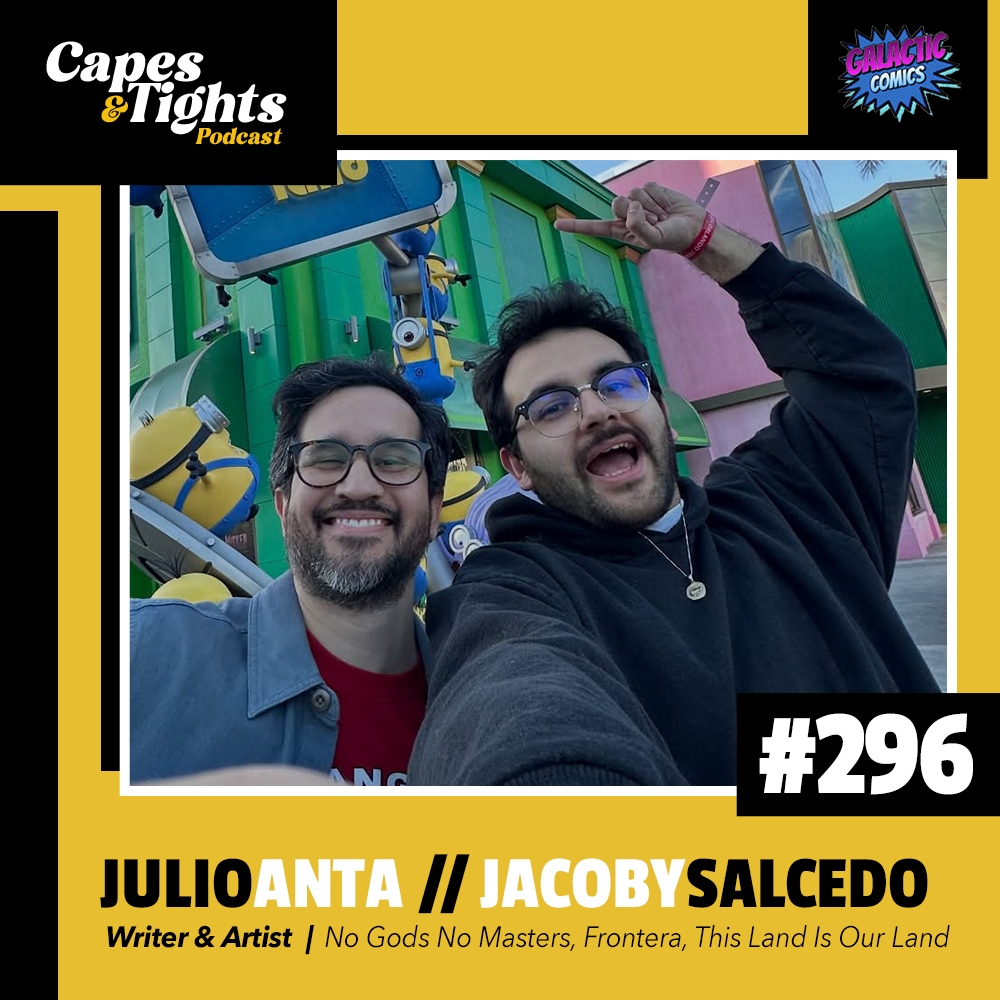
[00:00:00] Speaker A: Welcome back to the Capes and Tights podcast right here on Capesandtights.com I'm your host, Justin Soderbergh. This episode is once again brought to you by our friends over at Galactic Comics and Collectibles at galactic comics and collectibles.com or 499 Hammond street in Bangor, Maine, if you're in the area. We welcome back Eisner nominated comic creators Julio Anta and Jacoby Salcedo back to the podcast. Their creative duo is known for their work on Frontera, this Land Is Our Land, a Blue Beetle story, as well as the upcoming no Gods, no Masters over at Boom Studios, a Kaiju story with a ton of heart. So you gotta check that out. But before you listen, follow us on Facebook, Instagram, Twitter, bluesky, threads, all those places you can rate, review, subscribe over on Apple, Spotify or wherever you find your podcasts. You can watch the video portion over on YouTube.com and as always, visit chapesandtights.com for so much more, including a review of no Guys, no masters number one.
But this is Julio and Jacoby Salcedo 20, talking. No gods, no Masters. Enjoy, everybody.
Welcome back to the podcast. How are you two today?
[00:01:11] Speaker B: Doing all right?
[00:01:12] Speaker C: How are you doing?
[00:01:14] Speaker A: Yeah, great. You, Jacob, are you doing great?
[00:01:17] Speaker C: I'm doing great. I'm chilling.
[00:01:19] Speaker A: You know, it's always a little awkward when you have two people or like three total people, the host and two people because you're like asking generic questions who answers. So you have to be more direct. Jacoby, how are you this morning?
[00:01:29] Speaker C: I'm doing good. Good, that's great.
[00:01:33] Speaker A: But welcome back. This is a return.
I think it's the third time Jacoby's been on. I think it's the second time Julio has been on the podcast. But we got, we got comics to talk about. So this is pretty fun.
[00:01:44] Speaker B: Yeah, we're excited.
[00:01:46] Speaker C: We're.
[00:01:46] Speaker B: We're hyped to talk about no Gods.
[00:01:48] Speaker A: Yes. Right.
Kaiju's.
[00:01:51] Speaker C: Yeah.
[00:01:51] Speaker A: It's always fun to talk about something new with with both you. Obviously you had some success with Frontera and you had success with Blue Beetle and now we're here with no Gods, no Masters.
I was pumped to read. This was funny because I actually got an email from Boom for like their weekly email sending out for that coming weeks issues that are coming out and they added it which very actually doesn't happen that often with Boom. I think there's other like IDW does that a lot where like like I got one like on Friday for A comic book that's foc ing today as we were recording. And they're like, hey, Early. You know, early, look at this book. And I'm like, but I don't know if Boom's ever done that. And then I get an email like, a day later from Julio being like, hey, just, you know, we have a new comic coming out. And I was like, oh, awesome. This is awesome. People really want us to read it. And so I was so pumped to read it. So I'm glad I got to read it early and I'm glad I got. We got a review up there early because it was. It was awesome, as usual, for you to.
But before we jump too far into this, you guys are working on a project together again. You know, you've done some things separately now you're back together again. The group's back together.
[00:02:53] Speaker B: What's the experience working together?
[00:02:56] Speaker A: Like, is this something that you guys have done it so many times now? It's like, you guys know what you're doing. Is there a flow? I mean, Julio, why don't you start with that? Like, how does this. First of all, how did this come about working back on a comic book together? And how does the experience of working together?
[00:03:09] Speaker B: Yeah, I mean, you know, it's always an amazing experience. We've been making comics together since I started making comics Initially back in 2019, I started making mini comics, and Jacoby was the second artist that I ever worked with on a comic.
And, you know, he was making comics before that. But ever since then, we've worked together. You know, you say we're back together, but we've never. We haven't stopped making comics, you know, this whole time. So because we work. We work both in the book market with graphic novels. Like you said, Frontera and Blue Beetle were graphic novels and in the single issue market with no gods.
But there's actually enough. Another book that we made in between those that doesn't come out until next April.
So, you know, we've. We've continued. Like, I don't think there's been a moment since we started working together that we have not been working on a project.
You know, it may seem like there's been a little bit of a gap now, but that book will come out, you know, early next year, and then we have another one after that. And, you know, we just keep chugging away at projects that, you know, we're excited about, that we're passionate about.
But, yeah, it's always a great experience. This book came about from our shared love of Kaijus. You know, ever since we first started making comics together, very quickly we realized, you know, as you, like, start having different conversations with a new friend and you get onto new topics, eventually, you know, the topic of Godzilla and Kaijus came up, and we realized that we've both been obsessed with Kaiju since we were kids. And very quickly we started talking about, you know, what would it be like if we made a Kaiju book? Like, what would a Julio and Jacoby Kaiju book look like? And that's a conversation that's been ongoing ever since, you know, until the moment really presented itself to kind of jump on it and make our own Kaiju book.
[00:05:01] Speaker A: It's a conversation like one of those weird, like, five topics that you talk about as a teenager as you're growing up is, like, things in Godzilla or Kaijus and monsters in general becomes that conversation. But when you go to create a comic book like this, you have to also try to. To set it apart from the rest of the crowd, too, in that sense. Like, when you're trying to. I mean, you always try to do that with anything you're doing. But, like, inevitably, whenever someone makes a Kaiju book, it's always compared to the monster Godzilla. Like, it's always compared to the guy. Yeah, the guy that. Like the number one thing. Yeah.
I mean, it must be. So we're entering, doing this and working together. You guys obviously probably thought we need to make something that sets itself apart from that, right? I mean, you got that in your mind? Is that correct?
[00:05:44] Speaker B: And so, like, I mean, from the. From the beginning. Yeah, I. I just say, like, from the beginning, you know, it is a book that is in our voice, you know, so if you read Frontera, if you read our Blue Beetle graphic novel, if you've read anything that we've made, it's that same voice, it's that same energy that we bring to all those books, you know, so for us, like, we love Kaiju movies, we love Kaiju comics, toys, all of that. But the center of our book is these working class and poor teenagers, you know, who are just trying to survive the Kaiju apocalypse. A comp that we've been using a lot is the Walking Dead and Paper Girls, you know, so, like, the same way that the Walking Dead takes place in the zombie apocalypse, but they're just trying to survive. They're not trying to save the world, you know, they're trying to save each other. And that's one of the main themes of our book. And then, you know, it's also a coming of age story like Paper Girls was.
So, you know, it is. It's definitely a Kaiju book. There's a lot of Kaiju action.
But really what we care about the most is these kids that are just trying to make it through.
[00:06:47] Speaker A: Well, I've always said about. Whenever I talked to someone about Walking Dead because the comic book itself is one of my favorite comic books of all time. It's Kirkman's the Creation of the Walking Dead. It's all about. Usually about the people that are trying to survive and less about the zombies themselves. Like, the zombies are the villain as well as some of the other villains that are in there. But it's about how you work together and what you do and the sacrifices you make as people, as humans in this. And that's what most of the story is about. And I think that similar goes to at least through the first issue of no Gods, no Masters is that it's about the people. The Kaijus are there and they're starting this reason why people are where they are and why things are happening. But it's gonna be about the people. It's themselves. With some Kaiju battles and some destruction happening along the way. And that coming of age thing also hit me. I'm a huge young adult reader. Is. You know, I read a lot of young adult novels because I just. For some reason I had such a horrible and traumatic growing up probably that I'm like, I gotta live back in that day and age. No, but yeah, there's something about that. And I think, sorry, Jacoby, your artwork, the playfulness of it and that adds to that whole, like, you see, like the horror Godzilla just came out is phenomenal. And I'm guessing you guys have at least read the first issue of that or have seen that at least.
[00:08:02] Speaker C: Yeah, I've seen the aria for it.
[00:08:05] Speaker A: It's frightening. Like, it's absolutely scary. What you have to do with this, I'm guessing, Jacoby, is that you have to bring that more. A little bit more that playfulness, but a little bit more lightness to it because of the coming age part of this stuff. Is that true or is that just how your style works?
[00:08:20] Speaker C: I think that's just how my art has been working. You know, doing books that were like, intent. Like doing so many young adult and like kids books obviously has affected it. But I think it's just how I draw now.
And I think because of also, like, this was like a book about teenagers. It was a little bit like, yeah, my mind's still in the YA world, but except now it's like people are getting brutally killed by Kaiju's Kaiju debris.
Debris and just people getting killed. So I was just like, oh, well, I guess in the art style, that's kind of be attached to it as well.
[00:09:00] Speaker A: I mean, it works to me. I think that's what. I think that's my biggest point across, is that it works so well. And I think that I've learned with your books together that the artwork has worked with the story, and I think that's one of the things that succeeds the most. It's like a package deal in that sense.
[00:09:15] Speaker C: But.
[00:09:16] Speaker A: But yeah. So, like, what else went into thinking about when you went to illustrate this book? Was there something specific that you wanted to get across or something you wanted to add? Was there something about the monsters themselves that you wanted to get across?
[00:09:28] Speaker C: I mean, like, everything has a purpose, I guess, with the designs for each of these, like, the characters specifically, like, like, Genie wears this firefighter jacket, and I created, like, my own origin for that because, like, she's a foster kid. So I just kind of had, like, oh, what if she was dropped off at the fire department?
Like, she's just kept this, like, old firefighter jacket with her. And, like, oh, my God, Felipe, like, has this yellow shirt that says, like, formiga on it, and it has, like, an ant on the back because.
Or me guys like ant in Spanish. And I just thought it would be kind of funny to see because it's like, to the Kaiju, they just look like ants. So I'm just like, that's my little joke for the design there. And I don't know, Like, I just was really happy with the Kaiju design because, like, this hammerhead shark design was, like, kind of something that was, like, really pushed by, like, Julio and our editor to, like, create something a bit more, like.
Like, have a more striking silhouette. So, like, having that them support me to, like, really push myself. And, like, I think that's kind of, like, how we kept getting this, like, snowball improvement for this book is because, like, Julio and I are pushing ourselves. And, like, every time he sends a script, I'm like, all right, I got to amp this up. And then when I send the art to him, he's like, all right, well, I guess I got to amp up the script. And it's just, like, it really works out. And, like, also, like, the book, like, the art is also just feeling super, like, awesome. And, like, the story itself because of, like, our colorist, Francesco, who we Got to work with on this land is our land. So having him part of the team as well, it's just like this really cool reunion.
[00:11:20] Speaker A: So, yeah, I guess that blends together. I've always said it. It's weird. You can tell when a group of people working on something likes working with each other. Like, it's like one of those. Like, the finished product is always like, okay, this worked well. There's a small things that just, like, disconnected or something like that. Sometimes you're like, maybe they didn't not get along, but maybe they just don't know each other well enough. You know? I mean, like, maybe they just didn't. They're not friends or they got put together on this project because, you know, the editor and the publisher, like, okay, you guys are together. But when, like, books and stories like this, it's like, when you finish reading it, you're like, they seem like they were having fun making this book. I mean, I'm guessing that's true. Is that true, Julio? Like, you guys had fun making this book?
[00:12:00] Speaker B: Oh, yeah.
[00:12:01] Speaker A: Yeah.
[00:12:01] Speaker B: We had a lot of fun with it.
You know, there is a moment. There's a huge section of issue four that I just threw out, because as. As Jacoby, you know, I'm writing issue four when maybe Jacoby's drawing issue two or something like that.
And just seeing, like, the way that he was drawing the Kaiju, seeing, like, the way that he was dealing with action in the book just made me want to, like, throw out this flashback scene that was, like, very emotional scene and put more action in it, you know, because I thought that would be more fun and, like, a better use of, like, his, you know, what he's bringing to the book, essentially.
So it's been so much fun. Like, this is a book that we've been, like I said earlier, that we've been talking about making for so long. We've been wanting to make it for so long, and. And now that we have this opportunity and, you know, what really led to this book finally happening is our editor, Ramiro. You know, he's a good friend of ours. He's an editor at Boom.
And we became friends sort of like, independently from working together, you know?
And then when the time came where we were like, why don't we just do this book with Ramiro, you know, who's just a good friend of ours? And it's just been this great, fun process. So I've. I've been having a lot of fun, and now I'm excited for everybody else to See it?
[00:13:17] Speaker C: Yeah.
[00:13:18] Speaker A: I mean, do you feel like there's always, like there's this time, like you've been working on this for a little while and the idea's been kicking around for a little while. But is this the right time to release this book too? Not just that. It worked out well with the editor and at boom and stuff like that. Like what we're seeing societally right now with immigration and things like that. And that's obviously part of the heart of this story.
Does it seem like this is the right time to release a book like this too?
[00:13:43] Speaker B: Yeah, I mean, you know, I think it's a lot of my books tend to be, you know, the label timely is like what's thrown around a lot.
And it's a double edged sword, you know, because yes, I'm writing, I'm reacting to the world around me. All of my writing is a reaction to the world around me. It is me dealing with my feelings. Like my first book, Home, came from a place of anger, you know, and then other books have come, you know, from a place of like, wanting to celebrate certain aspects of my culture or wrestle with something that I dealt with when I was a kid, like struggling to speak Spanish. One of my middle grade books called Speak of Santiago is all about a kid who struggles to speak Spanish. So he spends the summer with his grandmother who only speaks Spanish.
And, you know, I think right now in 2026, we are in a place where I think a lot of people's political consciousness is being awoken and their class consciousness has been awoken. And I think a lot of that has to do with issues relating to Palestine, with issues relating to unaffordability in the United States.
And even though there's a Kaiju book, this is a class conscious Kaiju survival book. It is very.
It's very purposeful that our main characters are poor and working class kids. They have been survivors for long before the Kaijus emerged and immigration. Our main character, Felipe, he is at the beginning of the book, he's presented as a recent arrival from Venezuela. And obviously we're living in a time where there are a lot of recent arrivals from Venezuela. And as the issue goes on, you start to realize that his circumstances for coming to the US May be a little different than the real life circumstances and they may be tied to one of the main themes of our book.
You know, I'm tiptoeing around, trying not to spoil, but yeah, so, you know, again, everything is a reaction to the real world.
And I'm writing the stories that I want to read.
So, you know, of course it's going to be filtered through my own personal analysis of the world.
But at the same time, you know, I said a lot of, like, political things just now. But it is also just a fun Kaiju survival story that you can read into in a lot of different ways. But on the face of it, it is, you know, a survival horror comic that we're both really proud of.
[00:16:16] Speaker A: It's a.
I don't tend to just like, generically read stories of immigration just because. I just don't. I just don't. There's no reason behind it or anything like that. But this is just not one of those things that's on the top of my list. And so when something like this comes up, though, it makes me happy to think that I can get multiple facets in a book. You get multiple levels of multiple different things.
You get to experience through the lens of Felipe and different people in this story what it's like to immigrate to the United States from a different country. And so, like. But also, again, like you said, it's also a fun Kaiju story. It's a monster story as well. But, like, it makes it more impactful, though, in my opinion, that you get to read this story about these people. It gives them a reason for you to cheer for them. It's a reason for the root for them while they go through this. Because if it was just dropped in, it's just a couple of New Yorkers who were born and raised in New York and this Kaiju shows up. It's like, do you lose some of that connectivity to those main characters?
And so that's what made me, like, love it even more in that sense, too, because of that. And again, I think that comics are not just funny books. They're not just entertainment. There should be a little bit more meaning to them. And I think that's what they get out of the cross on this, too, is.
But, yeah, you get it also with your character, the small little intricacies you put in there. Jacoby. To make you also connect with these characters as well. Putting that little ant and having it in Spanish on the T shirt is something that also draws you in and something that I probably overlooked. But that's just because I wasn't paying attention fully, I guess.
[00:17:50] Speaker C: I don't know. I'll go back and look now.
[00:17:52] Speaker A: I'm gonna have to go back and look at this now.
[00:17:54] Speaker C: I mean, the logo is, like, very. It's like one of those hard, like, punk what would you say, like, hard rock? Like, the logos where it's just like, oh, this?
[00:18:04] Speaker B: It's like a death metal band.
[00:18:05] Speaker C: Yeah. Thank you. So it's just like, I barely could read it. I had to look up how to do these type of, like, logos. I was just like, what. Where is the word in these?
[00:18:15] Speaker B: That's.
[00:18:16] Speaker A: So if I just watched, like, an Instagram reel, like, of this dude who sits down with his mom.
This guy's like, a big metal head. He sits down with his mom and shows her logos and has her try to guess what they say. And she.
She's like, like, baffled by it. And, you know, like, he'll show, like, one band that has two different versions of, like, those kind of metal logos. And she's like. He's like, you've actually already seen this logo before in a different way. And she's like, I have. Like, what does this even say? And I'm like, I've listened to heavy music my entire life, and I've never understood those kind of logos in the first place. But it's. That's awesome how it's connected.
[00:18:51] Speaker C: Yeah, I respect them on a visual level, but, yeah, I ain't reading all that.
[00:18:57] Speaker A: It's. It's. It's. When Prince changed his name to a. A symbol, it's like. It's just that it's a logo. You don't. You don't have to read it. It's just what it says visually, what it looks like is what you want it to say. Yeah, but. Yeah, you know, but also, this is based in New York. I mean, you're in New York, too. Is there. Is there a. Is that. Is there a reason why New York is this space hobby? Obviously, we've had. This has a history of immigration, people immigrating to New York over the years. But there was. Is there a reason why New York is the hub of this story?
[00:19:26] Speaker C: Yeah.
[00:19:26] Speaker B: I mean, yeah, like you said, I live in New York. I've lived here for 14 years. Jacoby has lived in New York.
You know, it's a place that we both love, that obviously is.
You know, it's an iconic city.
So, you know, for me, it was.
I think it's like a familiarity. Like, I wanted to tell a story based here, but I also wanted a story that. You know, most Kaiju movies, we've talked a little bit about this, but most Kaiju movies, you know, the human character is, like, a scientist or somebody in the military or somebody in the government, someone in a position of power. Right. Who is Trying to solve the problem of these Kaijus.
Our story, like we talked about, is about working class kids. And so I wanted to take a city where you may have seen, like, you know, the 2000s Godzilla that takes place in New York City. You might have seen, like, a destruction movie in New York, but you probably haven't seen it from this point of view, from this perspective.
So for me, it was important to, you know, take this place that's iconic and show it in a sort of different light. And, you know, when Jacoby does this awesome thing where, like, when the Kaiju destruction is happening, he often puts the point of view on the ground, you know, and the people that you see running away from the destruction are nurses, construction workers, taxi cab drivers, you know, real. The real people that make a city what it is. Right.
So it was that sort of, like, shifting of the perspective that was important to us. And I thought that New York City would be a good place to do that in.
[00:21:06] Speaker A: See, now I'm kind of upset you didn't, like, put, like, P. Diddy in the corner and have, like, a Kaiju just step on him and, you know.
No, I mean, it's true. And that. And that that perspective is great. And I think that. I mean, I guess Jacoby also, like, this is an emotional story. It's also a terrifying story. It's also a spectacle. You know, it's action packed. Where do you find the balance in creating this on the streets in New York when you're going to illustrate it?
[00:21:33] Speaker C: I mean, I feel like this is like. Or like our first book together and like, something that's more adult and, like, something so action packed. Like, there's some action in my previous books together, but not nothing like this.
So I wanted to, like, really match that scale to like, show, like, this giant Kaiju and really show off the action and see show, show our readers, like readers of our books, like, what else we can offer, you know, But I mean, because, like, for me, it's like, it's always really fun for me to draw, like, those grounded and emotional scenes which Julio always kills it on. And it's like, you know, for me, it was actually just the grand scale stuff that I really wanted to also emphasize, which Julio, I don't know, he was a natural. I was like, oh, okay, you could have been doing this the whole time, you know, like, no, but we could
[00:22:28] Speaker B: have been making mainstream, marketable comics to make money this whole time.
[00:22:32] Speaker C: Yeah, we could have been making money this whole time.
I mean. But no, that was just kind of like something new for me that it was really fun to like, explore because, you know, you don't really have the opportunity to do that as well. I don't have the opportunity to do that as often. And I think, like, like I said before, this is just like something so new for us and we're just really amping each other up. So, like, it was the, the drawing, the small and like more intimate scenes that was easy for me because that's. That's my usual.
So it was the Kaiju scenes and action scenes that I'm just like, this is fun.
[00:23:11] Speaker A: I mean, you got. You've done. Graphic novels are a. You put it out there and it's all there for someone to sit there and just binge if they want to. So now you have this Julio, obviously, with Beast of Borkin.
[00:23:22] Speaker C: Is that.
[00:23:22] Speaker A: Is that saying that right?
That is also a monthly floppy comic. And obviously, Jacoby, you've done like It's Only Teenage Wasteland with Kurt Pierce. So you have this background to it. But what's different in writing floppy monthly issues versus graphic novels? You have to like, obviously pace it a little bit differently, I'm guessing.
[00:23:41] Speaker B: Yeah, pacing is a huge difference. You know, I view our graphic novels as sort of like films.
[00:23:47] Speaker A: Right.
[00:23:48] Speaker B: They are one and done. They could be a series also, just like movies or sometimes series.
But you. The idea is that you sit down and you read this whole story and you get the entire story.
Then on the other hand, I view floppies and like single issue direct market comics as like television. You know, it's serialized. It's something where you. You need a cliffhanger at the end of each issue to bring the reader back and hopefully it sticks with them for an entire month or longer. However your schedule is.
And you know, some stories just feel more like like single issues to me, and some stories feel more like graphic novels. Like, was always going to be a graphic novel. Well, it was originally going to be a webcomic, but, you know, it's still kind of part of that DNA.
But. And Blue Beetle was always going to be a graphic novel as well, you know, and if I wrote a single issue Blue Beetle series, it would be very different. It would be a different story, you know.
So, you know, I think a lot of people there's like this misnomer that it's like the only difference is, is cliffhangers or full stories. But really I think the idea is what dictates whether it's a graphic novel or a single issue series. And this idea we always knew from the beginning was going to be a single issue comic book series.
And a lot of times, what dictates that also is the audience. We knew that this was going to be a comic for adults, and making original graphic novels for adults is a much smaller market when it's fiction. Nonfiction is a different story when it comes to, like, YA and middle grade. That's all graphic novels.
So we knew that this was going to be single issues. And really, like I kind of mentioned before editor Ramiro, it was really just about waiting to find the right person to make this book with and, you know, for our schedules to open up, because we do work on a lot of projects together, but the stars kind of aligned. You know, we had an idea that felt like a single issue idea, and we met the right person that we thought would be like a good shepherd to bring this to life with us.
[00:25:53] Speaker A: It's. Yeah, it's a. It makes. Like I said, there's. There's places and spots for all this stuff. And I think this is what's great about this one, is that it is in the same with Beast of Orchid. It's like that, you know, to connect that to you, Julio, is it needs that single issue, like, story to go along too. And I think that's what's cool about it. It's like. But graphic novels, to me is also like one of those things that you, like you mentioned April. Like, you're. That's when you think about your. You're waiting for that finish line of it being on shelves are so much longer than it is for these single issues. However, you also get to have that ability to have all that story in someone's hand and guarantee they're going to read the whole thing or that they're likely going to read the whole thing. This you have to rely on, like, you know, September 2nd coming, and then issue 2, October 14th. You have to like, okay, guys, go buy the second issue. You're going to want to read more of these things. And so, like, you have to make your first issue concise, a good story that people want to read, but also entice you to read issue two.
Is there some, like, just single issue number one for both of you, like, writing and illustrating it? Is there something that specifically goes into writing in it first issue that you have to be like, we have to nail this.
[00:26:57] Speaker B: Yeah, it's tough, you know, because like, we've talked about a lot. We're used to graphic novels, you know, and in a graphic novel, you know, the first act of a 200 page book is like, 40 pages, you know, so you get, like. If you want to pace it, you know, in a single issue, we normally have, like, we have 24 pages in no gods number one.
So it is tough to, like, introduce your characters, introduce, like, the stakes, the why, like, why are we reading this? You know, what's happening, the cliffhanger, like, all of this. It's a lot to do in 22 pages or 24, like we had.
And it's. I think the first issue is the toughest one, but it's also the most exciting one to write, you know, So I think that's why you see a lot of times on Image books, they might do a double size issue one, which I love. And when you work with a publisher, like, boom. A lot of times you don't have that option. It's not under our control.
But I think that's why we spend a lot more time on the first issue.
I spent probably, I don't know, at least twice as long writing issue one. And not just writing it, but editing it, you know, because that's the biggest part. You know, when I wrote it, it was like, 28 pages. And then I had to, like, figure out, like, what can I condense?
And then I, like, rewrote big sections of it. And I just spent a lot of time trying to, like, hone in on the ideas on the characters. What was important to me to get done in 24 pages.
And then, you know, Jacoby can talk about the art, but then obviously, like, he knocks it out of the park and makes it something that makes people want to come back.
[00:28:38] Speaker C: For issue two, It's mostly like, the designing that was just, like, the longest process. I feel like just making sure that the characters felt right. And, like, the monster felt like. Like I mentioned earlier with the silhouette, like before, it was more just like a fish head for the monster because it was like, you know, based off, like, kind of sea.
That was the vibe for the Kaiju.
And, like, yeah, that was just like, the biggest part, because, you know, for me, I think the first issue, I finished that one the quickest because I was just like. I was just so excited to just, like, get into this and just, like, do something different that we haven't done before. So I hope that's kind of my feelings. Like, hopefully readers are like, hey, this is something new. I haven't seen this before because, I mean, like, I think Julio and I, we both have, like, such a distinct voice when we tell the stories we tell.
So to apply that to now A Kaiju genre. I think it's just like, something again. Like, every time I work with Will, I'm just like, I have never seen this in a book. Like the script. Every time he tells me a story, I'm just like, I've never seen this be done before.
And I think this. The same thing applies to no gods, no masters. It's just like, this is something I think, just very unique.
And then to throw in a Kaiju, it's just like, this is my shit, you know?
So I think that's why, like, issue one, I pumped that out. And then after that, I was just like, oh, shoot. Like any. This. This is the difference between book market and comic market is the deadline. So I'm just like going month after month after month. And I was like, oh, I gotta catch up. Gotta catch up.
But I mean, it's been like, super fun doing.
Doing the monthly. Even though it sounds. I just made it sound super stressful. But it was actually just like, really fun to have those like, kind of chapter breakthrough chapter breaks after each issue.
[00:30:35] Speaker A: It also gives you the opportunity to do different covers, which is kind of cool. So obviously you have issue one solicited coming out on September 2nd. And then issue two has been solicited now too. And so you have your different covers as well. But I always. I never. I don't think I've ever asked this question to an artist. This is episode, I think, 297.
What goes into. I mean, the COVID for Cover A on a monthly comic book is typically. I say typically because there are some anomalies.
The COVID for the trade when it comes out later on. So, like, a lot of. Not only are you trying to push a single issue comic deck from maybe some creators that people aren't as super aware of with a story that might be, you know, unique in that sense, but now you're also trying to get someone to buy the COVID of the book. What goes into the A cover for you on issue one?
[00:31:23] Speaker C: I mean, a lot I feel like, you know, like Julio said, like, where it's like issue one, you have to set up so much. You have to tell people, like, why they should keep reading and all this and kind of the same thing, but in a single image.
Because it's like there's like three checklists. Or that was four.
There's three things to check off. It's like the characters, the Kaiju and New York. Because I think New York's like. It's a character. Like, with all our books. Like, the setting is a character of itself.
And so, like, there's just a lot you had to do with that.
And really, like, I wanted to make sure that the characters were shown. Like, you know, we have Felipe, Malik, and Genie, and. But, like, we also didn't want to show the Kaiju just to you, you know, had that little looming thread, like, what is this? What is this giant tentacle doing here? And, like, in this destroyed New York landscape and, you know, how to pull, like, a clover field and show the destroyed Statue of Liberty head. I. I love Cloverfield. I don't. And I've heard people talk crap about it, but anyways, sidetracked.
But, like, I. I think that was just, like, a huge inspo for me. So, like, there was a lot, I think, that went into it to make sure. And again, like I mentioned previously, just, like, this team is pushing me. And, like, I think, yeah, the COVID that you see now is, like. Because, like, I had a really good support system going behind me and, like, being like, we got to make sure, like, all these things are shown. And so I was like, all right, I'll see what I can do.
[00:33:03] Speaker A: Oh, and you nailed it. I think it's the design, too. I don't know. I. I don't have the issue right in front of me. But who was the designer of the logo? Do you know?
[00:33:10] Speaker C: Was that. Oh, shoot. We met them this weekend or last weekend at San Diego. I am so sorry.
[00:33:16] Speaker A: I feel bad when I do that because I just pulled it out of nowhere. I should have it because it's probably on the inside of the issue.
Yeah, exactly. Right. But it's. It's. It's beautiful. And I think that's. I'm a designer by trade day. Like, my day job is as a graphic designer. And so when I see an issue of a comic book come out that I'm looking forward to reading, and, like, the branding of it is just. Is just, like, suspect, like, in the sense, like, where I'm like, why did. So who. Who let this go this far? And that's what you use, like, and it happens a lot at the Big two also. I'm like, this is, like a logo you'd see from, like, 1991. And we're like. And it's not trying to be nostalgic. It's just someone just hasn't. And so, like, when I saw that, too, the. The spray paint kind of, like, texture to the. To the logo drew me in as well, which was. Which was awesome. So, like, that whole. It all works together. And I think, again, that talks about a team that puts together a comic book. Not just, you know, individuals, but a whole team of people to put it together. Because it's got to me always the old statement, you know, don't judge a book by its cover. But, like, you can.
[00:34:19] Speaker C: You got us.
[00:34:20] Speaker B: You want to. I'm always judging books because of the
[00:34:24] Speaker A: COVID I never understood why that statement ever came. Like, we all do that. When you go into a store, the first thing you do is look at the COVID and if it entices you to read it, then you're going to read it. But yeah, and it's also. That image is not.
It's not always because it's the best image. But a lot of times I've talked to people who work behind the scenes at publishers, and that's like. Because it's used so much in the promotion of the book.
Like, when someone sees cover a issue one, and they're talking three weeks from now about the comic book or three months from now from the comic book, they'll use that graphic as, like, the promotion for the. Whatever you're doing. And so because it's been in front of people's eyes for so long that, like, it makes the most sense to be the trade cover. Because, again, it's kind of more like a free promotion, but, like, continuation. Yeah, it's there every once in a while. It's like, I see a cover get changed, and I'm like, there's probably a reason behind that. It's because it didn't connect with enough people. And that's why it's a different cover on the front of it. But issue two, did you draw any inspiration from any other monster stories to create that?
[00:35:27] Speaker C: I don't. Not intentionally. I just want to draw a cool, cool image of someone.
[00:35:33] Speaker A: No, it's someone jumping into it. It's beautiful. Yeah, it's so awesome. I just think that it's the iconic. Not the iconic, but it's like, what you need to see.
The reason I say that it's like, when you see a giant monster and someone having the balls and the guts to jump up like that, I feel like that's just like, you needed. That's what I was asking more is,
[00:35:51] Speaker C: like, in reality, he's gonna die.
Gonna die. There's no living.
[00:35:58] Speaker B: But there was a little, like, inside baseball or, like, behind the scenes that would. There was a big debate whether or not that should be our issue one cover A.
So because it's such a great image also.
But, yeah, I love cover two.
[00:36:14] Speaker A: Well, I Think the A cover brings in a little bit more of like what you're expecting fully. Like this. Not just massive monster battle. The A cover for issue one has that. Like you mentioned, you introduced the characters, you introduced the. The broken New York City, you introduced the monster, but also not the monster in a way that you can like show. Like, this is going to be a little bit more deeper than just, you know, ass kicking the entire time. There is some more to this story than just that. So I think that's what made it a little bit more impactful, I guess on that. And. And do you, as a creative team, both you have any say on who gets to do variants for this? Like Boom Studios? Or is it like the editor of the team over at Boom? That was. Yeah, you have.
[00:36:51] Speaker C: So, yeah, we got to.
Yeah, we got to actually suggest.
I think like most, almost all of them, Jen Bartelle was a surprise, which was really cool because I also didn't know that she was doing covers anymore. Like, I haven't seen her work in a minute. I think she's been in animation.
So, like when our editor was like, hey, we got Jen Bartell. I was like, what? She's back? She's back.
[00:37:17] Speaker B: Yeah. So we, yeah, like we, you know, it's a collaborative process with our editor. Like, we threw out a bunch of names and, and then we just talked through them, you know, but all of, I would say maybe like two of them was our editor's idea. The rest of them were ours.
So. Yeah, and we approve of all of them also, you know, so, like, if our editor threw out a name that we didn't, you know, think was the right fit for it, then, you know, we have, we always have the option to say no. But yeah, like, we're super excited. Like issue one, we have obviously Jacoby's cover. A. We have Jim Bartelle, we have Marcos Martin, which is crazy. I love his art.
And he doesn't really do a lot of covers, which is really cool that he's doing one for us.
Issue two, we have James Stoco, which is awesome, obviously, iconic Godzilla, comic book artist.
And then we have a bunch of other awesome people for the next few issues.
[00:38:13] Speaker A: I think it adds to the. I mentioned about the graphic design of the logo itself too, is it adds that it's a spot. It can go anywhere on the COVID It can get smaller, it can get bigger. It can go like with the Marcos Martini cover, it's further down on the COVID which I think I love that too. It's like the ability to move it around and work with whatever way the art looks like on the COVID it actually works. And the Stocco cover, it's smaller and up to the right corner. All of that to me always makes me happy because it makes the COVID look better when you can do that kind of stuff to it. If it's stuck, it makes sense only at the top. Then you have to work around it. Then you only get that small spot below it that you actually get to work with.
[00:38:52] Speaker C: But it makes it easier to draw it.
[00:38:55] Speaker A: Yes.
[00:38:55] Speaker C: I say it takes up like half the COVID So I'm just like, oh. So, yeah, I only got to worry about this right here.
[00:39:01] Speaker A: And then they're like, oh, by the way, there's a. There's a virgin Foil variant of it too. You're like, ah, God damn it.
[00:39:05] Speaker C: Yeah.
[00:39:09] Speaker A: And there's a 1 in 10 of the Jim Bartel in black and white too, which is really, really striking as well too.
[00:39:16] Speaker C: But.
[00:39:17] Speaker A: But to me, I'm a. I'm a. Unless there's a massive. Like, I gotta have this cover. I usually buy multiple covers, but I'm always a get cover a. Because that's like, that's the covering book. And then everything else is an additional purchase on top of that. So hopefully people go out and buy all of them. And then hopefully stores are getting more than 10. So they're getting the 1 in 10 variants as well. That's what's so hopeful around this thing. But yeah, it's a beautiful packaging. I think that's what's cool about it too. It's not just a wonderful story, but they. The packaging itself is wonderful and boom, does a great job putting these things together as well. So I give them credit as well on that. But, like, what are you hoping now with this book? Okay, September 2nd hit shelf. People grab it, they're getting. We're hoping that people. What are you convincing people to stay along with this Julio through the rest of the series? Is it five issues?
[00:40:03] Speaker B: Yeah, yeah, so it's five issues. And yeah, you know, like, we. We hope that people obviously, like find a story that they're really entertained with, but I think also that they like sort of immerse themselves in this world. I don't know if the PDF that you got had the back matter in it, but issue.
Okay, so issue one or every issue is going to have like in universe back matter.
So we have two things. In issue one we have a newspaper article, a Spanish language newspaper article. So I'm excited to see if people like pull out their Google Translate on their phone to try to read it.
That will give you a lot of information about the emergence of the Kaiju as it's reported in real time in the book. And then the second one is like a government document about Felipe's immigration to the US that also sort of reveals more character information.
But then a really cool thing that we're also doing is, do you know what? Oh, man, I don't have any on my desk. Do you know. Oh, Jacoby's got one. Do you know what a bromide card is?
So these are. These are, like, chap.
They were really popularized in Japan around Kaiju culture.
But every single issue has the opportunity for readers to get their own bromide card that is of our Kaiju. So essentially, in one of the last pages of the issue, there's a QR code, and it says that if you find the Chibi version of our Kaiju, which is hidden, it's like an Easter egg. It's hidden on a panel within the book. If you find it, you scan the QR code, you tell us exactly where you found it. You put your address in. The first hundred people are going to be mailed to them. A free bromide card of Archaiju. And we're doing this for every single issue. So the one that Jacoby has was a promotional one that, boom, gave out during San Diego Comic Con. I don't know if you can see, but it shows the San Diego Convention center being attacked by Archaiju.
So that was our first one. It was promotional, was only available at the convention.
But now with every issue of the book, there's going to be an exclusive bromide card that Shakoby designed with archaiju attacking one iconic location in New York City.
So I'll just say that the first one involves the Statue of Liberty.
And if you find the Chibi version of our Kaiju, scan the QR code, tell us where you found it. And if you're one of the first hundred people, you will get a free one mailed to you. So I think that's a cool thing that, like, will hopefully encourage people to read the book as soon as it comes out if they want to get, you know, free burrow mite card.
So, yeah, so there's, like, just a lot of, like, in universe stuff. Like, we both, like, we said we love Kaijus. Like, if you see Jacoby's background there, you can see, you know, his collection of safubis.
In my background, you might be able to see some of my Kaiju toys.
But, yeah, so we just want to, like, do cool, fun stuff and, like, just immerse readers in the world of this book.
[00:43:04] Speaker A: I love that. The extra thing. I want to go into my comic book, local comic book shop, on the day, in the morning, knocking on the door, being like, are you open yet? Let's go in the store. Reading it. He's trying to ring me out as a line of people. I'm like, hold on a second.
It also sounds more achievable and then having a record in it. Matthew Rosenberg.
[00:43:24] Speaker C: Oh, yeah.
[00:43:25] Speaker B: I love that.
[00:43:26] Speaker A: That was so awesome. I have. And this is a Diamond problem, not a Matthew Rosenberg problem or image comic problem, but I have in my poll box at my LCS still two issues that the records never came in because it was like, they got so far behind or whatever at the distribution level that they. Or this is a Diamond problem, obviously, that they sent the issues to the store and then charged the store for the issues and said, we'll send the records later.
[00:43:57] Speaker B: I'm starting to think there's a reason why diamond is going out of business.
[00:44:02] Speaker A: And I was like, oh. And so they just. My. My. My LCS owner was like. He's like, I'm not selling them to you. I'm not. I'm not getting my money while you wait for them. So if you want. I mean, obviously they're like, I already read the comic. It's like, we'll just keep them in your box until they come in. And so the Matt is working with LCS because I think he ended up buying back or getting back all the records, but it was a whole thing. And I was like, oh, my God. That sounded like such a cool idea at the beginning, but turned in because of distribution and the pandemic and stuff like that. Turned in such a shit show that. That I'm still waiting on two records to come in. Come in from my. For these.
[00:44:35] Speaker B: For these bromide cards. I am personally mailing them out. So you will. If you are one of the first hundred people, you will get your free bromide card.
[00:44:43] Speaker C: There's no doubt.
Yeah. If you don't get it, we're the problem.
[00:44:49] Speaker B: Yeah.
[00:44:51] Speaker A: This sounds like such an achievable thing. There's no real, like, you know, roadblocks in this, except for potentially postal delivery service. But we're going to hope everybody gets there. I think that's such a cool thing, though. Like, it's also, like, a way that, like, you, in a weird way, can interact with the creators on a level that. That typically is not like Unless you're at a convention or being able to like, I found this thing and email in and get something sent from the creators to you is pretty cool. And I think that that adds a little bit thing to it. And again, hopefully that entices people to go buy it like the week it comes out. And yeah, I mean, at the end
[00:45:25] Speaker B: of the day, like, like we're just trying to do things that are exciting to us, you know, Like I, you know, aside from being like a fan of Kaiju's, I'm a card collector. So like I get like the chase of these things and I want to make my own cards, you know. And you know, when you're working with somebody you work closely with like Jacoby and I do, like, it's easy. And you know, Boom has also been like really supportive of this whole, you know, project of making these cards. And you know, they distributed them at our panel at San Diego and then at their booth. So like there's already, you know, if you pick up issue one and you get the card and you start collecting them, like, you got to find out, figure out how to get the San Diego one now too, if you weren't there. So yeah, you know, that's the stuff that's fun for me.
[00:46:08] Speaker A: Well, it's funny is like I've never been able. I live in Maine. So like, San Diego is literally the other side of the continual United States. Like it's the other side of the country.
And so it's hard. And I have a five year old and a two year old. So it's like trying to get across the country to do this. And I've always missed out when San Diego has come around. Like it's always like you get the little bit of like a, you know, fomo. You're like, ah, man. But it's like never been that much because I've like never been and I don't have like, it's like one of those things where I went for 10 years and now I'm not going and. But this year there was something about like just things and interactions with fans and like promo stuff and things like that. Not even just comics, but things like this or, or the Beneath the Trees plushies and. And I think is it something telling the children they're doing a plot like an octopus, all these different things. It's like it was like finished San Diego finished. And I was like, ah, this. I really wish I was there.
And my wife's like, can we start like, we live in Maine. Can we start with Like New York. Can we like go to New York first and then like, we'll start there and then go. Yeah, but yeah, so it was kind of nice to see that. So, like having some things that like, boom, working with you and giving those things out to people who are there, it's really cool. Yeah. Now you're to go like trade with people or you know, see what the aftermarket of these things are like to get you one, but like to collect them all. But I can understand.
I've been a card collector my life, so I. Having these things and then collecting things in general, I always like having these things. So, yeah, I'm gonna be out on the lookout and I, I, Yes, I'm gonna be on the lookout here. I'll send an email in if I find anything. Yeah, but, yeah, but quickly, I wanted to. Julio, just quickly. You, you have Beast of Orkin out now too. I don't know if you wanted to. What is that about? And are you excited that you got to work on this project in True Weird Stories over at Dark Horse?
[00:47:50] Speaker B: Yeah, it's been awesome. I mean, working with Dark Horse, working with Tiny Onion has been really like an amazing process.
So visa Borican issue one came out last month. Issue two hit stores August 12th. And this is a tropical horror comic book series. It's one part tropical horror, one part political thriller.
It stars the Chupacabra. But it's really about like taking this like tabloid cryptid, you know, that like growing up in the 90s, we saw all over the place and humanizing it and making it a sort of a protector of the people of Puerto Rico. You know, our human story in the, in the book is about an activist who's fighting against the overdevelopment of the island. She's fighting to stop this massive hotel development that's going to be built on protected land. And on the day of the groundbreaking, a centuries old Chupacabras is awoken. And you know, it's angry and it sees itself in our main character. Her name is Loli in her eyes. And they sort of see like the intersectionality of their two struggles. One, you know, a human that's trying to stop a hotel that's gonna, you know, devastate her community. And another one is a chupacabra that's over 500 years old that has seen the destruction of this island for all of those years and now is ready to fight back, you know.
But yeah, so it's a book that I'm super passionate about, super excited for people to Keep reading. It's illustrated by Daniel Vizari.
Just like amazing cartoonist. If you flip through it, if you read it, like, you'll know what I'm talking about.
And he took my script and just took it to the next level. Like, I feel so lucky to be working with all these amazing artists who also become my friends, you know, that's been like the best process of making comics is making friends and doing it together, you know?
So, yeah, if you, you know, if you're a fan of like Creature from the Black lagoon of horror books of, you know, the stuff that Tiny Onion is doing, I think you'll, you'll find something to love in and be subordinate.
[00:49:56] Speaker A: It's, it's, it's that true weird series.
Steve Fox did one too, that it's like just these cool stories that, that revolve around these, these mystical or what are they called?
Cryptids. Yeah, on that. And it was wonderfully done. It was funny because I read the first issue like the day after my father in law said he's doing six months in Puerto Rico and six months in Maine. Like he's moving to Puerto Rico. For he was born. His dad was in the military and his was stationed there. So he was born in Puerto Rico, but he ended up moving back up here, whatever. And so he's getting ready to retire and he's like, I'm going to do six months in Puerto Rico and six months in Maine. And I was like, it was like funny. It was like literally the day before he mentioned that he's moving to Puerto Rico. It's like weird timing on this, but yeah, yeah, now I'm like, now you need to read this comic book. Yeah, but I don't know if he's ever read a comic book book in his life. But maybe this is the first. This is the first one you should try.
But it was fantastic, as always. And then obviously you guys have.
This is hitting. So no Gods, no Masters is hitting the stores September 2nd everywhere. So make sure you grab that at your local comic book shop if you go in there. And for some reason they don't have any. Tell them you want it and so on.
Hopefully they'll have it.
And then obviously you have this Land Is Our Land, a blue Beetle story. You can get that at bookstores everywhere, which is really cool. Again, that's the cool thing about graphic novels is that they're available in more locations than just your local comic books.
[00:51:22] Speaker B: But also comic shops.
[00:51:23] Speaker A: But also comic book shops. But I'm just saying, like I live in Maine and one of the reasons why I always say this is there's hopefully other people like this across the country. Not hopefully, but there are other people across the country like myself. Whereas, like, there may be, like, five or six independent bookstores and then one comic book shop in, like, a huge span of space. And so, like, if you can go to your local bookstore and say, I can want this book, they can get this graphic novel for you or a trade paperback. Whereas, you know, for me, it's my local comic book shop. And then the next one's not for another hour away.
And so, like, it's. We're not in the middle of nowhere. It just happens to be that there's not enough comic book readers to help put together comic book stores.
[00:51:59] Speaker B: And so there's not enough comic book stores to facilitate comic book readers.
[00:52:04] Speaker C: But.
[00:52:04] Speaker A: Yeah, but there's. But in that hour span, there's, like, four bookstores. And so, like, that gives you the opportunity for trade paperbacks or graphic novels as well as Frontera. You can get as well, wherever you find that. And I will also promote It's Only Teenage Wasteland because that was also phenomenal in Jacoby. Like, it's right here.
[00:52:21] Speaker C: See, it's right here. I think. I think it's out of print, though.
[00:52:24] Speaker A: Oh, is it?
[00:52:24] Speaker C: Yeah, I see it.
[00:52:26] Speaker A: It's right next to Fuller House.
There you go.
[00:52:30] Speaker B: So you gotta. You gotta go on ebay or Amazon and buy the, like, used library copies.
[00:52:36] Speaker C: Exactly.
[00:52:38] Speaker A: It will come back in. We'll see. We'll get it back in the print, right?
But yeah, I read everything and just search Julio and. And Jacoby Salcedo on. On Facebook and Instagram and all those things, and you find them and see what they get, because I highly recommend it. Anytime I see your names on any. Either one of your names on anything, it'll be an instant grab and read for me.
And I wish all the success to you, but yes, no gods, no masters, September 2nd at your local comic book shop, or if you can't and you want to read it digitally, it's available digitally, but, like, go grab this physical copy and then find an email and get your card, because I think that's an awesome thing. And then continue reading it. By all issues, tell your local comic book shop you want them all. Say, continue getting it. Put it in my box. I'm going to subscribe to this issue because it's worth reading. Thank you both so much for coming on the podcast once again and talking to us about comics.
We'll have you back on again in the future. Until then, much success and hopefully everything goes well. But, yeah, thank you so much.
[00:53:32] Speaker B: Thank you. Great to be here.
[00:53:33] Speaker A: Have a good one.
[00:53:34] Speaker B: See you.