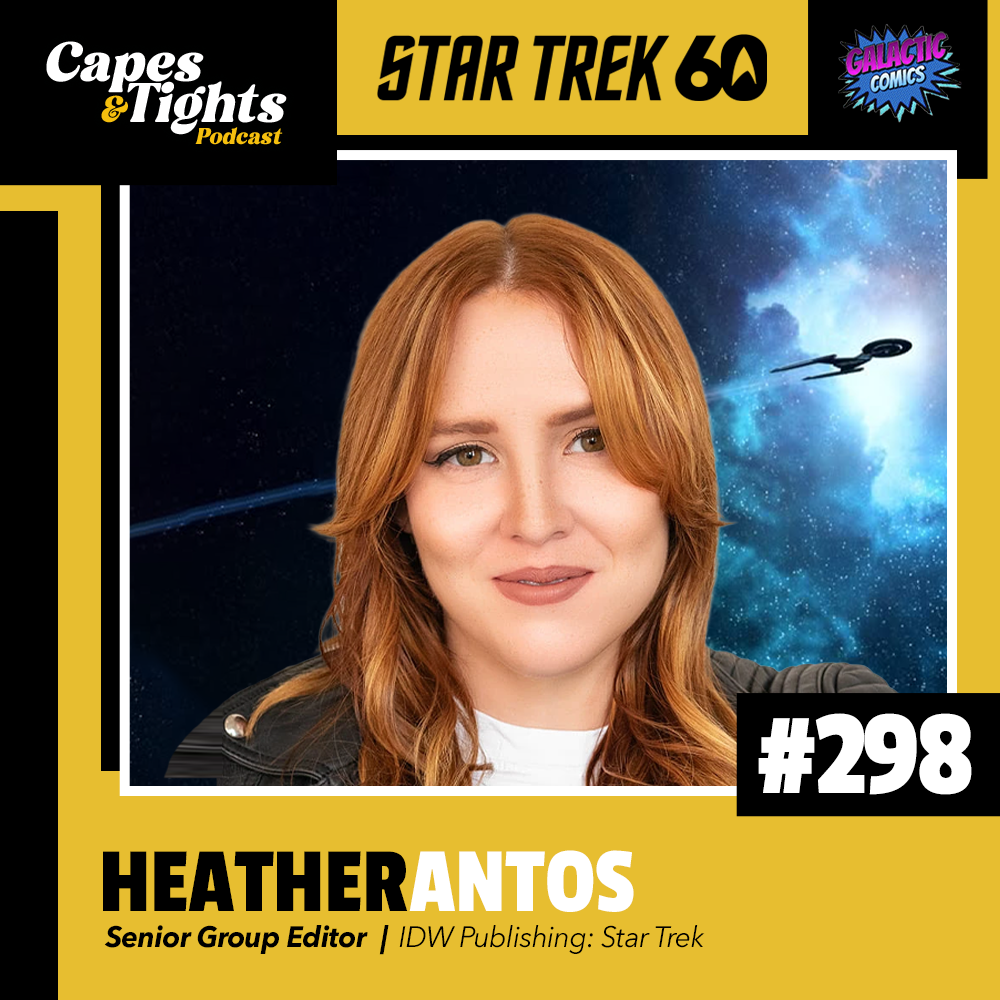
[00:00:00] Speaker A: Welcome back to the Capes and Tights podcast right here on Capesandtights.com, i'm your host, Justin Soderbergh. This episode is once again brought to you by our friends over at Galactic Comics and Collectibles at galactic comics and collectibles.com this episode we welcome Heather Antos to the podcast to help celebrate 60 years of star Trek for Star Trek Day, which is today the day this episode drops. If you don't know who Heather is, she's the senior editor over at IDW Publishing, responsible for Star wars comics like the Last Starship and red shirts and lower decks and Starfleet Academy and Strange New Worlds and the Star Trek line. And I keep on going on and on and on, but also in charge of the IDW Dark imprint. So you'll talk about the beneath the trees where nobody sees and the quiet place and smile and all those things. But today we kind of did a little bit of a split, though, celebrating Star Trek Day and talking about horror comics over at idw. But before you listen, follow us on Facebook, Instagram, Twitter, bluesky, threads, all those places. You can rate, review, subscribe over on Apple, Spotify or wherever you find your podcasts. And you can watch the video portion
[email protected] and as always, visit capesentice.com for so much more. This is Senior Group Editor Heather Antos of IDW Publishing, talking Star Trek and IDW Dark. Happy Star Trek Day, everyone. Enjoy.
Welcome to the podcast, Heather. How are you today?
[00:01:16] Speaker B: I'm good. How are you?
[00:01:18] Speaker A: I'm doing wonderful. It's beautiful out here.
I'm in Maine. Are you in West Coast? Is that what you are?
[00:01:24] Speaker B: No, I'm Jersey. I'm Jersey. So just a little. Yeah, a little. It's not amazing here, though. It's quite cloudy. I think it's about to rain. But I thought you just meant in
[00:01:32] Speaker A: Jersey altogether, but no, you meant the weather itself.
[00:01:36] Speaker B: Well, you know. No, no, Jersey's great. Jersey.
[00:01:39] Speaker A: No, that's great. It's one of those things. It's funny because there's like, very few as a few people, but very few people who live in, like, in the middle of the United States that make comics. It's a lot of people who are like east coast or West Coast.
[00:01:51] Speaker B: Yeah, well, I'm from. I'm from the middle.
I'm from Michigan originally.
But yeah, when I got the Marvel job, I moved. Moved out east. And then, I don't know, I had to, like, meet my fiance and buy a house. So I guess I'm stuck here.
[00:02:06] Speaker A: That's why I'm in Maine. How about that? No, I love Maine. I love Maine. But that's the reason why I stayed is because I met my fiance and got married and. Yeah. So now I have kids and all that stuff, so.
[00:02:16] Speaker B: Which.
[00:02:16] Speaker A: My son just started kindergarten.
[00:02:18] Speaker B: Keep ruining everything.
[00:02:19] Speaker A: It's unbelievable. I mean, I would have so much more money and so much more time.
I say that, but let's be honest. Like my wife was actually saying that to me the other day. She's like, would we, would we just spend it on other things?
[00:02:30] Speaker B: Yeah, you just, you just spend it on other things.
[00:02:33] Speaker A: I have XYZ house because I have kids in that financial, you know, whatever. I probably have a different house that I'd be spending more money on. So it wouldn't. It'd just be another thing where like, when's the next space coming? But no, they're fine. And it's like my son started kindergarten Friday. Today was the second day. And it's just so. It's exciting, but it's like daycare. There's like an app they track like, okay, he did this and he did this and he just. Daycare. Or sorry, kindergarten. There is, but it's not like a day to day. Like, I don't know what happened today. And so it's a little bit like, I want to know what happened. My wife's like, we should put an air tag on him so we know where he is.
[00:03:08] Speaker B: That's so different. I know we're supposed to be talking about comics, but like, whatever, we'll get there eventually. But that's, that's so different from how like when we were in school. An app, like, that's insane.
[00:03:21] Speaker A: It's an app. And it's funny because like the app they made us download during, during the open open house. So sorry.
They made us download this app. And then like as you're signing up, it's like, you want to pay for it. I'm like, pay for what? What am I paying for? What's going on here? And I guess there's lessons and things you can like do with your kids on it and it tracks it and helps it, whatever. But I was like, what it's basically for is if they need a message, just saying so and so, forgot his water bottle or da da da da, and so on.
[00:03:47] Speaker B: Yeah. And then it's a secure app and, and all this stuff.
[00:03:50] Speaker A: But, you know, yeah, you're right. I got on the bus and my mom and dad went to work and they're like, see you at three. And it was like, what'd you guys do today? I don't know. And then you wouldn't know nowadays, like, people actually could know. Like, my, my daughter, who's 2, is potty training. So now I'm like checking the app. Did she go on the potty at school? Did she do that?
You know, my parents were like, got home, pick him up from school and they're like, hey, did he go to the bathroom? Did he. Is he good? But yeah, it's a, it's a. It's the world we live in. But yeah, we thought about the airtag because I'm like, his first day back from. Or on the bus, he was going from bus to daycare and we're like, when is he going to get to daycare? And we don't know if they were going to check him in and whatever, let us know. And so my wife was jokingly saying we should get an air tag. And I was like, it actually isn't that bad of an idea because A, we can know where he was and B, if he loses his backpack that it's in, we'll know where the backpack. It's like, it's all kinds of great things and it's only 25 bucks. I'm like, no, no, 29, 25. I spent $25 on worse, I'll tell you that much.
And so we were talking about it. We're like, oh, we should do that. But yeah, it's the world we live in. But yeah, we're here to talk about, you know, comics and Star Trek and horror.
[00:04:53] Speaker B: Speaking of futuristic technology. Yeah, right.
[00:04:56] Speaker A: I'm guessing there's an app and the Starfleet. Like, that's not.
But no, it's true. So it's star. We're releasing this on Star Trek day. It's the 60th anniversary of Star Trek, which is absolutely insane.
And I'll tell you right now, it took me to the 60th year to really get into Star Trek. And that has nothing to do with Star Trek. That's just. There's just so much stuff to read and get into Heather, that it just never got to that point. It's never been a Star Trek vs Star wars thing for me. It's just always been not enough time and effort and energy put into it. And I started with the spin off type stuff. Like you're talking lower decks and red shirts and things that you don't really need to know the entire history of Star Trek to understand. Plus didn't feel like you were dropped right in the middle of a storyline or things like that. And so that is awesome for those people like myself who got into it later on in life. And I actually got into later in life in comics. Like, I've seen some of the movies and I've seen the things, but, like, comics is where I'm. My Star Trek.
[00:06:01] Speaker B: That was your drug. That was your, like, yeah.
[00:06:03] Speaker A: Which is awesome because I love the different mediums that people get into things. And comics always makes me happy when someone gets into something because of comics.
And that includes. I actually had this argument with someone at the. Out of a book club at my local comic book shop, and we were talking about something, so a comic book that was made based off of a movie or something like that, like one of those adaptations. And they get all upset, like, oh, they got into it because of the movie. And I was like, I don't care.
Are they reading comics now?
[00:06:31] Speaker B: I talk about all the time, and I will say this louder and proud.
So I.
I read, like, like, a lot of horror comics or like Vertigo or, like, stuff I, you know, before. But my first superhero comics were because of the Green Lantern movie. They, for whatever reason, they, like, you know, I had seen the Marvel films and, you know, the Dark Knight. I had seen the other films, but I never read superhero comics. I just read everything else, you know, like, why the Last Man, Sandman, like, all of that stuff. But for whatever reason, they announced, you know, the 2009 Green Lantern movie. And I just decided. I was like, I'm going to become the biggest Green Lantern fan before this movie. And I bought and read all the Green Lantern comics.
See? Yep, there it is.
[00:07:19] Speaker A: It's signed by Mark Guggenheim, who wrote this film. Yes. Look at that.
[00:07:22] Speaker B: Who wrote Star Trek for me? Who wrote some Star Trek for me.
But, yeah, so I, like, devoured everything leading up to that film. So by the time that film came out and I was in the theater, I was like, every other nerd in there being like, well, this blah, blah, blah. But I very proudly, like, I know people cringe because, you know, that movie is what that movie is.
But that is the movie that got me into superhero comics. And I will say that very proudly.
[00:07:49] Speaker A: We've reviewed my buddy who owns the local comic book shop, Galactic Comics here in Maine, we've reviewed that movie on this podcast because we do, like, obscure Marvel and DC movies from over the years. Like, movies that no one talks about anymore. But we should, like, let's talk about it now, because we can and so that was one of them. And we were like, this movie, I think, got bad timing. I think it was just bad timing. I think there was stuff that went around it that was so good that when that movie came out, it. It just shocked people into the point where, like, that it wasn't as good as the other stuff that was around it. And so it got crapped on a little bit more.
[00:08:21] Speaker B: And I think. I mean, like, the CG I could do without, right. That. That. That they were trying something, and I appreciate them trying a thing.
You know, it is what it is, what it is.
Mark Strong is the best Sinestro we're ever gonna get. Like, he was so, so good.
[00:08:43] Speaker A: And.
[00:08:44] Speaker B: And, yeah, I think. I think for a lot of people, too, like, it was that. That shock of.
We, Our DC movies up to that point were very grim, dark. You know, Christopher Nolan, Batman and the man of Steel, and then Green Lantern, it was such a swing in the opposite direction that. Yeah, I agree. And people just didn't know.
[00:09:07] Speaker A: Well, we talked about it because, like, Thor, the first Thor movie, came out May of that year, and then this. Then it was X Men First Class, then it was the Green Lantern movie, and then it was Captain America, the First Avenger. And so it's like, they obviously wasn't maybe what Marvel was doing at the time. And so you plop a DC movie in there that wasn't the greatest, and it just became horrible to people. They give you, like. It was like, yeah, but I mean, compared to the other movies, I'm like, well, compared to. Yeah, obviously they. Marvel had some stuff going on there. There was like, they were doing some things, but, yeah, so, yeah, to me, it was like one of those things, but I'm glad that's so funny. But see, that's. That's the story you like to hear. How did you get into comics? Or how did you start, like, doing. Getting to the genre you're in or this. This. This comic you're in? And that's how you. Who cares? Does it really matter?
It's. It's the same thing with, like, you know, people who.
Who don't know comics crap on, like, Patton Oswald for writing comics, whatever. Like, you don't know the whole story. Patton is a massive comic book fan. It just happens to be that he's a comedian actor, and that's moved. Like, that's where he's put all of his attention in and he writes comics. So, like, it's not. He's not using the comic book medium as a. Hey, let Me see if I can make some money. Because guess what? There's not a lot of money to be made in comics. He's going to make more money making movies than he is making comics, I tell you that much.
So, yeah, it's whatever, however you get started. So to me, reading comics, and I think it's part of it is thanks to IDW and Greg Katzman, who's, who's iew sending things to me, being like, would you be interested in reading this? And I'm like, you know what? I think I might. And so that snowballed into now me. Just before Greg even says anything, I'm always like, I gotta figure out what's coming up for Star Trek. Because it started with a little bit of a push. You should read this. And now I'm like, big into it. And now it's the 60th anniversary, so what better time to get into it, huh?
[00:10:51] Speaker B: Yeah. No, I agree. Star Trek is one of those interesting franchises. Especially, like, you know, I get that comic books and, you know, nerd. Like the comic books within nerd culture is like, nerdy, right? But even Star Trek within pop culture is like, well, I'm not that much of a nerd, right? People have this, like, idea of Star Trek being like, for the nerdiest of nerds, which is really quite funny to me because it's actually quite silly and goofy.
You know, like, yes, it has its values and ethics system, like Marvel does, like D.C. does.
Don't pretend that neither of those universes don't have, you know, morals and ethics in them.
But, but, yeah, like, it's, it's just such a weird, weird thing I've noticed where people like, oh, no, no, I'm not into Star Trek, but I'm into all of these other nerdy things that are just as nerdy as Star Trek. And so I have found that if you can just get them, find their entry point, whether it's. I'm a hardcore Star wars fan, like, great, try Deep Space Nine. You know, like, oh, I really love Rick and Morty. Great. Try lower decks, you know, Oh, I really like action or darker things. Great. Red shirts. Last Starship, that's for you, right? There's, there's an entry point for everyone in that and even with the shows as well. So I, I have found, like, that that has been the key thing for me is just finding, finding that entry point. Because there is 60 years of star Trek. There is, there is a Star Trek for you. Like, I promise you that I get
[00:12:35] Speaker A: a distractor over here, because my Tesseract is dying. The battery's dying in it, and it's, like, flashing. And I'm like, over here going, oh, my gosh, someone's opening a portal into my house. No. Yes, you're right. And it's funny how you say the nerdiest of nerd things people just assume is Star Trek, because I remember, isn't that episode. It was an episode of Big Bang Theory where they go to a Star Trek convention and they stop and they film scenes on the side of the road. And it's like, they're like, well, how can we make this even more nerdy on this show? And he's like, well, we'll put Star Trek in it. And that, to me, is like, yeah, it's that misconception. But, like, it's because there is 60 years of it that Star Trek is, to me, like Marvel in the sense that they have different genres in the genre. Like, to me, I've always appreciated that. My wife and I are actually doing the whole rewatched up to Doomsday. We were watching, like, the movies in it. And I'm always like, ant Man's a heist movie. And there's like, Guardians of the Galaxy is a comedy. Like, there's these things that lie within that genre.
[00:13:30] Speaker B: It's not just soldiers, espionage.
[00:13:31] Speaker A: Yeah. See, it's. It's not just a superhero movie. It's a superhero movie that has X, Y and Z. And Star Trek can be like that. And I think that that was, to me, we're trying to figure out, on my book club, I have. We're always, like, trying to figure out what books to read in dc, Marvel, all these different things. And there's certain ones that are really hard. Any DC or Marvel comic book is very hard to read in a book club format because of the fact you have to come into it knowing something. So if you have this one person who's read DC their entire life and never read a single Marvel comic book, they're going to be lost at times. And the opposite goes and so on. And so we're trying to figure out, oh, Star Trek, Star Trek's coming up. I was like, we should do lower decks, because, again, to me, that you have to have a little bit of knowledge, but, like, not a ton. And it's just funny and it's like the characters you wouldn't expect to see. And I was like, that, to me, would be one worth discussing because, you know, it's just hilarious. But then you've got.
[00:14:20] Speaker B: Yeah, I Was going to say, that's why, that's why I wanted to do the red shirts comic. Like, the whole concept of the red shirts comic was specifically for the fan who knows nothing else about Star Trek except red shirts die, right? Like the, the, the memeification of the red shirt, like, precedes all pop culture. Like you don't know Kirk or Spock or Picard or whatever, but you, you've heard of a red shirt. You, you know, you get the joke, right? And so that, that was the entry point for, for the Redshirts comics was I'm going to create a cast of characters in a world that you're going to care so heavily about, that you're going to be so piss when we kill them all in front of you in very, very brutal ways with a really great twist at the end. And same thing with Last Starship. Last Starship takes place during a period of 300 years of federation time where no stories have ever been told.
So it's all brand new characters in this wild west. And yes, we did bring back and clone Captain Kirk, but again, Captain Kirk, Shatner is one of those things that you don't know anything about Star Trek but heard of Captain Kirk.
You know, that's like, that's a void. That's like saying you've never heard of Superman, right? Like you, you've heard of this character.
[00:15:44] Speaker A: And, and when that was being put together, was it gonna be five issues? That's it. And then the success and the, in the, and the story itself spawned the second arc? Or is that, was it originally being like, we're gonna do what we can
[00:15:56] Speaker B: do until we can do was always designed as 12. From the very beginning. From the very beginning. When we first talked about the series, myself, Jackson and Colin, it was always, always going to be 12 from the very, very beginning. Which is really cool, that one.
It sold well enough that we got to stay at 12.
You know, like, I know a lot of times your marvel, your DCs, they'll say, like, you get 12. Just kidding. Here's four.
But, you know, we got our 12. We got a sales bump on five.
We, you know, we got little bumps like throughout the series, which is really cool and doesn't happen. You don't get sales increases on issues 5, 7, 10. Like that doesn't happen.
[00:16:43] Speaker A: And then
[00:16:46] Speaker B: like, and the fact that we're going to be wrapping up soon with issue 12, which comes out, I think in October, end of October, the fact that people are like, but wait, I don't want it to end, keep going, you know, is really great. But you know, this, this series does dovetail into the beginning of Discovery. So, you know, we do. And also our cloned Captain Kirk, we, you might have noticed in the TV shows, there's not a cloned Captain Kirk running around in a certain time period. So we have to kind of. We have a few loose ends to tie up there.
[00:17:18] Speaker A: And I'll tell you right now in a single issue format, the covers of the Last Starship also would draw me. And I'm a designer artist by trade. And so covers do sell books for me at a lot of times.
And so that to me was also like, if you did it, if you're like, oh, I want to look at Star Trek. And you saw that and you're like, those are all fantastic. Especially the trade cover. To me. Is that also an issue cover? I forget.
Yeah.
[00:17:43] Speaker B: The collection cover for Last Starship for the first volume of Last Starship is by Skylar Patridge.
So that was a variant on issue one or two.
And actually it's funny, funny enough, that concept was a concept she actually had pitched me for a different book.
That cover sketch was one she sent to us for red shirts.
She had sent a couple for red shirts, actually. I have the other one, which is the collection cover for, for the dtc. So this was what we went with for Skyler for red shirts. But the ship making, the Enterprise making the skull, I liked that concept so much that I was like, no, no, I know where we can use this.
And we put it on Last Starship,
[00:18:35] Speaker A: which is great because what's funny is if you. I've talked to people about covers of single issues versus trades and so on and so forth. And you would say. I would say what, 99 out of 100 times the first trade has the first issue cover on it. And that's as many reasons behind that. But one of them is for the length of the first five issues or whatever it may be, they've been using that picture. People have been pushing that.
[00:18:56] Speaker B: That's the image that people think of.
[00:18:57] Speaker A: Yes. Yeah. But to me, it's always like two things. One, either the image of number one wasn't the greatest and people didn't like it as much and so they went with something different for the trade, or there was something else that worked really, really, really well for a trade. And I think that's where this came into. It was more like it wasn't that issue one's cover didn't get anything across. It was that this was such a good cover that it worked well for the trade.
[00:19:21] Speaker B: And that was kind of the thinking, you know, when we think about the Star Trek collections in and of themselves, you know, and we all know this, the people who pick up collections are different than people who pick up the single issues, especially with Star Trek.
And so when we think of the collection covers specifically for Star Trek comics that are going to be going in the book sections in a Barnes and Noble or things like that, we do want it to look more closer to a book cover than necessarily a comic book cover, because that just attracts that audience that's in that space.
And sometimes especially too, when you have a bunch of characters on something that the casual audience would not recognize, right? It's like, I don't know who that blue guy is. This book isn't for me, you know, but like, oh, this. This ship that looks like a skull. That's intriguing. I might be tricked into picking that up.
So we're just. We're just manipulating the reader. That's all.
[00:20:22] Speaker A: That's that. I always say, I work for a brewery by day. And so to me, it's always like, yes, the liquid inside of it is what we're trying to get people to drink. But, like, it's the design.
You're going to want this label. And that's literally. We have anyone who.
[00:20:35] Speaker B: Who says they don't buy their wine or their ciders or their, you know, indie beer, whatever, by.
By not thinking, oh, that label is cool, is lying. That is how we all buy it.
[00:20:50] Speaker A: It's true. And it's like one of those things. It's like, there's certain.
We have a. There's a beer that we just came out with a couple. A couple months ago, which is the COVID of the Atlas, which is the Delormes. It's a. It's the main Gazetteer. It's blue. And. And people are like. They didn't. Like, they were buying it by the case, not even drinking it. They were just buying it because they're like, oh, my gosh, my dad used to use that. They used to have one in the backseat of my car all the time. And so it was like one of those things were like, oh, cool. We could put that with water in it and you would still. It still pays $18, a four pack. This is great. We should do this. No, but, yeah, so judging a book by cover, they always say that, but in the same sense, you shouldn't judge the overall product by the COVID but you should definitely be like, that's a cool cover. You should pick the comic book up or the book up or whatever. And that. And that's true. I mean, it's a visual medium too. This is not just words. The pictures do matter. And so to me, I'm always like a badass cover. And let's be honest, in the world we live in right now, since the Pandemic, even more variant covers are huge. So it's not like covers are definitely selling books right now, and that's a big thing. But, yeah, so, I mean, we've gotten to comic books. Do you remember your first Star Trek moment? Like, what made you go, star Trek might be something part of my future?
[00:21:58] Speaker B: No, I don't. Like, there's not like a specific aha moment. Like, Star Trek has always just kind of been a part of my life.
I watched TNG with my family growing up, you know, like, that. That was. It's just always kind of been a part of, you know, of. Of my world, like, so much so. I was just at a comic convention in Chicago and I brought my mom with me, and I was there in, like, Jonathan Frakes, sprint spiner, Gates McFadden. Like, they were all there.
And it was like, oh, these are people my mom would actually know, right? At a comic convention. And she gleefully. She's like, oh, we watched that show with you when we were kid, you know, like, so, like, it's just Star Trek has kind of always been in my fear. I. I didn't, like, hardcore pursue it personally.
I definitely was more of the Star wars kid growing up. Part of that is just age, right? Like, I was 8 years old when Phantom Menace came out. That was the right age for, you know, for those movies. So.
And then when the 2009, J.J. abrams Star Trek, right? Those films came out, I went and saw those. I enjoyed those.
But. But when. When I joined IDW and they asked me what licenses would I be interested in, I did pick out Star Trek specifically. Like, Star Trek was the one I wanted because I felt that, at least in a modern sense, it's never got. The franchise has never gotten the respect I think, feel like it deserves in comics specifically, because without Star Trek, the MCU would not exist as it is today. Without Star Trek, we wouldn't have San Diego Comic Con. Like, you know, the first fan conventions were Star Trek conventions put on by women, by the way.
You know, and Star Trek was the first cinematic universe.
It was the first thing to have books and comics and toys and TV show and movies. It was the first one to have all of that. And and yeah, as we discussed earlier, it gets this weird.
Like, everyone turns their nose up to it within our fandom spaces. And so I wanted to create a line of comics that were undeniable. I wanted to create a line of comics that spoke to the modern comics reader that anyone who is. Was reading Jonathan Hickman's Secret wars could then, you know, look at Last Starship and what we're doing there and be like, that's so rad. Or anyone you know who's reading Absolute Batman could pick up like a red shirt and be like, holy shit, I didn't know you could do that with a Star Trek comic. You know?
And, like, looking back at my last five years on the line, I can say I successfully did that. And I'm so unbelievably proud of the support I've gotten from idw, from Paramount, from the readers, from all the incredible creators that I've worked with for not laughing off all of my crazy ideas.
Because when I did start taking over Star Trek, I did get a lot of pushback from folks who were like, this is just what Star Trek has always sold. This is just what the comics have always been. And that's just not how I roll.
[00:25:29] Speaker A: And not just because you're on here, maybe because I was preparing for this episode where I did a little bit more research and more thought process on this is that. And let's be honest, within the last five years, my comic book shop that I go to went from, you want a Star Trek comic book, you let me know by foc, I'll order you a copy, put it in your box, and that's it. To now regularly carrying Star Trek.
[00:25:50] Speaker B: That's amazing.
[00:25:51] Speaker A: And that's one of the. Because when he first. Well, first of all, he was smaller. And so when he was smaller, he's like, taking risks on things was just not possible. And so it was like, I'll order any comic book you want. You want the Penthouse comics? We'll get those for you if you special order them. Like, if you, if you, if you do it that way. But not just carrying the comic books because I can't take the risk on having back issues and so on and so forth. As he grew as a company, it was the same thing as the Star Trek line became something a little bit more accessible to a lot more people and just refined a little bit. Like, it was more like, again, not just the way we've always done things, let's do something a little bit different. And I think that's where he was like, I could take a risk on this. I might read this comic book where he never has read Star. You know, like that kind of thing. And so, you know, again, I could be talking to anybody right now. But like, yes, your, your work as the group editor on this has helped mold this into a way that, like, people like myself are now Star Trek fans. And in your writing teams and your art teams and all that stuff have been phenomenal. And so it is different over the past five years and it felt different. Someone who was under Comic bookshop every day, every week, every day. I say every day. I used to go in every day.
Yeah, I used to do like one of those things.
[00:26:59] Speaker B: Speaking of what you would do with your money if you didn't have kids.
Comic shop every day.
[00:27:04] Speaker A: Yeah, it's like. And I did. It was like one of those things where I used to live in closer to. Closer to there and I'd go in like on the way home from work every day, even with the kids, like, they're at daycare, I'll get them. And Star Trek has become like, again, you go in there, it's down on the shelf, the trades are being carried. Whereas before it was like, hey, can I get last Star Trip? And they'd order it and then it would be in my box and no one else would see it. It wasn't even one of the ones, like some of the ones, like the Image comics, he'd be like, oh, you want that? Order one and maybe two extras put on the shelf because if you were interested in it, someone else might be. It was literally like, if you want Star Trek.
[00:27:34] Speaker B: Oh, yeah, no. And yeah, I've, I've been told that. I've been told that from, you know, from people all, all across, you know, and so it's, it's really, it's really just been quite cool to see, see how the industry has like shifted and been open. And especially when, if you look in comparison how, you know, Paramount has treated the TV shows right, and how they've been canceled the last couple of years or, you know, they're not announcing anything new to, to see, like, despite that the comic readership being like, no, but we still want it is really, really cool.
[00:28:14] Speaker A: It's funny, I was just talking to my son is like, I can't wait to be older so I could read comic books. Which I thought was really the funniest, like backwards thing that you could think of. Because people like adult, like migraine used
[00:28:24] Speaker B: to be like, oh, that's for kids. Yeah.
[00:28:26] Speaker A: Now it's like that. And yes, I read a lot more, more adult themed things. I'm reading more horror. And so yes, there is this, there are comics for kids. My comics are probably not the comics for my kids, but. But it was just kind of funny. And so he's really into Star wars right now. And so to me it was like as an early age, as a molding his minds, I'm like, okay, it's Star Trek too. I don't want you to be like me when I get older. Like, it was always Star wars and not just Star Trek. So there's some of those comics that, that eventually will make it to him as well. But like it's not just either the, the off the series that are like beside the main series that catch me like I did read Star Trek number one that's coming out here. And that, that it's, it's again, it grabbed me in a way that was different in the Halloween special that's coming out. And those ones that are those things, the stories are great. But you're also getting some creators that like Alex Segura, Star Wars, Star wars writer, has now shifted over. And I had to look that up. I was like, I was writing my review and I'm like, wait, has Alex written Star Wars, Star Trek before? And I said, no, he hasn't. So like seeing this person who's crossed over from Star wars to Star Trek is also another person like you who's come over from one universe to another universe. But you know, it's like these creators too. And so people who follow creators might also give this a chance. Which is fine because I'm a big Alex Segura fan. So like, seeing Alex take his, you know, swing at Star Trek has been phenomenal as well. So it's the whole line, not just these offshoots. I think the offshoots are what brought me in. But now I'm like, now I'm here for it. Now I need to go back and read 60, 60 year watch. Watch 60 years of the TV movies and all that stuff. And six, I'll see you in a couple of years. How about that?
[00:29:57] Speaker B: I will say when I, when I took over, I've watched a lot of, a lot of Star Trek in my life, I will admit and say I haven't watched every single thing. But like when, when I did take over the line in 21, I was like, I'm going to start from the very beginning and watch every single thing in chronological order. And then I remembered like, oh my gosh, those original series were 30 episode long seasons that were an hour long each.
And I was just like, oh.
[00:30:29] Speaker A: And I'm wondering if that's why we've done things differently now. Because I'm rewatching because I never actually finished fully any of the Walking Dead series. Like, I never watched all of them all the way through. I, like, I stopped like two seasons left for Walking Dead and like four seasons left for the Fear the Walking Dead, whatever. And so I'm gonna walk him. I looked online and say if you watch like up to a certain point, they just watch back and forth seasons because they kind of like intertwined in a way and all that stuff. And I'm like, thank God There are only 16 episodes though. Like, thank God they're like 10 to 16 episode seasons.
[00:30:59] Speaker B: Drop Arrow was.
It was when they did like the crossover with the Flash and like all of this, because I, like, I tried the Flash TV show, but it wasn't for me. Like, it just wasn't my, you know, jam. And then they did those whole, like, you know, whatever crossover and it was. You couldn't, you couldn't follow the episodes unless you watched the other ones. They were impossible. And it was like five or six episodes. That was, you know, that was that back and forth. And I was just like, I can't. I'm out. I'm done. Like, and I. And I've never watched it ever again.
[00:31:32] Speaker A: I guess at least the benefit to the Fear of the Walking Dead one was they had characters that crossed over and their storylines were deepened by knowing the history. But, like, you didn't need to know that, which was very smart for them. Because I'm like, there are people who aren't going to watch one of the other.
[00:31:46] Speaker B: That's the thing. And that's being a good story editor. Right? Like, that's a big thing for what we're doing. What we did on Star Trek and Defiant, the previous ongoing series, and what we're doing right now with the current Star Trek ongoing and the upcoming Star Trek Zero Point, those are two series that coexist at the same time and they will eventually cross over. And if you are reading both series, yes, you will, like, the lore will be deepened and you'll have a greater appreciation for the world building that's going on. But it's not necessary because I also don't want anyone to feel like they have to do homework in order to understand 20 pages of story. You shouldn't have to do any homework to understand a single 20 pages of story. I'm sorry. All the information you need should be within that book.
[00:32:28] Speaker A: And we used to not care. Like, it used to be people go to Spinner Rack, like, and they grab a comic book, like issue 610 of Spider man, and you could just read it and you'd be fine.
Nowadays you're like, who's this character? Wait, was they dating? They weren't dating. Tennis. Like, what's going on here? Like, there's all these different things that you're like, they're like a deep, deep, deep. Thing you need to know is like a huge thing is like, okay, then I can't read the series anymore.
[00:32:49] Speaker B: There's a. There's a thing I do just to like. It's. It's just to help exp. It's a nice little experiment I do. Whenever I go into a comic shop where I, like, I just close my eyes and I pick and I open them and I pick the first cover that, like, grabs my, you know, grabs my eye. And I don't care if it's a series. I've never heard of creators. I've never heard of an issue 1, 2, 13, whatever.
And there are times where I pick up, like an issue, you know, 17, or just something in the middle of whatever, and I read it, and not a single character will be named in the entire 20 pages. Not a single one. And it's so very obvious that the characters within know what's going on and that they have tension with each other for reasons that are unbeknownst to me.
But it is, It's. It's symptomatic of that, right? Like, well, you should have just been here from the beginning or. Or people thinking of like, oh, well, if you're confused, that'll. That'll force you to go back to the beginning. And I'm like, no, it'll force me to just not read it.
[00:33:50] Speaker A: Not. Not read it.
I was at Goodwill yesterday. Or yeah, yeah, yesterday, whatever.
I walked in there and on a table was a comic. I was a revival number 19.
Just one single comic. First of all, Goodwill, your pricing structure needs to change a little bit on these back issue comics. You're thinking you're getting $10 for number 19 of revival.
Let's be honest, that's not a $10 book. And I thought to myself, who's gonna pick this up unless you're like, missing issue 19 from your collection? And I thought to myself, because it's not someone who's just going to randomly get it, I'll give issue 19 of whatever to my, My son Star wars, because it doesn't matter if you just Chewie and Han Solo and Lou Skywalker, he doesn't care what's going on in the story. But like, that to me was like, it doesn't work like that anymore. Which is, which is somewhat okay. As long as, like there are 5, 10, 12 issue series, then you can go back and read some of these things. But like, when you're talking 27, 30 issues of something and you read you're 27 issues in, and I'm like, I don't want to buy the trades or whatever, and I just give up. I don't try to read the series. It's not like that anymore. Which is, which is whatever. But like, you know, then that's why I think there probably is this. If you didn't get into Star Trek a long time ago, you don't get into it. And I'm saying Star Trek. I'm staying Star Wars. I'm saying Marvel.
[00:35:06] Speaker B: Because current media has trained you where it's and where you have to have, right? It's trained you as like.
And I think that peer pressure and also I think some of that nerd culture, right? Nerd culture. We all have that proud badge of honor of over consumption, right? We all have that proud badge of honor of like, I can name every single character in the background of the scene in Star wars, including all of the characters that they don't even name in the script, but I know their names, right? And so, like, of course that's overwhelming to new people. And there's a level of shame, right, in our culture of like, I know this. You don't know this. What a loser. Like, it's so stupid.
[00:35:49] Speaker A: It's, it's, it's funny because sometimes I make up names for my son's, like, what's. Who's this person? I'm making up names. And like, he's gonna grow up if someone's gonna make fun of him because he's gonna be like, oh, that's not Nose McGee. He's. He played in the band in the Cantina and Star Wars. He's like, cool. And like 20 years from now, he's like, that's. I'm like, no. Oh, crap. No, I can't that do. Well, I did make the mistake once as a joke, thinking he wasn't old enough saying that my wife was Jabba the Hutt.
So I was like, oh, so that's my. That's mama. And he's like, cool. So now him, he's taught his sister this. So now every time Jabba the Hutt comes on the screen, my son says, that's Mama. And I'm like, oh, my God, I cannot believe I did this. So this is amazing. But yeah, so it's these ideas that have to come up. So you have red shirts, you have lower decks and you have. And you have Last Starship and things like that.
As an editor, where do you balance between, Like, I need to tell this story, I want to tell this story and balance finding the right creative team to do this story. Like, is there a. Like, I want a team to write Star Trek. Let's find a thing for them. Or is this is a story I want to do, let's find a team to do it.
[00:36:51] Speaker B: A little bit of both. You know, like when, when you're a group editor of a license as big as Star Trek, right? There are some licenses where, you know you're only going to have one book out at a time.
You know, like a Street Sharks, right? For us, we really just had like the one series happening at a time. It's not a big enough franchise to carry four books happening at the same time. But a Star Trek obviously is huge. It's massive. We know it like it can carry a full universe of titles. And so when I, when I think about looking at like the year ahead of me and what those books are going to look like, usually I have one anchor book, right? I have one book where if you're only reading one book in the Star Trek line, like, what is the most important book and like right now for the books coming out, it's the Last Starship, right? That has been our flagship title, the anchor book, the ongoing series for the. Since last September. That is the book that is the big one where, you know, you should feel FOMO if you're not reading it, right?
And then I look at what else is going on in the larger brand to see, you know, what holes are there. And it's like, oh, they're doing a new Starfleet Academy, you know, show. We should do a comic that ties into that. Lower decks. We should do a comic that ties into that. Strange New Worlds. We should have a comic that ties into the larger brand for the studio, right? They like to see that we are supporting what they are doing.
And then from there I like to see like, what gaps are missing. What characters have we not seen in a bit?
What genres are we not expecting exploring, you know, what, where. How can I make sure that I have a Star Trek book on the shelf this year for every kind of fan. What other moments are happening? It was the 30th anniversary of Voyager. Let's do something for that. You know, like we, I want something spooky for Halloween. I, you know, the red shirts are an underserved, you know, like, whatever, right?
So I kind of plug and fill my gaps like that to build out what a hypothetical publishing schedule looks like.
And then from there it's who do I trust to tell these stories? And throughout the years you get a ton of writers who are like, I really like Star Trek. I would love to do this, like, you know, Badgie's my favorite character of all time or whatever. And then it's making sure that it's not the same creative team writing every single story that's on a shelf all at once. Even though I love you, Jackson and Colin, and I know you want to write every single Star Trek series, you can't. They've offered. They really have offered.
[00:39:35] Speaker A: I'm not surprised.
[00:39:37] Speaker B: But no, you can't.
And who are the creators that are going to bring new readers to Star Trek who've never read a Star Trek comic before? Like Charlie Jane Anders, the incredible, incredible Hugo and Nebula award winning Charlie Jane Anders is coming on to write Star Trek Zero Point. That's going to bring people who have never read a comic book before ever to pick up their first comic and it's going to be a Star Trek comic. That's so rad.
Getting to bring up Mark Guggenheim, who's known for Green Lantern, for the Arrowverse, for all of his Marvel work, coming over to do a story here, I stole Ramon Rosannas from Star wars over to draw some Star Trek. So it's, it's a lot of that. And you know, I always tell people that yes, having a prior knowledge in fandom of Star Trek is, is helpful.
But like, you know, telling a story in any franchise, like, so long as you understand the, the, the, the anchors of what make that franchise, that franchise, like the ethos and you know, the, the, I mean, Star Trek obviously has a big morality code and like all of this stuff, like, so long as you're not breaking any of that.
And I mean, we're doing a story called the Last Starship. We did a story called Red Shirts where everyone died and we didn't break that ethos. Right? Like, so long as you understand that ethos, everything else we can help you with, like, that's what I'm for. That's what Paramount's for. That's what, you know, all the experts we work with are for so you know, like we brought Alyssa Wong and to do the wonderful Georgiou sex section 31 one shot, which was phenomenal. And like Alyssa's not. Wasn't, you know, didn't grow up with Star Trek. Wasn't really, you know, didn't really watch it. And that's one of my favorite books that we've done. And I think bringing new people to the brand is one of my favorite things because sometimes I think when we are such hardcore fans of a thing, we're so precious with it that we're trying to remake the nostalgic feeling that we had when we were growing up. And so things can tend to feel stagnant with that if we're just trying to do the same stories and the same beats and the same things from the last 60 years. And so bringing new creators and new voices can help keep the brand alive by like taking it places, taking it to strange new worlds. What, you know, boldly going where no Star Trek comic has gone before. What.
But like, and that's why like that's, I think what excited me about coming onto the franchise too is like I liked Star Trek but I wasn't, it wasn't my identity as a fan. And so I think I'm able to look at it through a fresh lens than, than some people who were on it before who like kind of idolized it anyway.
[00:42:40] Speaker A: Something that's as old as it is again, it's really hard for someone to take chances and say we should just do what we've been doing because this is a series that's been around for so long. Let's just keep going and to take those chances, take those risks, find those new people. And you just mentioned like five people who came over from Star wars too, which is really funny. So Alex Legros mentioned that to the Halloween special, four issues that are coming out this October too. Alex and then Alyssa and Mark all have written Star wars too, which is amazing. Just see that too. But like, so you have this, you obviously have Paramount part of this and the creative teams that are around Star Trek and so on. But then you have some of that to deal with, with, with IDW Dark, you know, to, to transition a little bit to. I talk a little bit about IDW Dark here is that. But you also have some creator owned stuff in there that's some, some, some unique and new ideas that are not just based off of ip, which is kind of a cool. Like I feel like it's one of those things that the announcement for IDW Dark a while back was was some IP stuff and like one or two I was mentioning this to when we were talking about Operation Iron Coffin. I was mentioning that it was funny to see that like in that time of that announcement that was the only new like creator own, like creator driven story out of all of them. Like obviously you had Beneath the Trees and obviously you had the bucking, the exorcism stuff. But like that was already. That was already done. That was just the new stuff or moving over to IEW Dark. It was like Operation Iron Coffin was like the first. Like this is a story that's created from zero in the IDW direct that wasn't an IP related thing. But now it's like growing, let's say exponentially, but it's growing to a point where like there's a lot more of these fingers being done with between IP
[00:44:20] Speaker B: and a mixture of stick around for another month, it's growing exponentially.
[00:44:26] Speaker A: Well, it was like that because, right. You had to get almost like stick your toes in the water. Like it was like with Buckingham palace and with Beneath the Trees and those ones coming to where it was and then having Smile and those franchises, Quiet Place, all that stuff. But it was like once in a while you'd get one. Now it does seem like I have that list of comics that are coming over the next six months. I'm like, holy smokes, here we go. Let's go for a ride. But again, my point was that there's a mixture there with you'll never leave alive with a fatal fest coming some more Beneath the Trees. You had the Operation Iron Coffin. Those are like there's no previous. It's created from the ground up. Then you have obviously Smile and you have A Quiet Place and you have Event Horizon and Sleepy Hollow. But like it's a mixture which is really cool to see.
You were doing horror comics before, but this is a whole new thing.
[00:45:18] Speaker B: Yeah, no, it's been, it's. I mean like I said earlier in this, like I came from non superhero comics originally. Like, you know, some of my first favorite comics were Hellblazer and Sandman and you know like Preacher and like all of that stuff. So like I am right at home here, you know, like this is this. I'm like giddy, you know, working on these comics and you know, obviously my history of working with Paramount and Licensors really, really help on the licenser side navigating things like Smile in a Quiet Place which have upcoming new media coming out. Right. We know there's a new Quiet place movie that is coming out soon. We know more Smile is in development. Like you know, so there's, there's a lot of T's to cross and I's to die on those to make sure you know, everything is, it's going with how the studio and directors need it to be. And then you have things like you know, Event Horizon where the fans have been so hungry for you know, 20 plus years for you know, waiting for new material on that and, and like Twilight Zone has been done in comics before. So how do we do it in a way that feels fresh and, and yet like nostalgic towards, you know, what it should be. And so like working on franchises and established IP is I do like because I like the sandbox problems it gives you.
You're given very, very like sometimes strict parameters. Sometimes you have to like trial and error to figure out what those parameters are.
You know, what, what they may tell you might not be what is real or not. And you have to figure, figure that out as you go push some boundaries.
And then when you're working on a creator owned property, like a fatal fest, like an exorcism, like a beneath, you know, iron coffin, all the things that are that were soon to announce like you, you have to make up what those parameters are because things can get very chaotic and out of hand very quickly if you are not setting your own boundaries right.
And so getting to dabble in both, you know, established as well as our own, like I think creatively is just so refreshing because you know, no, no book is the same.
[00:47:59] Speaker A: It's. We mentioned this off the top of how you get into comics is different. Like the smile film fans and the quiet place film fans getting a chance to read more, expand their stuff. And I've said this to me. So episode this is episode 298. Episode 300 is Kevin Smith. And episode 300 we've announced it's Kevin Smith. And so when I talk to him and one of the things that's always ingrained in me that he said in the past, which is who cares? Good, bad or ugly, let's just be happy they're making shit that we want or like the thing of me was like more if you're a big Smile fan, there's Smile comics. Like there's this like now it's in more to do in the same universe that you've fallen in love with. So why wouldn't you give it a chance?
[00:48:38] Speaker B: Who cares that it's not in, in the form that you want it to be? I get this all the time. Like, not to take it back to Star Trek, but, like, it's. It's a thing we're getting, like, all the time right now with the. The new Star Trek ongoing, which we're telling.
It's essentially legacy, right? It's the show that fans had been clamoring for for years. And Paramount, like, they can't do the TV show for. For reasons X, Y and Z. I'm sure the actor contracts, right? Like, Paramount doesn't own the actors. It might shock you that real people have autonomy in this, but, like, they're not. They're not able to do the story in the way that you want them to. But, like, we can.
And, and to get the amount of response of like, I wanted a TV show. And I'm like, okay, well, you're not going to get a TV show.
[00:49:26] Speaker A: So, okay, Veruca Salt. You can, you can. You can do your. It's what I've talked to people before to create creators who create their own comics is. There's a budget, obviously, to make these things, but there's not. There's not a budget like you see in, like, motion picture and TV. Like, it costs the same to print 28 pages for the most part. Like, it's not like, it's not one of these things. Obviously, creators have different rates and all these things. But I'm saying, like, if you want to make every page have an explosion on it, you can, because all you need to do is draw it. Like, whereas in film, you have to actually do that or there's CGI involved.
[00:49:59] Speaker B: I don't have to pay Patrick Stewart's rate to put them in my comic books.
[00:50:05] Speaker A: And that's like. That, to me, is one of those things where I'm like, why you complain about what the medium you're getting this in. I understand. Yes, you're right. It may not be the medium you wanted, but there's still something there. And so to me, it's like new muscles are being stretched because there's new creative teams behind things. One of the things I love about this Halloween special for Beneath the Trees where nobody sees. It's like Patrick has killed it for the 2 series arc so far, but now we actually get to see, like, other people mess around with Samantha and other people in Woodbrook, which is phenomenal.
[00:50:39] Speaker B: And my favorite thing about this is this book happening was an accident. This book was never part of the original plan.
But Patrick had to go and get so successful and famous from Beneath the Trees.
No, I love him but, like, he's very.
He's so delightful. He's just. He's just the most delightful man. But.
But because he's so busy, like, he wasn't able to get to volume three as quickly as we all had originally hoped that he would be able to get to. So we wanted to do, well, what's some holdover that we could do? Like, what's some sort of thing that we could do?
And obviously, we wanted to maintain the continuity of Patrick being the one who tells Samantha's stories.
But how is a way that we can allow other people to tell stories in this world without, you know, stumbling on that? And I think people are just going to be so happy when they read it to. I don't want to give too much away, because I know I was.
[00:51:40] Speaker A: I want to spoil it, but I want to, like. I want to say, like, there's, you know, Patrick's part of it. So that's this great. It was amazing. So you open up and you get Patrick's artwork, which is phenomenal. But then, like I said, to get other people to stretch their muscles and actually do their own story based on the thing. But also, like, the connectivity, connective tissue that is in it. I literally read it and emailed back to Greg, and I was like, oh, my God, I don't know how the hell, like, he continues to do this. Like, the creative mind between. I thought that Beneath the Trees Where Nobody Sees Volume one was like, what we were gonna get. And to me, it was like, okay. Then volume two, it's like, okay, maybe this so successful, they decided to do volume two. And I'm like, oh, my God, how did he build on that? And then to have this come out and have other people get to play with it. And that's honestly what I've loved to have seen in other universes. We mentioned the Walking Dead earlier. I would love to see Kirkman go X, Y, and Z. People, you do this story, and you do it this story, and you do this story based in the. But, like, let other people stretch their muscles and obviously have some creative control over it. So you're making sure they're doing the things that you want to happen in your universe, but, like, have other people who know how to tell great stories tell stories based in your universe. And I'm there day one. I'm. I'm buying this. And so to me, it was like, not only was it Patrick's story, but, like. Or Patrick's universe, but like, James Tinian and Tyler Boss and Jay Grace, like, All these people that are attached to this comic book. I was like, holy smokes, you've got me. And then I read it and like, you know, jealous. Everybody can be jealous if they want. By the time this drops, FOC is already over. So hopefully you've already told your comic book story you want it. But October 7th, it's going to be like you're going to want to pick this book up and buy the trade for volume two first. So you're like, no, not you don't need to, but do it because you
[00:53:15] Speaker B: need to do it because you need to.
And then pre order volume three.
[00:53:19] Speaker A: Yes, exactly. Like I just thinking about it. So like it's just, I don't know, it's something about it. And again, the juxtaposition of artwork versus the story has something special about Beneath the Trees. I mean, I remember when a couple years ago, Greg graciously from IW sent me a trade as a thank you to a lot of the media members. We got the trade for volume one sent to us as a gift. And I opened it up. My son was like, oh, is that for me? Like, no, it's not for you. As much as the COVID looks like it. And he's like, now I have the T shirt. And so I'm walking around with the T shirt. He's like, what's in the bag? I'm like, it's paint. He's just painting the shed red and he's got it in the trash bag and it's dragging behind it. Don't worry about it. But that, that has something to do with it. But I thought to myself, take away that artwork and do completely different artwork and it's still going to have same impact to me than that would have had. And that kind of is proven by this story with three to four different stories, different artists that still have a similarity. It's not like they went off ahead and did like a super realistic looking Samantha Strong, but I don't know, something special about it. And I think that's what's cool about Patrick's world in this Halloween special. And I'm glad, I don't glad because I want volume three right now, but I'm glad it was a mistake or by accident and we got this because this is going to add so much more to it. And I think there was that ashcan thing in between volumes one and two that not everybody's got a chance to read that. I think it was one of those limited things that this being more widely released and everybody's Going to get a chance to read this is going to be huge for people, I think. I think they're gonna love it.
[00:54:42] Speaker B: Yeah, I think so too. And I think hopefully it does well enough that we're, you know, that Patrick wants to. And we're able to continue to tell stories in this world in this way because it's just. Yeah, it's just been so cool to. To see how this has taken off. And I mean, I mean, similarly with Operation Iron Coffin, I mean, Operation Iron Coffin is one that like, you know,
[00:55:03] Speaker A: it
[00:55:06] Speaker B: really took off and sold above expectations and, you know, it's sold out at the distributor level now. And you know, anyone who grew up with like the pulpy BPRD or, you know, any of that stuff, it's just good monster horror action.
And Kenny Porter and Tyrell Cannon did just such a phenomenal, phenomenal job on this book. And I remember, I remember when Dave Igl, the editor on it, first pitched it to me to doing it. I. My one note that I gave. Well, I gave him two notes. I gave him two. Two notes throughout it. I was like, one, like, yes, Dracula is scary, but the Nazis have to be scarier. Like, the Nazis have to be scary to Dracula. Dracula. Dracula, you know, has to be afraid of the Nazis. Right? Like that's, that's, you know, because we need. Because so many times we get these comics or movies where like the Nazis are the mustache trolling Disney villains and we don't take the threat seriously. And it's like, no, this threat is so serious that Dracula is.
And then.
And then the other thing is like you're on a train that's moving.
So every second that this problem isn't solved, they are getting closer to ultimate destruction. You know, and that's scary. Like, that's. The horrors is you're on a moving train this whole time.
And so to see them capture that energy and that fear and the art and I mean, Tyrell's art is just phenomenal, that book.
[00:56:46] Speaker A: What's funny, I think you mentioned about how Patrick had to go get famous and all this stuff too. But first of all, I read Archie and Hal. It's phenomenal. So people need to read that over at onypress too. But was that the other ones you have in this IDW Dark with Kenny Porter being like.
And everywhere now. And Stephanie Williams everywhere now. And all these creators that you have that are like, yeah, you wish you could just hold like mentioned. You mentioned that the studio doesn't have control over the actors. Don't you wish you had control of these writers. I want you all here, I want you to write all your stories here. Because again, Stephanie Williams is killing it right now and Kenny Porter's killing it and Patrick's killing it and you have, you know, Declan Shelby, you know, those, all those people that are writing these stories over IDW Dark are heavy hitters. This is not just like, oh, we'll get so and so or like, or going after people, like big name people who have been writing comics forever. These are, again, I feel like these are creators people are following. And so not only are you now maybe trying to read Star Trek because you've never read it before because of a creator coming over, you might actually dabble in the horror side of things because you, because you haven't read something before because of some of these creators that are doing these things. And with any given Smile, a second volume that coming with Stephanie Williams attached to that, like, that's. I read that that's phenomenal as well. Like, they're just. It's so creepy.
[00:57:57] Speaker B: It's so creepy.
[00:57:58] Speaker A: But like, I'm huge. Like horror, to me there's more than just frights. And I think this is, this is horror side of things that like that when there's more real life horrors are also involved. And so like some of the horrors of being an athlete are also in that.
[00:58:12] Speaker B: Which is my favorite thing about Smile. And we did it with Hannah Rosemary on Smile for the camera, right? Like, the entity is the secondary horror in that. The real horror is the fashion industry and how they treat the women in it. Like, that's, that's the horror in that book. Like the, any given smile. The horror is how, like the underground gambling industry and how sports like CTE and like all of this stuff, you know, that Stephanie really captures on. Like, and, and then there's the entity, right? And then, and then there's this, this creature there. So yeah, that, that is really like, that's what I love about horror. And that's what we try to ingrain in every single one of the, that we're doing over at IDW. Dark is, is true horror is not the monster in the room. The true horror is the mirror that's reflected back on ourselves, us, the reader when we are reading it and what it makes us feel about the world we live in. That's what makes something scary. And then of course, you get the cool, creepy, creepy art. And I have to also shout out because I know you talked about any given Smile, Pablo, color the artist on that who is so, so unsettling like the pages he just turned in issue for the most unsettling images I've ever seen. Also just covers for our hello Kitty comics. So just like when you look at the hello Kitty comics, know that that person is also drawing well.
[00:59:35] Speaker A: It's funny because I used to like walk through like Marshalls or a home goods and I'd walk through and see like a nice cow right there. And I'd look over to my wife and I'm going, imagine if they just put blood right here, driven there. She's like, what the hell? And I'm like, sometimes that's how my brain works. I'm thinking the same thing with like the hello Kitty artist is also doing, doing horror comics. This is amazing. But yeah, there's something special. And I think that it could have easily been easy for IDW just to say, okay, we're creating this IDW Dark thing. Here's a punch of stuff like there's a lot of thought that's going into this and I think that the, the universes that you're attaching it to is like the smiles and the quiet places too are unique in that sense too. They had a different sense of, of horror or like fandom to them and I think that that's really cool. But again, interspersing creator owned or creator driven stories on top of that. It's just like I'm now one of those things where I'm like it doesn't matter what IDW Dark's coming out with. It's going to be on my list because there hasn't been a miss since then. And I want to give that Sleepy Hollow shout out to Delilah S. Dawson, another Star wars writer that's, that's ready. So it's also tackling that universe.
[01:00:42] Speaker B: You see my method. So I'm just taking all of my friends from my time on Star wars and be like, come over here.
[01:00:49] Speaker A: And Delilah is a phenomenal author too. If anybody wants to read any books, any horror books, Delilah's novels are phenomenal. I was actually got an opportunity to meet her in New Hampshire this past year and it was, it was such a delight. But yeah, it's, it's, it's cool to see this. Like I said, anybody who wants to come into comics, there's an avenue. And I think that there's, there's an avenue here and you're obviously not directly attached to it, but iw, IDW crimes killing it too. So if you want to talk about that too, people can talk about that because it's a Phenomenal thing over there, too, with our. Our boy Joy Esposito, who is from. Lives in Maine. So I always give a shout out to Joe Esposito. So, yeah, it's. It's a great place to be right now in idw, in my opinion. Like, it was one of those ones where I'm like, you know, trying to think about, like, publishers of the year or whatever. Not, like, in the quality or the. Like, whatever it may be just one that stood out to me in DC with absolute. It's been absolutely phenomenal. Like, thank you, dc, for doing this, because I feel like there's so many more comic book readers now because of the absolute universe, and I'm sure a lot of people agree with that.
[01:01:50] Speaker B: Yeah, it's definitely pulled people into shops, but they're not just obviously picking up absolute right there, because that might have gotten them in the door, but now they're like, oh, my gosh, there's so many other. It's like Stranger Things bringing people to Netflix, right, that might have got them to sign up for Netflix, but they stayed for all the other incredible stuff that came there, too.
[01:02:12] Speaker A: Again, create a absolute green arrow. Might have brought you over to horror, if you like the horror side of things. And so there's that side of it, too, the different genres that are in the main genre of it. But IDW and idw, with everything that's been coming out. Star Trek, you have the horror stuff and all that stuff too. And TMNT still is crushing it. And so it's a great place to be and a great place for you to be. Right? I mean, like, you. You know, it's. It's like you get to work with these. Like, think about this. Think about 20, 20 years ago, and, you know, you know, even longer than that. I want to put ages on things. But, like, many years ago, when you were a young lad, young child, I should say, did you think that you'd be working with Star Trek and horror and. And at one point, Star wars and Marvel and all that stuff?
[01:02:55] Speaker B: No. I mean, I never thought I would be working on Star wars when I was interviewing for Marvel.
So, no, it's. It's. Every day I live my younger child's, you know, dream. And it's just the fact that I'm in this industry 15 years now, and every single day I'm like, I can't believe I get to do this. Like, it's incredible. And I work with the best creators, and IDW is the best publisher I've ever worked for. And I. If you think what we're doing now is great, I cannot wait for you to see what we're announcing at New York Comic Con this year.
Some huge, huge things are coming our way, and I cannot wait until I can talk about them.
[01:03:40] Speaker A: And I don't want you to answer this question because I know you can't. But is. Or you can answer, but not answer with what? Is there a story that you still want to tell at Star Trek that you haven't been able to yet, or have someone tell? I should say that you're like, this is on, like, that wish list. Like, okay, at some point I want to get to this. If they allow me to do it, or something like that. Is there, like, this goal? Is it like this bucket. I should say, is there like a bucket list of this stuff?
[01:04:02] Speaker B: I mean, Redshirts was it? Honestly, like red shirts that I did with Cantwell, and now we're doing the second volume with Gerry Duggan.
Redshirts was it. When I started Star Trek, I wanted to tell that that book, but I knew Paramount wasn't ready for that book. Right.
And so it took three years for them to, like, trust me and trust what we're doing.
Having that been said, there was a dream creator I really wanted to bring to Star Trek that you'll learn more about at some point in October.
[01:04:41] Speaker A: That's cool. Like I said to me, it was like, there are these guests on this podcast that I obviously there's wish lists, and you cross them off and you add new ones as you either get no's or you get them on it. And it's one of those things I always like. There is that list of that go to, and so on and so forth. But what the cool thing I think about as we close this out is that we're celebrating 60 years of star Trek right now. Like, this is the 60th anniversary of Star Trek. But what's cool to me is that IDW is not just looking back 60 years. It's like, what can we do for the next 60 years? And which is actually way more important, to be honest with you. 60 years is gone. Like, we've already done that. This is gone. What's the next thing? And so it's so great to see the evolution of what we've seen so far already. And like you mentioned, there's more to come, and so on and so forth. And you already seem excited for it, which makes me excited for it and should make the fans excited for it. I'll tell you that Much. And the readers. Because when the person helping mold these things is excited, we should all be excited. Is that correct?
[01:05:40] Speaker B: Oh, yeah.
[01:05:41] Speaker A: Yeah.
[01:05:42] Speaker B: I only make comics that I'm excited about and I want to read. So I want to make something I wouldn't be excited about. How boring would that be? What if I did that? What if that was my job? I want to create something that bores me.
[01:05:54] Speaker A: Well, I feel like it would still sell because people would be like, well, I want to know what bore tether. Let's see what's going on here.
We've always said it's like, it's, it's like beer stores will buy your new beer the first two times. They'll buy it the first time because customers will buy it the first time and they'll buy it the second time to refill the shelves because they sold it so well the first time. It's the third time whether or not someone buys it again. And so yeah, so I think, think you would sell well no matter what you did. If you said, this kind of bores me because people would buy issue one and then after issue one they'd go, that sucked. So I'm not buying issue two. But you'd at least probably sell issue one on that.
[01:06:31] Speaker B: There you go. There you go.
[01:06:32] Speaker A: But we need people to buy all the issues because that's how you get more issues made people. But no, I digress on that. But yeah, so 60 years down. Hopefully 60 more. Hopefully 60 more. You're doing it right? How about that? You want to do it for 60 more.
But yeah, it's Star Trek day. And so happy Star Trek day to you, Heather, and to congratulations to all the success you've had over at IDW with Star Trek line.
[01:06:56] Speaker B: Thank you.
[01:06:56] Speaker A: But also let's go with IDW Dark. Let's do this. Let's keep this going. I want more. I want to be scared. I want new franchises eventually. I want everything. So just do everything and keep it going.
And congratulations to all the success over there at Star Trek and Iwdark and so much more.
Yeah. Happy Star Trek Day.
[01:07:17] Speaker B: Happy Star Trek Day. Thanks so much.
[01:07:19] Speaker A: You're welcome. And come on anytime, we'll chat, we'll talk about whatever you want. We've now a couple years ago we talked Star Wars. We started Star Trek. I don't know what next thing we need to do is star something. I guess that's just talk about the stars. We'll just talk about.
[01:07:32] Speaker B: I'll become an astronomer. There we go.
[01:07:35] Speaker A: No, we'll just talk about Hollywood stars.
[01:07:38] Speaker B: So here's the star, the podcast. Done.
Amazing. Well, thanks so much, Justin.
[01:07:43] Speaker A: Absolutely, Heather. And all the success to you.
[01:07:46] Speaker B: And.
[01:07:46] Speaker A: Yeah, Happy New Year. I mean, I guess it's almost there, right?
[01:08:05] Speaker B: Right.