Episode Transcript
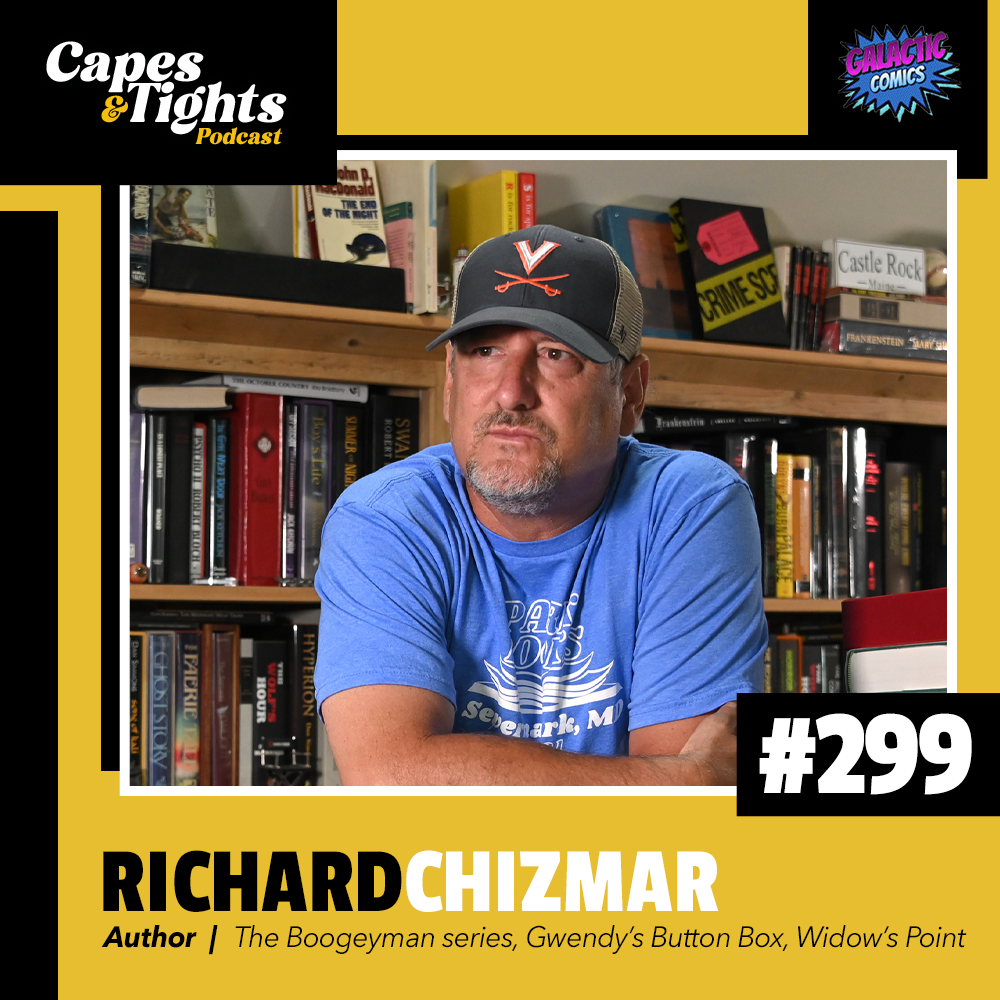
[00:00:00] Speaker A: Welcome back to the Capes and Tights podcast right here on Capesandtights.com I'm your host, Justin Soderbergh. This episode is once again brought to you by our friends over at Galactic Comics and collectibles. @gitalcomicsandcollectibles.com we welcome New York Times, USA Today, Wall Street Journal, Washington Post, Amazon and Publisher Weekly. Best selling author Richard Chismar to the podcast. You may know Richard from the Button Box trilogy that he co authored with Stephen King, Memorials, Widow, the Complete Haunting, which he co authored with his son W.H. chismar, and the Boogeyman series which is here to talk about today with the latest book in that series, Killing the Boogeyman hitting shelves October 6, 2026. But this is Richard Chesmar chatting Chasing the Boogeyman. But before you do listen to this episode, check us out on Facebook, Instagram, bluesky, Threads, Twitter, all those places you can rate, review, subscribe over on Apple, Spotify or wherever you find your podcast. And as always, you can visit keepsandtights.com for so much more. This is best selling author Richard Chesmar chatting the Boogeyman series. Right. Enjoy everyone.
Welcome to the podcast. Richard, how are you today?
[00:01:12] Speaker B: I'm good, how are you?
[00:01:13] Speaker A: I'm doing wonderful. Yeah, my, my five year old is at a second day of day kindergarten today.
[00:01:19] Speaker B: Oh boy, that's a big, that's a big deal. And I'm gonna sound like the old grandpa on the front porch rocker. But don't blink because before you know it, it'll be, you'll be saying, I just dropped off my boy at college and the tears will still be in the corners of your eyes and yeah, I, I, I, I, I've gone through it with two, two boys.
[00:01:42] Speaker A: Well, I have a, I have a two year old daughter too and she was like, she went to school for the first time at kindergarten on Friday and over the weekend she's like, I'm going on Monday. I'm like, whoa, whoa, whoa, whoa, pump the brakes there for a second, girl. Like, you have three more years before you're going. Just relax, go to daycare. Have fun at daycare.
[00:02:00] Speaker B: Yeah, it's scary. It's scary. It's scary how, right? You know everyone who, who told me that was and bittersweet. So enjoy every minute.
[00:02:10] Speaker A: I'm excited. See, the funny thing is I'm torn between this spot where like as a horror fan, wanting to introduce him, like I can't wait to introduce my, my offspring to, to the thing that I love, but I'm also like stay young also at the same time.
[00:02:24] Speaker B: Yeah, well, you know what, you know this as well read as you are. You introduce them to the right things at the right time and I think it actually helps them stay young. You know, my, my Billy's out on tour right now for them. His first solo book. My son, my oldest son. And I love hearing him tell stories about how he was, you know, introduced. He was surrounded by the books and the COVID so it was always there. And he used to come to office to, to my office every Monday because that was the one day we didn't have after school care.
So I pick him up and bring him back to CD and, and he had his own break room, his own playroom there, but he was still surrounded by, you know, Ray Garten and Richard Layman and Stephen King and, and he remembers each step. You know, he remembers the first time he was allowed to read something. He remembers his first. He still doesn't forgive me for, for not warning him. One of the first scary movies he watched was Signs the, the Mel Gibson M Night one. And he's just like, I didn't warn him about the cornrow scene or the birthday video and he's like, he's still scarred.
But yeah, they all remember, you know, both of them, you know, their first R rated movie was Silver Bullet on New Year's Eve. We, we took the plunge and let him watch Silver Bullet. We figured that was a good one. You know, not much language, not much sex, just a scary ass werewolf.
But yeah, you'll know the right time and it's a lot of fun.
[00:03:48] Speaker A: I mean that's, it's funny because like my daughter's three years younger but she'll probably be the person that's more into horror than my son like scared his own shadow. So there's like a, there's a moment there where my daughter was two is like she might actually be watching or reading and do things more in the horror than he is. But he's. We watched Star wars for the first time together. That was an amazing experience like he was getting. My parents took my son to Disney World in April and right before we were going he's like, I want to watch something that I haven't seen yet that I'm going to see when I'm in Florida. And so I was like, oh, Star wars, you haven't seen that yet. I recommend no one starts kids off with the original number four because they lost.
So you watched 4, 5 and 6 and then he was like, okay, what's next? I go, well, maybe we should start at 1, 2, and 3. And he's like, what's going on? Where's Luke Skywalker? And I'm like, he doesn't exist yet. It was very hard to explain that to him. So any recommendations to any other parents out there? Just start him with one. As much as you want to start him with episode 4, that way he'll at least understand the progression of the films.
The whole back and forth thing doesn't really. It didn't click with him yet. And he's still. I mean, he's starting to get it now, but like, it was like. And then I'm like, why don't I go back to 1, 2, and 3? I should have just done 4, 5, 6, 7, 8, 9 then. But it was this whole thing. But I think he's getting smart enough to kind of understand what's going on. And then. And then seeing the later films and seeing people die, he's like, wait a second, didn't Han Solo just die? I go, yep, that. That's, you know, sorry, he's passed. He's moved on. He's. He's still a force ghost. There you go. So you don't have to worry about that anymore. But. But yeah, yeah, he's. He's up with, you know, pops up in heaven. He's like, what?
[00:05:21] Speaker B: And you might be surprised if he's a big scaredy cat. Billy and I are the scaredy cats in the family. So of course, we're the writers and we're the ones with the imagination. So my wife and my youngest son, Noah are much more practical. And they just.
Noah doesn't really. Now that he's, you know, older, he. From the time he was a teenager on, he didn't get really. Get scared. So that's the thing.
[00:05:42] Speaker A: He would.
[00:05:43] Speaker B: He would watch movies and we were like. Billy and I would be like, that was amazing. And he'd kind of look, it was all right. And we were terrified. You know, Billy and I were cuddled in the same blanket.
But, yeah, so you'll be surprised how that turns out.
[00:05:57] Speaker A: It's so. So the reason I actually brought up the kids and things like that to start up with is you're no. Shy, not shy about being a family man like you. You. You're very proud and very open about how proud you are about your kids and your family and. And success that obviously Billy is doing. Having right now bestseller and all that stuff is. It's phenomenal.
So why did you Want to put them in a fictional book where there's a horror story going along with, with why would you want to put them around like you're Richard, you're. You're killing the Boogeyman, your Boogeyman series, and have them technically be involved in that in a sense.
[00:06:29] Speaker B: You know what? I really had no choice. I mean, it honestly would, you know, rewinding back to chasing. That's what I told people. I'm like, I realized really, I mean, when I say early on, I mean, I. When I started the intro to that book, it was not going to be about me and my story. But I mean, three or four pages in, I realized this is about me and my story and my hometown and I might as well not fake it this time.
I'm a big true crime fan, so I was like, you know what? I'm going to write this as a true crime book. I was there.
I just happen to be the editor of this brand new magazine called Cemetery Dance. I was about to get married, so I was back at home. And that's my reason for being back in my hometown, in my old bedroom, childhood bedroom.
And all this stuff is happening around my town. So I'm like, that was the way I knew how to tell the story.
So, you know, then you fast forward to becoming the Boogeyman, which was, which was present day.
Well, present day, I'm married and I have two kids. I gotta play it straight, you know, I gotta. And my wife wasn't. People ask all the time, we're all your friends and family thrilled to be written about in the book. And I'm like, oh, my friends loved it. My family was fine with it, meaning my extended family, my siblings and all that. My wife hated it.
She's like, what do you mean you're writing more about me? What do you mean you're writing about the house we actually live in now and there's pictures of it and blah, blah, blah. And so, yeah, that she was the only one I kind of had to win over with that stuff. The kids just kind of came along for the ride. And then in the third book, Killing the Boogeyman, they actually play bigger roles.
And again, because they do. And they would. You know, it's like in the first book I was writing about the past, so everything is spot on, accurate, honest, with the exception of, of how I would have reacted to the murders and that kind of thing. And I, and I really went to great lengths to try to be as honest as I could as to how I thought I would you know, react, even if it didn't shine, you know, a positive light on me necessarily.
Second book and third book was present day, so it was a little easier to.
To, I think, be honest about, you know, how I would react to certain things.
So, yeah, I had to have him in there. I really didn't have a choice. And they don't, they don't. They didn't mind, you know, Billy. Billy reads all my stuff early, gives me edits and all that. So he kind of got a kick out of it, especially since I made Noah still be the irresponsible college guy out there playing beer dye and stuff by the pool.
But, you know, I think I nailed their relationship of, Of a loving sibling relationship full of being a smart ass and, you know, throwing the other one under the bus, that kind of thing. But, yeah, they're stuck with me, you know, they know. They. It's like, you know, by this point they're like, yeah, Dad's gonna be dad.
[00:09:18] Speaker A: Yeah, yeah, yeah. And. And you know, write what you know. I mean, that's a lot of people. Like, like what easier thing? Not easier, but what. What's easier? I should say, not the easiest thing, but like to do is like to. To write what surrounds you or your history because obviously, you know, that I'm guessing you still, I mean, you lived in these towns and, you know, these towns, you still did some research, I'm guessing, on making sure things fit perfectly in that spot and stuff like that. Because I, as someone from Maine, don't know much about Edgewood in that area and stuff like that. So, like me, I'm like, I'm gonna take Richard's word for it at this X, Y and Z. But those people who live in that area or know that's that specific area, you might probably needed to say the course and make sure people don't like, pick you apart and be like, yeah, that's not kind of true, or that's not. That wouldn't go that way.
[00:09:59] Speaker B: Yeah, no, I definitely did a little bit. I mean, that's the thing, you know, you know, this writers, they kind of see everything around them. So I grew up that way and that was kind of, you know, people say, when they say, talk about the boogeyman books, you know, what is kind of. Does each one have an individual type focus? And I'm like, well, you know, the first one to me is about the loss of innocence, not only for a young man just graduating from college, but for a town, you know, for the small town he grew up in. Something that, you know, if you have very fond memories of people who have that shared experience with me, who have that, that, that fond memory of their, their safe place, you know, losing that is a big deal.
So for me, that was always kind of the thing with the first book. And I always just felt like I had to do the place justice, you know, in order to write about it like that.
So yeah, that's the neat thing is so many local readers, not just from Edgewood, but from the surrounding areas, they're just like, oh my God, you took me back and da da da. You reminded me of places. And you know, I was there, I did that. I, you know, same shortcut through the woods, all those things. So that's always neat to hear.
And yeah, I mean, at every signing, you know, tons of local people and I get to hear their stories about the same places. You know, sometimes 20, 20 years later, they were doing the same thing in the same woods, you know. Yeah, we cut through there, but we didn't go 7:11. We cut through there to go to the school or whatever. So yeah, I, that I personally, I
[00:11:25] Speaker A: love it as someone from Maine. We don't get forgotten. But there's a lot of. We're not like the most notoriously written about place in the world. Like, or we feature things. I live in Newport, Maine, which is the home of Cooper Flag. So like we're like hanging our hats on that. Like, like they had a sign of when you enter this into the town, they used to stay home of the Riverwalk Festival, which is like this festival we do on the river that's like six years old. The second he got drafted to the NBA, they changed it to home of Cooper Flag. I mean they were waiting and they had it printed and ready to put up there for like, okay, now he' an NBA star. Where you put this thing up there. But otherwise, I mean, whenever I read something in Maine, I get so much so excited. I almost like, oh, this is my backyard. You know, and Stephen King does that. But he obviously also alters these things in their, their fictional esque towns in Maine based on real towns for the most part. But like when you read a book, I mean, I was just finished reading Paul D. Warren's series of books.
They're all based in Maine. And every time he says something or is a town where I'm like, oh my God, I'm like giddy in the car. Listen to the audiobook. Like he said, somewhere I've been. And so I can imagine this connection to local and this True crime meta fictional story does impact those people who know these places that are like, I've been there before and can like hang their hat on that. I could imagine going to signings and having be like, how you mentioned this or you mentioned the school or I can't believe I could picture myself being there at that time. Must be a cool, cool thing.
[00:12:48] Speaker B: It is, it is. And it's always surprising what will, you know, push someone's buttons, their memory button and bring it back for them. I, I, I was at, I did a panel recently and I talked about this where I was shocked. But with Chasing the Boogeyman, with the first book in the series, I heard from so many people who had forgotten they had ever popped hot tar bubbles on the road and so many joyous people who were just like, oh my God, I forgot I did that and I forgot what it felt like. And you got your fingers, you got the tar all over your fingers sometimes and the, and the water that was in there, trapped in there, was from the sun and, and just people. Absolutely. That's the word, you know, joyous to have that memory brought back to them. And for me it was just, I think, two sentences in a paragraph, you know, somewhere in the, you know, near the beginning of that book when I'm talking about growing up there. But that jumping ramps, you know, with, with put together, you know, scraps of wood that we sometimes absconded from construction sites or found by dumpsters or the side of the road, that kind of thing.
Yeah, I mean, it's, that's the cool thing because you realize, you know, I know with chasing, I felt like, man, man, this book has a lot of buzz and it's really just this tiny little campfire story about this kid who grew up in this little working class town in Maryland.
You know, people, I think people might be expecting too much. And then I, and then it was a great reminder that, you know, you're not really right even if your character is named after you, you're not really writing about yourself, you know, and that's not, you know, people relate to the experiences and the memories and, and the thoughts, you know, that they have about what they're reading. So that's where the connection comes from.
[00:14:29] Speaker A: There is this, you could have sat down and written this book, so, or these books, I should say. We're talking about the series right now. I'll get to the final book of the series here in a second. But like, you could have written as a metafictional, like, I'm going to Write this as a true crime thing and feature a character. Then it's supposed to be real and it's supposed to be based on real events and so on and so forth. And, and it probably would have been a fine, it would have been great. But like, the fact that you used your name in your town and real places and put some real stuff in there and then interspersed the fictionalized part of it as well.
It's funny, whenever you go online and read people's reviews about any of these three books, they're always like, I was about halfway through. I keep on forgetting this is not real. And like, it's this way that you were able to blend and pull people in. But I think that made it more, I don't know, there's a. More of an attachment to me to it because, like, you're trying to figure out which ones are things are not real and which things are real. You're trying to go at the very end, you're like, God, I gotta Google again. Is Gallagher real? Like, like it's one of those things that's probably always, it's always superly Googled. Now, like, is Joshua Gallagher real?
[00:15:33] Speaker B: I imagine readers, you know, saying, I know it's so novel on the front, but what kind of idiot puts, you know, pictures in a book if they're not real?
And I know the pictures, having them at the end of each chapter really serves that purpose. You know, it reinforces the fact of what you just read visually.
And, and I know that has, that has worked. It's kind of magical in people. But like you said, by the middle of the book, they're like, questioning. And again, well, wait a minute.
You know, this, this picture, you know, especially because the pictures, you know, like a lot of true crime pictures, they're not gratuitous, they're not splashy, flashy. They're just simple pictures of people, places, you know, crime scenes aren't real. Like I said, flashy. You know, it's just trampled down grass behind a shed or something like that. And, and it lets your imagination do the rest. And it's also very somber because you've just read about what happened there and you get to see it and it reinforces it for you. So I know that's what, you know, drives a lot of people back to Google. And I love hearing those stories. I, I, you know, every once in a while someone gets mad at me. They're like, I read that afterward, I threw the book, and I'm like that, you know, I know that's not your intention. But that makes me smile even more.
I did my job.
[00:16:49] Speaker A: And it's not like you're trying to trick people in that sense. Like you're not. This is not the end of the book. That was a dream the whole time kind of thing. That pisses me off a lot. But like this you were kind of upfront about. You're up. This is a fictionalized story. This is not like you know, you. First of all, you probably would have heard about half this stuff already if it hasn't if it was in this book. Like this is not something that's like a mysterious thing that like you just discovered. Like, but also was there a line that you tried to, you had to like stop yourself from crossing to be like, I know this is fiction, but I can't go X, Y and Z because it is. Some people do believe it's real or is it just like it's fiction, like from the beginning?
[00:17:27] Speaker B: Yeah, no, I, you know, to when you know, when I talk about not necessarily shining a positive light on myself. To be honest, I really my intention with chasing the boogeyman because there was never any. I thought of a sequel or even three. Never at all.
So my intention when chasing the boogeyman was to completely Blair Witch the audience.
I, I was playing it straight. That's where the photos came in. There was no disclaimer in the front of the book that said hey, this is fiction.
I, I did not want the, the front cover to say a novel on there.
I had just absolute devious plans to plant fake newspaper articles online.
I was going to have someone design a like a 1990s era website with lots of updates and press connections and photos and then have it just be boom, you know, dead like, you know, like it just non updated from like 97 on.
So that way when people did Google they would find things and it would reinforce the idea that it was, that it was real. And, and I had gone so far as to even think about scripting like a three part podcast and having myself as a guest and you know, some of the police who were involved and you know, wit citizens of Edgewood who were there and the whole thing and I just thought that was the greatest idea in the world. And my son who, who rarely has practical ideas, you know, my oldest son Billy, because he's but his head's in the clouds like mine, he was the first person to kind of step up and say dad, you can't do that. You know, that's number one. It's, it's Got to be illegal. Number two. It's like you're gonna drive down property values in Edgewood and. Da, da, da. And I'm like, whatever, Billy. This is while I was writing it. And I'm like, you know, who knows? 10 people might read this book. I. I don't know.
Sold it to Simon Schuster. Within a month, I'm on the phone with Simon Schuster's legal department for. For the first of several phone conferences where they essentially, no, you can't do that.
So then my editor said, we got to put a disclaimer. I kind of stopped my feet. I said, well, Ed, you have to write that. I'm not writing it. So the disclaimer is written by my editor, and they put a novel on the front. But like you said, it's wonderful because it still. It still fools a lot of people. And the best ones are, as you detail, the best ones are the people who go in knowing it's a novel. But then some, for some reason halfway through, are convinced maybe. Maybe it's not.
[00:19:51] Speaker A: Well, I read three of these things so far. I've read Killing the Boogeyman now, and it's still to that point where I'm like, God damn it. I don't know.
Is he gaslighting us still? Like, you're saying this now. We're gonna do all these things, but really, it actually is all true now, people, we're gonna find this out now.
At the very end, we're like, yes.
[00:20:09] Speaker B: The last book in the. Afterwards, it says, fold you again. It's all true.
[00:20:12] Speaker A: It's all true. Yeah. So good luck.
[00:20:14] Speaker B: But.
[00:20:14] Speaker A: Yeah, that's what. But. But you said it wasn't supposed to be a duology, wasn't supposed to be a trilogy. It was supposed to be a single book. And now that you're finished, Killing the Boogeyman hits shelves in October.
[00:20:26] Speaker B: What?
[00:20:28] Speaker A: When did you know? Okay, I want. This is it. This has to be it. I got to finish this story.
Did you know what the ending was going to be like when you finished stealing it?
[00:20:37] Speaker B: No. And to be honest, I still don't know. I mean, I, I. You know, it's done as a trilogy, but at the same time, man, who knows? You know? You never know. I just. I. After the first one, I said, I'm never writing about myself again. You know, it. It was a very weird thing.
My agent. No one was more shake shocked than my agent, who is constantly about, rich, you should go to more conventions. You should do this. Because she knows I'm such a homebody. And I'm the last person who wants the spotlight. It's just not my deal, you know, I like being home.
So to tell her, hey, here's a new book. And by the way, I'm the main character. She was like, what?
Fortunately, you won her over.
But, yeah, never intentions for it to go anywhere else. Had the idea for the first chapter for Becoming the Boogeyman, which ends with a reveal that really strongly connects with the first book. And I actually think I'm the last person who. I always see writers who say, oh, I can't wait for you to read my new book. It's going to knock your socks off. I'm like, man, I love the confidence. I could never say it because I'm like, I can't wait for you to read my new book. It might suck, but, you know, hopefully not. That's about as far as I can go. When I thought, when I thought up the first chapter for Becoming the Boogeyman, I was out riding on my lawnmower, mowing the lawn, and it just kind of came to me in a flash.
I saw the whole chapter in a matter of minutes. And I, and I saw that reveal at the end of the first chapter that connected so intimately with the first book. And I just thought, that's really good. If anyone can stand in a bookstore and read that first chapter and not take that book home to finish it.
More power to him. But I'd be surprised. So I knew I had to write it then. And then my editor and I, you know, just really discussed the idea of kind of, you know, having a third book to. Because I ended with a cliffhanger. And again, not on purpose. I, I had no idea I was gonna end on that cliffhanger on, in book two until I was writing it.
Truth that, you know, not outlined, not thought of ahead of time, which is, you know, one of my problems. But, so, yeah, so, yeah, we'll see.
[00:22:38] Speaker A: I, I, I see it. I mean, you're in a, in a genre this, this true crime slash horror genre that, that there is never an end. Like, let's be honest, people don't actually die. There's like this weird thing like. And so, I mean, next it's like, what, Gallagher goes to space, right? That's the Dex.
[00:22:54] Speaker B: Yeah, of course.
[00:22:55] Speaker A: Yeah, of course.
[00:22:56] Speaker B: You gotta go.
[00:22:57] Speaker A: He's, for some reason, he ends up on a NASA spaceship and it's like, yeah, you know, Richard Chismer has to go to, to the moon to get to him. No, but I mean, I just recently talked to Adam Caesar about that. We talked about how the Clown in the Cornfield series, people kept on saying with book three, the final book in the trilogy. And he's like, no one ever said this. Like, where did. This is not like, I don't know where this came from. And he's like. Because he saw. He's like, I have an idea for a fourth book in my head. And thank God he did because he just. He just made a USA Today bestseller with that. With that fourth book. But, like. But it's like, he's like, even this. He's like, I don't have plans right now for a fifth book, but that doesn't mean there won't be one. And so he's like, the world we live in and stuff like that. He goes, I won't write it unless I have the right story. And so when you did one and then you did two, you said you didn't. You kind of didn't. You didn't know it was ending a cliffhanger yet, really, at the end of two. But, like, did you have in your mind there could be a third one while you were writing to. Or was this just like, you know, at the end, you're like, okay, we guess we could do this again.
[00:23:55] Speaker B: You know what? I honestly don't remember, but I would say.
I would say I had to have an idea that there. Since I fooled myself and I knew there was. You know, I was now working on the second one, which I had spent time telling, you know, various media people after the first one. Now, you know, this standalone, and I genuinely didn't, even though I had such writing. Chasing the Boogeyman was so much fun because, I mean, all my friends are in there and they're by their real names and just writing about my family, who was all together on the same roof for a lot of those early passages. And, you know, both my parents have been gone for a while, so they were alive during the writing of that book. In my head, it was a pleasure. Writing about myself was the least pleasurable part about it. So, like I said, I was done that. And then, you know, because you can write about family and friends, you just gotta use different names and other books, I do it all the time.
But yeah, so since I kind of surprised myself and there. And I was in the middle of writing a second book, I'm sure it was in the back of my head. Who knows? You know, you might end up doing it again now, dummy. So don't say anything.
But yeah, you know, we had my editor and I, when we discussed the idea, we're like kind of like, yeah, we can wrap it up there trilogy. You know, that's a good thing. But you know, it, it, you never, I, I, you know, I'm intrigued by like, even with the Gwendy books, you know, the, the third Gwendy book ends about as with such. It's about as definitive as an ending as you can have. But, but this just like Steve did with Dark Tower. We went back and wrote what went from the Keyhole, I think just kind of spliced in between.
Yeah, you know, we think about that with Gwendy sometimes we're like, well, there was a big gap between book two and three. You know, I wonder what was happening there.
So yeah, you never know. People have said you need to do a prequel to Chasing the Boogeyman.
A lot of people thought when Becoming the Boogeyman was, was announced that that's what it was, you know, big. So, you know, who knows?
[00:25:55] Speaker A: I,
[00:25:58] Speaker B: you know, I'm obviously very fond of all the characters except myself. So I enjoyed raking myself over the coals in book two and three, you know, with people saying, ah, blood money and this and that.
That's fun.
But yeah, we'll see.
[00:26:14] Speaker A: But I mean you also, it's not like you did, you know, I mentioned Adam because Adam was on recently, but he did, he's done other things here and there, but like he's basically done four clown books with other things that have been dispersed prior. He has books coming out now that were made years ago. But like, yes, but you did Chasing the Boogeyman, then the Gwendy third book came out and then becoming. And then you had memorials and Widow's Point. So like you've had things interspersed between these books too. So like, was it nice to have these kind of books? I know Widow's Point was like you guys had, you and your son had written that and then they retooled it to re release and stuff like that. But like, was it nice? Is it nice to break these up when you're going to write? They're not actually like just sitting there writing three straight books about yourself.
[00:26:57] Speaker B: Oh yeah, for sure, for sure. And I mean, and that again, Ed Schlesinger, my editor at Gallery is, is amazing. And that, you know, that was kind of his plan is to, is to, you know, I think from a strategy standpoint of, hey, let's remind these people that, you know, you're not just about these series. And again, you know, the fact that Wendy was a series and then, you know, The Boogeyman was a series. It's like, man, when I started writing, and I always admired people who wrote series, you know, and thought to myself and that. And I'm the last person in any room I walk into who will ever do that, because I don't want to have to keep track of all. And I just, you know, when I tell a story, I'm done. You know, even the biggest fans of my short story is always, you know, there's always that, you know, you left me wanting more, which is my intention. But a lot of times they're like, I just felt like there was, you know, three or four more pages to come. And I'm like, no, that the story was done. So I was done.
So, yeah, here it is. I have, you know, and people to this day ask me, they're like memorials that has got to have, you know, equal the way you left that. And I'm just like, no, I tortured those poor kids enough.
But then I, you know, I always say, but you know what? I say that. And you never know. I might wake up 10 years from now and know exactly what so and so is doing.
[00:28:07] Speaker A: Well, that's important to me as. As a fan of yours and a reader of your genre of books, is that not being like, oh, it made a bunch of money. So let's, let's, you know, I made a list of some sort of list here and this list here. So we got to make more. It's like when the story is right and it feels like you could be riding your lawnmower again and bam, have two more Boogeyman books, you're like, oh, I can do this and the next one and this one, the one after that. But you just don't know yet because you haven't. Hasn't gotten there yet. And so. But you also know that's a point. What I didn't realize until I went to a discussion recently with a person who wrote a series of books, a young adult series of books, that they aged the kids out. And the editor, the publisher weren't very happy with that. And I'm like, oh, my gosh, I never thought about that one that actually follows, like, real life age progression.
Your kids become young adults no longer, and they become adults. And then they're like, well, we don't want those books anymore. You got to stop telling that story because they're adults.
[00:29:01] Speaker B: Yeah, you better go back in time now again.
[00:29:05] Speaker A: And so, like, yeah, it's like I said, you have to maybe keep it in the universe, but go a Different route with it, or, like, you know, you know, the same thing. It could technically be that Gallagher isn't the villain. It could be something else, a cop, some sort of copycat, or some sort of other person that ends up being Richard Chismar is connected to and continues on that kind of thing, too. So, like, there is this way. But, like, again, as long as the story works, you'll continue doing it. But other than that, you have other stories you want to tell. I'm guessing as well that you want to get down to as well. So that's pretty cool. So, I mean, it's been a couple of years since the last Boogeyman book came out, so do you think there's this anticipation? Have you been, like, when you went to do signings for Widow's Point with your son and stuff that. Are people excited for this book to come out?
[00:29:46] Speaker B: Oh, yeah, Yeah. I mean, when.
When it was announced, yeah, there was. There was a nice groundswell of people saying, aha. I knew there would be, especially because the way the second one ended, they're just like, I knew it was coming. And. And even through memorials, people would kind of be like, they're like, you know, you get that. Oh, this is nice. This. This book sounds really good. I can't wait to read it. But by the way, you know, when's the next Boogeyman?
So, yeah, yeah, there was definitely. And that's nice because, again, I'm not one of those writers who just. Who. Who kind of thinks, well, you know, I got the audience that's out there waiting. I'm just like, you know, hope it's only been a year, but hopefully they remember me.
So, yeah, the fact that they have that. That they've, you know, forged that kind of connection to. To that world makes me really happy and grateful and. And it's extra cool that it's my friends and. And my family. You know, people are like, I feel like I knew your mom. I feel like I knew your dad. Your dad reminded me of your dad. They're like, you know, your friends. I, I, you know, writing in this book I wrote about how, you know the Hanson Road Boys, which is, you know, the guys I grew up with. You know, how we're still all on the same text thread, and I have people tell me all the time, they're like, man, I can't tell you how much I envy that. You know, I've lost track of the guys I grew up with or blah, blah, blah, or, you know, I'm still friends with a couple but, you know, your whole crew is still connected like that. And, you know, I mean, talking about having shared memories, when these guys, you know, we've known each other 50, 55 years in some cases, and, you know, experienced all those firsts in life, you know, kind of at each other's sides. And that's a neat connection. And they're all like, I have a big launch event coming October 2nd here in Bel Air.
Over 250 tickets were gone in two days, which was shocking. And I'm like, I'm advertising it. The Hanson Road Boys will be there. You know, I'm like, you guys are going to be signing books right next to me and posing for a lot of pictures. So it's just. That makes it that much more special.
[00:31:40] Speaker A: It does. It's in, you know, we're gonna celebrate Shizapalooza. Like, that's the other thing I want. I wanted. I want to go to this party. Like, I want to, like, I want to be at the Cheers of Palooza party. But, like, there's this. This connection. Like I said, we feel like we know you more because of this story. And it is a cool way. Like, there's some fictionalized in it. But, like, I mean, do you consider on the surface or some sort of, like, a small amount that this is a memoir of two or three books that's like, to be like, tell people. Because, like, you know, would someone sit down and read a memoir by Stephen King? 100%. I feel like you'd have to be a really big fan of your stories to sit down there and read a 100%, like a 300 page memoir from Richard Chismire. Is that correct?
[00:32:19] Speaker B: Absolutely. Unless you. Unless you find out, like, from age 19 to 29, I was robbing banks. And, like, I'm reading it, you know, so. Yeah, no, it. Absolutely, you know, I think people can. Can read it that way.
I never treated it that way, but, I mean, that's. And that's why in Becoming the Boogeyman, I have these section breaks, which are excerpts from a fictional memoir that came about because people like those sections so much in book one that they wanted to read more.
So, yeah, that was kind of my way of saying, you know, in this case, I am Stephen King, I'm writing the memoir, and you guys are really hungry for it. So here's these excerpts. But really, that was a strategic way of reconnecting. It was. It was twofold. It was. We got so many positive responses to the nostalgic stuff in the first book that I knew writing a book in present day was going to lack that nostalgia. So I figured out a way to interspace those. Those memories in there.
But then I also wanted those memories and their placement in the book to connect with things that were happening in the modern day story. To have that, that kind of parallel connection.
So.
So yeah, it was fun to do that. And yeah, you know, it's, it's. I think it says somewhere in the third book, maybe it was the second book. You know, you were, you were supposed. You were the one who's supposed to remember all this stuff. You know, I've had friends say that growing up. They're like, you know, and I have other friends who have great memories and they, it's always interesting because, you know, especially Jimmy Kavanaugh, who he, he is, is. I always felt like Jimmy would be a great writer if he, if he wanted to be. If he didn't, probably ha.
But he kind of saw a lot of the same things I did and remembered a lot of the same things. And I dinged him. Was it in the first book where I kind of ding him because he doesn't remember? I'm so disappointed because he doesn't remember the same things about the Myers house that I remember.
So. Yeah, it's. You know, memory is a funny thing. And it's.
[00:34:19] Speaker A: Yeah. I feel like I'm the same thing with my brothers, though. Like, I have two brothers. It's the same thing I have with memories. It's like, I'm like, they're like, say something. Remember this. I'm like, dude, I don't know if we ever went there. I don't know they're talking about. And he's like, they're explaining like vividly what happens and stuff. Like, I have no idea what you're talking about, but cool, I'll believe it.
[00:34:36] Speaker B: That's awesome.
[00:34:37] Speaker A: But like, I don't know if I'd be like, I'd have to like interview so many people, you know, like you mentioned you have these friends for a long time. I have like a friend that I had from like ages, like 4 to 10. And then a friend, like a really good friend from like 10 to 14. Like there was. I don't think I've had the same friends. Like, I've people that if I ran into, I'd be like, oh my gosh, nice to see you. But like this diehard friend group for a number of years is just. Isn't there. And I moved into within New England, but moved around enough that like, I couldn't bring those people with me. And even 10 years ago, I moved from Massachusetts back to Maine and all my friends that probably were going to be lifetime friends down there, I kind of abandoned, even with the mention of social media and texting and stuff like that. But I'm not any good at it. I'm like. I'm like, I will go see them if I'm down there, but I'm like, I'm not going to text you and see how your life's doing right now. I'm just really bad at it. And so I don't like having that made me jealous of stories, but also, like, happy that this was involved in this book like this, but that not everybody's memories are the same.
[00:35:31] Speaker B: No. And that's. Yeah. And that's a fun thing. And yeah. Now, like I said, I know it's a pretty unique thing and. And I feel very fortunate for it. And, you know, people have always made fun of me for that. They're like, yeah, you know, once he went away to college, you know, he. He's still friends with a handful from college. Then as an adult, there's a handful, you know, once the kids got older and you're. You're like, like forced to socialize at sporting events and all those things. It's like he picked up a handful more. But, you know, he still has, like, 18 friends and. And 14 of them he grew up with. So they're like, you know, I used to hear those jokes all the time. They're like, you should feel special because you're one of, like, four that, you know, he. That, you know, haven't seen him, like, skinny dipping, you know, in the neighbors 7.
And they're always.
Somehow, I don't feel special.
[00:36:16] Speaker A: I feel like I have all these crazy stories I'd like to tell some, but no one knows the people that I'm talking about, so they're not as weirdly crazy. And like, they're like, what? You did what? With what? What happened? I'm like, oh, you got to know the guy. The guy is like. And it's like one of those things that I'm like, the only people that I can talk to are my brothers about it. And again, memories are spotty for all of us. We're like, yeah, I don't even know if we were like, were you around for that? I don't remember because they. My brother lives in Virginia, and my other brother lives in Connecticut. And so it's like we don't see each other all the time.
But, yeah, it's just kind of funny, the memories of things, but it's cool. And I guess. I'm guessing some of these people, it's cool to read these books and be part of. Like you said, these people will be at the.
The signing and the event, the launch event that you're doing.
But, yeah, it's. It's funny how I got to know you better, in a sense, but also a fictional killer at the same time that doesn't exist. Mike. Go ahead. Go ahead.
[00:37:05] Speaker B: And you got to know my friends and my family. You got to. You know, you really did. If you met him, you'd be like, and. And you came fresh off a reading. You'd be like, oh, my God. You're just like he described. You know, you are a troublemaker or whatever.
[00:37:16] Speaker A: You know, like an anthology book. You, like, open to the chapter that you wrote and you haven't signed there. Can I, like, open up to a chapter of, like, when your wife was first introduced and be like, can you sign this right here on this page right here for me? Can you sign that?
[00:37:28] Speaker B: Well, I got a blurb for the third book, and they didn't use this part because marketing thought it would be confusing. But I can trans. I think it was Carolyn Kepnes. You know, her last line of the blurb was like. And meta. Cara is one of my favorite characters of all time.
And my wife got such a kick out of that, but at the same time was mortified.
So, yeah, she. I would like, somebody ask her to sign the book. She'd be like, oh, God, you don't want my signature.
But my friends would line up to sign it. Trust me, they.
[00:38:00] Speaker A: It's funny. So I have a. I have a picture. I have a stack of books. There's about half dozen, maybe eight books and about 25, 30 trade paperbacks that have quotes. Like, pull quotes on it for my reviews of these things. And I've actually. I've been at the comic book store, and when someone asked me to sign it, I'm like, I refuse to. I will not. This has nothing to do with me. I just wrote a review that you put your quote on there. I am not signing this.
One person forced me to do it, and I was like, this is it. I'm not doing this ever again.
This is not my thing. I am proud of it. So I collect them. But I'm not like, this is. You know, if a poke ends up on a book, it's beef, because I really like that book so much that I wrote something nice about it. So you should buy the book. Don't have me sign it, please. I do not want that. That's not what I want at all.
[00:38:42] Speaker B: But, yeah, trust me, my friends won't be so humble. They will be going off. I got a pen. And the thing is, is there'll be familiar faces because most of them appeared in the pictures under. Under other roles. You know, one was a detective one. You know, I won't give away the others, but I can see them now signing their pictures.
[00:39:01] Speaker A: And you should sign up. You know, like when you go to, like, a comic convention and they've got all the 8 by tens listed, you should just have those all out. So they all have, like, ones you can sign for people.
But yeah. So Joshua Gallagher calls you tonight. You answering the phone?
[00:39:16] Speaker B: No, I've learned my lesson.
And I looked away when I said that. So
[00:39:22] Speaker A: it's funny, as I thought about this, when I discussed having you on, I thought, this is coming. This episode's dropping right around the publication date. So no one's really read this. It's one of those things that I love going to book events on the launch. But in the same sense, I'm sitting there out of, like, probably so not 250 people, but like, I went to one a couple weeks ago, there was like 20, 25 people there. And I'm like, I look around, I'm like, I'm the only one in the crowd here who's read this book so far because I got an advanced copy of it. And so, like, listening to them talk, I'm like, ah, talk. And I'm like, wait, you can't talk about it because then you're spoiling the book. And so part of me wanted to email you and be like, can we do this as Richard Chismar from the book and discuss, like, interview you from the book and be like. And that. But then I thought to myself, you'd have to spoil things in the book because you'd have to talk about things that happened in the book. So I think that you should just. It doesn't have to be me, but someone should interview you, like a year from now, like with a. Around when the paperback comes out. And they should do an interview with Richard Chismer from the book and talk about events that happened in the book to kind of help promote it, because that would be badass. Again, now I'd spoil the book. So you'd have to be like, you don't want to listen to it on publication date. Because they're like, well, I've Got to read the book first. So I thought that would be kind of fun to do, though.
[00:40:28] Speaker B: Well, I still, I still have not thrown away my idea of doing like a three, three part fake podcast. And when the paperback of this comes out, would be the perfect time to do it. So I may be like, hiring you to eight actor and do it, being the podcast host or something, because I, I'm still intrigued by that idea. I think it'd be fun to, you know, hear various people talking about. To hear somebody being, you know, you know, one of the. One of the residents of Edgewood talking about how this happened on their street and seeing them play it completely straight. And I think the worst part would
[00:41:01] Speaker A: be me
[00:41:04] Speaker B: playing it completely straight because I'm not an actor. So I can just see me being like, well, you know, my voice being completely different in my posture, but going, all right, we better do another take. You know, and being like 27, we're
[00:41:19] Speaker A: gonna have to like, eventually the directors are like, no, you know what, can we just get someone else to be Richard Chismire? Is this possible?
Can we just. Can we get Stephen King to sit in for you? We'll just get Stephen to be Richard. And that's actually who it is. We've actually kind of funny to see, like, if you did do something like that where Steven is not himself, he's just some other random person that's like some sort of resident from the town that's being interviewed. And it plays off. You're like, wait a second. That looks like Stephen King. No, but, yeah, so I found you through Stephen because of the Gwendy books and things like that. And Steven lives in my backyard actually, growing up, he actually did live in my backyard. I lived two streets away in Bangor in middle school and in high school. And so he was actually in my backyard for a while there. But we call Stephen, you know, our. Our author here in Maine. And it's so cool that you guys were able to work together.
You know, he continues to read your books and things like that. I mean, is he reading everything you're doing now as a. As a friend of yours to make sure things are going well for you?
[00:42:20] Speaker B: You know, I don't bug them too much. I, you know, I, I just send up.
Sometimes I'll send up a manuscript and then follow up with an arc. Sometimes I'll just send up an arc. And. And, you know, the marketing department, I know is, is definitely, you know, we have this publisher. So I know there's, there's a, you know, sooner or later that's why I told him, I'm like, sooner or later we're gonna have a different quote on the front cover, you know.
But, yeah, I just, you know, it's just he, he's. I, he feels like part of that friend group with, with everybody else, you know, I don't put him on the same thread, you know, but he, he's just a good guy and has been a good friend for a long time. So it, you know, it, it thinking about blurbs and all that stuff, that's the kind of stuff that gets in the way. You know, I told a good friend when I was up in Maine for the end of the world signing and got to see him for a while and, and, and was hanging out with Michael Kurita and another guy, another Bangor local. And I just, that's what I said. I said, that's the weirdest part about the friendship. I said, but, you know, there's finally been enough time where, you know, for the longest time it was just no matter how normal and down to earth he is, it was still, you know, that, that strangeness because I grew up idolizing him in his books and he's the reason I'm doing this, him and my father.
So no matter how normal the guy is and no matter how normal you are, as far as just not, you know, you know, I'm not impressed by, you know, star power and all that stuff. It's just use the guy, man.
It there still has an element of strangeness to it now. I feel like enough times passed, you know, the part that's still strange and that I told this guy up there was, you know, it's just weird because he's just a friend. You have mutual interest you, mutual careers as far as, you know, the sharing there. But he's still such a big deal that he can do so much for your career and do so much. And it's like, that's a weird element because, you know, I don't have that with any of my other friends. You know, I can't help them in their career as an insurance salesman or a builder or whatever. You know, my endorsement's gonna. Not gonna do a thing for them and vice versa. You know, they can, they can help me build a deck, but, you know, that's not going to help my writing career. But when you're good friends with and you joke around with and you're in the same March Madness pool and you, you know, send each other pictures of your dogs when that's the case, and you have such a Kind of down to earth relationship, but at the same time the one guy is just the 800 pound girl in the room.
It's a weird thing. So I, I try to tread lightly. I try to just be, you know, really forthright anytime. You know, if I'm looking for a favor, I don't tiptoe. I'm just like, Steve, if you get a chance, can you, you know.
And again, he's. We've always had a very honest relationship where it's just, you know, don't be afraid to say no to me. I'm not gonna be afraid to say no to you.
You know, so that's a good thing. You know, I think there's a lot.
And you know, he just a normal guy, fun, smart.
[00:45:33] Speaker A: Yeah, I mean, he is. And he's one of those people that like you, you see him. People still see him around town, for the most part, treat him.
They don't try to bother him, which is nice. It's like his house is. It's crazy. I never. It's so funny because like, you know, Tanya Pell was on once and I was talking to her and I was like, like she's, she talked about Christopher golden and how Christopher golden is one of her favorite authors and their friends now and stuff like that. I go and she was down in Christopher's area in Massachusetts and I was like, go, go stand in front of his house and take a picture like people do in front of Stephen Sinking's house. And so show it to Christopher and see what he says. Because it's funny. It's like, it is a cool looking house, but it is. There's no, he's not hanging out in there, but people just still flock to it. I mean, I might, I go to the comic book store every Wednesday and it's right around the corner, literally around the corner from West Broadway where Stephen King lives. And it's every day in the summertime, there's five, six, seven cars parked in front, taking photos. It's just fascinating.
Well, they, they put cobblestone down now on that little section and they had to put signs, don't park here. Because people started to park like straight in. Like it was a parking spot. I'm like, they're not making a parking lot for you. This road is already the widest road in Bangor.
Thank God it is.
And so on. But it's kind of funny how this, this, this house still draws people in and I'm glad it's staying. And that's not like he decided to move and they sold it. And I'm glad it's now going to be there for the foreseeable future, barring any, you know, disasters or anything like that. But, like, it's there. It's cool for people to go to. And he's made a difference here in Maine, not just with his stories and not just with his, like, Persona, but, like, obviously, financially, he's made a huge difference as well. And so, yeah, it's pretty cool to see that. Like I said to me, you know, one reader, I know I'm not the only one that stumbled upon Richard Chismire because of Stephen King, which is awesome. And that's. You said you were a fan of him growing up. Now he's helping you get books sold, which is great.
[00:47:26] Speaker B: I mean, the fact that I wrote with him is, you know, people sometimes will say, give me one word, give me one thought, and I'm just the word I always use. I tell them I'm like the same word I always use. Ridiculous. You know, I'm just a constant reader who grew up, you know, the first one was Salem's Lot. I remember climbing the tree in my front yard and reading, you know, a Stephen King book. I always, you know, high school, you know, after a football game, you, you know, you shower up, you go out and you drink a few with your friends. And. And I remember sitting at Dead End Roads with my friends going, let me. I just got to tell you about this book I was reading called Christine. And they still remember. They're like, man, he was. He was a King guy, you know?
So, yeah, it's.
[00:48:05] Speaker A: It's so cool. But what. I would love to finish this. So October 6th is when killing the Boogeyman hits shelves, everybody should grab it all. The first two books, Chasing the Boogeyman, Becoming the Boogeyman, are available anywhere. You can buy books as well. Audiobooks, paperbacks, all that stuff. You can grab those everywhere. Just go to your local bookstore. I'm sure they have it. If they don't, tell them you want it and they can get it for you. And then Chasing the Boogie or, Sorry, Killing the Boogeyman hits shelves 10-2-6th. But as a father, and you just mentioned doing good things for Stephen, Keith did good things for your career and stuff like that.
What's it. I mean, I gotta find out what's it like having your sons book them be a bestseller on the USA Today and be. I mean, you must be proud. I mean, I can't. I mean, I don't wanna. I don't want to make Billy's head get bigger than it already is. But, like, you know, I mean, it's gotta feel good.
[00:48:53] Speaker B: Yeah. I mean, it, you know, it's interesting because that's, that's, you know, I've never shied away from posting stuff like you said, about my boys, and it's never been, you know, I've never posted, like. Like, it's interesting because I've never, like, posted their grades or I've never posted, you know, Noah scored three goals last game or whatever.
It's just always been, you know, I've always, you know, my wife and I were high school sweethearts, you know, really early on. You know, in college, we're like, you know, we knew we wanted to have kids, knew we wanted to be you know, parents and, and being a dad's kind of the best thing in the world. You know,
[00:49:33] Speaker A: it's.
[00:49:34] Speaker B: It's. For a time, it's the hardest thing in the world, but it's absolutely the biggest gift. You know, them and Kara, that, that I've ever been graced with. So I've always just shared that. And like I said, I've always. I've always kind of gone out of my way not to be the, you know, my kid did this. It's just, you know, I. Posting their lives.
But, yeah, to. To grow up, you know, and I've been fortunate that I've had it with both boys. You know, I.
My wife and I both played lacrosse in high school and college at a fairly high level.
So to see both of our boys go to college and play lacrosse, to see Noah in the Final Four in front of 30,000, 40,000 people, national TV as a freshman. And then, you know, for UVA and all those things, you know, they bring a tear. They bring. You know, I remember Noah's first game at. UVA, looking at Karen being like, how do we get here?
So the same thing goes with Billy. You know, I. Billy used to sit on my lap and. And we would open, you know, like one of those big coffee table books that you got at Barnes and noble for, like, 9.99 about, you know, the world of the unexplained. And we would flip through 200 oversized pages and. And look at all the pictures and talk about them. And then, like I said, he. He became attracted to this world fairly young.
So all the progression, and then you think about him writing his own stories and then writing his own books, and it's. Yeah, it's kind of.
I'm going to use that ridiculous word again. It's just kind of ridiculous and wonderful and, and at the same time there's a, there's a cautionary thing. It's like Billy's like, I'm gonna be a writer. You know, I'm gonna write. And it's like, are you sure? You know? And he shows me his Pokemon collection years ago and he's like, dad, this card's great. It's worth X amount of money. I'm like, well, put it away because you might need that to pay your mortgage one day. The life of a writer is not anything.
And he just laughs. But he, he, he's in it for all the right reasons. Has nothing to do with, well, it has a lot to do with dad, but it has nothing to do with, you know, wanting to follow my footsteps. It's the right reasons. It's because he can't, you know, this is what he wants to do. He, he, he enjoys it. He writes every day. He, he does not like the attention. He is the, the Simon Schuster's publicity department had to talk him into becoming active on social media. He loathes. So he's like that rare 27 year old who hates social media. You, he's like, the world's bad enough. I don't need to know everything.
So, yeah, I mean, so seeing him on tour and seeing him really open up and speak eloquently and, and I get emails from the appearances that I wasn't, you know, that I made a purpose, stay at home, just let him do his thing. I get emails from readers all the time saying he did one in Birch Tree Books in, in Virginia a couple days ago and I, I got a half a dozen emails from people who were there just saying, oh my God, you would have been proud and da, da, da. So yeah, it's just gratifying to see him able to do what he loves to do. That's the most, the biggest thing,
[00:52:30] Speaker A: you know. Yes, the name is there, Chismar, because obviously people will make the connection to that. But he's a very talented writer. I mean, them was phenomenal. I mean, Widow's Point was great too, but like them was like, it was amazing. It was just one of those things that like. And as a designer, that cover also pulled me in. So like, I was like, there's like a home run here for you, buddy. Like, this is going to be great for you because that cover, like just a bright color, forget the, you know, the other aspects of it, just a bright green is making, going to make it stand out on a shelf for people Going, what the hell is that?
[00:53:02] Speaker B: You can see it from 50 yards away. We did a festival recently, and we're sitting at the table together, and I would say, hey, Billy, here comes another them. And it would just be the green under someone's arm yards away in this field.
And again, example number 50, you know, actually probably 1500 of why my son is smarter than I am. I always said, I always tell people when we're together at an appearance, I always say, well, my dog's named Cujo. Billy's his name, J.J. after James Joyce. So that tells you right there. But the COVID that Simon Schuster gave him, like, six amazing covers. I'm like, this sucks, because you can't decide on one. They're just off. And that's never case. There's always like, three throwaways.
Were beautiful. And the one I wanted for him, it looked like this amazing movie poster had all these different elements, and it was just designed perfectly and was just a feast for the eyes is. Is what I called it.
But he and Ed wanted this green one. They're just like, now, this is a cover. This is a cover that'll sell. So it shows you how, again, you know, he's got a good instinct. And he also, you know, it doesn't matter who. If. If I strongly disagree, I'm stubborn, I'll be like, no, I want this one. You know, he shows that he's smart enough to know when to listen to. To. To wisdom. But, yeah, I'm glad you said that about the COVID because it's.
[00:54:24] Speaker A: There's just some out there, too, that I'm like, that passed how many I like, there's just one of those things where I'm like, how many people work for a publisher saw that was like, yeah, that should go to press. We should do that. And then you see the ones where, like, it was like, again, like you said, it was probably hard to choose from. And then this one was the one that they picked. And then it was like, it's just. This is a simple answer. Like, yes, this should have been the COVID from the beginning. Like, it's. Somehow it works, and somehow it just bright and so on and so forth. That's another comic book from Sarah Gailey and Liana Kangas. It's a bright pink.
It was the same thing. I'm like, I didn't even know they had the possibility of printing this color. Like, I didn't realize this could be put on paper. And they did it. And the same thing. I walked into the comic book store one day I looked straight ahead. I'm like, like, wow, someone's gonna buy that book just off the color and that same thing. It's like I said, there's a simplicity to it. But also, like I said, the book itself is phenomenal, so you should grab it as well as Widow's Point. It's amazing as well. All of you, you're doing great stuff. I can't wait for the next thing. Even though we're technically talking about something that hasn't come out yet, I'm just. I'm just eager for the next thing, so I can't wait for that to happen. But October 6th, you can buy Killing the Boogeyman at your local bookshop or bookshop.org or Libro FM if you're a big audiobook listener and all that stuff. But I recommend. I'm an audiobook listener, but picking these books up are great because there's the pictures and stuff that are in it. Add to the whole story, and I think that's a little bit. You can do both. How about buy the book and the audiobook and then read along with your audiobook? Does that sound good, Richard?
[00:55:45] Speaker B: I hear a lot of audio say, I had no idea there were pictures. So they come back and.
[00:55:50] Speaker A: Yeah, and sometimes depending on the place, like, I know Libro FM is DRM free or whatever, so you own the audiobook, like, you physically own it. And sometimes when you download it, to, like, put it on, like, a player on your phone or something that has, like, a folder that has other things in it. So it's possible that's with it. I don't know for sure, but I know, like, I listened to these books that were like, History of Marvel, whatever, and there's photos of, like, pictures of Marvel comics in it. And when I downloaded the book, there was a folder being like, here's the photos from the book. So just in case you missed it. So they're possible. I don't know. But, you know, if not, read the book or at least go to your local library and take it out so you can see the pictures if you listen to the audiobook. But yeah, October 6th at bookstores everywhere. Richard, I appreciate so much for you taking the time out of your busy schedule to chat with us here about the Boogeyman series, Killing the boogeyman, specifically, October 6th, and we'll have you back on at some point in the future.
[00:56:39] Speaker B: Sound good?
[00:56:39] Speaker A: Thanks.
[00:56:40] Speaker B: I always appreciate it. Always enjoy it. Thank you.
[00:56:42] Speaker A: Thank you.
[00:56:43] Speaker B: Take care,
[00:56:53] Speaker A: Sam.