Episode Transcript
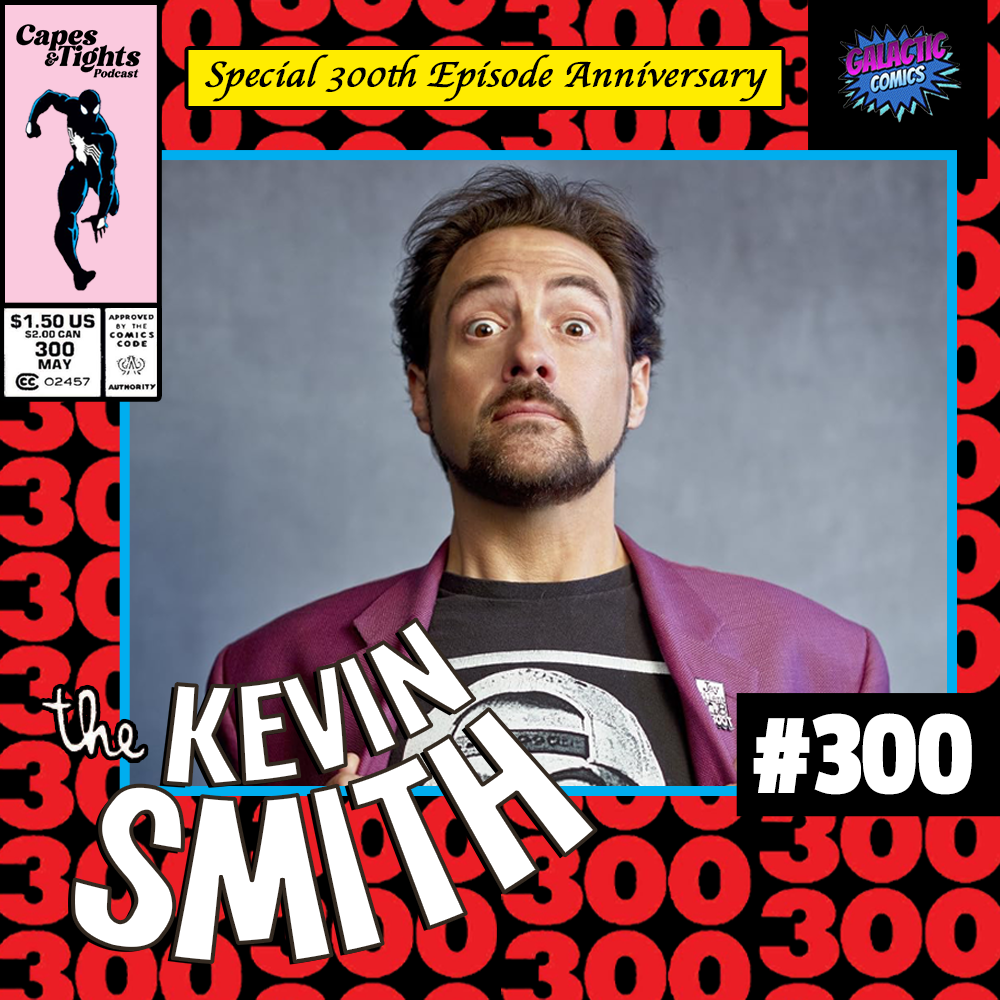
[00:00:00] Speaker A: Welcome back to the Capes and Tights podcast right here on Capesandtights.com I'm your host, Justin Soderbergh. This episode is once again brought to you by our friends over at Galactic Comics and Collectibles at galactic comics and collectibles.com Here we are, episode 300. And what better way to celebrate this milestone than to welcome comedian, actor, director, writer, podcaster Kevin Smith to the podcast. You will likely know him from the movies, Clarks or Mallrats or Dogma or maybe from his podcasts or his stand up comedy.
You can know him from his run on Green Arrow at DC Comics or Daredevil at Marvel Comics or his Quickstock comics over at Dark Horse. Or the recent announcement that he is doing the Star Wars Marvel crossover event for the 50th anniversary of Star Wars. Either way, he is here today to celebrate 300 episodes with us here at the Capes and Tights podcast. And we are extremely honored. Before you listen, follow us on Facebook, Twitter, Instagram, bluesky, threads, all those places you can rate, review, subscribe over on Apple, Spotify, wherever you find your podcast. You can watch the video portion of this podcast over on YouTube.com and as always, visit capesintites.com this is Kevin Smith celebrating 300 episodes of the Capes and Tights podcast right here. Enjoy everyone.
Welcome to our 300th episode. Kevin, how are you today?
[00:01:29] Speaker B: Unbelievably well, 300 episodes. Have you ever done 300 of anything in a row in your entire life?
[00:01:35] Speaker A: I don't think so. I think that's, it's a, it snuck up on, you know, it's like, it's one of those things. I feel like 100 caught there, 200 got that and all of a sudden I know where I was at 300. And so it was, it's pretty crazy.
2021 was a long time ago to start this and within five years we hit 300 episodes is, is pretty crazy. So yeah, it's.
[00:01:54] Speaker B: You started post pandemic.
[00:01:56] Speaker A: It was kind of like in that, like 18 months of like in that spot. We started as a different podcast. I'm based here in Maine and so we started as like a main focused podcast and we realized that we ran out of ideas pretty quickly and so we're like, ah, let's go. And my buddy Adam, who ended up moving away, we started it together and he, I kept it going afterwards and so yeah, so we started during the Pandemic but switched over to comics, pop culture, things like that in 2020. 1. And it's 300 episodes of that is going on now with this episode here.
[00:02:29] Speaker B: I remember when we hit multiples on podcast when we did, like, 100 and 200 and stuff. It was just, you know, it's when we grew up watching tv, we would see hundreds of episodes of a thing, you know, and, like, stuff like Good Morning America happened every damn day and whatnot.
And when podcasting. When I started podcasting back in, like, 2007, it just felt like, oh, we get to do, like, our version of that to some degree.
So it's kind of. Did you just knock this out? There you go, the dog walking around the office. Please don't start. Bark. And she's listening to the.
The gardener outside, so she might start.
But the, like, you know, being able to post numbers, like Happy Days numbers, not ratings, but, like, you know, I remember when Happy Days had 100th episode and stuff like that when I was a kid, and being able to replicate that on some level, you know, with podcasting later on in life, was so gratifying. So it's got to feel fucking cool to hit 300. Congratulations.
[00:03:33] Speaker A: Thank you very much. It does.
We mentioned it started right around the pandemic, but it was before that that I listened to a random episode of one of your many podcasts out there that you said, basically, like, if you want to do it, just. Just do it. Like, don't mess around, get the equipment, start working on it, do a quality recording, and be consistent. And I took that to heart, and I took it and said, you know what? I want to do this. And my wife will be like, is it okay if you just do an episode? No episode this week because your guest canceled. I go, no, we got to figure something out. Someone has to fill the slot. And to a point where we kind of annoyed her, but she's been a champion of it as well. And so, yeah, so 300 episodes is. And I'm hoping to do way more. I mean, that's. You know, I'm not slowing down here. This is like a milestone where I want to hit and I want to continue and guests continuing. I'm getting people now emailing you, like, before you're, like, fighting for those guests and fighting for the episodes you want to talk about now. It's like you're getting the emails to you, hey, can so and so be on your podcast? And it's. It's gratifying, for sure.
[00:04:32] Speaker B: It's very cool. You built a thing, man. Like, so many people, you know, partake in a thing. Watch a thing, spectator thing. But you built a thing. And, you know, in the modern Internet, a lot of people are building things. The.
The difference here, though, like, for years, I was out there, like. Like the Johnny Appleseed of podcasting, telling kids, like, start your own. Like, there ain't no gatekeepers. Start your own.
And it's depressing how many of them started political podcasts. Like.
Like, I was always like, hey, man, talk about what you love. And I don't even think these people love that stuff. I just think they find it profitable or rage baity and stuff. So the fact that you heard me, and then you have 300 episodes of a comic book podcast for heaven, that's. That's who I was. That's what I was talking about. You were who I was talking to, for heaven's sakes. I. You know, it just never occurred to me that anybody would, like, use the medium to talk about something as boring as politics.
Blew my mind. You could talk about, like, an infinite amount of comic book stories that have been published since before I was born, and. And all the time I've been here on Earth and whatnot. Like, it's, as, you know, it's a deep well, and you'll never run out, man, not in this lifetime. And it doesn't. The only rage that it'll bring out in people are people that, you know, they'll get opinionated about comic book stories and stuff like that. It doesn't feed on rage, you know, extolling the virt of things we love. And that's what we do in. In comics, man. I mean, yes, we grouse as well sometimes, but generally speaking, just like in the motto of the San Diego Comic Con, we celebrate the popular art.
So I applaud you for making something that doesn't make people unhappy or fuel the rage or feed into their already deeply honed biases and whatnot, to just speak freely about the things we love. You know, I'll take that show a thousand times, every time, man. Like, it's just. It's better for the soul of the world so.
[00:06:48] Speaker A: So much it's. So it's not profitable, I'll tell you that.
[00:06:54] Speaker B: Politics are profitable. And. But, you know, what is it the line from.
From A Man for all seasons, when St. Thomas More says to Richard Rich, the guy who eventually lied on the stand to get him, like, convicted, he said, it profits a man nothing to give his soul for the whole world, but for Wales, you know, because Richard was made the Chancellor of Wales, and I feel kind of the same Way about, like, I understand what the current economy on the maker market is and YouTube and podcasts, like those political podcasts dominate, but I can't a. I can't because I'm not smart enough and I don't know enough of the subject matter to even pass and stuff. Like, it'd be like me doing a sports podcast.
Like, you know, I know they exist, but I'm not deeply familiar with any of them except hockey and stuff. So, you know, I, I know there's money out there and that kind of thing, but I'd rather make less or no money and just talk about the I love man. Like, you know, and that's not gonna like heal the world, but at least I'm not, you know, contributing to the insertification of it.
[00:08:10] Speaker A: You've, you've mentioned this before though. It's like these proof is in the pudding with some of your movies, right? I mean you make things for a lot of money. It doesn't always pay. But you had fun making it 100%, man.
[00:08:20] Speaker B: I was telling people last night I was in Tulsa doing shows on Saturday, Friday and Saturday. And so, you know, I was saying like, it took a minute for us to find the budget for the next movie we're going to make.
And you know, that doesn't like, I don't bump into that because I'm surprised anyone at any point in history, let alone now, is like, oh, here's money. Go make pretend and tell a Jane Silent Bob story. I said, but what I do get is regretful about not being more financially successful. Like that I didn't care more enough about money throughout my career because I, I was always more into, no, let's make the thing. Like that's the most important.
And so I could always, you know, drop my salary in the toilet or be like, oh, we'll fudgeing scale these scenes back so we can hit this budget number and stuff.
And I was never that person that was all about like, you know, hey man, I'm making money. Like, don't get me wrong, I got paid and stuff. But not, I was never mercenary about it enough because later in life it would have been helpful to have some stuffed up coffers that I could be like, oh well, if I want to pay for a Jane Silent Bob movie, like, I'll do it myself. I don't need somebody else or something. So I was just talking to the audience about that this weekend going like, you know, I know there's probably a, like a better way to go about all this, but I.
For me, it was less about, like, let's get rich. Like, you know, they could have gotten away with not paying me this whole fucking time as long as they let me, like, keep fucking making movies. And. And again, I'm not like saying like, I've never made a fucking dime and stuff, but comparatively, every once in a while I see director salaries and I'm like, are you. No.
Are you serious? Like, you can get paid that. And I understand, like, stuff like Nolan, like, you know, you make the Odyssey and you make Oppenheimer. You know, you make the Dark Knight trilogy. You know, naturally this guy's gonna get paid a bunch of dough and stuff. But then there's some, like, other people I see that, you know, I would consider not so much peers because they work in more expensive movies than I do, but then, you know, not much more expensive and like, the salaries they get. And I'm like, man, like, you know, and so money has never been the motivator for me. I just want to see it, just want it to be out there, you know, rather than in here. And in here it's like, let's exercise this beast and get it into the world.
[00:10:59] Speaker A: You've done the same thing, though, on your podcast. Talking about things is. Is the same, you know, mantra I kind of have with these things being made. Like any superhero movie or Star wars thing or whatever, it's like good, bad, or ugly. I'm just happy they're frickin being made. Like, it's this, this, who cares? Like, I get to go to a sea. Like, my son is 5 and he's just now getting into Star wars and I'm absolutely loving it. And he's like, I want to watch Episode seven. And I'm like, hell yeah, you do. Because it's another Star wars thing that you can watch, it's another thing that you can get into.
And the next movie he'll go see because he just loves it. Good, bad or ugly, he's going to love that Star wars movies are being made. And so that's where I've also come like this. Similar things that have listened to you in the past on is who gives a shit? Good, better, ugly. Let's just. We're in a world that these things are being made. Kevin.
[00:11:48] Speaker B: Like, I love that everyone is. Seems to be coming back around on Marvel thanks to that second Dooms Doomsday trailer, the one that we saw at Comic Con and they just dipped on Friday because of D23.
And everyone's like, holy man, now this feels Right. Like, this feels like Thanos. This does feel. He's massive Dr. Doom.
So I'm happy for that, like, come back. The more the merrier is to make that a good time. But I'm not like, one of those people that was like, I hated the last phase or whatever the hell. Like, I'm like, I can't believe.
I can't believe they made a movie had a red Hulk in it.
Like, that's crazy. You know what I'm saying? Like, I can't believe they made a movie had Sidewinder in it. Like, it's. And. And were they perfect? No, but, like, you know, to be fair, even the Marvel movies I love are not perfect. You know, they don't need to be. But I. You know, I'm not obtuse. I understand people's complaints about what they didn't like about these new movies, but I guess it's just because, like, I grew up when I did, you know, like, the way my grandmother, like, appreciated a meal, because she grew up in the depression, you know what I'm saying? Like, she knew what it was like to go without and stuff.
So I grew up in a world without, you know, the best we had. It was like, well, Superman, you know, Christopher Reeve, Superman, Dick Donner, Superman, the Incredible Hulk on TV or something like that. This is a Spider Man's Amazing Friends cartoon. But, like, these were, you know, you
[00:13:24] Speaker A: know,
[00:13:26] Speaker B: oases in a desert, a virtual desert of mainstream media approaches to comic book material and stuff. So, you know, even when you show me a bad one or one that's, quote, unquote bad, and really what that just means is, like, not as good as the ones we love and the ones that, you know, have captured our imagination. Like, ain't nothing wrong with that Supergirl movie.
But, you know, we've seen bigger, better treatments, similar subject matter, and we did just have six years of a Supergirl show where every week we got to see her kind of do her thing. And. And I. You know, and I. And I know some people criticize that version of Supergirl now, going, like, well, that was just Girl Clark.
Like, they're not wrong. You know what I'm saying? That that was the. The Andrew Kreisberg who, like, worked on Supergirl before they ousted him and stuff, he said that, you know, I. When I was working on the first. Directing one of my first episodes, I was like, you know, he worked on Flash and he worked on Supergirl as well in Berlanti World.
And I said, you know, I didn't know you were such a big Supergirl fan. He's like, I wasn't. He's gone. But, like, I love Superman, and you could just tell Superman stories. They're never going to let us play with Superman. So we could tell Superman stories through Supergirl. And, you know, so we had, like, a bunch of years of that and stuff, so. And also, I. I think because we saw Superman last summer, like, I'm sure on. On paper, it made sense that, like. And then the next summer, Supergirl.
But I think there may have been some folks who are like, well, you know, I just had a super, you know, so to speak. What else you got? And stuff. So when. When the Internet, you know, goes ham or, you know, calls these movies mid. Or, you know, or outraged by their existence at all.
I just think back to the time when, like, we were slobberingly grateful that Dolph Lundgren had a little skull on the tip of his knife in a movie called the Punisher that, you know, didn't resemble the comic book, but, hey, man, it was kind of legit. So, yeah, I'm not too picky now because of that. The Internet likes people critical and picky, so me and Mark Bernard and on Fat man beyond have built a bit of a reputation for me, like, liking everything and him, you know, being far more critical. But I. You know, and some people, they get so, like, they're like, oh, you're being paid by the studios. And it's like, no one.
I'm not. Like, I like this. Seriously. I wish the studios would pay me and stuff. But, like, I, you know, this is the stuff I talk about, even if there was no podcast. So it's my passion, you know, it's. It's, you know, I know people who. And I've seen people in media who do a thing that they're known for and whatnot, and then their other side has nothing to do with, like, what it is they do or whatever, you know, like, what's his name? Do the. From Parks and Rec with the mustache.
[00:16:33] Speaker A: Ron Swanson or.
Yeah, Ron Swanson's a character, but it's.
[00:16:37] Speaker B: But, you know, his name escapes me. I smoked it away. But my man is, like, all about woodworking, like, an act, and he's building out of wood and whatnot. Like, it's nice to have a thing. My thing ain't very butch, you know what I'm saying? It's not very macho. My thing is, like, comic books, comic book movies, all this stuff. Like, and I'm 55 just turned 56, and I'm still able to interact with this, enjoy it. I'm not like one of those Disney adults who goes to Disneyland and bothers, you know, the people in costume because I'm like, I'm serving my inner child and shit like that. But I love engaging with this stuff as an adult as much as I did when I was a kid, because I engaged with all the stories on the page back then, and now I get to see them, like, up on the screen kind of come to life as well. So unapologetically, like, this is. This is my vibe. This is my. This hobby, you know, and because I'm a filmmaker and because, like, I direct or whatever, some people like, well, those two things could cross over. And the only time they ever really crossed over is when I was doing Flash and Supergirl. But, like, I. I don't think like that. Like, I don't watch Spider Man, Brand New Day and be like, oh, I want to make one. I watch Spider Man, Brand New Day and be like, I want another one. Please make it. And I'm heartening.
Yeah. Like, where's nine more? And I'm heartened by the fact that, you know, the Tom Holland keeps in interviews, he's like, I'll play this character until I'm 90. Like, he shows none of those normal signs of an actor who's like, I'm done with this. Like, I don't want to put this costume on again. Like, Michael Keaton seemed to get there pretty quickly with the Batman movies and stuff. And it's nice to see the kid be like, no, I love playing this character, and if they let me, I'll do it all the way through adulthood. And I'm thinking, they'll have my money if they do that. I love what they're doing with Spider Man. I love the journey he's on.
It's interesting. Like, when you look at the factoid information they put up on the Internet, where it's like, Spider man movies have outgrossed, you know, Batman and Superman and X Men movies combined or whatever the fuck, you know, he's. He's just by far the most popular superhero on the planet in history, perhaps at least cinematically speaking.
And there's. That's because they're serving the character right. So, like, keep doing that, and they'll have me until I'm off this planet and stuff. Like, they're.
It is about the closest experience that I've had to actually reading the comics and enjoying them for the first time when I Was a kid, like, it's absolute magic. So, yeah, I. It's a great time to be alive. As far as comic book movies, everything else in the world, worst timeline ever. Holy.
[00:19:26] Speaker A: I want the alternate universe. I want the other universe. I don't want this one.
[00:19:30] Speaker B: I might welcome Battle world.
[00:19:33] Speaker A: For heaven's sake.
You dabbled in it with the Arrowverse stuff, the cw, but you also, you write comics. That's the. Like. The thing is, what's cool about it is a lot of people maybe forget that with watching Clerks or watching any of the new movies you have come out that you passionate with comics and that you sacrificed some of that passion with comics to create Clerks, but now get to write comics. Do you think back even when you were making Clerks, that you'd ever be like, I get to write right now. You have one coming out soon as Spider Man, Hulk crossover thing. Do you think that you'd ever be able to do this in the future? Is this still a pinch me moment? You get to write comics?
[00:20:15] Speaker B: Still is, absolutely. And. And what's weird is, like, when I first got into the business with Clerks, one of the first things I tried to do was get into comics, use that as a backdoor into comics. And it kind of worked out by virtue of the fact that there weren't a lot of people doing that. Somebody did it before me, and that's how I knew it was possible.
Jeff Loeb had written Challenges of the Unknown. Of course, he went on to do, you know, the. All the books with Tim Sale, the Batman books and stuff. But Challenges. Challenges of the Unknown was a D.C. book that he drew, that he wrote and Tim Sale drew that I absolutely adored.
And they. They tried to make a lot of noise with this or not a lot of noise, but it was like, put out there that, like, this guy writes movies.
And he did. Jeff had written Teen Wolf and Commando screenplays for both of those movies.
And here he was writing in comics. The only other person I knew of did that was Sam Ham wrote the Batman script. And then he wrote Blonde.
I think it was Blind Justice. Was the detective comics, like 100th, 200th maybe. I forget what it was. It was a big summer issue.
So people had done it before me, so I knew it was possible.
So when I first. When Clerks got picked up, like, I started gravitating toward that world by mall rats. We were putting comic book artists in the front credits and stuff.
And so because of the Superman job, that's what got me into the inside the doors of the big two and the first one being being dc, because I remember I went to meet with Mike Carlin. He was then the DC Group, the Superman group editor.
And I was trolling around the offices, and you show me stuff. I was geeking out, met Jeanette Kahn and whatnot. She was the. The editor at that point, or the publisher.
And then I passed by Darren Vincenzo's office. He was the editor of Green Arrow.
And I said to him, I popped my head and I said, hey, man, if you ever want to put Green Arrow in the top 10, let me write that book. It's such a weird, arrogant thing to say. And, you know, he gave me a kind of look. And then he reached out to me, like, two years later to be like, are you still interested in writing Green Arrow? That was. By that point, I had done Daredevil.
So the. I got inside D.C.
first because of Superman, and then I got tight with Jimmy and Joe.
Joe Quesada, Jimmy Palmiotti. And those cats had their own label Event, you know, where they did a comic book called Ash.
So Joe was like comic book superstar from working at dc. He had designed the Asriel character, the Batman. Asriel was his design. He did that run, and then he had his own imprint with Jimmy, and they did Ash at Event Comics, Painkiller Jane, stuff like that.
And then, because they both ran a comic book imprint, I get. I don't know how the deal happened, but Marvel was in, like, bad back then. Like, you know, there were literally penny stocks. The stocks. The Marvel stock wasn't worth a penny. Like, it was more valuable just to have it because I had an image of Spider man on it than what it was. It's monetary work. So they were really in the. In the toilet. And so I think. Because that, you know, I don't know if Joe and Jimmy pitch them or if. If somebody at Marvel approached them. Is probably Jimmy and Joe approaching Marvel.
But they said, give us a couple titles to take over editorial content.
You know, the art, all that stuff. Like, we'll take them under our wings. And they called that imprint the Marvel Knights. And one of the books was Daredevil. It was Daredevil. It was Black Panther, it was Inhumans, it was Punisher.
So Jimmy and Joe were like, you know, I met them while we were doing Chasing Amy, like when we met him on Mallrats. They did artwork for the, you know, opening credit sequence. They do the Silent Bob Jane, Silent Bob piece of artwork.
But, you know, they came out with us for Chasing Amy when we did the fake comic Cons and whatnot. So they were there for that in our work world and did one of the covers for the fake comic books in Chasing Amy as well, like, alongside Mike Allred.
And so, you know, at that point, they knew in all the interviews I've done, I talked about loving Frank Miller's Daredevil run and blah, blah, blah. So they reached out to me. Joe and Jimmy were like, hey, man, how about you write Daredevil for our Marvel Knights imprint? And I was like, oh, my God, I would love to.
And said, yes. And I was like, let's do it. And then we were getting to.
Let me see, had I shot Dogma yet?
I think we're about to shoot Dogma.
[00:25:27] Speaker A: Or.
[00:25:29] Speaker B: Yeah. Because was Jen there?
Can't remember if Jen was in my life at this point, but I pretty. Yeah, I think she was. I remember being in the kitchen of the apartment on Broad street that was like, right next door to Jane, Silent Bob, Secret Stash. And Joe, you know, I realized I was like, I can't. Joe kept hounding me for a script, and I was like, I can't.
I got too much going on, man. I was in. Had Dogma up my sleeve still. So I was like, all right, you know what? I called them up. I said, joe, I'm not. I know I said I could do this, but I can't do it. I can't fill Frank Miller's shoes. I don't know what I was thinking saying yes and stuff.
And so he was like, oh, man, are you sure?
And, you know, he was more sad, bummed, you know, not angry.
Then I hung up and I was like, I'm. I'm clean. I got away scot free.
That's when Jimmy called me and he bad cop me. And he was like, you're a piece of.
Because I can't believe you broke Joe's heart like that. He's. He was there for you, man. He couldn't wait to do this. And my man was giving me the riot, reading me the riot act about how I let Joe down. And I on the phone was like, well, you know, oh, I don't know. At first I. He got off the phone, like, he didn't convince me on the line.
He just kind of berated me and yelled at me. And then he didn't hang up angry. But we hung up.
Then I was watching a movie called God Told Me to, and I was like, oh, my God, maybe I'll do, like a devil storyline.
And so I called them back, and I was like, you Know what? I think I have a storyline.
And so within a one hour period, I'd quit the book and berated for quitting the book.
Figured out a story to do, called the back and said, let's do this. And the book was back on and thank the Lord because like, oh my God. The amount of credibility that gave me in the comic books community, it was one thing to be the guy making movies where, you know, hey, there's this guy who collects comic books and he's got a comic book vault and hey, Dan Lee is in it because they have a comic book signing at the mall. And it's another thing to have a movie that's like, hey, these guys are inkers and, and pencil or anchor on an indie comic book. And this is the world of indie comics and stuff. And they're all trying to get to like the big two. You know, it's one thing to be that guy that's walking the walking the talking the talk. I guess walking the walk was actually writing some comic books and having people be like, all right, he didn't, he's not an idiot. He seems to know what he's doing. They're very verbose, but whatever.
And that had everything to do with Joe, because what I handed Joe Quesada for issue one of Daredevil was literally Marvel Method, like four paragraphs about what was going to happen in the whole issue.
And so he mapped it out and then I did all my dialogue afterwards and all my dialog balloons covered up all his beautiful art and he was like, we got to do this a different fucking way. So that's when I went, I started writing full script.
So I learned my craft in writing mainstream comics under Joe's and Jimmy's tutelage and whatnot. You know, I'd grown up reading it. Basically. You read my books. I'm basically aping the books that I love. So I'm aping Frank Miller, I'm aping Alan Moore, you know, Grant Morrison, Gaiman's Sandman stuff, you know, like, those are the books that swept me off my feet. And I, I know sometimes, like when I write comics nowadays, some people are like, like, oh, it's very old timey. Well, there's a lot of dialogue or whatever, you know, like, and, and I'm sure I could adapt my style to a modern day, but the fun of doing it is trying to write the thing that I enjoyed reading when I was a kid and approximate that. And, and so, you know, I, I did it for years. You know, I also had the same time, the oni stuff. And I was doing Jane, Silent Bob and Clerks comics. So I got to do my world in the comic books. But, like, you know, getting to write Green Arrow and eventually doing the Daredevil run, doing Spider Man, Black Cat, which took me forever to finish and stuff, gave me, like, huge credibility in the comic book community to the point where, you know, they were like, you can do what you want. And for years, I. I did. I did exactly what I wanted, but I never went beyond that. You know what I'm saying? Like, I'm gonna write Green Arrow. And I did it. I wanna write Daredevil. And I did it. I wanna write Batman. And I did it. But, like, it never occurred to me to, like, stick around. So I, At a certain point, like, I would dip in and out of comics and like, you know, I went back for the Batman run. And that was around the time that the Dark Knight was coming out because I'd seen a billboard and I was like, man, it'd be fun to do a comic book with Walt. So I reached out to Walt Flanagan from Comic Book Men and was like, who do you want to draw? Like, tell me everyone you want to draw in D.C. and I'll write a story that we can fucking do that.
So I, you know, did that first we did Cacophony and the Widening Gyre. And then I was meant to do the third one because Widening Gyro ends on a nasty cliffhanger and has for over a decade now.
But there was a follow up called Batman Bellicosity, which, like, is still sitting half finished in my laptop. And Walt drew two full books of and stuff. So now that I'm kind of back into it, you can damn skippy expect we'll be putting that back up on its feet. So wait, so after Batman, I dipped out for a while. And then I don't think I did anything for a red hot minute until, was it Mark Miller asked me. He's like, do you want to write Hit Girl?
And I oh, that's fun. That would be good times. Yeah, let me try to. So I wrote four issues of Hit Girl Goes to Hollywood.
And then so I got bitten by the bug again. And I was like. And you know, I was like, maybe it's time to do more books. Like, I had a bunch of view askew stories that I wanted to tell you would never make a whole movie out of them and stuff. So I was like, what if I had a comic book called Quicksteps? And so Mike Richards, like a Couple years back was like, why don't you do it here? Do it at Dark Horse. Which is funny because, like, years before, we had tried to go to Dark Horse with Blunt man and Chronic, before Chasing Amy came out, because we're like, we got fake comic book in the movie. Maybe Dark Horse will do the comic book. But Dark Horse passed. They were like, no. And so years later, it was nice for Mike to be like, come on over. And so he gave me a home, and I started Secret Secret Stash, Press, my imprint. And we started doing Quick Stops. And then we started doing Masquerade, which book I do with Andy McElfish and John Springlemeier. That was a failed attempt at a question TV series.
I pitched it to HBO Max.
It's kind of pitch question TV series that I put together with Jeff Johns. He was still there at the time at DC and porn Sack, the guy who's writing Ultimate Green Arrow right now.
So we developed a thing and I took it into to HBO Max, and they were like, we love this. Oh, my God, this. Let's do this, man. You just gotta get, you know, the okay from JJ's company, Bad Robot, because they had a big deal at Warner Brothers that nothing ever happened from it and stuff where he had, like, the comic book characters for a minute, like he was going to Justice League Dark or something. So they were like, if they're in, we're. We're off to the races. And I thought we were golden, because I was like, I know jj, this will be easy. But I didn't pitch it to J.J. a bad robot. It was somebody else, another exec. And the exec was like, this is too dark.
So then it went away. And so I thought, like, oh, maybe I'll just do it at DC as a comic book. Then I remember an interview that we'd done with Robert Kirkman, where Robert Kirkman had talked about, you know, I worked at Marvel for a fucking minute. And he's going, it was glorious because you get to play with all the toys. He's going, but then I realized I was given Marvel, like, really cool concepts that I didn't own anymore. He's like, so I started saving my cooler concepts to do myself. And that's where the Walking Dead comes from and the rest of this stuff. So I was like, that's. That's what a smart thinking. So instead of just like, you know, doing it, trying to pitch it again as a question TV show, or doing it as a question comic book series, like, I switched it around and made it masquerade, you know, obviously female lead versus the male lead of Vic Sage and stuff. But there's, you know, facial changes going on. We take more liberties and masquerade with what they could do. Vic Sage did look like other people. He just removed his face with pseudoderm and stuff. But one was the origin for the other man. Like, why let it go to waste? Manufacture for use kind of thing.
And so we did eight issues of that, and, you know, that's a thing I own. I wrote a screenplay as well. So hopefully maybe we get to do that one day.
So coming back to do Quick Stops, I guess that's what Nick Lowe saw. Nick Lowe over at Marvel, like, hit me up.
Is going back a year ago, two years ago, with an email or something or text or something. I don't know how he got to me, but he was like, hey, man, would you want to write a thing? Like, we're doing this Earth616 book, so we want to do like a Spider man story about 616. Would you want to write that?
And I was like, yeah, how long is it? And it was like a 12 or 16 pager. I forget. But I was like, you know, yeah, it. Let's play. I'll do that.
And I had a good time doing it. Didn't wind up being an Earth616 book. They turned it into an Amazing Spider man annual instead.
But during that job, he asked me, hey, we're doing Deadpool, Batman.
So we're going to cross over many stories all throughout. We're going to cross over Green Arrow and Daredevil. I was like, I wrote both of those. He's like, that's why we're reaching out to you. Do you want to write it? And he's like, it's an eight pager. And I was like, all right.
And so I did that.
And then I can't remember which one first.
I think it was. I think it was Hulk. And then Jay's came out of that. Jay's a future path, but on Hulk. They were like, are you enjoying this comic book stuff? Like, we loved your Spidey story.
How would you like to do another Spidey story? I was like, oh, sure.
[00:36:36] Speaker A: Why?
[00:36:36] Speaker B: What are we talking about? And they were like, well, the next Spider man movie coming out got Hulk. And I saw that. And this is like a year ago.
They were like, we want to have a book. You know, we got a Spider Man Punisher book coming out. We want a Spider Man Hulk book coming out. Same time. Do you want to Write it. And I was like, I don't know. I don't know if I'm your Hulk guy and stuff, but then I. I realized, like, Spider Man, Hulk, you're talking about two scientists.
So I was like, you know, I'm gonna turn to my boy Andy McElfrish.
You know, we. We did Masquerade together.
And I. He's the smartest person I know, and he's cocktail party science king. Like, knows a little something about everything, so well read and stuff. And he's a bird. A birder.
So I wanted to incorporate that into the. The story as an element that helps Bruce Banner, like, calm down. Like, instead of, like, the sun's getting real low, big guy. Like, throughout the story, it's clear that birds have a calming effect on the Hulk and help him turn back into Bruce Banner. So because, you know, Andy's that guy, I was like, hey, man, do you want to write a Marvel comic? Like, I know we've done Masquerade, but this would be working for, like, Marvel and doing Spider Man Hulk and stuff. And so he was like, yeah. And so I told Marvel, all right, man, I'm fucking in.
Then I came up with the outline, and we submitted the outline, and the outline got kicked back. I think CB Was just like, I don't like this. It was Spider man Hulk, colon, 1976.
So it was a story set in the past. And he was like, nobody's into that.
And I got real like, well, that man, you know, like, you asked me, like. And so I was gonna not do it.
And then Andy was like, oh, he's gone. Don't be like that. He's gone. How many chances you get to write the Hulk? He's like, you know, you'll come up with another story. And then I did come up with a better story, which was the exorcism of the Incredible Hulk. I did my quick research to see, like, has anybody ever done that story yet? And I'm like, oh. And I pitched it to Marvel, and Marvel was like, yeah, we like that much better.
So we were off to the races. And then I think it was around that time that Jay's a future past happened. And Jordan White is my editor on the Hulk book. And I think Jordan was the one that was like, would you ever want to do a Jay and Silent? But I didn't even let him finish. No, you know what? Here that goes even further back, because Jay and Bob started popping up in Marvel, a bunch of Marvel comics.
And that was from in my Spider Man 616 book. There's a little appearance by them. And then I think it was. It was Nick Lowe who was like, we're gonna start putting them in all the books. And then eventually you do a book about, you know, Marvel Universe, Jane Bob in the Marvel Universe. And I was like, oh, my God, yes. And Jordan White was my. Was my editor on that book.
So I had a blast writing that book. That was just like, you know, as a kid who was around when Kiss crossed over with Marvel and put their blood in the ink and stuff, you know, I couldn't think of too many instances where Marvel had done something like this. Naturally, it comes to mind, friend Hembeck destroys the Marvel Universe.
And, you know, I love my own name, but, you know, I would never push for Kevin Smith Destroys the Marvel Universe.
You know, I got too many people online who seriously say, Kevin Smith destroyed he man. So I don't need that shit even in Jess.
So. But. But it's breathing rarefied air where, you know, Marvel's like, here, take the characters and go play with them. Like, I could think of those two instances of. Of Kiss and of Fred Hembeck and stuff. And, you know, Fred Hambeck does his book. Kiss didn't do their book. But, you know, so I was like, there's no way I'm passing up on this is a dream come true. Especially because, like, I pitched Stan years ago on the set of Mall man, like, can I do a Jane Silent Bob book in the Marvel Universe? And he wasn't even in charge in those days. You know what I'm saying? Like, and I knew that I wasn't obtuse and stuff, but he was like, I could put in a good word if the movie does well. Movie didn't do well.
So, you know, it took many, many years for that to happen, but there was no guarantee it was ever going to happen. When it did happen, it was absolute fucking magic. Camo's art was amazing. Just, you know, everything about it was. Was bliss. I'll be honest, and it's kind of gross, but when Days of Future Past came out, I read it every day for, like a month. Like, I. It was my happy place. I'm like, look at this.
Like, I remember being the kid going to Katz's, which was the. You know, the. It was called Katz's Confectionery. It was a little greasy spoon slash magazine newspaper stand in Highland. So you can get pork relic and cheese there and coffee. You could buy your lottery tickets and cigarettes. But they had a massive old newsstand with Every magazine and. And they had spinner racks with comics on them.
So, you know, the magic of.
I was gonna say buying. I used to steal comics from that store. Magic of stealing those comics from castles and getting into those stories.
Like, that's what I felt reading my own comic. Like, you know, I was like, it's crazy. The boy who loved that, the boy who had a subscription to Vision and the Scarlet Witch, and it came in a brown paper wrapper, like it was a Playboy magazine or some. So, like, now you get to play with all these characters and it was just fucking wonderful.
[00:42:14] Speaker A: So I can imagine. Yeah, so I can imagine, like when you were doing Clerks and they're having the conversation at the counter about Death Star, like, that was probably to your mind at that moment, like, the only time you're ever gonna even like, be able to dabble in something like that with your characters as well. I mean, like, you had hopes that maybe you'd write comics or whatever, but, like, your characters crossing over with another major franchise, that's probably where you probably thought at the moment, like, that's the most it's ever going to cross over
[00:42:39] Speaker B: was I was just like, that's nothing gets better than this for Heaven. Like, you know, I. Marvel has a degree of legitimacy in our culture thanks to the movies that, you know, nowadays more people know fucking Marvel than did, you know, back when I was a kid or in the 90s, even in something like that. So there's a cultural cachet to being able to say, like, I'm, you know, Jane Silent Bob crossed over with the Marvel characters. You know, people like, what really, you know, and that wouldn't have been 10, 20 years ago.
20 years ago. Let's go that far. If I told people in my world, like, do a comic book where fucking Jane Silent Bob meet the Avengers. They'd be like the British people from that TV show in the 60s.
So, you know, it's breathing rarefied air, man. And I honestly thought, like, that was it. Like, it'll never get better than being able to do a Jane Bob book. Until they were. It sold out and they went to a second print and they were like, do two more, so we'll have a thick ass trade paperback. And I was like, you ain't got to fucking twist my arm to do like two more Jane Bob story. So I already wrote the script for the next one and Camo starts drawing it in September, and then there'll be one more to do after that. And the first one is Marvel Universe, and the second Jane Bob Book is the Dark Universe Universe. So it's all like, like Blade, Moon Night, shit like that. Like, I'm very happy with it. And the third one I think will go to space.
Cosmic Marvel, fittingly.
[00:44:05] Speaker A: Like, everything just goes to space eventually, right? It's just eventually.
[00:44:07] Speaker B: And I always joked when I was a kid, like, you know, one day they're like, what do you do after this with Jay and Bob? And I was always like, space, so we'll get there with the comic.
[00:44:16] Speaker A: But so they. You. They liked Jay and Sound Bob crossing over with Marvel so much. They're like, okay, then now you can do Star Wars Crossing over with Marvel. Is that cool with you?
[00:44:23] Speaker B: No, it was into that because I don't, I don't know the machinations behind the scenes at Lucasfilm and at Marvel, but I do know this.
Jordan White and Nicolo were like, would you like to talk to. I know you're working on this. Would you like to talk to the Lucasfilm people? They want to have a conversation with you. Can we give them your number? I said, yeah, absolutely.
So the Lucasfilm folks, Lucasfilm Publishing and the Marvel Star wars kids, like Mark Panacea and stuff, they were all on this group conference call and they said, for the 50th anniversary of Star wars, we're finally letting Marvel do what they've asked us to do for decades now, which is let our characters cross over into Marvel. Marvel has always been a home to the Star wars comics, but they exist in their own universe mythology and they never cross over. I mean, the Marvel characters know of Star wars, but like, you would never have Han Solo meeting, you know, Iron man. You would never have Spider man meeting Luke Skywalker if Lucasfilm had their way, and they did have their way for 50 years. But to celebrate the 50th anniversary, they stay explained. They're like, we're letting Marvel do this and we want to do a story. They didn't have a name for it at that point. Hope Assembles came later on. So we were just calling it Star wars meets Marvel. They had a code name for the project internally that was called Project Cocktail.
And periodically I would meet people in the real world who would be working in comics adjacent mediums, like people that work in clothing and licensing, retail, or like the people at the Panini who published the Marvel and DC stuff overseas. They were like, we know about the secret project, you know, And I was like, oh my God. Because it was like very secret. They kept it very stum.
So they gave me parameters for what the story would be like this, you know, it wasn't like go nuts. Like, like this is the box, the playing field in which you could work.
And they're like, are you interested? And you know, I'll be honest, because of the like the masters of the universe blowback, like there was a moment where I was like, play with somebody else's toys again.
This is different, this is comics. And comics is still. And man, I don't want to jinx it, but I hope it remains this way. Comics is the last creative playground in multimedia. You can around and tell what if stories without worrying about like, well, it's going to cost us $200 million dollars. You know what I'm saying? Or we got to make sure that Robert Downey Jr's schedule is clear. Like this is, this is, this is the wellspring from which all the other media flows, man. That's where they get these cool ass movies and those cool ass X men, you know, 97 TV shows and whatnot. It all begins on a page with a writer and a pencil or in an anchor. All gone. Like, well, what if this happened? So, you know, the notion of letting that opportunity just slip away because they were offering it to me, you know, like letting it slip away simply because I was scared what people might say. You know, I just kept thinking like, go back in time and tell the kid who had the subscription to these comic books you had. I had a Star wars subscription that I kept reading the book well after the movies were done and whatnot.
Go tell that kid that you get a chance to actually write the stories you dreamed about when you were young. Like, oh, what happened? What would happen if Darth Vader met Dr. Doom and like that. And you don't do it because you're afraid of. People might say some mean things like grow up. So I, in the moment I decided it's like, all right. I said, I think I, I said, oddly enough, I may be the right person for this job. They're like, that's why we're talking. You know, it just kind of makes sense. And so I gave him from my pitch for how the story could play out in the playing field. They presented and they loved it. You know, it was definitely a very comic books but with of course a.
A nod and understanding of how most people, you know, ingest their marvel these days, I. E. The movies and stuff and the TV shows.
So they, they liked what I was pitching. They said, go write an outline. I wrote an outline for all five issues and they wanted this. This started in December of last year. So December 2025. Because, you know, they're like, I said, when's this book come out? And they were like, starts in January of 2027. And then the last book comes out in May, just in time for the actual anniversary. So, you know, I don't think I've ever been involved in a book that was this far ahead of schedule. But, you know, you're talking about two Titanics that can't turn on a dime. And then you're also talking about, like I said, hearing from people who have been like, oh, I know about Project Cocktail. Like, there's merchandising in. In the. In the. In the offing. And. And not that they never said anything about that. They were never like, there's gonna be cool stuff, but there is. Which is kind of. Kind of neat. And it's like, not like, you know, oh, those are my characters. You know, I just took characters everybody knows and loves. I get to stand them next to each other. And because of that, there will be toys and stuff. The beautiful thing was when they. They announced it, you know, we kept quiet this whole time. And then out of nowhere, all of a sudden, they were like, oh, we're announcing it today. Like, I found out from somebody else, like, my friend Bob Perlitz texted me, and he was like, oh, my God, congrats. Is this what you've been talking about? Then I looked, and I was like, yes.
So when it went out there, wisely, they released it with. With David's covers.
And, my God, like, for. For months, you know, I had on my phone the black and white of the group shot. What is, like, now, you know, it's all sectioned up. It was broken into covers and stuff. But the mass piece that started with one cast, and then we added more characters and stuff, and so it got bigger and whatnot. And so I had this image, this penciled image on my phone forever and ever, ever where I was. I was like, you know, I'd be on a podcast. I was like, I have an image on my phone that would literally break the Internet if I released it.
And I was happy to see that it did break the Internet. It really did capture people's imaginations. Like, the idea of them meeting. And there's definitely some people who are saucy about it. Like, this is the end of creativity. I disagree. In the comic book, like, this is so creative. Like, but what I really liked was, like, people responded to the artwork.
Just seeing Darth vader standing beside Dr. Doom with Thanos and Ultron behind him. You know, people are like, what's Greedo doing there? But he makes sense. Some people are like, why Greedo? Why not the emperor?
Because if you look at those covers, kids, you'll remember everybody featured was in A New Hope.
We didn't have no emperor in the New Hope. So you know what I'm saying? So the emperor isn't going to be on that cover group.
But it's the same visceral reaction folks have been having to the artwork is what I had when I first saw like David's piece where I was like, like they just work standing next to each other, you know what I'm saying? And, and it just feels like somebody's wish come true. And even if it was nothing anyone had ever thought about before, the notion of those groups of characters crossing over has sparked imaginations. That's why it's just like, that is not. The bankruption of creativity is quite the opposite. Like it fires up people's imaginations and you know, it's going to create discourse.
Like people are going to talk about whether the story went in directions they thought, you know, there. But I'm telling you, bro, like, I, I treated this, I've taken every lesson I've learned in, you know, 30 plus years of being in the arts, and particularly even the harsh lessons I've learned of when you play with someone else's toys, they don't like the way you do it and brought it to bear on this. There are some like jaw dropping splash pages, concepts, crossovers.
The story is, is beautiful and heartfelt and fun, but simple as well.
But you know, there was the, the. When I wrote the out the outline and sent it in, the Lucasfilm cat was like this. This is like a love letter to Star wars, to Marvel and the comic books in general. And then I think he repurposed it for like the, the press release that they put out, he said this similar thing, but they were so happy at both sides and Marvel and Lucasfilm and you know, I was told in the beginning, like, this ain't gonna be like any other job you got because there are so many like, you know, eyes, you got a dot and T's you gotta cross when it comes to these two powerful franchises, like, you can't. There's gonna be a lot of oversight. There's gonna be a lot of people being like, yes, you can, no you can't. And stuff which I understood. I'm like, I get it. But there really wasn't like that much. Like it's the Editorial input was stuff like, well, if they're going to go from the tan teeve from the Star Destroyer to the tantive they used docking an Imperial docking ship that's called this.
Like, like, very technical information.
This is the design of a Thai bomber. You have to go with this design.
That's it. They're not like, you got to change the story or something like that. It's more notes like that. And then there were like, notes or conversations that were like, I can't believe we're all getting paid to do this. For example, can a lightsaber cut through adamantium vibranium? The Hulk? Like, you know, how powerful is this? And. And a bunch of adults sitting around, you know, kind of confabbing about like, well, you know, yeah, if we do that, what we're saying for all posterity, because this is a canon book, like, it's in canon. Some people I saw online were like, it's probably not canon, but Marvel's like, no, it's a canon book. We want to write a perennial story that, like, we'll fudge live forever, but it's set in the Marvel universe and it's real. It's not like we all woke up from a dream or some sort of shit.
So, you know, I. When I first pitched it to them, when they called me and I was in Denver, I was in Colorado doing shows, and they told me what the parameters were and asked me if I wanted to do it and stuff. And I was like, yeah, and here's how I think I would do it. And they were like, oh, man, I like that.
One of the things I'd asked them was, oh, I forgot where I was going with it. Hold on. It's a salient point. It was about.
I know it's my bad. It was. Sometimes I go on those threads and then you just.
That one slipped away. But I remember, yes, we were talking about it being canon.
And what about that?
I forget. It'll probably pop up in my head later. But, my God, what a dream job. And how geeky it got. Like, it never got frustrating, you know, I was never like, oh, my God, I'm getting noted to death. Like, the notes were like, this is really beautiful. Thank you. And like that. So I can't wait for people to dig into it, man. And I say that now and then if it comes out like, fuck you, we hate it, then it'll be a nightmare. But right now it's not. And they just sent me some. The first color pages is beautiful, but, you know, having those Characters side by side by side, man. And mixing and matching them. Like, I just essentially tried to write an Avengers movie. And that's what it feels like to me. It's just all the fun, the action adventure. I would probably even say that an Avengers movie is more complicated than my story, but it feels like that it Balancing a bevy of characters, to say the least. You know, you've got your entire cast of stars. Oh, that's what it was. I remember what I wanted to bring up. So while I was pitching the idea was 50th anniversary of Star wars, all the Star wars universe crosses over with Marvel. So I put forward. I said, may I make a suggestion as a lot.
You know what I'm saying? There's a lot of characters. I was like, how about we just stick to a new hope for the 50th anniversary? Because then 50th anniversary of Empire Strikes Back, we get to do this all over again. And they're like, okay. And so it became the mantra. So I'm writing the book and at one point there's a sequence where, you know, I mean, people, like, it's. It's spoilery, but, like, when you see those characters together, you. You can't.
I. I don't.
[00:57:56] Speaker A: I.
[00:57:56] Speaker B: Yes, it's a spoiler, but I don't think it's going to ruin the book for anybody. And you would have. Everyone would have seen this coming a million miles away.
Obi Wan Kenobi puts on the Cerebro helmet and they're inside Cerebro. And at one point, his life is writ large in front of them. And it's the life we all know from watching all of Star wars media, not just the first movie.
And one of the only no notes that I got back was from the folks at Lucasfilm going, we're just doing the first movie.
So I was like, oh, I was hoisted on my own guitar. So it changed from being like, hey, there's Ewan McGregor, to just him seeing the events of Star wars, including, like, what his own fate and stuff like that.
So when the notes were. When there were notes, they were nerdy notes. It's really such a fun project to work on. And now it's the cascading joy of just seeing the artwork come in.
And then, you know, next up, the lettering pass and stuff. So, yeah, 2027 kicks off with this book. And I.
I can't imagine this book doesn't sell. You know what I'm saying?
[00:59:11] Speaker A: I mean, did you have a conversation with Mark? You know, Mark's written Star wars comics before.
[00:59:16] Speaker B: Yeah, he knew I was doing this as well and I knew he was doing his and stuff and we kept. Obviously I had to keep very quiet on this. But yeah, I like when, when I got the gig, I realized like, oh, this is probably like you'll see this throughout your life more than you'll see anything you've made in me. Like, this feels like a book when the trade paperback or the hardcovers put out that will forever live in airports. And I travel a lot and it's just like they don't have a huge kids section in every airport, but there's always kids books and whatnot.
And this just feels like a book that you could sell to anybody that has never picked up a comic book in their life. You put that cover of all those characters together and whatnot. And now we live in a, in a post Marvel world where even your grandmother knows who Professor X is. Like, that's that. I feel like it's a book that will sell forever, honestly. Like it's the thing, one thing with my name on it that will probably outlive me the longest when I die. All the Kevin Smith stuff, the View of Skuniverse stuff will die with me. That book might keep going.
[01:00:29] Speaker A: My five year old will be like, this is amazing. He loves Star wars, he loves Marvel. The only thing that can make it better, if they put K pop Demon Hunters somehow work their way in there, it would be the trifecta for him. But this is going to be something for so many kids nowadays growing up and so many adult kids like myself.
These are two of your biggest things. And they're crossing over for the first time, which is absolutely. And I did laugh like someone in the comic book store when I went in the day after that this was announced or like and Kevin Smith was the top of their list. I'm like, yeah, of course they want.
So many people could have written this, you know that.
But like they had someone who can write comics who also is a fan. Right? You're a fan too. So it's like, why not have someone who's a super fan do the story that everybody else gets to read? Like it just makes the most sense. And so I was like, I was so pumped about it. I was like, yeah, perfect.
[01:01:15] Speaker B: Imagine how I felt. I was like, they could ask anybody. Like I'd read an Internet rumor at one point where they're like, there's going to be a Star Wars Avengers book. And I was like, oh, they're close. They have no idea and they said, mark Miller's writing it. And I was like, no, that's not right. Unless there's a book they didn't tell
[01:01:30] Speaker A: me about or they fired me and they didn't let me know.
[01:01:33] Speaker B: Exactly. They could have. You know, honestly, there's a bazillion wonderful writers out there who work in comics on a regular basis and stuff.
You know, if you. If you wanted a guy who moves books, like Scott Snyder, like, you know, I know he's a DC guy, but shit, there's a dude who can move a book or two when it comes to the absolute stuff.
So I realized that they could have went in a number of directions, and I was honored that they came to me. But I do also understand, like, why, like, at the end of the day, they're like, look, man, we got to build like, it sells itself, right? Like, you know, Star Wars, Marvel. It's not like, yes, it needs a writer, but it's not like it needs a rock star writer because the concept itself is going to put asses in seats.
But they were like, in terms of people who have been talking about this for their entire career, and they also write comics from time to time. Like, I. I could see how we all wound up on. On the phone.
And I was honestly, like, flattered. Like, you know, most people are like heat seekers, where they're like, let's get who's ever, you know, hot new and brand new and, like, selling books and like that. Like, I don't know. If I was in charge, I would have been like, I don't know, grab Robert Kirkman, for heaven's sakes. You know, so the fact that somewhere along the line, somebody. And I would really like to find out who it is, like, even introduce my name into the conversation, I. I'll be honest with you. I was completely honored. And it made me work harder because of that. Like, I poured my heart and soul into this, man. It is.
It is. It is a fan's story. And. And I hope everyone kind of imbibes it in the same way. Just good times. And, you know, I had incredible guardrails at all times. So it's not like, you know, I know this guy's gonna do, like, not really. Like, I had to tell a different story than I normally ever tell in my own books and whatnot. And my. My model was an Avengers movie. Like, you're just doing all these characters are crossing over and whatnot.
Of course, with a Susan of a Star wars movie, of one Star wars movie, specifically, which, honestly, like, that was a really nice byproduct of the job that was the most I've interacted with the original Star wars, like, in a long time. I'm a big Empire Strikes Back fan and stuff. So, you know, Star wars massive in my childhood. But like, I.
Because I was writing the book, I honestly watched Star wars at least six times, like from top to bottom. And then while I was writing, I would have it in the background, pausing, grabbing very specific lines and stuff like that. And it's. It really is just like a wonderful fucking movie. I look forward to. And they let us all know at D23 that they're releasing the classic version, the 1977 version, like, of Star Wars. And I think it's the month, like, when our miniseries ends in mid May. Boom, May 25, I think, is when they're releasing it or something. So, yeah, I'm honored that they thought of me and happy to be involved and I think, knock wood. But I. I think I may have guaranteed myself two more jobs because they got two more than movies that come with two more. 50 and 50th anniversary. So fingers crossed I've become their go to guy.
[01:04:56] Speaker A: Well, well, maybe they'll go with Kirkman because, you know, Kirkman could use the money, so it's.
[01:05:00] Speaker B: He probably needs to imagine, man, I wish I had a tenth of Kirkman's money. And people. I know people always like, you got money? But I'm like, no, I don't. I have a nice house, I will grant you that. And that's where all the money went. And then I thought more would keep coming behind it and it would never stop. But no kids. That's not what happened. That's why you see me out in the world a lot. People like, you're always on the road. I'm like, yes, I have bills to pay. Like, that's not me. I know there are some people who are like, like, I like Jay Moore. I've known for years.
Jay Moore does a podcast. But Jay Moore, I believe, is married into huge wealth right now.
So, you know, technically speaking, if Jay wanted to, like, not do anything for the rest of his life, he probably could, financially speaking.
But, you know, he's like, hey, man, I'm going to continue doing more stories. He's been doing it since he used to do it on my network years ago, just as an audio podcast.
So my point is, I think he does his more for fun.
When you see me at a place, kids, that's me singing for my supper. That's not me being A dilettante going like, oh, I think it would be fun to run a newspaper. No, that's me, like, going like, this is how I eat, man. Like, this is how, like, even writing comics, you know, I've always said for years I was like, well, you know, comic books, I couldn't do it for a living because, like, you'd have to write a lot of comics in order to make enough money and stuff. And now I'm in a world where I am writing a lot of comics for that reason, where I'm like, maybe I can make a living off of this comic book thing as well.
[01:06:28] Speaker A: And speaking of that, your MOTU Revolution, the library edition is coming too, which is. You got your story from Masters of the Universe in that it's coming out November 3rd, which is really hardcover. Library has all the different ones that came out for that. The Revelations Revolution, all that stuff's all.
[01:06:46] Speaker B: And the hero of those books, and that's not me ducking any credit. But he did the heaviest lifting is the. The wonderful Tim Sheridan, you know, who's responsible for the. The Alan Scott Green Lantern books. And he is a such a great writer.
I worked with him on. On Revelations and Revolution of Masters of the Universe and on the comics as well. But in the comics, like, we all storied. And then he went in with the script. So is. I'm happy to see all that stuff getting compiled especially for Tim because he deserves to have his own hardcover book. He put a lot of work into those stories.
[01:07:22] Speaker A: And I'll shout out Tim Seeley on that one too, because Tim Seeley is a pretty good. Pretty good writer as well, who did the Forge of Destiny was also going to be in that collection.
[01:07:31] Speaker B: Oh, they're putting that. Those books in there as well.
[01:07:32] Speaker A: Yeah. For Destiny, Revelation and Revolution are all on the. On.
[01:07:36] Speaker B: He said he. At one point we crossed paths and he said something very nice about me working on the show, and I said something very nice about his books and whatnot. So that's good. So he's in that compendium as well.
[01:07:49] Speaker A: Yeah, they do a great job over Dark Rush of those library editions.
[01:07:54] Speaker B: Oh, that was one of the reasons I was there for like three years. The Secret Stash Press, man, don't get me wrong, I like comic books, but I loved their hardcovers. Like, you would do four issues. That's how they did it. They were like, you do four, and then we put them into the hardcover and I still have them all lined up on my shelf, man, like, they make a beautiful book.
[01:08:14] Speaker A: And You've got your Spider Man, Hulk Fire, and Brimstone number two, which by the time this episode airs, will be out on the shelves. And Bizarro Year Young, I had a
[01:08:22] Speaker B: bunch on my desk, and I just bagged and boarded and put them in a case. Yeah, man, that book comes out this week, and we're doing a signing at the Secret Stash this Saturday for that and stuff. And that's. That's a book that I'm writing with Andy McElfish, same guy I did Masquerade with. And five issues, man. Like, originally, they said, hey, will you do five issues? And I said, I don't have enough story for five issues. Can we just do four? And they're like, all right. And so they approved for. And then when we got to four, I was like, we need more space. Can we have a fifth? And they were like, no, we approved four. And then they had to go back and get permission and reapprove a fifth. So it's five issues. RB Silva art, which is astounding. Gorgeous, gorgeous artwork in that book.
That's what I love about comics, man. Like, you know, I enjoy myself as a writer. I know I'm an acquired taste for others and stuff, but, man, even if you don't like the words, they team me up with some of the best artists in the business.
So I get to work with, you know, the absolute top tier, and my scripts are nothing to write home about. You know what I'm saying? Like, I. I give the writer a lot of free reign and give the barest of descriptions in them, but they somehow all honor, like, whatever composition I'm headed for and whatnot. And RB Was probably the one who took, like, the most liberties in a good way, where he was like, you don't need seven panels. I could do this in four, and it'll be more beautiful. Like, let me have at it. And he did, and he's absolutely fucking right.
So it's. You know, it's always a very collaborative medium.
And I. Since I can't draw for.
I would never presume to tell an artist, like, you can't. Or this has to be this. You know, generally, my screen direction from panel to panel is informational suggestion. More of just like, these are the characters who are at play and who will be talking, and they could be standing in this formation or doing this. But generally speaking, I kind of let the writer.
[01:10:18] Speaker A: The.
[01:10:18] Speaker B: The artists go hog with it, because that's their fun time. Like, I had my. My fun was I got to sit there and be like, oh, you know what else? He says, you know, and I got to do that for, like, 40 pages or whatever. The. Now it's time for them to have their fun. And so when it comes to, like, the seeing the pages, very rarely do I ever have a correction where I'm like, oh, we need to, like, on. On Spider Man Hulk. There was one point where we needed a specific bird, and RB Drew another. His wildlife is fucking gorgeous. But he drew this beautiful cardinal, but we needed it to be another bird, so we use the cardinal someplace else. But that was one of the only retakes that I was like, we're going
[01:10:56] Speaker A: to need a different.
[01:10:57] Speaker B: And a confessional, which kind of told the story of, like, who has and who hasn't been in the Catholic Church. So I wrote about, like, the confessional, and then his first rendition of the confessional was outside with people exposed to it, and I was like, no, man, that's a dirty, shameful thing. You go in a box, you need. And plus, for the gag, what we were about to do to work, he needed to be in an enclosed box and all that stuff. So that was only, like, after seeing the first pencil page, I was like, oh, it's a different confession. But generally speaking, man, it's such a goddamn honor and thrill every time they send you a new page and you get to look at it and stuff and be like.
Like, I remember writing these words, and now it's. It's a thing that exists. And you'll get credit. Like, when it comes to the Star Wars Marvel thing, like, David deserve deserves all the credit in that because it's his artwork that sparked everyone's imagination. Yes, the concept of these two things are crossing over is there at play as well.
[01:11:58] Speaker A: And.
[01:11:58] Speaker B: But that's the concept that came from upstairs, from corporate, right. From both Lucasfilm and Star Wars.
So nothing I've done yet makes anyone in the real world excited, and nor should they be, because, like, I. They haven't read a script, they haven't read a book. They don't know what I'm bringing to it and stuff. But you know exactly what David's bringing to it because you could see it. And that just shows you it is a. Like, I. I'm. I love the words in comic books, but it is a visual medium. It's an artist's medium. And a book lives or dies by your artwork. And right now, that's Star Wars Marvel. The hope abandons is.
Seems to be crowds surfing along on the extended arms of people who are very big fans of David's very simple renderings of some of the most famous heroes and villains in multimedia history standing beside one another for the first time.
[01:12:51] Speaker A: We haven't had Phil Hester out, but we have had Andy Parks on the podcast recently.
And Andy, as a little remark on that right there, we got Bizarro over here. Bizarro year none you got going on.
Yeah. And so it's. Yeah, the artists are great that you
[01:13:07] Speaker B: partner up with, but Nick Pitar is on. On Bizarro, you're none is astounding. Like, I honestly feel that book will win an award. And it's not because people are like, that's a good story. I think it'll be an art award. His stuff is gorgeous, spellbinding, and he's in a class into and of himself.
He's very. I know he's a big quietly fan. You know, he. He believe he's big Frank guy, but he. To me, his stuff is very Jeff Darrow, like, just globular and. And real and. And while being fantasy at the same time. And beautiful, ugly people. And ugly, beautiful people.
It's a fantastically drawn book, man, just.
And all the things you couldn't even do in a movie. Like in. In let's say we got Spider Man, Hulk coming out. So Arby's drawings are spellbounding beautiful, like classic comic book gorgeous.
But you can replicate this in the real world with actors. Marvel does that kind of all the time. We've actually seen the Hulk Hulk out, and it's now convincing and stuff. I don't think you could do a real world version of Nick Pitar's art.
[01:14:22] Speaker A: Art.
[01:14:23] Speaker B: Like, it's. It's his. His characters are. Are very.
Cartoony is not the word. They're animated. They're drawn. They live and breathe on the fucking page. It could be an animated movie for sure. But if someone was trying to do like a real life version of it, you would lose 75, 90% of what's special about that book, which is his art. Me and Eric's words are like, you know, goofy, and it's a cool concept and whatnot. And that too is another book that started as one thing and failed and then became something else. It didn't. It didn't fail. The whole thing failed.
You know, I've been working on the Berlanti verse stuff. So Sarah Schechter, who was an exec over there, she was like, hey, do you know anything about strange adventures? And I was like, yeah, man, that's fucking the Adam Strange book. You Know, amongst other things, when she's like, we want to do it as an anthology on hbo, Max. And here's a list of DC characters to play with. They don't want to touch the trinity and stuff. They don't want flags. All the usual suspects are off the table. They want to try to build the world out with characters other people haven't seen that much of and stuff. So you had Ragman on the list. You had Dead man, you had Bizarro.
And then in the mix, there was the Daily Planet staff, like, but without Lois and Clark.
So, you know, I was like, oh, you know what? If you guys don't mind, I would like to.
I'll do a Bizarro story.
And they were like, yeah, all right. Done and done. And then I said, can I bring in Eric Crosco? And they knew Eric from Berlanti World because Eric was a staff writer on Supergirl and worked there for years. So they were like, absolutely. So I brought Eric in and we co wrote it together. And the vision for this thing was like, you know, I thought they were talking CW numbers. CW average budget was about 4 million bucks. Do an episode of Flash or Supergirl is about 4 million bucks. Arrow was cheaper. I think Arrow was 2 to 3.
Except, you know, Arrow. The only special effect is this, you know, him pretending to shoot arrows. Whereas Supergirl, she got a fly Flash, he's got to run real fast and stuff. So I assumed, you know, since they were reaching out to me, she was like, you write it and direct it. And I was like, oh, my God, great. I thought we were talking CW budget, like 4 million bucks. And then Sarah was like, no, they're talking about 12 million dollar pilots. And I'm like, what? She's like, these are backdoor pilots. They could become TV shows.
So we wrote that, they loved it. And then it all went away. Berlanti lost the cw, the Berlanti verse. And. And that deal went away and HBO Max became Max for a minute and then went back, you know, so it was one of those things that just. We got paid to write a cool thing that would have been cool to make, but it was never going to see the light of day.
And so a couple years later, Eric was like, hey, man, why don't we do that thing that you did with. With Green Hornet and with Six Million Dollar man back in the day where they took your scripts and they turned them into comics. Like, Jonathan Lau drew the Green Hornet script that I wrote. Phil Hester broke it down into Comic Book. He took my script and turned it into comic book script so Jonathan could draw it and they could do it over so many issues and stuff.
And then I think they. It was. I don't remember. It was the same team that did the same on Six Million Dollar Man. I know Phil broke that down.
I can't remember who drew that off the top of my head, but who? That's dynamite.
Nick and dynamite. Like, he reached out to me one day and he was like, hey, man, like, would you be into doing Green Hornet? Like, you know, as a comic book, that script you wrote for the movie? And I was like, oh, my God, if they're into it, absolutely. And he got like, Disney owned it at that point. And Disney made a deal with him like, okay, you could do Greenhorn comic book. Kevin can't get paid to write it, though. He already got paid to write it once.
So, you know, so because of those two, like, what were once failed screenplays and were rescued and turned in comic books. Eric was like, why don't we do that? Like, with. With the Bizarro thing. Let's reach out. So we reached out to our editor over at dc, Paul, and he was like, yeah, let's do this. So, you know, it's beautiful to see it come to life in a world where we had no expectation it was going to sit in a drawer for the rest of our lives, sit in a file on our desktop or something like that. Not even. And then eventually go to a computer where it'd be left behind.
And then to have not only like, hey, we're going to do a book, but then to be given the gift of Nick, who didn't just do a book like, painted a fucking world. Like, just everything comic books can be, should be. Don't have to be in every instance and stuff, but, like, oh, the imagination at work. The story lends itself to a bizarre world like Sparks fires up the imagination of every artist, always.
So we got lucky being married to him. And I get lucky every time with the artist, man. Thank God it's not even like, you know, I can't do it. Of course I can't do it myself. And if. If I tried, it would all fall apart. But more than that, it's just, you know, art should.
Doesn't always have to be, but it should be collaborative. It's fun. Things are more fun when you do them with other people. Stuff like, don't get me wrong, I love sitting in this office and writing my scripts. And when I'm editing the movie, I'll be by myself editing the movie, but making the movie, like, oh, my God, you can't do it alone. And B, it's fun to have all those people. You all make it pretend you're all adults, and you're still all acting like children, kind of.
So, you know, I'm.
[01:20:04] Speaker A: I'm.
[01:20:05] Speaker B: I'm way back in. In comics. There's no reason for me to be like, you know, we go make a movie soon in the fall, so that'll take me out of writing for like, a month and a half or something. But I'm so far ahead in my schedule that we should be okay. And I've been talking to Marvel about, like, what we do next, you know, including, like, well, it's been, you know, I've. I've been flirting with Daredevil quite a bit. Like, I got to write that story for the Deadpool and book. And then Daredevil shows up in Spider Man Hulk as well.
Oddly enough, Daredevil did not show up in Jay's the future Past was. Until I was done and I saw the book and I was like, how the.
[01:20:49] Speaker A: Did I not miss Daredevil? Ye. I don't know.
You did the other characters because you've done that character.
[01:20:54] Speaker B: I think I was like, I've done him enough. But so, yeah, it's.
It is it.
It's been a good time being able to write the books again, and I think I'm going to be back and. And staying for Red hot minute. I keep hinting at Marvel, like, I'll take one of them overall deals, but they haven't hit me back with that yet.
[01:21:17] Speaker A: They're like, we'll go comic to comic, Kevin.
[01:21:20] Speaker B: Let's just see how this goes.
[01:21:22] Speaker A: No, I think it's awesome. I think it. To me, as a fan of your work, movies, comics, everything, seeing you back here and doing this more and taking the reins on some of these characters, it's a lot of fun. And that's one of the reasons why, I mean, I obviously set a goal. When you start a podcast, you have this bucket list or wish list of people you try to get. And so Mark Bernardin's been on the podcast. He was back on the podcast. It's episode 88. So it was a long time ago. It was talking census and Dora in the distance. So, like, we're talking that stuff over at Dark Horse as well. And. And so it's been, you know, things are slowly checking off now. I got the next thing. When you were on that list, I got across you off Now I go to the next. You know, who's the next guy?
[01:22:00] Speaker B: Keep going, man.
[01:22:02] Speaker A: Yeah, it's. It's crazy. So 300th episode is to have you on here is a blessing. It's an honor. I really appreciate you taking the time out to, to do it and so on and so forth. It's just amazing. So I really appreciate it. You're a busy person.
We're the little podcast that could. Hopefully we get to be doing this for a lot longer and hopefully get to the point where you're back on as a return guest in the future. But talking with you has been an honor. Thank you so much.
Anything else you want to talk about quickly before we wrap up here?
[01:22:36] Speaker B: Kids, if you're out there reading comics, chances are you can write them as well. And, you know, you may not get to write for the, for DC or Marvel or you perhaps can, but if you feel any inclination toward these books beyond simply reading them and collecting and feel like, oh, man, I always wanted to tell a story. There's no time like the present, man. There are a lot of, like, white label companies that will actually help you make a comic book. Like, you don't have to be lost in the wilderness anymore, going, well, I don't even know how the first steps would begin.
There are places you can go where they're like, hey, man, just tell us what you want to do. Give us your script, we got the rest. And like everything in life, it costs money and stuff, don't get me wrong. But beautiful thing about comic books, when done, you know, if, if everything works out well, is the amount of money you pay for it. You can make back, like, potentially three, four times what you make, you know, if you keep your print run small and stuff like that, these things are achievable and people are kick starting their comic books left and right. I won't do that myself because I feel like that should. I'm gonna leave that open if I, if I start jumping and be like, give me money. And that takes money away from a young creative who's like, look, I could use that Kickstarter money and stuff. So. But that's a way into it. A lot of folks are kickstarting their books and once they hit a goal of like 12,000, boom, the book goes forward.
So if you love reading comics, keep reading them forever. Never stop, man. Hold that in your heart. Buy your books every week and whatnot, Stack them nicely, bag and board them, get the hardcovers, all that. But if you've ever whimsied about making one. If you've ever been like, look, I love this shit so much, I think I could do one. Here's the news. You absolutely fucking can. You can and you should. Before you leave this best of all possible worlds, why the fuck aren't you making your own comic book? Worst case scenario.
Worst case scenario, you have a couple copies of a thing that would not exist had you not existed. Art to hand to friends and family and stuff like that. But if you're lucky, they're all sold. You don't have to worry about that. So that's worst case scenario. Best case scenario, somebody options it turns into a movie, you turn it into a cartoon. You, you go like, look, I've done this. Why can't I do something else? And you realize you are your own power, and you figure out how to take your career on book into a different space without signing it over to somebody else. All these things are possible if you take one step toward the creativity in the first place. Nobody's going to come to your house, knock on your door and say, hey, can I do a comic book for you? But if it's something you whimsy about, don't leave this world whimsing about things that are possible. You know, whimsy about shit that's like, you know, it wouldn't be great to have a rocket suit, like, that's going to be a minute. But whimsying about, like, wouldn't be great if I could do my own comic. You fucking can. And if you're thinking like that, that means you fucking should join us. The water is warm.
[01:25:26] Speaker A: Yeah. And there's always space for it. Let's do it. You know, and the same thing with the podcasting world. If you want to do the same thing, use the advice that I took years ago and start your own podcast. I. No competition. Hopefully I can share. Hey, this is who you need to get in contact to get to contact this artist or this writer or whoever it is. And I'll share that with you because I've always loved that too. So, 300 in the books now, Kevin. Like, this is it, 300.
[01:25:49] Speaker B: How are you gonna celebrate?
How are you gonna do it?
[01:25:53] Speaker A: See, the funny thing is I'd actually plan it. I think I work at a my day job as a creative director for a brewery. So I think we'll have a little party maybe at the brewery and just, you know, hang out with some friends and my local comic book shop owner who's frequent guest on the podcast, reviewing miscellaneous crazy movies over the Years, he'll probably be there hanging out, and then I'm just working hard to get the rest of it. I've got all the way up to like 310 scheduled or booked or tentatively ones coming out, so we're moving along. Kevin, don't stop, right? Just keep going. Just keep going.
[01:26:27] Speaker B: You do one, you do one, you do one, you do them, and then one day you drop dead. And then everyone knows who you are after you're gone. Like, think about it. Like, you know who your grandfather was, you know who your great grandfather was, and chances are you don't know anything about them beyond the roles and the titles that they had because they didn't have this. They couldn't sit down in front of a screen and talk about the that they loved. So it's good for the Soul man podcast. You don't need the whole world. You ain't gotta be Joe Rogan. It's only one Joe Rogan and stuff. So, you know, don't worry about having as many people as possible listening. You listen and your friends listen, and you have your people on and you talk to them and just keep conversation going. Because when you leave this best of all possible worlds, there's going to be a record of who the fuck you were, what you thought, and what mattered to you. You'll be dead and people will still be listening to your fucking thoughts. It's the closest we'll ever get to immortality, kids. That's what brought me, brought me to the arts in the first place. The chance to write my name on the wall. Well, don't be content to sit on the wall or lean on the wall. You write your name as well. Do it with a comic, do it with a podcast. Do it something, just don't do it with violence.
One of these assholes that's like, well, I'm gonna write my name on the wall by killing people. Fucking there's enough of that.
[01:27:39] Speaker A: No, we gotta come.
Yes, exactly, exactly. But thank you, Kevin, so much. Episode 300 in the books, and best of luck to you and everything on your future endeavors. Yes, thank you so much, Justin.
[01:27:54] Speaker B: Means the world, and happy birthday.
[01:27:56] Speaker A: Thank you,
[01:28:00] Speaker B: Sam.