Episode Transcript
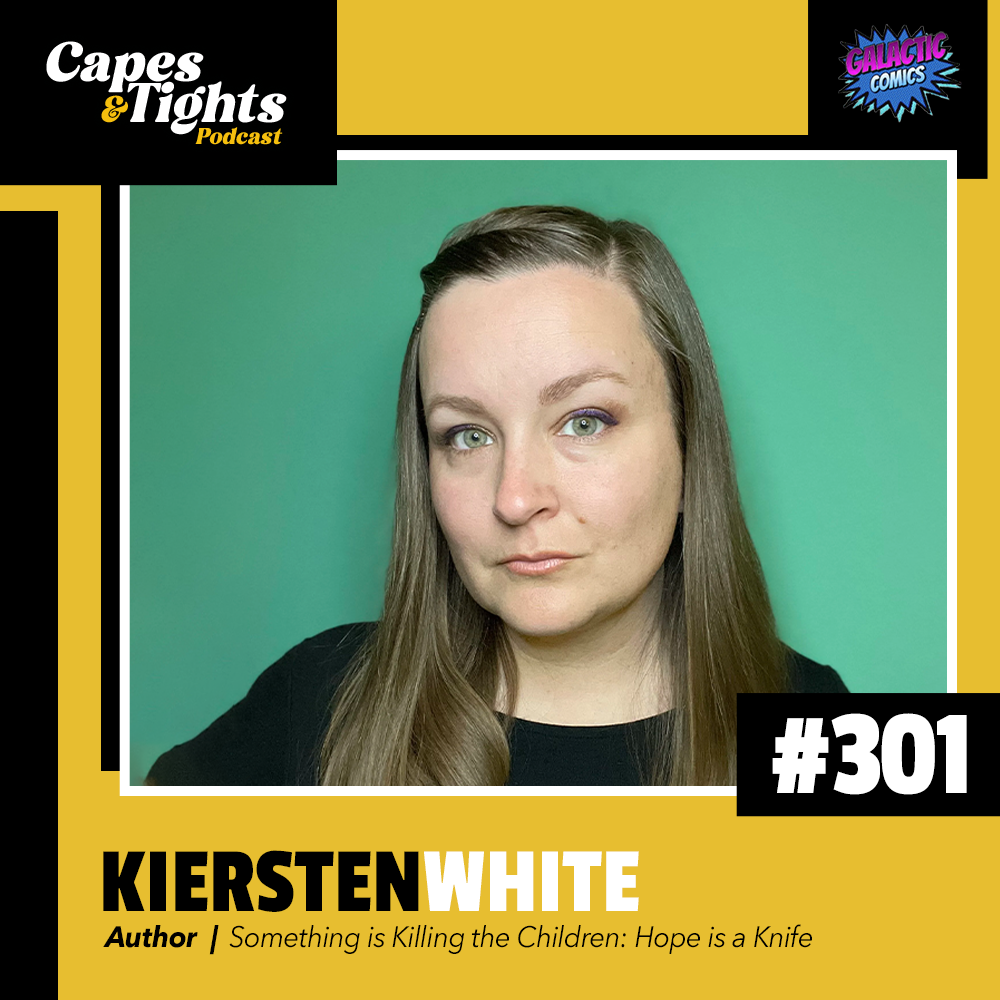
[00:00:00] Speaker A: Welcome back to the Capes and Tights podcast right here on Capesandtights.com I'm your host, Justin Soderbergh. This episode is once again brought to you by our friends over at Galactic Comics and Collectibles at galactic comics and collectibles.com this episode we welcome number one New York Times bestselling author and Bram Stoker award winning author Kirsten White to the podcast who is the author of books such as Mr. Magic, the House of Quiet, the Fox and the Devil, Hiding from the Dark, a Star wars horror novel and the first ever prose novel in the Slaughter verse. Something's Killing the Children. Hope is a Knife, which Kirsten co authored with creator James Tynan IV, which is available October 13th at bookstores everywhere in your comic book store. But yeah, Kirsten joined us to talk about Hope is a Knife and so much more in the Something that's Killing the Children universe. But before you listen, follow us on Facebook, Instagram, Twitter, Blue sky threads, all those places. You can rate, review, subscribe on Apple, Spotify or wherever you find your podcasts. You can also visit Capesintites.com for so much more, but this is best selling author and Bram Stoker award winning author Kirsten White chatting. Something's Killing the Children. Hope is a Knife. Enjoy everyone.
Welcome to the podcast. How are you today?
[00:01:14] Speaker B: I am so great. Thank you for having me.
[00:01:17] Speaker A: That's been, it's been, I mean, since Mr. Magic. I thought I found you through Mr. Magic. So since then I've wanted to get you on but now, I mean you're crossing over into comics and well, kind of multiple. Because you got Mr. Magic as a graphic novel but also with Something that's Killing the Children, Hope as a knife. So I'm glad you're here finally, I guess.
[00:01:34] Speaker B: Thank you.
[00:01:35] Speaker A: Yeah, it's not that you knew that you wanted to should be on here, it's just that I never got ahold of you to be on here. How about that? So it's not like you've been ignoring us here at the podcast.
[00:01:45] Speaker B: No, I'm slippery, I'm hard to get ahold of.
[00:01:49] Speaker A: But this is amazing and it's so funny because I didn't connect the dots. I'm a huge something Telling the Children fan. I have been since the first issue came out out. I'm a huge anything James Tiny in the fourth touches period. Like, and then it's like didn't like connect the two dots when I was talking to my local bookstore owner about this, this, this novel and he's like, yeah, she wrote Mr. Magic. And I was like, wait a second, that's the same person.
I was like. And so it was kind of funny. And he's like, we've got to see if, you know, they want to come up here and talk to us in Maine. And so at some point, hopefully, we get you to come up here to Maine, but until then, we'll just chat on the podcast. That sound good?
But, yeah. So I guess you've written horror fantasy, you know, Star wars, historical fiction. You've done a lot of things.
But what with this something skilling the children, Hope is a knife. How did this come together? Did James approach you? Did Tiny Onion? Did some. Well, how did this come to get to be what it is?
[00:02:52] Speaker B: Yeah. So, I mean, yeah, putting it in context, obviously, I'm an established author. I have dozens of novels, and in the last few years, I've moved into adult horror, specifically. I started out mostly in young adult, and so I had kind of made a name for myself there. And also, you know, word is out that I work in licensed properties as well. I've done Star Wars. I've done Buffy the Vampire Slayer.
And so people know that I'm. I can do that kind of work because it's a very different kind of work, creatively, logistically. Like, it's. It's not necessarily a type of work that every author can or wants to do.
So I do get approached about things a few times a year. If it's something that I'm a really big fan of, I'll make space for it.
But you have to consider it carefully. Right. Because it's taking me away from your own original properties. And I got contacted by an editor, I think it was a couple of years ago now. What is time? Who knows?
And she said that they had just gotten the rights to work with James and Boom Studios and Tiny Onion in creating an original novel set in the world of Something Skin to Children and asked if I would be interested in it. Full disclosure, I did not grow up reading comics. That was not a format that was. Was accepted in my house. It wasn't like it was against the rules, but it wasn't considered real reading. Right. And it wasn't until I had kids of my own and they got really into graphic novels that I realized this was a type of literacy that I did not have because comics and graphic novels require visual literacy, which is. Which is really different. And so I would read the graphic novels alongside my kids to try and build up that visual literacy, because it really Bugged me that there was this whole area of amazing storytelling happening that I was not good at reading.
And so it really was like a years long project for me, getting good at reading comics and graphic novels.
And I loved them. I found so much incredible stuff. But there were a lot of areas of comics that I hadn't dived into yet because it was mainly focused on things in my kids were reading. Spoiler alert. I was not letting my kids read something as killing the children because sometimes I'm an okay mom.
And so when they reached out, I said, give me two weeks. And I got the first omnibus and I started reading and I did not come up for air. It was very much as soon as I started reading this, I connected with Erica Slaughter. And I was like, this. This is the story that I've been waiting for. This is the protagonist that I've been waiting for. This is the answer to everything that has frustrated me.
Other spaces in horror comics that I have dipped my toes into.
This is the answer.
And I loved it. I found the storytelling to be so compelling. I mean, further, Delladero's art is phenomenal beyond compare. And James's writing and world building I find so, so sharp and incisive. And I love how he gives you just enough, but never more than that, right?
I love that Erica, we know her and we understand her, but she's so spare and she still is almost enigma. And I love the whole, like, almost wandering samurai aspect of it, right? Where she's just like going from town to town. And the way James puts it that I love is Erika is the protagonist of every. Something is killing the children's story, but she's not necessarily the main character.
And I thought that was such an interesting way to approach it. So Erica becomes almost like, who's the Poirot, right? Like the Agatha Christie or Sherlock Holmes, but you know, with a lot more blood and violence.
And so I loved it. And I was like, I have to have this project. I mean, I'm gonna read the book no matter what, but if somebody else gets it, I'm gonna have to hate them forever. And I don't need more nemeses, like, I have enough.
And so I was like, yes, I'm very interested. I want to do this. I pitched them my concept. We knew we wanted it to be like a standalone prequel, right? So it functions within the storytelling that already exists. And something is killing the children, but it's a new story you haven't heard before, and you don't need to have read the comics. First, in order to dive in here, like, obviously I think you should read the comics, but it works in either direction. It works if you've read all the comics and you're a long standing fan. It also works if you haven't dipped your tongue to them yet.
And so I pitched the kind of the concept, the framework that I wanted to use, the ways that I wanted to sort of dive in and explain, expand the story, because you know you're going to structure it differently for a novel than you would for a 15, a 15 issue comic arc. And so James and I went back and forth a lot. They gave me the job. Spoiler alert.
James and I went back and forth a lot in that stage. We talked about who Erica is, like, how she would feel on the page, because novels are inherently more interior than comics because you're in everybody's head, you're seeing everything through their eyes instead of, like looking at them.
And so we talked a lot about that. We talked a lot about characterization. We talked a lot about the feel, right. We talked a lot about how important it was not to get lost in the weeds of the Order of the Dragon, which is this order of monster hunters that exist within the world of Something Is Killing the Children. Which by the way, just to give everybody just a very brief summary of the series, in the world of Something is Killing the Children. When kids imagine monsters so vividly and viscerally, they actually can imagine them into being and the monsters come and kill a bunch of children. And Erika's job as a member of The Order of St. George is to find those monsters and kill, kill them, keep them secret, but also just make sure that they don't keep killing children.
The funniest thing is when I was writing this, I was talking to a friend. I was like, man, this one was really intense. Like, it was kind of harder to write than I thought it would be. And she's like, do you kill kids in it? I was like, I mean, the series is literally called Something is Killing the Children.
So yes, kids died. She's like, oh, yeah, yeah, that's true. Anyway, so, yeah, we did a. We did a lot of back and forth just really laying the foundation for the book, talking about what we, how we wanted to feel. James was very much like, I wanted to be like the intersection of Stephen King and Agatha Christie.
We really talked about how the location needs to be a really vital part of the book. Almost a character like you have in Archer's Peak.
And then. And then the next sequence in New Mexico. And I Can never remember the name of that town because I have the worst memory ever.
Anyway, all this. All this to be, you know, all of that.
A lot of. A lot of things that I just dumped on you. But, yeah, basically they reached out, they said, are you interested? I was like, yes, absolutely. And then we went from there, and it was a really, really fun, interesting process.
[00:09:41] Speaker A: What's funny is you talking and going on like that is like, it's great because it also shows the passion you have now for. It's like one of those things that, like, you know, if you're going to be like, oh, they're going to write, you write a story. You wrote a Star wars book that's it's coming on September 1st. Like, you. If you're a Star wars fan, you're like, yay, finally, I get this. But there's also the other side, the flip side of that, where it's like, you knew it was there, you knew was somewhat popular and you people were reading it, but you hadn't dove and dived into it yet. And so now you're like, holy shit, I get to do this. Like, this is like, I get to. I get to play in this world. And not very many people have, like, there's a few comic creators, there's a couple artists and a couple of writers who have been able to write like, a James Tanya story. So you have Tape Rambo, who's like the House of Slaughter and things like that. But, like, it's still, like, not very many people have been able to play with these toys, whereas Star wars, there's a lot more people nowadays who have been able to play with these toys.
[00:10:34] Speaker B: Yeah, it's true. And honestly, it felt like an honor and a huge responsibility. Right.
Because James was allowing me to inhabit Erica, who is just, I think, one of the most iconic characters ever, and she's his creation. And so, I mean, I take it really seriously when I am working in licensed properties. And it's why I don't say yes to very many, because I have to genuinely, genuinely love, love the property.
Both. Both to be willing to spend time in it, but also just out of respect for the creators, but also for the fans. Like, I'm not gonna jump into a property that I don't care about because I know how much the things that I love as a fan mean to me, and I know how much it would hurt knowing, like, if somebody came in and wrote it and they just didn't care about it. So, yeah, like, I take it really seriously.
[00:11:24] Speaker A: Yeah, they could have said, oh, you're good at writing, so write this book. You're not super passionate about it out there, but you just want the paycheck and move on. And there are people out there who would do that. But obviously, having a passion allows it to be easier to write as well. I mean, I can't imagine me. I can't imagine I'm not a huge. I have another recording later on with the person who wrote a Dungeons and Dragons comic book. I don't do Dungeons and Dragons. So to me, I'm like, I don't know what I would talk about. That's gonna be a very small part of that conversation. The rest of it's gonna be some other stuff. But so, yeah, being passionate about it does that. And I've always said that to people you're new to it or old to it.
Those people who write the best adaptation or stories that are based in an IP or some sort of other universe are the ones that are fans of it. And so you can be a fan of something you just learned about last week, but you also can be a fan of it since your childhood. And was there some of that? It's so popular, it's so loved in the horror comics community that. Was there part of that where you're like, I'm going to mess something up, or is that. Was that just, like, as long as James is by my side, I can figure this out?
[00:12:26] Speaker B: Yeah. I mean, I. I joke that I actually want to have James as co writer on everything.
Go on. It was. And honestly, yeah, it was such a confidence booster. And also, just, like, I could gut check things with him. Right. Like, we knew we wanted to include some, like, backstory reveal. Right. And I was like, I don't want. I don't think we should do one of the trials, because I want to see that play out visually. I want to see further illustrate that. And James was like, yeah, you're exactly right. We don't want to include one of the trials. And so I was like, can I include this thing instead? And we talked about it and talked about why it would have meaning. And, like, it was so nice getting to build this with him because I then have the confidence that, like, I'm doing it right. Right. I'm not. I'm not messing up this beloved iconic character and property because, yeah, James and I, like, especially in the planning stage.
And it was great because I would get notes like, can we include more Octo? And I hadn't included that much Octo because I was like, I don't know if I'm allowed to. I don't know how far I can take this.
And James was great. He's like, no, push it further, push it further. And so, yeah, it really made the whole process so much easier, but also made me so much more confident in it, in that it was James and I doing everything together. So it's still his. Something is killing the children. It's just, you know, my little. My little corner of that world.
[00:13:54] Speaker A: Well, I can also imagine, like, if you came up with an idea and it was like James had a different thought in his head moving forward. Like, this is obviously a prequel, so it does affect technically stories moving forward in the Summons, the Slaughter verse and all that stuff. But, like, he could have been like, well, that actually sounds good. So he could change it. It's not like he has to stick with something. So whereas Star wars or Buffy or something like that, they're like, there's a lot more people you have to answer to. There's a lot more people who have their hands in the cookie jar than just you. And so because of that, it's a little more tight constraint, I'm guessing, on that. Whereas James can be like, actually, that's a badass idea. Let's do that instead. And it's his thing. Yes, obviously he has to answer boom. And all those other people, but still, it's still his baby.
[00:14:35] Speaker B: And it was also nice because he does know where they're going next. And so, you know, while I didn't get necessarily spoilers, there was that sense of like, we're not going to mess anything up continuity wise, because James already knows what's going to happen. So, like, I didn't.
Sometimes when you're writing ip, you'll do this whole, like, sequence and they'll be like, actually, you can't do that for reasons we can't tell you. But. But working with James, it was just all, you know, he. He has it all in his head. He knows what's coming. And so that was never an issue, which was really, really nice.
[00:15:05] Speaker A: Yeah, well, I've seen that. I've actually heard people talk on podcasts and interviews and things like that. I was writing a TV show about X, Y and Z. I wanted to use this character. And they said no, which then had me. Me thinking, like, what are they gonna do with this character? Like, I'm so excited now. And it's possible they just don't want you to use the character. But in the same sense, it's also like, is there gonna be in a TV show or movie later on, like.
But there's also this. This. I love the fact. So I saw the first announcement of it, and I was like, gonna read. Don't care. It doesn't matter what it's about or gonna read it. It's something that's killing the children. I'm gonna read it. Then obviously, I'm like, oh, Gearson's attached to it. This is amazing. So there's all this, too. But. But I love the fact that it's not just an adaptation, because it could easily have been a way to get people into the slaughter verse by taking the first volume of Something's Killing the Children and just adapting it into novelization.
And it would have potentially worked because there is a way. There's an avenue there. And I have done that. I've read all. A bunch of the Marvel story arcs, your Secret War, Secret Invasion, all those ones. I've read the adaptation of it because I love those stories. So I want to hear it in a different voice and maybe a little bit expanded in certain places and so on. But the fact of the matter is that it's a new story in the universe, I think, just does so much more for it, because I feel like now those people who are fans of the comic book might read the prose novel, and those who only read novels might read the thing without having to duplicate it. So you're not like, I'm just rehashing. I mean, that must have been important. It sounded like it when you. When we first were having a conversation here, that it was important, but it seems like it's going to do so much mutter for the story. Do you believe that?
[00:16:40] Speaker B: Yeah. Yeah. And I think James and I both, like, neither of us were interested in just redoing something that had already been done, because, honestly, you can't improve on Archer's Peak. Right.
That story has been told and told so well.
I don't think it would benefit from having a prose adaptation.
Whereas this, where it is a prequel, we get to see Erica again, avoiding spoilers for people who haven't gone into it. But something very big happens in the Archer's peak sequence that breaks a lot of things that have come before. Right. A lot of the established aspects of Erika's life get broken during the course of the Archer's peak sequence.
And so it was fun to get to sort of go back when, you know, certain characters who are no longer alive at the start of that are still alive. And we see Erica when she's a little bit younger, when she's still like fully in this organization, the Order of the Dragon, and it's still fully functioning. She's doing her job for them. But we start to see those cracks, right, that are gonna, that are gonna turn into fault lines.
We see the beginnings of those. And that to me, when you are really into like a world and a character, getting those insights and getting to see those, it's really exciting. Like, and we've seen that in something that's cool in the children.
The last few issues have been when Erica was much younger, a teen.
So it's just for me, I love that stuff. I'm like, give me more, give me more, give me more insight. Let me see, like what was the origin of this specific thing? And so, yeah, I think we always knew it needed to be a new story because otherwise why wouldn't you just have further illustrate it?
[00:18:31] Speaker A: And there is this spot where there's people like you mentioned about comics and it's funny. My son, who's five, he's huge into Star wars right now. It's clicked. He went to Disney World with my parents. And just before he left, I was like, what movie do you want to watch that you haven't watched for Disney that you'll potentially see at the park? And he's like, Star Wars. So we watched the New Hope, which I stupidly, as a parent, any recommendation to any parents start with episode one when you're a kid because they don't understand the whole non linear part of the story.
He's like, well, where's Luke Skywalker? I'm like, well, he's not born yet. And I'm trying to explain that Anakin Skywalker is Darth and it just doesn't work. Obviously the best ones are the original three, but for this kid who's five, you need to start with one and go forward because they just need to know the linear progression of the story. But it was funny because last night he was talking about how he can't, he doesn't know how to read yet. And he was like talking about how he can't wait till he reads becomes an adult to read comic books. Because in his mind I'm a comic book reader and I'm an adult. So in his mind there are four grownups and they're just a Star wars comic book. So it could be read by a younger, younger child. But it was just kind of funny. He was like, like this is for adults. And so there is this either stigmatism or disdain towards comics. So there is this ability that there are People who are going to read the story, who will never read the comics just because I read novels, and novels are for, you know, adults and comics for kids. And even though this does say killing the children, and I don't know how you would connect that way, but. And so there is that. So this. Having this.
I was trying to battle battling back and forth on whether or not I wanted it to be a straight adaptation or a new story. And personally, I wanted it as a new story because, again, I've read everything. I don't need to do that again. And Werther is a phenomenal artist. So, like, why would you want anything different? And so. But I guess there is that aspect of it, like having to use. And you did a wonderful job at explaining and vividly, you know, some of the artwork that you get to see, you now have to write in prose. And so was there, like. Were you looking at imagery of Erica and Octo and characters from the stories of the comics when you were writing this story to make sure you get them visually across to people who were just reading words?
[00:20:41] Speaker B: Yeah, I mean, not so much with the characters, because I feel like James's writing, he.
And obviously where there's, like, expressions and everything, but James writing, he captures the character so well. For me, the thing that was the hardest to try and capture, not imitate, but capture the same feeling. Right. That's my big thing when I step into an existing world, is I'm not trying to imitate what's already there. I'm trying to give you the same feeling. So, like, when you read Hope is a Knife, I want it to give you the same feeling that you have when you read the comics. Like, when you read my Star wars novels, they wanted to give you the same feeling that you have when you watch Star Wars. Right.
And so that's when I always come back to is I want it to feel the same. And so the thing that I would do the most is I would look at the action sequences and the ways that those play out and the way that even though they're, like single images and still images, there's so much movement, they're so visceral.
There's so much tension. Right. And so I would just go over and over and over those. Those action sequences and the monster sequences and look at Werther's art and try to figure out how I could accomplish the same thing with just text.
Spoiler, you can't.
But I tried really hard. And I think we got close.
And. And so, yeah, it was mostly just that Feeling that. The feeling of the art, the feeling of the story. And how can we recreate that while acknowledging that it is a different format and it should be portrayed differently? Right.
I'm a really big proponent of adaptation in that I think you should always tell the best version of the story for the medium you're telling it in. Not necessarily the most faithful story, although obviously this is canon. It's incredibly faithful.
But in terms of adaptation, I just want it to be the best version for that.
[00:22:44] Speaker A: Yeah, yeah, it makes sense because, like, I've talked to people who have written screenplays. Daniel Kraus is a primal example. Daniel Krause, Dale's is big friend of the podcast. He's amazing, actually.
[00:22:56] Speaker B: I love him.
[00:22:57] Speaker A: We did. I work for a brewery by day, and so we did WhaleFall, the IPA when WhaleFall, the book came out, and Pay the Piper. It's actually right here, too. But, yes, Daniel's a friend of ours, but he's written screenplays, he's written books, he's written comic books. He's right. And so when I've talked to people like him, it's like there's a story in his head. It's sometimes a comic book, it's sometimes a book, and sometimes a movie. It's just the way it is. And so there is this. It's a comic book story, something telling the Children. Volume one is a comic book story. And so adapting that, you would have to change some things and do some things different, which would potentially take away from what it can't. I'm glad that this side note, glad that this came out before any screen versions of this came out, because I feel like now people are going to, you know, compare the novel to the screen unless the, you know, like, there's this weird, like, each one is for what it is, and when they go on screen, it's going to be different. Because there are certain things you can accomplish on a comic book page that you can't really do easily on a screen without spending a ton of money.
And that's what they said, like. So it's like one of those things like writing in a book or a comic book. You have an unlimited budget. Like, you can do whatever you want. You can make things crazy and do amazing stuff and explosions and fight sequences that you can't really do on screen because it could cost a lot of money. And so there is this place for everything. And I think that that's where. But I think that's why it's like this story was probably needed to be Told in prose, novel and not on a comic book page. Even though as I'm reading it, I'm like, I could see this is a comic book as well, but I think that's what it's great about. I said it's its own thing. But you also have to then balance your writing in James's writing and the story altogether. So you want this novel to feel like a Kiersten White story, but you also want it to feel like a James Dynion story. You also need it to feel like it fits the vibe of something that's killing the children. I'm guessing that was a balance that was probably trying to figure that out along the way as well. I mean, I guess it's somewhat like that in your other adaptation, like the Star wars book. I'm guessing it's somewhat. But no offense, but other people showing up because it's your book. It's a Star wars horror novel. Or is it. Is it peak because Darth Vader's in the COVID You know what I mean? Like, is that one. I think there's a mixture with this one. Something's Killing the Children is a mixture of your readers and the people who are fans of the series. I think there's a mixture where Star wars is probably more closer to, oh, my gosh, Darth Vader's in the COVID of this book than there is that. You're the author.
[00:25:17] Speaker B: Yeah. And that's a good distinction to make. And that's interesting that you brought that up, because I do definitely feel like my Star wars novels are read by Star wars fans. And most of the people who read them do not go on to read my other books. Which is fine.
I get it. Like, that's, you know, I. You know, you. You have your property that you love, and you want to stay in that. That's totally fine. And I really enjoy writing for them. And so. But yeah, with this one, it definitely feels a little bit more like we're both bringing something. Something to the table, I guess.
But I think that's probably part of why they picked me, too. We sent them Hyde, my novel that I think is probably the most similar to this one in terms of, like, voice and structure, where it's multiple points of view. You're shifting between points of view for every section.
And then also, if you've read Mr. Magic, which. Thank you.
That one is interesting because I feel like of all of my books, that's the one that never goes away.
Right. Because you'll have books that will have periods where they do really well. And then it goes really quiet. Mr. Magic just kind of like, quietly, like, keep selling and selling and selling and finding new readers. Like, you'll have books. This is a weird example, but like on Goodreads, which is a ratings site where people can review books, most of my older books maybe get a new review every couple of weeks. Mr. Magic, it is like, new reviews every day.
And that book came out in 2024, 2023. I don't know. It came out sometime, but not that recently. And it is still finding new readers who are engaged and interested enough to go and write reviews and talk about the book. And so Mr. Magic is, on the surface, it's about the last cast of essentially a cursed children's program that ended in tragedy. Thirty years later, they reunite for a podcast and have to grapple with their memories of the show.
Was it real? Was it something a lot more sinister?
But all of that is sort of a way of me exploring religious trauma and this particular brand of religious trauma that a lot of kids of, you know, my generation around were on the receiving end of. And so, unsurprisingly, something is killing children.
When we were talking about the angle for the book, I was like, james, can we do religious?
Because it's set in a small town.
I think small towns lend themselves so well to that because you get sort of a monoculture going, right?
And then where Erica is coming from, this very structured, not religious order, but has those trappings, right?
It has. Has. It has the rituals. It has the. Like the. The traditions and the. The clothing. Right? And so I was like, I think it would be really fun to explore religious horror.
Not in. In a sort of sideways way, right. But making it a part of the novel. And I think that is probably the biggest part where people are gonna be like, yeah, this is a Kiersten White book.
Because I do. I do keep hitting that. But, you know, write what you know. Right, Yes.
[00:28:41] Speaker A: I mean, the benefit, I guess. Well, you're an established author who has books, like, multiple books, like you mentioned. So, like, you also have to think about. You don't want to just always write an outlier, because that outlier.
Safe to say, you want to sell your other books, too. I'm just like, it's one of those things. And so it has to fit that multiple categories. And James wants you to be successful, too, so it's like he wants to sell more comics and more. All this, like, it goes back and forth. And this is a business, it's an artwork, but it's also a business. And so having it be so far of an outlier would really not work as well, because then someone's like, what's your next book you want to read? And then you're like, don't read this book.
[00:29:20] Speaker B: I guess.
[00:29:20] Speaker A: But Mr. Magic was.
To me, it was like, if I wasn't a summoning skill in the children fan, I probably would have still picked this book up, because the fact that I was such a big fan of Mr. Magic, and it's one of those. It's like a handful of books where I'm always just like, I don't care who you are. I want you to read this book. And that Mr. Magic is one of those ones. A buddy of mine who's hit or miss, he listens to a lot of audiobooks, and he's like, hit or miss on what he wants to listen to. And I'm like, read this book. And afterwards he goes, you suck. Because I loved it so much. And so, like, it's like, it was just. It was. It's one of those few books that I'm always just like, you know, read this book. Because there's something that it connected with it. And, I mean, I grew up in the 90s watching, like, Barney and things like that, so it's probably why I connected with it a little bit more. My dad's a pastor, so there's also religious stuff in there as well. And so. But that's probably why there's a personal reason why I connect with it. But, yeah, so to me, I'm like, I felt like it was your book, but I also felt like James was there. And so I'm guessing you took the majority of the physical writing, and it was, like, bouncing ideas off of James, and it's his creation. So that's why it's like, here's nobody with James.
So you were like, it's your book based in his world with his input on it. That's how the duties were basically separated. Like, he's not sitting there writing out dialogue or things in the book.
[00:30:30] Speaker B: No, no. So we did a ton of work beforehand, right? Like, the plotting and the outline, figuring out the structure of the book, the characterization.
And then I would draft it, and then James would give me editorial feedback. Right. Like, you know, one of my favorite lines was, erica's gonna be a bigger asshole when she meets people and they're not nice to her. And I was like, yes, I can do that.
And.
And so, yeah, it was. It was kind of like the raw material I was putting it down. And then James was helping refine it. So, yeah, it was, it was. It was a fun process. It was a really interest.
But yeah, I mean, in the end, it's James. James's characters, his world. His world set up. None of this would exist without him. And he was a really, really.
He was a great co author. It was really fun getting to do this project with him because you never know, right when you're embarking on something like this, like Star wars. You have the Star wars editorial team who are fantastic to work with. I love them.
And you do, you. You do the outline and the pitch, and they tell you what you can and can't use. You write the book, they go in and they give you notes, and like, it's the most amazing things. Like, actually the entire planet, of course, on is climate controlled. And I'm like, oh, I love that. That's amazing. I had no idea.
And so this one was a lot more. This one was a true collaboration, which I have not done in licensed property work before. And so it was really. It was really a cool process and I enjoyed it a lot.
[00:32:03] Speaker A: What do you mean? You didn't sit down with George Lucas during your Star wars books and say, hey, how are we? Can I bounce some ideas off of you on this book?
No, not so much. Not so much.
And that's the thing. It's funny because, like, we've always talked to. I talked to these creators who are writers or more writing nowadays than they were art. And, you know, the opposite. Like, they used to be artists and they always do art. Now they're writing a lot more and not doing as much art. Maybe do a cover for a comic book here and there or whatever, but, like, they just don't. Don't do it. And a lot of the answers they give me is I have so many stories I want to tell, but it's so much more time constraints on doing the artwork and I can write some stories. And so when I saw, like, House of Slaughter came out, which is the offshoot from Summons Killing the Children, if anybody doesn't know that comic book series and Tate Brommel is like the scripter of it, but it's still James Tynean story. And so James is probably like, I got so much to do. I'm gonna trust someone in that. And that's what this is probably like. It's like James probably would have taken a crack at writing this novel, but, like, he's also got a lot of other things to do. So why don't we have someone who writes novels for a living do this, that I trust and that I want to do it and that the publisher trusts and things like that.
But we can tell the story together, and it's still in my world. I can still build off of it and things like that. So that's what I'm guessing is what. I don't want to speak for James, and I don't want you to speak for James. But, like, I'm guessing that it just is the best for this story in this universe to have you write it than have him sit there on a daily just typing out pages on.
[00:33:26] Speaker B: I'm guessing absolutely. If James ever writes a novel, I will be the first person in line to read it. He is, I think, honestly, one of the best writers working in comics today. He's a phenomenal writer, but it's time consuming, Right? And it's also an issue of format. Like, I've often been asked if I will ever write a graphic novel or a comics series, and I used to think that I would until Hyde got adapted. Hide the graphic novel. It was adapted by Scott Peterson, who is incredible. He's worked on a ton of stuff. He's really, really smart.
And then art by Veronica Fish and Andy Fish. And I was like, well, I'm just gonna do editorial on the script. I'm gonna see what. What you actually write for a graphic novel script, and then I'll learn how to do it. And when I got that first script, I was like, oh, this is so much more technical than I ever would have imagined that it was. It's so specific. It's so intricate. And Scott knew so much more. I mean, Scott had a lifetime of knowledge, not just of working in comics, but of loving comics. And, like, he would. He would make these references like, I want the angle to pan down like this, and then I want something to be coming in from the edge, like. Like XYZ from so and so's run on xyz. And I'm just like.
Like, just the references. Like, I didn't even understand the references, but him throwing that in. Veronica and Andy, who, again, also are some of the best out there, immediately were like, oh, yeah, we know. We know what that means. We know what to do. Or my favorite is they would come back and they'd be like, we don't need this text. We can do it in just the art. And they were always right.
And working with people who were so good at that format, they also, all three of them did. The Mr. Magic graphic novel adaptation just taught me that like, if I respect a format, I'm going to put in the time that I need to in order to do it well. And if I wanted to learn how to write graphic novels and comics, it would take me years. It would take me years of studying, of pulling things apart, of researching in order to get to the point where I felt like I could do it justice and I don't have time.
[00:35:32] Speaker A: It is true.
It seems like to me, over the years that it's, I say, easier. It's more easy to come from, like, the film background to do a graphic novel than it is to do from a novel background to do graphic novel. Because film, there's that angle, there's the. Let the what the imagery speak for itself and not have to. And so there's that screenplay writer writing a comic book seems like it's a little bit easier of a transition than it might be someone who writes a prose novel and comes over to comic books for that reason. It's more visual. The visual thing is the primary thing and the secondary thing is the words that are on the page. And so, yeah, I can see that. And again, the same thing goes. James might be intricately involved in doing the adaptations on screen because again, he works in the comic book world, and that might be a little bit easier of a jump than doing this. But to me, it was like, as a comic book fan, being able to work alongside James, it's probably just a dream come true in the first place for anybody who likes that stuff. So having that partnership, I also think that that's huge in comics. Partnership, you don't get that as often in novels. You're sitting there writing Mr. Magic. It's you on an island with maybe some confidant people that you have around you, bouncing ideas off of here and there and your editor. But other than that, it's like success or failure. It's really on you. And so at least in comics, you can be like, the artwork sucks, or that guy can't let her or that guy. You know, like, there's a blame that can be passed around to people, whereas in pro's level, it's pretty much you. And so there's that pressure on you to do it. So there's a little, like the teamwork. It seems like it's awesome to have this James and Kirsten, because then it. Then it's a teamwork, like comics. And I think that's what's really cool about it. You bounce ideas and they. Both of you guys can be like, nah, that's not going to work or. Yeah, let's do that kind of thing.
[00:37:10] Speaker B: Yeah, yeah. The genuine collaboration aspect of it was, I would say, my favorite. Yeah. I mean, and I, you know, if you ever have a chance to collaborate with James, I recommend it.
[00:37:20] Speaker A: Well, I've always said that. I've always said that. So, like, I have, like, maybe three ideas percolating for comic books.
No way in hell I could script them. Like, no way in hell. I'd have to find an established comic book creator who's like, let's do this together. And I come up with some ideas, and I say, let's do this, that, and the other thing. And that person's like, let me script it. And they actually write the script out for what people are saying on the pages, but, like, the overall idea. And there are people that are really good at world building and then not so great at, like, executing the pages. And I've read some comics like that where I'm like, can they just create the world and let someone else read the comic book? And that's. I feel like that's what I would do. I would do it, and people would be like, great idea, dude. The comic book sucked. Like, that's like, if you just figure out how. But so if I can, like, attach myself to a couple of people who, like, I've written comics and say, hey, I got an idea. Do you want to write this together? I bet I can get it made to do the by myself thing. I don't think I would be able to script a comic book very well because, again, I read comics, but the technicality of it is just not there for me. And I'm an artist. No way I would want to do sequential art either. I'll do a comic book cover. There's no way I'm sitting there doing the same character 17,000 times in one comic book, going like this, and then like this. It's just not me. I'll do a cover. I'll be a very good cover artist if I ever wanted to be. But not a sequential art. And so there is a story for each medium and things like that. But the collaboration part is awesome. I love that collaboration part with that. In this. In this story and in this, you've now lived in Erica Slaughter's mind in the world, the Slaughterverse, and so on and so forth. Do you want to stay? Like, is this not staying? We haven't. The book hasn't technically come out yet. But, like, my point is, and I'm not saying that you want to, but, like, a couple Years down the road, they're like, hey, let's do another one. Are you the first in line to say, yes, I want to do this, or was it, you've done it now and I'm ready to move on?
[00:39:05] Speaker B: Yeah, I mean, absolutely. I would be open to working with them again because I love the character so much. And like, I said, James was like a dream collaborator. Right. He was so fantastic to work with.
But also, like, as a fan, I would kind of want to see another writer come in. I would want to see another writer's interpretation. I would want to see how they worked with James, like, what they came up with together.
So, yeah, there's the worrying parts of me, right? There's the. There's the part that's like, yes, I want to do it, but then there's the part that's a fan that's like, I want to see what somebody else does with it too.
So, yeah, I don't know. I don't know if I would be like, choose me above everyone else no matter what, or if I'd be like, oh, actually, I know so and so would be amazing.
[00:39:45] Speaker A: So are you now, as a fan, permanently in the Slaughterverse, like, you're always going to be reading things from the sliding thing that comes out in this world? Yeah, the comic books. Books. I didn't like that. Movies. You're gonna. You're now. Now you're in as a fan. Forget the working part of it. Just, I wanna be part of this.
[00:39:58] Speaker B: And actually, it was nice once I finished the book because I'm like, now I'm in the clear, I can just go back to enjoying things as a fan, which I was anyway, when I was writing it. But, like, it is nice once you have. Once you have cleared your slate and you can just go back, like, you know, once I finish the Star wars novel, I can just go back to, like, not using Star wars as research, just watching it for fun.
So, yeah, it is. It is fun. And I'm like, I'm so excited because they have so much coming up.
[00:40:28] Speaker A: Oh, there's so much coming up. And they're all. It's like. There's just, like. There's just so much potential too. Like, there's no. Like, when you first read the first. Like when I first read the first five issues, the first volume, like, oh, this is gonna be sweet. And that's where most of these things stay. Five issues, maybe 10 if it's an ongoing. They continue or whatever. But the offshoots and the offshoots being Successful in the prequels. And then this and the potential, you know, we get Netflix involved now and all this stuff. Like just this universe itself. Like, he could probably stop everything else and just focus on something killing the children. There's enough story there. And the amazing part for all of us is it's. There's more than that. So you've got like, exquisite corpses, which. I'm in Maine here, which is awesome because this first three volumes are based in Maine, a fictional town in Maine, which made us happy here in Maine. We never get things like this. We get Stephen King and that's about it. Which, again, is a good hat to hang out.
But, like, other than that, it's like, okay, so it's here in these, like, fictional town in Maine. We're like, oh, my gosh, this is amazing.
But there's just so much more to it. But you mentioned Star Wars. So this book comes out October 13th. If anybody is wondering that bookstores everywhere, which is really cool because there is so much other Slaughterverse stuff in trade format that your bookstore also can get that too, which is really cool. So single issue floppy comics that come out monthly are only available to comic book stores. Like, you can only get them there or digitally online.
But like Craig Paperback. So like the collection of like the first five issues and omnibuses and all that stuff of all the collections are available at bookstores. And so, boom, sells them to distributor, distributor, sells them to a bookstore. So you can just tell your local bookstore, I want hope is a knife, because I want to read the book, but also I want the omnibus or whatever to read the comic books, because they can get them, pick them up one spot, which is amazing. And, and. And I'm in rural Maine, and so there are far more bookstores than there are comic book stores, which is very interesting. So, like, if there's. We're always like thinking to myself, yeah, buy them from your local book comic book shop. Because they need their money too, because they're small and they're independent. But bookstores can get the trades easily. And that also means that, like bookshop.org which is a website that helps independent bookstores, you can get it. This is an audiobook. So there's an audio book that's going to be coming out for this. So, like, that's like, that's cool too, because, like, then you can listen to it if you don't read a book.
[00:42:36] Speaker B: Books.
Do you want to hear something extra cool, though?
So there will be.
So if comic book stores order it, you will be able to Purchase Hope as a knife at your local comic book store.
[00:42:49] Speaker A: Yes, yes, thank you for pointing that out. Yes. Because that would be a that. And then my local funny is I. I am huge, like into novels and huge into comic books. And so my local comic book store owner is like, actually my daughter, who's 2 is godfather, is my LCS owner. And so, so I go. He's my best friend. So I go there and I say, hey, I want. I'm going to read this book. And so like, I described the what if? Novel series from Marvel that came out over the past couple of years, which is culminated in August into what if the Multiverse is Doomed. And it was a connective five book series. And he's carrying those because I'm like, you might have people in there that are interested in reading a prose novel. And so. But we did the same thing with like the Batman Resurrection series and all that stuff. Like, hey, carry this as well, because it's gonna be worth having. And the best thing about a book is, like, you can carry like a copy and if you sell it, then you just order another one so you don't have to be late. You'll be like stuck with a back, a bunch of backstock. Like you can, you can actually just have that one. Because I'm guessing it's gonna be a little bit harder for a comic book store to move a book than it is a comic book.
[00:43:46] Speaker B: But.
[00:43:47] Speaker A: But yeah, in the Slaughter Verse, though, maybe not. Maybe those.
The number one selling trade paperback in my friend's comic book store is volume one of seven the Children. So like over the number of years, and, and it's the one that he just continuously has to order 5, 10 copies of because it's just, it's so popular. And yes, the title probably has something to do with it. Like, you're like, what the hell is this about?
But it is. And it's like one of those things. When I thought about making my own comics, I'm like, you gotta come up with a title like that that's gonna sell comics whether the book is good or not. Like, just the title of the book is gonna sell comics. And the artwork has been homaged in other covers for people. They've taken like some skill and children made that their cover and things like that. So it's just crazy. But so bookstores, comic bookstores, local. If you can't, yes, you might not like corporations like Amazon. However, if you cannot go to your local bookstore and buy this book, and you want this book, buy it on Amazon. Because show the people over at Tiny Young. And hiring Kirsten to write this book was a good idea. So just get the book. Also, your local library as well is a great resource for that too. And hopefully there's horror people out there. I was actually just at a book speaking with Adam Caesar and Paul Tremblay in Boston last week and they were talking. Two librarians came up to get their book signed, saying, I'm a librarian, one's at a school and one's a town library. And they said, I love horror so much. So I'm making sure that these books are available to the things. Because the young adult horror novels sometimes people don't tend to get. Because there's like that line.
But they're like, yeah, they're like cheering on these people, like, oh, you guys are all great for buying the book too. But these, these people are like these real soldiers right here on the front line trying to get the books in the library. So hopefully this ends up in libraries as well.
But you also have a horror novel, kids. It's a middle grade Star wars horror novel.
That's September 1st out there in physical, in audiobook.
This is your second, third. How many?
Second, yes. Star wars. But yeah, that comes out. What's that about?
[00:45:49] Speaker B: So Hiding from the Dark is a Star wars horror novel. It comes out, like you said, September 1st.
The premise is basically when I was talking with Mike, who's the head of Star wars storytelling and books, he was like, I want us to use Darth Vader, like Michael Myers from Halloween, where he's just this relentless looming figure in the background that is inescapable. And I was like, sold.
I loved it so much. It was so fun to write. So basically the premise is that this little girl has grown up on Coruscant. But you know, the average kid on Coruscant would have no idea who the Jedi were, would have no idea who or what Darth Vader was. And so that was a really fun thing to lean into. Is that anyone who reads the book, he's one of the most iconic villains of all time. We know immediately who he is, but the main character doesn't. And so getting to lean into that sense of like, how would you feel about Darth Vader if you didn't know who he was? Like, he the single most terrifying thing you would ever encounter or would ever encounter. So it was so much fun to write.
And yeah, that one's for 8 to 12 year olds, but adults can read it too. I would say adult books are for Adults. Teen books are for teens and adults and middle grade books are for everyone.
You can read it aloud with your kids, can read it yourself. Like it's just a fun time.
[00:47:04] Speaker A: And I'm always for that because as a big horror fan I'm like, how can I ingrain or at least keep it in the forefront of my kids minds as they grew up? That horror is a place that you might want to live in as you get older without scaring the crap out of them. And I have to be up on the night with them. Like there's like that, that, that line and obviously my son's five, so there's a little bit of time. But to me, like the second I heard about this book, I'm like, I'm gonna read this book. I don't like it, honestly. Sometimes is more fun because it's like, you know, like there's not. You don't have to worry about grossed out moments or moments where you're like, I can't sleep at night myself because it was so unsettling and uneasy. And I just read a comic book like that last night in bed and I was like, I'm not gonna be able to sleep tonight. And so like this, this way you can get that horror but not have to be like overwhelmed or disgusted or whatever it may be. There's a place for it. And that's what I love about horror. And you're, you know, Mr. Magic and Things like that. There's this, there's just so many different places you can be. I feel like there's. Romance can only go so far in, in fantasy and there's certain ones of horror I feel like could be in every single genre with the horror, you know, sub genre or, or that with a, you know. Clay McClaud Chapman just made the romance novel that's a horror that actually when I went to find it was in the romance section and I was like, oh, okay, I understand that. But I don't know if someone who's reading Nicholas Sparks is also going to read this book by you, Clay, but whatever. But yeah, this is cool. And so Star wars is a good place to live because I love Star wars and again adaptations of that. And so it's cool to see that you were able to add to the Star wars universe in this. But it's also really cool to see that you get to basically start the prose adaptations of some of these killed the children in that universe as well, which is really cool. So that must be a like forever.
The first novel in the Summon the skill in the children universe is by you. And so that must be a nice thing to put your hat on.
[00:48:47] Speaker B: Yeah, I'm going to asterisk that by James and me.
[00:48:50] Speaker A: But I'm saying like, other than James, I mean, so James is obviously going to be involved in it. But like you had the ability to play in that play box, to play, you know, toys, like I mentioned earlier in your first person to be able
[00:49:01] Speaker B: to do that and a huge honor. And I hope that it does. Well, I hope that. But I hope that readers find it because like I said, I want other novels in that world and I want, I want other authors to write them. I want to see what other people playing with James in that sandbox can bring to it because it's such a big world and it's so vividly realized and I feel like there's so much room for stories there and we're being well fed with the comics. I'm just greedy. I'm like, yeah, I want the Animated series, I want the movies, I want more bugs, I want more comics. Like, give it to me all well.
[00:49:36] Speaker A: And then that's one of the things that I talked to Kevin Smith on episode 300 was I always care about more and the things that I'm passionate about. And to be honest with you, this is amazing.
But things that even aren't good. So Star wars movies, there's people aren't their favorites. I still love it because it's more in the universe that I love. And so like good, bad or ugly, I'm always like, just keep giving me more. And luckily when you have something like this where it's like it's more, but it's also amazing is, you know, it's a great combination. And so yeah, give me more in the Slaughter verse 100% no matter what, in any medium.
A scripted audio podcast that has no actual books attached to it. It's just available in podcasts. Give it to me, whatever it may be. I'd love to see a claymation. I don't care. Give me a cut out, cut out pieces of paper with little kids like going around. I don't care. I'll watch it and read it and so on. But if you're only into comics as well, check out Mr. The Graphic Novel and hide the graphic Novel because those are phenomenal adaptations of your stories as well. And then maybe afterwards you can go, now I have a visualization of what these look like. Let me go read the book and maybe it's a little bit more for you. I Love that part. And that's one of the things I actually didn't touch on here, but is the fact that I know what Erica looks like in my head. And so it makes. When you read the book, it's like, oh, I don't have to worry about trying to figure out what she looks. I know what she looks like. I know what these characters look like. And so in my mind, if you're imagining things in your head, you're like, I know Erica's look, which is really cool. So that, to me, helps sometimes when you get distracted, you're like, oh, I know what this person looks like. I forgot to mention that. But, yeah, it's awesome. So, yeah, October 13th is exciting in bookstores everywhere. And again, September 1st for the Star wars book. But you also have plenty of books out there, so check your website out because there's.
If you want, we can take the next 15 minutes just listing all your books off if you want.
[00:51:19] Speaker B: I would think about that long. And I probably forget some.
[00:51:22] Speaker A: Yeah. People are like, she didn't mention this one. What the heck? What's going on? But no, yeah, it's awesome. And thank you so much for taking the time out of your busy schedule to chat here on the podcast. I want people to read the book, but I also just wanted to have a conversation with you, so I'm so glad you took time out to chat with us.
[00:51:37] Speaker B: Yeah, thank you so much. This is really fun.
[00:51:39] Speaker A: We'll get you again on sometime soon. You keep writing and maybe we'll talk again in the future.
[00:51:43] Speaker B: I always have something else coming out,
[00:51:44] Speaker A: so thank you so much.
[00:51:47] Speaker B: Thank you.