Episode Transcript
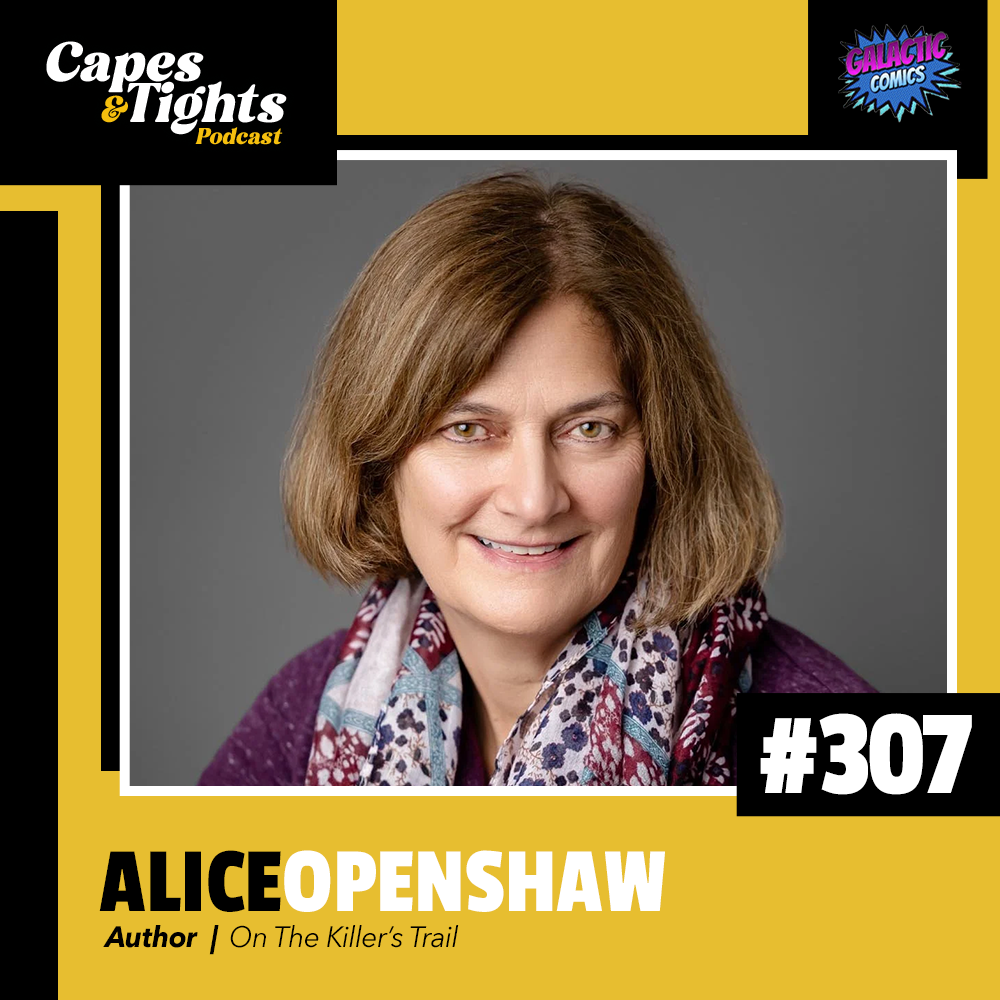
[00:00:00] Speaker A: Welcome back to the Capes and Tights podcast right here on Capesandtights.com, i'm your host, Justin Soderbergh. This episode is once again brought to you by our friends over at Galactic Comics and Collectibles. At galactic comics and collectibles.com we welcome Alice Openshaw to the program today. Alice was a librarian and adult education teacher before turning to writing and as an author. She's lived in Maine for 30 years, but now she lives near Cape Cod in Massachusetts. But today she's here to discuss her debut novel, on the Killers Trail, which is based in Maine. So we talked a little bit about that and so much more right here on the podcast. But before you listen, follow us on Facebook, Instagram, Twitter, bluesky, threads, all those places you can rate, review, subscribe over on Apple, Spotify or wherever you find your podcast. The video portion of this podcast is available on YouTube.com and as always, you can check out capesandtights.com for so much more. This is author Alice Openshaw discussing her debut novel on the Killer's Trail, which hits bookshelves on November 17th at a bookstore near you. Enjoy everyone.
Welcome to the podcast. Alice, how are you today?
[00:01:08] Speaker B: I'm great, thanks. Good to be
[00:01:10] Speaker A: here. Awesome. It's exciting. It is. It's funny because I actually have two book events coming up. I have one coming up on October 19th with Kevin Johnson, who wrote Twas the Night, a Christmas horror book. And then a month later, you and I are chatting and I just had Kevin record. So it's kind of funny. I'm like multiple times where I'm like having multiple. This is a warm up conversation for when we actually have our book launch conversation. How about that? No, I'm glad, I'm glad you're here. Yeah, it's a lot of fun chatting with people about their books. And you guys are both debut authors too. That's pretty cool too. It's like a cool thing. One thing you can only do once, right? I mean, like,
[00:01:46] Speaker B: that's right. It's, it's, it's not anything that was ever on, on the horizon for me. So here I am. It's a, it's a brand new thing.
[00:01:56] Speaker A: I've seen it before though. You've seen, like if you decide you wanted to write like a horror novel, be like, well, debut horror novelist. Like, it's like, okay, whenever you go into a new genre, they'll be like, oh, debut romance, debut this. Because I don't know if that.
I feel like it doesn't help people as much as it. They. I don't know. I don't know. I'm not a marketing person for a book publisher, so I don't know how much a debut novel helps someone.
[00:02:19] Speaker B: I, I'm the, like, the, the, the antithesis of the marketing dream. I'm like, you know, I'm an introvert.
I was, I was raised, you know, that you don't brag about yourself, you don't talk about yourself. Right.
And I can do basic, the basic tech things, you know, that one has to do to survive. But, you know, and so it's sort of the intersection of all these things. So I'm happy to be here. I love this. I, you know, but the whole marketing thing is, thank goodness there are people who, who are good at that.
[00:02:50] Speaker A: Yeah. And it's funny because in this publishing side of things, whether it's books, comics, any sort of short stories or anything like that, there's a lot of people who don't want to talk about themselves that they hope that as a debut novelist, too, it's like you have the backing of Crooked Lane, but, like, in the same sense, you still have to do the legwork for yourself. This is, you know, there are people who get more publicity. I mean, I live in Maine. Stephen King gets all of the publicity he needs, even though he doesn't need it. That's the best part. Like, there's so much marketing dollars behind a Stephen King launch, even though he's the one that actually doesn't need the marketing dollars. It's the people like yourself that need the marketing dollars. But it is kind of funny because he can, I don't know, publishes his grocery list that people would buy it. And so, but, but a lot of it is your own feet on the ground, your own joining podcasts or doing interviews or things like that to try to get people to know about your book. And. L got to do this on here. But what's funny is I want to start. So your debut novel. We talked about this, like, the fourth time I've said that. But, like, you have lived a previous life to becoming an author.
What made you want to actually sit down and write an actual novel?
[00:04:03] Speaker B: Well, so I. So the idea, the idea of the novel, you know, the premise came to me a long time ago. You know, I lived in Maine for 30 years, and the setting, the basic premise of the story was sort of inspired loosely by my experience. Right. And so I. And so for a number of years, I was, I was driving to, you know, I live Near Bangor. When I was working in Waterville, 50 miles, plus or minus each way.
I listened to a lot of audiobooks over the years.
Hundreds, many of them mysteries. And then. So at the same time, I was sort of.
I had this idea in my head and, you know, maybe. Maybe it's weird. Maybe some people plan, like, their dream kitchen or their dream vacation.
I had this little, like, story in my head, and I sort of, you know, it grew over the years, but it was always in my head. And I never thought about writing a novel. It never. It wasn't like I thought I couldn't or. It just never occurred to me. It was just something you do in your head, you know, I did in my head.
And then we. We moved about seven years ago, and it was November. I can't. It was around November 2nd or November 3rd. I can almost pinpoint it to the day.
2021.
I.
Two things happened. I heard a story, and I still. I don't remember if it was on NPR or if it was on an interview on a. On tv. I can't remember where I heard it or. But it was about this National Novel Writing Month, which was a thing. NaNoWriMo National Novel, which was November. And the idea was you just blast out a first draft of a book and you don't, you know, you don't get it pretty or anything. You just blast out the words. 50,000 words was the goal. You know, you divide it by 30 days in November, and so it's like 2000 and something words a day. And that was your goal. And you just write.
And I heard this interview about this, and it just started. It was a couple days into November, and at the same time, one of my daughters said something about, you know, sort of referring to our life on the farm. That was sort of, you know, what the premise was inspired by. And I said something. Yeah, yeah. And she says, oh, you should write. You should write a book about that or have you ever, you know, something. It was something. I can't remember exactly what she said, but those two things, like, happened, like, right at the same time.
And it was so. So I was like, give it a whirl. Right? And so I did this. I did this draft. I did it in six weeks, first draft. And, you know, and then it's like, well, then what? And so you, you know, the next thing. And so I just kind of did the next thing and then the next thing. And so I did a few revisions and then I found a couple of beta readers on some, you know, Internet program. I Sort of was self teaching myself.
And so anyways, it's just like the next thing and I just sort of did it and, and it never, I never really set out to like write this novel. I just sort of, it was in my head and it just sort of came out. So anyways, here I am.
[00:07:16] Speaker A: That's, that's great because it's also, I mean, we just reached 300 episodes here on the podcast. This is actually, this is like number three. Thank you. It's like 307 or something like that, this episode. But, but we.
One of the things that inspired me was my guest for 300 episodes was it was the filmmaker and writer and comedian Kevin Smith. And when he had a podcast one day, he said, just do something like if you want to do it. And his mind was podcasting. And that's what clicked at me. And I was 2001 when we started this and I said, okay, so yeah, I'll just do it. And it's nice. That is inspiration to the idea that if you have ever thought about it or even didn't think about it sometimes just do something. Just get it. Just get a keyboard in front of you and start typing and see what happens and see where it goes.
But then there's the other side of things where people are like, I've been trying to publish a novel for 30 years.
[00:08:00] Speaker B: I know, and honestly I have tremendous, you know, I was a librarian and I taught, taught English to adults and you know, my, in my previous life. And, and I have tremendous respect for, you know, real great writers. And I, you know, I feel very fortunate that I've been able to do this. But I don't, you know, I understand there's a difference, you know, to those people who have honed a craft over decades and so forth. And I mean I, I've gotten actually good reviews pre pub reviews from Publishers Weekly and Kirkus and stuff. So I'm really psyched about that. But I, I also appreciate, you know, that there are people who've been working at this for a long time and I, I do feel very fortunate that it's worked out for me the way it has.
[00:08:48] Speaker A: There's not, there's not a, a single publishing journey like this. There's. Every journey to publishing in any medium is different. You, you see the people who, who are on a big publisher immediately and then there's the people who have to like self publish for a while and get their way up and so on and so forth and a single journey, and that's what's cool. About it. It means that basically anybody can do it. As long as you put the time, effort, energy into it. You potentially could get to the point where, again, you live a. I always say that career. Like, you were a librarian, English teacher, but like, your career before your author career is like you. You did something else. It's not like you set out to be this. And you've been trying to work on it for 30 years. This is something that's just came. Came about later on in life. Which is cool, because like I said, there's no. And there's no.
You could be 16 years old, you can be 85 years old, you could be 100 years old and publish your first novel. It does not really matter, which is really cool to see out there. It's just. Like I said, I've seen people who publish their first novel, like, 18. I'm like, how the hell did you do.
I don't know what I wanted to do when I was 18, let alone work hard enough to do that. And I don't think I could ever. I love story creating. I. I think I'd be good at a job where I was like the editorial director, like the story director of, like, trying to help build a story. But the second I put that first draft out, Alice, I would have been like, I have to redo this. I'm done. I'm moving on.
[00:10:10] Speaker B: Well, well, you know, the. The. The thing about the first one, I didn't know what I was doing. And so if you don't know what you're doing, you. You don't have any sort of restraints, constraints, you know, you just sort of do it. Now I have started a second one, and I'm finding much more.
I'm much more constrained because, you know, I keep going over, you know, doing the same 20 pages over and over. And because, you know, now I'm like, oh, you know, so.
But really, I mean, like I said, the first. I mean, the first draft, I mean, the story has stayed essentially the same, you know, the plot line and so forth. But the. You know, lots of things change. I mean, the first thing. It didn't. First draft was. Didn't really even make sense. You know, I mean, had. I had sort of these things that would go. And I just sort of drop them because I didn't know where they were going. So I just sort of. And then, you know, I read it and they say, you know, then you put it down and don't look at it for weeks, if possible. And then you read it like a reader. The Sec. You know, and you're like, oh, this doesn't really make sense. And then work on it. You know, and really, you know, I did that for a bunch of times. And after, I guess it was about. After a year and a half, I had done as much as I could with. I had some, you know, critique partner online, somebody had never met, and, and beta readers and stuff. But. And then I was like, I don't even know if this is any good. You know, it's really hard for. At least for me to look at your own stuff and say, is it? You know, so I sent it. I start sending it to agents. Because that's what you do, right? You know, it's just like you do the next thing and, you know, so you just sort of. And it's like, you know, if you knit. Knit a sweater or you cook a fancy meal, you want somebody to wear the sweater or eat the food. So if you do write a manuscript, you want somebody to read it, right?
[00:11:56] Speaker A: If
[00:11:56] Speaker B: you do a podcast, you want somebody to watch it.
[00:11:59] Speaker A: It's exactly what you want someone to do. And to me, it was like, yes, you wrote the story because you wanted to accomplish writing that story, but in the same sense, the next thing, like you could, is to have someone read that story. And if you work hard enough on something, you do want that, you want that ability. And as my day job as a graphic designer, there is files upon files upon files on my computer of things that I've made that no one will ever see. Not. I can show them to you. I could go on my computer right now and look at them. I'm not legally required not to show them to people. Like some people out there are people who write, like TV pilots and like, movies who get purchased and they never get to show them to people.
Infuriate me. But I have worked hard on something that no one ever sees. And to me, sometimes it's like, it's like.
And it's not like you can repurpose it for something else later on. This is like, to me, it's like this file is done. I save it for posterity, but there's no real reason to save it because I'm never going to be able to use it again.
And it's, It's. It's sad at some time. So, yes, sending it out to agents and getting it to somewhere like Crooked Lane is. Is the next logical step. So people get to read the book and. Which is really cool. And it's.
When you saw the COVID for the first time, what Was that experience, like, was that something we were like, oh, my gosh, this is actually really happening.
[00:13:12] Speaker B: Yeah. I mean. I mean, getting the contract was like, oh, my gosh. But it's still. I mean, it's. It's almost a different world from my world, you know, I mean, it's. Everything is. You know, you do everything online, so it didn't really feel. So when I finally saw the COVID you know, image, and we talked about it, you know, we went back and forth. They asked me some ideas what I had, and we went back and forth and so until we got the final image. There were a couple of drafts before that, but. Yeah. And then when they finally sent the.
The arc, the advanced reader copies was the first time I saw an actual book. Yeah, you have one there. You have it. Yeah, yeah.
And then when.
Yeah, so that was. That was because it was something you could touch, you could hold. You know, it's real.
[00:13:57] Speaker A: Yeah. The words on the inside is obviously the story, but when someone promotes this thing and you see it on the shelves and things like that, this is what it is. So to a lot of people, this is obviously the thing that people are going to associate with you. And so, yeah, seeing it, I always thought, like, that's kind of like, to see the actual. Like, it's a book. It's not just words on a computer screen.
[00:14:15] Speaker B: That
[00:14:15] Speaker A: it actually is a book that can actually go on a bookshelf, I would imagine would be really cool. And so, you know, now we're approaching publishing day for this, that other people are gonna be able to walk into a store and potentially buy this book and so on and so forth. That's the next step for you in that. In that situation. So now you're at a waiting game. Like, now you're sitting in a holding pattern because everything's done, it's in the printer, it's being shipped, it's being wherever. Now you're waiting for people to actually be able to go in the store. The regular average Joe who doesn't have access to getting to read it ahead of time, like myself, would now read. Get to see this on the shelf. That's the next thing, probably for you. Like, when you actually walk into a store and go, oh, my gosh, my book is right there.
[00:14:56] Speaker B: Yep. Well, November 17th, I'll. I'll be in Bangor for the. For the. Yeah, for the long.
[00:15:02] Speaker A: When you walk in the table, into that room and it's gonna be on the table, though, I can experience. I imagine that's gonna be like, holy smokes, moment.
[00:15:09] Speaker B: Yeah, like this is real.
This happened. Yeah,
[00:15:14] Speaker A: it's a cool thing. So we're based in Maine, as you know, and I work in Maine. So we probably going to discuss a few things on this episode as well as when you actually do the book launch about it being in Maine. And so one of the things I've talked about with people about novels, books, movies, TV shows, all the stuff that are based in Maine is us Mainers hold that near and dear to our heart. Because there are probably other states in the United States that are like this. But to me it's like where the forgotten, like you go to Florida and someone's like, isn't main part of Canada. Like this is forgotten place up here. And so to me, when a story is based in Maine, there's just this other side of things. For me, this, this thing where like you can get onto it, you can be like, oh my gosh, this is based in Maine. And it seems so funny to someone based in or lives in New York or Boston or LA or Miami, where it's like there's things based in those towns all the time. But to me, having it based in my home, home state, it just becomes something special. You lived here for 30 years before moving away was that you mentioned driving on the road and talking about it, having a be in your mind about being in Maine. It must have been important to be in Maine. Like, that's the. We wanted it to be based in this state.
[00:16:24] Speaker B: Yes. I mean, so, you know, we, I, like I said the, the. The opening scene is inspired by my experience, personal experience. We had a little farm, you know, a hobby farm set against the woods. And we had animals, various kinds, at various times.
And, and you know, and I, And I have to say though, you know, when I'm talking about the book in general, to, to various. The world in general, I will often say that it's in. It takes place in northern Maine, which, you know, you and I know that, you know, the Bangor area is not really northern Maine, but if you say Maine to most people other places, they say, oh yeah, I've been to Maine. You know, I was in Kennebunk and you know, oh yeah, you know, like that. And I'm like, well, yeah, that's Maine too, you know. And we get into the talk about the, you know, the other mains and the, you know, the different mains. And so, so if I say northern Maine, then they. And also, you know, talking about small towns and sort of a rural environment that tried that, that sort of Sets it a little bit.
So you know, apologies to all of you who know that you know, this area is not really northern Maine. But you know, some people don't get understand that either. So that's why I do that. But, but yeah, so it's a, it's a combination. I mean I grew up in a. I grew up in a town of 400 people that was not in Maine. And so. And I've lived in other places in New England that were in small towns and so it's Maine. And there are some things about it, without giving anything away that are definitely Maine and not so much other places but. But it's also sort of a New England small town. You know, there's a lot that's not strictly Maine. And I mean, you know, I used a combination of real places completely made up, fictitious places and then some that are sort of, you know, in between things that are changed or have different names or re. Moved around a little bit in sort of a combination. I mean, so I try to make it realistic with. It's not, you know, you know, there's always a danger somebody's going to say oh, you know, that's not there, you know what I mean? Or that couldn't be that because yes, that's true. This is a novel. It is fiction. It's not, you know, real life. So.
[00:19:01] Speaker A: Well, it's. The town itself is fictional. Right? The actual like name of the town is fictional but
[00:19:07] Speaker B: Horton is not a town and it's not really any and, and us. And honestly nothing in the book, no person or any or you know is. Is like. It's not like this is John Doe, but it's really not John Doe. It's you know, Jack Smith, you know what I mean? I didn't. Everything is, is sort of a compilation or a mixture or made up completely or whatever. So. Yeah,
[00:19:32] Speaker A: but, but that's. I feel like that's somewhat important. I feel like that's one of the things that I've always liked about someone like Stephen King, but also disliked the fact that like selfishly I wanted Dairy, Maine to be Bangor. Like I just wanted it to be bang. Where I grew up in Bangor. I wanted like the name. I wanted to read Bangor, Maine in the book.
But smart wise like you know, being intelligent about it is that it's glad that it's not the actual place of Bangor, Maine. So you can stretch things a little bit and do things that you might not be able to do. Put things in certain places that don't make like when you Structure it down to an actual, like if you're like, oh, Horton's fake, but it's actually Waterville or whatever, you can only go so far with it because you can only like there's a school and this isn't there or whatever. So making it an affectional location. I can understand that because then you can like fictionalize it. You can do whatever you want with. You can mold it into whatever you want it to be. So I appreciate that.
[00:20:23] Speaker B: In fact, I mentioned to my, when I was there some like with Orno Brewing, right. It, it started out, the scene started out in a make believe setting, right. And, and that was one where I said, well, I can make it a real, I can make it a real place. But.
Well, you'll appreciate that for this, for the story, the plot to go. It had the, you know, Penny, the protagonist is, is there on a Monday. Well, it's closed on a Monday.
So I, you know, I mean it honestly. And also, you know, I started writing this a few years ago, you know, and by the time it's out, it's several years later. And so, you know, I, I put in something like, you know, the hours are changing pretty soon or, you know what I mean, this is the last Monday it's going to be something.
[00:21:15] Speaker A: Well, it's funny because like the way that things weave into this world and how this came about and I guess people can hear this too when we talk at the book launch, but a random email from you came through to my day job at Orno Brewing Co. Asking if you could use the name Orno Brewing in your book, if it'd be okay that, you know, so on and so forth. My response basically was like, as long as this is not like inflammatory, like it's not, hopefully you don't say we hate certain group of people or only these people are allowed in here or whatever it may be, or like the beer sucks.
As long as that wasn't the case.
You don't have to put us in this extreme positive light, like glowing reviews or whatever, but as long as it's not negative and yeah, absolutely, that's really cool, we appreciate what you're doing and so on and so forth. Because years prior, like this is the first year we actually didn't do. In four years we didn't do a literary beer, which I've been doing for the past couple of years, which has been. We did two with Daniel Krause and one with Christopher golden that we actually released beer can versions of their books into the Wild.
It started off with Whalefall. And when that book came out, and it's just kind of funny because like, next weekend or this weekend, as we're recording this, Whalefall hits the movie theaters, which is pretty crazy.
And then we did Pay the Piper, which is Daniel's book with George A. Romero. And then we did the Nightbirds with Christopher Golden. And this year I had a couple of feelers out and things just didn't work out. It had to be the right project and so on, and it just didn't work. And so I felt like this filled that gap that I had, which wasn't the same thing, but it was like instead of us taking the book and putting it on a beer, how about we take the beer place and put it in the book and there you go. We just switched the size of things. And I thought it was really cool. To me, personally, I thought it was amazing. It was wonderful. And a bunch of people at work thought the same thing when I explained this to them and so on and so forth.
But I think I took it. I was like, I was like, pumped. I was like, this is amazing.
[00:23:13] Speaker B: That's. Yeah, that's great. I, you know, and I used a couple, there's a couple real places, other real places, and there's also, like I said, some made up places, but yeah, that's, that, that's neat. But, you know, I guess there's always, you know, I mean, I didn't, I obviously, you know, that I didn't ask you any specific questions about the place. And so, and you know, so I just sort of went with it. And you know, it's like if somebody says, well, that, that doesn't happen there, or, you know, they don't. I didn't check the menu to say, oh, here she can, she's ordering, you know, whatever. And, and that the whole book is like that. I mean, I felt like it should be realistic without being, you know, I mean, and some, some writers are very specific, very detailed like that. And I, I didn't do that, but I hope, I hope I'm close enough, you know.
[00:24:02] Speaker A: Well, I mean, I just, I'm rewatching, rewatching, kind of rewatching the Walking Dead as a whole thing. And there's a way to watch it according to Reddit, that's like, you know, first couple seasons of this one and then you throw in a season of this one, like in the chronological how the world would look if you watched all of it in one encompassing go through. And I'm at the World beyond section, which is with the offshoot with the younger kids that were basically born into this world. Like, not really, but they were young enough, they didn't know what was going on. They grew up in this, this post apocalyptic world. And there's a guy who gets a Mountain Dew. And supposedly this, this show takes like 10, 10 years after the fall of the world. And so I'm like thinking myself like that Mountain Dew is probably not good enough to drink right now, but they had to. They're like, oh, Mountain Dew. And he opens it up and he's like, oh, this is amazing. I'm like, obviously Pepsi company paid pretty good amount of money for them to have this in here. And so I thought to myself, like, the actual drink was real, but the reception of drinking that drink 10, 12 years after, after it was manufactured is probably not the same as what they did. So you have to fictionalize sometimes some of these things. And it's just the name was cool because to me, seeing a place that I'm. February will be 10 years of the company and then. But also to me, it locks it again further into immersing yourself as a main or someone who's been to Maine or someone knows New England or whatever. It locks you into that. Like I said, you know, I'm not sitting here comparing you to Stephen King because there's not a lot that can compare to Stephen King. But in the same sense, when he mentions Bangor in a book or a certain place in Maine, it brings me closer into that book. And so that side of things, however, if you don't have any idea about Maine, you still can enjoy it. And that's, I think the line that you towed, that was pretty good on that stuff. Like the nods to places in Maine that Mainers or people who have been to Maine would understand, but not so much to be like, you'd be ostracized if you don't know where these places are in Maine. I think that's that line you towed that was actually really good.
Again, it's that, I don't know, reboot of a book or a movie or a TV show where they like, nod to the original stuff, but they don't make it so that if you don't know that you're lost kind of thing.
[00:26:11] Speaker B: Yeah, well, thanks. Thanks. I, I mean, I, I'm, I read a lot. I read mostly fiction and, you know, different people like books for different reasons. And I, I've just been reading. I, I don't read to learn about a subject. Like, I don't read.
If I read A book I'm reading more for. For what's universal about it, what it says about sort of humanity. And if it, you know, if you learn specifics because it's set in Germany or if it's set, you know, in the 1800s, or if the, or if the character is a, you know, is a plumber or something, and you buy you on the way you happen to learn about those things, fine. But. And I'm reading. I've read a couple books recently where it's very intensely about. It's a novel, but there's so much about the subject that, you know that I won't say what it is because, Mike, I don't want to diss somebody else's book, but I'll say it's about. Say it's about football. It's not, but say it was. You know what I mean? And it's like, well, I want to read a novel and if I learn a little bit about football, that's good. But I. If I want to learn about football, I'll read a book about football. But some people love that. They want to. They want to be immersed in the subject. And so I guess I feel like it's the same thing about Maine, whatever, you know. But I mean, you had Paul Doran on recently, right? I love his books. I love his books. And, you know, he knows Maine like nobody else does, right? And you know, every. The back corners and he knows, you know, he was a guide. So he know, you know, and I, and that's. But he's, he's also a great writer, I think. I, and I really enjoy it. And you know, and I, I. That. That's not this. Right. I. This, this book is not that.
[00:28:01] Speaker C: But he, he does do a good job in that sense. But also you have that there's no way in
[00:28:07] Speaker A: ever that this many crimes and this many, like, the crimes happen, but all connected to him. That's why I call Mike Bowditch the Jack Bauer of Maine, because, like, Jack Bauer on 24 had all this stuff happen to him. He's had like 17 presidential pardons. And also. And it's like one of those things like this would not happen to a normal person. Mike Bowditch does the same thing in Paul Dwarren's novels. They're fantastically written and they honor Maine and so really well. But in the same sense that they're like 18 books in, you're like, dude, this guy would be in jail. He'd be fired, he'd be dead. One of
[00:28:37] Speaker B: those
[00:28:37] Speaker A: things he'd be gone. And this is no way. So you have to still take it as a fictional story. But also. And I do think that there is that you learn a little bit about Maine, but you're not teaching people about Maine. I just finished off the Reservation by Stephen Graham Jones, and Stephen Graham Jones is fantastic, telling, like, indigenous people, history and culture without, like. Without being like a history book. And so I read it and I go, oh, the story was amazing. In the same time, I learned a little bit of snippets about the Blackfeet nation and things. And it's like, he's not trying to teach you about the Blackfeet nation. He's just, this is what he knows. And so he's doing this and the same thing here, you know, 30 years of rural Maine. And so you're going to write what you know.
And so putting it in there allows those Mainers to be like, oh, this is cool. And maybe those non Mainers have learned something about me. But the truth of the matter is this is a procedural mystery thriller like this. That's the story, is that the main.
[00:29:32] Speaker B: Is the
[00:29:33] Speaker A: setting.
[00:29:34] Speaker B: Yeah. And, you know, honestly, if you're writing a mystery, bad stuff happens. And so, you know, that's, you know, you have to. There has to be some bad stuff in there. And, you know, I love. I love Maine. I loved our. You know, but, you know, it's a. It is fiction. You gotta have a. You gotta have a plot. Right? You gotta. So, yeah,
[00:29:53] Speaker A: you don't want people. Like, that's. The other side of it is, like, there's a. There's. Speaking of Paul D. Warren, there's one or maybe two or three. At least I know of one. Remember, one absolute fictitious place that he went to. Most of the towns Mike Bowditch and Paul brings these novels to are actual places that people live and things.
But there's one book, Widowmaker, which he put on a fictitious ski lodge or ski resort that it was based off of Sugarloaf, but on a top mountain named Widowmaker, even though Widowmaker is a slope at Sugarloaf. So there's like this. This amalgam of what it is, but mainly because, like, the people at the ski lodge were kind of crappy people and the people in the community kind of sucked and some bad things happen and so on and so forth. He's also like, I don't want to just crap all over someone's town and see for. Sorry, it doesn't seem very good for me. So. So creating a fictional place where this murder happens is probably a good thing. So you're not just like someone yelling at Alice, being like, what the hell did you do to Caribou or wherever.
[00:30:52] Speaker B: Yeah, yeah, it's, it's a novel.
It's pretend.
[00:30:56] Speaker A: I mean people would take offense to it in the world we live in right now. It's one of those people who would like boycott. There'd be bookstores in store, you know, in that town that wouldn't carry your book because you, because you murdered someone in it, but that it becomes part of the story. But again it's, it's basically to like to move it along as Maine and. But there's this mystery, there's this family, there's this, the, the, the small town community is really big. So like it could be anywhere really that has this small town community feel that, that Maine has in most a lot of places in the state. And that's a big part of it is like these small towns where people don't want to talk and things. It makes a little bit harder for this, this mystery to be solved.
Were you.
Did you have you said you've been reading mysteries for a while. I'm guessing you mentioned that too. You said you've loved mysteries since basically you discovered Perry Mason as a kid. But like mystery was a big part of this. Right. You mentioned earlier that it's a story based in Maine and you had this whole thing in rural Maine and this farm and all that stuff. But like the mystery was where you were at for the beginning on this.
[00:32:01] Speaker B: Yeah, I, I guess I don't know what it is. I do. I have always liked mysteries and I, you know, and I generally tend toward a certain kind of mystery. Sort of a pretty straightforward.
Not so much. You know, I've, I've read different kinds but you know, I, I kind of like the sort of a simple, simple story about people, you know, so it's not so much the solving it because there's, you know, some little tricky thing about the, the weapon or some little tricky thing about the, you know, it's, it's more of just a story.
But I guess what about mysteries is.
I'm sort of a, I'm sort of a logical person. You know, I sort of like puzzles and things like that. And so, you know, it's something to solve and, and I, it sort of, it's kind of straightforward. I mean you have all these different possibilities, but I don't know. It's, it's.
It's. I have but. Right. Ever since Perry Mason. I mean My Little Town Library. 400 people in the town. You imagine the library was not fully, you know, furnished, but there was a series of Perry Mason books and I was, I think I was like, I don't know, I was 10, I think. And, and, and then yeah, all those years when I was driving so much, I, I would get audiobooks from the Libra, you know, I'd go through the series of the mysteries of different kinds, procedurals, but not always procedurals. And yeah, I just.
Not everybody makes like murder mysteries in their head in their spare time. No,
[00:33:40] Speaker A: well, no, I, I could see it. So like it's funny because like every once in a while I, I read. I don't know how the breakup is nowadays, but like there's a. I would say 80% of the books I read are in the horror genre. And then there's like superheroes in there somewhere and then there's mystery thrillers and it's basically those three I don't like. I've never really. I think I've read one romance novel.
I'd rather be like, I just read Clay McLeod Chapman's book where it's a romance horror so there's romance in it with this horror and so on. And, and I'm not into spicy style books and things like that. So like. But I just did finish a book where there was like a section of spiciness and I was like, what is going on right now? But the. But I always think about whenever I read a mystery thriller at the end of the reading a book I was like, I enjoyed that so much. And then I go back to some other genre where there's not like a big twist or something solved at the end. And I'm like let down because I'm like wait, wait a heck. I thought we were. And it's like open ended and it was all about the horrors that go along the way. That's the story and that they don't actually need to solve anything at the end. And I'm thinking to myself, I'm like, I kind of feel like I want to go back to the mystery side of things because like there is that. I feel like there's this accomplishment you get towards the end when something was like you're trying in your head to figure out what the heck's going on. And at the end they give you the answer and you're like ah, I got it. Or I had no idea what's going on in this book.
That's something about mysteries that does that to me. I just feel like, it's. You almost feel like you've accomplished something at the end or you're trying to get something, whereas you might not get that in a romance or any other genre. Nothing against those genres. I'm just saying I feel like there's this. That's like this. You're almost trying to solve the pieces of the puzzle yourself, where you don't potentially get that. And it's more just entertainment for entertainment sake.
[00:35:18] Speaker B: See, now, I.
I generally. Generally don't try to figure it. I like to go along for the ride, like, with. And. And then when I get to the end, if it's, you know, if it's a good ending, then I'm happy. If it's way too obvious, then I'm disappointed. And if it's like, you know, kind of a cheat ending, you know what I mean? Like, you know, then she was asleep.
[00:35:43] Speaker A: Yeah, that's not good.
[00:35:44] Speaker B: But. But, yeah, yeah. Or, you know, or victim witness protection or whatever you call it. I. That always. That's kind of like the. But.
But I don't. I usually. I like to go for the ride. So I. So I don't like to. Somebody was telling me that they always read the end of a book to see if they want to. And I'm like, what? I'm like, no. And they said, hey, well, you know, if I get your book, do I have to read it? You know, the way you read it. I said, hey, if you get my book, you can use it for paper machete. Yeah, it doesn't
[00:36:13] Speaker A: matter. You paid. As long as you bought the book, it's fine. But that's true. I can understand that, like, how someone would want to do it. But it seems as to me, I've always thought books are different because books take a lot longer to do. Like, to read for a lot of people. Like, I did read a book this weekend, but it was. I just had a lot of time and I was able to just bust through it. But for the most part, like, a book like yours might take me a week or two to read. And so because of that, I do feel like. And if it wasn't for the podcast or book launch or things like that, that if you told me the end of your book, I might not read it for a number of years because the fact that I know the end now what's the point Kind of thing, a movie is like, it takes an hour and a half, two hours of your life. So, like, if someone told me the premise of a movie, I'd probably still watch it because like, it's only, it takes too long, but like committing to it with the list of backlog of books I want to read if I. I know that story now and I'd probably push it. And so I'm glad people don't spoil books for me as much. And I'm glad that when I listen to podcasts or things like that, it's usually a spoiler free version of it like this because I want to be able to consume it, be entertained by the book. But I understand where you're like, not solving the mystery. You know, I try almost every once in a while where I'll be like, oh, I bet it's that person because something happened. And I'll tell you right now, nine times out of 10, I'm wrong.
I'm
[00:37:32] Speaker B: like, I'm like, you better not be that person because that is way too hot. Yeah, that's obvious.
[00:37:37] Speaker A: So that's a horrible way to do that or whatever. And then the funny thing is it's like, it's usually a person, I trust their writing. And so thinking to myself, I'm like, it can't be because if they did that, it'd be very let down if X, Y and Z author did this. And so, yes, but it is one of those things where it's like you try to like, I don't know, say that, solve it, but like, try to put the pieces at least together. And I do hold out full on reservations. Even when I'm talking to my wife about the book. I am reading this book. It's really good to get this. I don't even explain to her where I think I know the ending. I'm just like, I think I know where it's going. It'd be really cool if it did go this way, but I don't think it's gonna. And so whereas like other stories, I feel like it's not the same for me. So there's a difference. And that's why I think it's like, why each genre is its own thing. It's because you can get a little bit different out of it. And again, like you said, buy the book. You can level your desk out with it if you want to, as long as you buy it.
But reading it, it's really good. And I thought you do have this small fear, like when you're like, oh, can you put the, you know, can you put it in? Can we put ornament brewing in the book? And yes. And, and, and then you're like, oh, well, I want to read it. And I want to. I have this podcast and, and I review wet books on the website and I had this like, tiny, like 5% fear that it was gonna stink.
Do you know what I mean, though?
Like, it's one of those things where it's like, oh, gosh. And it happened to me in the, in the past where I, when I was earlier in the podcast. You're talking the first 20 episodes of the podcast where every once in a while I get cold emailed from an independent comic creator who's like, hey, I want to come on the podcast. And at that time I'm like, awesome, yes, people want to be on the podcast. And I say yes. And I had a co host at the time and I sent the advanced PDF over to him and he emails me back. He goes, are we really going to talk to this person?
And I was like, oh, gosh. And then that's where I started to have to say, yes, you're more than welcome to send me your stuff. Let me read it. And this is no offense to you or not, but I'm going to choose after I read it whether or not going to have you on or not.
And so it's kind of funny that, like, I'm glad I liked it so much because of the fact that it made it easier.
It was fantastic. And to me, like I said, there was that mystery element, there was that small town community element, there was the, obviously the main connection to me.
And if I didn't know you hadn't written a book before, I wouldn't have guessed that because it was fantastically written as well. So that's a great thing. Yes. Not to make your head bigger or make it blush or dry.
[00:40:02] Speaker B: No, I thank you. I appreciate
[00:40:03] Speaker A: that. Yeah. And so we are, we're going to do a book launch. This is going to come out actually a week prior to the book launch or so on and so forth. So, like, it actually works out well for people to listen to this who live in Maine or whatever and want to come to this at Bookspace in Bangor, Maine, obviously the connection to. Or no brewing is there. Obviously the connection to Maine's there for this book launch. But was it like, if, forget talking to me and doing this or whatever, was the idea, hopefully to do this book launch in Maine the whole time? Because,
[00:40:31] Speaker B: I mean, you know, like I said, I, I mean, I, it's, it's set, you know, in the Bangor area and I, you know, I, you know, my heart is, is in Maine as well as where I live now. And I still have a lot of friends. I was part of a.
And it's still, you know, in.
Hold on to. A. Part of a book group up there that really. I mentioned them in the acknowledgments because I. It was a fantastic book group and it helped me sort of, you know, help me with good, good writing, good literature, reading good, good books and talking about them and. And, you know, and so, I mean, I hope some of those folks will be there. And I. I mean, I. That was my community for a long time, and the book is set there, so I just felt like it made sense to. To launch it there. Yeah, I'm going to have another one down here in Massachusetts later in the week, too. But I just felt it. It belonged. The launch belonged there. Yeah,
[00:41:36] Speaker A: it's fitting. And it's funny because, like, I love that. And that's. I actually pitched to Kevin Johnson, who. Who has family, who lives up here. I said, hey, well, you do a launch up here, too? And so he has. He was actually. I was like, what I basically said was, are you visiting Maine anytime soon? And I said, well, yeah, I think sometime in October after the launch, will they come up here and do a book event when you're doing it? Because, you know, it makes sense. And then. But I've reached out to other people who have written books or comics or things like that that I've reviewed or that are based in Maine. And I was like, hey, you should really do an event up here. We really, like I said, if you say it's based in Maine and you do event in Maine, people will come out to it because they're like, oh, this is based in my hometown.
It's funny. It works that way. But what's cool about it, too, is that we're going to work it out. And I actually was thinking about it last night.
I randomly woke up from a nightmare that I was in my upstairs bedroom and I was reading in this nightmare and the house started to collapse down.
I have no idea where this. I'll tell you right now. I stacked a lot of wood yesterday and I stacked a lot of wood on my porch yesterday. And my mind, I had probably in my mind the fear of this porch collapsing and ended up. So there's probably where I crept in. But then I woke up and now I'm up. Like, I'm thinking, like, trying to go back to sleep. I'm thinking about things and I work in a way where I technically, stupidly think that the sleep is overrated because there's so much stuff to get done, Alice, that I just can't. Sleeping is stupid. No.
Which I have two young kids, so sleeping is not very often anyway. But I was thinking about how getting an actual person to pour beer so that I don't have to do it. Because right now, as it sits, that's probably going to be me sampling or in a brewing company beer at this book launch and then getting up from sampling the beer with people and then coming and sitting with you and then going back and doing that. So I was talking. My buddy Paul, who works at the comic book store near this place, might come pour it for us or whatever. But we're going to do sampling of Orno Brewing Company beer at this book launch, too. So that might get people in too. If you want to drink some beer and watch this book talk and discussion, that would be amazing. On November 17th at 7pm at Bookspace on Columbia street in Bangor. But that was really cool because we tried to do for the Nightbirds, I mentioned their beer, Christopher golden, he launched it in Massachusetts and we had the beer but distribution level and all the other stuff, the confusion world of distributing beer, it just didn't work out to have the beer at those places. That Massachusetts one. And so when he did it in New Hampshire, I brought it down. I couldn't sell it, but I could do a sampling. And so that was pretty cool about that. So, like, same thing here. We're going to do a sampling at this thing, which would be really kind of cool, and bring it kind of full circle for how we got talking and how the book launch thing and all that stuff that opens up avenues for.
That'd be exciting. I'm excited. I'm really excited.
I love the Bookspace place. It's a nice place to have events in the briar patches. Obviously, our local bookstore, which is amazing and Gibran has been great and so I can't wait to add. Other people read this.
I always forget. So I'm gonna have to remind myself and I won't spoil anything, but like when we were talking on that day, that people haven't read it.
[00:44:34] Speaker B: Right, Right.
[00:44:35] Speaker A: I'm always like, and you know what happens with Penny? And they're
[00:44:38] Speaker B: like,
[00:44:38] Speaker A: no, we haven't read it yet.
I figured I was. I went to a book event in Massachusetts and the same thing. I'm like, oh, yeah, I know what they're talking about. I look around and go, no one else here does because I've read this book already.
But it comes with the territory.
And that'll be fun. So I'm excited. So, November 17th, this hits bookstores everywhere. I highly recommend people buy it on your local bookstore. So go to your local bookstore, and if they don't have it, just tell them they can get it. For some chance reason they didn't, they missed it. On the new. You know, not enough books publish every Tuesday for people to miss things there.
Then tell them you want it, and so on, so forth. But bookshop.org is a great place, too, because bookshop.org, you can link your local bookstore to it and they get a portion of the sales, which is awesome.
And that would be really good for people to read that that way, as well as. As a librarian. Tell your library that you want it, because that's a great place. That's actually. I don't think some people understand how amazing that is for authors.
Like, it's very good for libraries to buy many copies of this book just to let you know.
It's also that, but also the librarian. It's going to be kind of cool to see it in the library, too.
[00:45:47] Speaker B: Yes. Yes. Yeah. In fact, my launch down here in Massachusetts is at the local library, so that'll be fun. Yep.
[00:45:54] Speaker A: That's awesome.
It's really cool to see that. It was like me going into a beer store and seeing my beer label for the first time at a beer store. I just. I want to be in your head the day that you walk into, like, a bookstore and see it on the shelf and go, oh, my gosh. That's my thing. Are you going to stand there and go, that's mine?
[00:46:13] Speaker B: No, no. I'll be just like a. Like a fly on the wall. You're like,
[00:46:17] Speaker A: oh, is that good? I've heard pretty good things about that,
[00:46:19] Speaker B: right?
I heard about somebody whose mother or grandmother or something went in and sort of ruffled up the pages and stuff to make it look like it had been well used. You know, their daughter or granddaughter's book or something.
It's been checked out a lot. You know, a lot of times you got to make
[00:46:34] Speaker A: sure people, like, see it. Like, they're all, oh, this is one I got to read. This is. This is always there. Or, like, always have it. Like, not where it's supposed to be. Like, it's be. Haven't been returned to the
[00:46:41] Speaker B: shelf yet.
[00:46:41] Speaker A: So people could be like, oh, this actually was just checked out. It just got returned. I bet it's pretty good. Like, yeah, we got all the secrets of this thing. But no. On the killer's trail.
November 17th.
It's. It's fantastic. And congratulations. We're early on pub day, but congratulations for publication day, and I'll see you on that day.
Anything else you want to throw in there before we say goodbye?
[00:47:05] Speaker B: No, I think this is great. And, yeah, November 17th. Yep.
[00:47:09] Speaker A: Awesome. Well, thank you for joining us, Alice.
[00:47:11] Speaker B: Take care.