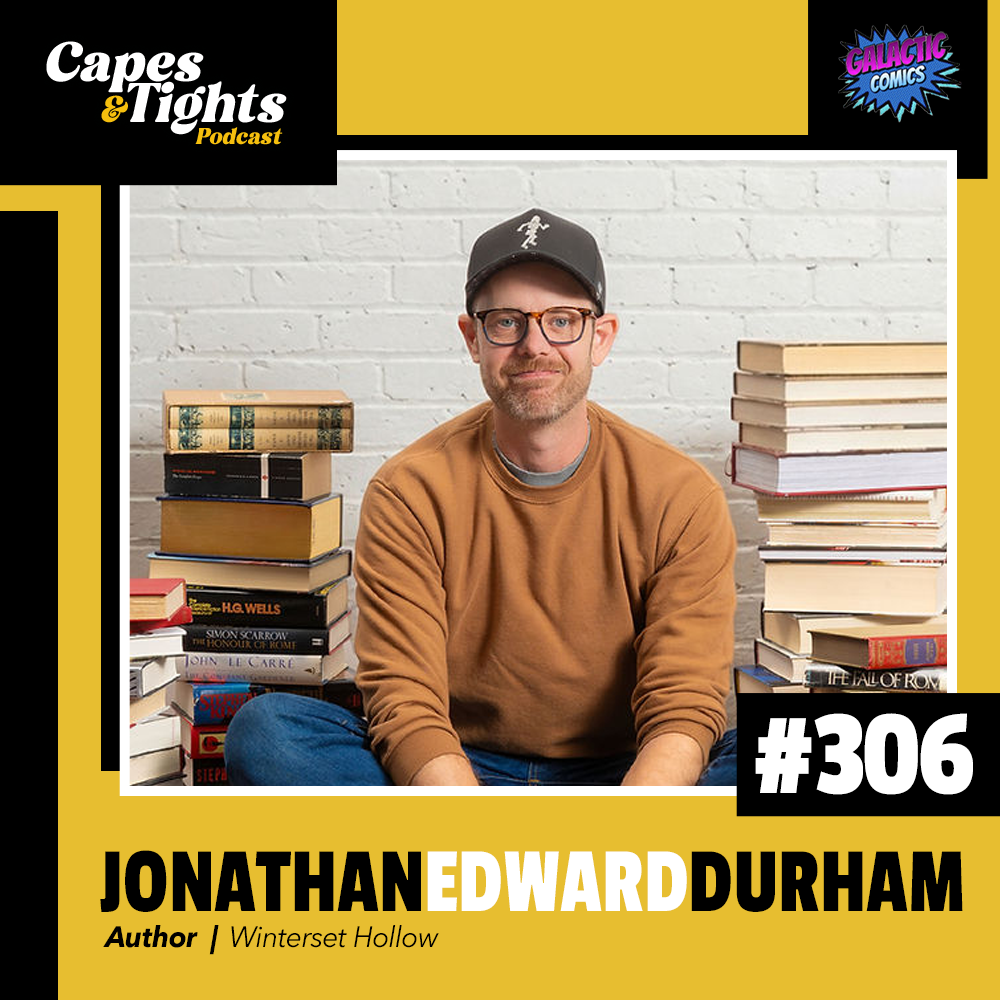
[00:00:00] Speaker A: Welcome back to the Capes and Tights podcast right here on Capesandtights.com, i'm your host, Justin Soderbergh. This episode is once again brought to you by our friends over at Galactic Comics and Collectibles at galactic comics and collectibles.com today we welcome author Jonathan Edward Durham to the podcast. Durham has studied literature over at William and Mary while pursuing a degree in neuroscience. Yes, you heard that right, neuroscience. But now he writes to bridge the wonder of his favorite childhood books with the pop culture sensibilities of of the classic thrillers he grew up with. So he's here today to discuss his debut novel, Winterset Hollow, which is a best selling book, USA Today bestseller, USA Publisher's Weekly bestseller, which is awesome. It originally came out self published and republished. It's amazing. You should read it. Winters at Hollow. Available bookstores everywhere. But before you listen, follow us on Facebook, Instagram, bluesky Threads, Rate, review, subscribe all those things over on Spotify, Apple or wherever you find your podcast. You can find the video portion of this podcast over on YouTube.com and as always, you can have so much more at Kate's intentions, including our review of Winterset Hollow over
[email protected] Like I mentioned, but this is Jonathan Edward Durham talking Winter Set Hollow right here on the podcast. Enjoy everyone.
Welcome to the podcast. Jonathan, how are you today?
[00:01:20] Speaker B: I'm great, man. Thank you so much for having me.
[00:01:22] Speaker A: Absolutely. So I mean you as of recording this, you just got back from I would say, a little tour.
[00:01:27] Speaker B: Yeah, a little main tour.
[00:01:28] Speaker A: How was that?
[00:01:30] Speaker B: It was great, dude. I think we did like six stops over six or seven days. Kind of up and down the northeast corridor here.
Just a bunch of bookstores, couple libraries. It was, it was awesome.
[00:01:43] Speaker A: That's awesome. It's so, it's funny how like things jump apart. Like I wasn't planning on being in Portland, Maine on Saturday. I live about an hour and a half north of Portland, Maine and but I was like, I was actually going to Massachusetts for an event on Saturday, the Merrimack Valley Halloween Book festival thing or whatever was there and a bunch of authors are there and stuff that. So I was heading down for that and coming back and it worked out perfectly. I was like looking online as I was going and I'm like, wait, Jonathan's gonna be in Portland. On my way home, I just had to make sure I left at a reasonable time from Matt's chooses to really get there, which is kind of funny. But I actually left in the middle of a panel. I sat in the back and the panel was happening, and I'm like, oh, shit, I should probably go if I want to make it. So, like, sneaking out the back. And I'm glad no one called me out because it would have been like, I'm leaving your thing to go to another author's thing.
I hope that was slight at you at all, but, you know, I got to get on the road.
But, yeah, it was cool. It was funny. I sat down in Portland at the library. Gorgeous. I never been in the library either, dude.
[00:02:44] Speaker B: I've never been to Portland, actually, that I can remember. Maybe when I was a little kid or something like that. But, yeah, the library's huge. Huge, man.
[00:02:51] Speaker A: I walked in there, I'm like, you sure this isn't like. Like a Boston? Like, I felt like it was in a big, big. I mean, Portland's a big city for Maine, but, like, it felt like it was in a big city. I felt like. I don't know, when I went on vacation in New York City or something like that, like, it would be there or not in Portland.
[00:03:04] Speaker B: Yeah. I had. I had no idea really what to expect. And it was like, just a big, beautiful library, man.
[00:03:10] Speaker A: And I sat down and I was like, I don't know, about 15 minutes early, and there was, like, one other person there, and I was like, oh, my God, please don't have this be that way. And then within moments. Within moments, I turned around, the place is like, you know, bowl. And I was. I was very happy about that.
[00:03:22] Speaker B: So, yeah, it was a good crowd
[00:03:24] Speaker A: because I've been at those events, Jonathan. I've been at those events. I'm sure you've been at those events too, where it's like four people show up and you're just like, oh, great. That was like, you know, this is amazing.
[00:03:33] Speaker B: But, yeah, it's no fun being on the author side of those either, when that happens. But luckily, everything on this event was really well attended, so that's so cool.
[00:03:41] Speaker A: I mean, now we're a couple weeks removed from the release of the book, and so I'm hit bestseller list here and there and stuff like that. So is it now we mentioned. You mentioned during that. That discussion that you've gone through some things which we'll get into here about how to get this going and stuff like that. But, like, it's real now, right? I mean, come on, it's got to be real now.
[00:04:01] Speaker B: I mean, yes, it definitely. It definitely feels real, for sure.
It's like the. You Know, kind of the big thing you've been waiting for your whole life has kind of finally happened. And that's like its own very, like, delicately balanced feeling, you know what I mean? Because there's a lot of, like, there's a lot of validation and relief that comes along with that. But there's also a lot of like, okay, now what? You know what I mean? And, yeah, and. And, you know, the release week is like, you know, we knew there were going to be a bunch of pre orders, so we knew it was going to be good. But then it's like, well, also, how do you, like, sustain success of a book after that? So there's a lot of, you know, there's a lot of like, very. These are all good problems to have, but there's also a lot of, like, new stresses that come along with that stuff too, you know.
[00:04:42] Speaker A: So, yeah, I've always loved that you're at like a book launch tour and you have the person. I don't fault them for that, but you had the person in the crowd who goes, so, what's next? And it's always funny to me because it was like for you, you've been building up for this since the first edition came out years and years and years ago. And then you had this like, you know, promotional period of a year or so of trying to get this book in people's hands. And now it's out there and people are like, okay, cool, that's awesome. That's now gone. What's next?
Like, what the hell? I can't even bask in this glory for a little bit.
[00:05:12] Speaker B: I mean, you can't blame people for asking those question.
But to be fair, like, I feel like authors are. We're constantly worried about that anyway. So, like, it's. It's fine, you know, But I think
[00:05:24] Speaker A: it's different too, because, I mean, we are now. We was the 17th when you had this event and the book came out a few weeks ago. So, like, there is this. People have read it. And so, like, once they're like, if they like your writing and they like your style, they're like, cool, I'm done with that now. I want the next thing. So I do understand that too, because, you know, I. But it was always funny when, like, people, like at launch date ones where, like, the book has. You haven't read the book yet, they're like, okay, I'm ready for the next one. I'm like, I am too. But like, like, let's, like, let's bask in this glory. For a little bit, which is pretty cool. But you're now an all published author with an actual publisher here, not just yourself, which is awesome. And I wanted to touch on really quickly before I forget this, but you did an event with Adam Caesar, is that correct?
[00:06:04] Speaker B: I did, yeah. Yeah. At Doylestown Bookshop.
[00:06:07] Speaker A: Yeah. Adam's a friend of ours. He's also a fellow Pennsylvanian with you and so. But he had a book re released to in the past couple weeks from Union Square too. You both re released books. Adams was 14 years in the making technically in yours is what, five or six years in the making and both hit USA Today bestseller lists.
[00:06:28] Speaker B: Yeah, Pretty cool.
[00:06:29] Speaker A: Is that a timing thing though? Is it like a. You have that built in promotional thing of people or is it a risk thing that actually turned out to be a reward for the publisher? Like there is this, people already read the book, so who's going to buy the book? And also this.
But also like there is a publicity and marketing part about people already have read the book so maybe they'll buy the new version.
[00:06:51] Speaker B: That's right, Yeah. I think it's a little bit of a double edged sword that way because like you said, it is good to have, it's certainly good to have a proven track record of success for a book because like in, in some light that's lower risk for somebody publishing it. Right.
Because they know people enjoy it, they know people will read it. But by that same token, people have already read it so they're probably less likely to buy the book again. Especially if it's, you know, a book with like a very particular core audience, like for a genre writer, you know what I mean? Like somebody who writes, you know, horror or romanticy or whatever or something like that. So it's a little bit of both. I think it just comes down to a gut feeling of do you think there's a larger audience out there for that book?
And also if, if said author has somewhat of a, of a, of a following that you think probably hasn't read it already or you know, has been looking for it for a while and couldn't find it because it had been self published and those books aren't always easy to find. Some people don't love ordering books from Amazon and as a self published author, a lot of times that's the only place you can get them because a lot of bookstores don't carry them stock because Amazon's a competitor of theirs, you know.
So I think it just comes down to a gut feeling and I think it Comes down a lot of times to how much the people making those decisions just like the book, like, if they really feel like it's a good story and there's people out there that'll enjoy it, I think, you know, I think that they'll go ahead and put it out there.
[00:08:19] Speaker A: And there's like, you have Adam who has published bestselling books with Clown the Cornfield and stuff like that. So, like, you have that to like, go, hey, the guy who sold those books, you know those books.
[00:08:29] Speaker B: I mean, he, he's. He's got a proven track record for sure, but.
[00:08:32] Speaker A: And then you have your side where you don't have anything published other than this, but you have like a social media following. And there's this, like, the risk is not as much because even if a portion of your Instagram followers buy the book, they're like, cool, we'll make our money back what we spent on this book. And so, like, there is that, like, not everybody's going to get this chance. And I think it does happen that 2026 was the right time for Winterset Hollow for multiple reasons. And I think that part of that is your built up following. Part of it is the climate we live in and the stories that people want to read and people do want something different. And that's one of the things you talked about when I saw you over the weekend, which was why it was hard to sell this book in the first place. Because it doesn't really like. And you're. I think your original one does say fantasy, dark fantasy, but like, sure, yeah. But does it really fit? Like, it's, it's. It's this. I walked into the Barnes and Noble or Bamboo a couple months ago and. And picked up. I was Looking for Clay McLeod Chapman's new book that's a romance horror. And I was like, that's a. Categories that don't really cross over that much. So like, where is it gonna be? It's gonna be in the horror section. It was full on in the romance section. Like, it was like there was two copies. So me, selfishly and probably annoyance of the bookseller, I picked up one copy, put it in the. In the.
[00:09:52] Speaker B: I was gonna say, whoever thought there would be a Clay MacLeod Chaplin book in the romance section? You know what I mean?
[00:09:56] Speaker A: It's like, it's like Emily Henry. And like, I was like, what is going on right here? But like, it's like hard. That was one of the things that in explaining it to people. I was at a comic convention at the beginning of the month. And I was talking about this book and I said, you got to read this book because we're big fans of Patrick Horvath's Beneath the Trees Where Nobody Sees. I don't know if you've. And it's like this juxtaposition of like something called Cuddly and Sweet that actually is like a murderous killer. And I was like, oh, you might like this book too, because there's that similar crossover theme to that here. And they're like, oh, cool. And I'm like, but I really can't explain anything else. And I can't tell you that it's horror. I can't tell you it's thriller. I can't tell you it's fantasy. And so I can understand that apprehension to, to originally buying the book and trying to publish the book.
[00:10:38] Speaker B: Yeah, I mean, that was, that was for sure the big objection from, I mean every, it was pretty much every bit of feedback I got back was some variation of that, you know, from agents and publishers and whoever. Like way back initially when I tried to get it traditionally published, it was a lot of like, hey, I, I think I enjoyed this, but you know what I mean? But I don't know what shelf it belongs on. So like it's, it's probably not the project for me or hey, this was good, but I don't think I can ever pitch it. So like, I'm probably not the person to represent this.
And it was just a lot of that. Which is like, now that I understand a little bit more about the publishing landscape and the book landscape, that's understandable.
Had I been a well known author at that point, they, somebody may have taken a chance on it. But given that nobody knew who I was, you know, it's just, it's a lot of work and it's a lot of risk. And you know, I understand people not being willing to take that.
[00:11:32] Speaker A: You know, I, I laugh because I'm like, when you think of like a children's movie, you automatically sell like one ticket to the child and then two adult tickets potentially, because like every. That's three tickets built in, right? I thought to myself, like, well, if it crosses over to like three genres, just convince every bookseller to buy or to buy three copies and put them in the three different genres. There's three copies. It's like, that would be great if
[00:11:52] Speaker B: they all thought that way, you know,
[00:11:54] Speaker A: because I was thinking like, I recently, I was just, actually just texted Daniel Krause about something and I was just reminding me that he doesn't have like a genre. Like he know he's mostly horror. But like it's like, yeah, you know, can't go into the store and be like, cool. Here's the Daniel Krause books that are all on the hoarder, Stephen King. They're mostly all in the horror section. Even if they don't qualify for horror. Like they're dark fantasy or something like that. They're basically next to all the other Stephen King books. They don't.
[00:12:18] Speaker B: Right. It's like, so where, where is your swallowed by a whale section? Like where is that, where's that section?
[00:12:23] Speaker A: And where's this like cool randomly weird written World War War War movie?
[00:12:29] Speaker B: Where is, where are the books without punctuation?
[00:12:32] Speaker A: Where's that go? It's like, yeah, well where does it go? It goes into the Pulitzer Prize award winning category.
But no, it's like one of those things. And so yes, they can take a risk on Daniel because they'll know, they'll sell that book. Whereas Jonathan Durham. They're like, who are you?
You're famous for Instagram. Oh, screw that, man.
[00:12:48] Speaker B: Not even at that point, dude. I mean, at that point. Oh, exactly following at all. So yeah, I mean that wasn't terribly surprising.
Yeah, so yeah, but I was actually.
[00:12:58] Speaker A: It was funny. So you mentioned this and you're. You're the publicist who connected us to together I believe is from Union Square. They said that you have a unique journey to this book, not just the book itself. Whereas you try to get it published. You had to end up doing it yourself.
You mentioned the number 100,000. I don't know how many. Do you know how many copies you sold yourself or roughly?
[00:13:21] Speaker B: Myself. When it was self published it was over 100,000.
[00:13:23] Speaker A: Okay, so yeah, that source is incredible. And then you have it now published by Union Square Hachette. But before that is where your really interesting story on how you got to this right now. And so when I was putting this together and I was like, how am I going to introduce Jonathan? I'm like, are you considered a screenwriter still? I mean, do you still consider yourself a screenwriter or like former screenwriter or are you.
[00:13:45] Speaker B: I mean, I don't even really consider myself. I mean, you can't find a screenwriting credit for me. So I don't know if I would even call myself a former screenwriter. I was a former attempted screenwriter. I don't know.
You know, I've done, I've done a lot of things in my life and I, you know, I really loved writing when I was younger when I was in high school and college and that sort of thing, and, and then I just kind of forgot. I enjoyed doing it for a long time and graduated college and just kind of bummed around the professional world working retail for a while.
And then. Yeah, and then when I turned 30, I was like, I don't think I want to do this anymore.
And at that point I thought I wanted to write movies because as a latchkey kid growing up in the 80s and 90s, like, I loved movies, you know what I mean? They kept me company. Like, I've seen all of them. So, so like you said, I, I started trying to write scripts and I wrote a couple really bad ones and I, I wrote a pretty good one eventually and I entered it in this, you know, big screenwriting contest and it, it won.
And I was living on the east coast at the time, you know, so I was like, great, like, here we go, man. And I, I waited to get my bonus from work and I quit my job and I packed up my Subaru and, and drove out west to Los Angeles. And yeah, that was when I was about 30, 31. And you know, I was like, this is great. The, the script got optioned. I was like, this is going to get made into a movie. And like, of course, course it didn't, which happens so often to so many people.
But I kind of kept writing and I kept writing what I thought were good stories and I wrote another really good one and it got picked up by a, a very well known producer named Bill Gilmore who had done Jaws and he'd worked on A Few Good Men and he done the sand lot and before the Devil knows you're dead and like really great movies I'd seen and loved.
And he was kind of this old Hollywood guy, you know, and, and he was kind of took me under his wing a little bit and was like, you know, listen kid, like, this is going to be our next picture. And I was like, great, well, this is definitely happening this time. You know what I mean? And then sadly, he passed away a couple months later. And Bill had a good life though, so don't feel too bad for Bill. But in any case, it was like, okay, it was another instance of like, I thought this was going to happen and it didn't.
But I kind of kept writing because I didn't know what else to do and I decided to try maybe writing a pilot for a series. So I came up with this sci fi series called Sapien, which was like this very grounded sci fi thing. And I thought it was pretty good. And we ended up showing it to Fox Television Studios who was run by a guy named David Madden at the time. Really good guy, you know, the kind of old Hollywood guy. I think he's in charge of Wattpad right now or something.
Anyway, he kind of did the same thing. He was kind of like, hey, I really like this. This is going to be our next series. And I was like, all right, this time for sure. You know what I mean? And then Fox Television Studios got sold 20 days later, like literally 20 days later, and they got disbanded. And all the people that worked there didn't work there anymore. And I never heard from any of them again, you know, and it was like that kept happening for, you know, eight years.
I kept writing stuff that I thought was good stories. And it kept, you know, I kept getting so, so close to actually having something to show for it, to being able to, like, tell my friends and family, like, hey, go see this. You know, I did this. And it just like kept never happening.
And that was kind of my Hollywood story. And it's not even like, particularly, you know, uncommon one. That happens a lot.
[00:17:08] Speaker A: It does. But the funny thing is that when I hear this story, it's like, it's. It's like the world was telling you, don't be a screenwriter. Because it's not just. It's not just things getting option. Because, I mean, I've interviewed Jay Bonin Singer who, Who had a movie come out recently, his. That got optioned like 30 years ago, and it was like multiple times it had been optioned over the years. He goes, it's nice because every time it's optioned, you get a check on your desk. But in the same sense, but in the same sense, he wanted the thing made. And so, like, at some point he wanted it. But yours is a little bit slightly different in the sense that like, someone passed away in a studio, got disbanded. It's like one of those things that, like, it just kept on seeing, like, the roadblocks are there and we can't get past them, but for weird reasons, do not just like, it just didn't work.
[00:17:57] Speaker B: I just didn't work, man. I'm not very good at listening to. To signs when the universe gives them to me, to be fair. Like, you know, so I just. Yeah, so after like seven or eight years of it, I just, you know, I was getting really frustrated, but I didn't kind of know how to stop and I didn't. It's like half of me wanted to turn around and go home. And the other half didn't because it. I was embarrassed to do it, you know, to quit. Like, in the eight years I've been out there, I'd seen so many friends come and go already.
And, you know, I had kind of like a rotating cast of roommates. And it was just like, I've seen so many people, you know, kind of give up and go home. And I just. I didn't want to be that, even though I felt like at this point I probably should.
And I was in this, like, weird place of indecision and unsure about my future. And then. And then Covid hit.
Yeah. And Covid in LA was not a whole lot of fun. And.
And it was just like another layer of, oh, what do I do now? You know what I mean? Because the entertainment industry shut down completely. So it's like whatever little money I did have coming in every now and then wasn't there. And also, just, like, the prospect of something good happening wasn't there because, like, that's the. That's the thing that kind of keeps you going when you're. When you're in that spot, right? Is that, like, you have a couple, you know, good stories that are kind of out there, and maybe you have some people that are. That are on your side. And I did, you know, kind of showing them around and trying to get stuff done. And it's like you. You kind of. In the back of your mind, there's always this thing that, like, all right, maybe tomorrow. Like, maybe tomorrow it'll be the day. Maybe tomorrow we'll get a phone call. Maybe tomorrow. You know what I mean? It's like, it's that thing. And then when Covid hit, like, that wasn't even there.
[00:19:34] Speaker A: So the studios took less of a risk, too, on those times, too. Like, they're going to be less of the unknown.
[00:19:40] Speaker B: Everybody did well.
[00:19:41] Speaker A: It's like, slight. Like, they just, like, everything stopped. And so, like, the machine is not going anymore. So the machine stopped you. There's, like, this period where we're going to start planning the future, but we're not going to really plan the future yet because we don't know how long this is going to happen, and so on and so forth. And so, like, you, as an unknown, unproven thing, might have also had a little bit harder thing. You know, it's funny when you talk about going out to L. A, I like a picture as you as Kramer in Seinfeld when he goes into LA and he's just, like, trying to fit in he's like, stumbling up to people at bars and being like, hey, you're from SO and so. I want to give you this treatment.
[00:20:17] Speaker B: Yeah, L. A was. Was tough for me, man.
I don't think I ever really gave it a fair shot.
Like, I didn't really go out much. I. I felt like I had a hard time fitting in out there.
I very much missed the east coast the whole time I was out there. I just kind of missed the vibe of home. It's a very different vibe, and I'm. I'm sure it's a plenty wonderful place. I did have some good times out there. It's tough when you're broke there, dude, I'll tell you that much. Like, for sure, you know, so.
So, yeah, I was, you know, I was just kind of in this really dark place, and I really didn't ever want to write another script again. Like, I felt like that chapter, so to speak, of my life had closed, and I just had this, like, weird seed for a story kicking around in my head, and I. I thought maybe it would make a good book. And for whatever reason, I. I started developing a book about it, and that became Winter Set Hollow.
[00:21:11] Speaker A: The original winners of Hollow.
[00:21:12] Speaker B: That's the OG Right there.
[00:21:14] Speaker A: Yeah, OG Right here. Yes, this one right here. But it's the other one behind me, actually.
[00:21:18] Speaker B: Right here.
[00:21:18] Speaker A: It's up at the wall now. They, they, they. Yeah. It's an interesting story. So I guess the question I have accompanying that with the whole screenwriting side of this things, it gets. It gets optioned tomorrow. Are you at all having any, like, inkling to want to, like, be a part of writing and the adaptation, or are you now at this point, that's my. I want someone else to handle and see what they do with my.
[00:21:41] Speaker B: Yeah, I don't know. I'd have to see. I mean, there are some discussions going on, you know, about that sort of thing. I'd have to see how it was sort of present and, like, who's involved in that sort of thing. I. I think I would. I think with a story like this that's like, such an intricate, personal story, every discussion I've had, they seem to want to want me involved in the process in some way. And I. I think I'm fine with that. As to whether I want to be the person to actually sit down and write the script, I don't know if I do.
I think if the right person came along with, like, that saw this thing through the light, through the right lens, and, like, after a conversation or two or whatever. I. I felt like I trusted their vision. I think I would be fine letting them do that.
But I think I'd want to be involved in some way creatively, you know, just as a sounding board or whatever. But I think, like, I've spent. You know, I spent a couple years with this story, and I think I might be a little too precious about it to adapt it correctly, like into a movie, you know, so. But we'll see.
[00:22:41] Speaker A: And as you know, as someone who's worked on that side of things, is that there is a translation that needs to happen. There is this. This can't be word for word screen picture thing you have. There is a. That's why they call an adaptation is that you do have to adapt it for screen.
You can't just take it. There are times where I've read certain books where I'm like, that's just a physical line from the book. But then there's other ones that just go a completely different direction with it. So you want to try to find that. Me. That middle ground. But, like, you got.
[00:23:09] Speaker B: You got to like, there's definitely a huge difference between writing a novel and writing an adaptation of that novel, like, for the screen. And certainly you can. You can borrow things verbatim from the book. I think that's wonderful. But.
But yeah, there's a huge difference. And it's. It's just an entirely different medium.
And you really do have to understand how to, like, translate it into another language while.
While being true to the story. Like, that's the thing. And if you can find somebody who's good at doing that, then, like, great. But it's really hard.
It's really hard.
[00:23:41] Speaker A: And I imagine that. And there are people. Like I said, I know.
Is it mentioned Daniel Cross? I think he's in charge. He's writing the script for angel down. I'm not 100% sure on that, but he didn't. He was doing that where he worked on Way off all but didn't. There's this connection to these things, but not fully. I know of other creators and writers who have had things adapted, and they're like, no, I want someone else. 100%.
[00:24:02] Speaker B: I want someone else.
[00:24:03] Speaker A: I want to be involved. I want to be on set here and there and say, hey, look at this as I'm here. And if you have any questions for me, I'm here to answer. But, like, at this point now, I wrote the X, Y and Z, now it's their turn to do it.
And that's part of it. And some people, like I said with your history, they might go, oh, well, he has. He can do this. He can help with this. And other people who have just written novels and never written a screenplay, they might go, well, you actually don't. This is different. We should probably get someone who's.
[00:24:27] Speaker B: Who's. Yeah, I mean, you definitely have to. It's such a. It's such a particular medium with, like, such a particular structure, and there's all sorts of rules you. You kind of have to follow in order for it to be, like, readable as a script at all. You would, like. If you've never written a script before, you would have to do. You would have to go to school, like, a little bit, you know what I mean? To be able to adapt it. So it's.
[00:24:49] Speaker A: It.
[00:24:49] Speaker B: You know, it's a lot of work, for sure.
[00:24:52] Speaker A: You know, so it's.
Yeah. And so deeper into the actual book itself. I don't want to spoil anything, because this is still new, and I still want people to read. I 100% want people to read this book. This is like a definite book. And again, those fans who are listeners of this podcast that, like, things like Beneath the Trees or things like that, and there's, like, that weird juxtaposition between, like, cute and cuddly and something a little bit darker. But there's a bunch of meanings and there's a bunch of connections. Like, you said, personal things in this book. But one of the things I discussed with my wife after I finished reading it, which was trusting people's stories and history and, like, we live in this world of, like, I was sitting in your. Actually in your discussion there, and someone had mentioned something that was utterly false. Like, utterly false. Like, I quit Google search, disproved the thing, and then they said the same thing as a different thing. And I was like, that is also false. Utterly false. But someone's gonna leave that discussion after hearing that from someone and go tell someone else.
Like, it's fact.
And that's nowadays. But like many, many, many, many, many moons ago, when there is no proof of the story, you have to trust someone's version of telling that story. And I think that there's a big thing in there about how, like, how history is molded in that sense and how things are told from generation to generation to generation. I thought that was interesting.
[00:26:18] Speaker B: Yeah. I think, you know, the concept of truth is an interesting thing, and unless you've experienced something yourself, there really is no finite version of that. Right. So it's like, it doesn't matter how many different sides of any one historical event or whatever you read, like, the truth disappears at a certain point and all you have is perspective. So, like, I think it's definitely important that we all keep that in mind. And, you know, it's certainly good to read every, every account you can find to sort of, you know what I mean, get, get a, a balanced picture of all those things. But yeah, I mean, you know, truth is only there if, if you were there. And after that, it's, it's just different people's accounts. So, like, we always need to keep that stuff in mind that, you know, history is, is only as good as, you know, the people who have written it or the people who have spoken about it.
And it's just, I think that's an important thing to always remember.
[00:27:20] Speaker A: Well, I thought about it. So a little inside information. My dad's a pastor, and he is a pastor in Connecticut, and he wrote a book about the church that he serves and the history of the church and the state and hockey and social media and a bunch of other stuff. And I was thinking to myself, I'm like, I still haven't yet to read a email. I didn't even know he was finished. I knew he was dabbling with it. And then I got to print a finished copy in the mail. I was like, what the hell, dad? Like, what's going on here?
So I was like. And then I was like, can you send me a PDF Because I want to read it digitally. I don't, I don't want to hold this book up. No, it was this. But now I'm thinking to myself, I took this into a consideration of, like, now this is my dad's telling of this story. Like, I am going to take that as, as, as truth because I'm not going to want to do the research that my dad had potentially done. And so now moving forward, I'm going to take that as fact. And my dad is probably right about it because he, we. But he's listening to someone else's story. But eventually it's a game of telephone. Eventually it's a game of, you know, this person had, you know, this big of a fish to this big of a fish to now he gets swallowed by a whale. And I was like, ah, dad, to me, I'm like, but there's no way to really go back and be there unless I could be back to the future and time travel.
[00:28:36] Speaker B: Yeah, I just, you know, you always, you always want to be cognizant of who's Telling you the story, you know, for sure. Yeah.
[00:28:42] Speaker A: And it was a big thing on that. But also the obsession factor of these things, like the traveling to certain places to see something. So obviously there's things happen on the island that they go to visit that are, that I don't want to spoil too much, but, like, leading up to it, this is the very beginning of the book where they travel to a party, get on a ferry, try to get on a ferry to go across to this island. And there's a sense of obsession in there. Yes. It's not, they probably wouldn't consider it that. Right. Like the characters themselves, probably your main.
[00:29:12] Speaker B: Yeah, I don't think that, I don't think they feel that way. I think, I guess, like they're passionate. I think they just feel like they're going to say thank you. But certainly from an outside perspective, some, somebody might think that, you know, that
[00:29:23] Speaker A: it's like an obsession or some sort of connected tissue to something and putting in. I said to my wife, I was like, nightmare Before Christmas is a good example of something where, like, it's become people's identities, tattoos and dressing up and their T shirts and their entire rooms are this, and so on and so forth. And I have obsessions with, or connections with, but I feel like of a broad range of these things. It's not like a specific thing. And the second someone comes out to be a complete asshole, it ruins all that stuff for you. And so, like, to me, we talked about it, to mention it, that there's a J.K. rowling part of these things, which I'm agreeing with on that.
Neil Gaiman. There's all kinds of people out there who have destroyed things for us because they themselves are assholes. But like, there is this almost cautionary tale to me nowadays now I think about, like, how connected I get to something.
[00:30:18] Speaker B: Yeah, it's funny that you say that. I, I, I didn't kind of intend for that to be a thread in this book necessarily. Like, you know, this was initially written four or five years ago, which was essentially before a lot of these things came out about, you know, previously beloved authors and sort of who they really are. So there was nothing intentional about that when I was, when I was writing. It's just funny how those things kind of get reframed, you know, in light of current events. But it was more so just a feeling I was having about, like, my, my relationship with stories in general and how sure that I did make that my whole identity. That's why I was out there in la writing movies at a certain point. So it was like my love of these things in general brought me to this place, and I was having a really complicated relationship with it at that point in my life. And that's really what it is about what. What it was about.
But you're not the first person to sort of pick up on that. I've actually had that comment, you know, a lot over the last couple weeks from other people who have read it. And it's just funny how, you know, I sort of love that, man. When things get, like, reframed in a different light and people pick up on that and connect to it because of that, I think that's pretty cool.
[00:31:32] Speaker A: It's funny because it was like, not. Not that long ago. Someone my myself has a few tattoos from a specific artist, as well as my wife's daughter's godfather, who's the owner of the local comic book shop that I go to, has similar tattoos. And someone, he continuously jokingly was like, what happens if that person comes out as a horrible person? Like, dudes, first of all, what a dick thing to say. For multiple factors. Multiple factors. One for that person. And for the second reason, now I am going to have to go spend a lot of money at the tattoo shop to get black arms. Because, like, this is not going to work out. And. But it's true. It's like one of those things nowadays, like, how much it sucks to think about that. Like, it really is horrible to think about that. Who can you trust to be a good person and you be loving? I mean, having. I love your book.
Don't be a dick, please. Okay, so, like, there's that, like, that thing. It's like one of those things that, like, it sucks to see that. And at some point, scarily enough that it might be, people get numb to it into the point where, like, it's just everybody's a bad person. So what are you gonna do? Just not like anything? And I'm like, God damn, I don't want to think that way.
[00:32:36] Speaker B: Yeah, no, you can't. You can't take that way. I mean, you just like, what can you do but, like, keep on loving what you love, you know, frankly, and hoping for the best, like, cautious optimism, I guess, is a good way to go about it.
Yeah.
[00:32:49] Speaker A: And it's also like. And then when things get created and we talk about the Rowling of it all and the people who worked on the movies didn't know what and all these other things, and now you can't, like, why are you gonna crap on all these things because all these other people connected to it kind of sucks. And, and all these things, and so it becomes this whole thing. But, like, that was cool. And so that's another thing. So you have multiple genres that this can fit into. You have the.
Unable to really explain the book to people fully and not. And have them get it. And then you have this, like, I love books that have these connective tissues to the broader world that you live in. Like you said, stories from childhoods that are involved in that and you're more. You also have some personal things you mentioned that are connected to it. Does that, does that make future writing different? Are you going to still put these personal things in these future stories that you write, or is it like, this is the book that you laid your heart out and then the rest of it's just going to be stories that come out of your mind?
[00:33:46] Speaker B: I mean, that's a really good question. There's definitely been a piece of me that for a while now has been fairly worried that, like, I, like, what if I wrote the best thing I'm ever going to write the first time around?
It's been like this weird fear of mine because there was 40 years of my life put into this book and like, I'm not sure that'll happen again. You know what I mean?
So I don't, I don't know what the answer to that question is. I think there's certainly always going to be personal things in everything I write. I don't know how to write. I don't know how to write other than that.
But I mean, this is a special book to me, like, in a lot of ways. And it for sure is the only book I'm ever going to write after 40 years of, you know what I mean, like, creative frustration. Like, so there's something special in that. So I just, I think I just have to remind myself that it's just like, that's okay.
And like, it's okay. It's okay to have, you know, a first book like that. Like, that's all right. And it's. I'm very, very lucky to sort of have that problem.
But I don't, you know, I don't know.
[00:34:55] Speaker A: You, you have this, you, you mentioned things that. I don't want to mention them here if you don't want to. But, like, you have this, you have, you have a future somewhat planned and you have a. Books in. In the works and stuff. Does, does, does a success like this, having the, the cult following, I would say, of These hundred thousand people who bought the book and your social media following and now bestselling lists and things like that now for this book kind of force you into more from this universe? Or is it like you want to, if you were going to do any more with it, you want to explore more in this universe because it's something so much to you?
[00:35:27] Speaker B: No, I don't, I don't know. I don't feel forced into that at all.
It messed me up for a little bit in the couple years that, you know, like that directly followed the initial success of this book because I was like, well, I have to write something similar now. You know what I mean? Like, and I kind of tried to do that a couple times and it kind of didn't work out.
But I've, like, I've, I've grown past that at this point and I don't feel. I don't feel pressured to do that at all.
You know, I kind of stepped back from writing long form stuff for a little bit and wrote a bunch of really great short stories, which kind of helped me, like, work my way out of that and just, you know, exercise those story muscles over and over and over and over. That really helped. There should be a short story collection coming out at some point, probably next year, by the way. But in any case, I don't feel like that now. Like, I've. I've realized I can. I can only write what I want to write. You know, writing a book takes so much and it takes a year plus of your life and it's something you have to read 150 times. And it's like you're doing yourself a disservice. For me anyway. Like, I feel like I. I'm doing myself a disservice if I'm not writing something I want to write and that I want to read. So, like, that's. That's really all I can do, you know. And I think I would like to write a prequel to this at some point, though a sequel's out of the question. If you've read the book, you understand why, but I think there are some really cool stories to tell before this one in that same world. So if and when I can find one that feels like it's worth telling, I. I think I'd like to do that.
[00:37:01] Speaker A: So it's going to be called Fall Set Hollow because it comes before winter? No, but. No, I'm glad you have that. Has you been approached for like anthology anthologies, things like that too, over the years? Or are you just. Are you now becoming on people's radars. Like, are you. Because you said short stories. But like, I think when someone starts to have some heat around them, they tend to, like, people want to pull them over to do anthology.
[00:37:24] Speaker B: Yeah, I have. That was sort of before I started writing short stories. Like, I kind of, for whatever reason, hadn't even considered that as like, a viable, like, exercise. I really don't know why, but it was really only over the last year or so that I really started doing that and realized how much I enjoyed it and like, how valuable they are, like, to me as a writer, it just as like a way to keep writing. You know what I mean?
And they're. I really, really love them because there are, you know, I've come to realize there are just some stories that are better in short format than they are on long format. And those stories, like, probably wouldn't get told otherwise. So it's been really great.
[00:38:02] Speaker A: I've really enjoyed is like that. I think that's one of those, like in. So this, this book does cross over to the horror category. And so the horror genre fans, I mention Spooktastic or the Merrimack Valley Book Festival. And before that I went to Spooktastic, which was in Massachusetts, and I had brought a book, a bag full of anthologies that I kept on meeting authors at different events and their own book launches and forgetting to bring the anthologies they were with to the. To get them, like to sign it and stuff like that. And so I just like, showed up in this, like, tote bag full of anthologies in there and realizing that with one, you start to meet, you get. You read these stories and you're like, oh, this person. Oh, this person has a book. And then you read their other stuff. And so it's really good for marketing reasons for yourself as your books and stuff like that, because it gets your name next to someone else's name that someone might know that they. Yeah, for sure.
[00:38:52] Speaker B: I think it's also great for readers for the same reason too. Like, like you just said, you know, just you, you, you know, you read a couple and they're good, and you put one you really connect to and you're like, oh, what else is this person written? You know, So I love anthologies, man.
[00:39:05] Speaker A: Do you find. Is there. Is there a genre you want to keep writing in or you want to write these things that, that screw up your publishers trying to figure out where to put these things?
[00:39:14] Speaker B: I mean, I'm not sure I'll ever, ever work my way out of that. It's like, everything I write is always a little hard to pitch and sort across genre. And I think it's just the way, like, it's just the way my brain works sometimes, man. I, I don't. I have, I have a lot of trouble setting out to write anything in a particular genre, like, and whenever I do that, it always comes out sounding a little like, forced and inauthentic because I, I try to put stuff in that maybe doesn't belong there, you know what I mean? Or I try to steer it in a particular direction and it just isn't the right one. And so I've, I've, I've learned that I, I don't write well that way. So I just kind of pick a story that I think is interesting and, and I follow it and it almost always ends up borrowing from a little bit from other genres. But, like, at this point, I'm okay with it. So we're just gonna have to ride this thing out, I think.
[00:40:03] Speaker A: Exactly. Hey, you know what it is, like I said, when you're successful, I guess already in that category of multiple cross genres, I guess it's fine to move on from that, but continue with that. But I also think it meets so many different places.
You have your people who. I don't really dabble in horror that much, but I'm like, thrillers I can get into, or dark fantasy. And so I'll give it a shot. And there's that.
Like you said, we talked about the anthologies. It gives you an opportunity for people to try you out that maybe haven't tried it out either, where they're like, this is not squarely in the horror genre or squarely.
[00:40:36] Speaker B: And, you know, it can definitely work that way. It can also, you know, it can also make it a little less enticing to, like, hardcore genre readers too. So it's a little bit of both, you know, but like, like I said before, man, you can, you can only write what you want to write and like, the world will sort it out afterwards.
[00:40:52] Speaker A: So that conversation with Philip Fricasse about his book he wrote it was like swearly in the sci fi genre or whatever. And they're like, people are like, pissed at the end of it, like, wait, this isn't horror. And he's like, what do you want me to do, man?
[00:41:04] Speaker B: Like, let the man write, you know, Seriously.
[00:41:07] Speaker A: Actually, he wrote a song for Santa Pause too. And so I have. Oh yeah, he wrote. So he has a screenwriting credit on Santa Pause too. And so when I saw him once, I had him Sign.
[00:41:19] Speaker B: That's amazing for Philippe.
[00:41:21] Speaker A: And so I was actually kind of finding. The news was here for my 300th episode, the local news. And they're like, can I ask you about why you have a Santa Pause 2 Blu Ray on your wall? And I was like, yes, you can.
[00:41:31] Speaker B: That's so cool.
[00:41:32] Speaker A: That' so funny. It's funny how that works. But speaking of, that's a ip. But like you said, you want to write stories, you know, that you. Or stories that are passionate about stuff that. Is there. Is there an IP that's out there that if someone was like, hey, Jonathan, we really want you to write a novel for this. In this ip, Is there one that you'd be like, yeah, I'd love to be able to jump into that thing?
[00:41:52] Speaker B: Oh, I don't know, man.
I don't. I might. I think I'd feel weird about that, frankly. I like jumping into somebody else's story. Right? I don't know. I don't know. It would help to be. I don't know. Nobody's ever asked me that.
[00:42:09] Speaker A: I asked this. There is these people. Like, there's like, my hope and goal for Star Wars Day this year and on February 7th in 2027 is to get Delilah Stalson on. And Delilah has done amazing horror novels, but she also writes in the Star wars universe. And so I thought to myself, like, you know, a lot of those ones that she writes or people write.
I just interviewed Kirsten White about something's killing the children books that she wrote. That is like, she was like, I got to tell my own story in this universe. So it's not like I'm trying to, like, I'm still get to basically write a story and then put like, the clothing on of what universe it's in. And so I didn't know if there was like a.
I don't know.
[00:42:48] Speaker B: That's a really good question. I. I've actually never thought about that before.
You know, there's a lot of IPs out there that I think have just been.
There's been so many writers that have written so many great stories that I don't know what I would have to add to it, but there's a couple, like, I don't know. I've gotten strangely fascinated by the Warhammer universe recently. Like, and I just. I've gone down this lore rabbit hole for like the last month or two about that universe, and the lore is so amazing and, like, so deep and, like, so brutal.
I've gotten like. I've had. I have this strange obsession with like all of those stories at this moment. So that's an interesting one to me.
But other than that, I don't, I don't know.
[00:43:32] Speaker A: I mean, would you think that, would you like, we. You mentioned a little bit of imposter syndro too that you had as well. Like, do you think that would also be like you're writing fan fiction? Like you're just like writing like I, I'm not good enough to really write this story in this universe because other people who came before me or what are you really adding to it? Is that. I mean, I don't know. Yeah, exactly like that.
[00:43:53] Speaker B: It would be, it would have to be something I'm, I'm like a massive fan of and I feel like I, I know well enough to do it justice. I think I would feel weird about coming on board and trying to like, play catch up. You know what I mean? I don't. I like, I feel like I may not be doing that IP the justice it deserves or those fans, you know, the justice they deserve. So I, it would really have to be the right situation.
But that's an interesting question. I've never, I've never ever thought about that actually.
[00:44:19] Speaker A: And it's funny because I don't know if I find it weirdly enough. I don't know if I like, if someone who's like 15 books and I would have asked that question because I felt like they're already like, like they've, they sat there. But like with you, with, with a single book out right now and more in the future, I was like, oh, and again, there is this hotness to, to you right now too with this. But I mean when you end up on any best selling list, people are gonna start looking at you a little bit differently. And I mentioned, I asked you that question about whether or not you had this like ha. Moment to these people who passed over you before.
And it's true. I don't think that you have this like in your face kind of thing, but like they're obviously gonna take notice. But you're not the first person this has probably happened to these people for either. Like they pick and choose what books they want to do and some are successful and some they never heard of here from again.
[00:45:01] Speaker B: Yeah, for sure. But I want to tell you that like, you know, I think most people don't feel angry when that sort of stuff happens. I think they genuinely feel happy for those authors or those whoever that like, even if that they've passed, been passed on and found Success.
And, you know, the truth is, like, just because somebody passed on your stuff doesn't mean they didn't like it. When they say things like, I'm probably not the right person for it, they mean that. And what they don't mean is, it's bad, and I don't think you'll ever find a home for it. They just don't know what to do with it. And, like, that's okay, or it's. They, they enjoyed it, but it's just not quite their genre. You know what I mean? And it doesn't fit the context that they have. And, and they're maybe not the right person to take it out into the world. And like, it doesn't mean they dislike it, and it doesn't mean they, they wish you ill. It just means it wasn't the right fit. And like, that's a very, very honest thing to say to somebody.
So I think, you know, nine times out of 10, those people see books that they passed on go on to be successful. And while there may be a part of them that was like, man, you know, maybe I, I wish I would have picked this up. There's probably another part that is going, like, good for them. I still don't think I would have been the right person for it there. It's.
[00:46:12] Speaker A: It's where it is now because it was in the right hands now, too. Like, it's the guy thing. And then there's a. Probably a part of a good amount of them who are going to buy it, pick it up and read it like, like that they actually want to read the book to.
[00:46:20] Speaker B: And also those, those people probably took that time and that energy that they would have spent on your project and found another one that, that benefited that person. You know what I mean?
[00:46:28] Speaker A: So that's way more famous than you now.
[00:46:31] Speaker B: That's right.
[00:46:32] Speaker A: Yeah.
That person passed on you for free to McFadden. That's what happened.
It was, you know, was actually someone mentioned that the other day about their marketing budget and how. How big their marketing budget budget was over as a crooked lane or whatever it is. And he's like, oh, maybe that's because they have freedom, McFadden. So they have an infinite marketing budget now. I'm like, yeah, that's probably true.
[00:46:53] Speaker B: That's true.
[00:46:53] Speaker A: Yeah, they did strike gold on that one right there. I think she sells a few, few books over there at Publisher, but yeah, a couple of books, but yeah. And so you have. This is a good time, I think, for the book, too, because, like, it's a weird. It's a. You're in your spooky season so you have that section of it too. But we're going into the holiday season and I think that if, you know, if people know a person who might like something like winners at Hollow, this is gonna be. This would be a great gift. And I'm not trying to sell the book here. We're here to have a conversation about the book. And you say please buy the book. But I'm also thinking to myself like, this is one every. I read hundreds of books a year.
[00:47:27] Speaker B: Okay.
[00:47:28] Speaker A: Hundreds of books a year. And I would say a handful of them are the giftable books. The other ones are like, tell your friend about it. If they want to read it, they want to read it. But like there's certain books that fall into rereadable. I really enjoyed it well written and that I would want to give this to someone else. And I feel like this is one of those ones that falls in that category. You know, it's, it's. And it's, it's. It's the whole conversation about is a movie good or rewatchable or award winning and that whole thing where it's like there's certain movies that are unbelievably amazing that I'll never watch again or books or whatever. Yes. But then there's those ones that are just like this is a great. It's a good movie and it's worth re watching. This is. We just watched Deadpool vs Wolverine again the other night. My wife tonight.
[00:48:09] Speaker B: Oh, I've seen that a number of times.
[00:48:11] Speaker A: Fantastic movie because of how funny it was and how like they make fun of the Marvel universe and all this. But is it award winning? Is it an amazingly made movie? No, it's not going to. So.
But there's also this giftable thing and I think that's what this book to me is. I want to buy six copies and give it to people for Christmas. I want like my Christmas list to be like cool. I'm just going to go to the store right now and buy 15 copies of this book and mail it to all my friends. Because that's what it is. And I think it's a mixture of the unexplainable, the twists that are in it, the connection to your childhood. Because a lot of the people I'd be giving into I'm 40 would be also grew up in the time that we would have read Winnie the Pooh and watershed down things like that.
Are you agreement Obviously you won't be able to buy the book, but separate yourself from selling the book.
[00:48:54] Speaker B: It's a giftable book, I think so. I think like you said, it's a hard book to necessarily explain without giving stuff away. It's also a really interesting book to go into blind if you don't know anything about it. And I think I've definitely had a lot of people give it as gifts, you know, over the years. And I think that's one of the reasons people like doing it is because they just like to give it to somebody and be like, here, read it without like any, any warning, you know what I mean? Or any explanation or anything.
I think that's a pretty, that's a pretty wild way to go into reading something like this.
[00:49:25] Speaker A: So I think it's also like, I want to talk to people about it too. So I'm like, read the damn book so we can talk.
[00:49:31] Speaker B: Exactly.
[00:49:31] Speaker A: I want to have a discussion with it. I don't want to ruin it. Are you going to read it? Are you gonna read it right now? If I send you a copy right now, will you read it right now? Okay then. I know, but yeah, it's, and I'm excited. Like I mentioned to you at your book in conversation in Portland, I actually took and listened to your audiobook, the original audiobook first, and listened to you drone on for nine hours.
[00:49:51] Speaker B: No.
[00:49:53] Speaker A: And there's a new narrator. I'm guessing that was important also to have you not do the new book.
[00:50:01] Speaker B: I offered, however.
No, I mean, look, I, you know, I'm a writer, I'm not a reader.
And you know, going through recording an audiobook the first time around, I didn't realize how, how exhausting and like creatively draining doing that is, you know what I mean? To like read performatively for eight hours a day for four or five days in a row. And like, it's, it's a, there's a reason there are professionals who do that.
And so when they sent me, you know what I mean, a list of like 10 auditions from, from voiceover artists and I listened to them, I was like, oh, these people are fairly professionals, you know what I mean? And, and I just, yeah, I, I listened to them all and I found the one and I was like, this is the guy. And luckily they were able to get him and he did such a good job.
[00:50:47] Speaker A: So, yeah, because I, because I'm a, I, I, I mentioned I read hundreds, hundreds of books a year, but there's like this, I, I have a 35 minute drive to my office.
I drove to Massachusetts this past weekend, things like that. So like there's these times I'm in the car, so I do a lot of hybrid reading a lot of times.
And, and so a good audiobook can make a difference. And I think there's people who just don't want to physically read a book. And so a good audiobook can, can boost people who, who read the book.
[00:51:13] Speaker B: Audiobooks, man. You know, I was just on the road for a week. I think I, I listened to four books, you know, on that trip, like, so I love it, dude.
[00:51:23] Speaker A: I'm always like, oh my God, I just started that book and I'm done because I just drove four and a half hours or whatever. You're just like. But yeah, and it's the same thing. I just stack wood when I got home on Sunday here in my house and had audiobook going and things like that. And so, you know, and I've always send people to Libro fm, which is a great place and it's available on there because that helps. Indie bookstores we mentioned. My biggest thing is buy the book or take it out at your library. If your library doesn't have it, tell them you want it.
Local's great. Buy your local comic bookstore or whatever. Have them get it. However, if it's something that doesn't work out for you and you want it mailed to your house and you need to buy it on Amazon, just buy it on Amazon. To me, it sucks to give big money to corporations like that. But like, in the end, you still get paid for the book, your publisher still gets paid for the book and you get sales for the book, you're worth, you're worth investing.
[00:52:13] Speaker B: You should support the bookstore you want to support. And look, if you are in a situation where you have to have something mailed to your house and you would also like to support an indie bookstore, you can buy it from bookshop.org which does the same thing Libro FM does. And you can literally pick an indie bookstore that they will, that they will support with your purchase. So there's always that option too.
[00:52:30] Speaker A: And selfishly, if you buy, if you click on the link on my website, I get a portion of that.
[00:52:34] Speaker B: There you go. There you go.
[00:52:35] Speaker A: I'm an affiliate. I'm an affiliate for Libro FM and for bookshop.org so I do get portions of that sale.
[00:52:40] Speaker B: But.
[00:52:40] Speaker A: But you supporting the local bookstores. But like I said, in the end it's like if you're delaying buying and reading this book because you don't want to buy at certain places or whatever. If you see it, just get it because it's worth reading. And I think I said, in the end, I want publishers to know. I want Union Square to know Jonathan's worth investing more time and energy into. And so the more book sales there are the same thing they have there. So it's an art form and we want people to read it. It's also a business. So like we do understand that. And Jonathan has to pay bills too. It's not like he's a. He's. You just heard a story about being LA for a while. Okay. He's still trying to catch up from la and he's been back in, back in the day.
[00:53:16] Speaker B: Sometimes it feels that way.
[00:53:18] Speaker A: Yeah.
But no, it's awesome. Yeah. So you are home for a while. Are you going some places or what's the. I'm home.
[00:53:25] Speaker B: I'm home for two days and then I have an event out in Central PA and then I'm home for a day. Then I'm off to Albuquerque and then St. Louis and it's a. This month is pretty, pretty jam packed. Not a lot of, not a lot of downtime.
[00:53:38] Speaker A: It's so. It's fun. I think in our world. I think books have been around for a long time. I think people have been reading for a long time. But I also feel like they. There's this weird resurgence over the past few years of like reading books and also just like going to visit and seeing these conversations as authors. Like there's just seeing the amount of people and authors that I see out there at places meeting the fans and the readers is just phenomenal. And so I'm glad you're out there talking to people and hanging out and seeing people.
[00:54:02] Speaker B: Dude, it's always a good time, man. And it's just good to like connect with people, especially people who have supported you, you know, like literally and figuratively, like over the years.
It's great. And it's, it's, you know, I know I speak for almost all the authors out there when I say it's. It's our pleasure to do that stuff. So.
[00:54:19] Speaker A: And I'm guessing, I mean there was a few in Portland. I'm guessing you're seeing a lot of these coming into this.
[00:54:24] Speaker B: Yeah, there's, there's always a couple of the OG self published editions at every signing. I love, I love seeing that stuff, man.
[00:54:30] Speaker A: That's so cool. It's really, it's really cool. What's funny is that I actually quickly, before we go down there at that Comic convention. I was explaining to it, but I was there for three days and I was running the panels there. And the next day I went in and I gave my friend's girlfriend the book that I brought with me to borrow. And I said, hey, this is. You know, it had come out. It was like coming out on Tuesday. And Union Square had sent me a copy a couple weeks prior. And I was like, read this book. You're going to want to buy it after anyway. And then I had to text her and be like, wait a second. I'm meeting the guy on October 17th. I need the book back.
[00:55:02] Speaker B: Yeah, hold on.
[00:55:03] Speaker A: Yeah, I'll give it back to you afterwards, but I need to steal it back. I'm sorry. And so I had to meet with her and find. Get handoff of the book. And I'm like, I'm so sorry. She goes, don't worry, I didn't read it yet. Start reading. I'm like, I would have been so pissed if she had, like, read the first chapter. And then I had to, like, steal it from her and be like, I will give it back to you, I promise. No, what I should have done was bought a book from Green Hand and given her another copy. But I ran out of there. I had to drive back to.
[00:55:26] Speaker B: Back to home.
[00:55:28] Speaker A: I am glad you just decided to take some time out to chat with us here about Winterset Hollow. It's available now at bookstore everywhere. If your bookstore doesn't have it, just tell them they can get it. They. I guarantee you they order books from Hachette so they can get your books. Don't. Don't worry about that.
And if not, like I said, bookshop.org
[00:55:44] Speaker B: is a good place.
[00:55:45] Speaker A: Or Libro FM for the audiobook version of this as well.
You can also reach digitally online as well. So that's if you're like a digital person sometimes, like myself. But yeah, I'm so glad and all the success is amazing and I can't wait for more. And again, I will be that person. Let's go. I want the next thing. Thing. Let's make this happen.
[00:56:02] Speaker B: Hey, man, I get it, dude. Thank you so much for having me on, man. This is awesome.
[00:56:04] Speaker A: Absolutely. Yeah. So enjoy it and good luck in the rest of your tour and we'll talk soon and we'll have you on again in the future.
[00:56:10] Speaker B: All right, thanks so much, dude.
[00:56:12] Speaker A: Thanks.