Episode Transcript
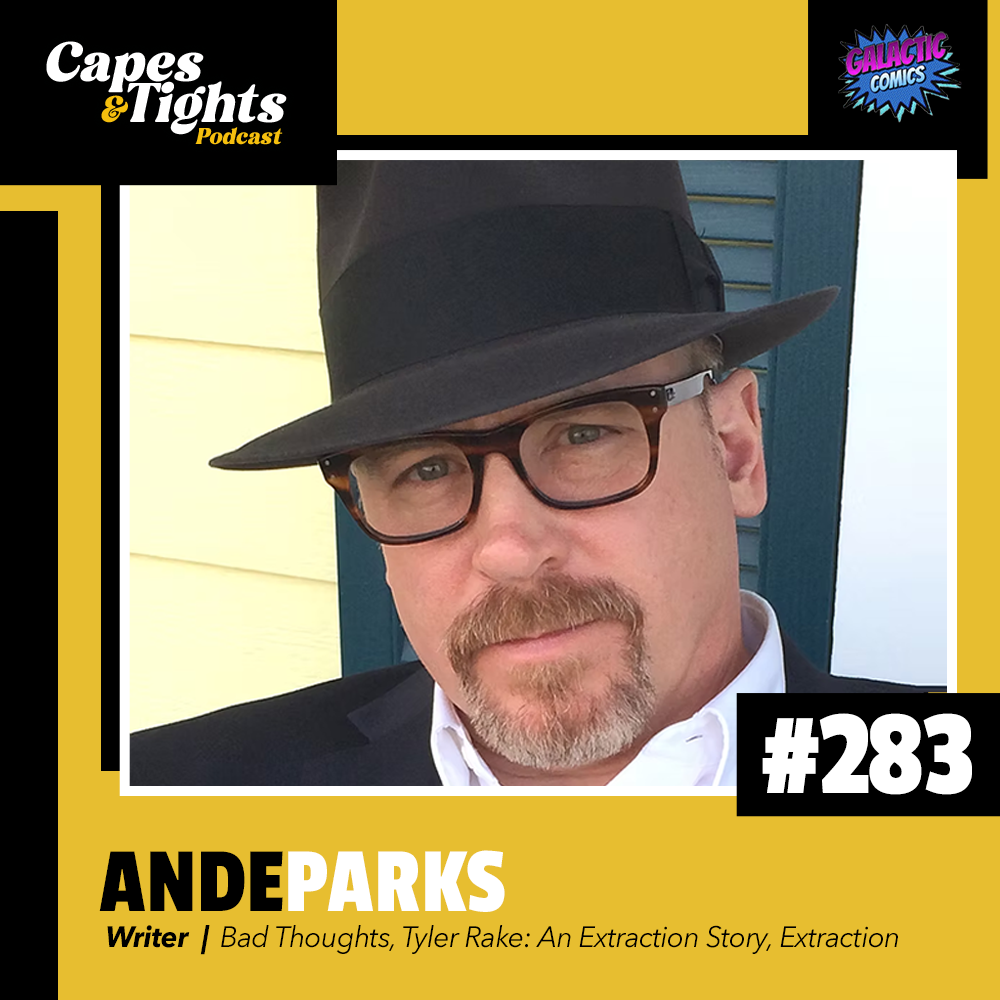
[00:00:00] Speaker A: Welcome back to the Capes and Tights podcast right here on Capesandtights.com, i'm your host, Justin Soderbergh. This episode is once again brought to you by our friends over at Galactic Comics and Collectibles. At galactic comics and collectibles.com we welcome Andy Parks to the podcast who is the who's worked in the comic book industry for nearly three decades. He's been inking titles such as Daredevil, Ant Man, Superman, Wonder Woman, Nightwing. He's best known for his long stint on Green Arrow with frequent collaborator Phil Hester was written by Kevin Smith, which one of my favorite people. Parks has written three graphic novels for oneypress, Union Station, Capote and In Kansas and Ciudad. You might know Ciudad because it ended up turning into the Extraction movie with the Russo brothers over at Netflix. He also has comic books Tyler Rake and Extraction Story, which is a prequel over at Ignition Press, as well as dropping today on the episode release of this episode is Bad Thoughts over at Ignition Press. So we chatted with Andy about his comics and so much more. Before you listen, follow us on Facebook, Instagram, Twitter, bluesky, threads, all those places you can rate, review, subscribe over on Apple, Spotify or wherever you find your podcasts. You can also watch the video portion of this podcast over on YouTube.com and as always, check out capes and tights.com for so much more, including our review of Tyler Rake and Extraction Story and Bad Thoughts. Enjoy this episode, everybody. Thank you.
Welcome to the podcast. How are you today?
[00:01:24] Speaker B: I'm good. Thanks for having me, man.
[00:01:26] Speaker A: Absolutely. I'm glad we're here. It's actually funny, I recorded the last two recordings I did with were people from Maine. And so I was able to, you know, bask in the glory of how good the weather has been recently because. Because here in Maine, it takes us a little bit longer to get to the point where we like the weather, but we still complain about it all the time. So it's actually nice out today. So we got a good weather today. But yeah, I'm glad we get to check. I mean, you're in the middle of the country, so you get a little bit, you're, you're a little bit south or a little bit south. You're Southern, more Southern than me. And you're in the middle of the country. So you have. How's the weather? We're in your neck of the woods right now.
[00:02:01] Speaker B: We're actually wrapping one of the best, probably the best week of the year. It's been like 6070s every day. Cool at night, really real great.
[00:02:09] Speaker A: Yeah, perfect. My son got like, my son's 5 or will turn 5 next week. And he, he just was like not knowing how weather fully works yet because he like one nice day and he's like, it's summertime and I'm like, in Maine that's not the case. We have lot of false starts for things. Like in the winter we have a snowstorm and it's beautiful for a couple of weeks.
In the spring we have, it's beautiful and then it's snows for a couple of weeks. So he's not fully grasping it. But I think we're there now. I think we're good now.
[00:02:37] Speaker B: What's a bad, like, what's a bad stretch in the summer for you? You don't, you don't get hundreds, do you?
[00:02:41] Speaker A: We get about 95, 90 to 100, 95 to 100. I say to people in the state of Maine, for me there's like three total weeks. If you combined all the days that are just crappy weather, really crappy weather, it's about three total weeks. So you get about three or four days in the summertime of 100 degree weather. You get like a couple really, really bad snowstorms, some rainy weather or some cold weather. But like in the summertime we get 100, maybe four or five times. I'll tell you now with climate change a little bit more, it's depending, it all depends. But like it's, it's definitely, we get to 100 here and there, but it's a little bit muggy when it is too. So it's not, it's just like you just feel wet.
But yeah, it's, most of the time it's good weather. Especially later on at night when you're like sitting around a fire or a campfire or something like that. It's usually pretty nice, but it gets
[00:03:30] Speaker B: human here and people complain. But man, I was in Houston last week and for them it was glorious. It was like 85, but I was like, oh, I don't want this place in July. No thank you.
[00:03:42] Speaker A: Let's just say my, my mom's visiting my grandmother in Florida right now and she's just like, it's kind of unbearable already. And I was like, it's May, like what's, what's August gonna be like? Jesus.
But yeah, my, my sister in law is getting married in Maine in September and I'm like, that's the best weather. It looks the best. It's get. It's cooling down. Everything is still alive. There's no. Like, the fall in Maine is great because obviously the leaves and stuff like that, but then it just becomes gross because everything's just dead.
And then the winter comes. So, like, September's gonna be great. Great wedding time, great time this year, but it's not that bad.
Mainers, like I said before, Mainers just like to complain about the weather. It doesn't really matter. It's too hot, too cold, it's too rainy, too wet, too too snowy. It doesn't really matter. We never really happy with the weather.
However, it's pretty safe to live in Maine, so.
So all other aspects of wildlife and animals and weather and crime and things like that, it's pretty, pretty overall safe to be here. So it's, it's okay. But yeah, we're here to not talk about the weather. I mean, we could talk about the weather the whole time if you really wanted to. It's, it's, it's, it's interesting. It would be an interesting podcast, but we're here to talk about comics. So. So you. Obviously we'd mentioned right before we started recording is that you've been doing this for a while. We're not gonna, we're not gonna say ages here. We're not gonna say how long. Well, I guess your website says, what, three decades, so we'll, we'll, we'll go on that. We'll go. We'll go on three decades. How about that?
But yeah, and so obviously games have changed a little bit in, in three decades of, of working on comics, and you've done pretty much everything. I mean, have you colored books?
No.
Okay, but. So, well, for comics itself, you've only. You've done everything else, basically.
[00:05:15] Speaker B: Yeah, I have red, green, color issues, so I have to be careful when coloring.
Photoshop is actually good for me because you can see the numerical values. It's watercolor sets where I get in trouble. I'm like, oh, brown, orange, what are we doing? Whatever.
[00:05:31] Speaker A: I want to see a book colored value that way, then. No, I wanted to see how it comes out.
It would be an experience in itself. No, but you basically inked, you penciled, you've been artist, you've been the writer, you've lettered. It's. You do a whole thing. I just actually finished. Have you seen these new books from Bloomsbury? They're Marvel. Marvel Age of Comics. They've been coming out in small aspects. So they had like three that came out last year.
They have one Coming out here in May, one coming out in June. The one I just finished was Weapon X Wolverine, and it was written by Jim Rugg. And it was basically like an in depth discussion of or like the in depth description of what the comic series was that was in Marvel Comics Presents. And then they go into like the storyteller, you know, Barry Windsor Smith in this case, and so on and so forth. And. And it was funny because it was like, Barry Windsor Smith did everything on a weapon ax. Like he was. Everything was just done. But. And they said this is not normal in modern comics nowadays. It's. It's basically like someone writes it, someone pencils it, someone inks it, someone. And that's basically because of timelines. You know, like, it's like they're trying to hit deadlines and things, and having multiple people do it makes them move things faster. So you can get three or four pages and so on and so forth.
[00:06:41] Speaker B: I do these library talks where I talk to kids sometimes in schools too, about the breakdown of labor in comics. And I have to explain, really, this only happens in America, where we decided that monthly serialized stuff was the way to go. In Europe, an artist takes a year, he makes a graphic novel, and it's his product. We just developed this kind of assembly line way because there was no way for a person to make a comic every month.
[00:07:10] Speaker A: We also live in United States of America where we're. So we need things now and we have to use this thing to pay for things and financing and so on. So, like, I've always been frustrated in the world of comics where I'm like, couldn't you have like four or five issues done before you released issue one and so that. So that they would never really have to worry about timing because you could just take the time to do that. No, we have to get like one or two issues done. So solicit them so that you're. You're telling your local comic book shop that you want to buy issue two before you've even bought issue one and read it and all these different things. I'm like, can we just like, calm for a moment, slow down for a second and just enjoy the creation that it is?
[00:07:47] Speaker B: It's a jump ahead. But we haven't mentioned Ignition yet. But that's where I'm writing now, Ignition Press.
And it's actually one of the things Jamie Richmond, editor, talked about when they founded the company was, I really want to get off the.
The roller coaster of this book's going to press Wednesday.
You know, blah, blah, I'm finishing, generally finishing scripts for four or five issues before art is started on my books.
And so before the art is done for the series. I'm, I've been in for months.
And it gives everybody a little leeway to say like if for myself, I just realized there's a payoff that could work better in issue five if such and such happened in issue three.
It's not a problem. I go back and revise the script pencil has it in time. Everybody has some leeway to say, you know what, here's what's going to work best. And it just makes for more efficient storytelling in the long run.
[00:08:47] Speaker A: And I feel like it takes all stress off of the creators and the story becomes better. Like you mentioned and I believe is Ignition Press mostly it's like five or six weeks too. It's not like months.
Yes, yes. Which allows for a little bit more of leeway on that leeway on art, but also for the comic book buyer, whether it be the local comic book shop or the reader, to potentially have a week or so between the FOC date potentially and like actually be like, we sold a crap ton of these books. Yes, I want issue two or we didn't sell any, so why am I buying issue two kind of thing.
[00:09:20] Speaker B: I went to Comics Pro, which is event, it's like a convention for comic book retailers.
Ignition brought me out to promote Bad Thoughts Announce it really.
And they talked about in their presentation, Philip Sack, the publisher, talked about the six week schedule. He said, we want you guys, the retailers to have some feedback before you have to go blind ordering, you know, subsequent issues. We want you to be able to gauge how it's going and let that inform your ordering.
And we're going to overprint such that if you do need more copies of the thing because it's selling out.
We don't want to brag about some kind of fake sellout because we didn't print enough. We want you to have product on your shelves so you can make more money off of it. You know, so they're doing a lot of things that are smart for retailers.
[00:10:07] Speaker A: I think it's, it is. And I, I'm not going to call, call name out names or call publishers out or anything like that specifically. But I was saying that to my friend the other day, it was like, I remember recently in the past three or four years that an issue 1 second printing had a more valuable, you know, price to it because there was less printed. And I was like, I don't understand, I don't understand that as much as it should be, like, it's the first issue, it should be the first. And to me, I'm like, and technically a second printing of a first appearance is technically not their first appearance. It's in the first. And so it was all these different things. And I was like, yeah, the six weeks gives it that, that lead time. Because I remember I've been in a shot before on a Wednesday. And they're like, yeah, the FOC for the second issue was Monday and today's Wednesday when the first issue hits the shelf. And I'm like, that doesn't really make a lot of sense for anybody who, who, you know, because of the fact that if you wanted it, maybe the person took a risk on the LCS owner took a risk on issue one, because issue one sell well, but didn't really plan out well and they missed issue two and, you know, so on and so forth. So it's nice to be six weeks. It's, it's a, you know, we all. We also have a wallet, so six weeks helps us sprayed out when we want to buy your issues. It's, it's a, it's a easiness on our wallet on that sense, too.
[00:11:21] Speaker B: It seems to me that, you know, there's always going to some nose dive from issue one to issue two in ordering. There's more variants now. Ignition doesn't go crazy. There's like three variants plus one that's retail exclusive on number one, and then just two covers on every issue after that. So they don't go 10 variants and all this stuff like some people do.
But the nose dive, I think you can, you can help prevent that a little bit if the retailer sees, oh, wow, number one, people really dug that one.
So I don't have to just slash my orders blindly on number two.
[00:11:59] Speaker A: Yeah. And it helps with the whole, like leveling it out and people understand it and have it like you said, having a retailer be like, what did do well, let's order some more. But because we can put it on their shelves and put it next to number one and number two could be next to each other on the release of number two and so on. But yeah, so Ignition's been great. And I actually have been saying this recently. I'm like. And I haven't. Here's the deal. I haven't read a comic from Ignition recently. I haven't read them all, but I haven't read one that hasn't been good. And that's the other part about it. It's not like Every once in a while a publisher will have a miss. And I was like, there really hasn't been a miss so far from Ignition.
And I've been a big fan since the beginning of this, which obviously hasn't been that long.
But that's because I'm a big fan of Jeremy Hahn too. So that, that helps a little bit on that sense too. Who's, who's obviously working part of the big team there over at Ignition, getting things done and things like that. And so we had Jeremy on early when the first issue launched and I was like, this is awesome. Ignition has been great. They're easy to work with. And that's on this side of things. To be able to email someone and have them be like, yeah, here's some preview pages, here's a PDF or whatever, and here's a Google Drive with everything coming up. So I can like pick and choose. And if I, if, if I forgot what happened in issue one, issue one's still there so I can go back to it and so on and so forth. Whereas some of them, you send you a link and then two weeks later the link's gone, you're like, oh, I wanted to look at, I wanted to look at a specific panel or something like that. And the comic book hasn't come out yet, so I can't even look at the physical copy or anything like that.
[00:13:20] Speaker B: So we're not paying for this big cloud storage.
[00:13:25] Speaker A: We had a budget debate, we can't do this. Yeah, no, it's been great, but so you're writing for Ignition with these comics. You're doing Tyler Rake, an extraction story, which is great. You've got bad thoughts. You mentioned coming up too.
Is this now your writing phase of life or is this just stories you want to tell and things like that? I mean, are you inking at all? Are you gonna ink, are you gonna pencil, are you gonna do any of that? Or is it just basically like, okay, it's time to write right now.
[00:13:54] Speaker B: I have inked a few covers for Ignition over Phil Hester, both for my own books. We did a variant for Tyler Rake and one for Bad Thoughts. But I've been trying to phase out of inking for off and on for at least a decade.
Part of that was, I mean, part of my transition in the first place was I didn't want to be begging 25 year old editors for inking jobs when I was my age, you know, and I wanted to have stuff out in the world that I own that if it, if it did well, I was the one who benefited. You know, if I'm working on Green Arrow, I had a great run on Green Arrow. It's made me a lot of royalties, very happy.
But if they make a Green Arrow movie, then it didn't do anything for me.
I invested in myself as a writer, started writing graphic novels, was able to team up with the Russos on this thing that became Extraction.
So in a way, I hit the lottery with that. Extraction became what it is.
But it wouldn't have happened if I hadn't bet on myself and said, you know what? I really want to transition into ownership.
So I did. I made that investment. And it was hard at times financially because I was thinking less, earning less while I was writing speculatively.
So I wanted to invest in myself as a writer. I also.
My spine is kind of shot. After 30 years of this, it's hard on you.
And I can solve a writing problem over there on the golf course. You're not. Nothing happens on that page unless you've been over that damn drafting table. And I was just kind of tired of.
[00:15:28] Speaker A: Makes sense. But it's funny. It's not. You're not like. It's not like you're the only person who has, like, thought about this or wanted to do this either, because, like, it's a very common thing. I think some of my favorite artists are also doing. They're. They're drawing here and there, but they're doing a lot of writing. And it's like, well, there's a lot of stories to be told and if you want, you can't do both. We already mentioned this. It's very hard to do both nowadays. There are people that are doing it and people are doing it fantastically. It's just a lot of work to do both. I mean, even you ask those people who do writing and illustrating are like, yeah, I can't do anything else, but I'm doing this. So I can only work on one project at a time. So obviously that hurts the wallet a little bit because you can't get these right.
[00:16:05] Speaker B: Well, it takes a bankroll, you know, if you're. You have to be able to fund yourself for the next six months. If you're going to write and draw maybe a three issue series, it takes. It takes some time.
[00:16:14] Speaker A: And so that's like, you know, I see that happening. And plus, I mean, you're creators and so you have stories to be told. And obviously, you know, you know, what started, what spawned the extraction stories and the movies and Tyler Rake and things like that.
You needed to create that, to do that. Like I said, you're not going to get stuff for Green Arrow, but you will for your creations if it's your own thing. And so Ignition, obviously, is helping with that because you're doing the two comics right now over there, but you've also released your own graphic novels and things like that on top of that stuff over the years to do this. But, I mean, are these stories that you've had? I mean, obviously Extraction is an expansion or a prequel. Tyler Rake is a prequel to the Extraction stories. But, like, Bad Thoughts, is this something that's been, like, percolating for years and you finally get to tell this story?
[00:17:04] Speaker B: Yeah, exactly. And part of why I think Ignition has had a really strong run their first year or two is that they were able to go to people like me and say, what do you got that you're most passionate about? And I pitched them. I forget if it was five or six things. When I first signed on and they said yes to my two favorites.
And really, one of them, I thought, well, they're not going to say yes to this because it's.
It's not as commercial. I thought Bad Thoughts was an easy sell. That's the. The other one that I'm almost done writing now that I can't talk about. I thought, well, they're not going to say yes to that, but it's the one I really want to do besides Bad Thoughts. And they said, yeah, it sounds like you're really into that. Let's go.
They didn't care that it was period or, you know, they didn't care about anything except that I seemed really passionate about it.
And that's what they're giving creators free rein to really pursue the stuff that they are hungry for, which has been
[00:18:04] Speaker A: really nice, which ends up turning out to be the best possible comic. You know, it's story to be told is if someone's super passionate about it, they're going to. They're going to try to, you know, finesse it and make it and edit it to be the way they exactly want it. Whereas if they're like, this is what you want, and so you're telling me to write this, I'll do it, but, like, there's no real, like, oomph to get it done. And I think that having your own story that you've been percolating for a while, or, like, it's been in the back of your mind for a while, you're like, I want to make this perfection. Plus, I mean, people know you Obviously, over the years, but like, in recent. In the past, what, five or 10 years, you've done less. No, like, this is not like saying it's a bad thing. We've done less than you did your Green Arrow days and things like that. So do you feel like you had to almost like, for those who don't know who you are, is it trying to like, re. Re. Advertise for yourself of who you are that you're legit? This is.
Is you're not a newcomer to the industry.
[00:18:56] Speaker B: Yeah, well, it was this month and last month have been really big for me because I've been kind of gone from the comic book stands. When Extraction hit six Years and Change ago hit Netflix, I mean, I thought, well, there's no great place for me to make comics right now. There's no business model on comics. It really works for me at the moment.
There's either a page rate, but they take all the ownership, or there's no page rate and I get back in. But then how am I supporting myself? So I decided to chase Hollywood money for several years. I was writing screenplays and TV pitches, and I had collaborators.
After four years of that, all I had was a bunch of scripts and proposals and stacks of notes, and nothing had no. No product, you know.
And so when Ignition rolled around, I was like, God, yes, I'm ready to actually get back to making things and quit chasing.
Oh, there's a project that might happen in three years. If I address these notes, Ignition just said, hey, we'll pay you a page rate. It's still creator owned. You get to do the things you want.
Let's make comics. That was really a welcome invitation for me.
[00:20:09] Speaker A: And now you're doing it. When Extraction came out, the original graphic novel, was that even in print?
[00:20:15] Speaker B: No.
It's a long, complicated story, I'm guessing,
[00:20:19] Speaker A: but I was just kind of quickly googling it. I'm like, the last time it came out in trade was what, 0:14 somewhere around there.
[00:20:26] Speaker B: It was out of print for about a decade. And now Ignition has a reprint of it out that's out now that people can ask their retailers about. And it's in color for the first time and it has a Dampanosian cover. It looks really great. I'm sorry, I don't want to.
[00:20:39] Speaker A: No, it's fine. I was just looking up. But Dan Panosian is also phenomenal artist. Is another person who's a phenomenal artist but also is writing comics. Yeah, but. Yeah, and it's you. And you're putting it it's cd, but it says Extraction story on it now. Like you're connecting the two too. Because obviously when you Google something like Extraction is based on a comic. And as it happens, sometimes from. From comics to movies, they decide to change the name of something or adapt it into a different name. Not just the story gets adapted, but sometimes the name. And so this is also nice because now I think both names is it. Both names are on the end. Ignition one. Is it. Is it?
I want to say it says this is Extraction.
[00:21:14] Speaker B: It doesn't say CDAD anywhere. The. The miniseries has the Tyler Ray Colon Extraction story, you know, but yeah, we just wanted people to know what the heck they're looking at, you know, because see, that is nowhere. It's not. The movie isn't even set in CS day anymore. That was the whole.
[00:21:33] Speaker A: That makes sense. And again, you. You tie. You know, you obviously benefit from it being adapted into a film. But the thing is, it was still created as a comic book. You know, people want to read it as a story. And so hopefully one of the things you do is two pronged marketing. The idea that the movie helps sell some more books. And so people buy the books and if they're not connected in a way that is easy to follow that then it's sometimes hard to find. This will make it a little bit easier. And so you can just Google or like go on to whatever bookstore, bookshelf.org probably has it or one of those other places has it where you can just Google or type in Extraction. You get the book too, not just happening to know what the original graphic novel was called.
[00:22:10] Speaker B: And then they. They finished shooting an extraction TV show that's called Mercenary.
And we don't know when it's gonna come out. But that really helps promote your books because the TV show hits, I don't know, Netflix does week by week releases.
[00:22:27] Speaker A: Yes.
Yeah, they do. Like, they've been doing this model where it's like. If it's. If it's like six episodes, they do like three episodes and then three episodes. But it depends on. On the show, I think.
[00:22:36] Speaker B: How unlike a movie, you know, is like an explosion.
The TV show promotes your books like week after week. And it. It really helps. So, yeah, we'll have a lot of Extraction product out there from Ignition by the time the TV show rolls out.
[00:22:51] Speaker A: Well, yeah, it's in this.
I am always one who want. You should read the source material. Movies are great. I love adaptations of things. I love seeing someone else's mind take a story from someone else. And say, hey, what do we do to either make this better or change it or what works better for TV or screen than it does on a comic book? You know, obviously, in a comic book, outside of the printing budget, you can do whatever you want. Making explosions. You can do, like, as many characters as you want because it's. You're just drawing them in. This is not like, nobody's gonna say,
[00:23:19] Speaker B: we can't afford another car crash.
[00:23:20] Speaker A: Yes. Yeah. And so you have to sometimes scale it down or scale it up depending, and all that stuff. And it's great to see, but the source material is always, like, it was created as a graphic novel or as a comic book. I always like seeing people do that. So it's one of those things I'm always, like, pushing for people like, oh, I saw that extraction on Netflix and, like, read the comic. Because I'm just like, I want people to read the comic as well. And obviously, you're with the Russo brothers, who. The Russo brothers obviously make big projects on TV and movies and things like that too. So they obviously have the. The movie minds to it, too. I mean, let's talk about that really quickly. I was. That experience, like, working with the Russo
[00:23:51] Speaker B: brothers, it was so. It was really interesting. It wasn't like I made a thing, and then the movie happened based on the thing. What happened was the Russos came to oni, and the Russos were making TV shows at the time. Community and Arrested Development, but they were kind of dying to get back into features. So they had this idea about an extraction expert and a story happening in Ciudad del Este, this place in South America.
And they thought, well, let's develop this as a comic and a screenplay at the same time. So we want to collaborate with somebody. They went to my producer, Eric Gitter, who's the guy behind Ignition, said, how about we collaborate on. Can you find us somebody to work with?
And I was ONI Press's kind of reality crime guy.
So they showed him Union Station. They like that, and they said, great. So we signed a deal to develop it together. So the Russos had the original idea, but then we fleshed it out together, and they were super supportive about the idea that the graphic novel didn't have to adhere to movie rules. You know, like, I would pitch things. They go, perfect. It probably won't make it that way in the movie.
Do it. It's just what we're looking for in the comic.
And I. There are some things that are unique and really character driven in the comic that are maybe too dark. For a mainstream action movie.
And they said, go for it. Perfect. Yeah. On the other hand, there's some great car chase stuff in the book that I'm very proud of. But frankly, Sam Hargrave, the director, who used to be a stunt guy, he can make that fly on the screen in a way that we could not on a comic book page, no matter how good you are. I mean, when Sam Hargrave, I don't know if you've seen their behind the scenes video of the first one. He's strapped onto the hood of a car holding the camera during that 12 minute car chase thing.
Just incredible stuff that really works well on screen.
[00:25:49] Speaker A: I love that way of doing it though, because actually this year I read M. Night Shyamalan's book with Nicholas Sparks. Now, I can't remember the name of it now, but it's a book that they wrote or the idea was together, the book was together, all that stuff. And M. Night or Nicholas Sparks wrote the book and M. Night's doing the movie. And it was like. It was the cool. And they were doing like a year apart. I think it came out in October and the movie comes out this October. And it was really cool in the sense that like both of them took what they're really good at, created a story together. One took the book and one took the movie and was like, we're gonna do this. And there are. They've said there's things in both that are not the same. It's because they had to do certain things in movies and again, things work differently and so on and so forth. And I was like, that's such a cool model in the sense that I would hope that maybe one day it does more of these things where it's like, you know, an idea spawns the comic book and the movie or the TV show and they both are basically putting together at the same time.
And then eventually. And obviously book publishing and.
Or comic publishing and movies are different schedules and different times and different budgets. So obviously they might not hit at this exact same time, but it works out that way. But you've been able to now take that and do like Tyler, Tyler Rake, which, which is a prequel over at Ignition Press. What was it like to jump back in to. To the extraction world of things in comics?
[00:27:10] Speaker B: It was cool. We knew we wanted to do. We knew we were getting the rights. Ignition was the problem was I didn't know exactly what was going on in the Extraction cinematic universe over the next, you know, I knew they had plans and they were doing A show and all this.
So we all agreed we wanted to make more comics, and I thought, well, I think the best way to go is explore Tyler leading up to the years leading up to the events of cdot.
That way we're probably not treading on anything that they're doing with him in the next film, and we get to explore. You know, his character is kind of enigmatic in the. In the graphic novel and in the movie. You don't know a lot about what led him to where he is.
So I thought, let's start telling the story of him as a mercenary, but not yet an extraction expert and see how that transition happens.
So that's what this first series is leading us to.
He starts as just a guy hiding out. He's wanted by, like, five governments, and he's, like, done with it.
He gets sucked back in and realizes he has no stomach for straight mercenary work anymore.
But by the end of our series, he realizes that there may be value in becoming an extraction specialist, at least for him personally. So. And then I got to get him to a place if we keep doing these lead ups.
By the time of Ciudad, he's so worn out by the extraction business that he hardly even views the people he's rescuing as humans anymore. They're just like packages to be moved from A to B, which is what C extraction is about, is him getting trapped in a place with one of these packages and having to start to view her as a human being again. So it's kind of a reawakening of those values.
And I say her because in the book, it's a female. In the movie, it's a. It's a young male victim. That
[00:29:15] Speaker A: to me is always like, there are reasons. But I'm like, why? Why did you change that? But, like, it's okay. It is what it is. But no, it. It.
It's cool. Like, I think it's one of those things that, like, if you're a big fan of the graphic novel or the comic book or the film, it's like going back and listening to a story about the prequel. And usually it's like movie four is where they're like, okay, let's go back. Let's go behind. Let's do prequel now. So you're fine now at this point that if they ever decide to do a prequel, hopefully they'll just base it off of the comics instead of. Instead of exactly, like, would come calling and say, hey, yeah, so we want the Tyler Rick story now. But no, it's a. Usually you don't get that. Usually you get. Like I said, people want that prequel, and I think they may not have to make it now because of this. Like, that's cool about it. Like, you can just be like, if you want a prequel story about how Tyler Ray got to where he was in the first movie or in the graphic novel, you can go read the Tyler Rake story at Ignition Press. And I think that's a good way of that whole working together in different platforms and different medias can actually work for someone's benefit. Where it's like the Russo brothers and all this group over at Netflix can tell all the stories they want to tell based around this Extraction universe, but they don't have to tell their prequel because you've done that for them, right?
[00:30:25] Speaker B: Yeah. And hopefully, I mean, I stayed away from current movie characters, like his handler in the movies.
I went back and dropped in. Like in the CDOT graphic novel, he has these brothers who are his handlers. So I introduced them for the first time in the prequel, like how he met them and so on. And we introduced some new characters who are real badass. I think there's a guy named Pudge in the series who is sociopathic almost, but also really has his own very unique moral compass that you'll experience through the series. So I. I really love Punch.
[00:31:07] Speaker A: And so you have Tyler Wake came out a couple issues. The third issue comes out in June. By the time this release, the second issue will be out.
[00:31:16] Speaker B: Yeah, I think two must come out real soon, because I got.
[00:31:19] Speaker A: I want to say it's next week, honestly, or something like that. I can't remember. I think these are the 13th or the 18th or the next week, the 20th.
But this. But was there a plan? Was Tyler Wake. Okay, we have Extraction, the graphic novel coming, reissuing again, and then Tyler Ray, because that. Was that why. That was first before Bad Thoughts. It's because he wanted.
[00:31:37] Speaker B: That's all timing credit because I. I asked him at one point, hey, can we lead with Bad Thoughts?
You know, it's. It's maybe the more personal thing to me. It's the one I've had in my mind for so long.
And they said, we think opening with Extraction, since you've been gone from the marketplace for a while, will reintroduce you in a way that will bring in people funneling into Bad Thoughts. And I think that was the right move.
People seeing Extraction go, oh, yeah, I remember Andy Parks as a writer. What else? What else is going on?
So then we can introduce the thing that that is all. All me. I'm very proud of Extraction, but it's a thing I co developed and so on. And bad thoughts along with Dave Wachter. The. The Artist is a very. It's a more personal book that I've had in mind for so long. Yeah.
[00:32:28] Speaker A: I wanted to mention really quickly too is Declan Shelve is doing the COVID The COVID a. Your main cover for Tyler Rake. And they're phenomenal. I mean, Declan's phenomenal.
[00:32:36] Speaker B: They're so cool.
[00:32:37] Speaker A: They're so cool.
[00:32:38] Speaker B: They're simple and bold and that, you know, I worked with Phil Hester for decades and we believe in bold graphic stuff.
Yeah. And Declan, like his covers are very simple images that still bring you into the storytelling of what they're. You know, they're very efficient storytellers, those covers.
[00:32:57] Speaker A: I think what's funny is I was just thinking about is they actually there's some issues of the Walking Dead that have that very same like, style like that, like the close up facial, like the first with Tyler Rake shooting with the bullets coming and things like that. I feel like that, like it, it reminded me a lot of that, which I love, which is.
Made me happy. It wasn't like, oh, oh, you know, it's more of that. No, it was just like that. And then like the second issue with the black, a stairwell going down and most of the front cover is in the shadow in the black. And it's like the color is like popping out at you because that's what's going on in the book. And I felt like I love that style and Declan does it phenomenally.
[00:33:33] Speaker B: What really thrills me about that is that he took the time to find out what's going on in the issue because there's a stairwell action sequence in number two that I'm really proud of and that Ronan, our artist, really nailed that. Let me. I don't think it's too spoilery to describe this sequence because it's a unique experience to read it. What happens is power's out. Fight on a stairwell being lit by a flashlight that's bouncing down the stairs.
So the beam of light flashes here and you see a certain bit of action, but then it bounces another step and now the flashlight bounce is shining this way. So you don't see that part of the action, but you see this. So it's just this panel by panel sequence of oh, oh, crap. Oh, I can see that. And I think if. I think the reader is going to be going like trying to.
Which is not confusing. I Think it's rewarding ultimately, but it's a really cool storytelling technique that Ronan really nailed. And it's so cool that the COVID artist bothered to say, hey, what's going on in this comic? I want to draw that.
[00:34:39] Speaker A: And now it connects it, which I've always like. One of those things I like when someone is a different cover artist, inside art in interior art. But as long as they're like. It's not like a big fan of Scotty Young, and Scotty does variants that the baby variants, but it's not like cover A is a baby variant, because that would throw me off a little bit to have like a baby variant on the front and the inside. Be like a typical X Men comic book or something like that, and. But when you have similar styles or at least there's the connection to what's going on the COVID to what goes on the inside, it makes a big thing. What I wanted to hear is that Ronan actually drew the entire stairwell sequence and then colored in with black to cover up everything else. Like, he actually. If you actually pull the black off, there's the full thing that I want to know that actually happened. No, but, yeah, I have a thing.
[00:35:24] Speaker B: I have a pet peeve with posing covers. I just.
Which we saw a lot in the 90s, you know, characters just looking cool and shiny and pointing their thing at you or whatever. Yeah, no, I want something. Some indication of what the story is about and what their abilities are. That's what I'm looking for.
[00:35:40] Speaker A: And it does it well. And I also think that I always. I always get mad at people like Ronan. You're talking about that, like, how, like, they come up with an idea or like to actually. To be able to come up with the idea and put it on paper to make it look that way. I'm almost like, how did you do that? Like, in the end, it's like, oh, that's a great idea. I wish I had.
Like, why did you do that to me? Because there's a certain. Certain artists and creators who just. It just. It's almost like second nature to them, where they're just like, this would be kind of cool to do. Or. Or this is what you want me to do in the story. This is how I'm going to do it. What do you think? Kind of thing. And I'm always like, that's why you're doing what you're doing. And I'm doing what I'm doing.
[00:36:14] Speaker B: I've been really lucky. We found great collaborators. I write a very complete Script. But I always.
It's written as kind of a note to the artist. And I'm like, look, my philosophy is I'm not going to ask you to draw anything that I can't see at least one way to accomplish in my head.
But if you have a better way, please, I just don't want to cheat you by giving you something that I view is impossible. So take my information and, and then go with your own abilities and turn it into magic. That's. That's what it's all about.
[00:36:47] Speaker A: Yeah. And it's, it's. You get that. And I think that covers nowadays, and I think having a little number of covers, you have, you know, your two main covers and maybe an incentive variant or something like that also makes people get the covers that make the most sense too. I think in that sense of like when there's 20 covers to something, there's a lot. At some point someone's going to create something that doesn't actually have anything to do with the be comic book characters on the COVID that don't even exist in the comic book anymore. Like a character could die three issues prior, but that's like a very popular character. So they put it on three issues later and it's like, well, they're not even in this comic anymore. They're not even alive anymore, let alone in this comic. And so having the minimal number, I'm, I'm. I'm not. I'm a completely against no variant covers because I do like the idea of artists getting to like flex their wings or, or do things. Because a lot of times these artists get seen more by having this. Like, if they, if they do a variant cover, maybe they'll get picked up for someone else's. Do main covers or the interior art for somewhere else. And I'm always like, I like at least a couple. Plus it gives people a choice when they go to the lcs, which one they want the best and.
But also not too many because then it gets a little bit lost in the shuffle too.
[00:37:53] Speaker B: Which cover, it stops being about this storytelling. It just becomes a. I gotta have that thing because it's more rare. Well, what's inside the book?
[00:38:01] Speaker A: I don't know.
[00:38:02] Speaker B: I just need that thing. Like, I get it because it's a tough marketplace and you want to maximize revenue.
But it'd be nice if it were all about the story.
[00:38:12] Speaker A: It's also maximizing a lot of revenue for other people outside the creators because a lot of people who make more money off of all these random covers are the people who are reselling it, not the people who are making the comic book in the first place. But you don't have time to get
[00:38:22] Speaker B: into that, get that pressed and get a 9.8 and then I can flip it on this.
[00:38:26] Speaker A: Well, I actually talked to my, my local comic book shop owner the other day and it was like I'm still waiting. One of my favorite artists of all time is Michael Del Mundo and and I'm still waiting for a comic book that was a 1 in 500 to just come down in value because I wasn't going to buy because a lot of times what do they sell for? Usually ratio variants are sold for roughly the cost of the ratio. So a lot of stores sell that one for $500 because it's a one in 500. And I'm like I'm never going to pay $500 for a comic book like that. Like there's just no way that I'm ever going to going to do that. And so I'll wait and wait. Now it's down to like 120 and some rest retail website. So I'm like if I just keep waiting as long as it gets farther away from when it first came out, I'll get it down to a reputable price that I actually want to pay. And I'm like that's what I need to do. I can't be over eager and want to get it right away. Like I gotta wait till it comes down in price though I understand some of it because I'm friends with an LCS owner and so to do store variants like it's beneficial because you get that 1 in 500 helps pay for the cost that's implemented and all of that stuff because a lot of times they order way more than they can save, sell immediately and all that stuff. But like especially small store owners. But I'm not paying 500 for a variant ratio variant. I'm sorry, it's just I can't do it. But.
But yeah. So Extraction Tyler Rake. It's out. People can read it. I was able to read the first issue early which was amazing and I was really cool to be jumping back into the extraction universe but without having to like it'd be a side story or retelling of the current stories that are out there. And so that's fun but also like it got me reinvigorated with your work. And so like having this ability to actually read something that you've done was bad thoughts like to have that spring into bad thoughts go hey Now I want to read something from you again. And so I was pumped about that and I'm a huge fan of Dave. So like that is like that team up there was, was, was, was a gold for me in the first place. So it is action packed, it is emotional, heartfelt. It's got superpowers of sorts if you want to, I mean, are you calling them superpowers? Is that what it is? Like he has superpowers? Or, or is it.
[00:40:28] Speaker B: Yeah, I guess. I, I, I'm always torn to call it a gift or a curse because it is, it is both.
[00:40:34] Speaker A: I wouldn't want it, I'm telling you right now, I would not want that ability at all.
[00:40:39] Speaker B: I the, the elevator pitch is it's an extraction style thriller with a Stephen King twist talking to a main person.
And the twist is that our lead character is an empath, but he only gets the most violent, vile, awful thoughts of those around him.
And those things linger in space for him. So that if he were in a produce department and a guy called his wife an ugly name the day before our lead might go, ah, he would feel the ugliness of that moment.
So going to Auschwitz or something like that, totally he lose, he'd be destroyed.
But it makes him useful as a crime scene investigator here because he can go and it's a painful ordeal to relive these moments from the point of view of the perpetrator, but he can pick up little tidbits that lead to apprehension of that purpose.
So that's where we find him. And in the second issue he's going to have his whole life turned upside down in a way that will force him into a new place. So that's, that's where the series is headed.
[00:41:40] Speaker A: I was very happy with it and one of the reasons why I was is I was a big fan of Rob and John Lehman's Chew in the sense where it had the same, like where they gave me that same feeling, that same like feeling about how like I wouldn't this is a super cool thing but I wouldn't want that ability to do that. Like it was like, I'm glad that person has that ability and I can read about it, but I don't want, you know, if anybody doesn't know chew is you can actually like eat things and know how it was killed or, or things like that. And so like you can eat.
[00:42:11] Speaker B: That's funny. I hung out with Rob a lot of the comics pro and that parallel never occurred to me. Yeah, that makes perfect sense.
[00:42:17] Speaker A: Like it's Like. Like the worst possible. Like, he doesn't get the worst possible thing. I guess there is. So obviously, because we could find out how people die and things like that. But, like, eating human flesh is a way that he could figure out how someone was killed. And I was like, I don't know if I'd ever want to do that. But also, hearing someone's worst possible thoughts also doesn't seem like something I want. And also. Because I feel like I would also be able to hear about what worst possible thoughts they have about me. And I'm just too. I. I have too much thin of a spirit skin for that, so I don't want to hear that either. But, no, it. You can tell, and it can tell that it's.
It's a gift and a curse, like you mentioned. It's something that he wants to be able to use for positives, but in the same sense, he can't. Obviously, it can't help but affect his personal life too. Like, it's just like he can't. You can't separate. It's not like you can be like, turn that off today. I'm going home. I'll turn it back on when I go to the office tomorrow. It's. It's a thing that he lives with, and you can see that he has this weight that he carries with him, but also, like, that he has a job to do and he has to do this. It's a cool concept in that sense. And it also screamed to me that it came from a person who wrote the extraction story. It seemed like, to me, it fits. You have a clientele, per se, that if you liked what you saw in the extraction stuff, you're gonna like bad thoughts in that sense, too. And obviously Dave's cover also is phenomenal in that one, too.
[00:43:31] Speaker B: I didn't really mean to go into another kind of military thriller, but I wanted to tell a story about the.
The rise and, in my view, the menace of private defense contractors and how they are.
And so I would. All this was conceived of within the last decade. So kind of a different. That's why in the series itself, we. There are no dates.
I don't ever drop the what year it is or anything. I kind of wanted to be like the movie, one battle after another, where you can just place it in your own brain, where you think it fits in our history.
But, yeah, so we went from. I want to say something about defense contractors and how they might operate in a way that is unchecked and potentially dangerous and. And have my Character spin out of that world into something new.
[00:44:25] Speaker A: So it makes. But I said, I also think that like, having that pre existing audience too helps as well. So I think that like I said,
[00:44:35] Speaker B: yeah, you do develop a brand. I. I'm not a guy who ever sat down and said, okay, here's my brand and here's how I'm gonna do abc. But you do learn like, you know, I like crime.
I like.
I. I guess I should just say I like violent stuff. To me, like someone once said to the Coen brothers, boy, your stuff has a lot of violence in there. Oh, you mean the. What propels the story?
Yeah, that's what we do.
So, I mean, I have done a quiet kind of graphic novel about an author struggling to write a novel with Capote and Kansas, but the novel he's writing is about horrific murders. So I. It's not like I ever.
[00:45:19] Speaker A: You couldn't get away from it. Yeah, you had to get it in there. I mean, you said thriller, but like I, I saw like the noise war part of this, the first issue. I mean, someone could say that, that Bad Thoughts has a little bit of horror in it. It's thriller. You have the military. It's like a. It's. There's not really a defining thing, at least out of the first issue, like obviously having read stages two, three, four and five. But like, it doesn't have like a defined genre in my opinion. Like, there is like an ambiguous thing to it, which is, which is cool because I feel like, you know, you also will not have people shy away from it because it's got a label on it of some sort. So that you're not like, oh, I don't like thrillers. Well, okay, then you're not gonna. I don't like violence or like whatever it may be, but.
[00:45:59] Speaker B: And I, I hope it. I think people will pick up on how personal it was because on its service you're like, well, it's a supernatural thriller or whatever, but it's really about what it's like to live in our modern world where there's so much ugliness kind of assaulting you on a daily basis basis, especially connected into social media and you know, everywhere you check can become doom scrolling in a heartbeat.
And how important the connection to someone in your life who grounds you and makes you feel safe, how important that is. And that's what Jack has in our first issue, and it's what will be threatened throughout.
Because I worked on this series for a long time before I realized it was about how I felt about my wife because I'm a person who has a lot of dark stuff rolling around in his head. It's kind of how I make a living.
And my, I'll tell my wife these things and she'll look at me like, oh, why would you. What? What?
Why?
So.
And I'm so thankful for that.
And that's what Jack has. He has somebody who, in a world where he cannot really feel safe around hardly anyone, he has this person, his partner, that always makes him feel safe and protected.
[00:47:14] Speaker A: So which means that it's going to be a problem for him moving forward because he has that. It's the whole why Spider man should never have revealed his identity. Some will come after the person you love, though. It's. But that also, like you said, it propels like that kind of thing. Propels the story forward too. I mean, it's not, it would be less interesting if there wasn't higher stakes personally for him as well. So I think that like you said, if it flips on its end there and some sort of crazy stuff happens, I think that that helps propel the story and make us as readers want to know how he's going to get out of this or how he's going to solve the problem or how he's going to, you know, figure this out. And I think that that set it up and like I said with the Ignition Press side of things is they obviously have horror, they have sci fi, they have romantic. Now they have everything. It's a little bit of everything going on over there too, which is really cool. And that's. This adds a little bit more to the variety of what's going on over at Ignition. Is this bad? Yeah.
[00:48:03] Speaker B: As far as they've got the, the heist, they've got several heists to them things, but I'm kind of the actiony crime guy so far in the roster. And with all due respect to your podcast name, they don't really have a guiding philosophy except they're not really doing superheroes. They're not really doing capes and titans,
[00:48:20] Speaker A: which I'm, I'm quite happy about. So funny thing is, is like this started we're, we're on this summer. We were five and five years ago it was like trying to come up with a name for a podcast because at one point this podcast Variate went from, from a main based podcast to the comic book centric podcast that it is and pop culture. And so we're like, oh, no one had it. And we're like, oh, let's Grab this. Let's do it. My buddy and I who started the podcast, and he ended up moving away.
Nowadays, I'm like, it kind of like, it just has to be that. In a sense, like, I can't change it because it's been five years, and I've got everything that goes along with it. And so now it's just like, whatever. It's. It is what it is. It's the podcast name. But, like, we do novels and horror and everything's now like, it's just a bunch of stuff. Stuff. But, like, yeah, I'm glad because I'll tell you right now, there's only a handful of people if that. That can create a superhero story is not based in the big two, that's actually worth reading, in my opinion. And so not doing it is probably the best. And if you are, you're gonna have to do some sort of obscure, unique way of doing this. You can't just be like, I'm gonna do our version of Green Arrow, per se. Like, you can't just do that because it's just.
[00:49:21] Speaker B: No. It used to be a totally different, irreverent take, like the boys. Wiser.
[00:49:25] Speaker A: Yes. Or invincible in the sense that, like, it's more raunchy or. So it has to be something where it's different. But I do think there are people who have. Have. I mean, Minor Threats has been great with Pat and also a Dark Horse. But again, it has to be something different. It has to do with the. The. The B characters and the C characters and D characters that it can be like trying to create your own Superman. I just don't. It's not as easy as people want to make it seem, like, because there is some successful ones out there. So, like, oh, I'll do that too. And it's like, it's not that easy.
People want their. They want their Superman, not the. The off brands.
[00:49:55] Speaker B: I mean, those. Those characters have decades of infiltrating your life through all these different avenues. They're just so ingrained in our existence, it's hard to beat that.
[00:50:05] Speaker A: And they're set up for most part for ongoings, or at least ongoing stories with resets for one. For. For rare, various purposes. But most of the stories now at Independent Comics are like, okay, we'll do five. Five, and then maybe five more, and then five more, or whatever. But, like, they could say, bad Thoughts is five issues and you're done and be happy with it. Whereas a superhero story is kind of almost set up to be 40 issues, in a sense. They can't just do 1:5 issue miniseries or whatever. But yeah, I mean, are you. Is this four issues or five issues for this? Right.
[00:50:33] Speaker B: And we did, we did a Cold open, which they've kind of shifted their model on that. It's fair enough being kind of kick Kickstarter model, but they found, I think that the shipping was prohibitive. You know, you're in a Kickstarter for 10 bucks to get the cold open and then wait, another 10 for shipping. What am I, you know, it's kind of off. So we kind of debuted the Cold open at Planet Comic Con, my hometown show in Kansas City, and it's been made available on the website and so on.
So that'll be part of the trade, I believe. But it's not connected to the main five issue arc of the story.
So five issues and then I'm really, God willing, I want to tell this guy's story for a long time to come. So I'm hoping there'll be more arcs.
[00:51:16] Speaker A: Yeah, but, but I'm also a big fan of the idea of making it five. And if you get to do five more, then plan a story for five more. And so I just would hate you if you have. I've had too many discussions with comic book creators who were told they were good 10 and they ended up getting seven and or eight. And now they get to squish the rest of the story they had laid out for 10 into the last two issues. And it hurts them, the quality of the product itself because you're squishing two issues into one or whatever and, and so like, yeah, it'd be nice to be able to say here's five issues and then, cool, that one did great, here's five more and here's five more and you know, so on and so forth. And I think that's what independent comics is really what it's like nowadays. I mean, some are set up for 10 issues or 12 issues, but most of them are four or five issues, maybe six issues.
[00:51:56] Speaker B: You know, you have to think about the economics. You, you, they're shelling out a real page rate to all these creators to make it so you want to bring in some revenue on the five issues, then you have the trade that's evergreen.
Keep it going. It's, it's a good publishing model. It makes sense.
[00:52:14] Speaker A: But in these, all these comics you've done recently and stuff where you've, you said you've partnered up with some great people. I mean, obviously in your entire history and creator history, you've Been able to partner up with some amazing people. Obviously you're still doing stuff. Stuff with Phil Hester because you're doing those variants for these books. But I know.
Would you ever want to partner up with Kevin again and do some combos with Kevin again?
[00:52:36] Speaker B: Yeah. He's one of the only things that could bring me back to inking like we did.
It's been several years ago.
[00:52:42] Speaker A: We did it quick stops together.
[00:52:45] Speaker B: Yes. Right.
So. And I was kind of out of inking already, but as I offer Kevin, you know, so, yeah, we. He changed our lives and we owe him a lot because, believe me, when DC said let's have a Kevin Smith Green Arrow book come out, Phil and Andy were not their first choice.
They could have gotten a lot harder, hotter artists to draw that book, but Kevin and the editor, Bob Schreck, said, these are my. These are our guys. This is what it is.
And that changed our whole career trajectory. So, yeah, I owe Kevin forever. And if he wants me, I'll try to find a way to make it work.
[00:53:21] Speaker A: He is. Well, I would say not physically personally, but he is the reason why this podcast. Podcast exists because of one thing he said once on his podcast, which was, if you're going to start one, just go do it. Stop waiting, buy the equipment, get quality equipment, keep up a good, consistent schedule and. And have fun doing it. Whether you get one listener or 5 million listeners, just keep doing it. And. And that, to me, has always stayed with me. And he's a bucket list. I've gotten amazing people on this podcast. He's always been a bucket list person, person for me was Kevin, because every milestone, 100 episodes, 200 episodes. We're approaching 300 episodes in the fall, which I already have a guest line up for. But, like, I've always wanted, like, oh, that's a great, you know, milestone episodes. Talk to Kevin and it's always been like, yeah, yeah, yeah. And then it's fallen through. So one of these days, and I'll get Kevin Smith on this podcast and we will chat about how much he's. Like I said, it's. He's changed you. Like I said, he didn't do it personally to me. He doesn't even know who the hell I am. Proud, probably. But like I said, this exists in the vein because he said something on a podcast that I took to heart, and it wasn't about some sort of fart joke. So it was. It was legit things. And I said, oh, that makes sense. Just do it. And so I bought the equipment and We've been doing it ever since. This is a great model for that.
[00:54:30] Speaker B: Not to rip off some slogan, but he's a great model for Just do it like you wanted to make a movie. He didn't have a studio behind him. He didn't let it stop him. He found a way to make it happen.
[00:54:41] Speaker A: Yeah. And. Exactly. And it's where it is. And again, you know, he's not fully to blame. I guess he's the blame. Anybody listening, It's Kevin's fault. Blame Kevin Smith if you want to listen to this podcast. No, it's great. And so I've been able to meet and I virtually through this podcast, you. And then physically with other people over the years because of it. And yeah, just do it and say. I would say the same thing with comics in writing or illustrating or whatever. Just do it. Just go out there and if you have a product you want to work on, project you want to work on, find the right team to work on it, make it, Kickstarter it, pitch it to. To. To people who are in the comping industry, whatever it is, go to your local printer and print it if you think you want to, whatever. But just. Just make something.
[00:55:16] Speaker B: You don't even have to go to Kinko's anymore with blogs and, you know, make it digitally.
[00:55:20] Speaker A: Yeah.
And so just do it. There you go. Now, hopefully someone five years from now is like, ah, that guy Justin on that podcast told me to go do it and you know, let's do this. Now.
[00:55:28] Speaker B: I tell people that all the time at cons. They come up and say, I to want to get into comics. How do I do that? And I'll say, what do you got on your phone? You can show me?
And often nothing. And I'll say, so I tell you what, I'll be at this show in four months or I'll be at this show a year from now again, come back and let me see something. You know, whatever it is, just start. And probably the most common advice I give is stop getting hung up on purpose. Perfection. Your ambition is going to outstrip your talent. When you start this, it's okay. Finish the thing in front of you as best you can, make the next one better and keep moving. Just.
[00:56:10] Speaker A: And just do it. And a lot of times, like, you obviously been doing this for a number of years, dude, but you talk to these creators nowadays. I'm like, how did you get X, Y and Z to, like, sheer luck, dude. Like luck. Like, it was absolutely lucky that I got. I knew someone who knew someone who Knew someone who, who, who pitched something to me and said something to me. Now I'm working in DC Comics and I'm like, oh, cool. So there isn't any like straight avenue to get to working in comic book.
There's always this random stuff.
[00:56:34] Speaker B: But yeah, when I broke in, it was relatively simple. Move to the east coast, go in and see the editors in their office and blah. It's not like that anymore. Put out good work and hope you get noticed.
[00:56:44] Speaker A: Yeah. But the Tyler Rake Extraction story is available now at your local comic book shops. Go grab it. The third issue comes out following this podcast in a couple of weeks, so check that out.
Bad Thoughts comes out today, the episode releasing today. So if you haven't been to your LCS yet, go to your lcs, grab this book. If for some reason they sold through the 500 copies they bought, tell them to order more because they, you know, it's worth reading. And then again, if you're a trade waiter, these things will come out in some pretty quality trades. I don't like support the creators so that the publishers know it's worth supporting, supporting these creators. However, I understand some people are budget conscious or want the whole story together and so on and so forth, but the trades that come from Ignition are also quality. So it's worth.
[00:57:27] Speaker B: Yeah, design team is great. I love the paper stock they're using on covers and stuff.
It's a good package.
[00:57:34] Speaker A: You're getting what you pay for.
[00:57:36] Speaker B: Yeah. The extraction trade they put out is on beautiful paper color for the first time and it's a 20 bill. It's an amazing value.
[00:57:43] Speaker A: It's, it's worth it. And again, again, if you have to wait, wait. But like I said, it's just like I always say to people, pre order books when you can for in the, in the book market because it tells the publisher that they invested in the right people and the story is going to do well. It's the same thing. Buy the issues if you can because again, it tells Ignition we want to work with this guy again in the future. And so. But trades are worth it as well. So.
But until the next time, thank you so much for joining us this time on the podcast to track Extraction, Tyler Rake, Bad thoughts and all kinds of other things. We'll have you back again in the future. Does it sound good?
[00:58:17] Speaker B: I would love it. Thanks so much.
[00:58:18] Speaker A: Absolutely. Thank you.