Episode Transcript
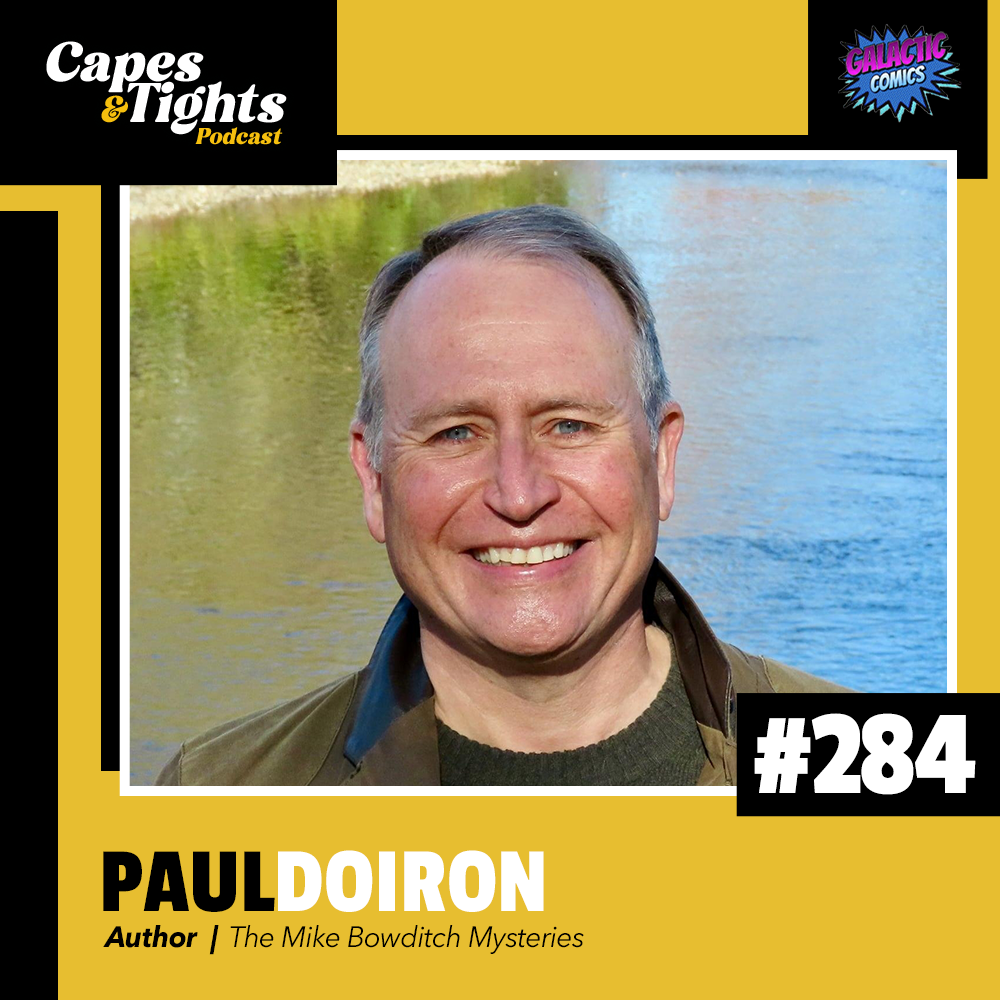
[00:00:00] Speaker A: Welcome back to the Capes and Tights podcast right here on Capesandtights.com I'm your host, Justin Soderbergh. Once again, this episode is brought to you by our friends over at Galactic Comics and collectibles@g Galactic comics and collectibles.com today we welcome Barry O. Ward and the Strand Critics Award winning author Paul Dwarren to the podcast. Paul is an author of the Mike Bowditch series of novels, a mystery series of novels based right here in the great state of Maine featuring a Maine game warden named Mike Bowditch. His first novel was the Poacher's Son and is set to read the 16th book in the series, Star Stormtide, which also there's also a bunch of short stories as well. But this one is the 16th book, a full length novel coming out in June. So check that out, bookshop.org, libro FM, all those places, your local bookstore, et cetera, et cetera. But before you listen, follow us on Facebook, Instagram, Blue Sky, Twitter threads, all those places. Rate, review, subscribe over on Apple, Spotify or wherever you find your podcasts. You can watch the video portion of this podcast over on YouTube.com and as always, you can visit capesentice.com for so much more. This is author Paul Dwaran talking about the Mike Bowditch series and the upcoming Storm Tide right here on the Capes and Tights podcast. Enjoy.
Welcome to the podcast. Paul. How are you today?
[00:01:19] Speaker B: I'm very well. It's actually a really nice day finally in Maine.
[00:01:24] Speaker A: Well, it's kind of funny. This is the, the second recording back to back. So like I recorded last week with a comic writer, Joey Esposito, who lives in Bath.
And it was kind of funny because a lot of these conversations I have with people, they're based all over the globe, right? And so like you're like, oh, it's beautiful out. Or it's snowing and someone's like, it's sunny in California. And now having someone actually get to talk to someone who's also, you know, based in Maine or New England, it's kind of funny. They know what it's like right now. I'm like, it's nice outside. They're like, really?
[00:01:55] Speaker B: Well, it's hard to believe it was a horrible winter. It was just, there's nothing good about.
[00:02:02] Speaker A: Didn't seem like it was going to end either. Like you'd have a glimpse of the spring, like, oh, it's nice outside. Put your windows down. And then the Next day, it, like, snowed. It was like. I don't know what's going on here.
But, yeah, main spring is. It's coming, it's here, it's beautiful. We're gonna be outside here pretty soon.
I went to Augusta this weekend and got a tug fitted for a tuck. So it's wedding season.
It's everything here in Maine. It's that. It's that fun time to do things. But yeah, you know, you're a writer, you're from Maine, you live in Maine.
It's. Maine is your background. It's. What I've mentioned before is it's almost a character in your story Maine. It's like Mike Bowditch is the character, but then there's Maine, which is like the character A in B.
Let's just kick off with that right there. Is it important to have Maine as this. Like, this character in your. In your novels?
[00:02:57] Speaker B: Absolutely. I.
You know, when I was coming up with the.
The first story that I ever wrote in, in this series, which was the Poacher's Son, and coming up with the character of Mike Bowditch, one of the things that I knew I wanted to do was to.
To describe Maine, especially the Maine outdoors, so vividly that people who had never been here before, you know, would sort of read about the. The sights and the sense and this, you know, the sounds and everything, and feel like they could imagine it, you know, kind of in multiple dimensions so that, you know, they would feel like they'd been here, essentially because I'd had that experience reading. Reading some other authors. Like, one of the. One of my inspirations had been James Lee Burke, who wrote. Writes about a Cajun detective in Louisiana called Dave Robichaux. And his. His. His prose is so vivid.
And I had never been to Louisiana before I started writing, and I. But I felt like I had, you know, from reading his work, and. And I want to do the same thing for Maine. So that's. That's been a big piece of it.
[00:04:13] Speaker A: Well, obviously, we're all Stephen King fans. You write books. You're from Maine, you're from Stephen King. So Stephen does this as well. He has obviously this. This like they're based in. Loosely based in Maine, places that are potentially have fictional town names or whatever, but it's not the same. I don't think. I think it's one of those things that you do get a feel when you read a Stephen King book. If you don't haven't been to Maine, like, you might get a glimpse of that. But like, reading your Mike Bowditch novels, it's like, I don't know. I just feel like being from Maine.
I was born in Massachusetts, but, like, I'm. I'll be turning 40 in a couple weeks, and in 30 of those 40 years I've spent in Maine.
So, like, it was like, I was born in Massachusetts, but we lived in Maine from ages like 1 to 10. And then I. At 20 to 30, I went away for a little bit, but I'm back in Maine. So, like, to me, I'm a Mainer, and I. We always feel like we're neglected. Like, as people, like, I don't know. It's always one of those things. I mean, we're very excited now. If you're a fan of basketball, Cooper Flag is pretty big in the NBA, and we're proud of this. And it's like, people. If you talk to someone from, like, California or New York, they're just like, it's just another famous person from your state. It doesn't seem so special. But, like. So when Stephen King writes about the books, you're gonna feel happy. But when I go to read a Mike Bowditch book, it's not just your prose and your style of writing and things like that and MIC as itself. It's like, I could. You get to see towns and things that I've been to. Like, I'm like, this is so amazing. I'm like, I feel even immersed. But then I'm starting to think of outside the box. Like, who are the people from Louisiana? Let's say, do the opposite of that. Reading this book and explaining Maine. And I. And I got to, like, you know, as you know, I've read all the books and most of the short stories, and as I finished, I was like, people would get an idea. Like, it's not just. Obviously, I hope people understand that it's not always about someone being killed or there's always a. There's a mystery. But, like, Maine is more than this series. However, if you did read this series, you would get a glimpse of. Of, like, I could imagine someone from Louisiana per se, wanting to visit Maine after reading your books because of the fact that you explain it so well and you have this. You know, there's so much fun things to do in Maine outside of the killing and the mysteries and the.
[00:06:19] Speaker B: Yeah, well, that's it. You know, I do sometimes people have kidded me about, you know, whether I'm on a mission to scare people away from.
Know, from ever visiting the state of Maine because my books are really dark. And my wife said, look, if, if Stephen King didn't do that already, it's, you're not going to be the one, you know. And so that's, that's always a good thing to keep in mind. That's, you know, it's interesting with, with him. I've never met him. I've met his, all of his kids at different kinds of things, right. Early things. And I used his, his daughter had a restaurant in Portland years ago.
But, you know, there's not a, I don't think there's a main writer who hasn't been inspired by him in one way or another, you know, and I, I, I do believe that, you know, I was reading him when I was a teenager and I think that the fact that he was writing about Maine was really important to me. Because what you're talking about is Maine is a really strange place. You know, it's, it's the second home capital of the United States, which is, means that we have the highest percentage of non residential homes.
These are vacation homes, you know, of some kind or another. Ski condos, you know, obviously waterfront homes and that sort of thing. So people are invested in it in the state. And of course we get millions of people coming up to Acadia every year, Portland now too. But very few of those people like ever travel west of Route 1, which is the coastal route, if you want to know. If you don't know Maine at all, you know, so there are a lot of people who, who feel like they know Maine or want to know Maine, but they know nothing about it.
And if you live here, that's really apparent all the time, especially in the summer when, when tourists are here, you know, because you get into conversations with people and you realize, my God, they have no idea where they are.
The, you know, the Daily show years ago did a really funny kind of thing where they had one of those backgrounds behind a correspondent that was supposedly, this person was supposedly in Maine. I forget who it was. It was Steve Carell or somebody, and they were supposedly up in Arista county and they had a lighthouse in the back.
Arista county, for those who don't know, is, is like potato field country. It's, it's, it's so many miles from the ocean, you wouldn't even know.
[00:08:41] Speaker A: It sounds like something you, someone would, someone would stupidly type into AI Maine. And it would be like potato fields and a lighthouse and a lobster and be like, hey, yeah, I'm in Maine. But you're right, but I do feel like one of the things I've always growing up in Maine and being here is, is that we're so locked in an area. Like, if you think about the United States of America, obviously you have Hawaii and Alaska who obviously stand out there, but, like, live in Iowa or Kansas or something. Like, if someone's driving, they can drive through your state to get to explorators, you know, like, wherever. For us, it's like you basically come up to us and then go back down. There's no, like, unless you're going to Canada and you're driving through Maine, there's no, like, you're on a pass through state. So I feel like we're always neglect. I mentioned the neglected thing is, whether it be writer events or concerts or plays or anything traveling that comes into it, it's been difficult as a person growing up in Maine to be like, I live in a place where nothing comes to it. And when you find someone that comes to it, I mean, we were. This is a couple of years ago, my buddy owns a comic book store in Bangor. And couple years ago I was in a shop and I opened up my Instagram and there's a picture of Charles Soule in front of Stephen King's house in Bangor. And I'm like, what is he doing here? Like, what is going on right now? Like, it was like this thing. But, like, I feel like if you live in other places, there's other places that are similar to this. I'm not saying Maine is the only place like this, but, like, it's surprising. So having a book, I guess my point is having a book that's based around this state gives it legitimacy and gives it, like a voice to scream out there for people. And I think that it also doesn't take away from people who don't care about me. Like, if you want to read a book and you don't really care about the main it being in Maine, it could be anywhere. You still have that because you still have that mystery. You still have the characters, you still have the people that are in this books from the beginning. I mean, you were at. This is Stormtide is 16 novels and
[00:10:38] Speaker B: it's the 16th novel. Yes.
[00:10:40] Speaker A: And then you have many short stories that have come out in there and plus collections and things like that. But, like, it doesn't mean that you have to know a lot about Maine. It also doesn't mean that you have to be like, gung ho about Maine. That's just.
[00:10:51] Speaker B: No, absolutely.
[00:10:52] Speaker A: Yeah, yeah.
[00:10:54] Speaker B: It's just, you know, it just happens to Be I did. You know, as I said, I wanted to write about it and.
And I wanted to write about the outdoors especially, but.
But Maine is really just what I know. It's the place that I know best. And, you know, I've thought about writing about other places and sometimes that's a big kind of an impediment to me. It's like, I don't know. You know, I've spent a lot of time in Flor.
I don't think I could write about Florida unless it was from the perspective of a tourist or essentially somebody just visiting, you know, who didn't know anything about the place because I couldn't presume to. To understand it, you know, not. Not actually living there. So I don't know. That's just sort of my own.
Obviously there are many people who don't stumble over that. They. I mean, that's what that was. Another reason why I wanted to write about Maine was that there are so many novels especially that are written by people who spent, you know, two weeks, you know, in Ketterbunkport or something, and they. And they felt like that qualified them to write, you know, a 500 word, 500 page, you know, book about. About, you know, multi generations of a made family or something. Ridiculous. But anyway, so, yeah, I just wanted to sort of represent the state that I knew.
[00:12:08] Speaker A: It's funny because I won't call out the author, but we definitely, my wife and I both, we don't read very many books that are the same. Like, we don't read the same book. She's into romance and fantasy. I'm more into horror. And then it branches off to mystery and thriller and stuff like that. But like, she. We both read the same book. And in the book they mention where I live now I live in Newport. And they talked about the ocean. And so like, in their mind, they like, looked up what's the main town. They found Newport and just. Just imagined that it was on the coast. And we're like, this is a person who.
[00:12:37] Speaker B: To.
[00:12:37] Speaker A: Who wanted to be something or a shout out to Maine, but didn't really do the research or wanting to figure this out. And we both were laughing and obviously we took personal offense to it, living in the town and being from Maine. But it was kind of funny. I'm like, yeah, I guess it is. And you're right about this whole vacationing thing is the number of people I've talked to. I just did in conversation with Caroline Bix, who, Who lives in Maine, but now. But she's like well, we always had this place we went to in Maine. It was like she said she knew about Maine, she was part of Maine, but she never really was like entrenched in the daily life of Maine. And I've met tons of people who have vacationed here at family vacation here or whatever, but they. This was the first time to Maine as an adult or whatever. And so like there is this. Or I'm reading Christopher Golden's new book, carry me to your grave. To my grave. And he mentions the town in Maine, but it's a made up. It's a fictional town in Maine. And so it's like he wants to like, he probably. I'm only like 30 pages in, but I guess is that he's going to like amalgamize what the town in Maine is like to potentially, you know, potentially so that he can kind of hit all the things on it. But it's a fictional town.
[00:13:38] Speaker B: Yeah, I make up towns too.
And I always. I always say so, sort of.
I will for two different reasons. One is when I was first starting out, I was a. Like a magazine journalist and I was really important for me to get everything right.
And I remember just sort of tying myself into knots once because I needed Mike to get to a hospital.
And I was like, the nearest hospital is just too far away. It's too far away. I can't. I don't know how am I going to redo this. And then it was just like, you know, Paul, you're writing fiction. You can make stuff up.
So that was. That's been. Yeah, I know it's rule one, Right.
But then the second. The second time that I will make places up if I don't want to be sued.
You know, sometimes you can.
If you're drawing inspiration from a place or a person or a situation. Yeah. It can be a little close to home. Like literally.
[00:14:31] Speaker A: So, yes.
[00:14:32] Speaker B: Better to. Better to fudge that.
[00:14:34] Speaker A: You know, if you're gonna like trash on a particular neighborhood to. Or place. It also doesn't seem very good. We're to. To alienate that town that might buy your books or read your books or friends and family who know about. So like there is that there was. In Widowmaker was the kind of thing. Because there's actually a bar in a. In a place at Sugarloaf called Widowmaker. And that was where I first like realized that I was like, wait a second, is he talking about the like Widowmaker? Is he. And then it ended up being a. It was a fictional.
[00:15:00] Speaker B: Yes.
[00:15:01] Speaker A: Ski mountain.
[00:15:02] Speaker B: Yeah. So I Got the. I got the. I mean, I'll tell you honestly, that was a great example of sort of how I tend to work, which is.
I got the name or. Yeah. From. From Sugarloaf and just decided that could be a really interesting.
You know, skiing has this whole aspect of, like, sort of almost reverse psychology. It's like you try to name name slopes and stuff after really scary things that might happen, you know, avalanche, whatever.
[00:15:30] Speaker A: And.
[00:15:31] Speaker B: And so I just thought it'd be kind of crazy to have a ski resort called Widowmaker. And I just. So I just took the name of the bar and turned it into a ski resort.
It's actually on a real mountain, East Canabago Mountain, which I could have did some research, topological, topographical stuff. And I was like, this mountain could actually have a ski resort on it. And so I put one on it.
[00:15:57] Speaker A: Now it's. Now it's there. It's just. It makes sense. Like I said, there's certain things. And some things happened at such mountain that. But also kind of like, you know, if you're still like, oh, they went skiing on the mountain, and it's like, whatever, you put this place there. But some things happen and some questionable things happen, so you don't really want to also make them look like a bad light. Even though it's fiction and even though it's a story and all that stuff, but it's still. There is a respectful thing there, too. And it's also, you live here, so, like, this is like a. And you visit here, and you're here and you're all over the state, and, you know, you have people, you know and friends, and so you don't want to, like, trash things when you're writing these mysteries and things like that. So there is. I can tell there's like, a balance that you have to hold on these things when you're writing these stories. Speaking about Maine, so do you go visit these places or do you take from, like, previous visits to these places and so on and so forth, or do you. Do you grab inspiration by actually visiting while you're. You're writing these novels?
[00:16:48] Speaker B: So I always start with a place that I've been to before. I mean, I never just decide, oh, I'm going to write about, you know, some part of the state I've never stepped foot in. It's. You know, I will. I keep a running list. And with 16 books, I mean, I've covered a lot of. A lot of the state. I have never written about our southern county, York county, yet, which I That's. I don't know how to do that quite. Even though I'm actually. My family's from there. But so I will, I will draw from a place that I, I lived or had spent a lot of time in.
And then as I begin to figure out the story, the plot, you know. So I'm thinking about the book that I'm currently working on. Believe it or not, is for 2028. And I'm sort of thinking about the, the whitewater rafting industry in Maine and which.
It's like I know that area really pretty well. The sort of the area around the Kennebec river and the Dead River.
But if I do end up going forward with this, I will definitely go up there and spend a lot more time.
Especially because it, if the, the rafting world, you know, ends up in the book, I will want to stay at a, you know, stay at a place while they're rafting, probably go rafting, definitely be, you know, eating in the dining room when, when the rafters, you know, just sort of get, sort of absorb all that stuff. But that only comes if I, you know, at sort of the, the more detail oriented research stage. And it's, you know, it's.
I like to draw in places that I, I've. I know a bit about before, before I'm even, you know, writing the first sentence.
[00:18:32] Speaker A: And it makes sense if certain styles or certain plot points you're doing it probably needs to be in. So you might think about this is going to happen. But so this characters needs that they need to be in this spot in the state of Maine to make sense. It's not like as simple as just being like they can't be like, oh, they're going to be on a lobster boat and then you're in county. You have to somehow get to the water at that point and so on and so forth. But. And that's obviously your latest book is on the water, but also not. It's close to the water. So that's pretty in that sense too. But when you wrote the Poacher's Son, obviously you, you have this, this that was released in 2010. I believe now you're 16 years. That's been doing this a long time, Paul.
But we wrote that as a. As that was the story. Right. I'm guessing you had the idea that you could do more. But I'm guessing you wrote the Poacher Son to be the poacher son. It wasn't like you were like, I'm gonna write 16, 17 of these things.
[00:19:21] Speaker B: No, absolutely. I mean, I wrote that book as if it was going to be my one and only book.
And I just happened to be to interest a literary agent who really wanted to sell it as the first of a series. And in fact, that's what she did.
I'm with my original publisher, which is Minotaur Books, which is an imprint of Macmillan, and 16 books into this and yeah, she just kind of, she saw it as a potential series when I didn't.
Although by that, the time I had, you know, we were publishing the Poacher Sun, I had spent so much time kind of immersed in the world of the wardens that I could see that there were going to be a lot of opportunities for a variety of different stories. Because in Maine, you know, wardens are almost, are kind of our most far ranging law enforcement officers because they not, they don't, you know, they don't just do things like write you a ticket if you have too many trout. I mean, they're also, you know, they're at boat crashes and snowmobile crashes and they have all of the arrest powers as, you know, deputy sheriffs. And so even like there, we had a mass shooting in Lewiston, Maine, which is our second largest city. And the wardens were some of the first cops on the scene at that. And they were evacuating, you know, people who had been shot and wounded in the backs of their pickup trucks. I mean, it was crazy, you know, so that's the, that's like sort of the scope of what I can deal with, right? I mean, I haven't, I haven't written about a mass shooting. I don't know if I ever will. But, you know, there it is. I mean, real life just gave me a scene if I ever want it, you know, so wardens give me, you know, there's so much that I could do. And I think that was why it's been really easy for me to write. I mean, I wouldn't say it's been easy.
Writing a series of 16 books is not easy, I will tell you. I mean, I, I was, I, I once went to, I was talking to a friend of mine who's a novelist who doesn't write series fiction. And I said, you know, thing is, is that there's no, like, reference guide. You can't go to a bookshop and buy a book on how to write a series of 16 novels and keep it, you know, keep it fresh and keep people wanting to read it. It's like something you have to discover on your own. All the way through. And you know, I'm lucky in that I seem to have found something that, you know, that people want to read. And I, and I keep coming up with hopefully new ideas that, you know, that makes it feel that like every book is going to sort of just be something different, you know.
[00:22:02] Speaker A: Yeah. And you do write them in a way. And I give you, I commend you for the right, the fact that you can read, you know, Widowmaker and just, you know, that's the one, you read it. It's better in my opinion to read them all. I mean, they're all, I like them all, but it's better to read them all because you do get certain context points that you have that you mention someone or Mike Bowditch, the main character in these books, knows someone else from before and things like that. But however you can pick up. I was getting that tux this weekend in Augusta and I was about 20 minutes early. And so right across the parking lot is a Goodwill. And I was like, I always like to go in the Goodwill and look at the book section, see what's available and so on and so forth. And there was Knife Creek sitting there on the shelf. And I was like, wait a second, that's one I don't have. And so I could, but, but I went to, I went to rent the tux and I had the book in my hand because my wife and my mother in law went to the Target that's in that parking lot. And so I didn't have a car. So I just walked over across the parking lot with this book in my hand. And the, and the gentleman that helped me out at Men's Warehouse said, what's that? And it was explaining to him, it was kind of funny because he mentioned, he goes, that's kind of like C.J. box's books. And I'm like, yeah, yes, yes, I understand. Yes, yes, you're right. But I was explaining to. And I was like, I could have just handed him the book and then like read this book and he would have been able to get stuff, he would have been able to understand it. He would have enjoyed it. He would have liked it. Hopefully he would have liked it. But that's the benefit to me because I came into it with, with reading Pitch Dark. And so like I read Pitch Dark and it was, I, I read to it just cold. And I went into it, I was like, this is great. And that's when I went online and probably was like recording it on my Goodreads or something like that. And Saw, wait, there's like a bunch more of these. And that's when I went back and did the Undertaking over course of a year or so, reading all the books. And it made every other book take us just so much better knowing that backstory. But it doesn't need to be that way. And that's what's great about it too. Like, I feel like if you picked up the middle of some other people's series and just read it, you would be lost. And I think that with you've been able to craft these stories in a way that it's bonus to have read more. But, like, you don't.
[00:23:57] Speaker B: Yeah, that's how I approach it.
You know, where I feel like, because you're following Mike as he's maturing as a person and a game warden, you know, people are kind of popping into his life and then they disappear for a few books and then they come back, but never in a way where I feel like you need to.
That the backstory is so important that you can't make sense of it.
And I mean, that's really deliberate. And also too, that the people at my publishing house are good at that. I mean, they can look at the manuscript and say, you know, that feels a little bit too specific or whatever. Whatever it is. But yeah, one of the funniest.
One of the sort of the things that people that authors sort of need to learn really quickly is like, you don't engage with negative reviews. You just sort of. You kind of. I don't know what you do. You kind of. You read it. If you. Or don't read it, and you roll your eyes or you forget about it or whatever. But I had a very funny review once. I wouldn't say who. Who gave it to me for one of my most popular books, which is Dead by Dawn. And the. The villains in that book do have a connection to Mike's past, but in a way that is absolutely meaningless.
They're almost. I mean, I won't say they're generic villains, because they're not. They're far from generic. But.
But. And it really caused one reviewer to say, well, I wouldn't. If you've never read the other books, I wouldn't read this one. I'm like, you know, I could have made that.
Those people up for. Just for this book and say that said that Mike had had an interaction with them, you know, in the past. It was just a really kind of funny experience because that's, you know, when you do write a series, I mean, that is one of the tensions. Right. You want to.
You're constantly needing to. To find new readers. On the other hand, you want to reward readers who have been with you for a long time.
And it's kind of this. Also this. This idea of, are you writing a series or are you writing a saga? Right. In fantasy, of course, that's. That is what we read. You know, I mean, Game of Thrones, a great example of that. You know, with mysteries, it's not sort of. It's not typically the way that it's approached, but I actually approach it that way. And I just let my editor,
[00:26:17] Speaker A: you
[00:26:17] Speaker B: know, keep me honest for the new readers. And it's always great for me, obviously, to hear somebody picked up Pitch Dark and that was the book that got them hooked. I mean, that's what you want is people to be able to read book 5, 6, 10, and decide they want to go back to the beginning.
[00:26:35] Speaker A: Well, I'm a Marvel Comics reader, and I was just actually just read over the weekend a book about the Ultimates, which is a series that came out a few years ago. And I was saying to myself, when the ultimate universe was created in the Marvel comics, it was this brand new starting of a universe. So you really didn't know any. You didn't know anything. And we talk all the time at my book club, at the comic book store, that it's hard to read Marvel or DC Comics right now, because if you're new, because there's just so much backstory that you kind of. Even the ones are like, this is a great place to start. There's still a couple of characters in there that you're like, I probably would have needed to know more about them to get the full grasp of this. And so there is this feeling when you go into a book in the middle of a book series like this that you're like, hopefully, I don't need to know anymore. And I'm guessing book five, six, people are like, I'll just read them all. It's fine. It's only, you know, there's a couple before this. But when you're at this point in the series, 16, 17 books, you're like, okay, there's a lot to cover. I mean, it was. It was an endeavor to cover. I was like, oh, man, am I going to be able to do this? But every. In reading them back to back, not back to back, because I usually read, like, with this kind of a series, I would read, like, one or maybe two and then read a book, a different book, to kind of like get your brain somewhere else and then go back to the series and read one or two, and so on and so forth. And there was a mixture of reading physically with Henry Leyva, reading the audiobooks, who's phenomenal. I mean, that's just Mike Bowditch's voice to me now in my head, has been related. But, like. So I was just back and forth. But as I read every one of them, every one, I went into it being like, I don't know how he's gonna do it again. You know, like that kind of thing. Cause it's like, how are you gonna grip me in a way that's not just feeling like it's Mike in a new quorum, like a new place, a new setup. And just every one of them feels original. Where I do say, you speak right to the longtime reader and the core people is in your short stories.
I feel like those are the ones. Like, I just read Blaze Orange. And it's like that, to any random person, would be a very weird book to read if you didn't have any. Because it's basically. There's no Mike Potich in it. It's just two other characters that are in it that are very close to Mike over the history. And it really deals with a little bit before, you know, when Mike became who we all know. And so, like, it's one of those things that you could probably get it and read it and be like, this is cool. But it means so much more to the people who have read all the stories, or at least a lot of the stories, because it just. That's where you speak to us, really.
[00:28:50] Speaker B: That's. Thank you for saying that. Yeah. I mean, and that was why I wrote that story. So that's. That's a story. It's set in the 1990s. And the funny thing is, is when I was writing it, I was putting in all. I never say 1990s, but I put in all of these, like, clues. You know, it's like there's a clock radio and, you know, she's listening to Pearl Jam's debut and. And this sort of stuff. And some of the readers that I had at the publishing missed it. They missed it. It was so funny.
But I wanted to write about two of the most popular sort of supporting characters in the series is Mike's mentor, Charlie Stevens, and then his first sergeant when he said starting, who's a woman named Kathy Frost? And they're really popular. And if I don't include them in a given book, people will kind of wonder If I've lost interest in them, like, when am I bringing them back?
So I did approach it, the story, basically from this perspective. I mean, I was just kind of, I. I wanted to write a story about Kathy's like, past and all of these, these sort of things about her that I had, you know, alluded to. It was sort of a way of kind of, you know, filling in, filling in details, like discovering details as I was writing it, which is always really the best.
That's where you're not writing by numbers. You're just sort of, you're being surprised by your characters and your story and everything. On the other hand, you know, and I really think I've approached the short stories from that point of view. I mean, that story, Blaze Orange is a story that's like, for my readers. It's like, it's meant to be like one Easter egg after another. Is this for you? You know, kind of thing. On the other hand, I was, I've been thinking recently, I belatedly started watching Dune prophecy.
And I hadn't read all of the Dune books.
I got through maybe the first three years and years ago, although I read Dune itself multiple times.
And I got really focused on this idea of having a long running series like that, especially one that's taken over, say by your son or whatever, where things that were alluded to in the early books are, are then made explicit, you know, and, and it like kind of robs the, that thing of its magic. Magic. You know, it's like you. Don't you want to know the, the term?
You know, in the, in Dune it's this, you know, the Butlerian jihad where it was like humanity kind of decides that we don't want thinking, thinking machines.
And it's a, it's a kind of a war. But it's very vague in Frank Herbert's books. Well, I turned it, you know, it became just very like detailed and everything. It kind of became boring. It's like, oh, this is the Terminator, you know, or whatever. It's like, I don't need that, I want it. It's better if it's like, I don't know what happened. And I think that's the thing when you write a series like this is don't fill it in too much, you know, let, let the reader imagine stuff, leave things, you know, mysterious because you think that what they want is more, more and more. And that's not the case. A lot of the times I would
[00:32:04] Speaker A: say and this, and it does that. It's funny because Also Stormtide Feet, not to spoil anything, but features Charlie, but not to the extent that some of the previous novels do. And so when I read Stormtide before Blaze Orange, because I had an advanced copy of it and it was kind of funny because I finished it and I was like, oh, it's great. It was wonderful. I loved it. It was another success for you, for you, Paul. But at the end I was like, I really wanted more Charlie Stevenson.
And like, it was like kind of funny. But it's also, I feel like if half the book was that way. I still think that you wrote, you wrote, you've written into these novels an unbelievable main character in Mike Bowditch who has grown from the poacher's son to where he is now, you know, and relationship wise as a man, as a game warden. All these things he's learned from his mistakes and so on and so forth.
But really, Charlie Stevens is like, I mentioned Maine being a character and being like the 1A and 1B with Micah and Charlie, to me over the series has become like your next character in line that's just fleshed out to a person where you're like, that's a Mainer. That's a definition of a man. Mike's a Mainer, but this guy's a Mainer.
And again, Henry Levitt does a wonderful job with his voice as well narrating these books. If you ever listen to the audiobooks, it's great to hear Charlie's voice come out of Henry, Henry's stuff. But like, to me, it was like I wanted picking up this short story. I was like, oh, it's mostly Charlie and it's mostly, not mostly, but he's in it. And I was like, this is great because in the sense that if someone reads Stormtime was saying things the same thing, like, I wish there was a little bit more Charlie. You can go replace Orange. You get a little bit more. You get right at the same time, right in this stories you haven't, haven't done. But your short stories do feature Charlie a little bit more in these things too, which is pretty cool. And I think that to me, I was like, if you ever were like, I need to take a break from Mike, you could just write to Charlie stories and we'd probably be happy to.
A lot of us readers of your stories, we would enjoy that because he's a character that's done. And then you have other ones. Obviously his daughter Stacy is a big integral part, even more now than in the past and so on. And so forth. But it's a.
If you see the evolution. So reading that, honestly, we compared it, in a sense, in a weird way to X Files, in the sense that I really like X Files a lot and what it was like. It's like you could just pop into an X Files episode and get your monster of the week or some sort of thing. But it was that small incremental thread that was through the entire series up until probably the eighth or ninth season, when there was the whole contract disputes between Duchovny and all that stuff. So, like, it ended up having. Not having Mulder in it that much. But, like, the first seven seasons, you're just like. If you watch it all, you see, like, a side story. You see the story of, like, this whole interconnected thing. If you only watch individual episodes, it's great. They're enjoyable, and so on and so forth. I think that's what you've done here with this. With this series. It's like there are people who write mysteries that these people just do these different things, but there's not really a connective tissue. And there is this connective tissue throughout.
The fact that Mike Bowditch probably shouldn't still have a job with the game warden services, Blake, I don't know if. I don't know if you read in my review of all the books is he's like Maine's Jack Bauer in the sense that at the point, after a number of seasons of 24, you're like, Jack Bauer should be in jail. Like, he can only get so many presidential pardons and things that, like, get him away with things like he's been diseases and illnesses and bullet wound. I mean, he's. There's no legitimate reason why Jack Bauer or Mike Bowditch should have their job still or be alive. And so it's kind of fun. Yeah, exactly. It's like. It's one of those things I read and I go, you know, it's probably a lofty comparison, but I was just laughing because I'm like, Mike Bowditch is Maine's version of Jack Bauer in the sense that he's always here to save us and do the right thing, even if he has to bend the rules a little bit or fight against authority or do, you know, not listen to someone or do something that we would consider stupid. But in the end, it seems to. I mean, he's. I won't spoil it for everybody, but we're in book 16. He's still alive, so he's made it all this way. So that does spoil some of the stories where he might be, like, on death.
That's a pretty good.
But like, he's. He's still alive. It's all, it's all that whole thing when someone watched the Lincoln movie, like, wait, he died? Yes. He died at the end. Yeah. But, yeah, it's. It's. He's been. He's been put to the edge so much that it's kind of funny as a reader of all the books, you're like, he should not be still doing. He should take his time. Like, I'm moving away from Maine.
But yeah, you put him into some precarious situations that he's been able to find himself out of. And you do it in a unique way. There are obviously some similarities in stories which mean, is not that big, people. It's big, but it's also not that big.
So you can only go so many places and not overlap or do things. And so it's a fun story. But now we're at Stormtide. You've gone all this direction. Now you're up to another book coming out, which I was pumped about because your last book was the collection of short stories. Right. Which was. Remind me of the name of it again.
Yes. Sin and Bones. Thank you. I read it. But Skin and Bones, which is also the name of a short story that you've done that's included in this book as well.
So this is the first novel you've had in a couple years. And that's pretty cool in that sense. So just. So if anybody doesn't know and want to get involved in Stormtide, what is Stormtide about to you?
[00:37:23] Speaker B: So Stormtide.
It's funny, you know, I, I like to have the books.
I. After I've written a book, I go looking for like an epigraph, a quote from somebody else, some piece of literature or whatever. That seems like it. It kind of really would work to introduce the. The book. And I, I found this, this quote from Robert Louis Stevenson, you know, Treasure Island, Dr. Jekyll. And he, he said, you know, sooner or something to the effect of sooner or later, everyone sits down to a banquet of consequences.
Which, you know, which is this idea that. That.
[00:37:59] Speaker A: Yeah.
[00:37:59] Speaker B: You know, that. I mean, it's, it's. It's like it's not just the past catching up with you. It's like your choices catching up with. You know, and I wanted. I. So that really, you know, I read that it's like this came after the fact, but it was like, yes, that's what I was trying to write about. And so it became the quote that I put on the front of the book or the beginning of the book. And but it's essentially, it's really. I mean, I don't think this is. This is on the book jacket and stuff. It's a book about vigilantes, and is it justified? You know, if you're killing bad guys, is that wrong?
And, you know, there was this idea that I had been had myself, which is, you know, people get away with murder. And so often, I mean, every. Every place has this case where it's so obvious that. That this guy killed this kid or whatever, but they can't make the case. They can't make the legal case.
And so. And it just enrages me personally, you know, but I'm not going to go out and go hunt that person down on my own. But my thought was, well, what if somebody did and what if they're so good at it, essentially that it's not clear whether that's what's happening or not.
And so this is. This is kind of the progression in. In the book, which takes place over the course of a year, although that makes it sound a little bit more sprawling than I hope it is. But where at first it's like, oh, my God, okay, here's a fire, and two people die in the fire.
And it feels very, very isolated, very detached from anything. And I mean, and this is sort of Mike's.
His mind at work, which is he. Is. He. He is great at pattern recognition. You know, he sees, you know, and like a lot of people who are great at pattern recognition, I mean, that is also sort of conspiracy thinking where you are trying to put random things together because you see something that's. Oh, that's what's really going on, you know, And Mike is sort of saying, is this is. What is this? Is it, you know, is it a coincidence that the people in this fire, you know, were kind of implicated and, you know, and killing and the death of this guy's child, and then something else happens. And it's also, you know, somebody who had been in this case. It was a, you know, a rape murder that this. These two young guys seem to have gotten away with. And now suddenly one of them is. Has been pretty brutally killed.
And it's like, okay, this is not a coincidence. But he can't. Mike can't get anybody else, you know, anybody at the state police level or anything else. Just sort of say, yeah, yeah, we see it, Mike. You know, we agree.
And Then. Then, you know, as. As inevitably happens with. With this kind of a book, is that it begins to get more and more personal for Mike. And he realizes, wait a minute, I'm on. If these are vigilantes, I. I think I'm on this list of people they want dead, you know, and so it's. Yeah, it's very much about. About, you know, the difference between, you know, justice and revenge and.
And, you know, sort of just setting yourself up as a kind of. As a moral authority outside the law, you know, as a kind of a free agent. Because we. I mean, this is. The thing is, you know, vigilantes.
That's our culture, right? I mean, talk about. Talk about comic books. Every comic book, every comic superhero is effectively a vigilante, you know, whether they're. They're. You know, whether they're actually, you know, killing people or not. But.
So we're very. We're very interested in vigilantism in the United States, but we only think about it in certain terms. You know, it's really. It's kept usually at the Frank Castle level kind of, you know, where it's like, this is just entertainment. I'm not going to really get into it too deeply, you know, about whether, like, what. What would a real vigilante like, be? Like, you know, that kind of thing. And that was what I wanted. Just explore is I just wanted to say, I want to take this, you know, somebody probably who did read a little bit too many comics and.
Yeah, like, how would they actually act in the real world if they were saying, I wanted, you know, here's a priest who's been molesting people, you know, kids and what I do with them, you know, kind of thing. So it was. Yeah, it was just a. There was a lot of.
It was. You know, it's. I mean, I don't want to say it's fun to kind of go that dark, but it, you know, it's just. It's really compelling to write that kind of stuff just because every. There's. There's all kinds of questions that keep coming up, and I'm like, huh, what do I think about that? You know, or what is. And certainly, what does Mike Bowditch think about it? Because he and I are not the same, you know.
So.
[00:42:49] Speaker A: Yeah, it was funny, though, because I first start reading the book, and it's about house fire and all that, you know, in this. This part, and I'm like, wait, the COVID of the book of the name has to do with water. And I'm Thinking to myself, like, at least Dead by Dawn. Like, there's certain books that dead with like, where there's a picture of a boat on it that most of it takes. And so I was thinking to myself, like, and it eventually gets there, but I was just thinking myself, I'm like, wait a second, what is going to happen? So it was kind of funny in that sense that what's going to happen here. But you mentioned it takes place over a year. But it's more like there's like time skips in the sense. There's not like, it's not like you're saying every day and you're moving quickly through a year or slowly through a year. It's like summer fall. And there's just these times since.
It also makes sense to me too, because there is this thing that pulls you out of the story sometimes when something moves too fast. I mean, like you're trying to solve something like a vigilante, vigilante mystery that Mike's the only one that really sees. It's not like he's going to solve in a couple of weeks. This is something that's going to take some time anyway. And so, yeah, having it spread out over here actually made a little bit more sense in my thoughts too. But, yeah, it doesn't like, it's not like all of a sudden you're trying to cram into 320 pages a year. There is some time jumps in that spot. So that's not.
[00:43:57] Speaker B: Yeah, I mean, thank you. Yeah, it really is. It's.
It's more that. It's. It's these concentrated periods over the course of a year, you know, and around these, these murders, you know, so there's one in the spring, there's one in the summer, there's one in the fall kind of thing.
After I turned this book in, I was in New York City and I had lunch. I was taken out to lunch by my publisher. And she said, I don't know how you did it. You may. It's like this is. This book takes place over a year and maybe your most suspenseful book, I don't know, like, how does that happen? You know, it's like, that's not. Because, you know, because the other ones, like you mentioned Pitch Dark. You know, Pitch Dark takes place over, you know, at 24 plus hours. And that was very.
That was the whole goal of that book was I want it to go, go, go, you know, with no let up.
And.
And this is kind of the opposite of it. And that was, you know, it's no coincidence. Pitch Dark was the last novel I published.
The 24 hour book and Stormtide is the yearbook, you know, so that's kind of how I, how I keep things interesting for myself.
[00:45:02] Speaker A: Next one's gonna be a 30 minute book and then a 10 year book. No, at the end of it, Mike's 80 and no, it's, it's. Yeah. And it's. They all are interesting and that's one of those things. And I guess there's different places in Maine and different stories that connect the. Like that these are connected to. And so if there's one that like screams to you if you're like a skier and you're one of the mountains, like you could go to Widowmaker. Like you do these different stories, they're based in different places and jump around if you wanted to. I recommend grabbing the Poacher Son and starting there. And if it takes you a couple of years to read because you want to pace them out, do it. It's worth it in my opinion. I do think that if you are a fan of Maine, you're from Maine, you love the outdoors and you're like mysteries. Like, this is like one of those things that just gets it all in one spot.
I will say it's kind of cool. I work for a brewery by day. And so when you were at a bar at one place and he's like, I'll take an Allagash. Allagash White. And I was like, oh my gosh. Again, another main reference. This is amazing and I won't spoil who it was, but I guess actually reached out to by an author who lives out of state now, but it's from. Grew up in Hamden and is actually going to place one of the spots in their book in Orono Brewing Company which is where I work. And they asked is that okay, it's gonna be on. Good lights. Don't get. No problem.
Don't have it. Be that like someone from the place murders. Don't do that, please. But like, or like be like someone gets food poisoning or don't do that. Like do something like, no, no, no. It's all in good light and so on. And so they just wanted to make it factual and realistic in that sense. And so we were like, oh, that's pretty, that's pretty cool. I'm so pumped about that, hearing that. And so there's this connection. Still though, like I said, it feels like as someone from Maine or has ever even visited Maine, you feel this, like you said, immersed in this feeling of being in Maine. And I think it's a unique place. As you know, Maine is super unique. Has very varying different places. There's cities, there's rural areas where there's like one person living in an entire town. There's people who are like living off the grid. There's people who live in condos up and you know, skyscrapers and skyscrapers but taller buildings in Portland and such. And so there's a bunch of different things that could happen. I think that Mike does most of it. I mean, obviously he hasn't been like hanging out in Portland solving crimes with runaway moose or something like that. Which you could do. That could happen.
Oh yeah, yeah. But you really, you put that map on your social media about where all the stories take place and it's like, it is like you mentioned York County. There's some missing. And there is some missing right in like the Bangor area. But again, it's mostly city. Yes, that's, it's, it's. But that's mostly. Again, it's mostly city. And so like there is. But we do have Sebasticook Lake. So there could be a problem on Sebastian to cook that you could do. And.
But like it's varying. Like I said, you're all over the state on this thing. This is one of those things. And again, we're not that big of a state.
You could drive from one side to the other easily in a day and. Well, maybe not west. East to west. Is it a little harder? North to south is pretty easy, but east to west is kind of hard. If you want to go to New Hampshire. It's not the easiest route to go to New Hampshire.
[00:48:02] Speaker B: No, no.
[00:48:03] Speaker A: I realized that the other day.
[00:48:05] Speaker B: An east west highway.
It's going to happen at this stage.
[00:48:09] Speaker A: I was just thinking myself, like if you. It seems we're not that far away from New Hampshire, but as the crow flies here in Newport. But like it takes three hours to get there. It's ridiculous. So. But yeah, it's everywhere. And I think that's the school. And Mike Bowditch as a character is just. There's just so much to him. And he's grown. He's dealt with people's deaths, family death of the family members. There's obviously a history with his dad and then growing into being what he is today. I don't. Do you. Is that something. Because there's a storyline there that, that I don't want to spoil for people. But like. Because if you read, don't read. If you read it, books 1 through 8, 9, 10. There's a storyline that is connected to now with his personal life. Is that something you just let people deal with on their own and figure it out, or is it something that people know about in public?
[00:48:59] Speaker B: You know? Yeah, I don't. I don't talk a whole lot about.
[00:49:02] Speaker A: It's. I wasn't going to. That's the thing.
[00:49:04] Speaker B: Yeah, no, no, no. I mean, I don't. And it's not because I avoid it. It's more that I find that it's. It's the kind of thing that I prefer readers to sort of.
[00:49:13] Speaker A: I.
[00:49:13] Speaker B: You know, I do. I do want the books to stand on their own, but I love it when people want to come up to me and talk about how they connect and about characters, you know, that this happened at this time in his life. And, you know, how did that kind of end up influencing book 16, that kind of thing, you know, so it's because I think that level of interaction is really what. What I.
What I respond to as. As an author is that, you know, it's great to write popular books. Obviously, it's.
But. But there's a kind of. They're different kinds of popular books, and especially with mystery series. And the thing for me is that when I. When I meet people who have been reading the books, they just sort of come up to me or whatever.
Everybody has their own thing, you know, so Mike, for instance, has this. He's sort of in possession of this wolf dog. It's not his pet, but he's kind of ended up with it. And it's like the. After Charlie, he's probably. The wolf dog is probably the second most popular character in the series. And people really want to talk to me about this dog, you know, Derwolf.
And that's great. You know, if that's the thing that they're following through the stories, that's. That's really good. I mean, ultimately, it's all Mike, obviously, but.
[00:50:40] Speaker A: But.
[00:50:41] Speaker B: But sort of the world. I guess that's the point. The thing I'm trying to say is that I didn't realize that I was creating kind of this. I always say, the Mike Bowditch fictional universe.
And. But it's. You know, it seems to be what people respond to most is that it's not so much an individual book, although it can be. It's usually just all of the books. It's the characters. It's kind of this. This, you know, this sort of version of maybe Maine that looks like ours in lots of ways. And Very specific ways, but it's also not ours.
And people want to spend time there even though it's so, so violent.
[00:51:25] Speaker A: That's the same. I want people, anybody who has read these books and isn't from Maine or hasn't visited Maine, please do. You can go to Acadia, you can go hunting. You can do a bunch of stuff in Maine and not have to worry about dealing with the stuff that Mike Bodhi does in this. This is not any common occurrence for most people who visit.
[00:51:41] Speaker B: Our state is the safest state in
[00:51:43] Speaker A: the US Promise that nothing will happen, but I'm just telling you right now because I don't want you to take me to court on that. But I will say that most people, I mean, I've lived here for, like I said, 30 out of 40 years and I haven't dealt with a lot of the stuff that Mike Potish deals with. And so he's a different line of work than me too. But yeah, it's a, it's a beautiful state. And again, it gets a character in this book as well as Charlie and Mike and other characters as well that you'll figure out if you read them all. But I recommend on June 30, going out and grabbing Stormtide. It is a book like I mentioned. You could just pick up and read if you wanted to. But you have some time now, so go read some other ones. Get yourself prepared and read and read Stormtide. And you'll be out doing some things this summer. I know I mentioned to you ahead of time. July 14th, we'll be over at the Bangor Public Library doing an event event with with our friends at the Briar Patch is also going to be there probably. I'm guessing they're selling your books there, is what I'm guessing. But yeah. Yep. And do a signing and things like that. So that would be fun. So if anybody's in the Bangor area and if listening to this prior to July 14th, go check that out. If it's afterwards, I'm sorry, find a time machine and go back in time or wait till the next event is announced for you that you're doing and stuff like that. But yeah, it's great to see you coming back to Bangor. You said it's been a little while. We talked about off air from coming up here, but we're excited to see you up here in this area and talking about Mike Bowditch and so much more.
And then Blaze Orange is also available. That's a, that's only. It's digital and audiobook
[00:53:08] Speaker B: through Apple Books or Kindle or Kobo or whatever you do.
[00:53:12] Speaker A: Yeah, I believe you can get them Both on Libro FM and bookshop.org too, which again, for us it helps either support us because we have a affiliate code with them, or if you type in the Briar Patcher or your local bookstore, even better. Helps them. Yeah, it helps them. Yeah.
But yeah, I appreciate you coming on talking Mike Bowditch and all things Mike Bowditch here on the, on the podcast. I'm so pumped. I'm hoping you're gonna do this for a long time more.
You know, it's, you know, if you end up. Do you have an end in your mind? Like, do you not, like physically like you want to finish with book 17 or 18, but do you think you have a place where you want to see Mike sail off into the sunset or anything like that?
[00:53:48] Speaker B: Early on in the series, I did. I thought I knew. What was I used to say that I thought I. That I knew the last line of the last book. And I have just blown right past that.
[00:54:00] Speaker A: He's already said it.
He's already said the lies. He went past it again. He's. He's impervious to this world. No, but I guess that's good, right? Because, I mean, I feel like if you have, if you almost pigeon yourself, pigeonholed yourself into that, it kind of like morphs where you go in between, I guess.
[00:54:15] Speaker B: Yeah.
I have a general idea, sort of some of the stuff that I want to have happen in his life, but it's not, you know. And of course, as a writer, I just don't want to get bored with it because I know that if I ever get bored with it, the readers are going to get bored with it. And it's better to stop for that point, you know. But as long as it's still fun and interesting to me, and it seems to be fun and interesting to the readers, then that I'm, you know, I'm really, I sit down and I'm really interested every day just to sort of see where it's going to lead me.
So, yeah, you know, we'll see. I have, my contract is for three more books, so I know kind of what I'm doing for the next few years.
And they're in the, they're. They're my bottage books.
[00:54:59] Speaker A: So it's funny, you, like, write it and you're gonna go, he gets shot. You go, you know what? I guess this is it done. Like, I don't want to try to get him out of this one. This is. He's done. He's gone now. No, it's kind of funny because it is one of those things that we all obviously want him to live forever, but at some point, as you continue to write these books and as he continues to get older and things happen and things like that, retiring seems like an option again.
Falling in the. In the. In the line of duty seems like an option. So there are all these different options for you. But yeah, it's one of those things that you never know when that happens, when it's going to happen.
We speak of comic books. The Walking Dead was solicited for three more issues and Robert Kirkman just said, nope, that's it, and just canceled the series on issue 193.
It was the most random issue. It was just randomly. People walked into this comic book store that day and found out that was the last issue of the series. And he had, in the back of the comic book was the next three covers that were going to come out. And he said he falsely had the art. He had the artist draw them, knowing they would never be released as comics because he wanted to. He wanted to be a surprise to everybody. And I was like, I like that kind of finishing. Like, I like the idea that it could never. You never know when that's going to end.
[00:56:06] Speaker B: Yeah, no. Well, that's again, who knows where I'll.
That might be my inspiration down the road.
[00:56:13] Speaker A: But I appreciate it, Paul and I. I will see you again. Again. So we'll see you in July and stuff like that, but hopefully have you back on it sometime in the future to deep dive a little bit more into Mike Bowditch and his mind and things like that. But for now, go buy Stormtide. It's out June. June 30th. For Minotaur books, go pre order it. Bookshop.org is a great place to pre order that or go to your local bookstore and pre order it for sure.
Again, I listen to audiobooks too, so Libro FM is a great place to get that as well. But yeah, until next time, Paul, I appreciate it. Enjoy the weather.
[00:56:43] Speaker B: You too.
Take care.