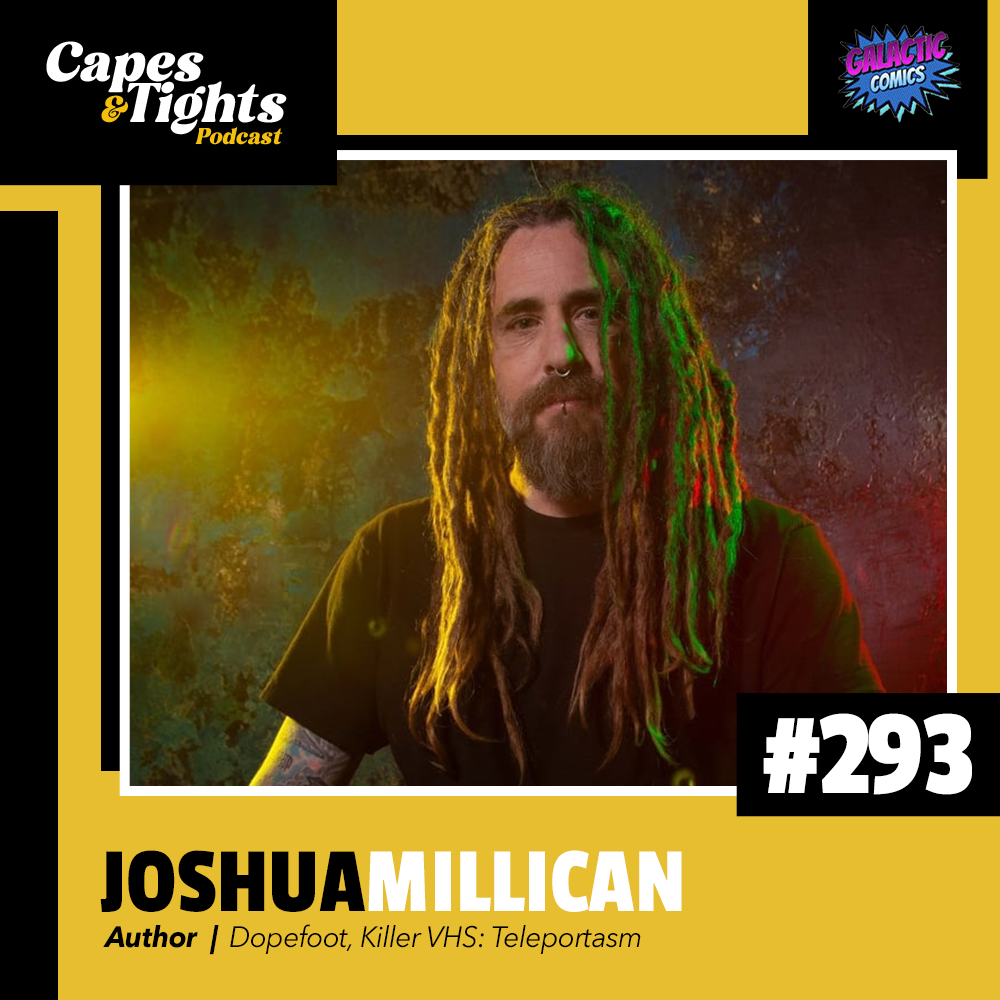
[00:00:00] Speaker A: Welcome back to the Capes and Tights podcast right here on Capesandtights.com I'm your host, Justin Soderbergh. This episode is once again brought to you by our friends over at Galactic Comics and Collectibles. At galactic comics and collectibles.com we welcome back author and former editor in chief of Dread Central, Joshua Milliken to the podcast. Milliken is the author of books such as Killer VHS Teleportasm, which is Fantastic, Septum, Deeper Than Hell, as well as many novelizations, including Forbidden Zone, the Novelization. But Joshua is back today to discuss his latest novel, which released June 16 from Maddox Studios, or Maddox Media, I should say, Dopefoot. So we chatted that and so much more right here on the podcast. But before you listen, follow us on Facebook, Twitter, Instagram, bluesky, threads, all those places. You can also rate, review, subscribe on Apple, Spotify, or wherever you find your podcasts. You can find the YouTube version of this video, this, this podcast over on YouTube.
You can watch the video portion of this podcast over on YouTube.com and as always, there's so much
[email protected] but this is Joshua Milliken, author of Dopefoot, chatting the book and so much more. Enjoy, everyone.
Welcome to the podcast. Josh, how are you today?
[00:01:15] Speaker B: I'm good. You know, we were just talking about how it's been two years since teleportasm came out. And, you know, it's great to be here again talking to you about Dopefoot this time.
[00:01:28] Speaker A: I tell you right now, the names are easy to have fun with, too. You're not boring names of your books here. There's some names to them that you want to. When I was telling someone, I was like, you got to read this book, Dopefoot. It's part of a guy. He also wrote a book called Teleportaz. And they're like, wait a second, what's that other book you're talking about? I'm like, you know, it's the cool thing.
[00:01:46] Speaker B: The cool thing about coming up with these wild titles is it's always the first Google search. You know, it's like these words kind of like, don't exist until I kind of coin them. There was a dope foot, but it was kind of like a sneaker blog, and it had already trans, like, transformed into something called like the Sneaker Locker or something.
So, you know.
Yeah, it's fun, though. Like, I'm still the number one search result when you, when you type in Dopefoot and of course, you know, teleportasm, the word doesn't exist in any other capacity except tied to my novel.
[00:02:20] Speaker A: Well, it's just. I mean, joefoots also when I. When I. You're right about that, because I was Googling something literally like, I don't know, half an hour ago, and I had to type in, like, book at the end of it because I needed to be like, no, I want to talk about the book, not the other 10 million things this could be.
And so, yeah, that's actually a good point there. It's. It's a nice thing there. But teleportasm is awesome. It's getting. While we're on the topic of teleportasm, it's getting a new refresh there over at short.
Their new distribution agreement they have with is it Simon and Schuster, and it's got a new little look to it. Are you pumped about.
The other one was awesome. Let's not get. Let's not forget that they're keeping the
[00:03:02] Speaker B: fantastic artwork by Alex V. Which is kind of like, integral to one of the connections. One of the threads through it is just this amazing art by Alec Vulcik that kind of unites them all and gives them that really collectible flavor that's gonna stay. But they are getting a revamp. Otherwise, teleportasm is like the gift that keeps on giving, free for the most part. You release a book, you know, it's kind of, like, hot for a while, and then it's just, you know, you move on to the next thing. I've been going to horror conventions and book festivals, and people love teleportasm. I never don't sell a stack of teleportasms. And I think it's just because, you know, you say, you know, it's been called, like, Goosebumps for adults. And that's like it. Everyone is. Is suddenly interested. And when I'm telling him about teleportasm, I'm also telling him that, you know, there are seven more of these, all by different authors, all kind of, you know, they're all standalone stories. They all, you know, kind of hit on different sub genres of horror, and they get really excited about the whole thing. So, you know, Alan Lasti've got shortwave, just joined Slam and Schuster probably less than a year ago at this point.
So he's working on getting his back catalog on this into this new distribution system. And because killer VHS has been doing so well, there's kind of like a little bit of A rush to. To get it all caught up, because number seven is coming out next month. That's tracking Death by Nikki R. Lee.
So, you know, and that's going to be, you know, in the new format straight. Straight out of Simon and Schuster. So that's going to be great. And then, you know, I think you've got the next three or four already kind of, like, mapped out.
It's only going to get more popular, you know, and every time, you know, another thing about releasing books, you get a lot of reviews, and then it all kind of dies down. Every time there's a new killer VHS book released, I get a new little surge of reviews because you can tell someone's discovering the entire franchise for the first time. And I think that, you know, that's going to happen exponentially. Once this book is everywhere coast to coast, and once the series gains a little steam, it's.
[00:05:16] Speaker A: They're all amazing. There's not a single miss so far. I will say that much. Like, there isn't. Like, I never have a point where I'm like, you know, with goosebumps. I will Admit, obviously, I'm 40, so they hit a little different at 40 than they do. But I have reread a bunch of them, and there are ones that I will say R.L. stein missed on. And it's not just because I'm 40, but I also feel like, compared to the other ones, I'm like, yeah, he probably just didn't hit home as much as it would. I don't think it's so far. So far, we're, like I said, seven or eight in here. There has been one way where it's been like, gosh, man, I don't know if I'm gonna read the next one now. Cause that one was kind of a miss. This is. They're all hits. They're all amazing. I want to give you credit, though, because Alan has called you out specifically saying that no one sold more, like, at conventions and signings and things than you. Like, you move some teleportations when people see.
[00:06:03] Speaker B: Yeah, well, I'm kind of like this. I don't want to say I'm a new breed, but I didn't know this kind of writer exists, you know, but there. There are some of us were like, writers going to these pop culture conventions, selling our. Our books to, you know, fans of comics or fans of horror movies or, you know, fans of. Of pop culture.
You know, it's. It's kind of like become a secondary gig for me. You know, you have Table fees. And sometimes, you know, you drive for a little while and there's. There's gas that eats into everything. But I've had some amazing days selling teleportasms, especially on two day festivals. You know, Dopefoot just came out. I've only taken dopefoot to one festival so far, but teleportasm just, it never didn't sell. And so, yeah, every two or three months I'd be like, Alan, send me another 60 copies. Alan, send me another 40 copies. Send me another 50 copies. So I have a feeling like, you know, and this is over a year and a half, but I have a feeling I've sold close to 400 copies of Teleportasm at tables, you know, just at Collins, by saying those magic words, goosebumps for adults. And people just kind of like stomping their tracks. It's like I hypnotize them with those, you know, simple words. And I'm leaving copies every single time.
[00:07:22] Speaker A: And if anybody's just like me, which there are people just like me who are going to be like, well, these new ones will fit the same size as the old ones. Alan said, like, they will fit on the shelf next to the old ones. But to me, I'm like, all my Goosebumps are the same version of Goosebumps books. I got to make sure. So to me, it's all likely that all seven of those first killer VHS books are going to be repurchased again so that I get the new refreshed cover to make it so they're all fit on the shelf together. And then what that means in that, in turn, Josh, is that I get to give. I usually give the other copies away. So I'm going to be giving. Someone's going to get a gift of, of teleportasm at some point because I'm gonna replace it with the newer one. And so, I mean, you might want
[00:08:02] Speaker B: to hold on to it though, collector's items. And I will admit I do sometimes say that, you know, when I'm hyping the series, I say it's going to be coming out souped up version, which technically makes these copies collector's items.
[00:08:17] Speaker A: And they'll be rare because there'll be more of the new ones, hopefully, in that sense. So, yeah, limited edition of that. Yeah. And I actually think you signed mine, so it's probably not a bad idea to keep it anyway.
[00:08:26] Speaker B: You better hold on to that. That's going to be worth a couple million dollars someday. You know, when I'm super famous.
[00:08:31] Speaker A: And when the movie adaptation comes.
[00:08:34] Speaker B: Exactly. Teleport sequel. And the sequel, Revenge.
[00:08:42] Speaker A: Teleport, Chasm. Slippery when Wet. No. What is that? Sequel. But no, it's true. It's really cool to see. And you got that. And Gemma Moore has happy hour coming out in the fall. And there's more and more and more coming, I'll tell you right now, from the beginning of falling in love with Shortwave, I've always praised Alan in the work that Alan does over there.
Small. He's by himself, basically doing this. And he has a couple people, I think, help him now since he moved, since he added Shine and Schuster. I think he has an assistant or something that's helping him as well. But, like, everything comes out of there is pristine. The design, he's an amazing designer. He backs the books, he cares about you as authors, all that stuff. So anything I can get to praise Alan in Shortwave, I will and do that. And so that's really cool on that.
[00:09:27] Speaker B: I joined Shortwave about three and a half years ago is when I was in Alan's ear pitching teleportas. And so I've really. And Shortwave's been around, I think, about five, five years. So I've really seen, like, the majority of history.
And I just couldn't be more impressed by, you know, the way he handles himself, the way he does his business. You know, I think he. He represents kind of like here, I'm about to say, new Breed again. But it's like he kind of like, is like the indie publisher who's approximating a big five experience, you know what I'm saying? And he's getting Stephen King to blurb his books, and he's getting, you know, Barnes and Noble exclusive cover designs. And it's. It's just amazing because he is also a fantastic graphic designer. I mean, this. This guy has skills, and he's a film producer. I think he's even a musician. He ran a record label at one point.
This guy's just amazing.
[00:10:21] Speaker A: Can you hand some talent to us guys? Like, period. Seriously, I'm always looking at these people like, what the hell? No, it's true.
It's. And I think it's one of those things. I feel like. I don't know if you ever see, like, the movie or the TV show where someone, like, says, hey, someone's calling for someone, they pretend like they're the assistant to the person. I feel like that's how Alan portrays.
He portrays it as a small independent publisher, but, like, if you didn't know if you weren't friends with them on Facebook or you didn't follow him on social media. And he gives you like this, this behind the scenes, like, transparency of things that, that really no one else does.
I think you'd think that he was bigger. You think there was 7, 8, 9, 10 people working in the office and there's a designer and a salesperson, but it really like him. And so he portrays it like you'd think with the way the books look and the way the quality of everything and the packaging. When you ordered a killer G VHS book from directly from Shortwave came in this like, look like a movie box. Like that kind of stuff is just like stuff that big people should be able to do, not small people. And he's doing it, which is awesome.
[00:11:20] Speaker B: And so you've been another thing, another thing. And this might kind of be a good segue is that like, I know that he's inspiring a lot of other indie presses because, you know, Dope Foot came out with Mad Max, Mad Ax Me Media, and that's run by Joey Powell. And you know, you know, I talked to him about the, the Shortwave experience and he said, you know, that was kind of what he was trying to approximate, that he had been very inspired by Alan's success and the way Shortwave was, was producing these really high quality, visually stunning novellas and novels and putting out a really diverse catalog.
And I think Mad Axe is really excelling primarily in the young adult. You know, I'm one of their adult size. A little more sparse, but that's fine. You know, I'm there ready to show people that, you know, Mad Ax is putting out novels and things like that. You know, things for the over 18 crowd. Of course, you know, I was reading Stephen King and Clive Barker when I was 14, so we didn't have ya, but that's a story for another time. But yeah, it was a pleasure working with Joey Powell at MADD Ax. The entire experience, you know, signing with them and seeing Dope Foot from start to finish with them was, was really positive as well.
[00:12:41] Speaker A: And I don't, I don't apologize because I can't. I don't have to apologize. But I also say I do apologize. I apologize to myself that, like, we've been in touch for a little while there, like back and forth. You would email me and then I would not respond, and then I would then a new DM or message me and I messaged you back saying, yeah, let me back and touch you, and back and forth and then it's one of those things where, like, then I read the book and I was like, God damn it, why the hell did I wait so long? And it's like, it's. It's like I kick myself sometimes for doing that. And I've done that with. With people I don't communicate with either, just people. I just read books. I just saw books on the shelf, and I'm like, one day I'll read that book. And then I continue pushing it, pushing it, pushing it, and all of a sudden I read it and I'm like, why the hell did I wait so long? All the other people out there were like, you need to read this book. And I was like, yeah, but I have other things to do.
[00:13:24] Speaker B: And no.
[00:13:25] Speaker A: And that's what I said. I don't really need. I would say I want to almost apologize to myself more like, why wait myself wait so long to read this book? Because there's just a mixture. I'm a huge. I love Cryptid, Like, Cryptids. And so, like, that alone was huge to me. And I know. I also love reading. And it sounds weird because I'm not into Big and I don't follow and part of the cannabis culture, but like, someone who is like yourself, writing a book that includes the cannabis culture in it, someone I would want to read from more than someone who's just writing on it because it's popular or writing on it because they want to. Like someone who actually, like, has lived this culture for a while. Like, that all that together was like, oh, I need to read this book. But I just still pushed it off. And I'll tell you right now, if anybody's waiting to read this book, stop, pause this episode, go read the book, and then come back, because I do believe it's phenomenal, and it's a book that I rushed through. Honestly, it was almost like, I want to read it. I should read it again. Because I pushed myself to read it because I'm like, oh, I want to know what happens. I want to see what's going on. And there's multiple facets to that. Like I said, mentioned the Cryptids, but I also mentioned I'm talking about cannabis and cannabis farming and the horrors that actually are included in that as well. And so there's a multiple levels and facets to why this book was good to me. And I want to say, like I said, I'm just kicking myself for waiting. Josh. I should have read it from the beginning. I should have been like, the second an advanced copy was out, I Should have been, like, opening the, pausing everything else. And I learned next time you have a book come out, I will. I will stop everything. Make sure you message me immediately. But, no, absolutely. So congratulations on it coming out and actually hitting shelves. And how is that? How's it been so far?
You know, the couple weeks?
[00:15:03] Speaker B: It's amazing. You know, there's, you know, writing a book is so lonely for the majority of it, you know, for the actual, you know, coming up with the first draft. And then there's so much editing, and then there's just a lot of waiting. You know, you set a date and you wait and you promote as much as you can, and then you wait, there's a lot of buildup, and then when it finally comes out, it's like a damn burst, and you can finally talk about it, you know, like the podcast I did before it was released, we're always kind of, like, dancing around, you know, now we can talk about spoilers, whatever you want, because you just pause it and like you said, go buy it, and then you come back and listen.
So, you know, we can talk about anything and everything.
And it's just great, you know, having people like you to give a platform to allow me to talk about this world I created and these characters who I became close to.
It's awesome, you know, because, you know, other writers and people who are really into literature are kind of like, the only ones who can like, really understand what it's like to have created something.
Something like a book, and then, you know, release it to the world, where it now becomes its own kind of entity. From here on out, it is its own thing. It's. It's subject to the interpretations of whoever reads it and feels a connection to it. So I just love it, you know, but then I don't want to say but, because I'm still really in the. The glowing stage of it all. But, you know, I don't have my next book lined up. I have manuscripts, but I haven't signed my next deal yet. You know, I've got some calls out, but nothing solidified yet. You know, I want to. I want to keep going. I want to keep this feeling rolling. You know, I can't wait to be one of those writers who puts out at least a book a year, maybe two books a year, maybe a book every eight or nine months. You know, that's who I really want to be. And, you know, that's always kind of in the back of my mind. But, yeah, I love this pre.
Pre release time, basically, like three Months after a book's release, it's always like popping up and becoming new and you never know who's going to review it or how word of mouth is going to affect it. So I'm still just really digging it all.
[00:17:10] Speaker A: That's awesome.
When you have a cover quote, too, from Clay. Clay, look, Loud Chapman. That's. That's another thing where you're like, to me is just, okay, I gotta read this book. Because, you know, I love Clay too, and I trust his opinion as well, so. And V. Castro as well. But just Clay to me is a personal favorite. And so to me, that was like a yes. And it's too. I always. I always love to read other platforms similar to myself and what their opinions are on something because obviously they're on the level that I'm doing the same. The same point of view of when I'm coming from just a different person, but in the same sense, like, I know when I've talked to you and I've talked to other authors who. How much is on, like, say, Clay's plate, for an example. Example to actually sit back and choose to actually say, yes, Josh, I will read your book and I will give you some sort of quote for it, because I will take the time to do that. It also screams to me, like, those people are busy. So for them to take the chance and opportunity and say, I'm going to read, you know, this book that, that I don't have to read and do it well in advance enough for you to put something on the COVID of it always just goes, I might take a chance. If they're going to take the opportunity, I should probably take the opportunity. And again, I missed that early opportunity. But again, I don't. That doesn't mean I still read it. And I still.
It's a beloved book to me now. I think this book is phenomenal. I'm not just saying it because you're on here, but it was. It was so much fun to read.
[00:18:27] Speaker B: I actually, Joey Powell was the one who had the connection to Clay. So, you know, I didn't even. It wasn't even like me reaching out and being like, hoping that he would respond to me out of the blue, you know. So, you know, that's another thing where it's great to have a publisher who, you know, can go to bat for you a little bit, has a few connections here and there, like shortwave, like Maddox Media. But yeah, Clay was very gracious. And, you know, after he gave me the quote, that was actually the first time I Talked to him where I just reached out, I said, thank you very much. You know, I was very humble. You know, it's part of a longer quote, too.
And he was like, your book is batshit. You know, I do not. I did not like that pit, you know, so he's a really cool guy.
[00:19:08] Speaker A: It was. It was awesome, though. I read it just enough time to be ahead of the release date, at least. But also, what was really cool is that at the end of May, I did a horror book event for a local bookstore, Briar Patch, where they brought in five or six horror authors from Maine and discussed their books and horror in general. And it was. I know what you read this summer was the name of the panel, and I was asked to be the moderator of it. And so it was awesome to do that. But part of that discussion was some of the books I was looking forward to coming out this summer that I would recommend to read that were outside of the authors that were there. So, like, what are some books that you can buy at the local bookstore that I could, you know, so on and so forth? And it was awesome timing because it was like a week or two prior that I had read the book, and I was like, cool, this is going on my list. And so I was able to do that in a book. Book that, you know, other people in that room are all horror fans. And so when I'm like, read Clay's book, they're like, oh, yeah, I know who Clay is. Like, it was one of those things where it was, like, it was, oh, so much. It meant so much to me that I could put on someone who may not know who you are or what dope foot is and to promote this book. And I even think the local bookstore even brought the book in or is trying to, or was going to. I don't. I don't remember how it ended up happening afterwards because I lost communication at that. At that point.
[00:20:20] Speaker B: But, like, there's so many factors to, you know, making even a big five book. There are so many factors to it really becoming a success. And word of mouth is so much more important than people realize. You know, I wish I had, you know, publicity agent. I wish I had a team. I wish I had a social media manager. But at the end of the day, I think, you know, actually resonate with people, and people have to be talking about it offline in order for it to really become something. Something special. And I've still got my fingers crossed. You know, I think dope foot, you know, I'm just So proud of you.
[00:20:54] Speaker A: It.
[00:20:54] Speaker B: You know, I don't think I'd be promoting it this hard if I wasn't so proud of it.
[00:21:00] Speaker A: And, And I said this a million times. Anybody who listens to every episode, I've always said, I don't talk to people that I don't want to talk to. Like, if I didn't want to talk to you, I wouldn't have said, hey, let's come on the podcast. Like, I reached out to you and asked if you want to be on the podcast, like, again. And you're like, absolutely, let's get this out. Let's make this happen. And that reason is I wouldn't talk to you if I didn't like your book, because this would be a very stupid Converse. Hey, your book is shit. How is it? Why did you make such a shitty book like that? That doesn't seem to be. I mean, that probably would get views and listens, but, like, I don't want that.
Not all publicity is good publicity either. Like, I'm pretty sure if I said that was shit enough times, people just not read the book. Not this like, oh, he said it was shitty enough. I should go see if I like it or not.
But. But that's the truth. And so I, I like the book enough, but it's also, like I said, there's a mixture of things in there, and I think that that went through. There's a number of books that are like that, where there's like just multiple levels to why it was a good book. And I think I like your writing. That's first, that's first and foremost. But I also think that I don't read books that deal with cannabis farming in Northern California. Like, I don't read those. But it's not like a book that's like, I gotta read that book because that includes that like, or even Cryptids. Even, even, even things like Bigfoot or monsters like that. Like, it's not something that I love them, but it's not something I'm seeking out on a regular basis. And so when you smash those things together and create a book with a cool cover and a cool title from. From. From someone I respect, it just added so much to it. So Doe Foot been. Create. Been. Been working on it for a long time. I'm guessing this is not something that just came up when you, when you talked to Joey and said, hey, I want to do a book. I want to do a book over at Maddox. Like this something that you've been percolating on along For a long time. And part of that question is, was it always cannabis and Cryptid, or was it. Did it evolve over time? Like so. Yeah, go into the. Get into it.
[00:22:43] Speaker B: Great question.
Yeah, I started it, you know, first draft, you know, December 2024. So, you know, good year and a half, more than a year and a half ago. You know, I knew I wanted to write a Bigfoot book. You know, it's not that I. I'm a cryptid guy. None of my other books are about cryptids. But for some reason I just got the bug. And I think it's something I've been thinking about for a while. There's another.
There was going to be a Cryptid book release.
First of all, I know that Bigfoot is a big, like, subculture kind of a niche. You know, there are tons of Bigfoot books if you go looking for them. There is even like Bigfoot romance is like a. A niche within the niche. It's wild. But always wanted to do a Bigfoot book. I felt like I needed a really good title. You know, there was a lot of pressure after Teleportasm. I was like, what's the next title gonna be? Because I can't go from that to just, you know, And Teleportasm taught me how important a title can be too.
So once, you know, I was thinking about a lot of different titles. And once the title Dopefoot presented itself, that was just it, you know, all I knew that I. All I knew before then was that it was going to be a Bigfoot horror. And as soon as dope foot, as soon as that term came into existence, the whole story came into existence. Because that, that word or those two words combined married Bigfoot and cannabis culture. And you already had the story right there. You had Bigfoot on a cannabis farm, you know, Northern California. And, you know, these aren't, you know, ideas that I completely pulled from the ether. I am, you know, in. In a community I do have, I do know people who have gotten more into the cannabis industry than I have ever gone.
I grew plants in my backyard in Northern California during the first few years of legalization.
Good times. You know, definitely enjoyed being part of the culture for quite some time now. But there is a documentary series that came out on Netflix that you might have seen called Murder Mountain.
It actually, it's like a five part series that talks about how the cannabis culture in Northern California, and I'm talking way north of San Francisco and Sacramento, you know, the, the hippie areas where, you know, cannabis culture first you know, came into existence and thrived, basically about how they're all getting pushed out by corporations or people with money who can just buy their way in. Now that it's legal and now that you need permits, you know, you don't have to have the community ties which made it so relevant. And, you know, it instantly presents this, you know, insiders versus outsiders scenario where you have the locals who had been and, you know, making a good living at it, always kind of like fighting against the government just to eke out a living. And now it's legal and, you know, so the cops will leave you alone as long as you pay these really high permit prices. And then you have all these newcomers. It's like the new green rush. You know, you have these outsiders coming in to exploit this area because, you know, Northern California, Humboldt, you know, Trinity, Mendocino, these are wonderful places to grow cannabis outdoors. You know, the. The quality, the distance from, you know, the coast, the loneliness of the soil at all. You know, it just comes out to this really wonderful, dependably wonderful cannabis.
Long story long, there is another docu series on Hulu called Sasquatch. And I really don't like the series for a lot of reasons, but this isn't about why I didn't like that series, but it does investigate a case, case of there. There were rumors that a couple of cannabis thieves had been killed by a Sasquatch. And so this investigative journalist, David Holthouse, goes and investigates.
And I don't like the way he investigates. I don't like his conclusion, but I like that. That idea was, of course, in my head, Bigfoot attacking cannabis farmers or cannabis smugglers, I guess, in this case. So the name dope footage, you know, rang out like a bell, you know, flash like a neon sign.
Bigfoot, Cannabis.
There it was. I started. I started outlining.
[00:27:11] Speaker A: It's. Yes, and I think that, like I said, if you were to just, if you start. Start the story, just called it Dope, for example, and just did about the horrors and struggles that could be like a cannabis farmer in Northern California during this. This.
[00:27:26] Speaker B: This.
[00:27:26] Speaker A: This era of time, that it's scary. Like there's this slavery part of it. There's this. There's this, like, war part of it that you see in this book, that you see like that there's. It's scary. It can be scary. I should say it's not all, but like, there's these moments that alone would have been like a book where I've been like, holy shit, this is a great book to read. And then you add in it and the same thing. Like I said, I don't. I have one, one and a half stories percolating in my head and some on paper of a miniseries, a comic series that I want to do.
And one of it deals with Cryptids and Bigfoots and your monsters that are in the woods or wherever. And so that to me is where it gets. But I'm not deep diving on the Internet trying to find these things.
What I did respect that your book, in a sense. And again, I don't know if any of this is spoilers, people who can pause it, whatever. The book's been out over a month ago, just about a month ago. Hopefully you've read it. If you haven't, I'm not going to spoil it too much, but like, let's
[00:28:22] Speaker B: do whatever we want to do.
[00:28:23] Speaker A: No, but like the point is that you added in this factor of the person that might not actually believe that this Bigfoot's out there. Like, there's this, like. I was talking to my wife, we just had dinner tonight. We're sitting on the front porch of my house and I was talking about how like, there's gotta be a percentage of people who like sell like expeditions to find Bigfoot that 100% don't believe it and they're just there to profit off of the people's, you know, need and want to find these things. And I, and I also agree this. I've talked to people like Sarah Took a Schaefer who did a book, a fictional book about influencers on the Internet. And I'm like, this also got to be your percentage. And I always think it's probably a fairly high percentage of influencers on the Internet who back something anti seed oil, whatever it might be that don't that have canola oil in their closet. Like, you know, like, there's gotta be this percentage who are just saying shit on the Internet because someone will listen and someone will pay them or sponsor them or do something. And they added, like I said, it's not a big part of your story in here, but there's a portion of that in here where there's people like don't actually believe what's going on. And so I, that's one thing that stood out to me. And I, it was such a small part of it really, to be honest with you. But like, do you agree that there's some people out there who just want to profit off of this, this Bigfoot phenomenon? You should say 100.
[00:29:41] Speaker B: In fact, it can't Be denied. You know, one thing I did, you know, to research this and to really ground myself in, I went out to Willow Creek. You know, there is a museum out there. It's not called the Bigfoot Museum, it's called the Willow Creek Slash China Flats Museum, home of the Bigfoot exhibit. You know, and there's a big wooden sasquatch in the, in the parking lot. You know, I actually went there in the off season and they had a volunteer come out and just give me a personalized tour of, you know, the entire exhibit, including going down into the basement and looking at stuff. You know, there just wasn't, wasn't room enough in the main room to see all this stuff. And he's showing me these foot casts and he's all, oh, this one's interesting because the dermal ridges and this one's interesting because the toes a little crooked. And this one you can tell is a hoax. And this is one where you're not really sure. And it's like, well, wait a minute. You've got something in the mix that you even, you acknowledge isn't real.
Once, once you acknowledge that that hoaxery exists, you put the onus on, on you to prove that it's not a hoax. And with Bigfoot, you know, the hoaxery is, is probably a very large percentage of it. You know, I mean, I, I reluctantly am a, am a non believer of Bigfoot. I don't believe in Bigfoot, but I, I did for a long time. I just kind of accepted it as truth, as a lot of people I think, who grew up in California in the 80s and 90s did. It was just presented as truth. So I'm not the kind of skeptic who enjoys tearing down other people's beliefs. I would be just mystified if it turned out Bigfoot's real. I would just like the Earth would, would be such a wonderful, interesting place. And I still love the idea that there could be something out there.
And the best part about Bigfoot is he can't definitively be disproven, you know, so that, and until you can or find a way to, to do that, there's always going to be a reason to just keep your mind open, even if it's just slightly.
I don't even know where, how I got on this tangent. Yeah, a Bigfoot belief. So, yeah, you know, I wanted someone who believes in Bigfoot to be able to read this book and not feel condescended. You know, like, belief in Bigfoot is normal. Like, of course you would believe in Bigfoot, especially if you live up here in this geography with these trees.
But I also wanted people who don't believe in Bigfoot to kind of like understand belief, but, but, you know, not feel like they're ever asked to suspend their own disbelief. You know, that's a big part of horror or sci fi or speculative fiction, you know, the suspension of disbelief. You know, I don't want my readers to have to do that, no matter where they are on the spectrum, you know, because with a Bigfoot book, it's like, okay, it's either Bigfoot's real or Bigfoot's a hook. You know, I wanted to come up with something where, okay, it's not quite that simple. And yeah, at this point we're getting philosophical, but I'm not talking about aliens, I'm not talking about interdimensional beings or the spirit world. I tried my damnedest to stay in a very corporeal realm. You know, there are things that really like, push the, the fringes of possibility, but, you know, there's, there's nothing straight up supernatural showing up. And I still wanted it to be something where you couldn't quite nail down for sure what the answer is. Or then when you get an answer, you're still going to question the answer.
[00:33:12] Speaker A: And the funny thing is like dope footage itself is like the majority of the story revolves around the anticipation of this creature feature happening. Like this is like you're talking farmers and the experience they're having and the disagreements with, with bigger corporations and things like that coming into these farms. And it's like a secondary. Is this technically a secondary thing in the sense of like, how the told. But again, to me it was like I was always, I'm waiting. It's what's cool was like the anticipation of like, where you going to see this? What's going to happen, what's going to go on? And I think, I love that. And, and again, yeah, I think that you're right on that. The idea of not pissing too many, like, you can't piss off one side or the other. If you want to read a book that has to do with Bigfoot because you're going to lose. You're going to alienate 50% of the readers that potentially might read this book. And I think that's a, that's a good spot to play in because you can't, like you mentioned, you can't definitively said that. It's not. And again, I would be same thing with you. I'll be like, hey, cool this is badass. Someone found Bigfoot. This is amazing. But I'm also not spending millions of my dollars that I don't have to go to try to find Bigfoot too. Like, to me, it was like, whatever. If they figured out, that's cool. If they don't, that's also. I'm not gonna change my life with any of these mysterious creatures that we don't know about. The. The creatures you see on the Monster of the Week on X Files. Like, those things are like. Like, if they existed. Sweet. I hope they didn't. Like, they're obviously not causing any problems there, Josh. Like, let's be honest. If they were a problem, we would know more about them. There'd be more sightings if they were killing people on a regular basis, wouldn't you?
So, yeah, so that's like, I agree on that side, too. But, like, so I want to say so as someone who has. Who. I'm 40 years old, I live in Maine. I've smoked weed in my life and had friends who were way more into it than I have been into it. But, like, what about the reader that's not a cannabis community person. Like, someone who's part of the cannabis community. What do you say to them when they go to enter a book that has a lot of. It has to do with cannabis and drugs and things in that nature that. Want to read this book? Is it something that, like, do you agree? I mean, as the author, I would say that anybody could read this book. This is not geared towards those people.
But is that something you agree on? Is that something you tried to do as well to make it, like, kind of like, okay, this is a story that features cannabis, but isn't, like, cannabis specific?
[00:35:28] Speaker B: Yeah, absolutely. You know, a lot. You know, a lot of great horror takes place in ships on the ocean and, you know, you don't have to be a sailor, but yeah, it's not. It's not kind of giving you or it's not preaching, you know, it's not telling you to come down on one side or the other side of the issue. And, you know, like I mentioned before, you know, the. The. Well, I preach pulled from. In terms of knowledge, you know, yes, there. There I have some friends who were very deep into it, heard some crazy stories. But, you know, I wrote about stuff on the level of. Of Murder Mountain and Sasquatch. You know, it was kind of like that. I kind of expected, at least on a certain level, those films were in the zeitgeist in the terms of, you know, People understood that, you know, the Pacific Northwest had changed, you know, that it wasn't the, the, the fun hippies anymore, that there was a new darker element, you know, that had evolved.
What was the question again?
[00:36:29] Speaker A: The cannabis readers?
[00:36:30] Speaker B: Oh, the cannabis, yes.
[00:36:33] Speaker A: You know, absolutely.
[00:36:35] Speaker B: So, you know, even if you know about Canada, it's interesting. You know, any kind of outlaw culture, you know, any type of, you know, off the grid community or, or cult or organization is interesting.
You want to know how a culture creates itself outside the bounds of society at large.
And for a book called Dopefoot that for the first half takes place on a cannabis farm, there's a surprisingly small amount of cannabis consumption.
The cannabis trees are there. But the main drug of this, I don't even know if you're going to have to believe, is this going to be on YouTube or anything, because the main drug, the main drug is, is not cannabis.
[00:37:23] Speaker A: And you know, it's what we've seen on other shows. Being blue in that sense too, if you want to say it that way. Like, other shows, like Breaking Bad has had it as a blue drug. That's what they're. We're actually more taking on, on this. It's actually funny because it kind of threw me by surprise. I'm like, oh, damn, we're going right forward here, aren't we?
[00:37:41] Speaker B: Yeah, you know, that's another thing. You know, there's still the perception that, you know, people in the industry who, who work on these to come out as trimmigrants, that it's a, that it's a really happy time, that it's kind of like a non stop hot party. And that's really not the, it's not the truth of it. And, and the main drug of this book, you know, is actually something that people use because they think that they can get more done and it becomes kind of necessary to, to, you know, achieve their goals, especially in a dangerous black market.
And as far as Doe Foot goes, that actually relates to how people's perceptions of reality shift throughout the story. You know, Harmless is not an unreliable narrator. You know, there's, it's not, he's, he's not the first person narrator. There is no unreliable narrator. But you notice things that the characters don't notice, that the characters are seeing everything through a filter of, you know, paranoia and, and sleep deprivation. You know, that's, that's making them feel and react and think and see certain things. But yeah, you know, come on in and be like a fly on the wall in this, this underworld, you know, a Lot of it I made up. You know, there are no such thing as boilers. There aren't camps of people with stills distilling marijuana into oil and, you know, flying it out with drones. I made all that up. You know, there's.
There are no motorcycle gangs in the woods, to my knowledge. You know, there are no cartels with heavy machinery, you know, war munitions. You know, I took it to extremes in those sense, but.
[00:39:29] Speaker A: Well, that's what's a work of fiction. You had to do stuff like that. Like. But I will say, after I said that question to you and was talking to you, we mentioned Breaking Bad, I was like, I've always loved the reaction to people being, like, saying, like, sensationalizing drug users use. And people have always said, like, Breaking Bad teaches you how to make the drugs. And it's like, dude, Breaking Bad tells you how bad of a time it would be to make these drugs. Yes, they make a ton of money, but do you see what happens to these people, like, in this world? And I said, I feel like dope puts a very similar thing where it's not. You're not sensationalizing anything at all. If you were to say that this actually, if you went to do exactly what harmless did, it didn't end well for people. Like, this is not a good thing to be doing. And. And it's obvious, like I said, you. You took it to level. You know, was it the spinal tap going to 11? Like, you went to 11 on a lot of these things. And I think that, yeah, it doesn't sensationalize anything. It really said it, actually. Honestly, at moments where, like, yeah, it's like, it's. It scared me almost to points where, like I said, there was times where I'm like, I'm almost more afraid of being a cannabis partner in Northern Carolina, Northern California, that I was of Bigfoot.
[00:40:29] Speaker B: Like, that was kind of like, to make Bigfoot kind of like a secondary, you know, concern. You know, they had much more pressing problems. But. But, yeah, you know, there's the character old man who considers himself sober even though he uses this blue drug. You know, he. And he says it's because, you know, he's not using this blue drug to be a druggie. He's doing it because that's part of the job. You know, he's really doing mental gymnastics to make this right. You know, it is so not right that he's. He can't even see, like, this diametric, you know, opposite. But he is kind of like a diametric opposite in himself. He's the character named Old man, who's the youngest character in the book, you know, which is another trippy thing I tried to do with names, you know, do names really tell you who this character is?
[00:41:27] Speaker A: That's all that stuff like how people got their names and the way they get there stuff that stuff that I remember because I do remember watching that, that docuseries. What was it? Was it Murder Mountain? I remember watching it. Was it 2018, 2019, somewhere around there came out on. And I remember watching that. I do remember like some of the stuff, but like learning again and like listening to what you were saying in this book about, like where they picked him up at gas stations and they went from. From a far distance that like, you're basically committing to going like, you get there, you're there. And that's some of what harmless has with like making the decision to use the drug or not was there. It's like, okay, well, well, I guess I will. I'm here. Like, I guess at this point I'm already this far into this. I might as well do this and make it work. And yeah, again, it brought this whole. And to me it was like not seeing a ton of documentaries on cannabis farming and not seeing a ton of documentaries on Sasquatch in general or Bigfoot is made this more enjoyable. Like, I don't read a ton of books like this, so it was like, to me, it was like this, this anomaly to it. And to me that was just really cool about it. So someone isn't a horror and just want something a little different from what? Like a haunted house story or some sort of like haunted vehicle or whatever. You know, this is a creature feature that features something a little bit different than what you'd expect. And again, I wouldn't expect anything else less from you, but it also turned out to be a book that I didn't expect at the same time that makes any sense. Like, when I got to the last page, I was like, that wasn't exactly what I was thinking. But I also couldn't tell you, Josh, what I was thinking was going to be.
[00:42:58] Speaker B: It's not the story you thought you were going to get. You know, you thought you were going to get something else, but you're not mad because what you got was.
[00:43:06] Speaker A: It's like, what's two thumbs up? Yeah, it was awesome.
[00:43:08] Speaker B: Crazy.
[00:43:09] Speaker A: I mean, that's good. I think that's what's good about it. I hope that, you know, other readers do that, but personally, I hope that other publishers see that too, because I think that's a huge thing. And I think that taking a risk on. On. On stories from you. Obviously it's worked for Allen and I'm hoping it's going to work for MadX in that sense that this book. Yeah, this book goes that far. And I think that there's a bunch of things. Did you ever see Sasquatch Sunset?
[00:43:34] Speaker B: I haven't seen that one yet. That one's the recent one. Right.
[00:43:36] Speaker A: It's a movie. It's. It's a movie about a family of Sasquatch that they don't talk the entire movie. It's like the first 13 minutes of the Star wars holiday special where it's just Woogies grunting at each other, but the entire movie is that way. And it was a movie that I didn't expect. And I was like, it's. It's. It's utterly stupid in a sense, but it's also utterly groundbreaking at the same time. I'm like, how someone put money into this movie and said, let's make this movie. And it's like, Sasquatch is like.
And like Sasquatch sex. And there's just like the lives of what it would be like to be Bigfoot in the woods.
[00:44:10] Speaker B: That's what people never really think about. Right? You know, it's like, I haven't seen it, so I can't say what the.
[00:44:17] Speaker A: But I also. I wouldn't say to you go watch it either. Like, I couldn't. I couldn't. On the right for a rifle mind be like, yeah, you should stop this podcast recording and go watch the movie.
Because I also don't want you to be upset with me, but you also could watch and go, that was phenomenal. I have no idea. Like, it's one of those movies where I'm like, I don't know.
I just don't know. And so it was kind of funny when I read this book to that made me that that movie trigger in my mind about how. Because you mentioned just recently too about like going to visit the museum.
And then this movie there's includes a museum of a Sasquatch museum. And it might be like a take on the same one.
[00:44:52] Speaker B: Like, I mean, it might be. It might be like a trope. But, you know, I'll tell you, Justin, you know, when I started writing this Bigfoot story, you know, it I kind of like pushed the goal post back. You know, slowly I kept pushing the goal post back. You know, first I just wanted to write a fun creature feature Bigfoot romp. And then it's like, well, okay, now I want to kind of like push the boundaries a little bit. You know, I didn't want to have any of the stereotypes. It wasn't going to be about hunters, you know, father and son hunters, you know, getting of a ton attacked by Sasquatch. There wasn't going to be anything like that. It wasn't going to be like cabin in the woods, college kids, cabin in the woods. There wasn't going to be any like accident on the side of the road and then you cut through the woods. No camping whatsoever. You know, I wanted it to be a different reason. I think I kind of knew that, you know, there had to be a story that was just as interesting as the Sasquatch story and that the characters would have to be just as interesting as the creatures if, you know, this book was really going to excel. And then, you know, I didn't think I could come up with anything original, original necessarily, but I at least wanted to be innovative. And then, you know, so I kept kind of pushing the goalpost back a little bit more, a little bit more until, you know, I don't want to get too, you know, esoteric, but like, you know, this, this book really became something more to me, you know, not just a fun brawn, not just kind of like an escapist story. This is kind of like my great American novel. You know, I've only written four novels so far. I mean, you know, who knows how many I'll write in a lifetime? But you know, this is definitely, I feel like the greatest thing I've ever written. You know, it's. It's a Sasquatch book, it's a horror book, but it's also kind of like my version of Catcher in the Rye with the character who's, you know, maybe 10 years older than Holden, you know, but. But maybe still just kind of like mentally not much different because you find out he's been really, really stunted emotionally and he's just not very self aware.
So, yeah, at the end of the day, you know, Dope Foot was more than just one thing to me, you know, and I'm just really happy with the people who have accepted, you know. There was one review that I got on Goodreads. They didn't start it, but it was, it did not finish. And their review was, if this is a horror book, it's taking too long to get here. So I just stopped reading. I stopped around halfway and it's like, man, if you had stuck with it for 25 more pages, you would have got all you thought I was depriving you of and more, you know, so, you know, there, there is, you know, a bit of a slow burn, you know, to the beginning of it. I wanted to incorporate elements of, you know, campfire storytelling and oral tradition and I wanted to put a lot of, you know, legend and lore into the air that people could kind of like have. Have in the back of their minds as they proceeded.
[00:47:44] Speaker A: But we also set up characters that we, that you, you, you set up characters that we needed to be invested in, care about too. Because what happens to these characters, like this is, this is. You weren't afraid of being like, okay, we're gonna take that character out. That's gone because of what's happening and, and that one's going to be going away or we don't know what's gonna happen now. Like, to me it wasn't like you, if you would have gone too far in too quickly into what the culmination of the story is, you wouldn't have had, I wouldn't have had as much care and love and, and what happens to Harmless and the people that are at this camp. Like, you set up a spot, you set up a foundation for us to be like, okay, now you actually care about these people. You had to get Harmless to the camp. So that was, that's obviously a trip and to show what it takes to get them there.
And then also like all these people you meet and it does kind of go quickly once you meet these people. But like you gotta meet these people and you gotta get to know these people. You gotta get to, to, to care about the characters before you potentially take them out. And so that does, I understand what someone's saying there, but I also, like, that's one of the reasons why I'm like, like I am like maybe a chapter or two. If I get past a chapter or two, you got to finish the book. Like if you don't like it's the first chapter or two does not connect with you or you're freaking lost completely. You just by reading it, you continuously lose yourself and like you're okay then, then I can understand that. But like if you go halfway, do you really have that not that much time in life to feel the pusher backpack? Like it's obviously they pushed them far enough that they liked your writing at least.
Like whatever, like it's your own time and energy and effort.
[00:49:17] Speaker B: If they just waited till they got to the outpost, it would have been non stop from then on out, you
[00:49:22] Speaker A: know, whatever, whatever to Each his own, like. And that's the one thing, you know, this is as a person who's in the public eye, that not everybody's gonna like it. And that's, that's a big, big thing. Yeah, you know, it's, this happens. But, but I don't, I don't agree with this person, I'll tell you that right now. Well, I agree with, I kind of like, I understand what you're, they're saying, but I don't agree with. There wasn't enough for them to push them forward. I think there was enough for you to push it forward.
[00:49:46] Speaker B: At a certain point I can see you're asking like, okay, is this really going to be horror? Is this kind of going to be like action horror? Because yeah, it almost feels like a grown up version of the Goonies or something like with a dark underbelly. You know, they're on an adventure at some point. Point. There's definitely like a Lord of the Rings vibe. They're all in their cloaks, running through the woods, you know, avoiding the dark writers on their motorcycles versus the flying beasts in their helicopters. And you know, the whole time, oh my goodness. I definitely set up that vibe on purpose. But yeah, you know, I really did want people to feel invested in the characters. I knew that that would go a long way and you know, I definitely ended up caring about them myself more than I thought I would. You know, it's like I always end up feeling bad about what happens to certain characters and you know, I feel bad for Honeydew, an old man. Although we don't see old man die. I guess he could technically have survived the apocalypse like you know, if harmless survived. I don't see. Well, old man was assaulted by something, you know, in the trees right before all the bombs went off.
[00:50:59] Speaker A: But, but I mean, anyway, it, it, I will say I agree with you and you're saying this, this is, this, this novel means a lot to you. I think that you could have easily gone and I think it would have been not as good but would have been worth reading if it was like just a full on rompy, just like fun cheesy like making fun of itself story. That, that it's kind of like with the Sasquatch movies.
Sunset feels like, it's like, it feels like it's just making fun of itself in the sense it probably would have been good book. It would have been like, oh, this is a fun read. But you, you flip the script on that a little bit, made it more emotional. I mean it had More of a connection to it that made it more.
Like I said, I think it just, it hits harder. And I think that I think was what made the book to me easily, you know, Dope Foot could have gone with the name Dope Foot. You easily could have gone two different ways. And I think that you went the way you, you leaned into the way, that was the better way, way. And I think that's what made the book even better. Which is, like I said, there's more to this story than just, you know, cannabis fires in the woods, running into to a Bigfoot and seeing what happens because, you know, finding out Bigfoot just as a big pot smoker and well,
[00:52:03] Speaker B: you know, I mean, like the title Dope Foot is just, it's. It works on so many levels. Because even if it just like hooks you with the idea that like I've had a lot of people like read Dope Foot and think, okay, this is going to be like cocaine bear, you know, this is going to be Bigfoot eats a ton of cannabis and you know, crazy stoned Bigfoot. You can go into it hoping for that. Even if that's what you, you're not going to get that. But I think even if that's what you come in hoping you're gonna get, you'll still end satisfied. Like, this is not the Bigfoot book you're expecting. You know, you can't possibly be expecting it to be this kind of Bigfoot book.
So, you know, I don't even know where I was going with that. I think that's a good thing though, Josh.
[00:52:45] Speaker A: I think that like, I think it's the whole, whole side of things of, of if you, if you knew exactly what to expect the whole book. It's like why I'm always like never a big fan of an exact adaptation of a novel. So someone had a. Took this story, Dope Foot and adapted it into a film and another person screenwriting it and they changed a few things, couple names here and there, locations, cup sped things up to get to the horrific parts or whatever, just to make it for film.
It makes it, it different. I wouldn't say it's better, but it makes it different enough that you want to watch the adaptation. Right. And so I don't like the idea of going into a book and fully getting what you fully expect. And because they. I think it's a letdown at that sense. Okay, I expected it to be this way. Okay, whatever. This is what it is.
But like having that little bit of big going, okay, I want to know what's happening. So the solicitation should tell me a little bit of what's happening. But then at the end, you're like, okay, this is not exact. I actually felt this way. I don't know if you've seen Abe Moss's Morsels is coming out in October. I felt the same way about this book where I was like. I read the solicitation. I was like, okay. And then I got to the end of the book. I'm like, that's not what I was fully expecting, but I'm glad that's the way it went. And I think that's what people will get out of Dope Foot, which is, like, this whole, like, side of things that you just don't expect. And it will be rewarding in the end. I'm guessing writing stories like this is more. It is different kind of rewarding than doing a novelization, right, for you. I mean, you've done novelizations. You've done your own stories. Like, there's a. They're both rewarding, I'm guessing. But is this a different type of rewarding?
[00:54:17] Speaker B: Absolutely. You know, I don't get as emotionally attached to novelizations because, you know, I'm playing in someone else's playground. You know, I'm a hired gun, and I'm here to do service for the. The original creators and the fans who appreciate it and who have, you know, always loved these cult films or popular films. But, you know, when you write your own stories, you know, they become real to you. And, you know, I felt the same way with Teleportasm, where I was really sad to end my relationship with. With Lars and Frankie and Snaps and the same thing, you know, this time, you know, it was really hard to say goodbye to, you know, especially Harmless and. And Honeydew and Old man, you know, but also, you know, Ranger Mason and, you know, the. The Woman in the.
And, you know, the creepy clowns. You know, it's. It was a really fun world to play in for a while. And, yeah, it's a mystery, so, you know, you can. You can go in, just have a good time, have a fun, like, adventure. You know, I don't know if it's. It's not the kind of mystery where it's like, okay, take notes as you go through so that you can put it all together. Hopefully everything just kind of falls into place. You know, there is a point at the end where I just kind of, like, back up and give kind of, like, the long view because, you know, the. Even the characters Involved don't really have all the pieces of the puzzle. Only you as the reader and you know, me as the storyteller can really like put all of the pieces together for you. The people who experience this will never really have a handle on what exactly they went through, you know, because it's just kind of, it's too, it's too bizarre.
[00:55:57] Speaker A: It is. And I think that's what's cool. But I said to me, it was one of those things that, like multiple things that I don't read a lot of the, the, the, the unexpected part of it, all that stuff just made it into a book that was like highly, highly sad that I didn't read it quicker, but glad that I read it in the first place. And I think that's what's huge about it. And I think that like I said, I was in. I didn't know who you were when I read Teleport asm, but I was in and caught in because of the killer VHS part of it. And so like the second I got in there, I'm like, okay, now I need more. And so I think that this with Dope Foot, hopefully Dope will be an entry spot for some people too. I'm hoping to get into, to reading you and maybe they'll read Dope Foot and then Teleport has them. Who knows? Maybe, you know, it's easy. They're not neither one. I mean, Dope Foot's not like extremely long, so there's that too. So you could easily read these things. This is not like you're going to take. It's not a Stephen. We talked about Stephen King earlier. It's not about Stephen. It's not a Stephen King book. You're not talking about spending months on reading these things. You can still read these things pretty quickly and your style of writing allows that too.
[00:56:57] Speaker B: Oh, thank you. You know that the story itself takes place over about three days, so maybe you could take about three if you picked it up, you know, I'm sure you could finish it in three days. You know, three sittings, three kind of three acts. But yeah, I like writing things that can be absorbed kind of quickly and trying to pack the same emotional punch as a much longer novel. I feel like if you can do that, you, you've done something really successful. So I always really go for an emotional gut punch even, you know, though I'm working in a small space and even though I might be in this kind of like bizarre, only semi real, you know, atmosphere, you know, I always, I don't even know what I was saying. I've been puffing this vape pen the whole time.
[00:57:42] Speaker A: Hey dude, that's the reason why I used to do like movie reviews for these on this podcast back in the early days. Like episode like 10 and we drink beer and we'd get to like the end of the episode and we'd be like saying actors names wrong and we'd be like, this is bad. We had like a top 10 comic book covers for one artist. And at the end of the episode I realized I had to edit it because it was like we were saying the wrong artist. And I was like, okay, this is not gonna be good anymore.
[00:58:06] Speaker B: But yeah, I love talking to you, Justin. Like
[00:58:11] Speaker A: I love talking and tell you what, right now it's a great book. I will say Teleportasm is one of my favorite of the killer vhs. That is true. And think that dope puts phenomenal. I think that's for any reader. I don't think that if you're a horror reader you're going to love it. Again, make it past halfway. If you are not a horror reader. I think that still, there's still a lot in there for you. And I think that's what's cool about this book too is that there's like, you know, maybe if you're not into super something super horror.
Maybe if you think you're a romance reader and that's all you read, it might be a little bit too much for you. However, I think that everybody should try it because I think it's something.
[00:58:47] Speaker B: It's goofy horror. I think the worst of it is goofy horror.
And then there's a torture scene, but it's kind of like presented very clinically. It's a found footage moment where you see this, this torture scene. But there are no major trigger warnings, nothing with children or animals, you know, no essay. So you know, just give it a whirl there. I. I hope you know the, the scene, you know, we were talking before we started about the, the blurb Clay McLeod did for me and you know how offline he was saying I did not like that area. There is a scene where, you know, basically I'm kind of like the main character harmless is like a version of me, a younger version of me. And I put this younger version of me through something so disgusting that I honestly think that at that time in my life it would have been the end of me. You know, it was something that, you know, I cannot imagine. You know, 22 year old, 24 year old Joshua Milliken enduring that, and not only that initial moment, but, you know, a lot of what comes next. I just. But, you know, that's kind of. That's kind of what makes a great story arc. Right? You know, that's kind of like an ego death moment. And, you know, as.
As the. The creator, you know, who. Who somewhat embody the character, somewhat embodies the creator, vice versa, I don't know. But, yeah, there. There was that moment where I just. I kind of had to. Had to.
Had to really go for the gusto. And, you know, I. I think I did. There were a few times writing it or editing it where I really kind of had just like, take a moment and take a deep breath and look away. But now I'm probably over hyping it, but, you know, yeah, you can get through it. It's like, you know, you're gonna have a rough time for what, eight, nine pages and then it's over. And then we're on some more fun stuff again.
[01:00:45] Speaker A: Tell you right now, to be honest with you, my wife's done it before where she just, like, literally just skipped that section too. She's like, I just gone to the next chapter. She goes, there may be something that you lose. Like there's some sort of, like, additional character or someone passes away. But then if you're like, if those are the case, you probably happen within that time, and she just accepts it and she moves on. She's like. There's times where she's like, yeah, that's. That might be just too much of a sex scene or whatever. I just. Whatever. And I'll just move on to the next thing. And then she just moves on with the book. And, like, that could also be your thing. I mean, you.
[01:01:14] Speaker B: But I hope it's not just, you know, I mean, yeah, I wanted to, like, really hit, you know, because it's also comes at a time in the story where it feels like there's a big narrative betrayal. You know, you think. You think you're getting this story about, like, the. The underdogs who are going to persevere over the much larger gangs and the convergences of bizarre forces, and you realize you're not getting the story you wanted. So emotionally, it's the hardest moment of the book.
Horror wise, physically, it's the hardest moment of the book. But I also think it hinges on the biggest surprises of the book, both in terms of what comes next for harmless and then the one kind of narrative flex I pull where, you know, I get off of harmless. Harmless. Shoulder. And I give Honeydew her own story, her own chapter, her own inner dialogue, her own conscious voice.
And, yeah, you know, if it wasn't for kind of like this. These. These, like, really harsh moments, I don't know how open people would have been for this kind of like, abrupt thematic shift. Thematic and tonal shift.
[01:02:25] Speaker A: It's well done in that spot. So it's not like, I guess, again, I don't know, I. There, There's. You're not gonna make everybody happy, first of all, like we talked about already.
But I think that, like, I think it's worth it. And if anybody did, like, teleport to ask, they listened to this point in the show and you've been spoiled or not spoiled or whatever, you're gonna like this book because, again, I think that you write in a certain style that I can't pinpoint, but I know it's like, okay, when I'm reading this book, I'm like, okay. I had the same, like, I don't know, feeling throughout it, which was really cool. Even though they're completely different in that sense that Teleportasm is a different book than Dope Foot is. But Dope Foot is available right now at bookstores, like, you know, anywhere you can get books. Hopefully, if you. If you go to a local bookstore and you can get it or they don't have it, I mean, just tell your bookstore owner, hopefully, they can figure out how to get it. I don't know how. How easy it is. I know Maddox probably has it on their website. You can get it on Amazon, you
[01:03:16] Speaker B: know, go straight to Maddox, you know, because when you buy it directly from the publisher, number one, you put fewer people in between me and my royalties. Number two, you let Joey Powell keep more of the money in his own pocket, you know, because he doesn't have to give as much up for the Amazon and the Barnes and Noble website infrastructure.
And, you know, it's a great way to boost, you know, everyone involved, you know. You know, small presses are really, you know, in it to win it. You know, some of the hardest working people I've ever met are the ones who are running small presses. So, yeah, you probably won't find it at your Barnes and Noble unless you got, you know, a real great sales manager who's gonna go to bat for it. But, you know, you can absolutely ask your libraries, your independent bookstores to order it. And you can ask absolutely. If you're in a hurry, just hop on Maddox and look in their adult fiction section and order yourself a copy of Dopefoot.
[01:04:11] Speaker A: And again, there's also for. Again, if for some reason you have gift card or. Bookshop.org is a great place too, because they can actually support local bookstores. So, like, my local bookstore is the Briar Patch here in Bangor, Maine, that I have it set to my bookstore. So if I buy things, they get a little bit of a. A cut too, because I bought it there and they're not.
[01:04:30] Speaker B: Yeah.
[01:04:30] Speaker A: So it's really cool on that. And maybe one day. You think you would ever make an audiobook of this? I know there's obviously costs and things and all that stuff to go into it, but I think that there is an audiobook audience for this book.
[01:04:41] Speaker B: I would love it, you know?
[01:04:43] Speaker A: Yeah.
[01:04:44] Speaker B: You know, who knows? If one thing leads to another, I'm tempted to.
When is this. When is this going to air?
[01:04:54] Speaker A: Okay, hold on. I can tell you right now,
[01:04:57] Speaker B: I'm not authorized to say anything but.
[01:05:00] Speaker A: August 5th.
[01:05:02] Speaker B: August 5th. Yeah, I'm still not going to tell you anything except to say that audiobooks are exciting and I'm excited about audiobooks, but. Yeah, nothing. I can't say anything except for Dope Foot. But it would be great if, you know, anyone wants to approach me about that. I think it would make a fantastic audiobook. It's written in first person, which is. Or, excuse me, present tense. It's not written in first person, but it's written in present tense. And I think that comes from the work I've done on novelizations because cinema is the present tense form of storytelling. So I wanted Dope Foot to be very cinematic, to give you these awesome images in your head, these explosions and these, like, crazy characters and stuff like that in this, you know, bizarre underground maze.
What was I even saying?
[01:05:51] Speaker A: That's the title of this episode. You know, what was I even saying? No, I'm just kidding. No, it's, it's. It's perfect for audiobook. If it does come out every night, I think it's worth it because I think that there's a. There's a. There's a audience for it. I know it's not as easy or there's more into evolved in it and there's all these things that go into it. And that's why, like, teleportasm isn't an audiobook either. Yet, like, that's. That stuff is all in the works, but it's one of these days it will happen. But I was just always noticed that when I see something, when I go to post Something I always post, like a review. I'm always like, get it online. Then I also say, the audiobook's also available.
[01:06:24] Speaker B: Well, check it out. I almost never talk about my first books, you know, Deeper Than Hell and Septum Small. Two book series I wrote with Encyclopocalypse. And both of those actually are on audiobook. So you can, you can kind of get to know Josh Milliken from his roots. Those are very, those are body horror, very inspired by Clive Barker, a lot of very dark fantasy. But you'll see there are some themes that carry through into teleportasm and Dopefoot. You know, I'm very interested by kind of like psychedelic horror. I'm very interested in narcotic horror. You know, the way drugs affect and create and intensify perception during these horrific situations. Also, I think all of the novelizations I've done, I'm pretty sure all of them film or on audiobook, again through Encyclopocalypse. So you can go and check out my version of Chopping Mall, which is kind of my best known audiobook. It's kind of fun. You know, I stayed very true to the screenplay, so purists have nothing to worry about. I did get to include a couple scenes that were in the, the screenplay but didn't make it into the film. And they also let me write a. An original prologue and epilogue where I got to give my own spin on things in a way that I hope the original creators appreciated.
[01:07:45] Speaker A: That's awesome. So, yes, there is something that's cool. So I do think, though, it's one of those things that don't wait because I think Dopefoot is worth reading in just book format. Like, just do it. There's an option for that. Just do it.
And also if you're an ebook reader, I will say the ebook is available on bookshop.org as well. And so if you're an ebook reader, you can get it that way too. You don't have to go over the big, big, the big Amazon people to get that. Like you could read the ebooks on other websites too. So there are available ebooks out there too. And I don't know about MadX if you can, you can get it on
[01:08:15] Speaker B: Maddox or not, but I'm pretty sure. And you know, I think, you know, again, I could be wrong. I think the ebook version, the, the illustrations are in color. There are about eight or nine illustrations scattered throughout Dopefoot, also by Joey Powell. Really just a fantastic artist. You know, when we were Kind of like brainstorming and visualizing these moments in the novel. So that's another fun aspect of Dopefoot, the paperback. They're black and white, but I think the digital version has full color version of these graphics of these images.
[01:08:51] Speaker A: So I was looking up this stuff while you're talking because I wanted to say for sure. And all these things I will say you'll have to go to bookshop.org, because as of right now, Maddox's website sold out of toefl. Just so you know, I don't know, it's just because they haven't upped the quantity, you know, like sometimes you have to up the quantity on the back end or something like that. But. But if you want it right now, I know for sure they have it in
[email protected] so you can get it. So go buy it again. And your local bookstore might be able to, your independent bookstore might be able to actually do that too. So just do that as well. But in the meantime, there is ebooks as well. So check that out. But I think I said don't wait, wait, run, don't walk, run to get this book because I feel like it's worth it. And get teleportizing while you're at it and all the other stuff that you're doing as well. So we'll be eagerly waiting by my computer and social media for the next announcement for a book from you.
[01:09:40] Speaker B: I'd love to have one for you.
I've got like a few partially completed manuscripts, like really percolating. If someone wants to sign me or sign me to a too big deal, just give me a call. I'd love to connect with a really ambitious small press or if there's someone out there looking to, to be an agent, looking to fill their ranks. Give me a buzz like I'm in it to win it in this horror literature game.
[01:10:09] Speaker A: And if we're not. If it takes a couple years, if it takes a couple years, I don't give a. Let's get back on in in a little while and just shoot the. If we need do, we'll talk more about do, we'll do whatever. Let's not wait two years.
[01:10:20] Speaker B: Something we'll just talk about. I'll have something within the next couple of years.
[01:10:24] Speaker A: Okay? We'll figure this out. We'll do a, we'll do a breakdown on something. You know, I'll drink beer over here, you'll smoke something and we'll just figure something out. We'll figure out how we get to the end of the episode.
Well, at the end, we'll be like, I don't even know. We started this first episode to do something, and now we're talking about something else. And we'll figure it out, though. But no Joshua. So thank you so much for taking time out out to chat with us about dope foot and teleportasm and so much more.
Congrats on the release and all the success to you, and we'll talk soon. Sound good?
[01:10:55] Speaker B: Sounds really good. Thank you again, Justin. You know, if it wasn't for people like you, I wouldn't really get the full experience. This whole game wouldn't be as satisfying. I really appreciate you and your colleagues offering emerging writers this platform to really get into the nitty gritty. Thank you again.
[01:11:13] Speaker A: Absolutely. Again. And all the success to you. I appreciate it.